Introduction
Calycobolus Willd. ex Roem. & Schult. is the only genus of Convolvulaceae to have an amphi-Atlantic distribution. Other genera in the family, for example Bonamia Thouars, Ipomoea L., Jacquemontia Choisy and Merremia Dennst. ex Endl., are widely distributed in the tropics but no other genus is confined to the tropics of America and Africa. In recent years the African species have, in greater part, been taxonomically revised (Lejoly & Lisowski, Reference Lejoly and Lisowski1985) and several new species described. The known African taxa now total 25 species and five infraspecific taxa (Lebrun & Stork, Reference Lebrun and Stork1997). One species attributed to Madagascar (Heine, Reference Heine1963a)Footnote a, but not mentioned in the recent Flora account for that country (Deroin, Reference Deroin2001), is a synonym of Bonamia semidigyna. Thus Calycobolus, as presently understood, is predominantly found in the wet tropics of Africa with four species historically reported from the neotropics: three in the tropics of South America, and one from Mexico. The latter, Calycobolus nutans (Moç. & Sessé ex Choisy) D.F.Austin, is here treated as a species of Porana Burm.f., evidence having accumulated that it is not correctly placed in Calycobolus. An overview of generic delimitation in a complex of genera distinguished by having branched styles strongly suggests that the characters historically used to define genera are in need of comprehensive, renewed investigation. Genera – among them Bonamia, Calycobolus and Dipteropeltis Hallier f., inter alia – as presently understood are polyphyletic and a reconsideration of the significance long attributed to fruit dehiscence modes and number of seeds per fruit is needed to bring new clarity to the situation.
Generic Relationships
Available morphological evidence (Heine, Reference Heine1963a, Reference Heine and Hepper1963b; Lejoly & Lisowski, Reference Lejoly and Lisowski1985) indicates the African taxa of Calycobolus are remarkably consistent in all plant organs and there seems little question that they are a monophyletic group. When the neotropical taxa are included the picture is not so straightforward. The morphology of the three South American species – Calycobolus glaber (Kunth) House, C. lanulosus D.F.Austin and C. sericeus (Kunth) House – is surprisingly consistent with that of the African species. The Mexican Calycobolus nutans, however, has several morphological characters that are at odds with both the American and African species. This led O'Donell (Reference O'Donell1960) to transfer Ipomoea nutans Choisy to Porana, as P. nutans (Choisy) O'Donell, where it remained until Austin (Reference Austin1971) moved it to Calycobolus. A preliminary taxonomic study of the tribe Poraneae (Staples, Reference Staples1987) assumed this placement was correct, but morphological evidence has subsequently accumulated that suggested Calycobolus nutans was better placed in the genus Porana. A recent revisionary study of Porana (Staples, Reference Staples2006) has restricted the genus to just two species: one from Malesia and tropical Asia (P. volubilis Burm.f.) and a second from tropical Mexico, P. nutans. The present paper concludes the studies of genera allied to Porana by revising the neotropical species of Calycobolus and Porana.
Although peripheral to a revision of neotropical plants, it bears mention that the relationship between Calycobolus and the enigmatic African genus Dipteropeltis has not been investigated in depth. Recent floristic accounts for Africa (Lejoly & Lisowski, Reference Lejoly and Lisowski1985, Reference Lejoly and Lisowski1993) recognised both genera but the diagnostic feature that separates them comes down solely to stigma shape: ellipsoid or globose in Calycobolus; linear to oblong in Dipteropeltis (Lejoly & Lisowski, Reference Lejoly and Lisowski1993: 352, in key). We are suspicious of this single trait because similar variation in stigma shape occurs elsewhere in the family – for example between species of Dicranostyles Benth. (Austin, Reference Austin1973) – without warranting recognition at generic rank. In other morphological characters, Calycobolus and Dipteropeltis are extraordinarily similar, a point which Hallier (Reference Hallier1898) acknowledged when he named the new genus. Furthermore, although Dipteropeltis is morphologically variable, all the taxa previously recognised within it have been synonymised with D. poranoides Hallier f. (Lejoly & Lisowski, Reference Lejoly and Lisowski1993: 368) and the genus is now considered to be monospecific.
Morphological Evidence
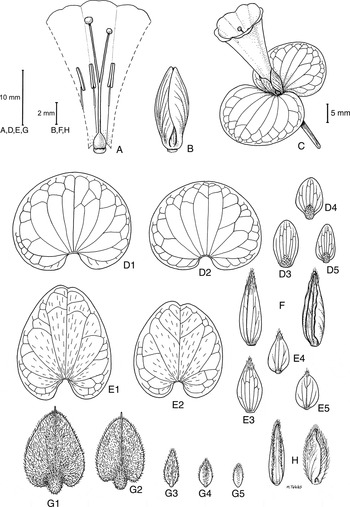
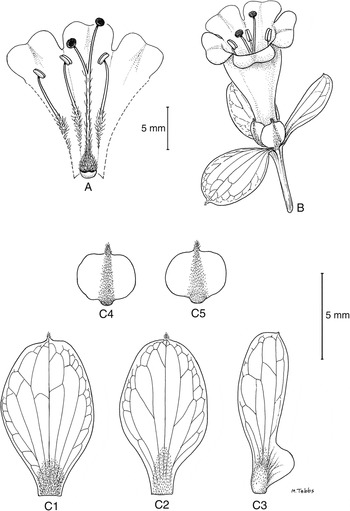
Morphological characters that can be used to differentiate Porana from Calycobolus take several forms, summarised in the key. First, the inflorescence architecture is distinctive: Calycobolus spp. have simple or compound umbelliform inflorescences composed of cymose units without leaves or leafy bracts among the flowers, whereas Porana has a leafy thyrse made up of racemose units. Flowering sepals of both genera show a marked disparity in size at flowering, with the outer sepals much larger than the inner; this disparity increases further during fruiting stages. With Calycobolus (Fig. 1), the outer two sepals are distinctly larger than the inner three, which are tightly rolled around the corolla tube and, later, the fruit. The outer sepals are cordate at the base, with a distinct sinus between the basal lobes. Porana nutans (Fig. 2), on the other hand, has the outer three sepals about equal in length and much larger than the inner two and the third sepal is distinctly asymmetrical. The outer three sepals all narrow to a claw-like base. In the fruiting stage the outer two sepals of Calycobolus remain tightly appressed against one another, face to face, whereas the outer three sepals of Porana nutans reflex away from the fruit, spreading like helicopter blades.
Molecular Evidence
Molecular sampling to date has been limited and, regrettably, none of the African Calycobolus species have yet been sampled. In the most comprehensive molecular analysis published so far (Stefanovic et al., Reference Stefanovic, Krueger and Olmstead2002) only two neotropical Calycobolus were sampled: C. glaber and C. nutans. The latter species had a second sample included under the synonymous name Porana velutina. While these data do not offer any insight into the relationships of African species of Calycobolus, they did corroborate the morphological evidence that indicates C. glaber and C. nutans are not part of the same monophyletic group, and that C. nutans is sister to Porana volubilis and should be transferred to Porana. Further molecular sampling among the African taxa is needed to test the hypothesis that the African and American species heretofore assigned to Calycobolus are indeed members of one genus. Coincidentally, Dipteropeltis poranoides, long presumed to be closely related to Calycobolus as noted above, paired up as the sister group to the monospecific Madagascan Rapona Baill. This clade in turn paired up as sister to a clade comprised of Bonamia media (R.Br.) Hallier f., Itzaea sericea (Standl.) Standl. & Steyerm., and Calycobolus glaber. Results such as this indicate that some convolvulaceous genera as historically conceived are polyphyletic, a conclusion already reached based on morphological evidence. Further molecular sampling, targeted on selected problematic species, is needed in the complex of genera defined by branched styles to clarify relationships among genera long regarded as clearly delineated that have now become ambiguous. It is unfortunate that such genera, monophyletic or not, have been formalised in a new tribal classification (Stefanovic et al., Reference Stefanovic, Austin and Olmstead2003).
Fruit Dispersal – Evidence for Convergent Evolution
Convergent and parallel evolution have long been noted within the Convolvulaceae. Fruits adapted for wind and/or water dispersal with accrescent sepals are known from at least seven lineages within the family (Austin, Reference Austin, Mathews and Sivadasan1998; Stefanovic et al., Reference Stefanovic, Krueger and Olmstead2002). Among the genera as defined in the 1990s were Calycobolus, Porana and some 15 others. In the course of identifying specimens for this revision a few collections uncannily similar to Calycobolus in general facies were found that subsequently proved to belong in other genera. Two such instances, apparently representing convergent evolution among different convolvulaceous plants growing in the same habitat, are described here. The similarity between the accrescent calyces of species belonging to three different genera suggests that there is selection for winged fruits as a dispersal mode in the habitats where these species grow. They are mentioned because anyone attempting to identify South American specimens of Convolvulaceae could, on gross morphology alone, easily mistake these species for Calycobolus.
Firstly, a collection from Brazil, Harley 19879 (K), was initially identified by Staples as Calycobolus lanulosus, but on closer inspection it proved to have stellate trichomes, a single style with two sausage-shaped stigmas, and a blue corolla – all characters that indicate it is a Jacquemontia. However, the overall facies of the plant (leathery leaves; densely hairy vegetative parts; crowded, glomerate inflorescences on short peduncles; accrescent, papery calyx) is virtually identical with Calycobolus lanulosus. The technical characters just mentioned will separate them. We have not identified this Jacquemontia specimen to species; it may still be undescribed (R. S. Bianchini, pers. comm., July 2008).
The second case of apparent convergence involves several specimens (six from Brazil, one from Peru, all in K) that first seemed to be an undescribed species of Calycobolus based on the habit, inflorescence architecture, markedly enlarged, cordiform outer two sepals, branched style, two capitate stigmas, and simple trichomes. However, two of the specimens proved to have fruits concealed within the accrescent calyces and these were dehiscent capsules with coriaceous or semi-lignescent walls that split into several valves; fruits of this type are not supposed to occur in Calycobolus, but indicate Bonamia. According to the most recent revision of the genus (Myint & Ward, Reference Myint and Ward1968), Bonamia is not known to have accrescent calyces. Use of the keys in this revision and consultation of comparative material in Kew demonstrated that all seven specimens were Bonamia peruviana Ooststr., heretofore known from Peru (Van Ooststroom, Reference Van Ooststroom1933; MacBryde, Reference MacBryde and MacBryde1959) as well as Amazonas and Pará in Brazil (Austin & Cavalcante, Reference Austin and Cavalcante1982). The Kew specimens reveal that the distribution of Bonamia peruviana overlaps with both Calycobolus glaber and C. sericeus and the plants occur in similar habitats. These specimens also demonstrate that Bonamia peruviana is more variable than described in the literature (Van Ooststroom, Reference Van Ooststroom1933; Myint & Ward, Reference Myint and Ward1968), with outer sepals in fruit almost 3 cm in length. Still, the Bonamia peruviana specimens resemble Calycobolus glaber to an extraordinary degree. The most distinctive features setting them apart are the short, dense, rusty indumentum on all parts of the plant (Calycobolus glaber is, as its epithet implies, glabrous) and the peculiar twisted anthers illustrated by Van Ooststroom (Reference Van Ooststroom1933) in the protologue. If mature, open flowers are present the anther contortion is easily observed and is diagnostic for Bonamia peruviana.
Taxonomy
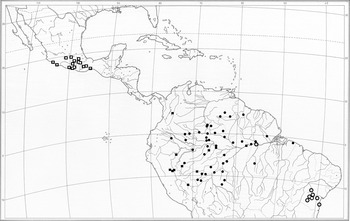
Two genera are recognised and described here. A key to similar plants is presented to separate the genera Porana and Calycobolus from the Jacquemontia sp. and Bonamia peruviana that can be confused with them in the herbarium. A second key separates the four neotropical species heretofore assigned to Calycobolus. Figure 1 compares the diagnostic features of the fruiting calyx for the three Calycobolus species. Figure 2 illustrates comparable characters for Porana nutans. The four species are described, full synonymies are provided, and the distribution, ecology, phenology, elevation range, and vernacular names are summarised for each. Figure 3 maps the distribution of the four species. Only type specimens are cited in the text but all numbered specimens examined are indexed at the end of the revision as an aid to herbarium curation.
A note about authorship of genera and epithets is warranted. Though a number of the Dufourea names have long been attributed to ‘Humboldt, Bonpland & Kunth’ or the shorter version ‘H.B.K.’ so often found in older literature, the compilers of Taxonomic Literature II (Stafleu & Cowan, Reference Stafleu and Cowan1979) have presented unequivocal evidence that new genera and species first published in the Nova Genera et Species Plantarum should be attributed solely to Kunth. The authorship and dates of publication presented here reflect this information from TL-2, and thus differ from the widely available and oft-cited – but nonetheless inaccurate – citations in the Index Kewensis, Gray Card Index, and IPNI.
Calycobolus is one of the genera caught up in the unfortunate nomenclatural mess created by the competing works published in the same year by Roemer & Schultes (Reference Roemer and Schultes1819) and Humboldt, Bonpland & Kunth (Reference Humboldt, Bonpland and Kunth1819). This situation has been described and the nomenclatural consequences sorted out by McVaugh (Reference McVaugh1955) and we will not repeat the story here. Stafleu & Cowan (Reference Stafleu and Cowan1979, Reference Stafleu and Cowan1983) have pinpointed the dates of publication for the volumes relevant for Convolvulaceae as follows: February 1819 for Nova Genera et Species Plantarum vol. 3 (Humboldt, Bonpland & Kunth, Reference Humboldt, Bonpland and Kunth1819), compared with December 1819 for Systema Vegetabilium vol. 5 (Roemer & Schultes, Reference Roemer and Schultes1819). We have endeavoured to bring the nomenclature followed in this revision into line with the evidence presented in the aforementioned works.
Herbarium acronyms follow the system developed for Index Herbariorum and now available online (http://sweetgum.nybg.org/ih/). Where IDC microfiches of historic herbaria are cited in the nomenclature sections, the citations follow the format proposed by Hepper (Reference Hepper1968).
The following key should separate all the similar plants discussed above and enable those identifying herbarium specimens to correctly name them.
Key to similar plants
1a. Indumentum on plant body stellate (trichomes with 3 to many arms); style 1, stigmas 2, tongue- or sausage-shaped; corolla often bluish, less often lavender, pinkish, or whitish Jacquemontia sp.
1b. Indumentum on plant body comprising simple or 2-armed – never stellate – trichomes; styles 2, free or fused below middle and free above; stigmas 2, capitate or depressed globose; corolla white, cream or pale yellowish, sometimes flushed lilac 2
2a. Fruits subligneous to coriaceous capsules, tardily dehiscent by several (4–8) valves; anthers twisted at anthesis, the lower half rotated through 90–210° relative to the upper half of anther Bonamia peruviana
2b. Fruits papery utricles or utricle-like, indehiscent, opening by erosion or eventual break up of fruit wall; anthers not twisted at anthesis, dehiscing lengthwise without torsion 3
3a. Outer 3 sepals much longer than inner 2; outer 3 sepals narrowed into a claw-like base; third sepal narrower than outermost 2, distinctly asymmetrical on one side [Mexico] Porana
3b. Outer 2 sepals much larger than inner 3; outer 2 sepals cordate at base, with distinct sinus between two lobes; third sepal similar to inner sepals, not markedly asymmetrical [South America] Calycobolus
1. Calycobolus Willd. ex Roem. & Schult., Syst. Veg. 5: 4 (Dec. 1819). – Type: Calycobolus emarginatus Willd. [= Calycobolus sericeus (Kunth) House], lectotype designated by House, Bull. Torrey Bot. Club 34: 144 (1907).
Dufourea Kunth in Humb., Bonpl. & Kunth, Nov. Gen. Sp. 3: 113 (folio ed. p. 88), t. 214 (Feb. 1819), non Ach. (1809), nec Bory ex Willd. (1810), nec Gren. (1827). – Prevostea Choisy, Ann. Sci. Nat. (Paris) 4: 497 (1825). A substitute name for Dufourea Kunth (1819). – Type: Prevostea sericea (Kunth) Choisy [= Calycobolus sericeus (Kunth) House], lectotype designated by Roberty, Boissiera 10: 153 (1964).
Reinwardtia Spreng., Syst. Veg. 1: 527 (1824 [title page ‘1825’]), non Dumort. (1822), nec Blume ex Nees (1823–24). – Type: Reinwardtia sericea (Kunth) Spreng. [= Calycobolus sericeus (Kunth) House], lectotype designated by Manitz, Feddes Repert. 85: 636 (1974).
Lianas; stems woody, climbing, glabrous or pubescent. Indumentum of simple or T-shaped hairs. Leaves petiolate, simple, entire, chartaceous to coriaceous, base attenuate, acute, or obtuse, apex attenuate to obtuse, pinnately veined, densely appressed pubescent to glabrous. Inflorescences axillary or terminal on lateral branches, umbelliform to paniculate-thyrsiform, composed of cymose units; peduncle hidden among flowers or quite long; bracts present, deciduous or persistent. Flowers small to medium-sized, slightly fragrant to odourless; sepals very unequal, outer 2 larger, cordiform, subtriangular, ovate or broadly reniform, tightly appressed to one another, base cordate, apex rounded to acute, inner 3 much smaller, decreasing in size towards innermost, ovate, elliptic, to rhombic, tightly enveloping corolla base; corollas tubular to narrowly funnelform, white, limb subentire to vaguely lobed, erect, interplicae pubescent outside or glabrous; stamens subequal, anthers oblong to linear-oblong, white, dehiscing lengthwise without twisting; pollen 3-colpate and 3-aggrecolpate (fide Lewis, Reference Lewis1971), non-spinulose; styles 2, free or partially fused below middle, stigmas 2, capitate or depressed globose. Fruits enclosed in accrescent, chartaceous calyx; indehiscent, an utricle or utricle-likeFootnote b, 1- or 2-locular, ovoid to ellipsoid, mostly chartaceous. Seeds 1–4, ovoid to ellipsoid, black to brown, glabrous; hilum basal, often D-shaped.
Found in the wet tropics of South America (three species) and Africa (25 species).
There are rather few collections of Calycobolus available in herbaria, despite more than two centuries of botanical inventory in the neotropics. We have been gathering data for this revision intermittently over more than 25 years and examined loans from or made visits to about 30 herbaria, yet we have seen scarcely 90 collections in all that time. The second author, who has collected in Peru several times and in Amazonian Brazil twice, has never found living plants of Calycobolus. Possibly the plants are rare in the habitats where they occur, or perhaps collectors overlook them; certainly the flowers are neither large nor colourful as in some other genera of Convolvulaceae.
Heine (Reference Heine1963a) speculated that the generic name was meant to be spelled Calycolobus (calyx-lobe) rather than Calycobolus (calyx-throw) but we wonder if Willdenow did not coin the name exactly as he meant it, referring to the fruiting calyces that are carried on the wind. Given the sharing of specimens and information that is known to have taken place between Willdenow, who began working up the collections, and Humboldt and Bonpland, who collected the plants on their South American explorations, it is entirely possible that Willdenow knew about the wind-dispersed fruits and coined a genus name reflecting that character.
The key that follows includes all four species for easy identification of similar plants.
Key to species
1a. Outer 3 sepals longer than inner 2, broadly ovate-elliptic, tapering abruptly to a narrow, claw-like base; third sepal markedly asymmetrical; fruiting sepals spreading away from fruit 2.1 Porana nutans
1b. Outer 2 sepals much larger than inner 3, shape various, bases cordate to auriculate-subcordate, with a distinct sinus between basal lobes; fruiting sepals appressed together, cupping fruit between them 2
2a. Inflorescence densely glomerate, subsessile or peduncle ≤ 3 cm long (hidden within inflorescence); flower pedicels 1–3 mm long; outer 2 sepals subtriangular to subsagittate, base slightly auriculate-subcordate, densely yellowish tomentose on both sides, apex sharply mucronate-apiculate; corolla 8–9 mm long 1.2 Calycobolus lanulosus
2b. Inflorescence lax, ± umbelliform, peduncle 6–20 cm long; flower pedicels 10–17 mm long; outer 2 sepals broadly elliptic, ovate, suborbicular, or reniform, glabrous or sparsely sericeous outside, apex rounded or emarginate; corolla 18–20 mm long 3
3a. Leaves glabrous; corolla glabrous outside or nearly so; ovary/fruit glabrous; outer 2 fruiting sepals wider than long: suborbicular or reniform; styles basally united, free above; fruits usually 4-seeded 1.1 Calycobolus glaber
3b. Leaves sericeous underneath; corollas pubescent outside on midpetaline bands (interplicae); ovary/fruit appressed pubescent apically; outer 2 fruiting sepals longer than wide: ovate-cordate or broadly elliptic with cordate base; styles free to the base; fruits 1-seeded 1.3 Calycobolus sericeus
1.1 Calycobolus glaber (Kunth) House, Bull. Torrey Bot. Club 34: 145 (1907). – Dufourea glabra Kunth in Humb., Bonpl. & Kunth, Nov. Gen. Sp. 3: 114 [folio ed. p. 89] (Feb. 1819). – Reinwardtia glabra (Kunth) Spreng., Syst. Veg. 1: 863 (1824 [title page ‘1825’]). – Prevostea glabra (Kunth) Choisy, Ann. Sci. Nat. (Paris) 4: 498 (1825). – Type: Venezuela, Amazonas: crescit prope San Francisco Solano, ad ripam Cassiquiares (Missiones del Orinoco), fl. v, Humboldt s.n. (lecto P, designated here [labelled as isotype #1]; iso P(×2)!, fragment in F!, B-W 4205! [as Humboldt 5091]).
Calycobolus pulchellus Willd. ex Roem. & Schult., Syst. Veg. 5: 4 (Dec. 1819). – Type: Venezuela, Amazonas: ad Cassiquiares, prope San Francisco Solano, Humboldt 5091 (holo B-W 4205!; iso P(×3)!, fragment in F!).
Prevostea amazonica Choisy in DC., Prodr. 9: 437 (1845). – Prevostea glabra var. amazonica (Choisy) Meisn. in Mart., Fl. Bras. 7: 324 (1869). – Calycobolus amazonicus (Choisy) House, Bull. Torrey Bot. Club 34: 145 (1907). – Type: Brazil, Amazonas: in sylvis ad Manacuru dit. Japurensis prov. R[io] N[egro], Martius 3095 (holo M!, on 2 sheets; photo GH).
Calycobolus species, flowers. A–D, C. glaber: A, corolla opened and partly cut away; B, inner 3 sepals in natural orientation; C, flower drawn with outer 2 sepals retracted; D, sepals in abaxial view, outermost (1) to innermost (5), with sepals 3–5 flattened. E–F, C. sericeus: E, sepals in abaxial view, outermost (1) to innermost (5), sepals 3–5 flattened; F, inner 3 sepals in natural orientation. G–H, C. lanulosus: G, sepals in abaxial view, outermost (1) to innermost (5), with sepals 3–5 flattened; H, inner 3 sepals in natural orientation. A & C based on Cid & Lima 3275 (K); B & D based on Teixeira et al. 666 (K); E & F based on Krukoff 5614 (K); G & H based on Harley 19393 (K).

Lianas; stems twining, to 7 m long, terete, brown, glabrous. Leaves with petioles 10–16 mm long, appressed sericeous or glabrescent; blades elliptic, elliptic-oblong, or broadly elliptic, 5–17 cm long, 3–6 cm wide, base obtuse or rounded to subcordate, apex obtuse to acuminate or retuse, mucronulate, glabrous on both sides; lateral veins 5–7 per side. Inflorescences umbelliform, usually 3–11-flowered; peduncles 12–18 cm long, glabrate; lowermost 1 or 2 bracts in inflorescence (i.e. at apex of peduncle) foliaceous, elliptic, 6–13 mm long, persistent; bracteoles squamiform, 1–2 mm long, deciduous; pedicels 10–16 mm long. Flowering sepals very unequal, outer 2 much larger than inner, reniform to orbicular-cordate, 17–22 mm long, 19–25 mm wide, base cordate, apex rounded, chartaceous, glabrous, venation reticulate; inner sepals smaller, elliptic, ovate, or obovate, 4–6 mm long, tightly enclosing corolla tube base; corollas tubular-funnelform, c.2 cm long, pure white or less often limb pale yellowish or pale bluish, outside glabrous or interplicae with few scattered sericeous hairs, corolla lobes obtuse, erect; stamens included, filaments 10–13 mm long, anthers linear-oblong, 3–4 mm long, white or yellow; ovary shortly ovoid, glabrous, styles 2, fused basally less than half their length, free above, glabrous, stigmas globose-capitate, green. Fruiting calyx accrescent and persistent, outer 2 sepals 23–28 mm long, 26–31 mm wide, papery, brown to straw-coloured, tightly appressed together with fruit cupped at base. Utricle-like fruits depressed-globose to subquadrangular, 2-celled, 6–7 mm long, brown to maroon, glabrous, papery, apex retuse, apiculate with persistent style base. Seeds 4 or less, ovoid to ellipsoid, keeled on inner face, 2.5–3 mm long, glabrous, black, surface granulose, apex truncate to flattened.
Distribution. Known from Colombia, Venezuela, Guyana, Peru, Bolivia and Brazil (Fig. 3).
Total of 56 collections examined.
Ecological notes. Occurring in selva virgen siempre verde and along or above watercourses, in shrubby areas with some trees, varzea forests, on terra firme, and in capoeira. Soil types have been noted as moist clay and solo argiloso. Elevation: 120–480 m.
Phenological summary.

Vernacular name. Flor de rabipelado (Venezuela, ex Liesner 3823).
Notes and discussion. There is now no specimen of Dufourea glabra present in the Humboldt and Bonpland herbarium at Paris, one of several ‘herbier historique’ that are maintained separately. Three specimens were located in the general herbarium at Paris that, although lacking Humboldt's collection number or label data matching the protologue, had paper characteristics and handwriting on the labels that suggested they are duplicates of the type gathering. Professor G. Aymonin examined these and confirmed that they are indeed duplicates of Humboldt and Bonpland specimens (isotypes). One sheet has the genus name ‘Dufouria’ (sic) written on the label in what is quite possibly Bonpland's own handwriting. We here designate this sheet, labelled as isotype #1, as the lectotype for Calycobolus glaber.
The incredible morphological similarity between Calycobolus glaber and Bonamia peruviana has been discussed previously. One feature observed that may be useful in separating these two similar species is the peculiar contorted anthers of Bonamia peruviana, illustrated by Van Ooststroom (Reference Van Ooststroom1933) in the protologue. If mature, open flowers are available this curious feature is readily apparent and diagnostic for recognising Bonamia peruviana.
Although utricles are, by definition, one-seeded, most of the fruits examined for Calycobolus glaber have more than a single seed. However, the thin papery fruit walls show no evidence of sutures that open up, so they are not genuinely capsules. Such intermediate character states are exactly why the question of generic delimitation needs to be reinvestigated in the genera with branched styles. For the time being we have described the fruits of Calycobolus glaber as utricle-like.
1.2 Calycobolus lanulosus D.F.Austin, Ann. Missouri Bot. Gard. 58: 243 (1971). – Type: Brazil, Bahia: Próximo a Jaguaquara, zona da mata, trepadeira em árvore de 5 m, 22 i 1965, Belém & Mendes 215 (holo US!; iso L!, RB).
Lianas or scandent shrubs; stems 2–5 m long, densely yellowish-grey woolly. Leaves with petioles 5–13 mm long, the blades elliptic to ovate-elliptic, 5–8 cm long, 2.5–5 cm wide, coriaceous, base rounded, obtuse (rarely truncate), apex obtuse, acute, acuminate, rarely emarginate, mucronate, upper surface reticulate, both sides woolly tomentose with yellowish hairs, the underside more densely so; lateral veins 5 or 6 per side. Inflorescences many-flowered, crowded, glomerate; peduncles 2–30 mm long, densely pubescent; pedicels 1–3 mm long, pubescent; bracteoles filiform to narrowly lanceolate, 1–11 mm long, persistent. Flowering sepals very unequal, outer 2 much larger, subtriangular to subsagittate, 10–12 mm long, 9–10 mm wide, base medially cupping the corolla base, sides flaring and slightly auriculate-subcordate, apex sharply mucronate-apiculate, both sides densely cream-white to yellowish tomentose, inner 3 sepals much smaller, tightly enclosing corolla base, lanceolate to ovate or elliptic, c.3–4 mm long, sparsely hairy along middle and towards apex, glabrous towards base and margins; corolla shorter than calyx, tubular, 8–9 mm long, white, limb shallowly lobed, lobes erect, interplicae outside red-gold sericeous distally; stamens included, filaments subulate, 6 mm long, glabrous, greenish white, anthers oblong, 1.7 mm long, yellow; disc cupuliform, 5-lobed, ovary 1 mm long and wide, apex villose-bearded, styles basally fused for 2–5 mm with 2 free branches 1 mm long, stigmas capitate, subglobose. Fruits tightly clasped in accrescent calyx, utricle ovoid, 6 mm long, 3.2 mm wide, pale brown, with apical hair tuft. Seed ellipsoid, 4 mm long, 2.8 mm wide, surface granulose. (Fruit and seed descriptions fide R. S. Bianchini, pers. comm., September 2008.)
Distribution. Known from the states of Bahia, Ceará (R. S. Bianchini, pers. comm.) and Pará, Brazil (Fig. 3).
Total of nine collections examined.
Ecological notes. Found in vegetação de mata de cipó and zona de mata.
Phenological summary.

Notes and discussion. Although several more specimens of Calycobolus lanulosus have now been examined since the species was described based on a single collection, the mature fruits and seeds have not been seen by us. The description given above is based on information provided to us by our colleague, Rosangela Simão Bianchini, based on her examination of a single fruiting collection, Coradin et al. 6565 (CEN, SP). In specimens we have examined, some inflorescences are clearly past flowering stage and the calyx has enlarged but there are only withered corollas, and no fruits, enclosed inside. Why the plants set so few viable fruits is unknown.
1.3 Calycobolus sericeus (Kunth) House, Bull. Torrey Bot. Club 34: 144 (1907). – Dufourea sericea Kunth in Humb., Bonpl. & Kunth, Nov. Gen. Sp. 3: 114 (folio ed. p. 90), t. 214 (Feb. 1819). – Reinwardtia sericea (Kunth) Spreng., Syst. Veg. 1: 863 (1824 [title page ‘1825’]). – Prevostea sericea (Kunth) Choisy, Ann. Sci. Nat. (Paris) 4: 498 (1825). – Type: Colombia, ‘crescit in Regno Novae Granatae, juxta urbem Mariquita, alt. 400 hex., fl. vii,’ Humboldt & Bonpland 1727 (lecto P-Bonpl.!, designated here, microfiche IDC 6209.68: II. 3!; iso B-W 4206!, P(×2)!, fragment in F!; photo GH). [See note added in proof, p. 153.]
Calycobolus emarginatus Willd. ex Roem. & Schult., Syst. Veg. 5: 5 (Dec. 1819). – Type: in America merid., Humboldt 1727 (holo B-W 4206!; iso P(×2)!, P-Bonpl.!, microfiche IDC 6209.68: II. 3!; fragment in F!; photo GH).
Lianas; stems twining, 6–12 m tall, terete, brown, older stems up to 2.5 cm diameter, verrucose, appressed puberulent, later glabrate. Leaves with petioles 9–20 mm long; blades broadly elliptic, 6–13.5 cm long, 1.5–8 cm wide, coriaceous, reticulate, especially upper side, base obtuse to rounded, apex obtuse, acuminate or apiculate, mucronate, upper side glabrous, underside shining sericeous with appressed indumentum; lateral veins 7 or 8 per side. Inflorescences paniculate-thyrsiform, appressed puberulent; peduncles 6–20 cm long; pedicels 10–17 mm long; bracteoles lanceolate-linear, 3–6 mm long, persistent. Flowering sepals very unequal, outer 2 ovate-cordate, 10–14 mm long, 13–15 mm wide, greenish flushed red-purple, darker along margins, chartaceous, sparsely sericeous when young, later glabrate, base cordate, apex rounded, retuse to emarginate, inner 3 sepals much smaller, tightly enclosing corolla base, ovate, 5–7 mm long, glabrous except for apical hair-tuft; corollas tubular-funnelform, 18–20 mm long, pure white or pale purple-lilac flushed, interplicae outside sparsely appressed sericeous; stamens subequal, 10–13 mm long, glabrous, filaments basally adnate to corolla tube, free above, anthers oblong, 3–4 mm long, white, dehiscing lengthwise; ovary slenderly angular-conical, 2–3 mm long, 4-ovulate, glabrous basally, golden velutinous-hairy distally, styles 2, filiform, free to the base, equal, 8–10 mm long, sparsely pubescent basally, glabrous above, stigmas 2, depressed globose, 1 mm diameter. Fruiting calyx persistent, slightly accrescent, chartaceous, sepals very unequal, outer 2 ovate-cordiform, 18–28 mm long, 14–17 mm wide, tightly appressed together, veins reticulate, outside reddish to purplish, fading to brown, inner 3 somewhat enlarged, tightly clasping fruit. Utricles conical-ellipsoid, 5–6 mm long, tan, chartaceous, glabrous except for apical hair-tuft, capped by style bases. Seed 1, conical ellipsoid, 4–5 mm long, dark brown-black, glabrous; hilum basal, D-shaped.
Distribution. Known from Colombia, Peru and Brazil (Fig. 3).
Total of 21 collections examined.
Ecological notes. Occurring in mature forest clearings and forest edges; dense forest on high sandy ground; in secondary vegetation within upland terrace forest on river bank; capoeira de terra firme; terra firme; en bosque bajo. Elevation: 200–400 m.
Phenological summary.

Vernacular name. Cipó tuíra (Brazil, ex Murça Pires 58).
Notes and discussion. We have chosen to lectotypify the basionym, Dufourea sericea, because it is not clear that the specimens conserved in the Humboldt and Bonpland ‘herbier historique’ at Paris can properly be considered the holotypes of Kunth's names in every case. Since duplicates were found in the general herbarium at Paris, as well as in the Willdenow herbarium at Berlin, choosing a lectotype seems appropriate under the current ICBN. [See note added in proof, p. 153.]
The vernacular name requires explanation: tuíra is not a typical Portuguese word, coming instead from the Tupí word tu'ira, meaning dark, reddish, so the vernacular name means ‘red vine’.
Calycobolus sericeus is one of the few species of Calycobolus that has been photographed alive. Photographs of a living plant may be viewed at the following URL: http://atrium.andesamazon.org/images_list.php?type=species&id=385 (accessed October 2008).
2. Porana Burm.f., Fl. Ind. (N. L. Burman): 51, t. 21* (1768).
For a full description of the genus see Staples (Reference Staples2006: 455–456).
The diagnostic features useful in distinguishing American Porana from Calycobolus include: the foliose, thyrsiform inflorescences composed of racemose units; the outer 3 sepals much larger than the inner 2, with bases narrowed and claw-like; the third sepal distinctly asymmetrical; the fruiting calyx widely spreading from the utricle at maturity. Furthermore, the neotropical Porana nutans presents a foliose thyrse that is quite different in appearance from the inflorescences of neotropical Calycobolus, which typically have a naked peduncle (if visible) without leaves or foliose bracts interspersed among the flowers (sometimes C. glaber has 1 or 2 leafy bracts at the apex of the naked peduncle and below the cluster of flowers).
Two species in the seasonally wet to dry tropics; one species in the Americas, confined to southeastern and south-central Mexico.
2.1 Porana nutans (Moç. & Sessé ex Choisy) O'Donell, Lilloa 30: 62 (1960). – Ipomoea nutans Moç. & Sessé ex Choisy in DC., Prodr. 9: 368 (1845). – Calycobolus nutans (Moç. & Sessé ex Choisy) D.F.Austin, Ann. Missouri Bot. Gard. 58: 244 (1971). – Type: Mexico, unpublished plate by Sessé & Moçiño (lecto G!, designated by Staples (Reference Staples2006: 456); copy US!).
Dufourea? velutina M.Martens & Galeotti, Bull. Acad. Sci. Bruxelles 12(2): 259 (1845). – Prevostea? (Dufourea?) velutina (M.Martens & Galeotti) Walp., Repert. Bot. Syst. 6: 742 (1846). – Porana velutina (M.Martens & Galeotti) Hallier f., Bot. Jahrb. Syst. 16: 538 (1893). – Turbina velutina (M.Martens & Galeotti) Roberty, Candollea 14: 26 (1952). – Calycobolus velutinus (M.Martens & Galeotti) House, Bull. Torrey Bot. Club 34: 144 (1907). – Type: Mexico, ‘sur la route de Tehuacan à Oaxaca, près de la Venta de Aragon, à 3000 pieds, iv 1840,’ Galeotti 1380 (lecto BR!, sheet 2° designated here; isolecto BR! [sheet 1°], G!, P!, W!).
Breweria mexicana Hemsl., Biol. Centr.-Amer. Bot. 2: 400 (1882). – Turbina mexicana (Hemsl.) Roberty, Candollea 14: 26 (1952). – Type: Mexico, [Oaxaca] Sierra San Pedro Nolasco, 1843–1844, Jurgensen 623 (holo K!; iso BM!, G!, G-BOIS!).
Breweria mexicana Hemsl. var. floribunda Villada, Naturaleza (Mexico City) ser. 2, 2: 127, t. 7 (1892). – Type: Mexico, [Guerrero] montañas de Cacahuamilpa, Villada s.n. (no specimen traced; the plate in the protologue is here designated as the lectotype).
Calycobolus pringlei House, Bull. Torrey Bot. Club 34: 145 (1907). – Type: Mexico, Morelos: Yautepec, 21 xi 1903, Pringle 8751 (holo US!; iso BM!, E!, G(×4)!, GH!, HBG!, K!, L(×3)!, M!, MO!, NSW!, NY!, S!, UC!).
Porana nutans. A, corolla opened and partly cut away; B, flower with outer sepals retracted; C, sepals in abaxial view, outermost (1) to innermost (5). All based on G.B. Hinton 3116 (K).

Lianas or scandent shrubs; stems twining, 3–10 m long, base 0.5–8 cm diameter, striate, older ones greyish brown, lenticellate; all axial parts varying from glabrous to tomentose with yellowish or ferruginous hairs. Leaves with petioles 2–18 mm long; blades lanceolate, ovate, or elliptic, 10–75 mm long, 4–50 mm wide, base rounded, obtuse, or truncate, apex usually attenuate or acute to obtuse and apiculate, glabrous or nearly so to tomentose on both sides, indumentum yellowish to reddish; lateral veins 5 or 6 per side. Inflorescence peduncles 3–30 mm long; bracts shaped like leaves only smaller; pedicels 8–13 mm long; bracteoles filiform, 0.6–3 mm long, deciduous. Flower sepals very unequal, outer 2 larger, ovate to elliptic, 8–14 mm long, 5.5–8 mm wide, base abruptly narrowing into oblong claw, apex rounded or retuse, mucronulate, outside glabrescent or finely velutinous especially near base, third sepal asymmetrical, as long as outer 2 but 4–5 mm wide, base lobed on one side, apex obtuse to rounded, mucronulate, inner 2 sepals tightly sheathing corolla base, broadly elliptic, trapezoidal, or transversely elliptic, 3–4 mm long, 4–5 mm wide, apex broadly rounded or truncate, mucronate, tomentose abaxially along middle, margins broadly hyaline, glabrous; corolla funnelform, tube broad, 13–17 mm long, pure white or yellowish white, limb flaring, bluntly 5-lobed, interplicae puberulent outside; stamens subequal, 13–15 mm long, filaments densely hairy around insertion, glabrous and free above, anthers broadly oblong, 2.5–3 mm long, white; pistil seated on an orange nectary disc, ovary globose-ellipsoid, incompletely 2-locular, 4-ovulate, densely pubescent, style branched, 1.2–1.5 cm long, fused below middle and pubescent, above 2-branched, arms unequal, glabrous, stigmas capitate-globose. Fruiting sepals accrescent, spreading at maturity, outer 2 sepals 10–20 mm long, obovate, base abruptly narrowed, clawed, blade ovate to broadly elliptic, third sepal asymmetrical, 10–18 mm long, 2 inner 5–7 mm long, apiculate, all sepals chartaceous, venose, glabrescent to finely puberulent outside. Utricles broadly ellipsoid to globose, 5–9 mm long, 4–7 mm wide, papery, straw-yellow to reddish, tomentellous. Seed broadly ellipsoid, 4–6 mm long, black-brown, glabrous; hilum basal, D-shaped or nearly circular.
Distribution. Known only from the highlands of Mexico, in the states of Colima, Guerrero, México, Michoacán, Morelos, Oaxaca and Puebla (Fig. 3).
Total of 47 collections examined.
Ecological notes. Reported from a variety of habits such as deciduous forest (selva baja caducifolia), disturbed tropical deciduous forest, desert thorn forest, laderas cerro yesoso, rocky hills, hot barranca, dry river bed, streambanks, and steep hills near the Pacific coast, among vegetational associates including Bursera, Ceiba, Cordia, Haematoxylum, Ipomoea and Pseudosmodingium. Soil types have been noted as rocky, limestone hills, and gypsum area. Elevation: 150–1650 m.
Phenological summary.

Notes and discussion. As the lengthy synonymy attests, Porana nutans is a variable species in several characters, particularly the trichome density and coloration, leaf size, and flower size and abundance. We have adopted a broad taxonomic concept that accommodates the observed phenotypic variability in one species; perhaps field study of living plants will enable recognition of infraspecific variants but at the current level of knowledge, based solely on herbarium material, we do not think it appropriate to recognise subspecies or varieties.
Distribution of Calycobolus and Porana in the neotropics: C. glaber (•); C. lanulosus (○); C. sericeus (▪); Porana nutans (□).

The type material, if such exists, for Villada's varietal name could not be located. The HUH online index of botanists (Harvard University Herbaria Index of Botanists, 2007–2008) states that Villada's collections are in MEXU but inquiries directed there did not locate any specimens that could be type material for his variety floribunda. In the absence of a specimen we have chosen the excellent plate as the lectotype.
In contrast to the three species of South American Calycobolus, Porana nutans is a plant of mostly higher elevations and drier habitats.
Excluded Species
Dufourea aurea Splitg. ex de Vriese, Ned. Kruidk. Arch. 1: 150 (1848), nom. inval., published as synonym. Based on Splitgerber 743 (L!). = Bonamia maripoides Hallier f.
Dufourea heterantha Nees & Mart., Nov. Actorum Acad. Caes. Leop.-Carol. Nat. Cur. 11: 79 (1823). ≡ Prevostea heterantha (Nees & Mart.) G.Don, Gen. Syst. 4: 299 (1837). ≡ Aniseia heterantha (Nees & Mart.) Choisy in DC., Prodr. 9: 430 (1845). – Type: Brazil, Barra das Varedas, vi 1817, Prince Maximilian Neuwied s.n. (iso BR!, G!). ≡ Jacquemontia heterantha (Nees & Mart.) Hallier f.
Prevostea ferruginea Choisy, Ann. Sci. Nat. (Paris) 4: 498 (1825). ≡ Calycobolus ferrugineus (Choisy) House, Bull. Torrey Bot. Club. 34: 146 (1907). – Type: Brazil, Ferreira s.n. (holo P!). ≡ Bonamia ferruginea (Choisy) Hallier f., vide Myint & Ward (Reference Myint and Ward1968: 191).
Prevostea spectabilis (Choisy) Meisn. in Mart., Fl. Bras. 7: 325 (1869). ≡ Maripa spectabilis Choisy in DC., Prodr. 9: 327 (1845). ≡ Calycobolus spectabilis (Choisy) House, Bull. Torrey Bot. Club 34: 146 (1907). – Type: Brazil, prov. Rio Negro, in campis ad Rio Negro, xi, Martius s.n. (lecto M!, designated by Austin, Taxon 19: 907 (1970)). = Bonamia maripoides Hallier f., vide Austin (Reference Austin1970: 907).
Prevostea umbellata Choisy, Ann. Sci. Nat. (Paris) 4: 497 (1825). ≡ Calycobolus umbellatus (Choisy) House, Bull. Torrey Bot. Club 34: 146 (1907). – Type: Brazil, Rio de Janeiro, 1819, Leandro de Sacramento s.n. (syn P!); Rio de Janeiro, 5 xii 1819, Gaudichaud s.n. (syn P!). ≡ Bonamia umbellata (Choisy) Hallier f., vide Myint & Ward (Reference Myint and Ward1968: 192).
Acknowledgements
We thank F. Stauffer (G) and L. Rico Arcé (K) for help in locating literature; G. Aymonin and C. Loup (P) for assistance with the Bonpland herbarium; M. Tebbs (K) for preparing the figures; and R. S. Bianchini (SP) for sharing data from Brazilian specimens of Calycobolus lanulosus unknown to us. Institutional support was provided for G. Staples by A/GH and later by SING; and for D. F. Austin by FAU and later by ARIZ. We thank the directors and staff of the following herbaria for sending loans and permitting herbarium visits: A, ARIZ, BM, BR, B-W, COL, E, F, G, G-BOIS, GH, HBG, IAN, INPA, K, L, LE, M, MG, MICH, MO, NA, NSW, NY, P, S, UC, US, USF, VEN and W.
Index of Numbered Specimens Examined
The numbers cited in parentheses after each collection are the same as the taxon numbers used in the text. T indicates a type specimen.
Aguirre-Galviz 1055 (1.1); Albuquerque, B.W. de 710, 1266 (1.1); Albuquerque, B.W. de et al. 700 (1.1); Amaral, I.L. et al. 1409 (1.1); Anderson, W.R. & Anderson, C. 5683 (2.1); Anderson, W.R. & Laskowski, C.W. 4324 (2.1); Araújo, F.S. 790 (1.2).
Bahia 10 (1.1); Baldwin, Jr., J.T. 3420 (1.1); Barbosa Rodrigues 4044 (1.1); Belém, R.P. & Mendes, J.M. 215 (T) (1.2); Bernardi, A. 6663 (1.1); Bilimek ? 49 (2.1); Breedlove, D.E. 35889, 35893 (2.1); Breedlove, D.E. & Almeda, F. 60457 (2.1).
Calzada, J.I. 24502 (2.1); Cardona 2506 (1.1); Casas, F. & Susanna 3030314 (1.1); Cavalcante, P. 129 (1.1); Chiang, F. et al. 506 (2.1); Cid, C.A. et al. 792 (1.1); Cid, C.A. & Lima, J. 3275 (1.1); Cid Ferreira, C.A. et al. 5177, 5456, 8988 (1.1); Coêlho, L. et al. 1718 (1.1); Colella, M. et al. 1844 (1.1); Conzatti, C. 2348 (2.1); Coradin, L. et al. 6565 (1.2); Cordeiro, M. 636 (1.1); Crespo, F. 243 (2.1); Cuatrecasas, J. 7113 (1.1).
Davidson, C. & Martinelli, G. 10644 (1.1); Ducke, A. 7164, 11591 (1.1); Dunn et al. 17339 (2.1); Dunn, D.B. & Dunn, D. 18678 (2.1).
Ferreira s.n. [in herb. Geoffroy] (1.1); Ferreira, A. 799 (1.1); Foldats, E. 253 (1.1); Fröderström, H. 216 (2.1); Fröderström, H. & Hultén, E. 215 (2.1); Fróes, R. de Limos 21559 (1.1).
Galeotti, H. 1380 (T) (2.1); Galeotti, H. 1380bis (2.1); García Moya, E. 399 (2.1); Gentry, A. et al. 18576 (1.3); Grubb, P.J. et al. 45 (1.3).
Harley, R.M. 19393 (1.2); Harley, R.M. et al. 18614, 21189 (1.2); Hatschbach, G. et al. 5691 (1.2); Hinton, G.B. 3116 (2.1); Hinton, G.B. et al. 4431, 5531, 7096, 7268, 13527, 16223 (2.1); Humboldt 5091 (T) (1.1); Humboldt & Bonpland 1727 (T) (1.3).
Janovec, J.P. & Maceda, A.P. 2733 (1.3); Jardim, A. 2355 (1.1); Jurgensen, C. 623 (T) (2.1).
Krukoff, B.A. 5614, 5776 (1.3).
Liesner, R. 3823, 9006 (1.1); Luteyn, J. et al. 4921 (1.1); Lyonnet, E. & Elcoro, J. 1192 (2.1).
MacDougall, T. 158 (2.1); Maceda, A.P. 733 (1.3); Madison, M.T. et al. 6380 (1.1); Martinelli, G. 6955 (1.2); Martius 3095 (T) (1.1); Mathias, M.E. & Taylor, D. 5102, 5387, 5557, 5600, 6081 (1.3); McDowell, T. 3260 (1.1); McVaugh, R. 22191, 22993, 24965 (2.1); Miranda, F. 2506 (2.1); Monteiro, O. & Ramos, J. 792 (1.1); Murça Pires, J. 58 (1.3).
Nee, M. 34465 (1.1); Nelson, E.W. 1987 (2.1); Nunes, T.S. et al. 953 (1.2).
PLK & Marilene 12504 (1.1); Passos, L. et al. 5715 (1.2); Prance, G.T. et al. 5633, 14179, 14516 (1.1); Pringle, C.G. 8751 (T) (2.1).
Ramos, J. & Souza, R. 401 (1.1); Reveal, J.L. et al. 4173 (2.1); Rico A., L. et al. 439 (2.1); Rodrigues, W.A. et al. 10543 (1.1); Rzedowski, J. 33733 (2.1).
Santos, T.S. et al. 3211 (1.2); Sastre, C. 2375, 3391 (1.1); Schiefer, H.P. 197 (2.1); Schunke V., J. 1965 (1.3); Seler, C. & Seler, E. 4834 (2.1); Silva 3713 (1.1); Silva, J.A. 294 (1.1); Silva, N. 4447 (1.1); Smith, L.C. 336, 337 (2.1); Soukoup, J. 3077 (1.3); Spruce, R. 231, 3062 (1.1); Stannard, B. et al. 51604, 51926 (1.2); Steyermark, J. 97762 (1.1); Steyermark, J. et al. 117693 (1.1).
Teixeira, L.O.A. et al. 666 (1.1); Traill, J.H. 559 (1.1).
Ule, E. 5568 (1.3); Uribe-U., L. 2627, 2988, 3321 (1.3).
Williams, Ll. 2132, 14748 (1.1); Woronow 2399, 2400 (2.1); Woytkowski, F. 5754 (1.3); Wurdack, J. & Adderley, L.S. 43575 (1.1).
Note added in proof
After this paper was in proof, we learned of the detailed investigations made by Prof. Dr H. W. Lack, Berlin, into the Humboldt collections (Lack, 2003). In response to an e-mail inquiry about the nomenclatural status of the material in Paris, we received the following: ‘I therefore conclude that the specimens in P-Bonpland are to be considered holotypes’ (H. W. Lack, pers. comm., 3 December 2008).
Accordingly, the specimen chosen as lectotype for Calycobolus sericeus, Humboldt & Bonpland 1727 (P-Bonpl.), should be considered the holotype for this name.