Stereotactic radiosurgery (SRS) involves the use of an external, three-dimensional frame of reference to locate and target intracranial lesions for treatment. SRS delivers highly focused radiation by multiple collimated and convergent beams (15) as an alternative or additional therapy to whole brain radiotherapy (WBRT) and microsurgery. Studies have shown benefit in patients for certain indications, including cerebral metastases, arteriovenous malformations, and various benign intracranial tumors. The major potential advantages of SRS over surgery are the ability to target surgically inaccessible or difficult lesions, and a decreased risk of hemorrhage and other complications related to surgery and anesthesia. SRS may also offer an advantage over WBRT as it affords greater precision, potentially allowing healthy surrounding tissue to be spared during treatment (9). SRS can be delivered using specialized dedicated systems such as Gamma Knife, or by hardware and software appended to standard linear accelerators (Linacs). The latter option provides a relatively cheap and straightforward SRS solution, however, dedicated systems such as Gamma Knife have been suggested to be more accurate and user friendly (5).
In light of the potential benefits of SRS, international health technology assessment (HTA) bodies including those in France (Agence Nationale d'Acreditation et d'Evaluation en Sante [ANAES]), Australia (Medical Services Advisory Committee [MSAC]), and Canada (Agence d'evaluation des technologies et des modes d'intervention en sante [AETMIS]) have commissioned reviews to assess SRS. With the exception of Australia, these countries all now reimburse dedicated Gamma Knife technologies, despite the limitations of comparative evidence between Gamma Knife and other systems (1). Australia, however, has not been persuaded to provide additional reimbursement for dedicated systems (8). This economic analysis aims to assess the cost-effectiveness of Gamma Knife versus modified Linac systems and was undertaken as part of an HTA of Gamma Knife conducted by the Australian Medical Services Advisory Committee (MSAC).
Methods
A systematic review of the medical literature was undertaken. The scope of the assessment was narrowed to include only comparative studies of Gamma Knife radiosurgery and alternative treatments. The search strategy was used to identify papers in Medline, EMBASE, Pre-Medline, Current Contents, CINAHL, and the All-EBM databases.
This review found studies on the comparative effects of Gamma Knife versus Linac for only two indications (cerebral metastases and primary malignant lesions), which showed weak evidence (nonrandomized cohort studies with concurrent controls, Level 2b evidence (14)) that there is no difference in overall survival between patients treated by Gamma Knife versus Linac-based radiosurgery (2). In light of the paucity of evidence on comparative effects between Gamma Knife and Linac across indications, only a partial assessment was conducted to evaluate costs.
This study seeks to compare the relative cost of Gamma Knife with a modified Linac for the treatment of six intracranial indications (cerebral metastases, arteriovenous malformations, acoustic neuroma, primary malignant lesions, meningioma, and pituitary adenoma). The analysis focuses on the direct costs of capital. Other direct costs (staffing costs and the utilization of basic supplies) are considered in the discussion and sensitivity analyses. Costs are reported from a government perspective in Australian 2005 dollars.
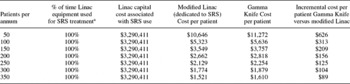
Capital purchase, annual maintenance charges and equipment life expectancy were based on figures specified by the relative system providers (9). U.S. dollars were converted to Australian dollars using the 2005 purchase parity rate (see Table 1) (12). Annual maintenance costs were modeled to be equivalent to a full service contract (to include maintenance, technical support, training, software upgrades, and faulty parts). No further maintenance and refurbishment costs were modeled (except the Gamma Knife cobalt source reload). In the base-case analysis it was assumed that two cobalt source reloads would be required during the estimated working life of a Gamma Knife system (15 years). The reloads are modeled to occur at the end of years 5 and 10, slightly sooner than the provider estimate (6–7 years) because treatment time increases by cobalt source age and early replacement was consequently assessed to be preferable (8).
Cost Estimates for Stereotactic Radiosurgery Treatment Systems

Note. Values quoted in Australian dollars: US dollars converted using Organisation for Economic Co-operation and Development purchase parity rate (2005) 0.73 USD/AUD.
a Modified Linac costs estimated as cost of a standard Linac (estimated AU$2.4 million – Commonwealth Department of Health and Ageing 2005) plus cost of the adaptation equipment (AU$890,411 – BrainLab 2005). Total capital cost AU$3.29 million.
b Estimated by manufacturer or Australian representative (2005).
c Cost distributed over estimated working life and discounted at 5% per annum.
Capital and maintenance costs were annualized over the equipment life expectancy (Table 1), with a discount factor of 5% applied to future costs (4). An average annual capital cost was estimated for each comparator using these figures, and a cost per patient was subsequently calculated. The cost per patient was based on 150 patients per treatment center, estimated from current patient utilization at an existing center in Australia, which treated 165 SRS patients in 2003 (11). It should be noted that this count may be an inflated estimate of normal patient numbers per treatment center, since the other SRS facility in the state was being refurbished in 2003. However, it is also understood that this equipment was fully used and patient demand may consequently not have been met (3;11). Assumptions on discount factor, capital costs, maintenance charges, life expectancy, the number of cobalt reloads, and patient volumes were varied in sensitivity analyses.
Two cost analyses have been conducted. The base-case analysis assumes capital costs for both a modified Linac and Gamma Knife are only spread across SRS patients. Whereas this is reasonable for Gamma Knife because it can only be used to treat SRS patients, a modified Linac could be used to treat other radiotherapy patients if spare treatment time was available as per current practice in Australia (11).
A second simple analysis has, therefore, also been undertaken to explore the impact of allocating Linac capital costs according to SRS use. It is assumed in this analysis that, when equipment is not used for SRS treatment, it is used to meet other radiotherapy needs.
The potential spare capacity of a modified Linac was estimated from data from current SRS usage patterns in Australia (11). Treatment time for 150 patients per year was estimated by assuming 50% of patients received an average of twenty-eight fractionated treatments (approximately 20 minutes) and 50% received a single dose (approximately 90 minutes) as per current approximate usage in a major treatment center in one Australian state (11). Assuming equipment is available 40 hours per week, 48 weeks per year, 150 SRS patients would use around 830 hours or approximately 43% of the potential service time available (1,920 hours), allowing the remaining spare time and costs to be potentially shared across other radiotherapy patients. Allocating capital costs relative to the proportion of working time treating SRS patients indicates 43% of the AU$2.4 million Linac capital costs (approximately AU$1042,000) plus the estimated cost of adaptation equipment (approximately AU$890,400) would relate to SRS treatment (AU$1,932,400; see Table 1). These figures were applied in the second analysis.
Results
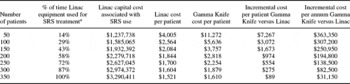
The base-case analysis, which assumed a modified Linac would be used only to treat SRS patients, estimated the additional (incremental) cost per patient Gamma Knife versus a modified Linac to be AU$209, based on 150 patients per annum (see Table 2). The second analysis, which assumed a modified Linac could be used to treat other radiotherapy patients and proportioned capital costs according to SRS usage, resulted in an incremental cost per patient Gamma Knife versus Linac of AU$1673, based on 150 patients per annum (see Table 3).
Base-Case Analysis: Modified Linac Dedicated to SRS Use

Note. Purchase costs distributed over estimated working life and discounted at 5% per annum. Maintenance costs discounted at 5% per annum.
SRS = stereotactic radiosurgery
Second Analysis: Modified Linac Capital Costs Proportioned According to SRS Use

Note. Capital costs proportioned according to the amount of time spent treating SRS patients. Equipment time not used for SRS treatment was assumed to be used to address other radiotherapy needs.
a Estimated assuming 50% of patients receiving single-dose treatment (average 90 minutes per session) and 50% of patients receiving fractionated (average 20 minutes per session for 28 occurrences) (11).
SRS, stereotactic radiosurgery
Sensitivity Analyses
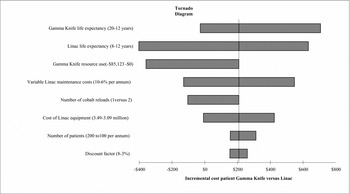
One-way sensitivity analyses were conducted to test base-case assumptions. Results of these analyses showed the incremental cost per patient was sensitive to variations in parameters (see Figure 1). Increasing the number of patients treated proportionally reduced the incremental cost per patient Gamma Knife versus Linac, whereas changes in three other key assumptions resulted in Gamma Knife costing less than a modified Linac. Assuming one rather than two cobalt reloads within the 15-year equipment life expectancy (year 7) resulted in an incremental cost per patient −AU$105 (150 patients per annum). Applying 10% rather than 8% annual Linac maintenance costs resulted in an incremental cost per patient −$130 (for 150 patients per annum), whereas a life expectancy of 8 years rather than 10 years for a modified Linac gave rise to an incremental cost per patient −$402.
The base-case analysis did not take into account potential differences in treatment time, set-up time, consumables, or staff resource use. Whereas expert opinion suggested these were similar between systems (9), previous SRS reviews have suggested that Gamma Knife may require less preparation time and substantially lower staff resource use (half the time of a radiology technician and clerical support than a Linac [13]). Applying these previous estimates of resource use differences (13) indexed to 2005 and converted to Australian dollars using 2005 purchase parity rate gave a difference of −AU$85,123 per annum Gamma Knife versus Linac, which rendered Gamma Knife less costly than a modified Linac (incremental cost per patient −$359 Gamma Knife versus Linac for 150 patients). However, it should be noted that variations in prices and practices may affect the applicability of these results.
The results of these sensitivity analyses indicate some uncertainty in base-case conclusions, and suggest that, if capital equipment costs are dedicated to the treatment of SRS patients, Gamma Knife could under certain assumptions be considered more cost competitive.
One-way sensitivity analyses of base-case incremental cost per patient Gamma Knife versus Linac.

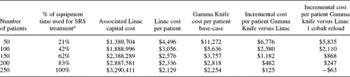
The second analysis suggested that, if a modified Linac could address other radiotherapy needs when it was not used to treat SRS patients, Gamma Knife could be substantially more expensive than a modified Linac. One-way sensitivity analyses showed that, unlike the base-case, this result is insensitive to variations in all previously considered assumptions. The incremental cost per patient Gamma Knife versus Linac given one cobalt reload or lower staff resource use for example was $1,360 and $1,106, respectively. However, the cost sharing advantages of the modified Linac reduce as the amount of time spent on SRS treatment increases; at 100% usage the analysis reverts to the base-case and Gamma Knife appears only cost competitive under certain conditions. It should be noted that SRS usage could increase given higher patient numbers or a greater proportion of fractionated patients, because fractionated patients use more treatment time than single dose patients. If 150 patients per annum were treated with 80% receiving fractionated treatment rather than 50% as previously assumed, the amount of equipment time used by SRS patients would increase from 43% to 62%, see Table 4.
Sensitivity Analysis: Increase in the Proportion of Patients Receiving Fractionated Versus Single-Dose Treatment (80% Receive Fractionated Treatment)

Note. Capital costs proportioned according to the amount of time spent treating SRS patients. Equipment time not used for SRS treatment was assumed to be used to address other radiotherapy needs.
a Estimated assuming 20% of patients receiving single-dose treatment (average 90 minutes per session) and 80% of patients receiving fractionated (average 20 minutes per session for 28 occurrences) (11).
Discussion
The results of these cost analyses suggest that Gamma Knife may be considerably more expensive than a modified unit when the ability of a modified Linac to treat other radiotherapy patients is taken into consideration. In Australia, SRS services are provided at a local level and patient numbers per center appear to be relatively low. Furthermore, spare equipment time is currently used to address other radiotherapy needs. Evidence from this review suggests that, under these circumstances, Gamma Knife seems unlikely to be cost competitive.
Changes in service provision could alter SRS usage and relative costs. For example, if services were pooled to a particular center at a state or national level, patient numbers per center would increase. Equally, if SRS was used to treat a wider range of indications or the proportion of patients receiving fractionated treatment expanded the amount of equipment time used by SRS patients would also rise. If SRS usage became high enough that facilities could be dedicated solely to SRS use, Gamma Knife may be expected to be moderately more expensive than a modified Linac. Analyses suggest, assuming full equipment usage, the incremental cost per patient would be $89 per patient (350 patients with 50% receiving fractionated treatment, Table 3). This result is sensitive to variations in assumptions and as per the base-case (see Figure 1) given one cobalt reload, or differences in Linac maintenance costs or staff and other resource use Gamma Knife may be cost competitive.
Limitations in this cost analysis include the narrow range of indications and SRS technologies considered. Stereotactic radiosurgery can be used to treat a broader range of conditions than those considered in this review and other dedicated technologies are used to deliver SRS treatment. However, this study has focused on Gamma Knife and Linac technologies, the systems used most frequently internationally (10), for applications of treatment considered the most relevant to Australia (9). Other limitations include the strength of evidence on patient numbers and treatment type (single-dose or fractionated therapy), because estimates were predominantly taken from one hospital in one Australian state. Although this hospital is the major treatment center, it may or may not reflect treatment patterns in other Australian and international centers. Furthermore, differences in preparation time, staff, and other resource use have not been evaluated in this review, and although international evidence has been applied in sensitivity analyses, further research in this area may be beneficial.
Finally, it should be noted that the comparison between SRS technologies has been made under the assumption that SRS is an appropriate treatment choice. Although SRS is widely used, the benefits and cost-effectiveness of SRS as a supplementary or alternative treatment to WRBT and microsurgery have not been appropriately established (6;9;13). Nonetheless, the current acceptance of SRS for treatment of certain patient groups has driven decision makers to fund the technology. Faced with a range in SRS systems and limited evidence of differences in effects between devices, decision makers have differentiated technologies by costs. It is in this context the current evaluation has sought to clarify cost arguments and highlight potential circumstances when Gamma Knife may and may not be cost competitive. However, it should be emphasized that this study is not a cost minimization analysis, and the results should still be interpreted in context of uncertainty in effects.
This study is the first cost comparison of SRS technologies to our knowledge that has attempted to estimate the opportunity cost of Gamma Knife versus a modified Linac under assumptions of low patient demand and competing radiotherapy service needs. This analysis extends previous Australian cost reviews (8) that were limited by a lack of evidence on equipment purchase, maintenance costs, and patients numbers and could only consider the average cost per patient Gamma Knife versus Linac for a large range of scenarios. This analysis also extends previous international HTA assessments of Gamma Knife and Linac. A Canadian HTA (13) assessed cost differences between systems for construction, equipment purchase, maintenance, supplies, staff resource use, and patient born costs and estimated a cost per patient across a spectrum of patient numbers. The cost per patient for Gamma Knife (150 patients) was estimated as $11,237 compared with $10,807 for Linac, with an incremental cost per patient $430. However, no analysis was undertaken to establish the opportunity cost that would be associated with a dedicated Gamma Knife facility. This study has highlighted that, under an assumption of competing radiotherapy demands, this opportunity cost may be substantial. Further research into differences in effect between SRS other available treatments as well as research into the differences in effects between competing SRS technologies are clearly paramount for future evaluations.
CONCLUSION
The cost analysis indicates Gamma Knife is likely to be more expensive than a modified Linac. This cost difference is substantial if the number of patients treated was expected to be low and spare capacity could address other radiotherapy needs; under these circumstances, it may be difficult to justify the additional reimbursement of Gamma Knife over Linac without further (and favorable) evidence of survival or quality of life differences.
POLICY IMPLICATIONS
There is no evidence to support a preference for Gamma Knife over other forms of SRS. It is clear that more data are required on the incidence of conditions for which radiosurgery is indicated, its effectiveness and side effects. Current evidence suggests that Gamma Knife could, under certain conditions, be cost competitive in high throughput settings, and consequently decisions about its use internationally will differ, depending on estimates of population size and preferences applied. In Australia, funding is consistent with Linac costs with no additional reimbursement for Gamma Knife or other dedicated technologies. Other countries, including France and Canada, appear to have funded Gamma Knife with further data collection planned (7).
CONTACT INFORMATION
Alison Griffiths, BA (hons) (alison.griffiths@ctc.usyd.edu.au), Project Officer, Health Economics, Luke Marinovich, BA (Hons) (Luke.Marinovich@ctc.usyd.edu.au), Project Manager, Systematic Reviews and Health Care Assessment, NHMRC Clinical Trials Centre, University of Sydney, 88 Mallett Street, Camperdown, New South Wales 2050, Australia
Michael B. Barton, MBBS, FRANZCR (m.barton@unsw.edu.au), Professor of Radiation Oncology, South West Clinical School, University of New South Wales, Senior Staff Specialist, Department of Radiation Oncology, Liverpool Hospital, Elizabeth Street, Liverpool, New South Wales, 2170 Australia
Sarah J. Lord, MBBS, MSc, NHMRC Clinical Trials Centre, The University of Sydney, 88 Mallett Street, Camperdown, New South Wales 2050, Australia