Introduction
Bipolar disorder (BD) comprises a group of chronic and recurrent neuropsychiatric conditions characterized by pathological mood instability, which finds its maximum expression in the full-blown manic and depressive episodes that many affected individuals experience throughout their lifetime. At present, it has been widely documented that a substantial proportion of BD patients exhibit measurable neuropsychological impairments, which persist beyond acute mood episodes (Bourne et al., Reference Bourne, Aydemir, Balanzá-Martínez, Bora, Brissos, Cavanagh and Goodwin2013; Kjærstad, Eikeseth, Vinberg, Kessing, & Miskowiak, Reference Kjærstad, Eikeseth, Vinberg, Kessing and Miskowiak2019; Varo et al., Reference Varo, Solé, Jiménez, Bonnín, Torrent, Valls and Reinares2020) and have been shown to be highly predictive of suboptimal outcomes in different aspects of real-world functioning (Ehrminger et al., Reference Ehrminger, Brunet-Gouet, Cannavo, Aouizerate, Cussac, Azorin and Roux2019; Gilbert & Marwaha, Reference Gilbert and Marwaha2013; Gitlin & Miklowitz, Reference Gitlin and Miklowitz2017). Consequently, cognitive impairments are currently acknowledged as key aspects of BD that should be targeted in the clinical management of affected individuals (e.g. controlling variables known to worsen cognitive outcomes) and, in turn, in our theoretical and research considerations, as these neuropsychological features could shed light on the underlying mechanisms of the disorder. However, a large knowledge gap exists about the causes, onset, correlates, and longitudinal course of cognitive dysfunction in BD.
In contrast to research findings in the field of psychotic disorders, most population-based studies of premorbid neuropsychological functioning in BD have reported good and even outstanding cognitive outcomes (Koenen et al., Reference Koenen, Moffitt, Roberts, Martin, Kubzansky, Harrington and Caspi2009; MacCabe et al., Reference MacCabe, Lambe, Cnattingius, Sham, David, Reichenberg and Hultman2010; Reichenberg et al., Reference Reichenberg, Weiser, Rabinowitz, Caspi, Schmeidler, Mark and Davidson2002; Smith et al., Reference Smith, Anderson, Zammit, Meyer, Pell and Mackay2015). However, these studies explored neurocognitive performance by means of intelligence quotient scales, fluid intelligence tests, or proxies for cognitive outcomes (i.e. scholastic achievement) and therefore did not provide any information regarding individuals' functioning in those circumscribed domains typically found to be impaired in BD patients (i.e. verbal episodic memory, processing speed, attention, and executive processes). Consequently, the possibility of neuropsychological dysfunction occurring in the premorbid phases of BD cannot be excluded. Indeed, studies of young offspring of bipolar patients have reported the presence of deficits in the same cognitive domains found to be impaired in well-established BD and with similar inter-individual heterogeneity (Bora et al., Reference Bora, Can, Ildız, Ulas, Ongun, Inal and Ozerdem2019; Bora & Özerdem, Reference Bora and Özerdem2017a). In addition, prospective studies of adolescents and young adults at high risk for BD, though scant, have reported impaired cognitive outcomes in individuals with subsequent development of the disorder (Meyer et al., Reference Meyer, Carlson, Wiggs, Martinez, Ronsaville, Klimes-Dougan and Radke-Yarrow2004; Ratheesh et al., Reference Ratheesh, Lin, Nelson, Wood, Brewer, Betts and Bechdolf2013). Altogether, these pieces of evidence suggest that cognitive impairments may be present prior to illness onset (despite being unclear when exactly their emergence occurs), and they may be selective and milder than those observed in premorbid psychotic disorders. Thus, neurodevelopmental abnormalities may play a role in BD-related cognitive dysfunction (Martino, Samamé, Ibañez, & Strejilevich, Reference Martino, Samamé, Ibañez and Strejilevich2015).
In well-established BD, both state- and trait-related neuropsychological impairments represent a consistent finding even in early-course patients (i.e. following the first episode of mania) (Bora & Pantelis, Reference Bora and Pantelis2015; Bourne et al., Reference Bourne, Aydemir, Balanzá-Martínez, Bora, Brissos, Cavanagh and Goodwin2013; Chakrabarty et al., Reference Chakrabarty, Torres, Su, Sawatzky, Keramatian and Yatham2021; Kjærstad et al., Reference Kjærstad, Mistarz, Coello, Stanislaus, Melbye, Harmer and Kessing2020). In recent years, a widespread hypothesis known as ‘neuroprogression’ has proposed that such impairments develop during the long-term course of the disorder as a result of illness-related neurodegenerative changes (Carvalho, Firth, & Vieta, Reference Carvalho, Firth and Vieta2020; Kapczinski et al., Reference Kapczinski, Magalhães, Balanzá-Martinez, Dias, Frangou, Gama and Berk2014; Velosa et al., Reference Velosa, Delgado, Finger, Berk, Kapczinski and de Azevedo Cardoso2020). This assumption was initially supported by findings of cross-sectional studies that reported a relationship between a larger number of previous affective episodes (especially of mania) and severity of cognitive deficits (López-Jaramillo et al., Reference López-Jaramillo, Lopera-Vásquez, Gallo, Ospina-Duque, Bell, Torrent and Vieta2010; Robinson & Ferrier, Reference Robinson and Ferrier2006). However, early follow-up studies of cognition in BD have not supported neuroprogression, and alternative explanations have been proposed for the association between number of manic episodes and cognitive deficits (for a review, see Strejilevich, Samamé, & Martino, Reference Strejilevich, Samamé and Martino2015). For instance, cognitive dysfunction in BD might be a severity marker associated with an increased number of recurrences and a poorer clinical course rather than being the consequence of cumulative effects of multiple mood episodes (Martino et al., Reference Martino, Strejilevich, Marengo, Igoa, Fassi, Teitelbaum and Caravotta2013).
It is evident that only findings from longitudinal research might provide direct evidence to answer the question about cognitive stability or decline in BD. At present, three meta-analyses have been conducted to synthesize the results of investigations on the longitudinal course of cognition in bipolar individuals. A pioneering meta-analysis by Samamé, Martino, and Strejilevich (Reference Samamé, Martino and Strejilevich2014), which combined the results of studies including only euthymic participants on both test and retest occasions, did not find any significant differences between BD patients' performance at baseline and after a mean follow-up period of 4.62 years for 14 neuropsychological variables. However, data from controls were scant and only made it possible to perform meta-analyses for four cognitive variables, for which no significant patient-control differences were found regarding test-retest effect sizes in a mean interval of 2.2 years. In a subsequent meta-analysis including a larger number of studies (Bora & Özerdem, Reference Bora and Özerdem2017b), similar results were found for BD individuals' test-retest differences (mean follow-up period: 3.7 years). In addition, this meta-analysis compared longitudinal cognitive outcomes between short-term (mean duration: <3 years) and long-term (mean duration: ⩾3 years) follow-up studies and reported similar results between subgroups for seven cognitive variables. When patients' test-retest neuropsychological differences were compared with those of healthy controls, similar trajectories were observed. However, this analysis included only seven neuropsychological variables, and the follow-up periods used at the primary study level ranged from 1 to 5 years (mean follow-up period: 3.3 years). More recently, a small review by Szmulewicz, Valerio, and Martino (Reference Szmulewicz, Valerio and Martino2020) analyzed the longitudinal course of neurocognitive functioning in recent-onset BD (mean follow-up period: 1.4 years) and late-life BD (mean follow-up period: 2.8 years) and found no evidence of cognitive deterioration. However, only a limited number of cognitive domains were analyzed besides using short follow-up periods, which may have been insufficient to detect changes in cognitive function.
In this context, further evidence from controlled long-term follow-up studies is needed to gain insight into the course of neuropsychological functioning in BD and determine whether progressive decline indeed occurs. Broadening our knowledge on the longitudinal trajectory of cognition in BD would contribute to a better understanding of the pathophysiological mechanisms of the disorder, the establishment of possible bipolar subtypes, the identification of targets for treatment, and the development of more efficacious therapeutic strategies. The aim of the current study was to conduct a systematic review and meta-analysis of studies exploring the long-term neurocognitive course (⩾5 years) of BD individuals as compared with healthy controls.
Material and methods
Search strategy
The present study was conducted in accordance with the PRISMA 2020 Statement guidelines (Page et al., Reference Page, McKenzie, Bossuyt, Boutron, Hoffmann, Mulrow and Moher2021). The review protocol was registered in the International Prospective Register of Systematic Reviews (PROSPERO, CRD42020198367), and can be accessed at https://www.crd.york.ac.uk/prospero/display_record.php?ID=CRD42020198367.
PubMed, PsycINFO, and Scopus databases were searched from inception through 1 July 2021 to retrieve publications available in English. At the first step of the search, combinations of keywords were used as follows: ‘bipolar disorder’ AND (‘cognition’ OR ‘neuropsychol*’) AND (‘longitudinal’ OR ‘follow-up’). Additionally, in order not to miss potentially relevant literature not covered by the aforementioned databases, a search was performed through Google Scholar using the same algorithm. First, titles and abstracts retrieved using this strategy were screened to identify relevant studies. Full texts of the articles identified in this initial screening were thoroughly assessed to confirm or reject their inclusion based on prespecified criteria. As a second step, the reference lists of the articles identified for inclusion and other relevant studies on the topic (e.g. systematic reviews) were checked for additional eligible reports. The different steps of the literature search were conducted independently by two reviewers (CS, BLC). Disagreements were resolved by consensus-based discussion.
Study selection criteria
Studies were considered for the current meta-analysis if they met the following criteria: (1) included a patient group with the diagnosis of BD according to standardized criteria; (2) included a healthy control group; (3) involved longitudinal study design with neuropsychological assessment at baseline and after a follow-up period of at least 5 years; (4) provided data to estimate patient-control effect sizes for neuropsychological change; (5) included at least one behavioral measure of cognitive functioning that was used in a minimum of three independent studies.
In addition, if a study was based on a group of patients with different diagnoses including BD (e.g. ‘first-episode psychoses’, ‘affective psychoses’), we contacted the original authors to request separate data for BD individuals. If there were studies with overlapping content based on the same patient sample, we considered the data from the study with the largest sample size. Two studies on the same patient group were only included if they reported different cognitive measures and were therefore not meta-analyzed together.
Data extraction and quality assessment
Two reviewers (CS, BLC) independently extracted data from full texts of the studies selected for inclusion using a standardized precoded spreadsheet. Data regarding age, education, sample size, and neuropsychological functioning at both assessment time points were extracted for both BD and control groups. When available, the following data were also extracted for the BD group: mood state at both assessment time points, subtype of the disorder, number of previous depressive/(hypo)manic episodes, duration of illness, and medication use. A consensus meeting was held to resolve any disparities between the two reviewers.
To appraise study quality, the National Institutes of Health Quality Assessment Tool for Observational Cohort and Cross-Sectional Studies (NIH, 2014) was used, with some questions adapted to the current review. Quality assessment was performed in duplicate. Studies were considered ‘good quality’ if they achieved at least a score of eight (i.e. eight ‘yes’ answers). Disagreements regarding quality scores for each individual study were resolved by consensus.
Meta-analytic procedure
Meta-analyses were performed using the Comprehensive Meta-Analysis software version 3.0 (Borenstein, Hedges, Higgins, & Rothstein, Reference Borenstein, Hedges, Higgins and Rothstein2013). Patient-control effect sizes for test-score changes (i.e. changes in scores of neuropsychological tests from baseline to a follow-up time point) were calculated as standardized mean differences (Hedges' g). To compute the effect sizes, a conservative value of 0.5 was assumed for pre-post correlations. For each neuropsychological test or cognitive domain composite score, the sign of patient-control effect sizes for test-retest change was adjusted so that positive effect sizes reflected greater decrease in neuropsychological performance in the BD group. Effect sizes were weighted using the inverse variance method (DerSimonian & Laird, Reference DerSimonian and Laird2015). A random-effects model was used in all the analyses performed. According to this model, the studies in the analysis are assumed to be a random sample in the universe of studies (Borenstein et al., Reference Borenstein, Hedges, Higgins and Rothstein2013).
The Q-test for heterogeneity was used to estimate the homogeneity of the resulting mean weighted effect size for each variable. The I 2 index was calculated to describe the percentage of total variation across reports due to heterogeneity rather than chance. I 2 values of 25, 50, and 75% indicate low, moderate, and high heterogeneity, respectively (Higgins, Thompson, Deeks, & Altman, Reference Higgins, Thompson, Deeks and Altman2003). In analyses including at least five studies, publication bias (the tendency of small studies to show larger effects) was assessed using Egger's test (Egger, Davey Smith, Schneider, & Minder, Reference Egger, Davey Smith, Schneider and Minder1997).
In addition, subgroup meta-analyses were performed considering only those studies including homogeneous samples of euthymic or stable (not in an acute mood episode) BD patients at both assessment time points.
A significance level of p < 0.05 was set for all the analyses performed.
Cognitive variables
For the purposes of this study, the results of investigations utilizing the same test or tapping approximately the same neuropsychological construct were combined into a single summary measure. Twenty-four overall neuropsychological measures were obtained (Table 1, online Supplementary material).
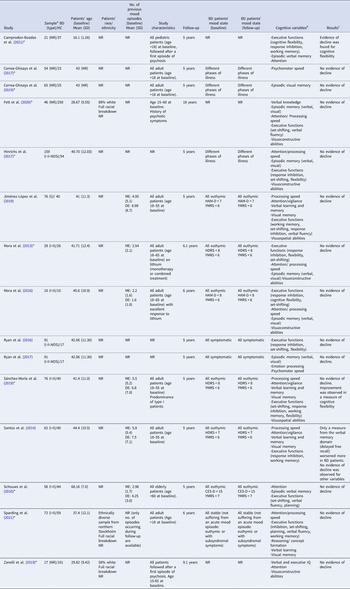
Long-term (⩾5 years) follow-up studies of neuropsychological functioning in BD patients and healthy individuals

BD, bipolar disorder; CES-D, Centre for Epidemiologic Studies Depression Scale; DE, depressive episodes; HC, healthy controls; HDRS/HAM-D/HRDS, Hamilton Depression Rating Scale; IQ, intelligence quotient; ME, (hypo)manic episodes; NR, not reported; NOS, not otherwise specified; s.d., standard deviation; YMRS, Young Mania Rating Scale.
Studies included in the meta-analysis.
a Some studies included other clinical samples besides BD (e.g. psychotic disorders) or a sample of first-degree relatives of bipolar patients, but the corresponding data are not reported here as they fall beyond the scope of the current review. The sample size reported for each study corresponds to the number of participants (BD/HC) who underwent cognitive assessment on two occasions separated by a minimum interval of 5 years. The study by Fett et al. (Reference Fett, Velthorst, Reichenberg, Ruggero, Callahan, Fochtmann and Kotov2020) did not provide cognitive outcomes for HC at baseline, but an estimation of cognitive change was made from longitudinal normative data.
b Neuropsychological variables are reported here only if both test and retest outcomes were available.
c The results reported here correspond to the long-term cognitive outcomes of individuals with a BD diagnosis as compared with healthy individuals. Given that the studies by Camprodon-Boadas et al. (Reference Camprodon-Boadas, de la Serna, Baeza, Puig, Ilzarbe, Sugranyes and Castro-Fornieles2021), Fett et al. (Reference Fett, Velthorst, Reichenberg, Ruggero, Callahan, Fochtmann and Kotov2020), and Zanelli et al. (Reference Zanelli, Mollon, Sandin, Morgan, Dazzan, Pilecka and Reichenberg2019) were based on mixed samples of individuals with different diagnoses, separate data for bipolar individuals were provided by the authors of these studies. Hence, the results here reported correspond to individuals with a BD diagnosis exclusively.
Results
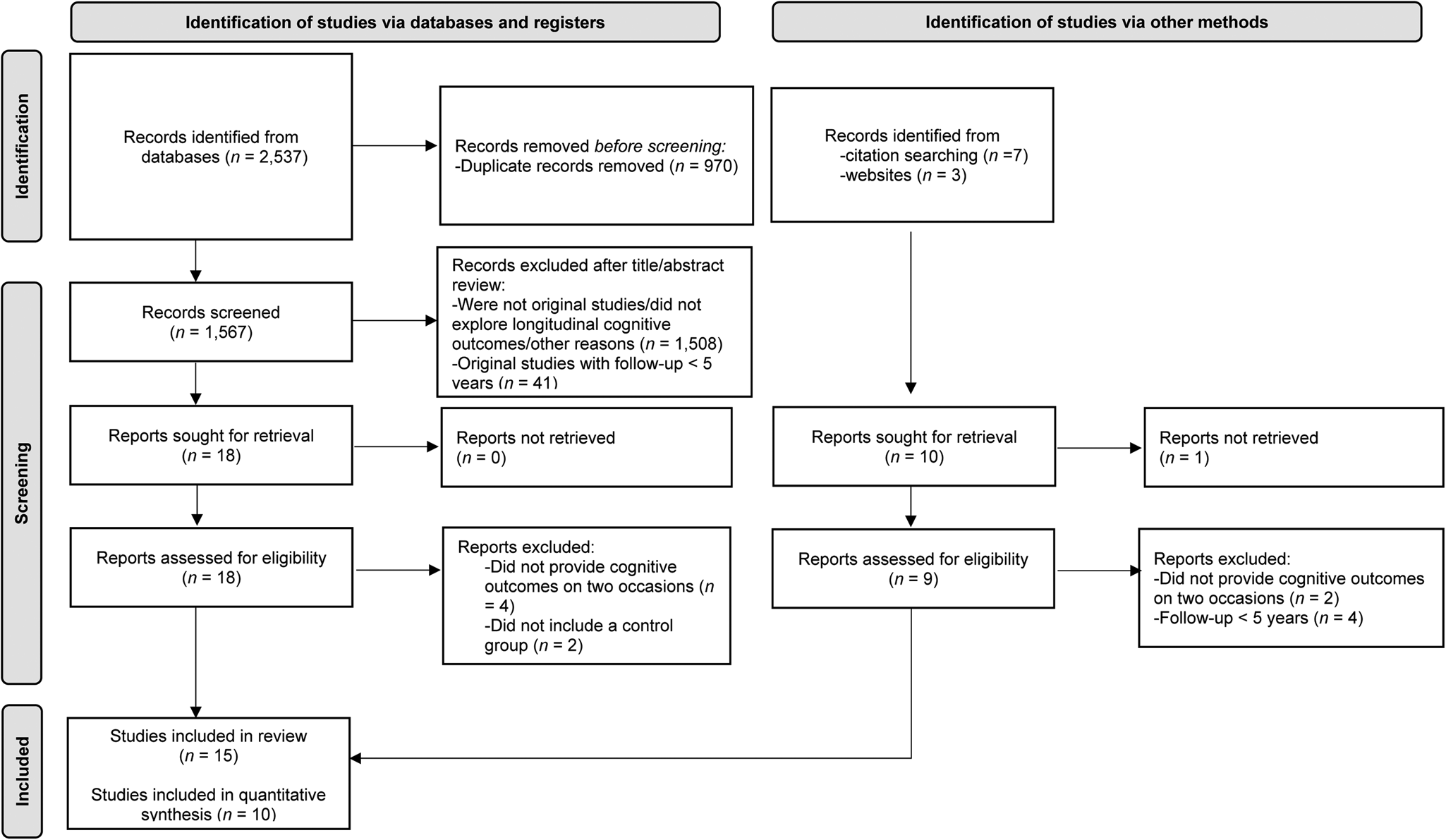
The selection process of included studies is summarized in Fig. 1. Fifteen studies compared the long-term course (⩾5 years) of cognition in BD patients with that of healthy individuals and are synthesized in Table 1. Five studies were not included in the meta-analysis due to overlapping sample with other reports (Jiménez-López et al., Reference Jiménez-López, Sánchez-Morla, López-Villarreal, Aparicio, Martínez-Vizcaíno, Vieta and Santos2019; Mora, Portella, Forcada, Vieta, & Mur, Reference Mora, Portella, Forcada, Vieta and Mur2016; Ryan et al., Reference Ryan, Assari, Pester, Hinrichs, Angers, Baker and Langenecker2016, Reference Ryan, Assari, Angers, Marshall, Hinrichs, Easter and McInnis2017; Santos et al., Reference Santos, Aparicio, Bagney, Sánchez-Morla, Rodríguez-Jiménez, Mateo and Jiménez-Arriero2014). Finally, 10 studies were included in the quantitative analysis and involved 540 BD patients and 644 healthy controls (mean follow-up period: 8.9 years). Two studies based on the same sample were included (Correa-Ghisays et al., Reference Correa-Ghisays, Balanzá-Martínez, Selva-Vera, Vila-Francés, Soria-Olivas, Vivas-Lalinde and Tabarés-Seisdedos2017, Reference Correa-Ghisays, Sánchez-Ortí, Ayesa-Arriola, Setién-Suero, Balanzá-Martínez, Selva-Vera and Tabarés-Seisdedos2019) as they explored different neuropsychological variables, but only that with the largest sample size was considered for calculating the total number of individuals included in the meta-analysis. The authors of these two reports were contacted by e-mail and requested to provide separate data corresponding to the same group of patients who underwent cognitive assessment both at baseline and after a 5-year follow-up period, as that information was not available from the publication. The studies by Camprodon-Boadas et al. (Reference Camprodon-Boadas, de la Serna, Baeza, Puig, Ilzarbe, Sugranyes and Castro-Fornieles2021), Fett et al. (Reference Fett, Velthorst, Reichenberg, Ruggero, Callahan, Fochtmann and Kotov2020), and Zanelli et al. (Reference Zanelli, Mollon, Sandin, Morgan, Dazzan, Pilecka and Reichenberg2019) explored the longitudinal course of cognition in a group of patients with ‘psychoses’, which included both patients diagnosed with psychotic disorders and patients suffering from affective disorders with psychotic features. The authors of these studies were contacted by e-mail and requested to provide separate data for the individuals diagnosed with BD. The study by Fett et al. (Reference Fett, Velthorst, Reichenberg, Ruggero, Callahan, Fochtmann and Kotov2020) provided a cross-sectional comparison for healthy controls only at the end of the follow-up period but was included in the meta-analysis as it used a reference for normative cognitive change, based on recent data from a longitudinal study that included people of the same age group (in their 30s and 40s) from the same country (Hughes, Agrigoroaei, Jeon, Bruzzese, & Lachman, Reference Hughes, Agrigoroaei, Jeon, Bruzzese and Lachman2018).
PRISMA 2020 flow diagram for systematic reviews.

Out of the total studies reviewed, most reports were based on samples of middle-aged adults. One report included only late-life individuals (Schouws, Comijs, Dols, Beekman, & Stek, Reference Schouws, Comijs, Dols, Beekman and Stek2016) and one report included only pediatric patients at baseline (Camprodon-Boadas et al., Reference Camprodon-Boadas, de la Serna, Baeza, Puig, Ilzarbe, Sugranyes and Castro-Fornieles2021). Three studies included BD individuals followed up after a first episode of psychosis (Camprodon-Boadas et al., Reference Camprodon-Boadas, de la Serna, Baeza, Puig, Ilzarbe, Sugranyes and Castro-Fornieles2021; Fett et al., Reference Fett, Velthorst, Reichenberg, Ruggero, Callahan, Fochtmann and Kotov2020; Zanelli et al., Reference Zanelli, Mollon, Sandin, Morgan, Dazzan, Pilecka and Reichenberg2019) (Table 1). Overall, the quality of the studies included in this review was good (Table 2, online Supplementary material).
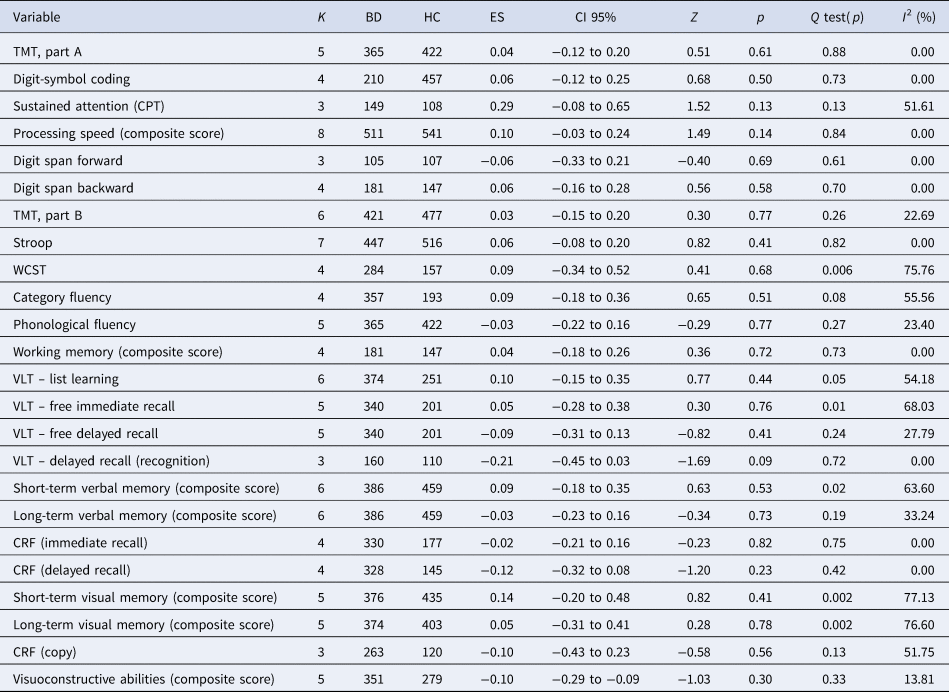
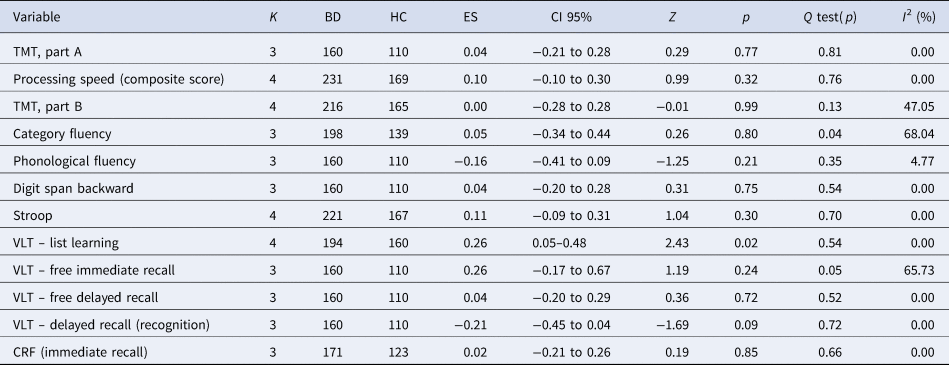
Pooled weighted effect sizes for patient-control differences in test-score changes.

CPT, Continuous Performance Tests; CRF, Complex Rey Figure; TMT, Trail Making Test; VLT, Verbal Learning Tests; WCST, Wisconsin Card Sorting Test; K, number of studies; BD, bipolar disorder patients; HC, healthy controls; ES, effect size (Hedges' g); CI, confidence interval.
There were no statistically significant differences for age or baseline years of education between the group of BD individuals and the healthy control group neither in the total sample nor in any of the meta-analyses performed (p > 0.05).
Meta-analytic results for patient-control differences in neuropsychological change
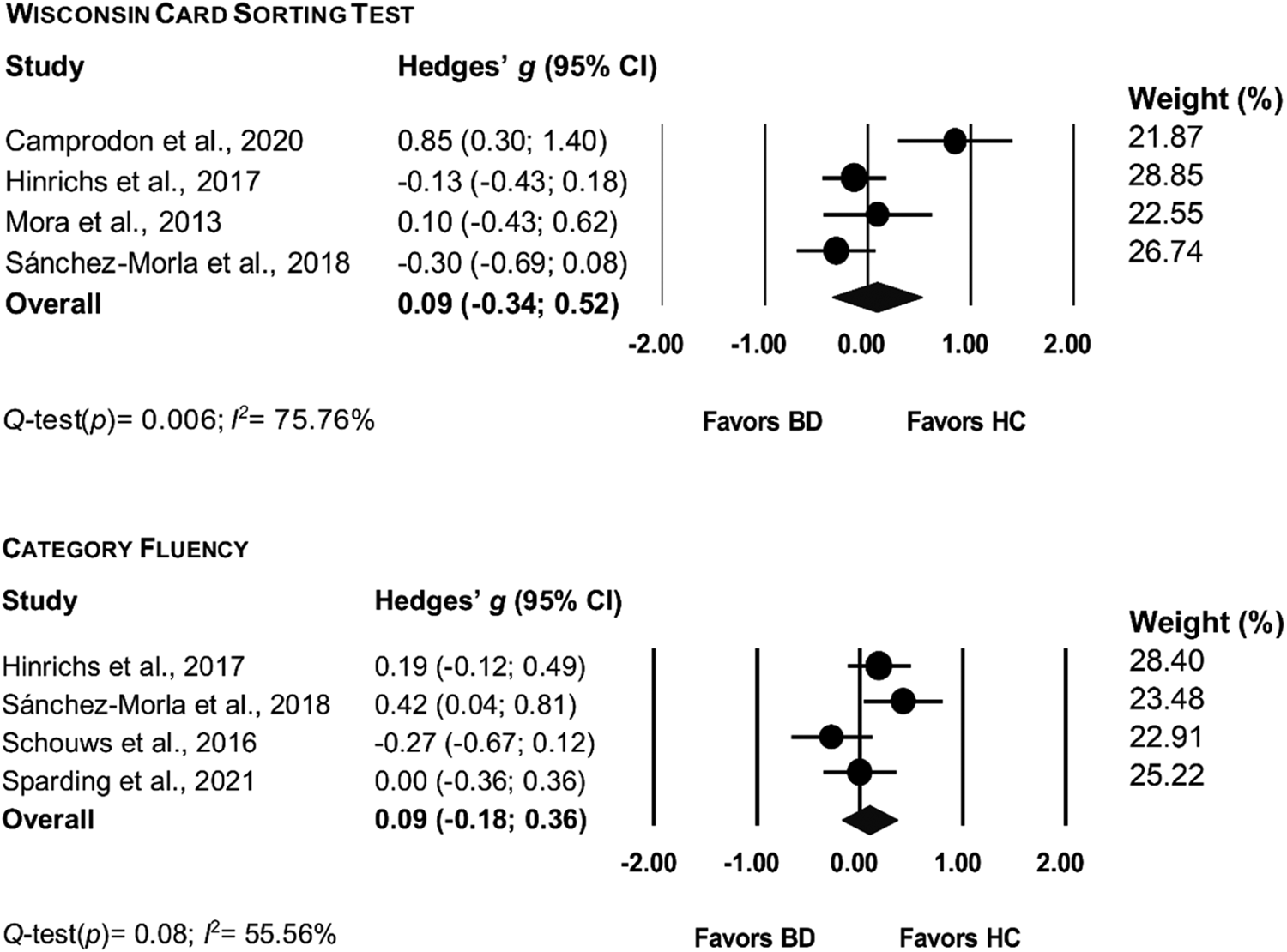
No significant patient-control differences were observed for longitudinal cognitive outcomes in any of the 24 variables explored (Table 2). Large significant heterogeneity was observed for five neuropsychological variables. Figure 2 provides forest plots depicting individual and pooled patient-control effect sizes for changes in category fluency and the Wisconsin Card Sorting Test (WCST), the two executive measures with the least consistent effects across studies. In the WCST analysis (Fig. 2), there was one clear outlier (Camprodon-Boadas et al., Reference Camprodon-Boadas, de la Serna, Baeza, Puig, Ilzarbe, Sugranyes and Castro-Fornieles2021). When removing this study, the distribution of effect sizes became largely homogeneous in the absence of significant patient-control differences [before: Hedges' g = 0.09, p = 0.68, Q(p) = 0.006, I 2 = 75.76%; after: Hedges' g = −0.15, p = 0.19, Q(p) = 0.47, I 2 = 00.00%]. No evidence of publication bias was observed (Table 3, online Supplementary material).
Forest plots of individual and pooled patient-control effect sizes for changes in two executive measures. BD, bipolar disorder patients; HC, healthy controls.

Pooled weighted effect sizes for patient-control differences in test-score changes (subanalysis of studies including euthymic patients on both assessment occasions)

CRF, Complex Rey Figure; TMT, Trail Making Test; VLT, Verbal Learning Tests; WCST, Wisconsin Card Sorting Test; K, number of studies; BD, bipolar disorder patients; HC, healthy controls; ES, effect size (Hedges' g); CI, confidence interval.
Subgroup meta-analysis of euthymic patients
Subgroup meta-analyses were performed including only studies of euthymic/stable individuals at both assessment time points. Four studies (Mora, Portella, Forcada, Vieta, & Mur, Reference Mora, Portella, Forcada, Vieta and Mur2013; Sánchez-Morla et al., Reference Sánchez-Morla, López-Villarreal, Jiménez-López, Aparicio, Martínez-Vizcaíno, Roberto and Santos2019; Schouws et al., Reference Schouws, Comijs, Dols, Beekman and Stek2016; Sparding et al., Reference Sparding, Joas, Clements, Sellgren, Pålsson and Landén2021) compared longitudinal neuropsychological outcomes between 232 euthymic/stable BD patients and 169 healthy controls (mean follow-up: 5.5 years) and were included in this analysis. No significant between-group differences were found for 11 of the 12 variables analyzed (Table 3). Homogeneous distributions of effect sizes were observed for most of the analyses performed.
Discussion
This meta-analysis aimed to compare the long-term cognitive trajectory of BD patients with that of healthy individuals. Meta-analytic findings for 24 variables yielded no significant patient-control differences in test-retest neuropsychological change (mean follow-up: 8.9 years). In a subanalysis considering studies of euthymic individuals only (mean follow-up: 5.5 years), no significant patient-control differences were found for 11 out of 12 cognitive variables analyzed. In addition, at the primary study level, most studies reported similar long-term cognitive trajectories between bipolar patients and healthy individuals.
Our results are in keeping with previous meta-analyses of longitudinal neuropsychological outcomes in BD (Bora & Özerdem, Reference Bora and Özerdem2017b; Samamé et al., Reference Samamé, Martino and Strejilevich2014; Szmulewicz et al., Reference Szmulewicz, Valerio and Martino2020). However, unlike these meta-analyses, the current review includes primary studies with a long follow-up period and a healthy control group in addition to analyzing a much larger number of neurocognitive variables. Therefore, the results here reported provide more robust evidence not supportive of the concept of progressive cognitive deterioration of BD individuals as a group.
Furthermore, the results of our review and those from previous meta-analyses are in line with the classic concept of BD, according to which leaving aside the general impact of mood swings on the overall functioning of those affected, cognition and general intelligence are preserved along the course of the disorder. Despite these considerations, it is not possible to exclude the possibility that cognitive deterioration indeed occurs. Several issues should be taken into account before drawing any firm conclusions about the long-term course of cognition in BD.
First, a number of investigations using cluster-analytic approaches have consistently demonstrated the existence of at least three different cognitive subgroups of BD individuals, including a ‘cognitively intact group’ in comparison with healthy individuals, a ‘globally impaired group’, with severe and generalized deficits, and a ‘moderately impaired group’ with moderate or selective impairment (Burdick et al., Reference Burdick, Russo, Frangou, Mahon, Braga, Shanahan and Malhotra2014; Chakrabarty et al., Reference Chakrabarty, Torres, Su, Sawatzky, Keramatian and Yatham2021; Varo et al., Reference Varo, Solé, Jiménez, Bonnín, Torrent, Valls and Reinares2020). These distinct groups of BD individuals could have different long-term neurocognitive trajectories. However, it should be noted that cognitive subgroups have been found to be equally present in young (Frías et al., Reference Frías, Dickstein, Merranko, Gill, Goldstein, Goldstein and Birmaher2017) and late-life patients, with a remarkable similarity in their distribution compared to that found in middle-aged patients (Martino, Marengo, Igoa, & Strejilevich, Reference Martino, Marengo, Igoa and Strejilevich2018). These findings and the fact that cognitive subgroups are detectable even in first-episode BD and before illness onset (Bora et al., Reference Bora, Can, Ildız, Ulas, Ongun, Inal and Ozerdem2019; Chakrabarty et al., Reference Chakrabarty, Torres, Su, Sawatzky, Keramatian and Yatham2021) suggest that cognitive heterogeneity is not the result of neuroprogressive changes or solely attributable to differences in long-term exposure to pharmacological agents. It is likely that these subgroups reflect different underlying processes and cognitive reserve, which, in turn, may interact with other clinical characteristics. Another issue that warrants consideration when interpreting the neurocognitive heterogeneity observed among bipolar individuals is the fact that some cases of late-onset BD (LOBD) may be behavioral manifestations of other conditions that mimic the disorder. LOBD, which is associated with more severe cognitive deficits (Samamé, Martino, & Strejilevich, Reference Samamé, Martino and Strejilevich2013; Schouws et al., Reference Schouws, Comijs, Stek, Dekker, Oostervink, Naarding and Beekman2009) and a possible progressive course, has been proposed to be different from the ‘primary’ and most prevalent forms of the disorder as its etiology may be related to vascular illness or early manifestations of neurodegenerative diseases (Mendez, Parand, & Akhlaghipour, Reference Mendez, Parand and Akhlaghipour2020; Subramaniam, Dennis, & Byrne, Reference Subramaniam, Dennis and Byrne2007). As evident, both illness-related processes and other clinical factors (e.g. drug treatment, severity of the course of illness) have an impact on the overall cognitive picture of BD, in which the relative weight of each variable remains to be determined. All this said, although progressive cognitive decline is not a general rule in BD, it is possible that a subgroup of patients presents with a neuroprogressive course. In line with this hypothesis, the study by Sánchez-Morla et al. (Reference Sánchez-Morla, López-Villarreal, Jiménez-López, Aparicio, Martínez-Vizcaíno, Roberto and Santos2019) reported that the number of previous (hypo)manic episodes was a significant predictor of long-term progression of neuropsychological impairments. Similarly, Schouws et al. (Reference Schouws, Comijs, Dols, Beekman and Stek2016) found that more manic symptoms were significantly associated with a greater decline in memory. Further studies considering the neurocognitive heterogeneity of BD may contribute to better understanding of the expected cognitive evolution of the disorder and disentangling the correlates of neuropsychological dysfunction.
Second, it is possible that, in the most ‘classic’ forms of BD, cognitive deterioration occurs prior to the onset of the disorder as a result of illness-related processes and may remain quite stable during the course of illness. It is also possible that such cognitive decline occurs when the first mood manifestations of the disorder emerge in the absence of a BD diagnosis [taking into account that depression occurs long before the first episode of (hypo)mania that is necessary for performing any diagnosis] or immediately after the first well-established manic episode and then remain stable over time. For instance, the only study reviewed here that documented a decline in executive functions (Camprodon-Boadas et al., Reference Camprodon-Boadas, de la Serna, Baeza, Puig, Ilzarbe, Sugranyes and Castro-Fornieles2021) was based on pediatric patients who were followed up after their first episode of psychosis, and the differences observed with other studies could be explained by the fact that this study included younger patients in the very early manifestations of BD. It is evident that neurodevelopmental factors do not exclude the possibility of neurodegeneration. However, to prove a progressive neurodevelopmental nature of BD, more consistent evidence for progressive deterioration is needed. At present, the strongest empirical support for neuroprogression is drawn from studies showing progressive cortical thinning in bipolar individuals (Carvalho et al., Reference Carvalho, Firth and Vieta2020). However, these studies have not controlled for variables such as exposure to antipsychotic drugs, which have also been correlated with cortical thinning (Hibar et al., Reference Hibar, Westlye, Doan, Jahanshad, Cheung, Ching and Andreassen2018; Strejilevich, Quiroz, & Bitran, Reference Strejilevich, Quiroz and Bitran2020).
Third, it is possible that cognitive decline occurs in the very-long term and the studies reviewed here do not capture such changes. As is evident, follow-up periods of more than a decade are difficult to accomplish in research settings with accurate data. However, the findings of the only meta-analysis of neuropsychological outcomes in late-life bipolar individuals, with long-standing illness in most cases, showed a pattern and a magnitude of cognitive impairments similar to those observed among younger bipolar individuals (Samamé et al., Reference Samamé, Martino and Strejilevich2013).
A number of limitations should be acknowledged when interpreting the results of this meta-analysis. Of note, very few reports were included in some analyses. However, most studies were rated as ‘good quality’ and yielded quite consistent results. It should also be noted that the studies reviewed were quite diverse as regards clinical and demographic characteristics of patient samples. In some individual studies, considerable between-patient heterogeneity was also observed regarding such variables. Furthermore, it is worthy of note that, in terms of race and ethnicity, there was very limited information on how diverse the samples were, as the vast majority of studies did not report these important variables. All these issues may hinder comprehension of the relationship between specific characteristics of bipolar patients and cognitive change. In addition, the small number of studies included prevented us from conducting meta-regression or further subgroup analyses to explore the relation between change-score effect sizes and characteristics of each study. Additional long-term follow-up studies are needed to help ascertain the generalizability of our results and gain insight into the influence of certain variables on the long-term cognitive outcomes of BD patients. Other shortcomings are essentially those of the primary studies reviewed. First, despite a large number of neuropsychological variables being included, long-term outcomes for emotion processing and ‘hot’ executive domains such as decision-making could not be analyzed given the lack of longitudinal primary studies exploring these domains. Second, differences in pharmacological variables between assessment occasions could not be controlled and may have influenced the results of this review. Maintenance of pharmacologic status over prolonged periods of time is hardly possible to accomplish in BD patients and may have an impact on cognition. Indeed, preliminary findings suggest that prolonged exposure to lithium may have a protective effect on the risk of cognitive deterioration (De-Paula, Gattaz, & Forlenza, Reference De-Paula, Gattaz and Forlenza2016; Forlenza, Radanovic, Talib, & Gattaz, Reference Forlenza, Radanovic, Talib and Gattaz2019; Won & Kim, Reference Won and Kim2017). However, the alleged long-term neurotrophic effects of this agent have yet to be confirmed in large, controlled studies of bipolar individuals. By contrast, other psychotropic drugs commonly prescribed to bipolar patients, such as antipsychotics, have been shown to be related to gray matter loss and cognitive impairment (Cullen et al., Reference Cullen, Ward, Graham, Deary, Pell, Smith and Evans2016; Torrent et al., Reference Torrent, Martinez-Arán, Daban, Amann, Balanzá-Martínez, del Mar Bonnín and Vieta2011; Vita, De Peri, Deste, Barlati, & Sacchetti, Reference Vita, De Peri, Deste, Barlati and Sacchetti2015). Another important limitation of the current review involves the fact that some of the primary reports did not provide mean scores for mood rating scales both at baseline and after the follow-up period. Therefore, it was not possible to explore differences in mood state between time points that could have influenced our results. Lack of information was also evident at the primary study level regarding race and ethnicity, and it was therefore not possible to explore how these variables may have influenced the observed outcomes. Finally, the potential influence of attrition on the results of this study should not be overlooked. As evident, the number of missing observations increases over time, with attrition rates ranging between 15% and 60% in the studies reviewed, thus raising concerns of drop-out bias. Therefore, although there is no evidence so far suggesting that patients who dropped out were those who would display worse cognitive outcomes, this hypothesis cannot be excluded.
To conclude, although it is not possible to assert that cognitive deficits are stable in BD, the strongest and most updated evidence from longitudinal studies, which is synthetized in the current meta-analysis, is not supportive of the hypothesis of neuroprogression in BD. Further studies should map longitudinal trajectories in different cognitive subgroups of bipolar individuals combining behavioral task with neuroimaging techniques and trying to control the effects of mood and medication variables on the observed outcomes.
Supplementary material
The supplementary material for this article can be found at https://doi.org/10.1017/S0033291721004517
Financial support
This study was supported by a grant from the National Scientific and Technical Research Council (CONICET, Buenos Aires, Argentina) awarded to Dr Samamé. The funding source played no role in the study design, collection, analysis, or interpretation of the data, in the writing of this study, or in the decision to submit this article for publication.
Conflict of interest
None.