Introduction
The Lower Cretaceous small-sized heteromorph ammonoids with simplified ornamentation on the hook were commonly assigned to the Helicancylidae Hyatt, Reference Hyatt1894, the genotype of which is Helicancylus Gabb, Reference Gabb1869 and type species is Ptychoceras aequicostatus Gabb, Reference Gabb1864 (p. 74, pl. 13, fig. 20). He described Ptychoceras aequicostatus on the basis of a small fragment of a retroversum from the Horsetown Beds of California housed at the University of California Museum of Paleontology (specimen UCMP.12090). Five years later, the same author included two other fragments (i.e., the helix UCMP. 4799 and a lost fragment of a proversum plus retroversum) in the type material of Ptychoceras aequicostatus for which he introduced the genus Helicancylus.
According to Anderson (Reference Anderson1938), the three specimens that compose the type material of Ptychoceras aequicostatus are not conspecific and should be subdivided into different taxa. He introduced the new genus Hamiticeras Anderson, Reference Anderson1938 and selected the new species Hamiticeras pilsbryi Anderson, Reference Anderson1938 as the type species, typified by the lost fragment of Ptychoceras aequicostatus illustrated by Gabb (Reference Gabb1869, pl. 25, fig. 20b–f). He considered the species Ptychoceras aequicostatus as a member of Hamiticeras, and he selected the original material published in 1864 as the holotype of that species (Gabb, Reference Gabb1864, pl. 13, fig. 20). He, finally, confined Helicancylus to his new species Helicancylus gabbi Anderson, Reference Anderson1938 based on the helix of Ptychoceras aequicostatus illustrated by Gabb (Reference Gabb1869, pl. 25, fig. 20, 20a).
The specimen UCMP.12090 was conservatively retained as the holotype of Ptychoceras aequicostatus by Frau et al. (Reference Frau, Bulot and Delanoy2017), because the subsequent fragments (i.e., the helix UCMP. 4799, and the lost fragment) reported to further typify that species by Gabb (Reference Gabb1869) were considered as an abusive emendation in the sense of ICZN Art. 74.6 (ICZN, 1999). Re-examination of specimen UCMP.12090 has shown that it is based on a worn fragment of a flexus that lacks any diagnostic features (Frau et al., Reference Frau, Bulot and Delanoy2017). Ptychoceras aequicostatus was thus considered as a nomen dubium, and, therefore, that Helicancylus is a nomen nudum (Frau et al., Reference Frau, Bulot and Delanoy2017). As a consequence, these authors retained the Acrioceratidae Vermeulen, Reference Vermeulen2004 as a substitute for Helicancylidae because there is agreement that the two families share the same specific content (Bert, Reference Bert2009; Vermeulen, Reference Vermeulen2010; Vincent et al., Reference Vincent, van Buchem, Bulot, Immenhauser, Caron, Baghbani and Huc2010; Bulot et al., Reference Bulot, Frau and Pictet2018; Bersac and Bert, Reference Bersac and Bert2021). As to the difference, Klein et al. (Reference Klein, Busnardo, Company, Delanoy, Kakabadze, Reboulet, Ropolo, Vašiček, Vermeulen and Riegraf2007) considered the Helicancylidae as a collection of small forms and microconchs of various Lower Cretaceous heteromorphic ammonoids, and the family was synonymized with the Ancyloceratidae Gill, Reference Gill1871. However, the issue of sexual dimorphism between the Acrioceratidae and the Ancyloceratidae has not yet been proven and remains largely speculative throughout their range (e.g., Vermeulen, Reference Vermeulen2010, p. 64).
The lack of consensus on the validity of the Helicancylidae has long depended on the taxonomic emendation of Helicancylus made by Anderson (Reference Anderson1938). A comprehensive revision of Gabb's (Reference Gabb1869) type material is, however, lacking. The aim of his paper is to re-evaluate the original material and to clarify the taxonomic status of Helicancylus and Hamiticeras, and their stratigraphic ranges.
Stratigraphic range
Background
The studied material was collected from Shasta County, northwestern California, but the exact locality and horizon were not defined by Gabb's (Reference Gabb1864, Reference Gabb1869) contributions. In his monograph on the Lower Cretaceous of California, Anderson (Reference Anderson1938) reported Hamiticeras and Helicancylus from the middle part of the Horsetown Group of Shasta County. The stratigraphic framework of the Horsetown Group was revised by Murphy (Reference Murphy1956) who introduced a formal lithostratigraphic unit, the Ono Formation, for sediments previously included in the Horsetown Group. He also outlined that Anderson's (Reference Anderson1938) zonal scheme for the Horsetown Group is of limited value, noted contradictions regarding the ranges and stratigraphic positions of several species, and established a new zonal classification based entirely on his collections. A new Gabbioceras wintunium (now Eotetragonites wintunius; see Murphy, Reference Murphy1967) Biozone was introduced to accommodate parts of the Horsetown Group of Anderson (Reference Anderson1938). The faunal content of the Eotetragonites wintunius Biozone was discussed by Popenoe et al. (Reference Popenoe, Imlay and Murphy1960, p. 1508), who subdivided it into three informal subzones:
(1) a lower subzone lacking diagnostic ammonoids;
(2) a middle subzone that is characterized by an undescribed species originally assigned to Gabbioceras Hyatt, Reference Hyatt, Zittel and Eastman1900, which was more recently assigned to Eotetragonites shoupi Murphy, Reference Murphy1967 = Gabbioceras angulatum (Anderson, Reference Anderson1902) in Anderson (Reference Anderson1938, pl. 35, fig. 2), ‘Australiceras’ argus Anderson, Reference Anderson1938, Parahoplites shoupi (Anderson, Reference Anderson1938), Parahoplites dallasi Anderson, Reference Anderson1938, and Shastoceras shastense Anderson, Reference Anderson1938; and
(3) an upper subzone that is characterized by the presence of Gabbioceras angulatum, Lytoceras batesii (Trask, Reference Trask1855), Neocalliphylloceras aldersoni (Anderson, Reference Anderson1938), Parahoplites cerrosensis (Anderson, Reference Anderson1938), Hulenites reesidei (Anderson, Reference Anderson1938), and Hamulina aldersona Anderson, Reference Anderson1938. According to Popenoe et al. (Reference Popenoe, Imlay and Murphy1960), Hamiticeras occurs in the middle and upper parts of this subzone.
The lithostratigraphic framework of the Lower Cretaceous of the Ono Quadrangle was finally improved by Murphy et al. (Reference Murphy, Rodda and Morton1969) and Murphy (Reference Murphy1975). The Ono Formation was abandoned and the Budden Canyon Formation formally defined and divided into seven members, namely the Rector Conglomerate, the Ogo Member, the Roaring River Member, the Chickabally Member, the Huling Sandstone, the Bald Hills Member, and the Gas Point Member. The Eotetragonites wintunius Zone covers the lower part of the upper Chickabally Member, but the zone was extended to the base of the Huling Sandstone Member by Fernando et al. (Reference Fernando, Nishi, Tanabe, Moriya, Iba, Kodama, Murphy and Okada2011). No further Hamiticeras occurrence was mentioned in the contributions of Fernando and his collaborators (Fernando et al., Reference Fernando, Nishi, Tanabe, Moriya, Iba, Kodama, Murphy and Okada2011), and it seems that no new material was collected during the mapping of the Ono quadrangle by Murphy et al. (Reference Murphy, Rodda and Morton1969).
Range and calibration of the Eotetragonites wintunius Zone
The correlation of the Eotetragonites wintunius Zone with the Standard Mediterranean Ammonite Zonation (SMAS of Reboulet et al., Reference Reboulet, Ottilia, Aguirre-Urreta, Barragan, Company, Frau, Kakabadze, Klein, Moreno-Bedmar, Lukeneder, Pictet, Ploch, Raisossadat, Vašíček, Baraboshkin and Mitta2018) remains largely unclear. A complete revision of the faunal content of the zone is well beyond the scope of the present contribution but a few points should be outlined to clarify the range of the taxa discussed in the present contribution (Fig. 1).
Integrated magnetostratigraphy and northern Pacific ammonoid and nannofossil biostratigraphy of the Budden Canyon Formation in the North Fork Cottonwood Creek section (modified from Fernando et al., Reference Fernando, Nishi, Tanabe, Moriya, Iba, Kodama, Murphy and Okada2011). The red dot indicates the putative occurrence of Hamiticeras according to Popenoe et al. (Reference Popenoe, Imlay and Murphy1960).

First, the lower boundary of the Eotetragonites wintunius Zone lies on the Huling Sandstone Member, consisting of poorly sorted, conglomeratic, relatively massive sandstones (Fernando et al., Reference Fernando, Nishi, Tanabe, Moriya, Iba, Kodama, Murphy and Okada2011). According to these authors, the deposits reflect an episode of marine erosion coinciding with a major sea-level drop, also associated with a hiatus of a major portion of the Barremian/Aptian boundary interval because there is no record of the magnetic reversal CM0r at this level (Fernando et al., Reference Fernando, Nishi, Tanabe, Moriya, Iba, Kodama, Murphy and Okada2011, p. 362), the latter being presumably latest Barremian in age (Frau et al., Reference Frau, Bulot, Delanoy, Moreno-Bedmar, Masse, Tendil and Lanteaume2018; Gale et al., Reference Gale, Mutterlose, Batenburg, Gradstein, Agterberg, Ogg, Petrizzo, Gradstein, Ogg, Schmitz and Ogg2020). This hiatus conforms with the high-amplitude relative sea-level fall recorded at that time in many platform environments of the Tethys (Frau et al., Reference Frau, Tendil, Pohl and Lanteaume2020).
Secondly, Murphy and Rodda (Reference Murphy and Rodda2006) suggested that the Eotetragonites wintunius Zone, the ‘Acanthoplites’ gardneri Biozone, and the ‘Acanthoplites’ reesidei Biozone of the upper Chickabally Member correlate with the upper Aptian of Europe. This is partly based on the reinterpretation of faunal association of the ‘Acanthoplites’ gardneri and ‘Acanthoplites’ reesidei zones by Amédro and Robaszynski (Reference Amédro and Robaszynski2005, p. 590) as equivalent to the Nolaniceras nolani Biozone of the SMAS. However, all of the Californian index species are endemic to the northern Pacific, and their affinities and ranges remain unclear with respect to the European relatives.
In fact, the correlation between the northern Pacific and the European ammonoid scales can only be indirectly constrained by the integrated calcareous nannofossil biostratigraphy and magnetostratigraphic framework established by Fernando et al. (Reference Fernando, Nishi, Tanabe, Moriya, Iba, Kodama, Murphy and Okada2011). It has been suggested that the Eotetragonites wintunius Zone correlates with the BC18 to lower BC21 nannofossil zones, indicative of a middle-lower to lower-upper Aptian range according to the Cretaceous Geological Time Scale of Gale et al. (Reference Gale, Mutterlose, Batenburg, Gradstein, Agterberg, Ogg, Petrizzo, Gradstein, Ogg, Schmitz and Ogg2020). As further evidence, Fernando et al. (Reference Fernando, Nishi, Tanabe, Moriya, Iba, Kodama, Murphy and Okada2011) documented a short-lived magnetic reversal M1r at the boundary between the Eotetragonites wintunius Zone and the ‘Acanthoplites’ gardneri Zone. This magnetic reversal, otherwise known as ISEA, is well constrained in the Tethys, and occurs just above the first occurrence of the planktonic foraminiferan index species Globigerinelloides algerianus Cushman and ten Dam, Reference Cushman and Ten Dam1948 (see Tarduno et al., Reference Tarduno, Sliter, Bralower, McWilliams, Premoli-Silva and Ogg1989). Correlations between Tethyan planktonic foraminiferan and ammonoid scales suggest, de facto, that the upper boundary of the Eotetragonites wintunius Zone falls in levels correlating to the upper Epicheloniceras martini Biozone and/or lower Parahoplites melchioris Biozone depending the definitions of these zones (e.g., Dauphin, Reference Dauphin2002; Herrle and Mutterlose, Reference Herrle and Mutterlose2003; Guzhikov et al., Reference Guzhikov, Birbina and Baraboshkin2003; Dutour, Reference Dutour2005; Luber et al., Reference Luber, Bulot, Redfern, Frau, Arantegui and Masrour2017, Reference Luber, Bulot, Redfern, Nahim, Jeremiah, Simmons, Bodin, Frau, Bidgood and Masrour2019; Gale et al., Reference Gale, Mutterlose, Batenburg, Gradstein, Agterberg, Ogg, Petrizzo, Gradstein, Ogg, Schmitz and Ogg2020). As a consequence, we should consider a lower upper Aptian range for the Californian Hamiticeras.
Material
Repositories and institutional abbreviations
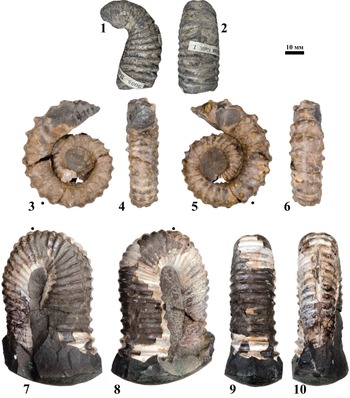
Examination of the Gabb and Anderson collections was made possible through the courtesy of Erica Clites and Dave Strauss at the University of California Museum of Paleontology (UCMP), Sara Mansfield and Peter Roopnarine at the California Academy of Sciences (CAS), and Lindsay Walker at the Natural History Museum of Los Angeles County (LACMIP). These include the holotype of Helicancylus aequicostatus (Gabb, Reference Gabb1864, pl. 13, fig. 20), the holotype of Helicancylus gabbi (see Gabb, Reference Gabb1869, pl. 25, fig. 20, 20a), and the holotype of Hamiticeras philadelphium Anderson, Reference Anderson1938 (p. 216, pl. 79, figs. 2, 3), respectively labelled UCMP.12090 (Fig. 2.1, 2.2), UCMP.4799 (Fig. 2.3–2.6), and UCMP.4797 (Fig. 2.7–2.10).
Holotypes, Budden Canyon Formation, Shasta County, northwestern California: (1, 2) UCMP.12090, Ptychoceras aequicostatus Gabb, Reference Gabb1864, 2 views; (3–6) UCMP.4799, Helicancylus gabbi Anderson, Reference Anderson1938, 4 views; (7–10) UCMP.4797, Hamiticeras philadelphium Anderson, Reference Anderson1938, 4 views. Black dots indicate the ends of phragmocones.

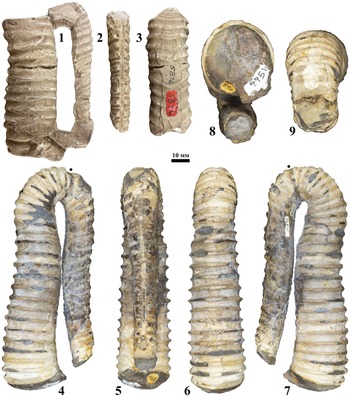
Despite an extensive search in the Californian paleontological collections, the specimen of Helicancylus aequicostatum illustrated by Anderson (Reference Anderson1938, pl. 37, figs. 2, 2a, 3) and the holotype of Hamiticeras pilsbryi (see Gabb, Reference Gabb1869, pl. 25, fig. 20a–f) could not be located. A cast of Hamiticeras pilsbryi resides in the collections of the California Academy of Sciences (CAS.5876) and is herein designed as plastoholotype (Fig. 3.1–3.3).
The specimen of Hamiticeras pilsbryi found by W.P. Popenoe and D.W. Scharf mentioned by Anderson (Reference Anderson1938, p. 216) is reposited in the Natural History Museum of Los Angeles County (LACMIP.9951-3). It is here illustrated for the first time (Fig. 3.4–3.9); a 3D, digital-model has been uploaded to: https://www.morphosource.org/Detail/MediaDetail/Show/media_id/40009. Note that a plastic mold of this specimen is included in the UCMP collection (UCMP.006402F).
Specimens from the Budden Canyon Formation of Shasta County, northwestern California: (1–3) plastoholotype CAS.5876, Hamiticeras pilsbryi Anderson, Reference Anderson1938, 3 views; (4–9) LACMIP.9951-3, Hamiticeras pilsbryi (mentioned by Anderson, Reference Anderson1938, p. 216), 6 views. Black dots indicate the ends of phragmocones.

Systematic paleontology
Order Ammonitida Haeckel, Reference Haeckel1866
Family Acrioceratidae Vermeulen, Reference Vermeulen2004 (= Helicancylidae Hyatt, Reference Hyatt1894)
Genus Helicancylus Gabb, Reference Gabb1869 (nomen nudum)
Type species
Ptychoceras aequicostatus Gabb, Reference Gabb1864 by monotypy.
Helicancylus aequicostatus Gabb, Reference Gabb1864 (nomen dubium)
Figure 2.1, 2.2
- Reference Gabb1864
Ptychoceras aequicostatus Gabb, p. 74, pl. 13, fig. 20.
- non Reference Gabb1869
Helicancylus aequicostatus; Gabb, p. 141, pl. 25, fig. 20, 20a (= Pseudoaustraliceras gabbi), fig. 20b–f, ?g (= Hamiticeras pilsbryi).
- non Reference Anderson1938
Hamiticeras aequicostatum; Anderson, p. 216, pl. 37, figs. 2, 2a. 3, pl. 79, fig. 6 (= Hamiticeras aff. H. philadelphium).
- non Reference Hanna and Hertlein1943
Hamiticeras aequicostatus; Hanna and Hertlein, fig. 61-18 (= Anderson, Reference Anderson1938, pl. 37, figs. 2, 3).
- non Reference Wright, Callomon, Howarth and Kaesler1996
Helicancylus aequicostatus; Wright et al., p. 225, fig. 174, 2a, 2b (= Anderson, Reference Anderson1938, pl. 37, figs. 2, 3).
- non Reference Avram, Bordea, Cociuba, Huza and Preda2001
Helicancylus aequicostatus; Avram et al., p. 17, pl. 1, figs. 12 (?), 13 = ‘Hamiticeras’ carcitanense (Matheron, Reference Matheron1880).
Holotype
UCMP.12090 (Frau et al., Reference Frau, Bulot and Delanoy2017).
Description
Specimen UCMP.12090 consists of a worn fragment of a flexus bearing the simple ornament typical of the Acrioceratidae.
Synonymy list
The doubtful species Helicancylus aequicostatus was reported by Anderson (Reference Anderson1938, pl. 37, figs. 2, 2a, 3, pl. 79, fig. 6) from California, but the figured specimens should be reassigned to Hamiticeras aff. H. philadelphium as defined below. The report from the northern Apuseni Mountains of Romania (Avram et al., Reference Avram, Bordea, Cociuba, Huza and Preda2001, pl. 1, figs. 12, 13) was confused with ‘Hamiticeras’ carcitanense (see discussion below).
Remarks
The holotype UCMP.12090 lacks valuable diagnostic features and prevents clear typification of Helicancylus, as well as the Helicancylidae. In line with Frau et al. (Reference Frau, Bulot and Delanoy2017), both Helicancylus and the family Helicancylidae are nomina nuda.
Genus Hamiticeras Anderson, Reference Anderson1938
Type species
Hamiticeras pilsbryi Anderson, Reference Anderson1938 by original designation.
Hamiticeras pilsbryi Anderson, Reference Anderson1938
Figure 3.1–3.3
- Reference Gabb1869
Helicancylus aequicostatus (Gabb); Gabb, p. 141, pl. 25, fig. 20b–f, ?g.
- Reference Anderson1938
Hamiticeras pilsbryi Anderson, p. 216, pl. 79, fig. 1 (= Gabb, Reference Gabb1869, pl. 25, fig. 20b–f).
- Reference Arkell, Kummel, Wright and Moore1957
Hamiticeras pilsbryi; Arkell et al., p. L212, fig. 240.3 (= Anderson, Reference Anderson1938, pl. 79, fig. 1).
- non Reference Drushchits, Drushchits and Kudriavtsev1960
Hamiticeras pilsbryi; Drushchits, p. 295, pl. 11, fig. 6a-б (= ?Acrioceratidae gen. indet. sp. indet.), fig. 7a-б (= ? ‘Hamiticeras’ carcitanense).
- Reference Wright, Callomon, Howarth and Kaesler1996
Hamiticeras pilsburyi (sic); Wright et al., p. 224, fig. 174, 2c (= Anderson, Reference Anderson1938, pl. 79, fig. 1).
- ? Reference Kakabadze and Hoedemaeker1997
Hamiticeras pilsbryi; Kakabadze and Hoedemaeker, p. 75, pl. 13, fig. 1a, b, text-fig. 10a–d.
- non Reference Avram, Bordea, Cociuba, Huza and Preda2001
Hamiticeras cf. H. pilsbryi; Avram et al., p. 17, pl. 1, fig. 11 (= Acrioceratidae gen. indet. sp. indet.).
- non Reference Kakabadze and Hoedemaeker2004
Hamiticeras pilsbryi; Kakabadze and Hoedemaeker, pl. 54, fig. 2 (= Toxoceratoides sp. indet.).
Type specimens
The species Hamiticeras pilsbryi is based on the proversum and retroversum fragment illustrated by Gabb (Reference Gabb1869, pl. 25, fig. 20b–f) and considered to be lost in the UCMP collections. The plastic mold CAS.5876 is here designated as plastoholotype of that species. The specimen LACMIP.9951-3 of W.P. Popenoe and D.W. Scharf, and its plastic mold UCMP.006402F, conforms to the plastoholotype.
Description
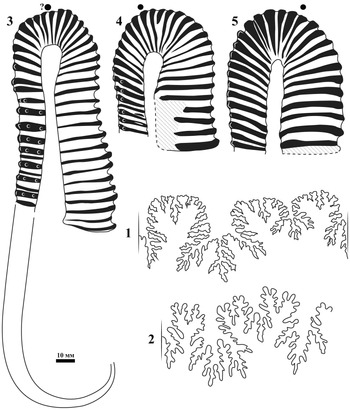
Hamiticeras pilsbryi has a toxoceratid-like shell whose inner ontogeny remains unknow. The proversum is long and slightly flexuous and followed by a gooseneck flexus and an elongated flexuous retroversum. Proversum and retroversum are almost contiguous at midheight. The proversum ornamentation develops alternating trituberculate primaries and one atuberculate intercalatory that disappear as growth increases. All of the ribs are interrupted on the venter delimiting a narrow-flattened ventral band vanishing on the flexus. The lateral tubercles are rounded and discrete on the primary ribs, whereas the external ones form indistinct clavi on the periventral area. The ornamentation changes as flat-topped simple ribs on the flexus, becoming distant and sharper, almost annular on the retroversum, and continuous over the venter. The peristome is marked by a constriction followed by a distinctive bifurcate annular rib. Based on Gabb (Reference Gabb1869, pl. 25, fig. 20g), the suture line has a subrectangular ventral lobe; a broad, rather symmetric external saddle; a deep, symmetrically trifid adventive lobe; and a narrow, bipartite lateral saddle (Fig. 4.1).
Suture lines: (1) Hamiticeras pilsbryi Anderson, Reference Anderson1938 based on Gabb (1868, pl. 25, fig. 20g); (2) Hamiticeras aff. H. philadelphium Anderson, Reference Anderson1938 based on Anderson (Reference Anderson1938, pl. 79, fig. 6). Suture lines not to scale. Diagrammatic reconstruction of Californian Hamiticeras: (3) Hamiticeras pilsbryi Anderson, Reference Anderson1938 and hypothetical general coiling; (4) Hamiticeras philadelphium Anderson, Reference Anderson1938; (5) Hamiticeras aff. H. philadelphium Anderson, Reference Anderson1938. Black dots indicate the ends of the phragmocones.

Synonymy list
Hamiticeras pilsbryi has been reported outside of California: in the northwestern Caucasus (Drushchits, Reference Drushchits, Drushchits and Kudriavtsev1960), the northern Apuseni Mountains of Romania (Avram et al., Reference Avram, Bordea, Cociuba, Huza and Preda2001) and the Boyacá district of Colombia (Kakabadze and Hoedemaeker, Reference Kakabadze and Hoedemaeker1997, Reference Kakabadze and Hoedemaeker2004).
The specimen figured by Drushchits (Reference Drushchits, Drushchits and Kudriavtsev1960, pl. 11, fig. 6a-б) is a rather complete acrioceratid lacking the spire. Its general coiling mimics that of Hamiticeras pilsbryi, but it can be easily differentiated by its rounded whorl section in the adult lacking ventral rib interruption. The other specimen of Drushchits (Reference Drushchits, Drushchits and Kudriavtsev1960, pl. 11, fig. 7a-б) is a large retroversum fragment that has affinities with ‘Hamiticeras’ carcitanense (see discussion below).
The Romanian specimen consists of a poorly preserved flexus fragment of doubtful identification.
The Colombian form figured by Kakabadze and Hoedemaeker (Reference Kakabadze and Hoedemaeker1997, pl. 13, fig. 1a, b) is a large flexus and retroversum fragment that very closely matches Hamiticeras pilsbryi. The lack of proversum prevents further confirmation. The other specimens figured by Kakabadze and Hoedemaeker (Reference Kakabadze and Hoedemaeker2004, pl. 54, fig. 2) resemble the Colombian species Hamiticeras chipatai Kakabadze and Hoedemaeker, Reference Kakabadze and Hoedemaeker1997, but its general coiling, regular alternation of trituberculate and atuberculate ribs on the proversum, becoming atuberculate, cuneiform then flat-topped over the venter through the retroversum better compare with the upper Aptian Toxoceratoides representatives (e.g., Frau et al., Reference Frau, Bulot and Delanoy2017; Bulot et al., Reference Bulot, Frau and Pictet2018).
Remarks
Hamiticeras pilsbryi retains the general features of the Acrioceratidae, viz. small heteromorphic shell with tripartite coiling and simplified ornamentation on the retroversum (e.g., Vermeulen, Reference Vermeulen2004; Bulot et al., Reference Bulot, Frau and Pictet2018). The closest affinities are found with the genus Toxoceratoides Spath, Reference Spath1924 (type species Toxoceras royerianus d'Orbigny, Reference Orbigny1842). Toxoceratoides encompasses small to medium-sized taxa that differ from Hamiticeras by their toxoceratid coiling with a shorter retroversum; slightly depressed, subrounded to octagonal whorl section in the adult; and generally the following ornamental stages: (1) atuberculate annular simple ribs; (2) alternation of a variable number of thin, slightly prorsiradiate, intercalate ribs and trituberculate primary ribs that interrupt on the venter; and (3) loss of lateral and ventral tubercles; and sharp, radial, narrow single ribs, sometimes originating by twos or threes from tubercles on the dorsal shoulder (Bulot et al., Reference Bulot, Frau and Pictet2018). The Toxoceratoides suture line differs from that of Hamiticeras pilsbryi by its narrow, asymmetric external saddle and broader bipartite lateral saddle (compare Bulot et al., Reference Bulot, Frau and Pictet2018, fig. 2F).
Of major interest is the end of the phragmocone at the transition between the proversum and the flexus in Hamiticeras pilsbryi and other Hamiticeras taxa described below. This long phragmocone is rather unique for the Acrioceratidae. In comparison, the end of phragmocone most commonly occurs in the upper proversum in Toxoceratoides (e.g., Bulot et al., Reference Bulot, Frau and Pictet2018). For the above-mentioned reasons, Hamiticeras should be retained as a separate Acrioceratidae genus.
Hamiticeras philadelphium Anderson, Reference Anderson1938
Figure 2.7–2.10
- Reference Anderson1938
Hamiticeras philadelphium Anderson, p. 216, pl. 79, figs. 2, 3.
- non Reference Föllmi1989
Hamiticeras philadelphium; Föllmi, p. 122, pl. 4, figs. 2, 3 (= Acrioceratidae gen. indet. sp. indet.).
- ? Reference Kakabadze and Hoedemaeker2004
Helicancylus cf. H. philadelphium; Kakabadze and Hoedemaeker, p. 77, pl. 64, fig. 2a–c.
Holotype
UCMP.4797 (Anderson, Reference Anderson1938).
Description
The holotype UCMP. 4797 develops a moderately straight upper proversum, a gooseneck flexus, and an elongated retroversum. Its general adult coiling thus rather compares to that of Hamiticeras pilsbryi, but the species differs by its ribbing style because it develops prorsiradiate ribs with discrete thickenings in the upper lateral and periventral margins along part of the proversum. The specimen referred to as Hamiticeras aequicostatum by Anderson (Reference Anderson1938, pl. 37, figs. 2, 2a, 3) closely resembles Hamiticeras philadelphium, by its coiling and long phragmocone, but it differs in its proversum ornament lacking upper lateral tubercles. This specimen is here referred to as Hamiticeras aff. H. philadelphium. Both species have a long phragmocone ending at the transition between the proversum and the flexus. The suture line of Hamiticeras aff. H. philadelphium illustrated by Anderson (Reference Anderson1938, pl. 79, fig. 6) is similar to that of Hamiticeras pilsbryi drawn by Gabb (Reference Gabb1869, pl. 25, fig. 20g), although marked by a simpler external saddle and a narrower, less symmetrical bipartite lateral saddle (Fig. 4.2).
Synonymy list
Hamiticeras philadelphium has been reported outside of California: the Helvetic nappes (Föllmi, Reference Föllmi1989, pl. 4, figs. 2, 3), and the Boyacá district of Colombia (Kakabadze and Hoedemaeker, Reference Kakabadze and Hoedemaeker2004, pl. 64, fig. 2a–c). The specimens from the Helvetic nappes are based on a poorly preserved acrioceratid fragment of doubtful identification wheras the Colombian specimen is rather convincing.
Remarks
The Californian Hamiticeras taxa differ in ornamental style on the proversum either marked by trituberculate (Hamiticeras pilsbryi, Fig. 4.3), bituberculate (Hamiticeras philadelphium, Fig. 4.4), or unituberculate ribs (Hamiticeras aff. H. philadelphium, Fig. 4.5). Those ornamental styles can be used for specific identification. However, this can also illustrate intraspecific variabilities but the low number of specimens and poorly resolved stratigraphy prevent further confirmation.
Family Ancyloceratidae Gill, Reference Gill1871
Genus Pseudoaustraliceras Kakabadze, Reference Kakabadze1981
Type species
Crioceras ramososeptatum Anthula, Reference Anthula1900 by original designation.
Pseudoaustraliceras gabbi Anderson, Reference Anderson1938
Figure 2.3–2.6
- Reference Gabb1869
Helicancylus aequicostatus (Gabb); Gabb, p. 141, pl. 25, fig. 20, 20a.
- Reference Anderson1938
Helicancylus gabbi Anderson, p. 222, pl. 79, figs. 4, 5 (= Gabb, Reference Gabb1869, pl. 25, fig. 20, 20a).
Holotype
UCMP.4799 (Anderson, Reference Anderson1938).
Description
The holotype corresponds to a moderately-sized, dextral, open, descending spiral. The end of the calcified phragmocone is in the outer whorl. The ornamentation is composed of two distinct stages: (1) strong, rectiradiate single ribs that progressively change into (2) distant, robust trituberculate ribs with strong spiny tubercles.
Synonymy list
There are no other citations of Pseudoaustraliceras gabbi in the literature.
Remarks
Specimen UCMP.4799 cannot be the spire of a U-shaped acrioceratid ammonoid because it is almost complete. Aguirre-Urreta (Reference Aguirre-Urreta1986) compared Helicancylus gabbi to the ancyloceratid Kutatissites Kakabadze, Reference Kakabadze1970, the helicoidally coiled inner whorls of which resemble the species (e.g., Kakabadze, Reference Kakabadze1970; Stoykova, Reference Stoykova1992; Delanoy et al., Reference Delanoy, Ropolo, Gonnet and Ebbo2000). The genus flourished within the Barremian/Aptian boundary interval in the Mediterranean Tethys, and extends into the upper lower Aptian in Colombia (= Dufrenoyia sanctorum-Stoyanowiceras treffryanus Biozone of Etayo-Serna, Reference Etayo-Serna1979, Reference Etayo-Serna1983). In this zone, Etayo-Serna (Reference Etayo-Serna1983) reported Pseudoaustraliceras columbiae (Basse, Reference Basse1928), the inner whorls of which have a “coiling elliptical in one more or less inclined plane” (Etayo-Serna, Reference Etayo-Serna1983, p. 7) and bear the two similar ornamental stages of Helicancylus gabbi described above. The presence of a helicoidally spiral in the inner whorls of Pseudoaustraliceras is observed in many upper Aptian taxa from the Tethys and the Pacific Coast, notably in the widespread species group Pseudoaustraliceras ramososeptatum (Anthula, Reference Anthula1900) – Pseudoaustraliceras pavlowi Wassiliewsky, Reference Wassiliewski1909 (see, e.g., Kakabadze and Hoedemaeker, Reference Kakabadze and Hoedemaeker2004, pl. 66, fig. 1). For these reasons, specimen UCMP.4799 could correspond to the helicoidally coiled inner whorls of a Pseudoaustraliceras species. Helicancylus gabbi is, therefore, transferred to the Ancyloceratidae and referred to Pseudoaustraliceras gabbi. The presence of Pseudoaustraliceras in the Aptian of California remains unknown to date. However, the taxonomy of two ancyloceratids from Shasta County, e.g., Tropaeum percostatum (Gabb, Reference Gabb1864) and Australiceras argus, are indeed in need of revision because both taxa better conform to the original understanding of Pseudoaustraliceras given by Kakabadze (Reference Kakabadze1981).
Discussion
Specific content of Hamiticeras
In the Fossilium Catalogus, Klein et al. (Reference Klein, Busnardo, Company, Delanoy, Kakabadze, Reboulet, Ropolo, Vašiček, Vermeulen and Riegraf2007) listed seven species of Hamiticeras. Their validity and taxonomic assignment are discussed below:
Hamiticeras aliensis Lobjanidze, Reference Lobjanidze1972 is a nomen nudum according to ICZN Art. 13.1 (ICZN, 1999) because it does not meet the requirements for a species designation for material published after 1930 (Klein et al., Reference Klein, Busnardo, Company, Delanoy, Kakabadze, Reboulet, Ropolo, Vašiček, Vermeulen and Riegraf2007).
Anisoceras carcitanense Matheron, Reference Matheron1880 was introduced on the basis of a large retroversum fragment from the Aptian of Cassis, southern France (Matheron, Reference Matheron1880, pl. D-25, fig. 2). The species was transferred to Hamiticeras by Conte (Reference Conte1995) and Vermeulen et al. (Reference Vermeulen, Thieuloy and Lapeyre1999), but many individuals of that species were commonly confused with Californian taxa in the literature (see synonymy lists above). The species is under revision thanks to the collection of new topotypes, and it seems that the species can hardly be accommodated into Hamiticeras due to its larger size; simple, uniform, denser ribbing crossing the venter through most of the proversum; and smooth ribs in the flexus and retroversum. It is herein referred to ‘Hamiticeras’ carcitanense pending revision.
The Hauterivian species Hamiticeras crevolai Vermeulen, Thieuloy and Lapeyre, Reference Vermeulen, Thieuloy and Lapeyre1999 was selected as the type species of Monodites Bert, Reference Bert2009, the latter typifying the monogeneric family Monoditidae Bert, Reference Bert2009 from the upper Hauterivian of southeastern France.
Finally, the taxa Hamiticeras chipatai, Hamiticeras longus Kakabadze and Hoedemaeker, Reference Kakabadze and Hoedemaeker2004, and Hamiticeras ventrotuberculatum Kakabadze and Hoedemaeker, Reference Kakabadze and Hoedemaeker2004 form a closely allied group of species from the ‘middle’ Aptian of Colombia. Those species compare well to Hamiticeras and can be distinguished from one another by varying lengths of the proversum and ornaments. After a juvenile stage made of simple ribs, the Colombian species either develop alternating thin atuberculate intercalatories and strong trituberculate (Hamiticeras chipatai), bituberculate (Hamiticeras longum), or unituberculate primaries (Hamiticeras ventrotuberculatum) along the proversum. Such variability mimics that observed in Californian Hamiticeras. However, differences are seen in the extension of intercalatories up to the upper proversum, and an early termination of the phragmocone at this stage (see e.g., Kakabadze and Hoedemaeker, Reference Kakabadze and Hoedemaeker1997, pl. 13, fig. 2a–d; Reference Kakabadze and Hoedemaeker2004, pl. 54, fig. 2a, b).
Origin of Hamiticeras
The plexus of Colombian Hamiticeras—namely Hamiticeras chipatai, Hamiticeras longus, and Hamiticeras ventrotuberculatum—have a mixture of features of Toxoceratoides and Hamiticeras. It is tempting to consider that Mediterranean Toxoceratoides and northern Pacific Hamiticeras could be phyletically linked through this plexus of Colombian species. Note that some fragmented Hamiticeras individuals are known in the lower upper Aptian of the Caribbean domain (e.g., Moreno-Bedmar et al., Reference Moreno-Bedmar, Casados-Monroy, Frau, Pictet, Chávez Cabello and Esquivel-Macías2018), which could indeed correspond to the area of inception of Hamiticeras.
Conclusions
Revision of the types of Ptychoceras aequicostatus invalidates the genus Helicancylus and thus the family Helicancylidae. Anderson's (Reference Anderson1938) taxon Helicancylus gabbi is transferred to Pseudoaustraliceras. The Acrioceratidae should be used as a valid substitute. Designation of a plastoholotype of Hamiticeras pilsbryi supports the separate use of Hamiticeras for grouping the plexus Hamiticeras pilsbryi, Hamiticeras philadelphium, and Hamiticeras aff. H. philadelphium from California, and Hamiticeras chipatai, Hamiticeras longus, and Hamiticeras ventrotuberculatum from of Colombia. Hamiticeras has the closest affinities with Toxoceratoides, but its toxoceratid-like coiling with a gooseneck flexus and an elongated flexuous retroversum, a long phragmocone extending up to the lower flexus, and a suture line with a rather symmetric external saddle and a narrow, bipartite lateral saddle are diagnostic features to be used to identify that genus. The presence/absence of intercalatories on the proversum is variable in both genera, and this cannot be used as a reliable diagnostic parameter. A phyletic link between Toxoceratoides and Hamiticeras is hypothesised but is in need of further investigation.
Acknowledgments
We are grateful to E. Clites and D. Strauss (UCMP), S. Mansfield and P. Roopnarine (CAS), and L. Walker (Los Angeles) for providing pictures of the type and figured specimens under their care. J.-M. Pacaud provided help with Latin names. We appreciate the constructive comments of the editor P. Harries (Tampa, Florida), B. Aguirre-Urreta (Buenos Aires), and an anonymous reviewer.
Declaration of competing interests
The authors declare that they have no conflicts of interest to disclose.