1. Introduction
Is natural selection a mechanism? This question is the subject of recent discussion in the philosophical literature. Skipper and Millstein (Reference Skipper and Millstein2005) argue that it is not. Barros (Reference Barros2008) replies that it is. This discussion exposes and evaluates a succession of problems for Barros's account: first, it is incomplete; second, even once it is filled in, the account does not characterize natural selection but instead describes any selective process; third, the account is not mechanistic. In other words, the proposed mechanism of natural selection neither describes natural selection nor is a mechanism. It is argued that these problems are a product of the variability inherent within natural selection. The discussion concludes with an examination of the motivations for providing a mechanistic account of natural selection and advises against further attempts.
The analysis of how to represent natural selection is historically and practically as well as philosophically motivated. In the first edition of Origin, Darwin explicitly calls natural selection an action (Reference Darwin1859/1964, 90, 108, 129, 133, 211), a doctrine (5, 95), a means (6, 246), a power (43, 109, 205, 238, 454), a principle (80, 95, 116, 127, 188, 206, 239, 475), a process (93, 104, 109, 179, 203, 235, 280, 350), and a theory (237, 245, 281, 320, 325, 338, 345, 460, 462, 472, 474, 478); he never calls it a mechanism. There is uncertainty about the meaning of natural selection from the moment of its conceptualization. The passage of time since 1859 has added to rather than detracted from the list of potential characterizations. Natural selection is also called an agent,Footnote 1 an algorithm (see, e.g., Dennett Reference Dennett1996), a cause (see, e.g., Stephens Reference Sober2004), a concept (see, e.g., Mayr's introduction to Origin; Darwin Reference Darwin1859/1964, xvi), a consequence (see, e.g., Brunnander Reference Brunnander2007), a force (see, e.g., Mayr's introduction to Origin: Darwin Reference Darwin1859/1964, xvi, xvii; see also Sober Reference Stephens1984), an idea (see, e.g., Dawkins Reference Dawkins1986), and, of course, a mechanism (see, e.g., Mayr's introduction to Origin: Darwin Reference Darwin1859/1964, viii, xv, xxv). Since these terms are not generally considered synonymous, the idea that natural selection somehow manages to be all of them strains credulity. So, what is natural selection? This discussion hopes to clarify the situation, by examining natural selection alongside one of the candidate identifiers (mechanism) and determining whether natural selection can be accurately referred to in that way (as a mechanism).
2. Prior Debate
Skipper and Millstein (Reference Skipper and Millstein2005) argue that natural selection is not a mechanism in the sense of the new mechanistic philosophy, despite the fact that it initially seems like a plausible candidate. The authors state that “the new mechanistic philosophy has the broad aim of building a philosophical framework for understanding the nature and role of mechanisms in science. And our aim is to determine whether natural selection can be adequately described within that framework. We argue that it cannot” (328). To make this argument, Skipper and Millstein first articulate a conception of natural selection, then examine two dominant conceptions of mechanism from the new mechanistic philosophy, and finally demonstrate why the former does not fit with either of the latter.
The first of the two conceptions of mechanism is from Glennan:
A mechanism for a behavior is a complex system that produces that behavior by the interaction of a number of parts, where the interactions between parts can be characterized by direct, invariant, change-relating generalizations. (Reference Glennan2002, S344)
The second is from Machamer, Darden, and Craver (hereafter MDC):
Mechanisms are entities and activities organized such that they are productive of regular changes from start-up or set-up to finish or termination conditions. (Reference Machamer, Darden and Craver2000, 3)
But neither of these conceptions of mechanism fit with natural selection, according to Skipper and Millstein. This is because the authors discover three problems for describing natural selection as a mechanism. These are the problems of organization, productive continuity, and regularity: “We argue that natural selection is not organized in the ways Glennan or MDC argue, that productive continuity between its stages is captured neither by Glennan's ‘interactions’ nor by MDC's ‘entities’ and ‘activities’, and that natural selection is not ‘regular’ in the way that MDC claim” (Skipper and Millstein Reference Skipper and Millstein2005, 335).
Barros (Reference Barros2008) responds to each of Skipper and Millstein's problems while explaining his account of the mechanism of natural selection. Barros defines natural selection as:
A two-level, multistage stochastic mechanism that explains the phenomenon of adaptation. It is two-level because the phenomenon of adaptation cannot be fully explained using either individual or population level mechanisms alone. (318)
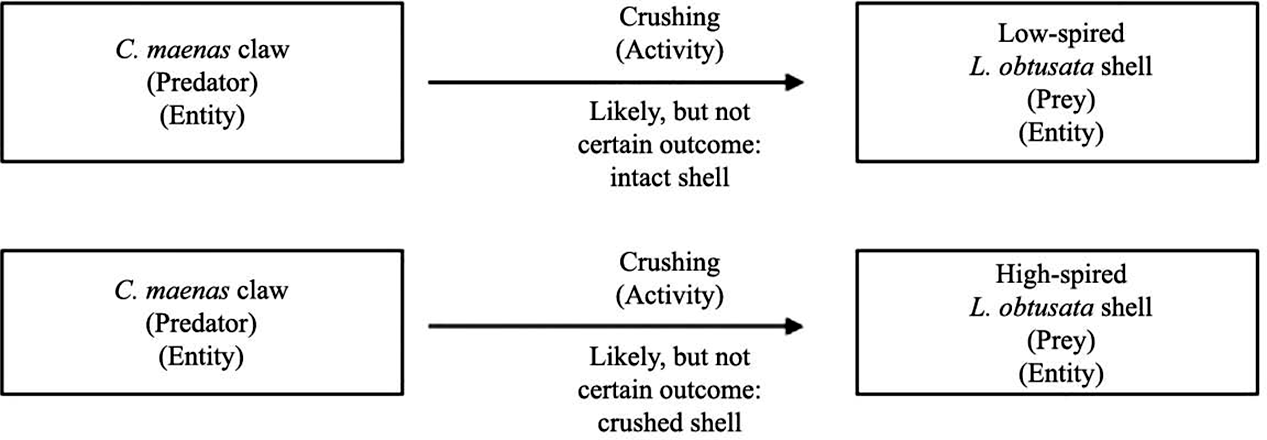
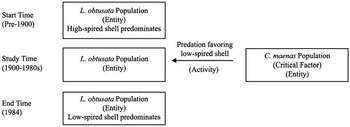
The argument for this account is offered in two stages. First, Barros describes the mechanism acting in a specific case of natural selection, aided by a pair of diagrams (see figs. 1 and 2).Footnote 2 As the quote above makes clear, Barros's position is that natural selection is a two-level mechanism. Together, figures 1 and 2 depict the mechanism of natural selection in a specific case acting at both of its levels. The case is that of predatory crabs (C. maenas) selecting for shell shape in a population of intertidal snails (L. obtusata). There are high-spired shells and low-spired shells within the population of intertidal snails, and because crab predation is more successful on the high-spired shells, selective pressure leads to the gradual adoption of low-spired rather than high-spired shells.
Individual level of the mechanism of natural selection in a specific case (adapted from Barros Reference Barros2008, 315).

Population level of the mechanism of natural selection in a specific case (adapted from Barros Reference Barros2008, 316).

Figure 1 depicts natural selection acting at the individual level in the specific case of intertidal snail predation; figure 2 depicts natural selection acting at the population level in this case. Together, these two diagrams are supposed to represent the mechanism of a particular case of natural selection, but this is not equivalent to a mechanistic account of natural selection in general. Obviously, natural selection is not restricted to intertidal snails, and selection processes do not only occur via crab predation.
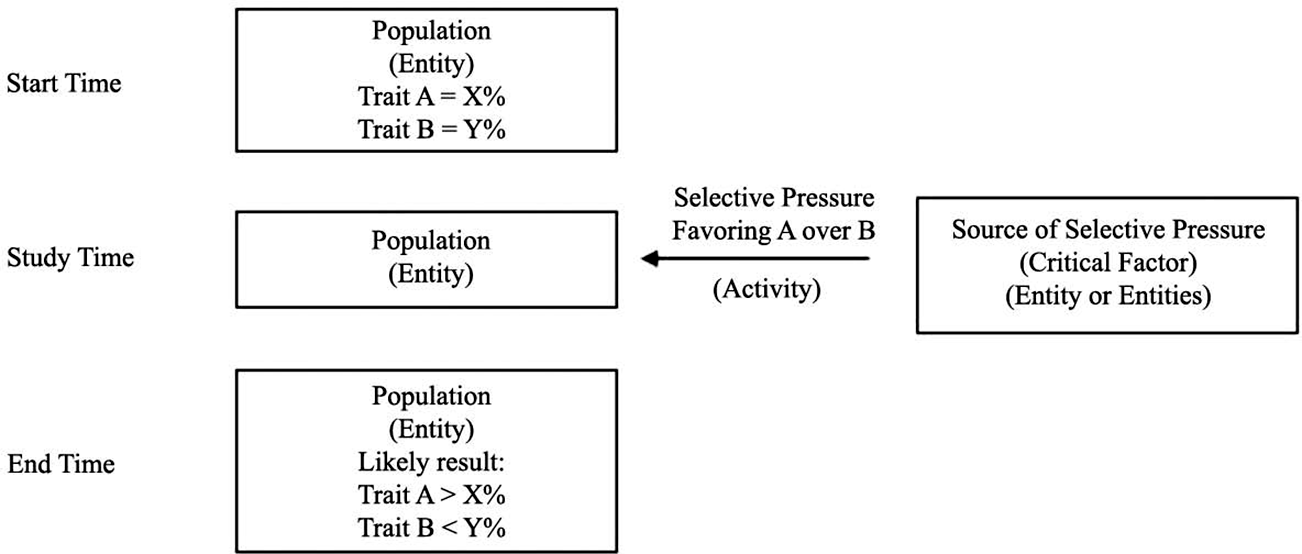
Barros realizes this, and thus the second stage of his argument is to describe natural selection in general. To do this, he adjusts the previous diagram (fig. 2), which depicted natural selection acting at the population level, so that it is no longer specific to a particular population (fig. 3). Barros concludes that he has resolved the difficulties raised by Skipper and Millstein and successfully described the mechanism of natural selection.
Population level of the mechanism of natural selection in general (adapted from Barros Reference Barros2008, 318).

3. Problems for Barros's Account of Natural Selection as a Mechanism
Barros, however, never describes what the individual-level mechanism of generalized natural selection looks like. His definition of the mechanism of natural selection states that natural selection is a two-level mechanism that “cannot be fully explained using either individual or population level mechanisms alone” (Reference Barros2008, 318). Barros depicts both the individual and the population levels when providing an account of the mechanism of natural selection in the specific case of intertidal snail predation, but when providing an account of natural selection in general, he depicts only the population level. By his own stipulation, Barros has not fully explained his account of the mechanism of natural selection.
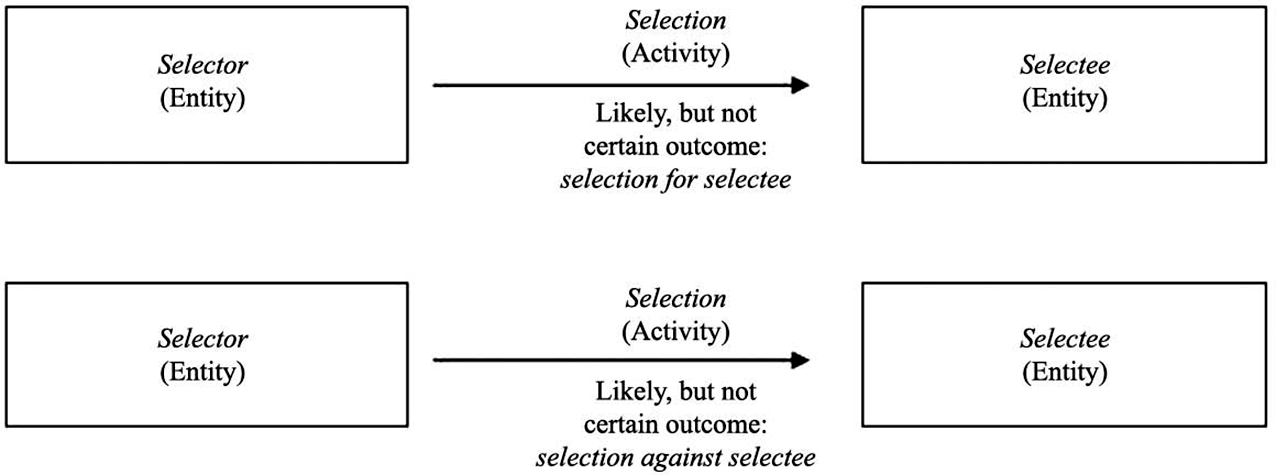
Perhaps this can be easily remedied. Figure 1 shows what the individual level mechanism of the specific case of natural selection among intertidal snails looks like; that diagram might be generalized in the same way figure 2 was generalized to create figure 3. But figure 4 reveals that Barros's mechanistic account of generalized natural selection, even when depicted at both the population and the individual levels, does not characterize the mechanism of natural selection. This is because it is so general that it no longer describes natural selection in particular. Instead, the account describes any selective process: it is satisfied by someone reaching their hand into a bowl of marbles and picking out black ones instead of red ones, for instance. The mechanisms of the new mechanistic philosophy usually include more detail than this, and for good reason. More detail is required in order to specifically characterize the phenomenon of interest.
Individual level of the mechanism of natural selection in general.

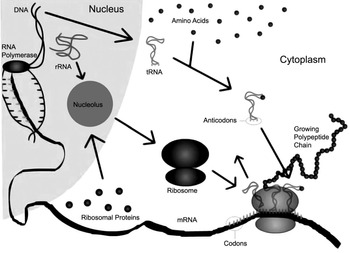
Contrast the ambiguity of Barros's mechanism of natural selection with a more typical example of a mechanism, that of gene expression (fig. 5). This diagram is specific to gene expression: the entities in particular are so specific as to make the diagram impossible to interpret as a depiction of anything other than gene expression. The diagram characterizes the relevant mechanism and only that particular mechanism. But perhaps the mechanism of natural selection is simply undeveloped at this stage. As discussed by Darden and Craver (Reference Darden and Craver2002), the original mechanism of gene expression was just a schema or a sketch:

Subsequent work allowed for schema instantiation, eventually producing the degree of understanding reflected in the enhanced diagram (fig. 5). It is possible that, like the mechanism of gene expression, the mechanism of natural selection will progress via schema instantiation.
Mechanism of gene expression (adapted from Darden Reference Darden2005, 365).

But gene expression is not analogous to natural selection. For one, schema instantiation occurred in the case of gene expression as the field of genetics matured. The original schema or sketch comes from the field's infancy; as technology developed and knowledge accrued, research progressed in ways that led to more detailed descriptions of the components of the mechanism as well as to accounts of what precisely the arrows between these components represented. Acquisition of information produced schema instantiation. However, current evolutionary theory is not a field in the early stages of its development, as gene expression was when it could only provide a schema or a sketch. Evolutionary theory is already a mature field with a long and detailed history, and it is not a lack of information that prevents schema instantiation in the case of natural selection.
Rather, it is variation that prevents it. This variation represents another point of substantial disanalogy with the case of gene selection. Consider several paradigmatic cases of natural selection: finches whose beak size varies with seed size for ease of foraging, peppered moths whose coloration varies with local backgrounds to assist with camouflage, and bacterial strains whose genes mutate in response to antibiotics in order to develop resistance. Add Barros's case of intertidal snails whose shell shape varies with crab predation in order to decrease the likelihood of crushing, and there is already far more variation within the proposed mechanism of natural selection than there is among cases of gene expression. Radical simplification of the evolutionary story in each case permits identification of the various components as snails, crabs, birds, seeds, moths, light on trees in the presence of predating birds, cells, and antimicrobial compounds. These components are also doing a variety of things, including crushing, foraging, camouflaging, and mutating or developing resistance. Since these cases are just a fraction of the number of instances of natural selection that have actually occurred, the variation among them is miniscule in comparison to the variation within natural selection in general. But there is already enough variation in these cases to demonstrate the difference between natural selection and gene expression.
Natural selection is less like gene expression and more like respiration. Gene expression is a biological phenomenon caused by a relatively uniform mechanism. The relevant entities (to use MDC's terminology) or parts (to use Glennan's) are DNA, RNA, and protein. The relevant activities (MDC) or interactions (Glennan) are transcription and translation. Although there are different strands of DNA (as well as different kinds of RNA and different proteins), each of these groups has ways of being identified beyond its role in the expression of genes. For example, all DNA is composed of certain nucleic acids. So is RNA. All proteins are chains of amino acids. So, the entities/parts involved are specific and identifiable things. The activities/interactions are similarly specific and identifiable: transcription and translation are processes that are realized in very similar ways in each case of gene expression, and these processes can be described in ways beyond that of their functional role in gene expression.
Respiration, however, is a biological phenomenon that occurs via several different mechanisms. Mammals use lungs; fish use gills; insects use spiracles. Each of these methods of respiration is realized via its own complex mechanism, and there is no purported account of a general mechanism of respiration. What would its entities/parts and activities/interactions be? The respirator, the respiratee, and the act of respiring? Barros's attempt to mechanistically characterize generalized natural selection produces similar entities/parts and activities/interactions: there are simply sources of selective pressure, populations of selected entities, and selection activity. In both the natural selection and the respiration cases, the entities/parts and activities/interactions are identified only by their role in the putative mechanism. And in both cases, it is unclear what the generalized mechanism refers to or explains. At best, Barros's account is characteristic of any selective process, rather than natural selection in particular. This ambiguity is demonstrated by the fact that the described and depicted mechanism pertains to a person selecting a certain color of marble or a sieve retaining a certain size of particle, and many other selective processes, just as easily as it refers to a natural selection.
A description of the mechanism of natural selection would explain the phenomenon of adaptation by natural selection, but what the provided account explains is selection in general rather than natural selection in particular, and these kinds of explanation are importantly distinct. Offering an account of selection-type processes as though it is the same thing as an account of natural selection in particular is like offering an account of unregulated cell growth as an account of melanoma. Melanoma is a cancer, of course, but it is a specific kind of cancer, and the mechanism that explains cancer in general insufficiently explains melanoma in particular. In both of these cases, there are two different accounts, one of which explains a wider range of phenomena (selective processes and cancer) than the other (natural selection and melanoma). Explanation of a group of phenomena is not equivalent to explanation of a particular member of the group.
The argument is that, if the description of a mechanism purporting to explain a particular phenomenon covers a host of other processes, then the account is insufficient as an explanation of the particular phenomenon of interest. Barros's mechanistic account of natural selection in general does not pick natural selection out from among other selection-type processes, and thus it is insufficient as an explanation of the particular phenomenon of adaptation by natural selection. The problem arises from the fact that, in order to unite the extreme variability among all of the specific cases of natural selection in different populations, a degree of abstraction is required such that the generalized account no longer precisely characterizes natural selection but rather describes any selective process. This is not a temporary but instead a persistent problem for natural selection.
4. Problems for Any Account of Natural Selection as a Mechanism
The fact that a generalized account of natural selection basically characterizes any selective process has been noticed before. Darden and Cain (Reference Darden and Cain1989) discuss abstract characterization and selection-type processes. After exploring the concepts of abstraction and natural selection, the authors construct an abstract characterization of natural selection. Then Darden and Cain demonstrate that the abstraction of natural selection also characterizes two other selective processes (clonal selection theory for antibody formation and selectionist accounts of neural connectivity), with very little revision: “The abstraction extracted from the characterizations for natural selection proved of sufficiently high order for the immunology and neuronal cases, except that the longer-range effects weren't necessarily reproduction. A disjunction, such as ‘reproduction or amplification or reinforcement,’ might serve unless some more abstract term for these payoffs can be found” (124–25). In other words, the degree of abstraction required to represent the process of natural selection just about suffices to represent other processes of selection as well. In order for Darden and Cain's abstract account of natural selection to capture selective processes in general, the only adjustment required is due to their mention of a particular activity (reproduction), which the authors must then expand to encompass other activities (amplification and reinforcement).
In fact, the particular mention of reproduction makes Darden and Cain's abstract account of natural selection more specific than Barros's proposed mechanistic account. Barros's account simply mentions selective pressure as the relevant activity—nothing as specific as reproduction is incorporated—so no adjustments are required to alter his account from a description of natural selection in particular to selective processes in general. But Barros's failure to describe the mechanism of natural selection does not entail that it would be impossible to provide a better account. In particular, this discussion suggests that natural selection might be well characterized as an abstract mechanism.
When Darden and Cain (Reference Darden and Cain1989) create an abstract account of natural selection and then use it and other selection-type theories in order to construct an abstract account of selective processes, they are providing a schema for selection-type theories of which natural selection, clonal selection, and selective theories of brain function are then instantiations. There is a hierarchy of relations: at the level of selection-type theories, there is a schema, and this is instantiated by natural selection, clonal selection, and other examples of selection-type theories. But that instantiation of natural selection is also a schema, which can be instantiated by different kinds of natural selection, such as genic, organismic, and perhaps group selection.
Barros has shown that what Darden and Cain called a ‘first order abstraction’, organismic selection, can itself be instantiated by a specific case of natural selection in a population of organisms, such as the intertidal snail population. At the lowest level, that instantiation is also a schema that can itself be instantiated at the object level. Natural selection of shell shape via crab predation at the population level is a schema for a certain kind of predator-prey interaction in a pair of actual populations (intertidal snails and crabs). This schema is instantiated in each individual interaction: an instance of one actual crab successfully preying on an actual snail with a high-spired shell and unsuccessfully preying on an actual snail with a low-spired shell is an instantiation of the schematic outline of the individual level of the specific case of natural selection of snail shell shape via crab predation.
Schemas and instantiations exist at different levels of abstraction in scientific theories, and what is a schema at one level of abstraction can be an instantiation of another schema at a higher level. In other words, there is a hierarchy of schemas and instantiations, and abstraction occurs at every level above that of the individual objects. But where are the mechanisms? Both MDC's and Glennan's definitions stipulate that mechanisms must have entities/parts and activities/interactions. Given these stipulations, mechanistic accounts might be provided at the levels of objects and specific cases of natural selection. At both of these levels, there are specifiable entities/parts and activities/interactions. But proceeding up the hierarchy of levels, the next degree of abstraction becomes far more problematic as a candidate for mechanism. In order to capture the variety inherent within generalized natural selection, the schema at this level of abstraction refers at best to selectees, selectors, and selection pressure. Barros's description of natural selection at this level includes neither a specifiable set of parts or entities nor a particular group of interactions or activities; rather, it encompasses an unspecified host of things and an undetermined variety of behaviors. Natural selection at this level does not satisfy the requirements of mechanism.
The amount of abstraction required to describe natural selection was not a serious problem for Darden and Cain, who were trying to provide an account of selection-type theories. And they considered natural selection to be a process. But the degree of abstraction is a significant problem for Barros, now attempting to characterize natural selection as a mechanism. The primary goal of the new mechanistic philosophy is to identify and describe cases in which the sciences explain the production of a particular phenomenon via a particular mechanism. This goal is reiterated throughout descriptions of the new mechanistic philosophy. For example, MDC emphatically state that “mechanisms are sought to explain how a phenomenon comes about or how some significant process works” (Reference Machamer, Darden and Craver2000, 2). To classify natural selection as a mechanism, despite its inherent variability and the corresponding degree of abstraction required to describe it, would require mechanists to substantially alter the aims of their project.
But this is unnecessary. Better to leave mechanism as is and simply acknowledge the incompatibility with natural selection. Mechanisms are incredibly powerful tools that explain phenomena by answering “how” questions: such as, how does it work? Descriptive accounts of phenomena pertain to “what” questions instead: for instance, what is it? Barros's generalized account of natural selection merely describes the phenomenon. How natural selection works can get filled in with a mechanistic account but only by moving to the individual case. At the general level, natural selection is an abstract process without the entities/parts and activities/interactions characteristic of a mechanism.
5. Conclusion
The consideration of natural selection as a mechanism began for several reasons. For one, natural selection is often called a mechanism. As Skipper and Millstein put it, “Discussion of natural selection as a mechanism is pervasive in evolution” (Reference Skipper and Millstein2005, 328).Footnote 3 For another, both natural selection and mechanism are fundamental, dominant, and popular concepts within biology and philosophy of biology, and the possibility of unification is an enticing one. Barros's concluding declaration is that “natural selection can be characterized as a two-level, multistage stochastic mechanism that explains the phenomenon of adaptation. This example highlights the flexibility of mechanistic explanation” (Reference Barros2008, 321). This seems like a triumph for the new mechanistic philosophy.
But the argument of this discussion is that Barros's mechanistic account of natural selection fails to sufficiently describe the phenomenon of interest. Further, natural selection in general—although it might be mechanistic in specific instances—covers a wide range of processes for which it is not possible to give a single mechanistic account in the new mechanistic philosophy's sense of the term ‘mechanism’. Finally, expanding the concept of mechanism to allow the level of abstraction necessary for natural selection is contrary to the aims of the new mechanistic philosophy. The mechanists are committed to specifying entities/parts and activities/interactions, and this is a substantial part of what makes mechanist accounts so powerful: they are tied to specific phenomena and the particular ways in which those phenomena are produced.
What could explain the fact that natural selection is often called a mechanism? This discussion has shown that the term ‘natural selection’ can refer to, at the least, (1) individual instances at the object level, (2) specific cases at the population level, and (3) various selective processes acting among organisms and populations. Both 1 and 2 are kinds of natural selection that are well characterized mechanistically, and this explains the frequent description of natural selection as a mechanism. But 3 is not well characterized mechanistically.