Implications
There is increasing concern about accommodating beef cattle on fully slatted concrete floors. The effect of adding rubber to slatted floors on animal intake and performance is unclear from previous studies. The results of this study indicate a higher performance in cattle accommodated on rubber covered slats compared to those accommodated on concrete slats. The effect of floor type on performance is influenced by the diet offered and in particular bulls offered a high concentrate diet had a higher ad libitum intake of concentrates when accommodated on rubber covered slats compared to those accommodated on concrete slats.
Introduction
The Royal Society for the Prevention of Cruelty to Animals (RSPCA) amended their welfare standards for beef cattle in 2010, stating that ‘fully slatted systems without bedding are prohibited’ (2010). If these standards were implemented on all beef farms it has potential to have massive implications for the beef industry, particularly in areas where the lack of straw makes it economically prohibitive to use as a bedding substrate. While there is a clear preference for finishing beef steers to choose to both lie and stand on bedded substrates such as straw and sawdust over concrete slats, these animals have also been shown to prefer to both lie and stand on perforated rubber mats or strips of rubber attached directly over concrete slats compared with fully slatted concrete floors (Lowe et al., Reference Lowe, Steen and Beattie2001a). Moreover, it must be taken into account that preference tests simply give a measurement of relativity of preference for each floor type in the short term, but do not give an indication of an actual measure of the longer-term welfare of the animal on each system. The effect of accommodating beef cattle on fully slatted concrete floors and potential alternative floor types have been researched over the past two decades (Lowe et al., Reference Lowe, Steen, Beattie and Moss2001b; Absmanner et al., Reference Absmanner, Rouha-Mulleder, Scharl, Leisch and Troxler2009; Brscic et al., Reference Brscic, Ricci, Prevedello, Lonardi, De Nardi, Contiero, Gottardo and Cozzi2015b). Covering fully slatted concrete floors with rubber is one possible alternative to a straw bedded system, but the effect on animal performance and cleanliness has been not clear cut. Herva et al. (Reference Herva, Virtala, Huuskonen, Saatkamp and Peltoniemi2009) reported a positive relationship between daily carcass gain of bulls and their welfare, so if improved performance was noted in beef cattle on alternative floors to fully slatted concrete floors, it could be indicative of improved welfare. There are concerns over dirtiness of beef cattle accommodated on rubber covered slats compared with those accommodated on fully slatted concrete floors (Brscic et al., Reference Brscic, Gottardo, Tessitore, Guzzo, Ricci and Cozzi2015a), since a dirtier hide is associated with a higher bacterial contamination of the carcasses (McEvoy et al., Reference McEvoy, Doherty, Finnerty, Sheridan, McGuire, Blair, McDowell and Harrington2000). Increased dirtiness of cattle accommodated on rubber covered slats has been reported to be due to the lower drainage area relative to fully slatted concrete floors (Brscic et al., Reference Brscic, Gottardo, Tessitore, Guzzo, Ricci and Cozzi2015a). Commercial innovators have attempted to overcome this dirtiness problem in their design of rubber coverings for slats.
Traditionally bulls are intensively finished on high concentrate diets. In temperate countries such as the United Kingdom and Ireland, bulls may be grazed for several months during the grazing season, before being intensively finished indoors to be slaughtered at less than 16 months of age (Murphy et al., Reference Murphy, Swan and Prendivile2016). However, Patterson et al. (Reference Patterson, Steen, Moore and Moss2000) reported that high-quality grass silage could constitute up to a third of the diet on a dry matter (DM) basis for Continental bulls, without having a negative effect on animal performance and that 95% of maximum performance could be gained when the diet was composed of 60% grass silage. There is a dearth of research to ascertain if there is any potential interaction of the diet of finishing bulls and the floor type they are accommodated on.
Material and methods
Animals and treatments
This experiment was carried out at the Agri-Food and Biosciences Institute (AFBI), Hillsborough, Co. Down, Northern Ireland, from October 2016 to June 2017.
Forty-eight dairy-origin bulls (28 purebred Holsteins, 18 Holstein crosses, bred from Holstein cross Swedish Red cross Jersey cows and two Limousin cross Holstein), which were born between 16 December 2015 and 7 April 2016, were used in the study. Before the commencement of the study, the animals were at pasture from 23 June 2016 and were offered 2 kg concentrate/head per day at grass from turnout. All calves had been vaccinated for pneumonia and treated for internal and external parasites 3 weeks after turn-out and every 6 to 8 weeks thereafter. The bulls, which had a mean initial live weight of 212 kg (SD = 23.7 kg) and an average age of 243 days (SD = 26.7 days), were blocked according to live weight and breed into 12 blocks, each of four animals and were housed on 11 October 2016. Cattle within each block were randomly assigned to one of four treatments and treatments were balanced as far as possible for breed. Four animals were accommodated per pen and thus there were three pens of animals per treatment.
Experimental diet and feed intakes
Initially all bulls were offered ad libitum medium-quality grass silage supplemented with 2.0 kg concentrates/head per day. This was increased by 1 kg/week for bulls offered what was termed the ‘intensive’ diet, until ad libitum levels of concentrate feeding were achieved. At this stage, chopped barley straw was offered ad libitum to these bulls as the forage component of their diet. Bulls offered the ‘less intensive’ diet had their concentrate increased by 0.5 kg/week until they were offered 6 kg/head per day and it was capped at this level for the remainder of the experiment. These bulls were offered ad libitum grass silage for the entire experimental period. All bulls were fed once daily in the morning. Concentrates were offered first at 0800 h, whilst the silage was subsequently offered at ~1000 h. Feed intakes were measured on a per pen basis, assuming that each bull within a group consumed an equal proportion of the feed. The quantities of feed offered were recorded daily throughout the experiment. The amount of feed that was offered ad libitum was based on the previous day’s intake plus an additional 10%. Once levels of concentrates reached ad libitum levels for bulls on the intensive diet, they were put in two plastic boxes (which held up to 65 kg) in the feed passage directly in front of the pens. Grass silage and straw samples were sampled daily and dried at 80˚C for 24 h to determine DM. Samples of the dried forages were retained and bulked over a fortnight. In addition, a fresh sample of grass silage was analysed by NIRS once every 2 weeks for determination of pH, metabolisable energy and digestible organic matter concentration in the DM (D value), according to Park et al. (Reference Park, Agnew, Gordon and Steen1998). Any silage refusals were removed and recorded twice per week and a representative sample analysed for oven DM for each pen. Concentrate samples were collected daily and bulked fortnightly, then dried at 60°C for 36 h to determine DM. For bulls on the intensive diet, chopped barley straw and concentrate refusals were recorded and removed once per week during the finishing period. All dried feed samples were analysed for ash, gross energy, CP, ADF and NDF as described by Purcell et al. (Reference Purcell, Law, Gordon, McGettrick and Ferris2016).
The four treatments consisted of two floors and two diets, arranged in a 2×2 factorial design. The two floors were a fully slatted concrete floor and fully slatted concrete floor covered with rubber strips (Comfort Slat Mat; Irish Custom Extruders Ltd, Dublin, Ireland). Bulls were offered an intensive high concentrate diet or a less intensive grass silage-based diet supplemented with concentrates. Thus, the four treatments (T) were: (T1) bulls accommodated on fully slatted concrete floor and offered the intensive diet; (T2) bulls accommodated on slatted floor covered with rubber and offered the intensive diet; (T3) bulls accommodated on fully slatted concrete floor and offered the less intensive diet; and (T4) bulls accommodated on slatted floor covered with rubber and offered the less intensive diet. Four pens of bulls, one from each treatment, were slaughtered at the same time, giving three slaughter dates. All bulls were slaughtered once the oldest bull approached 16 months, balanced for treatments. The mean total duration of the experimental period was 216 days. One bull from treatment one had to be removed from the study on day 173 due to sore knees, on recommendation from the veterinary surgeon. Another bull could not be introduced to this pen to maintain space allowance, as the risk of fighting was too high.
Experimental pens
The dimensions of the experimental pens were 3.4×2.7 m for both the concrete slatted and rubber flooring treatments. The fully slatted concrete floor had individual slats which were 12.5 cm wide with a 4 cm void between them, thus giving a drainage area of 24% of the total area. The rubber was clipped into position by commercial technicians directly over the concrete slat, using a plastic rigid fixing system at each side of the slats, whereby no adhesives or screws were required. The rubber attachment marginally increased the width of the slat to 13.5 cm, leaving a 3 cm void area and thus reducing the drainage area to 18%. The space allowance for bulls accommodated on fully slatted concrete floors and fully slatted floors covered with rubber strips was 2.3 m²/animal, which is in line with the recommendations of the Farm Quality Assurance Scheme for Northern Ireland based on a 600 kg animal (Livestock and Meat Commission, 2014).
Live weight
Animal live weights were measured on the 2 consecutive days before the commencement of the experiment, every 14 days thereafter and on the day before and the day of slaughter.
Cleanliness scores
All bulls were scored for cleanliness on days 0, 56, 97, 175 and in the week before slaughter, according to the scoring system devised by Scott and Kelly (Reference Scott and Kelly1989). Each side of the animal was visually subdivided into 35 sections and scored from 0 (clean) to 3 (very dirty). The scores were then summed for each bull. A single observer who was experienced in these techniques scored all the cattle on each occasion.
Carcass measurements and instrumental meat quality
At slaughter carcass weights, dressing proportion and perinephric and retroperitoneal fat weights were determined for each bull. Carcasses were graded mechanically for conformation and fat scores according to the continuous 15-point EU beef carcass classification scheme (EC, 2006). These grades were converted to a numerical scale; whereby 1 represented the lowest conformation (P−) and leanest fat (1−) scores, while 15 represented the highest conformation (E+) and fat (5+) scores. Carcass weight gain was estimated by subtracting initial live weight from final live weight and multiplying by the dressing proportion (expressed as kilogram final carcass weight/kilogram final live weight). Marbling score and subcutaneous fat depth were measured on the day following slaughter as described by Murphy et al. (Reference Murphy, Lowe, Lively and Gordon2018). Fore-rib joints of bulls slaughtered on the second and final slaughter dates were available for an assessment of meat quality. Two samples from the longissimus dorsi muscle was removed from the fore-rib joint at 4 days post-slaughter. Meat samples were aged at 3°C, one until day 7 and the other until day 14 post-slaughter. At day 7 ultimate pH and colour (L* (lightness), a* (redness) and b* (yellowness)) were assessed as described by Murphy et al. (Reference Murphy, Lowe, Lively and Gordon2018). Hue angle and metric chroma values were calculated as described by Dawson (Reference Dawson2012). Percentage cooking loss and Warner–Bratzler shear force measurements were completed on days 7 and 14 samples, according to the method described by Dawson (Reference Dawson2012).
Statistical analysis
All analysis was carried out using Genstat release 18 statistical package (Payne et al., Reference Payne, Harding, Murray, Soutar, Baird, Glaser, Channing, Welham, Gilmour, Thompson and Webster2015). For each pen an average total, forage (either silage or straw) and concentrate intake was calculated and all resultant variables were analysed using an ANOVA in a 2×2 factorial design with df1 = 1 and df2 = 8. Live weight and the normally distributed carcass measurements (dressing proportion, carcass weight, estimated carcass gain, feed conversion ratio (FCR), mean subcutaneous fat depth and perinephric and retroperitoneal weight) were analysed using ANOVA with a 2×2 factorial treatment structure and pen as the blocking factor, with the animal as the experimental unit and df1 = 1 and df2 = 8. The other carcass measurements (carcass conformation and fat classifications and marbling scores) were meaned at pen level and therefore analysed with pen as the experimental unit as in the intake data. Cleanliness scores were also analysed using ANOVA with a 2×2 factorial treatment structure and pen as the blocking factor, with the score at the start of the experiment used as a covariate and animal as the experimental unit (df1 = 1 and df2 = 7). The meat quality data were analysed by a linear mixed model using the restricted maximum likelihood estimation method. Pen was fitted as a random effect and the 2×2 factorial treatment structure fitted as fixed effects, with the animal as the experimental unit and df1 = 1 and df2 = 26. In all analyses the adequacy of the models used, that is normality and homogeneity of variance was assessed by graphical inspection of residual plots. In all cases Fisher’s LSD test was used to assess pair wise differences between treatments if the interaction term was significant.
Results
Feed intake
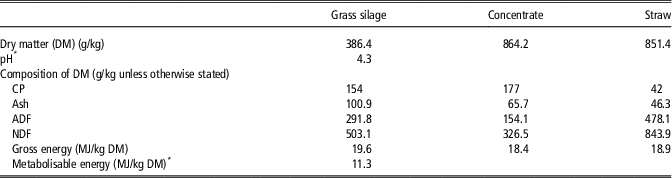
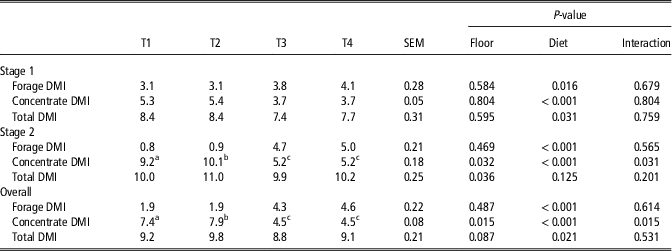
The silage offered was of good quality with a D value of 706 g/kg. The chemical composition of the feeds offered are given in Table 1. Dry matter intakes (DMI) are presented in Table 2. Since there was a significant interaction between floor type and diet in the overall concentrate DMIs, the DMIs of the four individual treatments are presented. Over the entire experimental period, floor type had no significant effect on forage or total DMI. However, there was a significant floor × diet interaction in the concentrate DMI, whereby bulls offered the intensive diet had, as planned, significantly higher concentrate DMI than those offered the less intensive diet, but bulls accommodated on rubber floors and offered the intensive diet had a significantly higher DMI of concentrates of 7.9 kg/day compared to 7.4 kg/day for those bulls offered this diet but accommodated on concrete slats.
Composition of feeds offered to cattle (g/kg unless otherwise stated)

* Determined using NIRS.
Dry matter intakes (DMI) of bulls for the four treatments in the study (kg/day)

T1 bulls accommodated on concrete slatted floor and offered intensive diet; T2 bulls accommodated on slatted floor covered with rubber and offered intensive diet; T3 bulls accommodated on concrete slatted floor and offered less intensive diet; and T4 bulls accommodated on slatted floor covered with rubber and offered less intensive diet.
a,b,cValues within a row with different superscripts differ significantly at P<0.05.
In order to understand this more fully, DMIs are presented for two stages of the experiment. Stage 1 was where the levels of concentrates were increased weekly at two different rates for the intensive and less intensive diets and all animals were offered grass silage ad libitum as the forage component of their diet; stage 2 was where animals offered the intensive diet consumed concentrates ad libitum supplemented with barley straw (from day 102 onwards) and animals offered the less intensive diet were offered a flat rate of 6 kg concentrate/head per day, supplemented with grass silage ad libitum. During stage 1 floor had no significant effect on DMI, but bulls offered the intensive diet consumed significantly higher amounts of concentrates (P < 0.001), but less forage (P < 0.05), resulting in a significant higher total DMI than in those bulls offered the less intensive diet (P < 0.05). As expected bulls offered concentrates ad libitum consumed a higher amount of concentrates than those restricted to 6 kg/head per day during stage 2. However, when bulls were allowed ad libitum access to concentrates, those animals accommodated on rubber covered slats had a significantly higher concentrate intake of 10.1 kg/day compared to 9.2 kg/day for bulls accommodated on concrete slats.
Performance
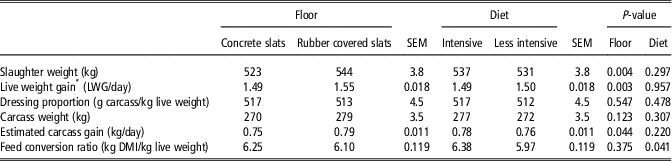
There were no significant interactions between floor and diet on animal performance and therefore main effects are presented in Table 3. Animals accommodated on rubber covered slats had a significantly better performance than those accommodated on concrete slats, as assessed by live weight at slaughter (544 v. 523 kg, respectively); daily live weight gain (DLWG) (1.55 v. 1.49 kg/day, respectively) (P < 0.01) and estimated daily carcass gain (0.79 v. 0.75 kg/day, respectively) (P < 0.05) (Table 3). Diet had no significant effect on animal performance. Bulls offered the intensive diet had a higher FCR than those offered the less intensive diet, while floor type had no effect on FCR. Feed conversion ratio of animals on each treatment were as follows (T1 6.43; T2 6.33; T3 6.07 and T4 5.87).
The effect of floor type and diet on bull performance

* Calculated by regression.
Carcass and meat quality measurements
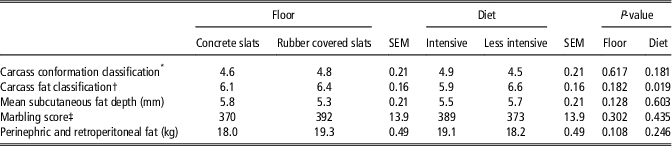
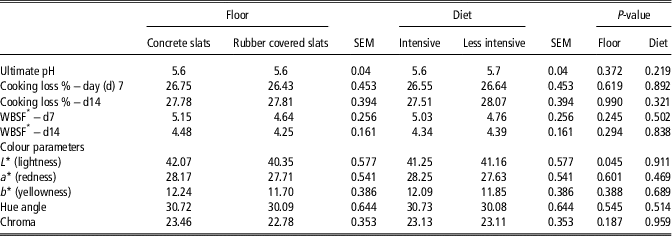
There were no significant interactions between floor and diet on carcass or meat quality measurements and main effects are presented in Tables 4 and 5, respectively. Floor type had no significant effect on carcass measurements (Table 4). Bulls offered the intensive diet had a lower carcass fatness classification than those offered the less intensive diet (5.9 v. 6.6, respectively) (P < 0.05). Diet had no significant effect on meat quality measurements (Table 5). Floor type also had no significant effect on meat quality measurements apart from lightness (L*) values of colour, which was significantly higher in bulls accommodated on concrete slats than on rubber (P < 0.05).
The effect of floor type and diet on carcass measurements of bulls

* 15-point scale; 1 = worse, 15 = best.
† 15-point scale; 1 = leanest; 15 = fattest.
‡ Meat Standards Australia marbling score range from 100 to 1190 in increments of 10.
The effect of floor type and diet on meat quality measurements of bulls

* Warner–Bratzler shear force (WBSF) (kg F).
Cleanliness scores
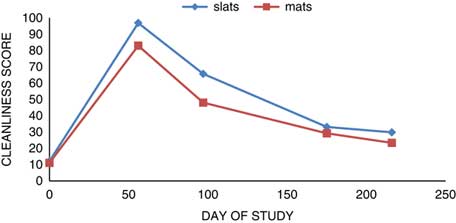
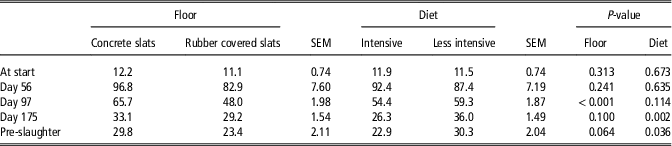
Bulls accommodated on rubber covered slats were significantly cleaner than those accommodated on concrete slats on day 97 (P < 0.001), but there was no significant effect of floor type when measured at other time points in the experiment (Figure 1). Diet had no significant effect on cleanliness score measured at days 56 or 97 of the experiment (Table 6). However, by day 175, bulls offered the intensive diet were significantly cleaner than those offered the less intensive diet of grass silage supplemented with concentrates. This effect was also noted in the pre-slaughter assessment (P < 0.05).
The effect of floor type on cleanliness scores of bulls, using the scoring system devised by Scott and Kelly (Reference Scott and Kelly1989).

The effect of floor type and diet on bull cleanliness scores*

* Using the scoring system devised by Scott and Kelly (Reference Scott and Kelly1989).
Discussion
Previous research has consistently reported no effect of adding rubber to concrete slats on overall total DMI of beef cattle (Lowe et al., Reference Lowe, Steen, Beattie and Moss2001b; Cozzi et al., Reference Cozzi, Tessitore, Contiero, Ricci, Gottardo and Brscic2013; Earley et al., Reference Earley, McDonnell and O’Riordan2015; Keane et al., Reference Keane, McGee, O’Riordan, Kelly and Earley2015). The effect of adding rubber to concrete slats on animal performance has not been consistent in previously published studies. Some studies have reported an improved performance in cattle accommodated on rubber covered slats compared to those accommodated on concrete slats (Cozzi et al., Reference Cozzi, Tessitore, Contiero, Ricci, Gottardo and Brscic2013; Keane et al., Reference Keane, McGee, O’Riordan, Kelly and Earley2015; Brscic et al., Reference Brscic, Ricci, Prevedello, Lonardi, De Nardi, Contiero, Gottardo and Cozzi2015b). Although Cozzi et al. (Reference Cozzi, Tessitore, Contiero, Ricci, Gottardo and Brscic2013) reported that feed intake was not affected by floor type, average DLWG of intensively reared young bulls was higher in those accommodated on perforated rubber mats compared with those accommodated on fully slatted concrete floors. However, bulls accommodated on a perforated concrete floor had an intermediate DLWG, which was not statistically different to animals accommodated on either of the other two floors. In effect adding rubber per se, in this case to a perforated concrete floor, had no significant effect of intake or DLWG. It would have been useful if Cozzi et al. (Reference Cozzi, Tessitore, Contiero, Ricci, Gottardo and Brscic2013) had included a further treatment of a concrete slatted floor covered with rubber. Brscic et al. (Reference Brscic, Ricci, Prevedello, Lonardi, De Nardi, Contiero, Gottardo and Cozzi2015b) reported a study carried out on five commercial farms comparing a fully slatted concrete floor with one where the slats were covered in synthetic rubber. Continental bulls were offered a finishing total mixed ration (TMR) based on maize silage ad libitum and it was reported that bulls accommodated on concrete slats had a significantly lower DLWG compared with those accommodated on rubber covered slats (1.46 and 1.53 kg/day, respectively; P < 0.05). However, intakes of the cattle were not reported in this study. Keane et al. (Reference Keane, McGee, O’Riordan, Kelly and Earley2015) reported no effect of adding rubber mats to concrete slats on the DMI of Continental crossbred beef bulls, but reported a higher live weight gain and estimated carcass gain in bulls accommodated on rubber mats but no difference in carcass weight. Keane et al. (Reference Keane, McGee, O’Riordan, Kelly and Earley2015) reported that bulls accommodated on rubber mats had a higher FCR than those accommodated on concrete slats. However, others have reported no effect of adding rubber to concrete slats on performance (Lowe et al., Reference Lowe, Steen, Beattie and Moss2001b; Murphy et al., Reference Murphy, Lowe, Lively and Gordon2018). Lowe et al. (Reference Lowe, Steen, Beattie and Moss2001b) offered Continental-cross steers grass silage ad libitum, supplemented with 4 kg of concentrates. Floor type had no significant effect on either intake or performance. More recently Earley et al. (Reference Earley, McDonnell and O’Riordan2015) reported no effect of floor type on the performance of Continental-cross and dairy-origin steers, whereby similar total DMI and live weight gains were reported in steers accommodated on concrete slats; on two different types of rubber mats on top of the slats and slatted to allow drainage or on wood-chip bedded pens. These animals were offered TMR based on grass silage and rolled barley, on a 50 : 50 DM basis. Earley et al. (Reference Earley, McNamara, Jerrams and O’Riordan2017) subsequently compared a fully slatted concrete floor; three different types of rubber mats and out-wintering pads (OWP) on performance and welfare of Continental crossbred beef steers. While steers accommodated on the OWP had a higher live weight gain than those on the concrete slats and one of the rubber mats floors, the LWG of steers accommodated on the other two mat types were the same as other treatments. There are many variables, such as animal gender; breed and slaughter weight; pen space allowance; group size; pre-experiment accommodation; rubber product type and diet noted in these studies, which could potentially have an impact on the effect of floor type on animal performance. Many different rubber products are commercially available which have different hardness properties. This may affect animal comfort and potentially performance. The rubber mats used in the study of Keane et al. (Reference Keane, McGee, O’Riordan, Kelly and Earley2015), where an improved performance was reported compared with bulls accommodated on concrete slats, were also used in the study of Earley et al. (Reference Earley, McNamara, Jerrams and O’Riordan2017). However, Earley et al. (Reference Earley, McNamara, Jerrams and O’Riordan2017) reported no difference in performance in steers accommodated on these rubber mats compared to those accommodated on concrete slats. The two rubber mats used in the study of Earley et al. (Reference Earley, McDonnell and O’Riordan2015) had differences in the German Agricultural Society’s Deutsche Landwirtschafts-Gesellschaft (DLG) certification tests (DLG; Groß-Umstadt) for deformity (2.25 v. 5.0 mm) and elasticity (2.20 v. 6.3 mm) but this was not reflected in any difference in performance. Gender would seem to have an important role to play on the effect of floor type on animal performance; whereby an effect of floor type on performance has been more commonly observed in bulls than in steers or heifers. It should also be noted, however, that most of these bulls have been offered a high concentrate diet or certainly a high-energy diet such as a TMR of maize silage and concentrates. Studies carried out on steers (Lowe et al., Reference Lowe, Steen, Beattie and Moss2001b; Earley et al., Reference Earley, McDonnell and O’Riordan2015) have reported no effect of adding rubber to concrete slatted floors on animal intakes or performance. However, an effect of floor type on performance has not always been observed in bulls (Murphy et al., Reference Murphy, Lowe, Lively and Gordon2018). Keane et al. (Reference Keane, McGee, O’Riordan, Kelly and Earley2018) carried out a meta-analysis of the effect of floor type on performance of beef cattle. Although they concluded that using rubber covered slats instead of concrete slats had no effect on beef cattle performance, only eight studies were used to come to this conclusion and thus they were unable to shed any light on teasing out the relative importance of the many aforementioned factors which may affect performance.
Adding rubber to fully slatted concrete floors had no significant effect on carcass measurements in the current study and these findings are in general agreement with others reported in the literature (Lowe et al., Reference Lowe, Steen, Beattie and Moss2001b; Murphy et al., Reference Murphy, Lowe, Lively and Gordon2018). Similarly, floor type generally had little effect on meat quality in the current study, although animals accommodated on slatted floors had a significantly higher L* value than those accommodated on rubber covered slatted floors.
Conflicting effects on the effect of adding rubber on to concrete slats on cattle cleanliness have been reported in the literature and appears to be largely dependent on the relative drainage areas of the two systems. Brscic et al. (Reference Brscic, Ricci, Prevedello, Lonardi, De Nardi, Contiero, Gottardo and Cozzi2015b) reported that bulls accommodated on rubber slatted flooring were dirtier than those accommodated on concrete slatted flooring, which they attributed to the lower drainage area of the rubber pens compared with concrete slatted floor in their study. In the current study, even though the drainage area was reduced in rubber covered slats compared with concrete slats (18% v. 24%, respectively), cattle accommodated on the rubber were not dirtier than those accommodated on concrete slats. In fact despite this smaller drainage area, cattle accommodated on rubber slats were significantly cleaner than those on concrete slats at day 97, although there was no effect of floor on cleanliness by slaughter. A possible explanation for this could have been the design of the rubber used in this study, which was curved on the upper side of the rubber slat to assist removal of faeces and urine into the slurry tank below. Animals accommodated on concrete slats and rubber covered slats had a similar pattern of dirt scores as illustrated in Figure 1, whereby there was a rapid increase at the beginning of the study followed by a gradual decline as the bulls shed their winter coat.
Effect of diet on animal performance
Traditionally bulls are intensively finished on high concentrate diets. In temperate countries such as the United Kingdom and Ireland, bulls may be grazed for several months during the grazing season, before being intensively finished indoors to be slaughtered at less than 16 months of age. Murphy et al. (Reference Murphy, Swan and Prendivile2016) highlighted targets for such a spring-born Holstein-Friesian calf, gaining 0.9 kg/day during the first grazing season and then offered ad libitum concentrates-based diet indoors, growing at 1.4 kg/day. However, Patterson et al. (Reference Patterson, Steen, Moore and Moss2000) reported that Continental bulls could be offered a high-quality grass silage-based diet supplemented with 40% concentrate (on a DM basis), without having a negative effect on animal performance compared to those offered 75% concentrates. Keady and Kilpatrick (Reference Keady and Kilpatrick2006) compared a grass silage-based diet supplemented with 50% concentrates on a DM basis and an ad libitum concentrate diet supplemented with 1.2 kg silage DM/day and reported no difference in live weight gain or fat and conformation classification scores of Continental bulls. However, bulls offered 50% grass silage diet had a significantly lower total DMI, kill out percentage, carcass gain per day and higher FCR. Bulls offered the less intensive diet in the current study had a significantly higher carcass fat classification score than those offered the intensive high concentrate diet, which is in contrast with the findings of Patterson et al. (Reference Patterson, Steen, Moore and Moss2000) who reported a linear increase in carcass fat class with increasing proportion of concentrate in the diet.
Interactions between diet and floor type
One of the aims of the current project was to ascertain if the diet offered had an effect on the response to adding rubber to concrete slatted floor on animal intake and performance. An interesting point to note about the current study is that when bulls were offered ad libitum concentrates, those accommodated on rubber covered slats had a higher concentrate intake than bulls accommodated on concrete slats. In contrast, floor type did not significantly affect intake when bulls were offered grass silage supplemented with 6 kg concentrate. Diets offered in the studies that have concluded that floor type has no significant effect of intake have mostly been based on grass silage supplemented with concentrates offered either to steers (Lowe et al., Reference Lowe, Steen, Beattie and Moss2001b) or to bulls (Graunke et al., Reference Graunke, Telezhenko, Hessle, Bergsten and Loberg2011; Keane et al., Reference Keane, McGee, O’Riordan, Kelly and Earley2015). Cozzi et al. (Reference Cozzi, Tessitore, Contiero, Ricci, Gottardo and Brscic2013) offered bulls a higher energy TMR of 45% maize silage: 44% concentrates. Total DMI was 8.1 and 9.2 kg for bulls accommodated on fully slatted floors v. perforated rubber floor with a rubber mattress, respectively. While there was no significant effect of floor type on DMI, this represented a 13.6% increase in DMI. Murphy et al. (Reference Murphy, Lowe, Lively and Gordon2018) offered similar diets to the intensive diet offered in the current study. Although these authors concluded that floor type had no significant effect on feed intake, a similar trend was noted to the current study whereby when bulls were offered ad libitum concentrates, a 4% higher concentrate DMI on rubber covered slats was noted compared to those accommodated on concrete slats (ad libitum concentrate DMI of 10.08 and 9.69 kg, respectively). To the best of the author’s knowledge no other study has highlighted a higher ad libitum intake of concentrates in animals accommodated on rubber covered slats compared to those accommodated on concrete slats. Lowe et al. (Reference Lowe, Steen, Beattie and Moss2000) reported that cattle got up and down more frequently on rubber-covered slats than on concrete slats. Absmanner et al. (Reference Absmanner, Rouha-Mulleder, Scharl, Leisch and Troxler2009) concluded that adding rubber mats onto concrete slatted floors made standing up and lying down less painful. It is possible that in the present study bulls accommodated on rubber flooring were able to get up and down more readily to gain access to ad libitum concentrate feeding. It is postulated that the motivation to get up to consume the higher energy concentrates was higher than getting up for grass silage consumption, which was available ad libitum to animals on the less intensive diet treatments. The higher concentrate intake of bulls on rubber was translated into higher performance of these animals compared to those accommodated on slatted floors in the current study, with a similar FCR noted in animals on both these treatments. With the use of measurement of individual feed intakes now more commonplace in animal research, a more detailed study on the effect of floor type on intake using different diets would merit further study.
Acknowledgements
The authors sincerely thank staff from the Sustainable Beef Unit at AFBI, Hillsborough. This research was funded by the Department of Agriculture, Environment and Rural Affairs in Northern Ireland (DAERA). Preliminary results of this study have been published in abstract form (Lowe et al., Reference Lowe, Lively and Gordon2018).
Declaration of interest
No conflicts of interest.
Ethics statement
This study was conducted with the approval of the AFBI Hillsborough Ethical Review Committee, in accordance with the requirements of the UK Animals (Scientific Procedures) Act 1986.
Software and data repository resources
None of the data were deposited in an official repository.