Introduction
Social networks are important for wellbeing and life satisfaction across the whole lifespan but are likely to be especially important in later life when functional and health challenges increase. In different ways, kin and non-kin are important providers of social contacts, personal support and wellbeing for older adults (Merz and Consedine Reference Merz and Consedine2009; Yeung and Fung Reference Yeung and Fung2007). It has been found many times that receiving social support predicts higher wellbeing in older adults (e.g. Cheng and Chan Reference Cheng and Chan2006; Tesch-Römer, Motel-Klingebiel and von Kondratowitz Reference Tesch-Römer, Motel-Klingebiel and von Kondratowitz2002), although social support is a complex construct and the effects may vary by type of support and who provides it (Merz, Schuengel and Schulze Reference Merz, Schuengel and Schulze2009; Uchino, Cacioppo and Kiecolt-Glaser Reference Uchino, Cacioppo and Kiecolt-Glaser1996). Indeed, emotional and social support may be related to wellbeing differently (Merz and Consedine Reference Merz and Consedine2009), and receiving support from family members may associate with different outcomes than receiving the same support from non-kin (Komter and Vollebergh Reference Komter and Vollebergh1997). Such complexities suggest that much remains to be understood about the associations between social support and wellbeing among frail older people. In addition to any variations that arise from different types and providers of support, it seems likely that the recipient's characteristics qualify the relation between support and wellbeing (Yeung and Fung Reference Yeung and Fung2007). Drawing from earlier studies (e.g. Merz, Schuengel and Schulze Reference Merz, Schuengel and Schulze2009; Silverstein et al. Reference Silverstein, Conroy, Wang, Giarrusso and Bengtson2002), we suggest that the quality of and satisfaction from the relationship with the support provider are prominent moderating factors.
Different providers of informal social support
Academic writing and policy documents tend to subsume support from kin and non-kin as informal support and to distinguish it from formal or professional care provision (Fast et al. Reference Fast, Keating, Otfinowski and Derksen2004). It seems likely, however, that the availability, quality and satisfaction with informal support varies as between kin and non-kin providers and that it requires further differentiation, especially in association with adaptive outcomes in older adults. Informal support from the kin network has often been found beneficial for the wellbeing of older people (e.g. Levitt, Guacci and Weber Reference Levitt, Guacci and Weber1992), but some studies have reported negative associations (e.g. Silverstein, Chen and Heller Reference Silverstein, Chen and Heller1996). Support from non-kin network members has generally been found to increase wellbeing and to bring other positive outcomes among frail older people (Yeung and Fung Reference Yeung and Fung2007) but to be less important than kin support (Chi and Chou Reference Chi and Chou2001). These complex results point to the need for further differentiation of the providers of support. Moreover, western societies are experiencing increases in individualisation and individual autonomy, and it seems likely that the importance of the family network has decreased and that friends have become more important to individual wellbeing, partly because friend relationships tend to be voluntary and sustained by feelings of solidarity or love rather than obligation (Komter and Vollebergh Reference Komter and Vollebergh2002).
One possible reason for the greater importance of kin than non-kin support is that in later life social networks tend to shrink and to be dominated increasingly by family members who are themselves at later stages of the lifecourse (Van Tilburg Reference Van Tilburg1998). Family support, often provided by a spouse or adult children, might be more important for individuals approaching the end of the lifespan, because it is generally a few family members that are close and trusted confidants. In some cases, however, providing instrumental support within the family may be motivated primarily by norms like filial obligations, rather than a volitional wish ‘to give back’ to loved ones (Merz et al. Reference Merz, Consedine, Schulze and Schuengel2009). In short, providing support to older people may have different motivations among kin and non-kin. If the motivations of the providers are to fulfil a moral or reciprocal obligation, this could interact with the severity of the dependency characteristics of the care recipient. It might create, for example, the sense of being unwanted or guilt about being dependent. If this interaction occurs, it may mean that receiving instrumental support from a kin relation generates negative outcomes. On the other hand, support from friends is often voluntary and may entail a lesser sense of dependency, particularly if friends share similar backgrounds, attributes and values (Yeung and Fung Reference Yeung and Fung2007). Moreover, friendship support is less often motivated by moral obligations and more often sustained by feelings of affection, mutuality and love.
Different types of support
As previous studies have failed to find an overall association between social support and wellbeing (e.g. Lee and Ellithorpe Reference Lee and Ellithorpe1982; Merz, Schuengel and Schulze Reference Merz, Schuengel and Schulze2009; Whitbeck, Hoyt and Tyler Reference Whitbeck, Hoyt and Tyler2001), research has begun to differentiate the components of support (Zunzunegui, Béland and Otero Reference Zunzunegui, Béland and Otero2001). It has been shown that receiving instrumental support has a negative impact on wellbeing because it is related to loss of autonomy and increasing needs and dependency, while emotional support associates positively with wellbeing (Reinhardt, Boerner and Horowitz Reference Reinhardt, Boerner and Horowitz2006). A study of older adults with coronary artery disease showed that reduced depressive symptomatology was related to greater perceived emotional support, but not more instrumental support (Bosworth et al. Reference Bosworth, Steffens, Kuchibhatla, Jiang, Arias, O'Connor and Krishnan2000), a finding that has been replicated in other work (e.g. Lang and Schütze Reference Lang and Schütze2002). In summary, such findings underscore the importance of distinguishing types of support and outcomes if we are to increase our understanding of how social network characteristics affect adaptation in later life.
Moderation of the association between support and wellbeing
It has been suggested by developmental psychologists (e.g. Cicirelli Reference Cicirelli1993) and social gerontologists (Koropeckyj-Cox Reference Koropeckyj-Cox2002) that individual characteristics qualify the association between receiving support and wellbeing (Merz and Consedine Reference Merz and Consedine2009). Moderators of this association might be related to differences in the recipients' attitudes and in how special forms of support are experienced. Yeung and Fung (Reference Yeung and Fung2007), for example, investigated the role of familism as a moderator of the relation between support and life satisfaction. In a study of 108 older Chinese adults, they compared family and friend support and emotional and instrumental support in association with life satisfaction. Familism was measured as the closeness of an individual to their family (the inverse of seeking independence and autonomy). Yeung and Fung found that instrumental support enhanced wellbeing only among participants with high familism values.
A general construct that helps to clarify the conditions under which instrumental and emotional kin and non-kin support promote or harm wellbeing is the ‘quality of the relationship’. Individuals who perceive their relationship with potential support providers as positive and of high quality might experience intimacy and closeness through the relationships yet achieve a satisfactory balance between being autonomous and having interdependent relationships with close others (Merz, Schuengel and Schulze Reference Merz, Schuengel and Schulze2007). In high-quality relationships, the partners are likely to experience more harmony, to communicate well and to adapt to changes in the pattern or intensity of support, which would enhance wellbeing and might also influence the extent to which receiving support reduces wellbeing. Support might be enjoyed and accepted without being accompanied by feelings of increased dependency and decreased autonomy. In low-quality relationships, by contrast, receiving support might strongly associate with unpleasant feelings and lead to decreased wellbeing. Research on intergenerational support between adult children and their parents has suggested that the moderating role of relationship quality is especially pertinent for the provision and receipt of instrumental support (Merz, Schuengel and Schulze Reference Merz, Schuengel and Schulze2007).
The research question and hypotheses
Support from kin and non-kin network members and wellbeing have been linked before (Chi and Chou Reference Chi and Chou2001), but few previous studies have investigated how this association varies by support type and provider and as a function of relationship characteristics. The present study replicates previous analyses using Dutch survey data (cf. Merz et al. Reference Merz, Consedine, Schulze and Schuengel2009; Merz, Schuengel and Schulze Reference Merz, Schuengel and Schulze2009) with German data, and extends the examination by not only comparing different types but also different providers of support in their association with wellbeing. It was hypothesised that receiving emotional support is positively associated with wellbeing, receiving instrumental support decreases wellbeing, and that receiving instrumental support from non-kin providers is less detrimental for older adults' wellbeing, because non-kin support is voluntarily motivated whereas commonly family support is based on moral obligation. We expected the quality of the relationship generally to buffer the negative impact of instrumental support for both kin and non-kin support, but for the effect to be stronger for kin support.
Methods
Participants and procedure
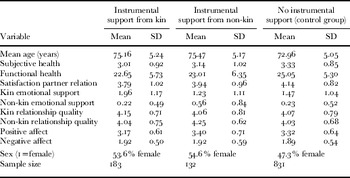
The data for the present study stem from the second wave of the Deutscher Alterssurvey (German Ageing Survey; DEAS). The DEAS began in 1996 and is a continuing nationally-representative panel survey of people aged 40 or more years living in private households in Germany. The data for the current report were collected through computer-assisted personal interviews and self-completion questionnaires between February and July 2002. The respondents were asked about support received and the characteristics of their kin and non-kin relationships. For the presented analyses, we selected 1,146 participants aged 65 or more years and they were arranged into three groups: 831 who did not receive instrumental support, 183 who received instrumental support from kin, and 132 who were supported by non-kin. The health and relationship characteristics of the respondents from the three groups can be found in Table 1.
Health and relationship characteristics of the sample

Note: SD: standard deviation.
Measures
Table 1 profiles the age, sex, subjective health and functional health of the sample, and the scores for satisfaction with partner and relationship quality. We examined not partner status itself but rather satisfaction with the partner status as a control because this subjective measure is likely to be associated with wellbeing. Instrumental support was measured with one item that indicated whether a participant received help with cleaning, household chores or odd jobs from kin or from non-kin during the previous 12 months. Emotional support was measured with two items that indicated how many kin or non-kin members respectively provided advice and comfort to the respondent during the previous 12 months. The two items were combined into a mean score. The respondents rated the quality of the relationship on a five-category scale (1 ‘very bad’, 2 ‘bad’, 3 ‘mediocre’, 4 ‘good’, and 5 ‘very good’). As found by others (e.g. Winkeler, Filipp and Boll Reference Winkeler, Filipp and Boll2000), the scores were highly skewed, with most participants rating their kin and non-kin relationships as ‘good’ or ‘very good’. Two dichotomies were therefore created that distinguished ‘very good’ and ‘good’ from ‘mediocre’, ‘bad’ and ‘very bad’ relationships.
Subjective wellbeing is a heterogeneous construct with cognitive and emotional aspects (Diener Reference Diener1984). We focused on the emotional aspects using the PANAS items for positive and negative affect (Watson, Clark and Tellegen Reference Watson, Clark and Tellegen1988). Positive affect indicates inter alia happiness, excitement and pride, whereas negative affect indicates sadness, fear and hostility. Both subscales have ten items that were rated on a five-category Likert scale. Higher values indicated more positive affect or negative affect. Means of the item scores were computed for each respondent. It has been shown repeatedly that positive and negative affect are not strongly correlated and are influenced by different factors (e.g. Diener Reference Diener1984). Subjective health was assessed from responses to the question, ‘How do you assess your current state of health?, which were scored from 1 ‘very bad’ to 5 ‘very good’. Functional health was measured by the subscale physical functioning of the well-established Short Form 36-item Health Status Questionnaire (SF-36, version 1.0) (Bullinger and Kirchberger Reference Bullinger and Kirchberger1998; Ware and Sherbourne Reference Ware and Sherbourne1992). Impairments in ten everyday activities (e.g. climbing stairs, carrying shopping bags) were rated on a three-category scale, higher values indicating less impairment. Given their association with both wellbeing and social support, subjective health and functional health were used as control variables (Silverstein, Chen and Heller Reference Silverstein, Chen and Heller1996).
The statistical analyses
The Pearson bivariate correlation coefficient matrix was examined to assess the associations among the study variables. Two multivariate analyses of covariance (MANCOVA) with positive and negative affect as dependent variables were calibrated to estimate the effects of receiving instrumental support from kin or non-kin in association with relationship quality. The first model examined the effects of instrumental support from kin, the effects of relationship quality with kin, and the interaction of both factors on wellbeing, controlling for sex, subjective health, functional health, partnership quality and emotional support from kin. The second model examined the effects of instrumental support from non-kin, the effects of relationship quality with non-kin, and the interaction of both factors on wellbeing, with the same controls as the first model.
Results
Correlations among the variables
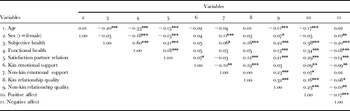
Table 2 presents the correlation matrix. The respondents reporting better subjective and functional health, and those with a high satisfaction rating of their partner status, showed higher positive affect and lower negative affect. Older participants showed less positive affect than younger respondents, and rated the quality of the relationship with their non-kin network lower than younger respondents. Higher emotional support from kin and non-kin providers associated with higher positive affect, but only higher emotional support from kin providers significantly related to lower negative affect. Higher relationship quality with kin and non-kin network members associated with higher positive affect and lower negative affect. Women reported higher relationship quality scores with non-kin members than did men.
Bivariate correlations among socio-demographic, kin and non-kin support and wellbeing variables

Significance levels: * p<0.05, ** p<0.01, *** p<0.001.
The multivariate results
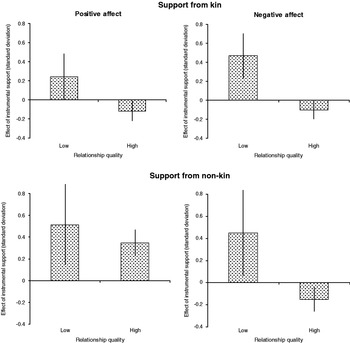
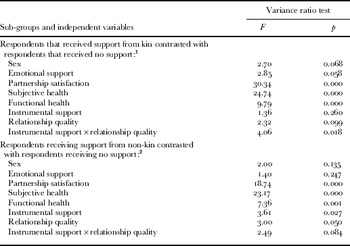
The MANCOVA results are arrayed in Table 3. Beginning with instrumental support from kin, we first compare the participants who did and did not receive such support. Wellbeing was significantly associated with partnership satisfaction, subjective health, and functional health, and marginally associated with gender and emotional support from kin. The main effect of receiving instrumental support from kin was not significant after controlling for the confounding influences, and the main effect of the quality of the kin relationship was marginally significant. Among the respondents who had a less than good relationship with their kin member, however, receiving instrumental support from that person was detrimental for their subjective wellbeing. This was indicated by the significant interaction between instrumental support from kin and relationship quality with kin. Figure 1 demonstrates that this interaction effect was largely driven by the increase in negative affect that was associated with receiving instrumental support from a kin member.
The effects of instrumental support on positive affect and negative affect.

Main and interaction effects of socio-demographic and kin and non-kin network characteristic variables on wellbeing, in older adults

Notes: 1. Degrees of freedom, 2 and 953. 2. Degrees of freedom, 2 and 872.
Turning to the comparison of those who did and did not receive instrumental support from non-kin, wellbeing was significantly associated with partnership satisfaction, subjective health and functional health, but not with gender or emotional support received from non-kin (Table 3). The main effect of receiving instrumental support from non-kin was significantly positive for wellbeing after controlling for the confounding influences, as was the main effect of relationship quality with non-kin. The interaction of both effects was marginally significant. The lower two diagrams on Figure 1 show that, after controlling for possible confounders, receiving instrumental support from non-kin and a good quality of relationship with the non-kin person independently increased positive affect. The right-hand diagram indicates that a better relationship buffered against the adverse influence on wellbeing of receiving instrumental support.
Discussion
Social support and wellbeing
Consistent with our expectations and with previous work, this study has found that emotional support from kin providers positively associated with wellbeing, but that having emotional support from non-kin care providers associated only with positive affect and not with negative affect. Receiving instrumental support from non-kin benefited wellbeing, i.e. positive affect increased and negative affect decreased. Relationship quality with members of the kin and non-kin network was a positive predictor of wellbeing, and qualified the association between instrumental support and wellbeing. More specifically, the analyses showed that receiving instrumental support negatively associated with wellbeing only in cases of low-quality kin relationships. While the association between social support and wellbeing was generally weak, it varied by type and source of support. Confirming findings from previous studies, receiving emotional support from members of the kin network raised wellbeing, whereas receiving instrumental support from family members either did not affect wellbeing or associated with a negative effect (cf. Bosworth et al. Reference Bosworth, Steffens, Kuchibhatla, Jiang, Arias, O'Connor and Krishnan2000; Merz and Consedine Reference Merz and Consedine2009). To this extent, receiving emotional and instrumental support from kin had different implications for the lives of the recipients. Among the respondents that experienced their kin network as supportive, reliable and available (indicated by higher emotional support scores), it is not surprising that this benefited their personal wellbeing.
In contrast, the measure of instrumental support might more directly assess the actual use of the kin network for tangible support. It has previously been suggested that receiving instrumental or practical support might be negative for the wellbeing of older adults because it elicits unwanted feelings of dependency in performing certain activities (Silverstein and Bengtson Reference Silverstein and Bengtson1994) or because it threatens autonomy (Baltes Reference Baltes1996; Lee and Ellithorpe Reference Lee and Ellithorpe1982). Additionally, instrumental support, especially from adult children, can be motivated by filial norms and obligation (cf. Lowenstein and Daatland Reference Lowenstein and Daatland2006) and negatively related to parental life satisfaction (Lowenstein, Katz and Gur-Yaish Reference Lowenstein, Katz and Gur-Yaish2007). The current study did not find this negative association between instrumental kin support and subjective wellbeing after controlling for subjective and functional health.
With respect to support from non-kin, a different picture emerged. Emotional support associated with positive but not negative affect, whereas the receipt of instrumental support from members of the non-kin network improved the subjective wellbeing of the recipients. This positive association might be more dependent on the provider than the type of support. Because friends and neighbours might provide instrumental support entirely voluntarily, whereas kin members might feel a moral obligation to do so, it seems likely that the recipients perceive help and care from friends and neighbours rather differently. Moreover, often the recipients are of similar age, educational background and socio-economic status as non-kin support providers. To this extent, it is plausible that instrumental support is more positively experienced when it is from non-kin than from kin (especially younger kin).
We did not find a positive association between emotional support from non-kin and subjective wellbeing, an interesting finding given that earlier work has shown that emotional support is more likely than instrumental support to have positive outcomes (cf. Jasinskaja-Lahti et al. Reference Jasinskaja-Lahti, Liebkind, Jaakkola and Reuter2006; Merz and Consedine Reference Merz and Consedine2009). On the other hand, as has been described before, relationships with members of the non-kin network are likely to be characterised by emotional closeness and voluntarism and therefore the receipt of emotional support might be more taken-for-granted compared to the receipt of instrumental support. Additionally, emotional support and relationship quality may partially overlap, especially in non-kin relationships. Comfort, warmth, interest and advice may more readily be provided through relationships distinguished by these characteristics. Providing emotional support through poor-quality relationships hardly seems possible; it might manifest mainly in high contact frequencies and lots of advice that is given to meet family norms and obligations.
Relationship quality and wellbeing
The respondents who rated their relationship with members of their kin and non-kin network relatively highly had high subjective wellbeing. Moreover, the quality of the relationship with kin and non-kin network qualified or moderated the negative impact of receiving instrumental support from family members. Relationships of good quality might be characterised by more harmony, better understanding, less conflict, and more reliable care and support. In contrast, people with poor relationships, possibly meaning less connectedness and inconsistencies, may react negatively to support because of a sense of reduced autonomy. Overall the interaction of instrumental support with relationship quality on wellbeing suggests that relationship characteristics influence how received instrumental support is experienced. Relationships with kin can be very strong alliances, not least because of shared backgrounds and interests and the blood tie. They are not easy to terminate, even when they not characterised by openness, trust and solidarity.
To sum up, this study has replicated and extended previous research on the links between social network characteristics and wellbeing by giving close attention to the types and providers of support. More specifically, it has provided evidence of the importance of the affective characteristics of kin and non-kin relationships, such as relationship quality, for the wellbeing of older people who receive instrumental and emotional support. In addition, although the data are complex and the findings intricate, they clearly suggest that the associations between social support and wellbeing are not general but conditional. Given the struggle between autonomy and relatedness, individualisation and dependency, future research should examine in more detail how and from whom emotional and instrumental support is received and their relationships with wellbeing outcomes.
Limitations of the study
The current study has certain limitations. First, the available variables provided limited details about several aspects of relationship quality and the types and intensities of care and support. Relationship quality clearly has several dimensions, such as intensity, communication, openness and flexibility, which were not captured in the data. As a cross-sectional analysis, we have not been able to establish the direction of causality in the observed relationships.
Acknowledgement
The German Ageing Survey was funded by the German Federal Ministry of Family Affairs, Senior Citizens, Women and Youth.