Introduction
Species of Angiostrongylus Kamensky, 1905 and of the related genera Gallegostrongylus Mas-Coma, 1977, Rodentocaulus Schultz, Orlov & Kutass, 1933 and Stefanskostrongylus Drozdz, 1970 (Metastrongyloidea, Angiostrongylidae) are parasitic nematodes that use various species of mammals (Rodentia, Carnivora, Soricomorpha and Afrosoricida of the former Insectivora, and in one case a primate) as definitive hosts and a wide diversity of snails (Gastropoda) as intermediate hosts. Most modern authors have accepted around 20 species in the genus Angiostrongylus (e.g. Maldonado et al., Reference Maldonado, Simões, Thiengo and Lorenzo-Morales2012: 304; Spratt, Reference Spratt2015: 179; Barratt et al., Reference Barratt, Chan and Sandaradura2016: 1088; Robles et al., Reference Robles, Kinsella, Galliari and Navone2016: 181; Valente et al., Reference Valente, Robles, Navone and Diaz2018: 143), with fewer species in the other genera, which have been variously recognized by different authors.
Three of these species have attracted the most attention. Angiostrongylus cantonensis (Chen, 1935), with rats as its definitive hosts, can infect humans and other mammals (e.g. domestic animals) and birds as accidental hosts, causing often severe neurological problems when the parasites reach the brain and spinal cord, where the majority of them die (e.g. Alicata & Jindrak, Reference Alicata and Jindrak1970; Graeff-Teixeira et al., Reference Graeff-Teixeira, da Silva and Yoshimura2009; Lunn et al., Reference Lunn, Lee and Smaller2012; Cowie, Reference Cowie2013a; Barratt, et al., Reference Barratt, Chan and Sandaradura2016). Angiostrongylus costaricensis Morera & Céspedes, 1971, also primarily using rats as its definitive hosts, causes a gastrointestinal vascular syndrome in humans (e.g. Graeff-Teixeira et al., Reference Graeff-Teixeira, Camillo-Coura and Lenzi1991, Reference Graeff-Teixeira, Goulart and de Ornellas Brum2005) as well as in other mammals as accidental hosts (e.g. Miller et al., Reference Miller, Kinsella, Garner, Evans, Gullett and Schmidt2006). Dogs and other canids are the definitive hosts of Angiostrongylus vasorum (Baillet, 1866) and infection can cause a diversity of signs and symptoms, respiratory problems and coagulopathy being the most common (e.g. Morgan & Shaw, Reference Morgan and Shaw2010; Di Cesare & Traversa, Reference Di Cesare and Traversa2014). Relatively little is known about most of the other species in the group (e.g. Spratt, Reference Spratt2015: 180; Valente et al., Reference Valente, Robles, Navone and Diaz2018: 143).
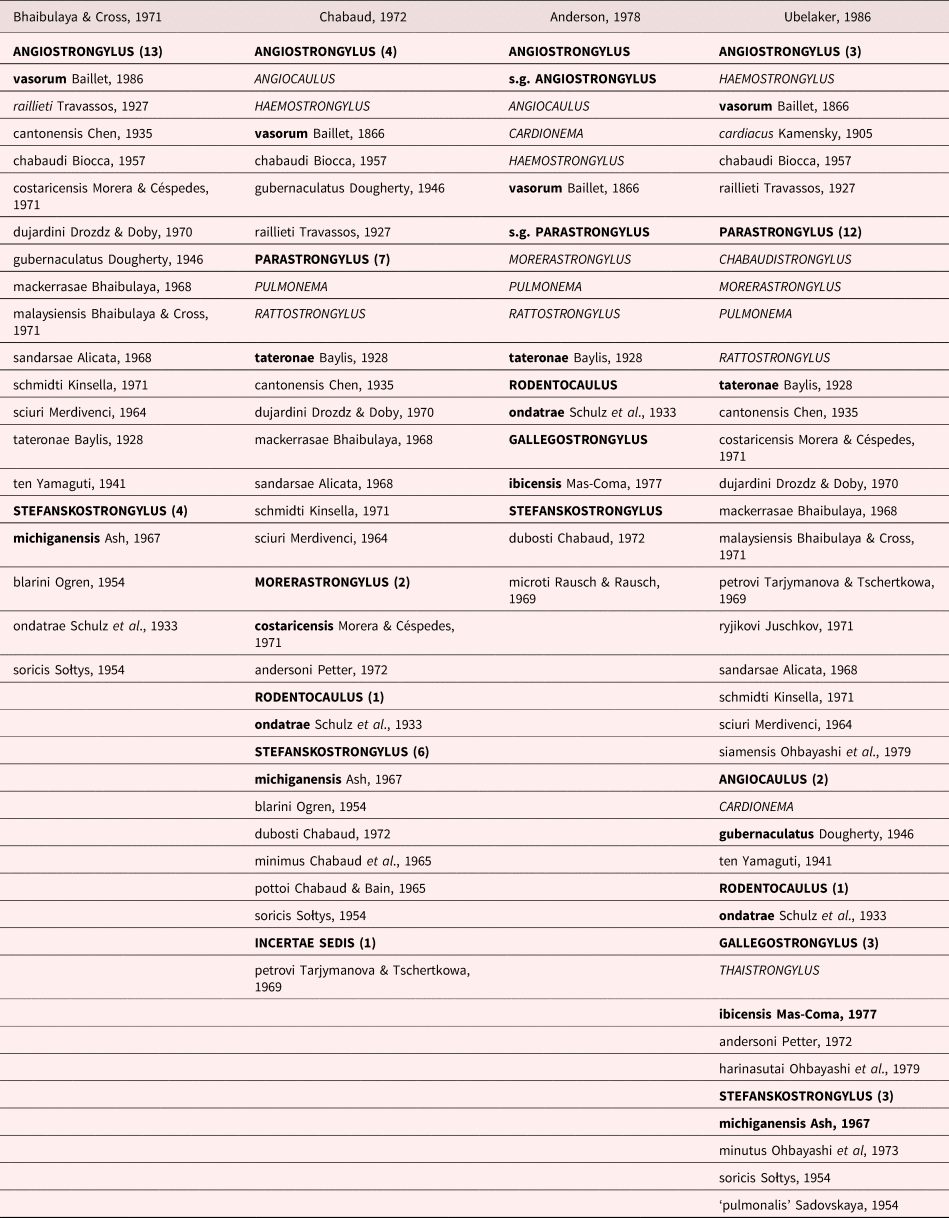
The taxonomy and systematics of the genus Angiostrongylus have relied primarily on the morphology of the male reproductive structures, host taxa and the location of adult worms in the definitive hosts. Classification has been extremely fluid, in part depending on the emphasis given to each of these suites of characters (e.g. Dougherty, Reference Dougherty1951: 92) and on whether to split or lump genus-group taxa. The key revisions that have been published (tables 1–3) are as follows.
Classifications and lists of species of Angiostrongylus and related genera by selected authors, 1946–1970. Valid genus-group names (listed alphabetically, subgenera within genera) shown in bold capitals, generic synonyms in italic non-bold capitals listed alphabetically beneath the valid genus-group name. Type species of the valid genus shown in bold non-italic lower case immediately below the genus-group synonymy. Other valid species in non-bold non-italic lower case with synonyms in non-bold italic lower case beneath the valid name; unavailable names in non-bold, non-italic lower case in quotation marks and listed at the end of the list of valid species. The number of valid species in each valid genus is listed in parentheses after the genus name.

Classifications and lists of species of Angiostrongylus and related genera by selected authors, 1971–1986. Valid genus-group names (listed alphabetically, subgenera within genera) shown in bold capitals, generic synonyms in italic non-bold capitals listed alphabetically beneath the valid genus-group name. Type species of the valid genus shown in bold non-italic lower case immediately below the genus-group synonymy. Other valid species in non-bold non-italic lower case with synonyms in non-bold italic lower case beneath the valid name; unavailable names in non-bold, non-italic lower case in quotation marks and listed at the end of the list of valid species. The number of valid species in each valid genus is listed in parentheses after the genus name (Anderson (Reference Anderson1978) did not list all species, only examples, so no numbers are provided for his classification).

Classifications and lists of species of Angiostrongylus and related genera by selected authors, 1991–present. Valid genus-group names (listed alphabetically, subgenera within genera) shown in bold capitals, generic synonyms in italic non-bold capitals listed alphabetically beneath the valid genus-group name. Type species of the valid genus shown in bold non-italic lower case immediately below the genus-group synonymy. Other valid species in non-bold non-italic lower case with synonyms in non-bold italic lower case beneath the valid name; unavailable names in non-bold, non-italic lower case in quotation marks and listed at the end of the list of valid species. The number of valid species in each valid genus is listed in parentheses after the genus name.

Dougherty (Reference Dougherty1946) was the first to bring some order to Angiostrongylus and related genera, acknowledging Haemostrongylus Railliet & Henry, 1907 as an objective junior synonym (same type species) of Angiostrongylus, while also placing Parastrongylus Baylis, 1928, Rodentocaulus, Pulmonema Chen, 1935 and, tentatively, Cardionema Yamaguti, 1941 in synonymy. He included seven species (Cardionema ten Yamaguti, 1941 only tentatively) (table 1).
Skrjabin et al. (Reference Skrjabin, Shikhobalova, Schulz, Popova, Boev and Delyamure1952) differentiated the seven species placed by Dougherty (Reference Dougherty1946) in Angiostrongylus into four genera: Angiostrongylus, Rodentocaulus (revived from synonymy) and two new genera of Schulz (Reference Schulz1951), i.e. Angiocaulus Schulz, 1951 and Rattostrongylus Schulz, 1951 (table 1). Yamaguti (Reference Yamaguti1961) accepted the arrangement of Skrjabin et al. (Reference Skrjabin, Shikhobalova, Schulz, Popova, Boev and Delyamure1952) but also included in Angiostrongylus two more recently described species, Angiostrongylus blarini Ogren, 1954 and Angiostrongylus soricis Sołtys, 1954, for a total of nine species (table 1).
Drozdz (Reference Drozdz1970) split Angiostrongylus sensu lato into two subgenera, Angiostrongylus sensu stricto and Parastrongylus. The genus now included 12 species (with the placement of ten uncertain but tentatively in Angiostrongylus sensu stricto) (table 1). In a footnote he noted that he had become aware of petrovi Tarjymanova & Tschertkowa, 1969 after submission of his manuscript but had not been able to obtain the publication in which it was described. It is listed herein in his classification (table 1) as incertae sedis. He also established a new genus, Stefanskostrongylus Drozdz, 1970, for Angiostrongylus michiganensis Ash, 1967 (as type species), Angiostrongylus blarini Ogren, 1954 and Angiostrongylus soricis Sołtys, 1954 (table 1).
Bhaibulaya & Cross (Reference Bhaibulaya and Cross1971) added the then recently described species Angiostrongylus costaricensis Morera & Céspedes, 1971, Angiostrongylus malaysiensis Bhaibulaya & Cross, 1971 and Angiostrongylus schmidti Kinsella, 1971 to Drozdz's list, but did not acknowledge Drozdz's subdivision of Angiostrongylus, placed Haemostrongylus raillieti Travassos, 1927 in the synonymy of Angiostrongylus vasorum Baillet, 1866 and moved Rodentocaulus ondatrae Shultz, Orlov & Kutass, 1933 from Angiostrongylus to Stefanskostrongylus, for a total of 13 species in Angiostrongylus and four in Stefanskostrongylus (table 2).
Chabaud (Reference Chabaud1972) accepted the subdivision of Angiostrongylus, as proposed by Drozdz (Reference Drozdz1970), but raised the subgenera to full generic status, Angiostrongylus and Parastrongylus. He retained Rodentocaulus ondatrae in its re-established original combination with Rodentocaulus (which had been previously synonymized with Angiostrongylus by Dougherty and with Parastrongylus by Drozdz) and moved Angiostrongylus costaricensis to his newly created genus Morerastrongylus Chabaud, 1972, to which he also added the recently described Aelurostrongylus andersoni Petter, 1972. He added three of his own species to Stefanskostrongylus, i.e. Aelurostrongylus pottoi Chabaud & Bain, 1965, Aelurostrongylus minimus Chabaud, Brygoo & Petter, 1965 and the newly described Stefanskostrongylus dubosti Chabaud, 1972. He implicitly excluded Cardionema ten from consideration by excluding Cardionema, of which it is the type species, as it was described only from females, the male morphology being key to distinguishing species. He noted in a footnote that he did not consider Rattostrongylus petrovi Tarjymanova & Tschertkowa, 1969 because he had not been able to consult the original description. Thus, he accepted four species in Angiostrongylus (Angiostrongylus), seven in Angiostrongylus (Parastrongylus), two in Morerastrongylus, one in Rodentocaulus and six in Stefanskostrongylus – a total of 20 species, plus two that could be regarded as incertae sedis (petrovi and ten) (table 2).
Anderson (Reference Anderson1978, republished as Anderson, Reference Anderson, Anderson, Chabaud and Willmott2009) recognized three genera, Angiostrongylus, Rodentocaulus and Stefanskostrongylus, plus the recently introduced Gallegostrongylus, and with Angiostrongylus divided into two subgenera, Angiostrongylus sensu stricto and Parastrongylus. He did not provide lists of species in each, just illustrated examples (in all but one case the type species of the genus-group taxon), and only these species are listed in table 2. Nonethless, his genus-group arrangement has been influential.
Kontrimavichus (Reference Kontrimavichus, Kontrimavichus and Delyamure1979a: 57) ‘accepted in toto’ (English translation edition, 1985) the system of Chabaud, although he introduced Chabaudistrongylus for Angiocaulus ryjkovi Juschkov, 1971 and Rattostrongylus petrovi Tarjymanova & Tschertkowa, 1969, neither of which had been included in Chabaud's system. He placed Sobolevingylus microti Rausch & Rausch, 1969 in his new genus Rauschivingylus Kontrimavichus, 1979 as its type and only species, although Anderson (Reference Anderson1978: 3) had placed it in Stefanskostrongylus.
Ubelaker (Reference Ubelaker1986), in an influential review, recognized six genera. He raised the subgenera of Angiostrongylus to genera (Angiostrongylus and Parastrongylus). He reinstated Angiocaulus Schulz, 1951, which had previously been synonymized with Angiostrongylus by Drozdz (Reference Drozdz1970: 600), Chabaud (Reference Chabaud1972: 742) and Anderson (Reference Anderson1978: 24), including two species, its type species, Angiostrongylus gubernaculatus Dougherty, 1946 and Cardionema ten Yamaguti, 1941. And he retained Gallegostrongylus, Rodentocaulus and Stefanskostrongylus as valid. In total, he listed four species in Angiostrongylus, 12 in Parastrongylus, two in Angiocaulus, one in Rodentocaulus and three in Gallegostrongylus; he did not formally treat Stefanskostrongylus but mentioned three species in passing, one of which, Angiostrongylus minutus Ohbayashi, Masegi & Kubota, 1973, he newly assigned to the genus, for a total of eight species now in Stefanskostrongylus (table 2).
Bhaibulaya (Reference Bhaibulaya1991) preferred to retain in Angiostrongylus most of these species that had been placed in other genera, listing 20 species in Angiostrongylus (table 3). [See also Bhaibulaya (Reference Bhaibulaya and Cross1979), who had listed 19 of the 20 species, omitting only Angiostrongylus siamensis Ohbayashi, Kamiya & Bhaibulaya, 1979, which was published later in the year]. He omitted the three species placed by Ubelaker (Reference Ubelaker1986) in Gallegostrongylus as well as Rattostrongylus petrovi Tarjymanova & Tschertkowa, 1969 and Angiocaulus ryjikovi Juschkov, 1971. However, he included in Angiostrongylus the species placed by Ubelaker (Reference Ubelaker1986) in Angiocaulus and Stefanskotrongylus, the latter in contrast to Bhaibulaya & Cross (Reference Bhaibulaya and Cross1971), as well as Angiostrongylus blarini Ogren, 1954, which was omitted by Ubelaker (Reference Ubelaker1986).
Costa et al. (Reference Costa, De Arauja Costa and Guimaraes2003), in a rather inconclusive review, seemed to accept Angiostrongylus, with at least Haemostrongylus and Angiocaulus as synonyms and a total of 12 species (table 3). They also accepted Rodentocaulus, with its single (type) species, as had Chabaud, Anderson and Ubelaker. And they recognized Stefanskostrongylus, with three species, Angiostrongylus michiganensis Ash, 1967, Angiostrongylus blarini Ogren, 1954 and Angiostrongylus soricis Sołtys, 1954. Other species treated by previous authors were not mentioned.
There have been no major revisions since this, although various authors, in providing lists of species of Angiostrongylus, have explicitly or implicitly accepted or rejected one or other of the above arrangements. Gibbons (Reference Gibbons2010) reviewed genera introduced since the key of Anderson (Reference Anderson1978) but made no judgements as to their status. In general, despite this diversity of treatments, the consensus has long been that Angiostrongylus is a valid genus. However, the division of Angiostrongylus into two subgenera or genera (Angiostrongylus sensu stricto and Parastrongylus) and the validity of Angiocaulus have not been widely accepted (e.g. Campbell & Little, Reference Campbell and Little1988: 570; Kamiya & Fukumoto, Reference Kamiya and Fukumoto1988: 48; Cross, Reference Cross2004: 107; Robles et al., Reference Robles, Navone and Kinsella2008, Reference Robles, Kinsella, Galliari and Navone2016; Graeff-Teixeira et al., Reference Graeff-Teixeira, da Silva and Yoshimura2009; Souza et al., Reference Souza, Simões, Thiengo, Lima, Mota, Rodrigues-Silva, Lanfredi and Maldonado2009; Rebello et al., Reference Rebello, Barros, Mota, Carvalho, Perales, Lenzi and Neves-Ferreira2011; Maldonado et al., Reference Maldonado, Simões, Thiengo and Lorenzo-Morales2012: 304; Vieira et al., Reference Vieira, Muniz-Pereira, de Souza Lima, Moraes Neto, Guimarães and Luque2013; Spratt, Reference Spratt2015).
Although Costa et al. (Reference Costa, De Arauja Costa and Guimaraes2003: 10) included the type species of Stefanskostrongylus (and two other species consistently placed in this genus, i.e. Angiostrongylus blarini Ogren, 1954, Angiostrongylus soricis Sołtys, 1954) in Angiostrongylus, the consensus seems to be (often implicitly by omission of its species from Angiostrongylus) that Stefanskostrongylus is a valid genus, although the number of species explicitly included in it varies. Rodentocaulus also seems consistently to be considered valid, with just a single species, Rodentocaulus ondatrae Schulz, Orlow & Kutass, 1933. Gallegostrongylus appears not to have been considered a synonym of Angiostrongylus, but while Ubelaker (Reference Ubelaker1986) placed Aelurostrongylus andersoni Petter, 1972 in Gallegostrongylus (table 2), Spratt (Reference Spratt2015: 180) and Robles et al. (Reference Robles, Kinsella, Galliari and Navone2016: 181) listed it in Angiostrongylus (table 3).
Thus, four genera, Angiostrongylus, Gallegostrongylus, Rodentocaulus and Stefanskostrongylus, seem to emerge as valid, although some authors include some species of the last three genera in Angiostrongylus. This catalogue accepts these four genera as valid, pending further research. Three additional species have been noted that were not included in the above revisions and lists: Stefanskostrongylus mascomai Kontrimavichus, 1979, Stefanskostrongylus yagii Asakawa, Kamiya & Ohbayashi, 1988, both still treated in Stefanskostrongylus, and Gallegostrongylus australis Spratt et al., 2001, still included in Gallegostrongylus. In total, therefore 36 species are treated herein as valid in these four genera: 21 in Angiostrongylus, four in Gallegostrongylus, one in Rodentocaulus and ten in Stefanskostrongylus (table 3). This classification is primarily a work of nomenclature, not taxonomy. It should be considered as a comprehensive compilation of names in this group of genera but not as a definitive taxonomic treatment, rather a starting point for such a treatment.
Further taxonomic revision integrating morphological and molecular evidence may well confirm or deny the validity and placement of at least some of the taxa treated herein. Spratt (Reference Spratt2015: 179) noted that ‘Despite the efforts to divide the genus Angiostrongylus into subgenera that conveniently separate species in carnivores from species in rodents, this separation now appears artificial rather than phylogenetic’. Similarly, placement of species from Soricomorpha, Afrosoricida and a primate in Stefanskostrongylus may yet prove to be artificial. The key will be molecular phylogenetic analyses. However, such analyses are beset by the problem that many species are only known from their original description and perhaps one or a few subsequent studies. They are often only known from their type locality. Thus, obtaining new material of many of them will be a daunting task, given their occurrence in widely separated parts of the world. As yet, molecular analyses have not been sufficiently comprehensive to address the overall phylogeny of this close-knit group of genera as most such studies have only analysed a small number of species and have not included representatives of all four of the genera here considered valid (e.g. Fontanilla & Wade, Reference Fontanilla and Wade2008; Jefferies et al., Reference Jefferies, Shaw, Viney and Morgan2009; Eamsobhana et al., Reference Eamsobhana, Lim, Solano, Zhang, Gan and Yong2010; Foronda et al., Reference Foronda, López-González and Miquel2010; Gasser et al., Reference Gasser, Jabbar, Mohandas, Schnyder, Deplazes, Littlewood and Jex2012; Lv et al., Reference Lv, Zhang and Zhang2012; Jabbar et al., Reference Jabbar, Jex, Mohandas, Hall, Littlewood and Gasser2013; Gherman et al., Reference Gherman, Ionică, D'Amico, Otranto and Mihalca2016a; Rodpai et al., Reference Rodpai, Intapan and Thanchomnang2016; Yong et al., Reference Yong, Song, Eamsobhana and Lim2016; Deak et al., Reference Deak, Mihalca and Hirzmann2018).
Explanatory information
Scope
This catalogue does not treat all genera and species of the family Angiostrongylidae. Rather, it includes only those species in the genus Angiostrongylus and genera that are closely related to it and into which various species have been placed differently by different authors over the last century. Species placements into these genera and the relationships among these genera and other genera of Angiostrongylidae are largely unclear. This catalogue only considers species placed in Angiostrongylus, Gallegostrongylus, Rodentocaulus and Stefanskostrongylus, as discussed in the Introduction.
Arrangement and treatment of taxa
The sequence of genera is alphabetical. Genus-group synonyms are listed chronologically under the genus-group heading. Species-group names are listed alphabetically within genera. Treatment of names generally follows the most recent authoritative revisions, although few of these are up to date, as discussed above and explained in more detail as necessary under each entry. No subgenera are recognized as valid, again as discussed above.
No revisionary work has been attempted and no new taxonomic decisions have been made, with the exception of the introduction of the synonymies of Cardionema Yamaguti, 1941, Chabaudistrongylus Kontrimavichus, 1979, Morerastrongylus Chabaud, 1972 and Rattostrongylus Schulz, 1951 with Angiostrongylus Kamensky, 1905, of Rauschivingylus Kontrimavichus, 1979 with Stefanskostrongylus Drozdz, Reference Drozdz1970, and of Cardionematinae with Angiostrongylidae, which are indicated in boldface by ‘n. syn.’, as explained in Remarks sections associated with those names. With these exceptions, the nomenclature presented in this catalogue is derived solely from review of the literature. All interpretations follow the fourth edition of the International Code of Zoological Nomenclature (ICZN, 1999), hereafter the Code.
Unavailable names
Nomenclaturally unavailable names are listed with full citation and a statement of why the name is unavailable. Additional information is provided in the Remarks sections. Incorrect spellings are not listed separately but some are discussed, although no doubt there are others scattered through the literature.
Typographical treatment of names
Family and genus headings are placed flush left (i.e. lined up with the left margin) in bold upper case type. Valid, available species-group names are listed flush left in boldface. Synonyms are listed in italics flush left, upper case for family and genus-group names, lower case for species-group names. Unavailable names are listed in plain type, flush left. Additional information about the status of a name is provided in the Remarks sections.
Taxonomic references
The citation for the original proposal of a genus-group name follows the name. The reference consists of author(s), date of publication and page and plate/figure numbers. For species-group names, on the line following the name and indented, the name is given in its original generic combination, verbatim as published by the author, using the original orthography, even if now considered incorrect according to the Code. The name is followed by its author(s), date of publication, page number and plate/figure number(s).
The author/date citation acts as a reference to the work as listed in the References. If an author published more than one work in the same year, a suffix (a, b, etc.), indicating chronological order of publication, is attached to the date in both the catalogue text and the References. The page number cited is that on which the name first appeared. In some instances, the name first appeared, for example, in a title, abstract, figure legend or table, with the actual description beginning on a subsequent page. In such cases, and others in which it seemed useful, all relevant page numbers are generally cited. In one case (dujardini Drozdz & Doby, 1970), a later publication has bearing on the original introduction of the name and the reference is included in square brackets following the original reference. Authors’ names are given as in the original publication, for instance without accents or diacritical marks if these were absent.
Current taxonomic status
The current taxonomic status is indicated and includes the current combination if a valid taxon, and if not, the appropriate synonymy (with one or a few supporting citations).
Type species
For genus-group names, the type species and its method of fixation (Code, Articles 66–70) are given following the taxonomic reference.
Type material
Only the following angiostrongylid type specimens are noted in this catalogue: holotypes, paratypes and syntypes; there are no known lectotypes, paralectotypes or neotypes. Catalogue numbers, numbers of specimens in each lot, whether males or females, are noted, if known. Most original descriptions were based on both males and females, with a male usually designated as the holotype (if a holotype was designated). Most of these authors who designated a holotype also designated a female as an ‘allotype’. However, although according to the Code (Recommendation 72A) the term allotype may be used to indicate a specimen of opposite sex to the holotype, designation of allotypes and their status are not regulated by the Code (see the Code Glossary). Such specimens, as part of the type series, are considered paratypes but are here also noted as having been designated as allotypes. However, as was the case in much early parasitological research (Brooks, Reference Brooks1993), some descriptions did not mention type material, or, if they did, they did not mention where it was deposited or provide collection catalogue numbers. The information provided is derived from the original description, other literature (citations given) and from enquiries made to museums either directly to a person or via the museum's on-line databases, and in one case by direct examination of the material. In some cases personal communications are not cited in the text but all those who provided assistance, some of them extensively, are listed in the Acknowledgements, along with their institutions. This catalogue is not a taxonomic revision and I have seen very little of the type material. The true status of much of it needs to be verified by more in-depth study; this catalogue simply lists known type and possible type material as the starting point for such study.
Type localities
The type locality (‘the geographical … place of capture, collection or observation of the name-bearing type’; Code, Article 76) is given for each available species-group name. The location is given verbatim as published by the author, within quotation marks, and no citation is appended; if a translation seemed useful it is provided in square brackets. If the type locality was indicated in other than the original description, the citation of that source is provided. Any additional interpretive or explanatory information regarding the type locality is placed in the Remarks sections. An exhaustive attempt to determine exact collection localities has not been made.
Type hosts
In most cases a single species of host was reported, in which case this is considered the type host. In other instances, in which more than one host was mentioned, one of them was identified as the type host, whereas in one case (Angiostrongylus cantonensis) neither of the two species mentioned was selected and the hosts are considered as ‘syntype hosts’. These host species are here considered to be definitive hosts, that is hosts in which the nematodes develop to reproductive maturity and females produce viable eggs or larvae. Nomenclature, both scientific and common names, of type hosts and other vertebrate hosts (see below) mostly follows the appropriate sections of Mammal Species of the World (Wilson & Reeder, Reference Wilson and Reeder2005): Bronner & Jenkins (Reference Bronner, Jenkins, Wilson and Reeder2005) for Afrosoricida, Musser & Carleton (Reference Musser, Carleton, Wilson and Reeder2005) for Muroidea, Thorington & Hoffmann (Reference Thorington, Hoffmann, Wilson and Reeder2005) for Sciuridae, Hutterer (Reference Hutterer, Wilson and Reeder2005) for Soricomorpha and Wozencraft (Reference Wozencraft, Wilson and Reeder2005) for Carnivora.
Symbiotype material
Symbiotypes are the host specimens from which the type material of a parasite was described (Frey et al., Reference Frey, Yates, Duszynski, Gannon and Gardner1992; Duszynski, Reference Duszynski2016). Rarely were details provided in original descriptions, perhaps because the hosts were rarely preserved. Details of symbiotypes are provided if known. Symbiotypes are not mentioned in the Code and their designation and status are not regulated by the Code.
Location in host
The location in the definitive host where mature angiostrongylids have been found is noted, in most cases quoted directly from the original description but in some cases additional detail or clarification is provided.
Other hosts
In many cases, species in which angiostrongylids have been found have been listed or treated as ‘hosts’ but without indication of whether these are definitive or accidental hosts, i.e. hosts that, in contrast to definitive hosts, are hosts in which the nematodes do not become reproductive adults and in which they die. Thus, it would be presumptive in some cases to assume that these species listed as ‘hosts’ are definitive hosts unless it were known that mature reproductive nematodes had been found within them; so they are listed here as ‘other’ hosts pending future investigation of their true status. An exhaustive search for records of other hosts has not been made and these entries are undoubtedly incomplete for some species.
Intermediate hosts
All species use Gastropoda (snails, including slugs) as intermediate hosts, i.e. obligate hosts in which early larval development takes place; some (e.g. Angiostrongylus cantonensis) employ a great diversity of host species (Kim et al., Reference Kim, Hayes, Yeung and Cowie2014). If the list is long, then a reference is provided to give access to more details. If only a few species are known as intermediate hosts, these are listed with references, although under the assumption that other species so far not reported could also act as hosts. For others, no specific intermediate host species have been reported, in which case this is stated.
Known range
The range (if known) of each valid species-group taxon is given. In some cases this information is not detailed, providing simply the country or region from which the species has been recorded in the literature. Citations for the sources of this information are provided, unless no information other than the type locality is available, in which case this is stated.
Miscellaneous annotations
Under each genus-group name, explanatory and other useful information is given immediately under the standard entry for the name in a Remarks section. For each species-group name, annotations other than those indicated in the above paragraphs are placed in square brackets immediately following the item to be clarified or, if the annotations are more extensive, placed in a Remarks section following the standard entry for the species. Citations in the text often provide, in addition to the year, the page number specific to the particular statement to which the citation refers, for ease of reference in what are often large and complex works.
Abbreviations and acronyms
- AHC
Australian Helminthological Collection, South Australian Museum, Adelaide, Australia
- BAS
Bulgarian Academy of Sciences, Sofia, Bulgaria
- CHIOC
Coleção Helmintológica do Instituto Oswaldo Cruz, Rio de Janeiro, Brazil
- CHMLP
Helminthological Collection of the Museo de La Plata, La Plata, Buenos Aires Province, Argentina
- Code
International Code of Zoological Nomenclature (ICZN, 1999)
- Fig(s).
Figure(s)
- IEE RAS
A.N. Severtsov Institute of Ecology and Evolution of the Russian Academy of Sciences, Moscow, Russia
- MCZR
Museo Civico di Zoologia di Roma, Rome, Italy
- MLP
Museo de La Plata, La Plata, Buenos Aires Province, Argentina
- MNHN
Muséum national d'Histoire naturelle, Paris, France
- MPM
Meguro Parasitological Museum, Tokyo, Japan
- NHMUK
Natural History Museum, London, UK
- n. syn.
new synonymy
- p(p).
page(s)
- pl(s).
plate(s)
- s.g.
subgenus
- UFRJ
Universidade Federal do Rio de Janeiro, Rio de Janeiro, Brazil
- USNM
United States National Museum, National Museum of Natural History, Smithsonian Institution, Washington DC, USA
- USNPC
United States National Parasite Collection, Helminth Collection, National Museum of Natural History, Smithsonian Institution, Washington DC, USA
- WoRMS
World Register of Marine Species
Systematic catalogue
Superfamily METASTRONGYLOIDEA Molin, 1861
METASTRONGYLOIDEA Molin, 1861a: 437 [as Metastrongylida]
Much confusion has surrounded the author and date of publication of this family-group name. In the past, various websites, including WoRMS, recognized ‘Diesing, 1851’ as the author of the family name. However, the name does not appear in his monograph (Diesing, Reference Diesing1851), and in fact the genus Metastrongylus had not at that time been published and so could not have formed the basis for the family-group name. However, although the entries in WoRMS have now been corrected (see below), Diesing (Reference Diesing1851) is still recognized incorrectly by various other derivative websites. Leiper (Reference Leiper1908), Railliet & Henry (Reference Railliet and Henry1909: 85) and Lane (Reference Lane1917) have also been variously recognized as authors of the superfamily, family and subfamily names.
Molin (Reference Molin1861a: 437, 589) was the first to establish the name, as the family ‘Metastrongylida’, with two included genera (his new genus Metastrongylus and Prosthecosacter Diesing, 1851). He also published the name in at least one subsequent article in 1861 (Molin, Reference Molin1861b: 513). Leuckart (Reference Leuckart1864: 79) used the family name ‘Metastrongylida’ and included Metastrongylus, which he stated incorrectly was a new genus. Leiper (Reference Leiper1908: 189, 191) was the first to use the name with the correct endings for both the family Metastrongylidae and subfamily Metastronglinae. As a result, Leiper (Reference Leiper1908) has generally been treated as the authority for the family and subfamily names (e.g. Böhm & Gebauer, Reference Böhm and Gebauer1934: 287; Schulz, Reference Schulz1951: 296; Skrjabin et al., Reference Skrjabin, Shikhobalova, Schulz, Popova, Boev and Delyamure1952: 639; Yamaguti, Reference Yamaguti1961: 513; De Lay & Blaxter, Reference De Lay, Blaxter and Lee2002: 16; Maldonado et al., Reference Maldonado, Simões, Thiengo and Lorenzo-Morales2012: 303), although Dougherty (Reference Dougherty1944: 66, Reference Dougherty1946: 23, Reference Dougherty1949: 231, Reference Dougherty1951: 91) referred the family name to Leiper (Reference Leiper1908 [as 1909]) but (Dougherty, Reference Dougherty1949: 231, Reference Dougherty1951: 91) referred the subfamily name to Railliet & Henry (Reference Railliet and Henry1909: 85). Lane (Reference Lane1917: 422) was the first to use the name for the superfamily Metastrongyloidea (e.g. Stiles & Hassall, Reference Stiles and Hassall1920: 577; Carreno & Nadler, Reference Carreno and Nadler2003: 971) and as a result Lane (Reference Lane1917) has generally been treated as the authority for the superfamily name (e.g. Dougherty, Reference Dougherty1944: 66; Merdivenci, Reference Merdivenci1964: 155; Corrêa et al., Reference Corrêa, Bueno, Soares, Vieira and Muniz-Pereira2016: 912; Deak et al., Reference Deak, Mihalca and Hirzmann2018). Chabaud (Reference Chabaud and Grassé1965: 922, 923) referred the superfamily name to Leiper (Reference Leiper1908 [as 1909]) and the subfamily name to Leiper (Reference Leiper1908). Beveridge et al. (Reference Beveridge, Spratt, Durette-Desset and Schmidt-Rhaesa2014: 600, 603) referred the superfamily name to Lane (Reference Lane1917) but the family name to Leiper (Reference Leiper1908: 603).
Despite all this confusion, it is clear that Molin (Reference Molin1861a: 437, 589) was the first to introduce the family-group name. Although according to modern convention he used an incorrect suffix, which is deemed an incorrect original spelling and must be corrected (Code, Article 32.5.3), the corrected name retains the authorship and date of the original spelling (Code, Article 33.2.2). Furthermore, regardless of the rank attributed to the name (superfamily, family, subfamily), its author and date remain unchanged, according to the Principle of Coordination (Code, Articles 34.1. 36.1). Thus, authorship and date of Metastrongyloidea, Metastrongylidae and Metastrongylinae are all of ‘Molin, 1861’.
The entries for Metastrongyloidea and Metastrongylidae in WoRMS have now been corrected (on 5 July 2018 by D. Gibson, in communication with this author) on the basis of the above bibliographic research; see Bezerra et al. (Reference Bezerra, Decraemer and Eisendle-Flöckner2018) and WoRMS (2018), respectively.
Family ANGIOSTRONGYLIDAE Böhm & Gebauer, 1934
ANGIOSTRONGYLIDAE Böhm & Gebauer, 1934: 291 [as Angiostrongylinae]
Introduced as a subfamily Angiostrongylinae of the family Metastrongylidae. A full synonymy is not listed here as being beyond the scope of this work. Family placement of the four genera treated herein has differed among authors but the consensus seems that they be placed in the family Angiostrongylidae, which was first elevated to family level by Anderson (Reference Anderson1978: 3), in the superfamily Metastrongyloidea (e.g. Liu, Reference Liu and Liu2013: 477; Vieira et al., Reference Vieira, Muniz-Pereira, de Souza Lima, Moraes Neto, Guimarães and Luque2013: 330). Others have placed them in the Metastrongylidae, perhaps not acknowledging the validity of the family Angiostrongylidae (Souza et al., Reference Souza, Simões, Thiengo, Lima, Mota, Rodrigues-Silva, Lanfredi and Maldonado2009; Maldonado et al., Reference Maldonado, Simões, Thiengo and Lorenzo-Morales2012: 303) or treating it as a subfamily (Mas-Coma, Reference Mas-Coma1977b: 639). Dougherty (Reference Dougherty1946: 17, 19) placed Angiostrongylus in the subfamily Filaroidinae (of which he considered Angiostrongylinae a synonym) of the Metastrongylidae. Skrjabin et al. (Reference Skrjabin, Shikhobalova, Schulz, Popova, Boev and Delyamure1952) placed their four genera in the subfamily Angiostrongylinae of the family Filaroididae, while Yamaguti (Reference Yamaguti1961), who followed the subfamily and generic assignments of Skrjabin et al. (Reference Skrjabin, Shikhobalova, Schulz, Popova, Boev and Delyamure1952), placed the Angiostrongylinae in the Protostrongylidae, as did Alicata (Reference Alicata1964: 12) and Bhaibulaya & Cross (Reference Bhaibulaya and Cross1971), while Ash (Reference Ash1967: 625) also adopted this arrangement and placed the Protostrongylidae in the superfamily Metastrongyloidea. Chabaud (Reference Chabaud1972) and Kontrimavichus & Delyamure (Reference Kontrimavichus and Delyamure1979) placed the subfamily Angiostrongylinae in the family Filaroididae. Thorough phylogenetic analysis of the entire Metastrongyloidea at all levels from the species to the superfamily is needed to resolve these relationships.
This catalogue does not treat all genera and species of the family but only the genera Angiostrongylus, Gallegostrongylus, Rodentocaulus and Stefanskostrongylus and the species assigned to them, as discussed in the Introduction. It follows the most recent convention (cf. table 3) of placing these four genera in the family Angiostrongylidae (not subdivided into subfamilies) of the Metastrongyloidea.
Genus ANGIOSTRONGYLUS Kamensky, 1905
ANGIOSTRONGYLUS Kamensky, 1905: 44. Type species Strongylus vasorum Baillet, 1866, by subsequent designation of Leiper (Reference Leiper1926: 207)
Remarks. Regarding the designation of the type species, Kamensky wrote (translated) ‘Angiostrongylus g. n. with typus – Ang. vasorum (Baill.) and Ang. cardiacus (Bossi)’, thereby designating, inappropriately, two species as types. Such was not unusual at the time (N.L. Evenhuis, pers. comm., 15 July 2018); the lack of punctuation between the two names indicates that the designation was not of a type species and a second included species. Leiper (Reference Leiper1926: 207) was the first to state explicitly that the type species of Angiostrongylus is vasorum. The availability and authorship of cardiaca Bossi, 1871 (unavailable) and cardiacus Kamensky, 1905 are discussed herein under the entries for those names.
HAEMOSTRONGYLUS Railliet & Henry, 1907: 753. Type species Strongylus vasorum Baillet, 1866, by monotypy.
Remarks. Objective junior synonym of Angiostrongylus Kamensky.
PARASTRONGYLUS Baylis, 1928: 284, Figs 3, 4. Type species Parastrongylus tateronae Baylis, 1928, by monotypy.
Remarks. Junior synonym of Angiostrongylus Kamensky, teste Dougherty (Reference Dougherty1946: 21) and Chabaud (Reference Chabaud and Grassé1965: 928), for example.
PULMONEMA Chen, 1935: 312. Type species Pulmonema cantonensis Chen, 1935, by original designation.
Remarks. Junior synonym of Angiostrongylus Kamensky, teste Dougherty (Reference Dougherty1946: 21) and Chabaud (Reference Chabaud and Grassé1965: 928), and junior synonym of Parastrongylus Baylis, Reference Baylis1928 teste Drozdz (Reference Drozdz1970: 601), Anderson (Reference Anderson1978: 24) and Ubelaker (Reference Ubelaker1986: 237). Had Pulmonema been retained as a valid genus, the specific epithet would be spelled correctly as ‘cantonense’, as Pulmonema is neuter.
CARDIONEMA Yamaguti, 1941: 436, 437. Type species Cardionema ten Yamaguti, 1941, by original designation.
Remarks. Some authors, given the importance of the male morphology in angiostrongylid taxonomy, have explicitly excluded Cardionema from consideration (Chabaud, Reference Chabaud1972: 741) or considered it incertae sedis (Yamaguti, Reference Yamaguti1961: 678) because the description was based only on females. Nonetheless, Dougherty (Reference Dougherty1946: 23) tentatively synonymized Cardionema with Angiostrongylus and subsequent authors (e.g. Skrjabin et al., Reference Skrjabin, Shikhobalova, Schulz, Popova, Boev and Delyamure1952: 709; Drozdz, Reference Drozdz1970: 600; Anderson, Reference Anderson1978: 24) definitively did so. Placed in synonymy with Angiocaulus Schulz by Ubelaker (Reference Ubelaker1986: 237, 240, 241), although Cardionema has priority over Angiocaulus; both are here treated as synonyms of Angiostrongylus. Type genus of Cardionematinae Yamaguti, Reference Yamaguti1941. Chabaud & Choquet (Reference Chabaud and Choquet1953: 183), following the classification of the Filaroidea by Wehr (Reference Wehr1935), placed the Cardionematinae as a subfamily in the family Dipetalonematidae, with Cardionema Yamaguti, 1941 as its only genus. The subfamily Cardionematinae was listed in the synonymy of Filaroidinae by Dougherty (Reference Dougherty1946: 20). However, if the type species (Cardionema ten) of the type genus (Cardionema) is placed in Angiostrongylus, the type genus of Angiostrongylidae, as it is herein, then Cardionematinae Yamaguti, 1941 must be treated as a synonym of Angiostrongylidae Böhm & Gebauer, 1934; n. syn.
ANGIOCAULUS Schulz, 1951: 296. Type species Angiostrongylus gubernaculatus Dougherty, 1946, by original designation.
Remarks. Junior synonym of Angiostrongylus Kamensky, teste Chabaud (Reference Chabaud and Grassé1965: 928), Drozdz (Reference Drozdz1970: 600), Anderson (Reference Anderson1978: 24), Costa et al. (Reference Costa, De Arauja Costa and Guimaraes2003) and Spratt (Reference Spratt2015: 179), followed here, although Ubelaker (Reference Ubelaker1986: 240) considered Angiocaulus Schulz to be a valid genus, with Cardionema Yamaguti as a synonym of it.
RATTOSTRONGYLUS Schulz, 1951: 296. Type species Angiostrongylus cantonensis (Chen, 1935), by original designation.
Remarks. Junior synonym of Parastrongylus Baylis, teste Drozdz (Reference Drozdz1970: 601), Anderson (Reference Anderson1978: 24) and Ubelaker (Reference Ubelaker1986: 237). Because Parastrongylus is here not recognized as a subgenus but as a junior synonym of Angiostrongylus, Rattostrongylus is treated as a junior synonym of Angiostrongylus, apparently for the first time; n. syn.
MORERASTRONGYLUS Chabaud, 1972: 742. Type species Angiostrongylus costaricensis Morera & Céspedes, 1971, by original designation.
Remarks. Synonym of Parastrongylus Baylis, teste Anderson (Reference Anderson1978: 24) and Ubelaker (Reference Ubelaker1986: 237). Because Parastrongylus is here not recognized as a subgenus but as a junior synonym of Angiostrongylus, and because Angiostrongylus costaricensis, the type species of Morerastrongylus, is placed in Angiostrongylus, Morerastrongylus is treated as a junior synonym of Angiostrongylus, apparently for the first time; n. syn.
CHABAUDISTRONGYLUS Kontrimavichus, 1979a: 85. Type species Angiocaulus ryjikovi Juschkov, 1971, by original designation.
Remarks. Junior synonym of Parastrongylus Baylis, teste Ubelaker (Reference Ubelaker1986: 237). Because Parastrongylus is here not recognized as a subgenus but as a junior synonym of Angiostrongylus, and because Angiocaulus ryjikovi, the type species of Chabaudistrongylus, is placed in Angiostrongylus, Chabaudistrongylus is also treated as a junior synonym of Angiostrongylus Kamensky; n. syn.
canis
Strongylus vasorum Canis Vogel, 1899: 252. Unavailable name: not intended as a trinomen (subspecies, variety, form, etc.).
Remarks. Considerable misinterpretation has surrounded this name. Vogel (1899: 252) was the first to have put the three words together, which has been interpreted as an intention to describe a subspecies (or variety or form, etc.) of Strongylus vasorum Baillet. Others have subsequently listed it in the synonymy of vasorum. Stiles & Hassall (Reference Stiles and Hassall1920: 57, 167, 739) listed canis as of ‘Vogel (Rev. of Guittard…)’ and ‘Vogel in Guittard’, on p. 57 as ‘canis Vogel’ (which could be interpreted as a synonym or a subspecies) and on p. 167 and p. 739 as ‘vasorum canis Vogel’ (which suggests interpretation as a subspecies, etc.). Stiles & Hassall (Reference Stiles and Hassall1920: 739) also referenced Capdebielle & Hussenet (Reference Capdebielle and Hussenet1911; with incorrect volume and page numbers; correct details given by Hassall et al., Reference Hassall, Doss, Farr, Carson and Bero1939: 668) but these authors did not mention ‘canis’. Dougherty (1946: 21) listed ‘Strongylus vasorum canis Vogel in Guittard, Reference Guittard1899’ in the synonymy of vasorum Baillet. Despite these various interpretations, Vogel (1899: 252) had essentially only translated and paraphrased an article by Guittard (Reference Guittard1899: 131), which was a case report of a dog that died and during autopsy was found to have ‘strongles’ in the right ventricle of the heart, the atrium and the pulmonary artery. Guittard identified the worms as Strongylus vasorum. The title of Guittard's article, which is the sole article under a heading ‘Médecine Canine’ is ‘Le Strongylus vasorum’. Vogel titled his translation ‘Strongylus vasorum Canis’ (note the upper case C of Canis). He may have simply appended ‘Canis’ to vasorum to indicate that the worms came from the blood vessels (vasorum, genitive plural) of the dog (canis, could be interpreted as nominative or as genitive singular), or more generally that it was a parasite of dogs. Or ‘Canis’ could simply have been an acknowledgement of Guittard's ‘Médecine Canine’. Even if Vogel had intended ‘Canis’ to be part of the name of the species (and not of a taxon of lower rank, i.e. subspecies, variety, form, etc.), the entire name could then be interpreted as non-binominal and hence unavailable (Code, Articles 5.1. 5.2). Thus, canis Vogel does not appear to be intended as the introduction of a subspecific name, especially as in the body of his article Vogel stated ‘Der Wurm heisst jetzt Strongylus vasorum’ [The worm is now known as Strongylus vasorum]. Fiebiger (Reference Fiebiger1912: 265) headed his entry ‘Strongylus vasorum canis Baillet’ but Baillet did not mention or describe a subspecies (or variety or form) ‘canis’. Fiebiger did not mention Vogel. Although Fiebiger provided a description he did not explicitly indicate that he intended to describe a subspecies, etc. He referenced two publications by Laulanié (1882, Reference Laulanié1884) and no others. Thus, neither Vogel's nor Fiebiger's articles are here interpreted as having been intended to introduce a subspecific (or varietal or form) name and so neither ‘canis’ Vogel nor ‘canis’ Fiebiger are available names. Subsequent usages (Stiles & Hassall, Reference Stiles and Hassall1920; Dougherty, Reference Dougherty1946) in which the name was published as a synonym of a valid name (i.e. vasorum Baillet) also do not make it available (Code, Article 11.6).
cantonensis
Pulmonema cantonensis Chen, 1935: 312, 313, Figs 1–6.
Current taxonomic status. Angiostrongylus cantonensis (Chen, 1935). Valid species (e.g. Graeff-Teixeira et al., Reference Graeff-Teixeira, da Silva and Yoshimura2009, Reference Graeff-Teixeira, Morassutti and Jones2018; Maldonado et al., Reference Maldonado, Simões, Thiengo and Lorenzo-Morales2012; Cowie, Reference Cowie2013a, Reference Cowie2017; Eamsobhana et al., Reference Eamsobhana, Lim and Yong2015; Spratt, Reference Spratt2015; Barratt et al., Reference Barratt, Chan and Sandaradura2016; many others).
Type material. Syntypes (‘Types et paratypes’) – Département de Biologie, Lingnan University, Canton (Chine) (description based on six males and six females) (Chen, 1935: 317). Lingnan University no longer exists, and the material appears to have been lost, probably around 1952 during the reformation of the universities at that time (Z.-D. Wu & Z.-R. Lun, pers. comm., 11 July 2018).
Type locality. ‘Canton (Chine)’ [Guangzhou, China].
Type hosts. Syntype hosts: Rattus norvegicus (Berkenhout) (as ‘Mus’; brown rat, Norway rat), Rattus rattus (Linnaeus) (as ‘Mus’; black rat, roof rat, ship rat) (Muridae).
Symbiotype material. Unknown.
Location in host. ‘Bronches et leurs ramifications dans le parenchyme pulmonaire; trouvé une fois dans le coeur’ [Bronchi and their ramifications in the lung parenchyma; found once in the heart] (Chen, 1935: 317). Adults, in the right ventricle of the heart and the pulmonary arteries (e.g. Prociv et al., Reference Prociv, Spratt and Carlisle2000: 1296).
Other hosts. Murid rodents in the genera Bandicota, Berylmys, Diplothrix, Hydromys, Maxomys, Melomys, Niviventer and Rattus are thought to be definitive hosts, as listed or reported by Mackerras (Reference Mackerras1958: 128, 132), Carney & Stafford (Reference Carney, Stafford and Cross1979: 17), Anderson (Reference Anderson2000: 158), Smales (Reference Smales2005: 371), Yong & Eamsobhana (Reference Yong and Eamsobhana2013: 112), Okano et al. (Reference Okano, Haga, Mizuno, Onuma, Nakaya and Nagamine2014: 322) and Shamsi et al. (Reference Shamsi, Miles, Tozer, Raidal and Smales2018). However, other reports and listings of hosts have not distinguished clearly between definitive and accidental hosts (e.g. Robles et al., Reference Robles, Kinsella, Galliari and Navone2016: 186). Valente et al. (Reference Valente, Robles, Navone and Diaz2018: 145) listed Sigmodon hispidus (Say & Ord) (hispid cotton rat) as a definitive host based on the publication of Núñez & Mirambell (Reference Núñez and Mirambell1981) but that paper seems to refer to S. hispidus as a host only of Angiostrongylus costaricensis and not of A. cantonensis. Valente et al. (Reference Valente, Robles, Navone and Diaz2018) also listed Podomys floridanus (Chapman) (Florida deermouse) as a definitive host although the publication on which this was based (Cross, Reference Cross2004: 109, referencing Kim et al., Reference Kim, Stewart, Bauer and Mitchell2002, as Neotoma floridanus) did not demonstrate that this species was a definitive as opposed to an accidental host. York et al. (Reference York, Creecy, Lord and Caire2015: 1235) reported Angiostrongylus cantonensis in S. hispidus but could not be sure it was a definitive host. Among non-rodent hosts, Valente et al. (Reference Valente, Robles, Navone and Diaz2018: 145) listed opossums (Didelphis virginiana Kerr) and lemurs (Varecia variegata Kerr) as definitive hosts based on Cross (Reference Cross2004: 109), as did Maldonado et al. (Reference Maldonado, Simões, Thiengo and Lorenzo-Morales2012) based on Kim et al. (Reference Kim, Stewart, Bauer and Mitchell2002), but it seems more likely that these are accidental hosts. Non-rodent hosts, at least, should probably be considered accidental hosts until proven otherwise. Numerous accidental hosts, both naturally and experimentally infected, have been reported (e.g. Anderson, Reference Anderson2000: 158; Spratt, Reference Spratt2015: 185; Barratt et al., Reference Barratt, Chan and Sandaradura2016: 1090). In some of these accidental hosts, including humans and domestic animals, infection may result in serious disease or death (e.g. Wang et al., Reference Wang, Lai, Zhu, Chen and Lun2008; Lunn et al., Reference Lunn, Lee and Smaller2012; Kottwitz et al., Reference Kottwitz, Perry, Rose and Hendrix2014; Spratt, Reference Spratt2015: 183; Barratt et al., Reference Barratt, Chan and Sandaradura2016; Cowie, Reference Cowie2017).
Intermediate hosts. Many species of Gastropoda, as listed for instance in the various contributions in Cross (Reference Cross1979), by Anderson (Reference Anderson2000: 158) and more comprehensively by Kim et al. (Reference Kim, Hayes, Yeung and Cowie2014: Table 1, Fig. 3, on-line supporting information), with additional hosts continuing to be reported (e.g. Martin-Alonso et al., Reference Martin-Alonso, Abreu-Yanes, Feliu, Mas-Coma, Bargues, Valladares and Foronda2015; Ramos-de-Souza et al., Reference Ramos-de-Souza, Thiengo and Fernandez2018). Tadpoles of Xenopus laevis (Daudin) (clawed frog) can act as intermediate hosts experimentally (Oku et al., Reference Oku, Katakura and Kamiya1980) and tadpoles of Rana chensinensis David (Asiatic grass frog) may also be able to do so (Oku et al., Reference Oku, Katakura, Nagatsuka and Kamiya1979). In addition to these intermediate hosts, various amphibians, lizards, crustaceans, planarians and centipedes can act as paratenic hosts (Ash, Reference Ash1968; Asato et al., Reference Asato, Taira, Nakamura, Kudaka, Itokazu and Kawanaka2004; Cowie, Reference Cowie2013b; Barratt et al., Reference Barratt, Chan and Sandaradura2016; Wang et al., Reference Wang, Lu, She, Wen, Mo, Li and Li2018).
Known range. Tropical and subtropical regions of the world, as reported for instance by Anderson (Reference Anderson2000: 158), Wang et al. (Reference Wang, Lai, Zhu, Chen and Lun2008), Cowie (Reference Cowie2013a: 8), Yong & Eamsobhana (Reference Yong and Eamsobhana2013: 112), Barratt et al. (Reference Barratt, Chan and Sandaradura2016: 1095) and Giraldo et al. (Reference Giraldo, Garzón, Castillo and Córdoba-Rojas2019). The range may change as the global climate changes (Lv et al., Reference Lv, Zhang, Steinmann, Yang, Yang, Zhou and Utzinger2011; York et al., Reference York, Butler and Lord2014; Kim et al., Reference Kim, Wong, Curry, Yeung, Hayes and Cowie2019).
Remarks. Placed in Parastrongylus (genus or subgenus) by those who consider this to be a valid genus-group taxon (e.g. Drozdz, Reference Drozdz1970: 601; Chabaud, Reference Chabaud1972: 742; Kontrimavichus, Reference Kontrimavichus, Kontrimavichus and Delyamure1979a: 100; Ubelaker, Reference Ubelaker1986: 238) but in Angiostrongylus by many others who do not consider Parastrongylus valid (e.g. Graeff-Teixeira et al., Reference Graeff-Teixeira, da Silva and Yoshimura2009: 324; Maldonado et al., Reference Maldonado, Simões, Thiengo and Lorenzo-Morales2012: 304; Cowie, Reference Cowie2013a: 6; Spratt, Reference Spratt2015: 180; Barratt et al., Reference Barratt, Chan and Sandaradura2016: 1088; Robles et al., Reference Robles, Kinsella, Galliari and Navone2016: 181). Much of the known range has resulted from accidental introduction in rats and snails transported around the world by people (Alicata, Reference Alicata1991: 152–153; Prociv et al., Reference Prociv, Spratt and Carlisle2000: 1296; Maldonado et al., Reference Maldonado, Simões, Thiengo and Lorenzo-Morales2012: 303; Cowie, Reference Cowie2013a: 8).
cardiaca
filaria cardiaca Bossi, 1871: 303. Unavailable name: non-binominal.
Remarks. Bossi (Reference Bossi1871: 303) wrote ‘tutti questi caratteri essendo quelli che segnano l'ordine dei nematoidei ed il genera filaria, parmi che si potrebbe con ragione chiamare questo ematozoa filaria cardiaca del cane’ [all these characters being those that signify the order of the nematodes and the genus filaria, I think that we could rightly call this ematozoa filaria cardiaca of the dog]. There has been confusion regarding the name and its availability. Costa et al. (Reference Costa, De Arauja Costa and Guimaraes2003: 11) listed it as ‘Ematozoa filaria cardiaca’ as if cardiaca were a subspecies of the species ‘filaria’ in the genus ‘Ematozoa’. However, Bossi explicitly stated that it was in the genus ‘filaria’ and probably used the term ‘ematozoa’ to mean a parasite of the circulatory system. The genus Filaria was established by Müller (Reference Müller1787: 64) with its type species subsequently designated by Stiles & Hassall (Reference Stiles and Hassall1905: 67, 106). Bossi's use of all lower case italics (as in the quotation above) is perhaps the cause of the confusion. Had he written ‘Ematozoa Filaria cardiaca’ there would have been no confusion as his intention would have been clear and his introduction of the name ‘Filaria cardiaca’ arguably would have conformed with the use of binominal nomenclature in which a generic name must begin with an upper-case letter (Code, Article 5.1; although see Article 28). However, in his paper Bossi also referred to other species similarly, in italic but apparently in a Latinized vernacular, which suggests that his ‘filaria cardiaca’ was also vernacular and not a formal binomen. Even if Bossi's intention had been to establish the species cardiaca in the genus Filaria, the Principle of Binominal Nomenclature was not followed and his name is considered here as unavailable.
cardiacus
Ang. [= Angiostrongylus] cardiacus Kamensky, 1905: 44.
Current taxonomic status. Junior synonym of vasorum Baillet (e.g. Dougherty, Reference Dougherty1946: 21; Costa et al., Reference Costa, De Arauja Costa and Guimaraes2003: 11).
Type material. The material of Bossi (Reference Bossi1871), location unknown.
Type locality. ‘Torino’ [Turin, Italy] (Bossi, Reference Bossi1871: 302).
Type host. Domestic dog.
Symbiotype material. Unknown.
Location in host. ‘ventricoli … cuore’ [ventricles … heart] (Bossi, Reference Bossi1871: 302, 303).
Other hosts. Not reported.
Intermediate hosts. Not reported.
Remarks. Kamensky (Reference Kamensky1905: 44) was the first to make the name available, when he introduced the genus Angiostrongylus with two included species, vasorum Baillet and ‘Ang. cardiacus (Bossi)’ (see Remarks under Angiostrongylus). Some subsequent authors attributed the name cardiacus to Bossi (Reference Bossi1871), e.g. Leiper (Reference Leiper1926: 206, as ‘Bozzi’) and Tiğin (Reference Tiğin1972: 78). Others attributed it to Bossi (Reference Bossi1871, who described the species but did not make the name available; see cardiaca Bossi), but acknowledged Kamensky, e.g. Dougherty (Reference Dougherty1946: 21), who listed it as of ‘Bossi, of Kamensky, Reference Kamensky1905’, Skrjabin et al. (Reference Skrjabin, Shikhobalova, Schulz, Popova, Boev and Delyamure1952: 709) as ‘Bossi after Kamensky, 1905’ and Yamaguti (Reference Yamaguti1961: 505) as ‘Bossi, 1870, of Kamensky, 1905’, perhaps implicitly acknowledging the problems with Bossi's introduction of the name and its subsequent availability from Kamensky (Reference Kamensky1905). Leiper (Reference Leiper1926: 206) considered cardiacus Kamensky (as ‘Bozzi’ [sic]) as a valid species, but since Dougherty (1946: 21) synonymized it with vasorum Baillet, very few authors have mentioned it, e.g. Ubelaker (Reference Ubelaker1986: 238, as ‘Bossi, Reference Bossi1871 of Kamensky, 1905’), who listed it in the synonymy of vasorum Baillet.
chabaudi
Angiostrongylus chabaudi Biocca, 1957: 526, Figs 1–6.
Current taxonomic status. Angiostrongylus chabaudi Biocca, 1957. Valid species (e.g. Maldonado et al., Reference Maldonado, Simões, Thiengo and Lorenzo-Morales2012: 304; Varcasia et al., Reference Varcasia, Tamponi, Brianti, Cabras, Boi, Pipia, Giannelli, Otranto and Scala2014; Robles et al., Reference Robles, Kinsella, Galliari and Navone2016: 181).
Type material. Holotype (‘tipo’, male); paratypes (‘cotipi’, nine male, ten female specimens) – originally in the Istituto di Parassitologia dell'Università di Roma (Biocca, Reference Biocca1957: 526), now in MCZR Invertebrati Parassitologia (L. Mariniello, pers. comm., 30 October 2018, 11 January 2019).
Type locality. ‘Provincia di Roma e di Grosseto’; ‘Italia Centrale’.
Type host. Felis silvestris Schreber (Felidae; wild cat).
Symbiotype material. Unknown.
Location in host. ‘cuore destro e polmoni (vasi polmonari)’ [right heart and lungs (pulmonary vessels)] (Biocca, Reference Biocca1957: 526); ‘right side of the heart and pulmonary arteries’ (Giannelli et al., Reference Giannelli, Kirkova, Abramo, Latrofa, Campbell, Zizzo, Cantacessi, Dantas-Torres and Otranto2016: 189).
Other hosts. Domestic cat (Varcasia et al., Reference Varcasia, Tamponi, Brianti, Cabras, Boi, Pipia, Giannelli, Otranto and Scala2014; Traversa et al., Reference Traversa, Lepri, Veronesi, Paoletti, Simonato, Diaferia and Di Cesare2015).
Intermediate hosts. Cornu aspersum (Müller) (garden snail), experimentally (Colella et al., Reference Colella, Cavalera, Deak, Tarallo, Gherman, Mihalca and Otranto2017).
Known range. Italy (Biocca, Reference Biocca1957; Varcasia et al., Reference Varcasia, Tamponi, Brianti, Cabras, Boi, Pipia, Giannelli, Otranto and Scala2014; Veronesi et al., Reference Veronesi, Traversa and Lepri2015), Greece (Diakou et al., Reference Diakou, Psalla, Migli, Di Cesare, Youlatos, Marcer and Traversa2016), Romania (Gherman et al., Reference Gherman, Ionică, D'Amico, Otranto and Mihalca2016a; Colella et al., Reference Colella, Cavalera, Deak, Tarallo, Gherman, Mihalca and Otranto2017; Deak et al., Reference Deak, Gherman and Ionică2017), Bulgaria (Giannelli et al., Reference Giannelli, Kirkova, Abramo, Latrofa, Campbell, Zizzo, Cantacessi, Dantas-Torres and Otranto2016), Bosnia and Herzegovina (Stevanović et al., Reference Stevanović, Diakou, Morelli, Paraš, Trbojević, Nedić, Sladojević, Kasagić and Di Cesare2019), possibly Germany and Luxembourg (Traversa et al., Reference Traversa, Lepri, Veronesi, Paoletti, Simonato, Diaferia and Di Cesare2015: 686; cf. Steeb et al., Reference Steeb, Hirzmann, Eskens, Volmer and Bauer2014).
Remarks. Biocca (Reference Biocca1957: 526) noted ‘Esemplari tipo e cotipi’ (i.e. holotype and paratypes, plural). On p. 529 under the section heading ‘Esemplare tipo’ (i.e. type specimen, singular) he nonetheless provided details of both a male and a female, and on p. 530 in a table under the same section heading he provided a table of ranges of measurements for ten males and ten females. The ranges encompass the measurements of the male and female described on p. 529, and some of the measurements of this female (width, oesophagus length, distance of the nerve ring from the anterior end) are the maximum values in the table, which suggests that the male and female described on p. 529 are included in the 20 specimens represented in the table. These 20 specimens therefore constitute the type series (Code, Art. 72.4.1). The material comprises 19 vials, with eight containing ten males, nine containing ten females, one containing five specimens in bad condition and one containing fragments. The range of length measurements of both the males and females in Biocca's table (p. 530) matches the range of measurements (if noted) on the labels of the vials containing males and females. The 20 individuals in good condition are thus taken to be the 20 specimens that constitute the type series. One of these vials contains a single male and a label indicating its length as 14.9 mm, which is the length given by Biocca on p. 529 for the specimen described under the heading ‘Esemplare tipo’; this specimen is considered to be the holotype. Determining which specimen is the female described by Biocca on p. 529 requires further study of the material. The specimens in bad condition and the fragments are excluded from the type series as not having been mentioned in the original description. A morphological re-description and morphological and molecular comparison with other Angiostrongylus species was undertaken by Gherman et al. (Reference Gherman, Ionică, D'Amico, Otranto and Mihalca2016a). Traversa et al. (Reference Traversa, Lepri, Veronesi, Paoletti, Simonato, Diaferia and Di Cesare2015: 689) cast some doubt on whether Angiostrongylus chabaudi is ‘a parasite truly able to infect the domestic cat’. Colella et al. (Reference Colella, Cavalera, Deak, Tarallo, Gherman, Mihalca and Otranto2017) described the larval development in the land snail Cornu aspersum.
costaricensis
Angiostrongylus costaricensis Morera & Céspedes, 1971: 173, 174, Figs 1–7.
Current taxonomic status. Angiostrongylus costaricensis Morera & Céspedes, 1971. Valid species (e.g. Maldonado et al., Reference Maldonado, Simões, Thiengo and Lorenzo-Morales2012; Eamsobhana et al., Reference Eamsobhana, Lim and Yong2015; many others).
Type material. Holotype – Department of Parasitology, University of Costa Rica (male); paratype (as ‘allotype’) – Department of Parasitology, University of Costa Rica (female); paratypes – possibly Department of Parasitology, University of Costa Rica (two male specimens) (Morera & Céspedes, Reference Morera and Céspedes1971: 174; see Remarks). Attempts to confirm the presence of the type material in the University of Costa Rica were unsuccessful.
Type locality. ‘Costa Rica’.
Type host. Not reported.
Symbiotype material. Unknown.
Location in host. Adults in the mesenteric arteries (Morera, Reference Morera1973: 617); arterial vessels of the caecum, large intestine and mesentery (Mota & Lenzi, Reference Mota and Lenzi2005: 410).
Other hosts. Various species of cricetid, murid, heteromyid and echimyid rodents, as well as opossums, raccoons, coatis and a number of primates, as listed for instance by Anderson (Reference Anderson2000: 160), Maldonado et al. (Reference Maldonado, Simões, Oliveira, Motta, Fernandez, Pereira, Monteiro, Lopes Torres and Thiengo2010: 939; Reference Maldonado, Simões, Thiengo and Lorenzo-Morales2012: Table 2) and Valente et al. (Reference Valente, Robles, Navone and Diaz2018: 147), who also included domestic dogs. However, it is not clear that all are definitive rather than accidental hosts.
Intermediate hosts. Various species of Veronicellidae (Caballero et al., Reference Caballero, Thomé, Andrews and Rueda1991; Anderson, Reference Anderson2000; Maldonado et al., Reference Maldonado, Simões, Thiengo and Lorenzo-Morales2012), including Sarasinula marginata, experimentally (Mendonça et al., Reference Mendonça, Carvalho, Mota and Lenzi2008); Limax maximus Linnaeus, Limacus flavus (Linnaeus) and Bradybaena similaris (Rang) (Graeff Teixeira et al., Reference Graeff Teixeira, Thiengo, Thome, Medeiros, Camillo-Coura and Agostini1993); Meghimatium pictum (Stoliczka) (Rodriguez et al., Reference Rodriguez, Sandri and Porto2018); possibly Deroceras laeve (Müller) (Maurer et al., Reference Maurer, Graeff-Teixeira, Thomé, Chiaradia, Sugaya and Yoshimura2002); various Biomphalaria species experimentally (Lima et al., Reference Lima, Massara, de Souza, Vidigal, Lenzi and Carvalho1992; Guerino et al., Reference Guerino, Carvalho, Magalhãesa and Zanotti-Magalhães2017); Lissachatina fulica (Bowdich) experimentally (Carvalho et al., Reference Carvalho, Teles, Mota, de Mendonça and Lenzi2003); probably many others.
Known range. Southern USA to northern Argentina, including Costa Rica, El Salvador, Guatemala, Honduras, Nicaragua, Panama, Mexico, Brazil, Ecuador, Colombia, Peru, Venezuela and islands of the Caribbean (Núñez & Mirambell, Reference Núñez and Mirambell1981; Santos, Reference Santos1985; Jeandel et al., Reference Jeandel, Fortier, Pitre-Delaunay and Jouannelle1988; Caballero et al., Reference Caballero, Thomé, Andrews and Rueda1991; Incani et al., Reference Incani, Caleiras, Martín and González2007; Maldonado et al., Reference Maldonado, Simões, Thiengo and Lorenzo-Morales2012; Dard et al., Reference Dard, Nguyen, Miossec, de Meuron, Harrois, Epelboin, Cabié and Desbois-Nogard2018).
Remarks. The original description was based on three males and one female. However, only a holotype (male) and an allotype (female) were explicitly designated, and expressly mentioning other specimens could be construed as excluding those other specimens from the type series (Code, Article 72.4.6). Nonetheless, to be excluded, the Code requires that these other specimens be listed, which they were not, and recommends that excluding specimens from the type series should be explicit (Code, Recommendation 72B). Thus, the remaining two male specimens should be considered paratypes. If they were preserved, they were presumably also deposited in the Department of Parasitology, University of Costa Rica, as were the holotype and allotype. Article 72.4.6 and Recommendation 72B of the Code have been interpreted similarly by Cowie et al. (Reference Cowie, Strong, Rosenberg and Hayes2017: 184, 189). Designated by Chabaud (Reference Chabaud1972: 742) as the type species of his new genus Morerastrongylus, which was recognized by Kontrimavichus (Reference Kontrimavichus, Kontrimavichus and Delyamure1979a: 89). Placed in Parastrongylus, of which Morerastrongylus was considered a synonym, by Ubelaker (Reference Ubelaker1986: 238). Herein placed in Angiostrongylus, following numerous authors, including Anderson (Reference Anderson2000: 160), Graeff-Teixeira et al. (Reference Graeff-Teixeira, da Silva and Yoshimura2009: 324) and Spratt (Reference Spratt2015: 180).
daskalovi
Angiostrongylus daskalovi Janchev & Genov, 1988: 81, 82, Figs 1–3.
Current taxonomic status. Angiostrongylus daskalovi Janchev & Genov, 1988. Valid species (Spratt, Reference Spratt2015: 180; Robles et al., Reference Robles, Kinsella, Galliari and Navone2016: 181).
Type material. All type material in the Central Laboratory of Helminthology, BAS. Holotype – 10744-1 (male); paratype (as ‘allotype’) – 10744-2 (female); paratypes – 10744-3 (fragments), 10745-1 (six specimens, males), 10745-2 (fragments, female), 10746 (fragments, female), 10747-1 (two specimens, females), 9321-1 (three specimens, females), additional un-numbered specimens (Janchev & Genov, Reference Janchev and Genov1988: 82; see Remarks).
Type locality. ‘the town of Teteven (Lovech district, Bulgaria)’.
Type host. Meles meles (Linnaeus) (Mustelidae; European badger).
Symbiotype material. Unknown.
Location in host. Pulmonary arteries (Janchev & Genov, Reference Janchev and Genov1988: 82).
Other hosts. Martes martes (Linnaeus) (European pine marten), Martes foina (Erxleben) (beech marten) (Mustelidae) (Janchev & Genov, Reference Janchev and Genov1988: 82).
Intermediate hosts. Not reported.
Known range. Bulgaria (Janchev & Genov, Reference Janchev and Genov1988; Panayotova-Pencheva et al., Reference Panayotova-Pencheva, Trifonova, Dakova, Salkova and Movsesyan2017), Spain (Gerrikagoitia et al., Reference Gerrikagoitia, Barral and Juste2010), Romania (Gherman et al., Reference Gherman, Deak and Matei2016b; Deak et al., Reference Deak, Gherman and Ionică2017).
Remarks. The original description was explicitly based on 19 male and 38 female specimens (57 specimens in total), all of which must be considered members of the type series, even though some were not numbered (Code, Article 72.4.1, Recommendation 72B). A comprehensive morphological description and molecular phylogenetic analysis was undertaken by Gherman et al. (Reference Gherman, Deak and Matei2016b), and a serological study to distinguish the three Angiostrongylus species in European carnivores, A. daskalovi, A. chabaudi and A. vasorum, demonstrated complete correspondence between serological results and identifications based on morphology (Deak et al., Reference Deak, Gherman and Ionică2017). The disjunct distribution (Eastern Europe, Spain) suggests possible misidentification of the Spanish species, as acknowledged by Gerrikagoitia et al. (Reference Gerrikagoitia, Barral and Juste2010).
dujardini
Angiostrongylus dujardini Drozdz & Doby in Doby, Drozdz & Beaucournu, 1970: 377, Figs 1, 2 [Drozdz & Doby, Reference Drozdz and Doby1970: 659, Figs 1–10].
Current taxonomic status. Angiostrongylus dujardini Drozdz & Doby in Doby, Drozdz & Beaucournu, 1970. Valid species (e.g. Maldonado et al., Reference Maldonado, Simões, Thiengo and Lorenzo-Morales2012; Eamsobhana et al., Reference Eamsobhana, Lim and Yong2015; Robles et al., Reference Robles, Kinsella, Galliari and Navone2016: 181).
Type material. Holotype, allotype, paratypes (one male, two female paratypes) from the type locality – Laboratoire de Parasitologie de la Faculté de Médecine de Rennes 4979; additional paratypes – 4920 (one male, four female specimens), 4770, 4790, 4795, 4831 (five male, 12 female specimens) from Venanson (Alpes-Maritimes). Paratypes also in Laboratoire de Parasitologie de l'Académie des Sciences polonaise de Varsovie [Warsaw]. Details from Drozdz & Doby (Reference Drozdz and Doby1970: 665, 668). Attempts to verify whether the type material still exists were unsuccessful.
Type locality. ‘Vallée d'Ossau – Gorges du Bitet, Basses-Pyrénées’.
Type host. Myodes glareolus (Schreber) (Cricetidae: Arvicolinae; as ‘Clethrionomys’; bank vole) (host of the holotype).
Symbiotype material. Unknown.
Location in host. ‘Coeur droit et artères pulmonaires’ [right side of the heart and pulmonary arteries] (Drozdz & Doby, Reference Drozdz and Doby1970: 665).
Other hosts. Murid and cricetid rodents: Apodemus sylvaticus (Linnaeus) (long-tailed field mouse) in southern France (Doby et al., Reference Doby, Drozdz and Beaucournu1970; Drozdz & Doby, Reference Drozdz and Doby1970) and Hungary (Mészáros, Reference Mészáros1972: 163), A. sylvaticus dichrurus (Rafinesque) also in southern France and Apodemus sp. in Portugal (Doby et al., Reference Doby, Piedade-Guerreiro and Drozdz1971: 59); also Apodemus flavicollis (Melchior) (yellow-necked field mouse), Microtus subterraneus (de Selys-Longchamps) (as ‘Pitymys’; common pine vole) in Hungary (Mészáros, Reference Mészáros1972: 163); Apodemus mystacinus (Danford & Alston) (eastern broad-toothed field mouse) added to the list without country location by Kontrimavichus (Reference Kontrimavichus, Kontrimavichus and Delyamure1979a: 105). Reported as accidental hosts in zoo individuals of various callitrichid monkeys in France (Graille et al., Reference Graille, Ferté, Petit, Ollivet Courtois, Gauchot, Nougaillon, Vitaud, Wardzynski and Lemberger2015) and Italy (Eleni et al., Reference Eleni, Di Cesare, Cavicchio, Tonnicchia, Meoli, Frangipane di Regalbono, Paoletti, Pietrobelli and De Liberato2016) and Suricata suricatta (Schreber) (Herpestidae; meerkat) in Italy (Eleni et al., Reference Eleni, Di Cesare, Cavicchio, Tonnicchia, Meoli, Frangipane di Regalbono, Paoletti, Pietrobelli and De Liberato2016).
Intermediate hosts. In experimental studies, Drozdz et al. (Reference Drozdz, Doby and Mandahl-Barth1971) identified the following gastropod species as potential hosts: the freshwater species Biomphalaria glabrata (Say), Lymnaea corvus Gmelin, L. stagnalis (Linnaeus), L. peregra (Müller), Planorbis planorbis (Linnaeus), Planorbarius corneus (Linnaeus); and the terrestrial species Deroceras laevae (Müller), D. reticulatum (Müller) (both as ‘Agriolimax’; although in these two species very few larvae developed to the third, infective stage), Cepaea nemoralis (Linnaeus), Cornu aspersum (Müller) (as ‘Helix’), Retinella incerta (Draparnaud) and Hygromia limbata (Draparnaud).
Known range. Albania, France, Hungary, Portugal (Kontrimavichus, Reference Kontrimavichus, Kontrimavichus and Delyamure1979a: 105), Italy (Eleni et al., Reference Eleni, Di Cesare, Cavicchio, Tonnicchia, Meoli, Frangipane di Regalbono, Paoletti, Pietrobelli and De Liberato2016: 335).
Remarks. Doby et al. (Reference Doby, Drozdz and Beaucournu1970: 377) introduced the name and made it available by bibliographic reference to Drozdz & Doby (Reference Drozdz and Doby1970) (Code, Article 13.1.2), a publication that appeared in print subsequently and that Doby et al. (Reference Doby, Drozdz and Beaucournu1970: 381) referenced as ‘sous presse’ [in press]. Exact dates of publication are not known but the paper by Doby et al. (Reference Doby, Drozdz and Beaucournu1970) was presented at the 13 May 1970 séance of the Société de Pathologie exotique, while the paper by Drozdz & Doby (Reference Drozdz and Doby1970) was presented at the 10 November séance of the Société zoologique de France and referenced the earlier paper (with volume number and the number of the article's first page). Although the name is available from Doby et al. (Reference Doby, Drozdz and Beaucournu1970), these authors attributed it to Drozdz & Doby; thus its full authorship is Drozdz & Doby in Doby, Drozdz & Beaucournu, Reference Doby, Drozdz and Beaucournu1970. The type material, type locality and type host are also therefore those designated by Drozdz & Doby (Reference Drozdz and Doby1970). The record of tateronae Baylis in Apodemus epimelas (Nehring) (as A. mystacinus) from Albania (Erhardová, Reference Erhardová1960: 92) has been considered the result of a misidentification of dujardini Drozdz & Doby (Chabaud, Reference Chabaud1972: 742; Kontrimavichus, Reference Kontrimavichus, Kontrimavichus and Delyamure1979a: 105). Drozdz et al. (Reference Drozdz, Doby and Mandahl-Barth1971) demonstrated great variability in receptivity among potential intermediate host species and noted their phylogenetic diversity. They also noted the importance of this variability from an epidemiological perspective as well as suggesting the importance of external variables (e.g. temperature) in influencing receptivity. Drozdz et al. (Reference Drozdz, Doby and Mandahl-Barth1971) were sceptical of the suggestion that infection of intermediate hosts could occur via penetration of the integument, in this and other Angiostrongylus species, and noted that they had never seen release of larvae in the mucus of the intermediate hosts. Included in the phylogenetic analyses of Fontanilla & Wade (Reference Fontanilla and Wade2008), Foronda et al. (Reference Foronda, López-González and Miquel2010), Eamsobhana et al. (Reference Eamsobhana, Lim and Yong2015) and Gherman et al. (Reference Gherman, Deak and Matei2016b).
felineus
Angiostrongylus felineus Vieira, Muniz-Pereira, de Souza Lima, Moraes Neto, Guimarães & Luque, 2013: 327, Figs 1–13.
Current taxonomic status. Angiostrongylus felineus Vieira, Muniz-Pereira, de Souza Lima, Moraes Neto, Guimarães & Luque, 2013. Valid species (e.g. Spratt, Reference Spratt2015: 180; Robles et al., Reference Robles, Kinsella, Galliari and Navone2016: 181).
Type material. Holotype – CHIOC 35812a (male); paratype (as ‘allotype’) – CHIOC 35812b (female); paratypes – CHIOC 35812c (two female specimens), 35812d (one male specimen) (M. Knoff, pers. comm., 24 July 2018; see Remarks).
Type locality. ‘Juiz de Fora (21°41′20″S, 43°20′40″W), Minas Gerais State, Brazil’.
Type host. Puma yagouaroundi (Saint-Hilaire) (jaguarundi) (Carnivora: Felidae).
Symbiotype material. Unknown.
Location in host. Pulmonary arteries (Vieira et al., Reference Vieira, Muniz-Pereira, de Souza Lima, Moraes Neto, Guimarães and Luque2013: 329).
Other definitive hosts. Not reported.
Intermediate hosts. Not reported.
Known range. Brazil.
Remarks. Apparently known only from the original description (Spratt, Reference Spratt2015: Table 1) and the lists of Robles et al. (Reference Robles, Kinsella, Galliari and Navone2016: 181), Vieira et al. (Reference Vieira, Muniz-Pereira, de Souza-Lima [sic], Rocha and Luque2017: 804) and Valente et al. (Reference Valente, Robles, Navone and Diaz2018: 149). The report of its presence in the Iberian Peninsula (Spratt, Reference Spratt2015: Table 1) appears to be in error. Vieira et al. (Reference Vieira, Muniz-Pereira, de Souza Lima, Moraes Neto, Guimarães and Luque2013) indicated four male paratypes and three female paratypes on p. 327 but six paratypes in total on p. 329. In fact, the lots they noted contain only five specimens, as listed above. Vieira et al. (Reference Vieira, Muniz-Pereira, de Souza Lima, Moraes Neto, Guimarães and Luque2013) also gave the coordinates of the collection locality as 21°40′22.03″S, 43°26′39.07″W on p. 327, but as above on p. 329.
gubernaculatus
Angiostrongylus gubernaculatus Dougherty, 1946: 16, 19, 22, Fig. 2.
Current taxonomic status. Angiostrongylus gubernaculatus Dougherty, 1946. Valid species (e.g. Maldonado et al., Reference Maldonado, Simões, Thiengo and Lorenzo-Morales2012: 304; Robles et al., Reference Robles, Kinsella, Galliari and Navone2016: 181).
Type material. Holotype (male) – USNM 1337632 (USNPC 36934); paratype (as ‘allotype’) – USNM 1337633 (USNPC 36935); paratypes – Hastings Natural History Reservation (presumably six specimens; see Remarks) (Dougherty, Reference Dougherty1946: 22; details also from USNM Invertebrate Zoology collection on-line database).
Type locality. ‘Pine Valley, near Hastings Natural History Reservation, Monterey County’.
Type host. Taxidea taxus neglecta Mearns (Mustelidae; California badger).
Symbiotype material. Unknown.
Location in host. ‘“Heart” (? right ventricle)’ (Dougherty, Reference Dougherty1946: 22).
Other hosts. Mephitis mephitis holzneri Mearns (Carnivora: Memphitidae; Holzner striped skunk) (Dougherty, Reference Dougherty1946: 22), Urocyon littoralis (Baird) (Canidae; island fox) (Faulkner et al., Reference Faulkner, Patton, Munson, Johnson and Coonan2001).
Intermediate hosts. Not reported.
Known range. California (Dougherty, Reference Dougherty1946: 22; Faulkner et al., Reference Faulkner, Patton, Munson, Johnson and Coonan2001).
Remarks. According to Spratt (Reference Spratt2015: Table 1) known only from the original description, which was based on four male and four female specimens, and one additional record (Faulkner et al., Reference Faulkner, Patton, Munson, Johnson and Coonan2001; Valente et al., Reference Valente, Robles, Navone and Diaz2018). Reported from Germany and Luxembourg in wild cats (Felis silvestris) by Steeb et al. (Reference Steeb, Hirzmann, Eskens, Volmer and Bauer2014), although this is probably a misidentification, as suggested by Traversa et al. (Reference Traversa, Lepri, Veronesi, Paoletti, Simonato, Diaferia and Di Cesare2015: 686), who thought the species more likely to be A. chabaudi. Other references to it (e.g. see tables 1–3) have not added new information. Type species of Angiocaulus, which was treated as a valid genus by Ubelaker (Reference Ubelaker1986: 240), but retained as a synonym of Angiostrongylus by Maldonado et al. (Reference Maldonado, Simões, Thiengo and Lorenzo-Morales2012: 304) and Robles et al. (Reference Robles, Kinsella, Galliari and Navone2016: 181).
kanis
Strongylus vasorum kanis Schneidemühl, 1896: 318. Unavailable name: not intended as a trinomen (subspecies, variety, form, etc.).
Remarks. Name attributed to Railliet by Schneidemühl (Reference Schneidemühl1896: 318), perhaps in error for Baillet, the author of vasorum. Stiles & Hassall (Reference Stiles and Hassall1920: 99, 167, 739) listed kanis Schneidemühl, apparently considering it a replacement name for canis Vogel, despite the latter's later publication date, and referring it to ‘Str. vasorum’. Dougherty (Reference Dougherty1946: 21) listed ‘Strongylus vasorum kanis Schneidemühl, 1896’ in the synonymy of vasorum Baillet. However, kanis Schneidemühl is considered unavailable as it appears not to have been intended as a proposal of a new subspecies (or variety, etc.), the word ‘kanis’ simply indicating that it was the Strongylus vasorum of the dog. This interpretation essentially follows that of canis Vogel (see Remarks under that species). Subsequent usages (Stiles & Hassall, Reference Stiles and Hassall1920; Dougherty, Reference Dougherty1946) in which the name was published as a synonym of a valid name (i.e. vasorum Baillet) also do not make it available (Code, Article 11.6).
lenzii
Angiostrongylus lenzii Souza, Simões, Thiengo, Lima, Mota, Rodrigues-Silva, Lanfredi & Maldonado, 2009: 1507, Figs 1–3.
Current taxonomic status. Angiostrongylus lenzii Souza, Simões, Thiengo, Lima, Mota, Rodrigues-Silva, Lanfredi & Maldonado, 2009. Valid species (e.g. Maldonado et al., Reference Maldonado, Simões, Thiengo and Lorenzo-Morales2012).
Type material. Holotype – CHIOC 35621 (male); paratypes – CHIOC 35620 (four female specimens) (M. Knoff, pers. comm., 24 July 2018; see Remarks).
Type locality. ‘Serra dos Órgãos, Teresópolis, Rio de Janeiro, Brazil (22°12′44″S, 042°48′40″W)’.
Type host. Akodon montensis Thomas (Cricetidae: Sigmodontinae; grass rat, montane akodont).
Symbiotype material. Museu Nacional/UFRJ 72044 (Souza et al., Reference Souza, Simões, Thiengo, Lima, Mota, Rodrigues-Silva, Lanfredi and Maldonado2009: 1509).
Location in host. ‘Pulmonary artery’.
Other hosts. Not reported.
Intermediate hosts. Not reported.
Known range. Known only from the type locality (Valente et al., Reference Valente, Robles, Navone and Diaz2018).
Remarks. Known only from the original description (Spratt, Reference Spratt2015: Table 1). Souza et al. (Reference Souza, Simões, Thiengo, Lima, Mota, Rodrigues-Silva, Lanfredi and Maldonado2009) indicated a holotype (male) and two male paratypes on p. 1507, plus one allotype and five female paratypes on p. 1508, a total of nine specimens. However, in the ‘Taxonomic summary’ on p. 1509 they noted the holotype but no male paratypes and the allotype and only four female paratypes (the allotype may be one of these four), a total of five or six specimens. In fact there are only five specimens in CHIOC, as listed above. Noted by various authors, but with no additional information (e.g. Maldonado et al., Reference Maldonado, Simões, Oliveira, Motta, Fernandez, Pereira, Monteiro, Lopes Torres and Thiengo2010, Reference Maldonado, Simões, Thiengo and Lorenzo-Morales2012; Robles et al., Reference Robles, Perfumo, Kinsella and Navone2012).
mackerrasae
Angiostrongylus mackerrasae Bhaibulaya, 1968: 790, Figs 1–4.
Current taxonomic status. Angiostrongylus mackerrasae Bhaibulaya, 1968. Valid species (e.g. Maldonado et al., Reference Maldonado, Simões, Thiengo and Lorenzo-Morales2012; Spratt, Reference Spratt2015: 181).
Type material. Holotype – NHMUK ZOO 1967.1745 (male, ecatalogue 7045001); ‘allotype’ (paratype) – NHMUK ZOO 1967.1746 (female, ecatalogue 7045002) (details from NHMUK on-line database); paratypes – Department of Parasitology, University of Queensland, Brisbane (Bhaibulaya, Reference Bhaibulaya1968: 790).
Type locality. ‘Rain-forest, Mount Glorious, Queensland, Australia’.
Type host. Rattus fuscipes (Waterhouse) (Muridae; Australian bush rat).
Symbiotype material. Unknown.
Location in host. ‘Pulmonary arteries and right ventricle’ (Bhaibulaya, Reference Bhaibulaya1968: 790).
Other hosts. Rattus norvegicus (see Bhaibulaya, Reference Bhaibulaya1968: 791), Rattus lutreolus (Gray) (Stokes et al., Reference Stokes, Spratt, Banks, Pech and Williams2007: 178; Aghazadeh et al., Reference Aghazadeh, Jones, Aland, Reid, Traub, McCarthy and Lee2015a: 186, Reference Aghazadeh, Reid, Aland, Restrepo, Traub, McCarthy and Jones2015b: 325; Spratt, Reference Spratt2015: 181); Rattus leucopus (Gray) reported by Aghazadeh et al. (Reference Aghazadeh, Jones, Aland, Reid, Traub, McCarthy and Lee2015a: 1) in error for Rattus lutreolus (M. Aghazadeh, pers. comm., 7 July 2018); Melomys cervinipes (Gould) (Bhaibulaya, Reference Bhaibulaya and Cross1979: 8; Smales et al., Reference Smales, Heinrich and McKillup2004: 69; Callaway et al., Reference Callaway, Turner, Croshaw, Ferguson, Julson, Volp, Kerr and Rymer2018: 140).
Intermediate hosts. ‘Helicarion sp.’ experimentally (Bhaibulaya, Reference Bhaibulaya1975: 7). Meridolum jervisense (Quoy & Gaimard) and two unidentified helicarionid species (Stokes et al., Reference Stokes, Spratt, Banks, Pech and Williams2007: 180). Austropeplea lessoni (Deshayes), experimentally (Aghazadeh et al., Reference Aghazadeh, Harvie and Owen2016: 1244).
Known range. Australia.
Remarks. Placed in Parastrongylus by Drozdz (Reference Drozdz1970: 601), Chabaud (Reference Chabaud1972: 742), Kontrimavichus (Reference Kontrimavichus, Kontrimavichus and Delyamure1979a: 109) and Ubelaker (Reference Ubelaker1986: 238). The unknown number of paratypes that Bhaibulaya (Reference Bhaibulaya1968) stated had been deposited in the Department of Parasitology, University of Queensland, apparently were not transferred to the Queensland Museum when other parasitological specimens from the University were transferred to the Museum, and are now considered lost (M. Bryant, pers. comm., 14 February 2019). Bhaibulaya (Reference Bhaibulaya1968) demonstrated that the study of Mackerras & Sandars (Reference Mackerras and Sandars1955), purportedly on cantonensis, was in fact on a morphologically distinct species, which Bhaibulaya (Reference Bhaibulaya1968) described as mackerrasae. Bhaibulaya (Reference Bhaibulaya1974) conducted crossing experiments demonstrating that mackerrasae and cantonensis were distinct species, and Bhaibulaya (Reference Bhaibulaya1975, Reference Bhaibulaya and Cross1979) demonstrated differences in morphology, moulting times and growth rates. Stokes et al. (Reference Stokes, Spratt, Banks, Pech and Williams2007) reported locally disjunct populations of the two species. And Aghazadeh et al. (Reference Aghazadeh, Harvie and Owen2016) showed that brain lesions in experimentally infected laboratory mice (Swiss mice, Mus musculus Linnaeus) differed in appearance depending on the species with which they were infected, and that the rate of meningitis development differed. However, Chan et al. (Reference Chan, Barratt and Roberts2015) detected little or no difference in 18S and ITS1 sequences between the two species, and Song et al. (Reference Song, Yong and Eamsobhana2018) showed that the two species were extremely similar on the basis of mitochondrial DNA sequences. The entire mitochondrial genomes of both A. cantonensis and A. mackerrasae have been sequenced by Lv et al. (Reference Lv, Zhang and Zhang2012) and Aghazadeh et al. (Reference Aghazadeh, Traub, Mohandas, Aland, Reid, McCarthy and Jones2015c), respectively. Nonetheless, neither Chan et al. (Reference Chan, Barratt and Roberts2015) nor Song et al. (Reference Song, Yong and Eamsobhana2018) synonymized the two species, indicating that more information is needed to resolve their status as distinct species, subspecies or synonyms. There have been no verified cases of A. mackerrasae infecting humans, but Mackie et al. (Reference Mackie, Lacasse and Spratt2013) reported it in a flying fox (fruit bat, Pteropus alecto Temminck) as an accidental host, although their report of numerous worms in the pulmonary artery and of eggs and larvae in the pulmonary parenchyma indicate that this species may act as a definitive host.
malaysiensis
Angiostrongylus malaysiensis Bhaibulaya & Cross, 1971: 527, Figs 1–4.
Current taxonomic status. Angiostrongylus malaysiensis Bhaibulaya & Cross, 1971. Valid species (e.g. Maldonado et al., Reference Maldonado, Simões, Thiengo and Lorenzo-Morales2012; Eamsobhana et al., Reference Eamsobhana, Lim and Yong2015, Reference Eamsobhana, Yong, Song, Prasartvit, Boonyong and Tungtrongchitr2018; Spratt, Reference Spratt2015).
Type material. The type material was deposited in the Museum and Reference Centre for Tropical Medicine of Thailand, Mahidol University, Bangkok (Bhaibulaya & Cross, Reference Bhaibulaya and Cross1971: 527, 529): holotype – N1-1971 (male); paratype (as ‘allotype’) – N2-1971 (female); paratypes – 38 specimens (19 male, 19 female). The building in which the reference museum was housed no longer exists and the type material could not be located in Mahidol University, neither in the Faculty of Tropical Medicine nor in the Department of Parasitology at Siriraj Hospital (P. Eamsobhana, pers. comm., 2018).
Type locality. ‘Malaysia’.
Type host. Rattus tiomanicus (Miller) (as ‘jalorensis’; Malaysian field rat).
Symbiotype material. Unknown.
Location in host. ‘Pulmonary arteries and the right side of the heart’ (Bhaibulaya & Cross, Reference Bhaibulaya and Cross1971: 529).
Other hosts. Numerous species of Rattus, as well as Suncus murinus (Linnaeus) (Soricidae; Asian house shrew) and Tupaia glis (Diard) (Scandentia: Tupaiidae; common tree shrew) as listed by Lim & Ramachandran (Reference Lim, Ramachandran and Cross1979) and Spratt (Reference Spratt2015: 181).
Intermediate hosts. Many species of Gastropoda, as noted for instance by Bhaibulaya & Cross (Reference Bhaibulaya and Cross1971: 529), Lim & Ramachandran (Reference Lim, Ramachandran and Cross1979: 29), Pipitgool et al. (Reference Pipitgool, Sithithaworn, Pongmuttasaya and Hinz1997: 191) and experimentally by Sawabe & Makiya (Reference Sawabe and Makiya1995: 229).
Known range. Malaysia, Thailand, Laos, Myanmar, Indonesia, Japan (Sawabe & Makiya, Reference Sawabe and Makiya1995: 228; Eamsobhana et al., Reference Eamsobhana, Yong, Song, Prasartvit, Boonyong and Tungtrongchitr2018: 254–255).
Remarks. The original description was based on 20 male and 20 female specimens (Bhaibulaya & Cross, Reference Bhaibulaya and Cross1971: 527). A holotype (male) and paratype (as ‘allotype’) (female) were designated, and so the remaining 19 male and 19 female specimens constitute the paratypes noted without numbers by Bhaibulaya & Cross (Reference Bhaibulaya and Cross1971: 529). Bhaibulaya & Cross (Reference Bhaibulaya and Cross1971: 529–530) described morphological features that differentiated malaysiensis from both cantonensis and mackerrasae, and Cross & Bhaibulaya (Reference Cross and Bhaibulaya1974) conducted crossing experiments demonstrating that malaysiensis and cantonensis were distinct species. Infectivity in the freshwater snail Biomphalaria glabrata differs between the two species and larval survival under various environmental conditions also differs (Sawabe & Makiya, Reference Sawabe and Makiya1995). Molecular evidence seems to indicate that they are distinct but closely related (Eamsobhana et al., Reference Eamsobhana, Lim, Solano, Zhang, Gan and Yong2010, 2015, 2018; Aghazadeh et al., Reference Aghazadeh, Jones, Aland, Reid, Traub, McCarthy and Lee2015a; Yong et al., Reference Yong, Song, Eamsobhana and Lim2016; Song et al., Reference Song, Yong and Eamsobhana2018). The New Guinea flatworm Platydemus manokwari has been reported as a paratenic host (Chaisiri et al., Reference Chaisiri, Dusitsittipon, Panitvong, Ketboonlue, Nuamtanong, Thaenkham, Morand and Dekumyoy2018).
morerai
Angiostrongylus morerai Robles, Navone & Kinsella, 2008: 515, Figs 1–9.
Current taxonomic status. Angiostrongylus morerai Robles, Navone & Kinsella, 2008. Valid species (e.g. Maldonado et al., Reference Maldonado, Simões, Thiengo and Lorenzo-Morales2012).
Type material. Holotype – CHMLP 5715 (male); paratype (as ‘allotype’) – CHMLP 5716 (female); paratypes – CHMLP 5717 (three male specimens and 13 tail fragments, one female specimen and four tail fragments) (Robles et al., Reference Robles, Navone and Kinsella2008: 516; Lunaschi et al., Reference Lunaschi, Álvarez and Damborenea2012: 5).
Type locality. ‘Cerro de la Gloria (Partido de Castelli, 36°06′S, 57°46′W), Buenos Aires Province, Argentina’. Specifically ‘Estancia San Pedro’ (see details of symbiotype).
Type host. Akodon azarae (Fischer) (Cricetidae: Sigmodontinae; Azara's grass mouse, Azara's akodont).
Symbiotype material. Colección de Mastozoologóa del Museo de la Plata, Buenos Aires, Argentina, MLP 26.XII.02.5 (skull and jaw of Akodon azarae; collected 31 July 1998 by M. Merino from Buenos Aires, partido de Castelli, Estancia San Pedro).
Location in host. ‘Pulmonary arteries’.
Other hosts. Sigmodontinae: Akodon dolores Thomas (Robles et al., Reference Robles, Perfumo, Kinsella and Navone2012), Deltamys kempi Thomas, Akodon montensis, Sooretamys angouya (Fischer), Calomys callosus (Rengger), Necromys lasiurus (Lund) (Robles et al., Reference Robles, Kinsella, Galliari and Navone2016: 183).
Intermediate hosts. Not reported.
Known range. Argentina (Robles et al., Reference Robles, Navone and Kinsella2008, 2012, 2016).
Remarks. Apparently known only from the original description and the subsequent publications of Robles et al. (Reference Robles, Perfumo, Kinsella and Navone2012, Reference Robles, Kinsella, Galliari and Navone2016). Noted by Maldonado et al. (Reference Maldonado, Simões, Thiengo and Lorenzo-Morales2012) and Valente et al. (Reference Valente, Robles, Navone and Diaz2018). The tail fragments, listed with paratypes above, were not explicitly designated as paratypes by Robles et al. (Reference Robles, Navone and Kinsella2008).
petrovi
Rattostrongylus petrovi Tarjymanova & Tschertkowa, 1969: 307, 310, Fig. 1.
Current taxonomic status. Angiostrongylus petrovi (Tarjymanova & Tschertkowa, 1969). Valid species (e.g. Maldonado et al., Reference Maldonado, Simões, Thiengo and Lorenzo-Morales2012; Robles et al., Reference Robles, Kinsella, Galliari and Navone2016: 187).
Type material. Syntypes – Central Museum of Helminthology, Moscow 17169 (two males, four females) (Samoylovskaya et al., Reference Samoylovskaya, Khrustalev, Moskvin and Uspenskiy2014: 437).
Type locality. ‘Azerbaidzhan (Kel'baidjarsky region)’ [translated from Russian].
Type host. Dryomys nitedula (Pallas) (Sciuromorpha: Gliridae; forest dormouse).
Symbiotype material. A single host specimen (of 27 studied); details not reported.
Location in host. ‘Heart cavity and bronchi’ [translated from Russian] (see also Spratt, Reference Spratt2015: 180).
Other hosts. Not reported.
Intermediate hosts. Not reported.
Known range. Only known from the type locality.
Remarks. The authors’ names have been spelled (transliterated from the Cyrillic) variously in the literature (e.g. Tarjymanova, Tarzhimanova, Tadzhimanova; Tschertkova, Chertkova). Even within the description they are spelled as both Tarjymanova on p. 307 but Targimanova on p. 310, and Tschertkowa on p. 307 but Tchertkova on p. 310. Transliteration from the heading of the publication following the UNGEGN Working Group on Romanization Systems (2016) would spell them as Taržimanova and Čertkova. Here, however, they are spelled as Tarjymanova and Tschertkowa, as these are how the authors themselves transliterated them in introducing the name as the heading of the description (p. 307). Similarly, in the original publication the species name has been spelled as both petrovi (in the title) and petrowi (in the body of the work). Consequently, it has been spelled in the subsequent literature as petrovi (Chabaud, Reference Chabaud1972: 740; Robles et al., Reference Robles, Kinsella, Galliari and Navone2016: 181, 187) and petrowi (Kontrimavichus, Reference Kontrimavichus, Kontrimavichus and Delyamure1979a: 85, 87; Ubelaker, Reference Ubelaker1986: 237, 238, 240; Souza et al., Reference Souza, Simões, Thiengo, Lima, Mota, Rodrigues-Silva, Lanfredi and Maldonado2009: 1507; Maldonado et al., Reference Maldonado, Simões, Thiengo and Lorenzo-Morales2012: 304; Vieira et al., Reference Vieira, Muniz-Pereira, de Souza Lima, Moraes Neto, Guimarães and Luque2013: 329; Samoylovskaya et al., Reference Samoylovskaya, Khrustalev, Moskvin and Uspenskiy2014: 437) and even as both in the same publication (Spratt, Reference Spratt2015: 179, 180, 184). As First Revisor (Code, Articles 24.2.3, 32.2.1), petrovi is here selected as the correct original spelling, for three reasons: it appears as such in the heading of the publication (although as petrowi in the body of the work); the name was given in honour of a Soviet helminthologist whose name, as given in the first paragraph of the description, is transliterated following the above UNGEGN document as Petrova; and the name in the French resumé is given as Pétrov. The species appears to be known only from the original description (Spratt, Reference Spratt2015: Table 1). Placed in Chabaudistrongylus by Kontrimavichus (1979a: 85). Not Sobolevingylus petrovi Romanov, 1952, the type species of Sobolevingylus Romanov, 1952, which was placed in the subfamily Sobolevingylinae in the family Pseudaliidae by Romanov (Reference Romanov1952: 327) and Yamaguti (Reference Yamaguti1961: 529), in Angiostrongylidae by Anderson (Reference Anderson1978: 3, 20), and in the subfamily Sobolevingylinae of Angiostrongylidae by Kontrimavichus (Reference Kontrimavichus, Kontrimavichus and Delyamure1979b: 141). Sobolevingylus petrovi Romanov, 1952 appears never to have been placed in Angiostrongylus or any of the other genera treated herein (e.g. Anderson, Reference Anderson1978: 3, 19; Ribas et al., Reference Ribas, Milazzo, Foronda and Casanova2004: 59; Segovia et al., Reference Segovia, Torres, Miquel, Sospedra, Guerrero and Feliu2007; all as petrowi) and is not included in this catalogue.
raillieti
Haemostrongylus raillieti Travassos, 1927: 54, text figs (pp. 58–61).
Current taxonomic status. Angiostrongylus raillieti (Travassos, 1927). Valid species (e.g. Maldonado et al., Reference Maldonado, Simões, Thiengo and Lorenzo-Morales2012: 304; Vieira et al., Reference Vieira, Muniz-Pereira, de Souza Lima, Moraes Neto, Guimarães and Luque2013: 330; Spratt, Reference Spratt2015: 179; Robles et al., Reference Robles, Kinsella, Galliari and Navone2016: 181).
Type material. Syntypes – CHIOC 5633 (approximately 150 specimens, most of them female, many of them fragmented but some males and females in good condition; M. Knoff, pers. comm., 7 May 2018).
Type locality. ‘Angra dos Reis. Est. do Rio. Brasil. Janeiro’ [Rio de Janeiro state].
Type host. Cerdocyon thous azarae (Wied-Neuwied) (Canidae; as ‘Canis azarae’; crab-eating fox).
Symbiotype material. Pieces of heart are associated with the nematodes in CHIOC 5633 (M. Knoff, pers. comm., 7 May 2018).
Location in host. ‘Ventriculo direito e arterias pulmonares’ [Right ventricle and pulmonary arteries].
Other hosts. Domestic dog (Grisi, Reference Grisi1971: 28). Valente et al., (Reference Valente, Robles, Navone and Diaz2018: 149) listed Nasua nasua (Linnaeus) (Carnivora: Procyonidae; South American coati) among definitive hosts, but this may be in error, as the reference cited (Vieira et al., Reference Vieira, Muniz-Pereira, de Souza-Lima [sic], Rocha and Luque2017) does not mention this species as a host of A. raillieti.
Intermediate hosts. Not reported.
Known range. South America, notably Brazil (e.g. Grisi, Reference Grisi1971; Jefferies et al., Reference Jefferies, Shaw, Viney and Morgan2009; Vieira et al., Reference Vieira, Muniz-Pereira, de Souza-Lima [sic], Rocha and Luque2017; Valente et al., Reference Valente, Robles, Navone and Diaz2018).
Remarks. Much confusion, summarized by Jefferies et al. (Reference Jefferies, Shaw, Viney and Morgan2009: 107), has surrounded the taxonomic status of this species. It was considered a possible synonym of vasorum Baillet by Dougherty (Reference Dougherty1946: 21), whose opinion was supported by Rosen et al. (Reference Rosen, Ash and Wallace1970: 138) and followed by Kinsella (Reference Kinsella1971: 495), and formally synonymized with vasorum Baillet by Costa et al. (Reference Costa, De Arauja Costa and Guimaraes2003: 11). However, it has been treated as a valid species of Angiostrongylus in most other major treatments (e.g. Yamaguti, Reference Yamaguti1961: 505; Drozdz, Reference Drozdz1970: 601; Chabaud, Reference Chabaud1972: 742; Ubelaker, Reference Ubelaker1986: 241; Maldonado et al., Reference Maldonado, Simões, Thiengo and Lorenzo-Morales2012: 304; Spratt, Reference Spratt2015: 179; Robles et al., Reference Robles, Kinsella, Galliari and Navone2016: 181), although largely uncritically. Jefferies et al. (Reference Jefferies, Shaw, Viney and Morgan2009), based on their molecular phylogenetic study, which showed distinct Brazilian and European lineages, suggested that the two species might both be valid, a conclusion reiterated by Vieira et al. (Reference Vieira, Muniz-Pereira, de Souza Lima, Moraes Neto, Guimarães and Luque2013: 330). Most or all studies of Angiostrongylus vasorum in South America may in fact refer to Angiostrongylus raillieti (e.g. Jefferies et al., Reference Jefferies, Shaw, Viney and Morgan2009; Morgan & Shaw, Reference Morgan and Shaw2010). Grisi (Reference Grisi1971: 28), in redescribing it from the domestic dog, placed raillieti Travassos in Angiocaulus as a valid species.
ratti
Haemostrongylus ratti Yokagawa, 1937: 247, 250, Figs 1, 2.
Current taxonomic status. Junior synonym of cantonensis Chen (e.g. Dougherty, Reference Dougherty1946: 22).
Type material. Unknown.
Type locality. ‘Karenko Prefecture, a district on the east coast of Formosa’ [Taiwan].
Type host. Rats (species not reported).
Symbiotype material. Unknown.
Location in host. ‘pulmonary artery and right heart’.
Other hosts. Not reported.
Intermediate hosts. Not reported.
Remarks. Spelled incorrectly as ‘Hemostrongylus’ in the title (Yokagawa, Reference Yokagawa1937: 247) but correctly as ‘Haemostrongylus’ elsewhere in the publication.
ryjikovi
Angiocaulus ryjikovi Juschkov, 1971: 344, 345, 346, text figs.
Current taxonomic status. Angiostrongylus ryjikovi (Juschkov, Reference Juschkov1971). Valid species (e.g. Maldonado et al., Reference Maldonado, Simões, Thiengo and Lorenzo-Morales2012; Robles et al., Reference Robles, Kinsella, Galliari and Navone2016: 181).
Type material. Museum of the Helminthological Laboratory of the USSR Academy of Sciences (now part of IEE RAS). Holotype (male) and paratype (as ‘allotype’) (female) – preparation No. 348, presence in IEE RAS confirmed (S. Spiridonov via Y. Kantor, pers. comm., 4 December 2018); paratypes (possibly IEE RAS) – (six specimens) (Juschkov, Reference Juschkov1971: 344, 345; see Remarks).
Type locality. ‘North Ural’ [in English title]. ‘Komi Autonomous Republic, Pechora District (river Synya)’ [translated from Russian].
Type host. Myodes rutilus (Pallas) (Cricetidae: Arvicolinae; northern redbacked vole; as ‘Clethrionomys’).
Symbiotype material. Two animals out of 145 examined; location unknown.
Location in host. ‘lungs’ [translated from Russian].
Other hosts. Not reported.
Intermediate hosts. Not reported.
Known range. Known only from the type locality.
Remarks. Spelled ‘ryjikovi’ in the Russian title of the work, the legend to the figure (p. 345) and in the English title of the English summary (p. 346), but as ‘ryjicovi’ in the heading of the description. Apparently neither spelling has been selected as the correct original spelling; therefore, as First Reviser, ‘ryjikovi’ is here selected and ‘ryjicovi’ becomes an incorrect original spelling and is not separately available (Code, Article 19.3). The author's name was spelled ‘Jushkov’ in the English title and summary (p. 346), but ‘Juschkov’ associated with the name and description heading (p. 344), the latter accepted here. The original description was based on eight specimens but although only a holotype (male) and an allotype (female) were explicitly designated, the remaining six specimens should be considered paratypes (see Remarks under costaricensis Morera & Céspedes); however, only the holotype and allotype could be confirmed as present in IEE RAS. Known only from the original description (Spratt, Reference Spratt2015: Table 1). Type species of Chabaudistrongylus, placed in Parastrongylus by Ubelaker (Reference Ubelaker1986: 238).
sandarsae
Angiostrongylus sandarsae Alicata, 1968: 896, Figs 1–6.
Current taxonomic status. Angiostrongylus sandarsae Alicata, 1968. Valid species (e.g. Maldonado et al., Reference Maldonado, Simões, Thiengo and Lorenzo-Morales2012; Robles et al., Reference Robles, Kinsella, Galliari and Navone2016: 181).
Type material. Holotype – USNM 1366737 (USNPC 71160) (male); paratype (as ‘allotype’) – USNM 1366738 (USNPC 71161 (female); paratypes – USNM 1366739 (USNPC 71162) (one male, one female specimens); paratypes – unknown location (two male, two female specimens) (Alicata, Reference Alicata1968: 896; details also from USNM Invertebrate Zoology collection on-line database; see Remarks).
Type locality. ‘Vicinity of Beira, Mozambique’.
Type host. Mastomys natalensis (Smith) (Muridae; Natal multimammate mouse, Natal mastomys).
Symbiotype material. Unknown.
Location in host. ‘Pulmonary arteries’.
Other hosts. ‘Gerbil tatera’ (Alicata, Reference Alicata1968: 896; Muridae, possibly a species of Gerbilliscus).
Intermediate hosts. Not reported.
Known range. Known only from the type locality, a locality in Kenya (Kamiya & Fukumoto, Reference Kamiya and Fukumoto1988: 48) and a possible record in South Africa (Archer et al., Reference Archer, Appleton, Mukaratirwa, Lamb and Schoeman2017: 62).
Remarks. The original description was based on four male and four female specimens with a holotype, allotype and paratypes explicitly designated (Alicata, Reference Alicata1968: 896). However, the single paratype lot listed (USNPC 71162/USNM 1366739) only contains one male and one female specimen. The location of the four additional specimens, also considered paratypes, is unknown. Apparently (Spratt, Reference Spratt2015: Table 1) known only from the original description, the report of Kamiya & Fukumoto (Reference Kamiya and Fukumoto1988: 48) in ‘Praomys’ natalensis and the tentative identification, also in Mastomys natalensis, of Archer et al. (Reference Archer, Appleton, Mukaratirwa, Lamb and Schoeman2017: 62); included in various classifications and lists (e.g. those in tables 1–3).
schmidti
Angiostrongylus schmidti Kinsella, 1971: 494, Figs 1–5.
Current taxonomic status. Angiostrongylus schmidti Kinsella, 1971. Valid species (e.g. Maldonado et al., Reference Maldonado, Simões, Thiengo and Lorenzo-Morales2012: 304; Spratt, Reference Spratt2015: 181; Robles et al., Reference Robles, Kinsella, Galliari and Navone2016: 181).
Type material. Holotype – USNM 1367154 (USNPC 71577) (male); paratype (as ‘allotype’) – USNM 1367155 (USNPC 71578) (female); paratypes – USNM 1367156 (USNPC 71579) (two male, two female specimens), USNM 1367157 (USNPC 71580) (microscope slide(s) of lung sections) (Kinsella, Reference Kinsella1971: 495; details also from USNM Invertebrate Zoology collection on-line database; see Remarks).
Type locality. ‘Paynes Prairie, Alachua County, Florida’ [USA].
Type host. Oryzomys palustris (Harlan) (Cricetidae: Sigmodontinae; rice or paddy rat, marsh oryzomys).
Symbiotype material. Unknown.
Location in host. ‘Pulmonary artery and branches’.
Other hosts. Cricetidae and Muridae: Sigmodon hispidus (hispid cotton rat), Rattus norvegicus (brown rat) and Meriones unguiculatus (Milne-Edwards) (gerbil, Mongolian jird), experimentally (Kinsella, Reference Kinsella1987).
Intermediate hosts. Not reported.
Known range. Only known from the type locality.
Remarks. The description was based on nine males and nine females. However, only three of each are accounted for in the USNM on-line database, with an unknown number represented in slide preparations of lung sections. Placed in Parastrongylus by Kinsella (Reference Kinsella1987: 245) on the basis of the generic revision of Ubelaker (Reference Ubelaker1986: 238) (see also Chabaud, Reference Chabaud1972: 742; Kontrimavichus, Reference Kontrimavichus, Kontrimavichus and Delyamure1979a: 114). Listed in Angiostrongylus by Costa et al. (Reference Costa, De Arauja Costa and Guimaraes2003: 10), Maldonado et al. (Reference Maldonado, Simões, Thiengo and Lorenzo-Morales2012: 304), Spratt (Reference Spratt2015: 181), Robles et al. (Reference Robles, Kinsella, Galliari and Navone2016: 181) and Valente et al. Reference Valente, Robles, Navone and Diaz2018: 149). The life cycle was described by Kinsella (Reference Kinsella1987), who, in addition to demonstrating the possible role of the species noted above as potential hosts, showed that Peromyscus maniculatus (Wagner) (deer mouse), Peromyscus leucopus (Rafinesque) (white-footed mouse), Mus musculus (house mouse) and Mesocricetus auratus (Waterhouse) (golden hamster) were not suitable hosts.
sciuri
Angiostrongylus sciuri Merdivenci, 1964: 155, 156, Fig. 1.
Current taxonomic status. Angiostrongylus sciuri Merdivenci, 1964. Valid species (e.g. Maldonado et al., Reference Maldonado, Simões, Thiengo and Lorenzo-Morales2012; Spratt, Reference Spratt2015: 180; Robles et al., Reference Robles, Kinsella, Galliari and Navone2016: 181).
Type material. Syntypes (as ‘paratype’) – Merdivenci helminthological collection (one male, three female specimens) (Merdivenci, Reference Merdivenci1964: 158), location unknown.
Type locality. ‘Turkey (Nort [sic] Anatolia: The coast of the Black Sea, Samsun Region.)’
Type host. Sciurus vulgaris Linnaeus (Sciuridae; Eurasian red squirrel).
Symbiotype material. Unknown.
Location in host. ‘Lungs, in venae pulmonales’. ‘Pulmonary arteries’ (Spratt, Reference Spratt2015: 180; citing Merdivenci). ‘Lungs and heart’ (Robles et al., Reference Robles, Kinsella, Galliari and Navone2016: 188; citing Merdivenci and Spratt).
Other hosts. Not reported.
Intermediate hosts. Not reported.
Known range. Apparently known only from the type locality.
Remarks. Apparently known only from the original description (Spratt, Reference Spratt2015: Table 1) and from various lists and taxonomic compilations (e.g. tables 1–3).
siamensis
Angiostrongylus siamensis Ohbayashi, Kamiya & Bhaibulaya, 1979: 5, 6, Fig. 1.
Current taxonomic status. Angiostrongylus siamensis Ohbayashi, Kamiya & Bhaibulaya, 1979. Valid species (e.g. Maldonado et al., Reference Maldonado, Simões, Thiengo and Lorenzo-Morales2012).
Type material. Syntypes – helminthological collection of the Department of Parasitology, Faculty of Veterinary Medicine, Hokkaido University, Japan (one male, five female specimens) (Ohbayashi et al., Reference Ohbayashi, Kamiya and Bhaibulaya1979: 6). Attempts to confirm the presence of the type material in this collection were unsuccessful.
Type locality. ‘Nakorn Nayok, 100 km northeast to [sic] Bangkok’, ‘Thailand’.
Type host. Leopoldamys sabanus (Thomas) (Muridae; noisy rat, Indomalayan leopoldamys; as ‘Rattus’).
Symbiotype material. A single specimen, location unknown.
Location in host. ‘Mesenteric arteries’.
Other hosts. Muridae and Cricetidae: Maxomys surifer (Miller) (as ‘Rattus’), Berylmys berdmorei (Blyth) (as ‘Rattus’), Bandicota savilei Thomas and Bandicota indica (Bechstein) (Ohbayashi et al., Reference Ohbayashi, Machida, Kamiya, Oku, Abe and Klongkamnuankarn1983: 49; Anderson, Reference Anderson2000: 162; Spratt, Reference Spratt2015: 181); and Sigmodon hispidus (cotton rat), Meriones unguiculatus (gerbil) and mice (presumably Mus musculus), experimentally (Kudo et al., Reference Kudo, Oku, Kamiya and Ohbayashi1983: 152).
Intermediate hosts. Reared experimentally in Biomphalaria (species not mentioned) (Ohbayashi et al., Reference Ohbayashi, Kamiya and Bhaibulaya1979: 8) and Biomphalaria glabrata (Kamiya et al., Reference Kamiya, Oku, Katakura, Kamiya, Ohbayashi, Abe, Suzuki and Bhaibulaya1981: 118).
Known range. Thailand.
Remarks. Ubelaker (Reference Ubelaker1986: 238) placed siamensis in Parastrongylus, whereas Anderson (Reference Anderson2000: 162), Maldonado et al. (Reference Maldonado, Simões, Thiengo and Lorenzo-Morales2012: 304), Spratt (Reference Spratt2015: 181) and Robles et al. (Reference Robles, Kinsella, Galliari and Navone2016: 181) retained it in Angiostrongylus. Hybrids between Angiostrongylus siamensis and A. costaricensis can be produced experimentally (Kudo et al., Reference Kudo, Oku, Kamiya and Ohbayashi1983: 156).
tateronae
Parastrongylus tateronae Baylis, 1928: 284, Figs 3, 4.
Current taxonomic status. Angiostrongylus tateronae (Baylis, 1928). Valid species (e.g. Maldonado et al., Reference Maldonado, Simões, Thiengo and Lorenzo-Morales2012: 304; Spratt, Reference Spratt2015: 180; Robles et al., Reference Robles, Kinsella, Galliari and Navone2016: 181).
Type material. Syntypes (Baylis, Reference Baylis1928: 280) – NHMUK ZOO 1929.1.24.45-50 (six specimens) (NHMUK: ecatalogue: 7077983) (details from NHMUK on-line database).
Type locality. ‘Ibadan’, ‘Nigeria’.
Type host. Gerbilliscus (Taterona) kempii (Wroughton) (Muridae; Kemp's jerboa, northern savanna gerbil).
Symbiotype material. Unknown.
Location in host. ‘stomach, according to collector's label – normal habitat perhaps lungs or air-passages’.
Other hosts. Possibly the western broad-toothed field mouse (Apodemus epimelas) (as ‘Apodemus mystacinus’) (Erhardová, Reference Erhardová1960: 92). [These two Apodemus species (Muridae) are now considered distinct, with epimelas in the Balkans and mystacinus in the Aegean islands and farther east (Musser & Carleton, Reference Musser, Carleton, Wilson and Reeder2005: 1265, 1269)].
Intermediate hosts. Not reported.
Known range. Known only from the type locality and possibly from Albania (Erhardová, Reference Erhardová1960: 92).
Remarks. Type species of Parastrongylus. Apparently (Spratt, Reference Spratt2015: Table 1) known only from the original description, although mentioned subsequently in various taxonomic treatments and lists (e.g. those in tables 1–3), comparatively in treatments of other species, and as a record in Apodemus epimelas (as ‘mystacinus’) from Albania (Erhardová, Reference Erhardová1960: 92). This latter record may be the result of a misidentification of Angiostrongylus dujardini Drozdz & Doby (Chabaud, Reference Chabaud1972: 742; Kontrimavichus, Reference Kontrimavichus, Kontrimavichus and Delyamure1979a: 105).
ten
Cardionema ten Yamaguti, 1941: 436, pl. 9, Figs 27–29, text Figs 29, 30 (p. 437).
Current taxonomic status. Angiostrongylus ten (Yamaguti, 1941). Valid species (e.g. Yamaguti, Reference Yamaguti1961: 678; Ubelaker, Reference Ubelaker1986: 240; Bhaibulaya, Reference Bhaibulaya1991: 189).
Type material. Syntypes – location unknown (three female specimens).
Type locality. ‘Yamasina near Kyoto’ [Japan].
Type host. Martes melampus melampus (Wagner) (Mustelidae; common black-footed marten, Japanese marten).
Symbiotype material. Unknown.
Location in host. ‘Heart’.
Other hosts. Not reported.
Intermediate hosts. Not reported.
Known range. Apparently known only from the type locality.
Remarks. The only species to have been described or placed in Cardionema, but the description was based on only three ‘mature, though not yet fully gravid, females’. Some authors therefore, given the importance of the male morphology in angiostrongylid taxonomy, have explicitly excluded ten from consideration (Kinsella, Reference Kinsella1971: 495; Morera & Céspedes, Reference Morera and Céspedes1971: 175) or explicitly considered it incertae sedis (Spratt, Reference Spratt2015: 179). See also the remarks under Cardionema in the synonymy of Angiostrongylus. Nonetheless, Dougherty (Reference Dougherty1946: 23) placed it tentatively in Angiostrongylus (tentatively also placing Cardionema in the synonymy of Angiostrongylus). Yamaguti (Reference Yamaguti1961: 678) listed Cardionema as incertae sedis, and thus Cardionema ten also incertae sedis by implication. And Ubelaker (Reference Ubelaker1986: 240) placed Cardionema ten in Angiocaulus based on host affinities, despite listing Cardionema, which has priority, as a junior synonym of Angiocaulus. Not listed by Chabaud (Reference Chabaud1972), Maldonado et al. (Reference Maldonado, Simões, Thiengo and Lorenzo-Morales2012) and Robles et al. (Reference Robles, Kinsella, Galliari and Navone2016), but listed in Angiostrongylus by Bhaibulaya (Reference Bhaibulaya1991: 189).
vasorum
Strongylus vasorum Baillet, 1866: 587.
Current taxonomic status. Angiostrongylus vasorum (Baillet, 1866). Valid species (e.g. Jefferies et al., Reference Jefferies, Shaw, Viney and Morgan2009: 107; Koch & Willesen Reference Koch and Willesen2009; Morgan & Shaw, Reference Morgan and Shaw2010: 616; Gasser et al., Reference Gasser, Jabbar, Mohandas, Schnyder, Deplazes, Littlewood and Jex2012; Maldonado et al., Reference Maldonado, Simões, Thiengo and Lorenzo-Morales2012: 304; Eamsobhana et al., Reference Eamsobhana, Lim and Yong2015; Spratt, Reference Spratt2015: 179; Robles et al., Reference Robles, Kinsella, Galliari and Navone2016: 181; many others).
Type material. Unknown, not present in the École nationale vétérinaire de Toulouse, according to the collection register (see Remarks).
Type locality. Toulouse, France (see Remarks).
Type host. Domestic dog.
Symbiotype material. Unknown.
Location in host. ‘L'oreillette et le ventricule droit … l'artère pulmonaire’ [The atrium and right ventricle … pulmonary artery] (Serres, Reference Serres1854: 71). Right ventricle and pulmonary arteries (Spratt, Reference Spratt2015: 181).
Other hosts. Various species of fox, wolf, coyote and jackal (Canidae), European otter (Lutra lutra Linnaeus), ferret (Mustela putorius Linnaeus), stoat (Mustela erminea Linnaeus) weasel (Mustela nivalis Linnaeus), badger (Meles meles) and red panda (Ailurus fulgens Cuvier) (Musteloidea), and meerkat (Suricata suricatta; in captivity) (Herpestidae) (e.g. Koch & Willesen, Reference Koch and Willesen2009: 349; Spratt, Reference Spratt2015: 181; Gillis-Germitsch et al., Reference Gillis-Germitsch, Manser, Hilbe and Schnyder2017; Valente et al., Reference Valente, Robles, Navone and Diaz2018: 149; Priest et al., Reference Priest, Stewart, Boudreau, Power and Shutler2018).
Intermediate hosts. Numerous species of Gastropoda (references in Koch & Willesen, Reference Koch and Willesen2009: 350; Ferdushy et al., Reference Ferdushy, Kapel, Webster, Al-Sabi and Grønvold2009: 381; Patel et al., Reference Patel, Gill and Fox2014: 4366; Aziz et al., Reference Aziz, Daly, Allen, Rowson, Greig, Forman and Morgan2016: 6; Hicklenton & Betson, Reference Hicklenton and Betson2019), including some experimentally infected (e.g. Guilhon & Afghahi, Reference Guilhon and Afghahi1969: 435; Guilhon & de Gaalon, Reference Guilhon and de Gaalon1969: 613; Rosen et al., Reference Rosen, Ash and Wallace1970: 133; Guilhon & Cens, Reference Guilhon and Cens1973). Frogs (Rana temporaria Linnaeus) can act as intermediate hosts experimentally (Bolt et al., Reference Bolt, Monrad, Frandsen, Henriksen and Dietz1993).
Known range. Much of Europe (e.g. Jefferies et al., Reference Jefferies, Shaw, Viney and Morgan2009; Koch & Willesen, Reference Koch and Willesen2009; Ferdushy & Hasan, Reference Ferdushy and Hasan2010; Gerrikagoitia et al., Reference Gerrikagoitia, Barral and Juste2010; Majoros et al., Reference Majoros, Fukár and Farkas2010; Traversa et al., Reference Traversa, Di Cesare and Conboy2010; Simin et al., Reference Simin, Kosić, Kuruca, Pavlović, Savović and Lalošević2014; McCarthy et al., Reference McCarthy, Ferrand, De Waal, Zintl, McGrath, Byrne and O'Neill2016; Barutzki et al., Reference Barutzki, Dyachenko and Schaper2017; Čabanová et al., Reference Čabanová, Guimaraes, Hurníková, Chovancová, Urban and Miterpáková2017, Reference Čabanová, Miterpáková, Druga, Hurníková and Valentová2018; Deak et al., Reference Deak, Gherman and Ionică2017; Schnyder et al., Reference Gillis-Germitsch, Manser, Hilbe and Schnyder2017; Čabrilo et al., Reference Čabrilo, Simin, Miljević, Čabrilo, Mijatović and Lalošević2018; De Liberato et al., Reference De Liberato, Berrilli and Odorizi2018; Lange et al., Reference Lange, Penagos-Tabares, Hirzmann, Failing, Schaper, Van Bourgonie, Backeljau, Hermosilla and Taubert2018a; Schug et al., Reference Schug, Krämer, Schaper, Hirzmann, Failing, Hermosilla and Taubert2018; Garcia-Campos et al., Reference Garcia-Campos, Power, O'Shaughnessy, Browne, Lawlor, McCarthy, O'Neill and de Waal2018), where it appears to be spreading (Morgan, Reference Morgan2018); Turkey (Tiğin, Reference Tiğin1972); Uganda (see Jefferies et al., Reference Jefferies, Shaw, Viney and Morgan2009); eastern North America (Bourque et al., Reference Bourque, Conboy, Miller and Whitney2008; Kistler et al., Reference Kistler, Brown, Allison, Nemeth and Yabsley2012); Colombia (Lange et al., Reference Lange, Penagos-Tabares, Vélez, Gutiérrez, Hirzmann, Chaparro-Gutiérrez, Piedrahita, Taubert and Hermosilla2018b). Reported in a dog introduced to Australia (Tebb et al., Reference Tebb, Johnson and Irwin2007).
Remarks. Both Baillet and Serres, who first reported the parasites in a dog (Serres, Reference Serres1854) and from whom Baillet received his specimens (see also Laulanié, Reference Laulanié1884: 490; Schnyder et al., Reference Gillis-Germitsch, Manser, Hilbe and Schnyder2017: S32), worked at the École impériale vétérinaire de Toulouse. The type material may have been retained there. The institution was moved in 1964 and is now the École nationale vétérinaire de Toulouse. However, there appears to be no record of these types in the collections of the École (M. Franc, pers. comm., 12 February 2019). Baillet and Serres first encountered this species in 1853 in a dog brought to the hospital associated with the École, and Serres (Reference Serres1854: 70), in an article in the veterinary journal that was published by Serres, Baillet and others of the École, described the case and reported a large number of worms in the dog's heart. Baillet (1854: 72), in the following article in the journal, provided a description of the worms but misidentified them as Strongylus trigonocephalus Rudolphi, 1809. Subsequently, having realized his error, Baillet (1866: 587) described them as the new species Strongylus vasorum. Although neither Serres (Reference Serres1854) nor Baillet (1854) mentioned a type locality explicitly, it seems reasonable to consider the material on which the description was based to have been obtained in Toulouse, which is here taken as the type locality. Reports of widespread presence of vasorum Baillet in South America are probably referable to raillieti Travassos, which has sometimes been considered a synonym of vasorum Baillet (for details see the entry for raillieti Travassos). However, genetic analysis of specimens from Colombia showed that they were more closely related to European than to Brazilian isolates, suggesting that vasorum Baillet is indeed present in South America, probably together with raillieti Travassos (Lange et al., Reference Lange, Penagos-Tabares, Vélez, Gutiérrez, Hirzmann, Chaparro-Gutiérrez, Piedrahita, Taubert and Hermosilla2018b). However, the range of vasorum is increasing, both in Europe and elsewhere, and its presence in South America may be the result of anthropogenic introduction, as has been suggested for its presence in North America (Morgan et al., Reference Morgan, Jefferies, Krajewski, Ward and Shaw2009, Reference Morgan, Clare, Jefferies and Stevens2012). The geographic range of Angiostrongylus vasorum is expanding (Morgan et al., Reference Morgan, Jefferies, Krajewski, Ward and Shaw2009). That gastropods are the intermediate hosts was not conclusively demonstrated until 1960 (Guilhon, Reference Guilhon1960). The life cycle was further elucidated by Guilhon (Reference Guilhon1963, Reference Guilhon1965a, Reference Guilhonb), Guilhon & Afghahi (Reference Guilhon and Afghahi1969), Guilhon & Cens (Reference Guilhon and Cens1969, Reference Guilhon and Cens1973), Guilhon & de Gaalon (Reference Guilhon and de Gaalon1969) and Rosen et al., (Reference Rosen, Ash and Wallace1970).
Genus GALLEGOSTRONGYLUS Mas-Coma, 1977.
GALLEGOSTRONGYLUS Mas-Coma, 1977b: 637, 641, 642. Type species Gallegostrongylus ibicensis Mas-Coma, 1977, by original designation.
Remarks. The original description placed Gallegostrongylus in the subfamily Angiostrongylinae of the family Metastrongylidae. Anderson (Reference Anderson1978: 23), Ubelaker (Reference Ubelaker1986: 241) and Spratt et al. (2001a: 45) included it in the Angiostrongylidae, but it was excluded by Morales et al. (Reference Morales, Ubelaker and Gardner2012: 615) without placing it in a different family. Gallegostrongylus is here retained as a valid genus in Angiostrongylidae, following Anderson (Reference Anderson1978: 23), Ubelaker (Reference Ubelaker1986: 241) and Spratt et al. (Reference Spratt, Haycock and Walter2001a: 45), pending further study.
THAISTRONGYLUS Ohbayashi, Kamiya & Bhaibulaya, 1979: 8, Fig. 2. Type species Thaistrongylus harinasutai Ohbayashi, Kamiya & Bhaibulaya, 1979, by original designation.
Remarks. Junior synonym of Gallegostrongylus Mas-Coma, teste Ubelaker (Reference Ubelaker1986: 241). Listed separately from Gallegostrongylus and excluded from Angiostrongylidae by Morales et al. (Reference Morales, Ubelaker and Gardner2012: 615), but retained here in Angiostrongylidae as a junior synonym of Gallegostrongylus, pending further study.
andersoni
Aelurostrongylus andersoni Petter, 1972: 131, Figs 1, 2.
Current taxonomic status. Gallegostrongylus andersoni (Petter, 1972). Valid species (e.g. Anderson, Reference Anderson2000: 157; Spratt, Reference Spratt2015: 180).
Type material. Syntypes – MNHN-IN-BA-58 (multiple specimens, male and female).
Type locality. ‘Bobo-Dioulasso (Haute-Volta)’ [Burkina Faso].
Type host. Gerbillus nigeriae Thomas & Hinton (Muridae; as ‘Taterillus’; Nigerian gerbil).
Symbiotype material. Unknown.
Location in host. ‘poumons’ [lungs].
Other hosts. Gerbilliscus kempii (Muridae; Kemp's jerboa; as ‘Taterona’), experimentally (Petter, Reference Petter1974: 72).
Intermediate hosts. Lymnaea stagnalis, Planorbarius corneus, Cornu aspersum, Deroceras reticulatum and Arion hortensis Férussac could be experimentally infected, although these species would not be encountered naturally by the parasite as they do not occur within its range (Petter, Reference Petter1974: 71), and larvae in Arion hortensis and Physa acuta Draparnaud suffered high mortality prior to reaching the third stage (Petter & Cassone, Reference Petter and Cassone1975: 470).
Known range. Burkina Faso (Petter, Reference Petter1972), Chad (Petter & Cassone, Reference Petter and Cassone1975).
Remarks. Petter (Reference Petter1972: 134) found adults in experimentally infected Gerbilliscus kempii (as ‘Taterona’) but no eggs were present in the females. However, larvae were obtained from G. kempii (as ‘Tatera cf. nigrita’) by Petter (Reference Petter1974). Placed by Chabaud (Reference Chabaud1972: 742) in his new genus Morerastrongylus (type species Angiostrongylus costaricensis Morera & Céspedes, Reference Morera and Céspedes1971) followed by Kontrimavichus (Reference Kontrimavichus, Kontrimavichus and Delyamure1979a: 95). Morerastrongylus is here treated as a synonym of Angiostrongylus. Placed in Gallegostrongylus by Mas-Coma (Reference Mas-Coma1977b: 642), Ubelaker (Reference Ubelaker1986: 241) and Spratt et al. (Reference Spratt, Haycock and Walter2001a, Reference Spratt, Haycock and Walterb) but listed in Angiostrongylus by Anderson (Reference Anderson2000: 157), Spratt (Reference Spratt2015: 180) and Robles et al. (Reference Robles, Kinsella, Galliari and Navone2016: 181). Morales et al. (Reference Morales, Ubelaker and Gardner2012: 615) grouped Gallegostrongylus with a number of other genera, considering them not to belong to the Angiostrongylidae but to show ‘relationships to nematodes belonging to the Filarioidea’. Pending further research, Aelurostrongylus andersoni Petter is here retained in Gallegostrongylus. Its life cycle and development were described by Petter (Reference Petter1974) and the pathway of infection, via ingestion, by Petter & Cassone (Reference Petter and Cassone1975). Little else is known about this species.
australis
Gallegostrongylus australis Spratt, Haycock & Walter, 2001a: 45, 46, 47, Figs 1–7.
Current taxonomic status. Gallegostrongylus australis Spratt, Haycock & Walter, 2001. Valid species.
Type material. Holotype – AHC 31393 (male); paratype (as ‘allotype’) – AHC 31394 (female); paratypes – AHC 31395 (four specimens, males), 31396 (five specimens, females) (Spratt et al., Reference Spratt, Haycock and Walter2001a: 48).
Type locality. ‘Ludwigs Swamp, Nadgee (formerly Naghi) State Forest (NSF), (37°17′S, 149°48′E) approx. 30 km S of Eden, New South Wales, Australia’.
Type host. Rattus fuscipes (Australian bush rat).
Symbiotype material. Location unknown (eight males, eight females).
Location in host. ‘subpleural nodules of the lung’.
Other hosts. Muridae: Rattus lutreolus (Australian swamp rat), Mus domesticus Schwarz & Schwarz (house mouse), and experimentally Rattus rattus (black rat) (Spratt et al., Reference Spratt, Haycock and Walter2001a: 48; Spratt, Reference Spratt2002: 178).
Intermediate hosts. Experimental infection of Deroceras panormitanum (Lesson & Pollonera), Lehmannia nyctelia (Bourguignat), Limacus flavus, Limax maximus and Milax gagates (Draparnaud), but Cornu aspersum was unsuitable (Spratt et al., Reference Spratt, Haycock and Walter2001b).
Known range. Australia (New South Wales, Tasmania). Known only from the type locality and two other locations, as mentioned in the original description.
Remarks. In their original description Spratt et al. (Reference Spratt, Haycock and Walter2001a: 45; also Spratt et al., Reference Spratt, Haycock and Walter2001b: 115) placed this species in the family Angiostrongylidae. Gallegostrongylus was excluded from the Angiostrongylidae by Morales et al. (Reference Morales, Ubelaker and Gardner2012: 615). Spratt (Reference Spratt2015) did not mention australis, perhaps because he accepted Gallegostrongylus as valid and therefore excluded from his paper, which was concerned only with species of Angiostrongylus, yet he did treat andersoni as a species of Angiostrongylus even though it had been previously placed in Gallegostrongylus by Mas-Coma (Reference Mas-Coma1977b: 642) and Ubelaker (Reference Ubelaker1986: 241). The life cycle was described by Spratt et al. (Reference Spratt, Haycock and Walter2001b).
harinasutai
Thaistrongylus harinasutai Ohbayashi, Kamiya & Bhaibulaya, 1979: 5, 8, Fig. 2.
Current taxonomic status. Gallegostrongylus harinasutai (Ohbayashi, Kamiya & Bhaibulaya, 1979). Valid species.
Type material. Syntypes – helminthological collection, Department of Parasitology, Faculty of Veterinary Medicine, Hokkaido University, Japan, No. 140 (Ohbayashi et al., Reference Ohbayashi, Kamiya and Bhaibulaya1979: 6; Gibbons & Krishnasamy, Reference Gibbons and Krishnasamy1986: 107) (one male, one female, and possible additional syntypes; (Ohbayashi et al., Reference Ohbayashi, Kamiya and Bhaibulaya1979: 6; see Remarks). Attempts to confirm the presence of the type material in this collection were unsuccessful.
Type locality. ‘Mae Sariang, 150 km southwest to [sic] Chiang Mai’, ‘Thailand’.
Type host. Berylmys berdmorei (Blyth) (Muridae; as ‘Rattus’).
Symbiotype material. Location unknown.
Location in host. ‘Lungs’.
Other hosts. Not reported.
Intermediate hosts. Not reported.
Known range. Apparently known only from the type locality.
Remarks. The description was based explicitly on one male and one female, both fragmented, as no complete worms were available (Ohbayashi et al., Reference Ohbayashi, Kamiya and Bhaibulaya1979: 8). However, in the host from which the specimens were obtained a ‘conglomeration of worms’ was observed and some of these may have contributed to the description. The species was redescribed by Gibbons & Krishnasamy (Reference Gibbons and Krishnasamy1986: 108–112, Figs 8–16) who referred to the ‘holotype male and paratypes’ in the original description, indicating that more than the two specimens explicitly described by Ohbayashi et al. (Reference Ohbayashi, Kamiya and Bhaibulaya1979: 8) constituted the type series. Use of the term ‘holotype’ by Gibbons & Krishnasamy (Reference Gibbons and Krishnasamy1986: 107) does not constitute a lectotype designation because they did not explicitly indicate that they were selecting from the type series that particular specimen to serve as the name-bearing type (Code, Article 74.5). The species appears only to be known from the original description and the redescription of Gibbons & Krishnasamy (Reference Gibbons and Krishnasamy1986), which was based on the original material, as confirmed by Veciana et al. (Reference Veciana, Chaisiri, Phuphisut, Morand and Ribas2014: 331, 332). Thaistrongylus was treated as a synonym of Gallegostrongylus by Ubelaker (Reference Ubelaker1986: 241), with harinasutai therefore placed in the new combination with Gallegostrongylus by him.
ibicensis
Gallegostrongylus ibicensis Mas-Coma, 1977b: 637, Fig. 1.
Current taxonomic status. Gallegostrongylus ibicensis Mas-Coma, 1977. Valid species (Anderson, Reference Anderson1978: 23; Ubelaker, Reference Ubelaker1986: 241).
Type material. Syntypes – Département de Parasitologie de la Faculté de Pharmacie de Barcelone (ten male and four female specimens) (Mas-Coma, Reference Mas-Coma1977b: 638). However, the type material could not be found in the University of Barcelona (C. Feliu, pers. comm., 10 October 2018) and is not in the University of Valencia, to which Mas-Coma moved in 1981 (S. Mas-Coma, pers. comm., 21 July 2018).
Type locality. ‘Ile d'Ibiza (Baléares, Espagne)’.
Type host. Mus musculus (Muridae; house mouse).
Symbiotype material. Unknown.
Location in host. ‘poumons’ [lungs].
Other hosts. Mus spretus Lataste (Muridae; Algerian mouse, western Mediterranean mouse) (Mas-Coma et al., Reference Mas-Coma, Esteban, Fuentes, Bargues, Valero and Galan-Puchades2000: 44).
Intermediate hosts. None reported.
Known range. Ibiza (Balearic Islands), as ‘Eivissa’ (Catalan) (Mas-Coma et al., Reference Mas-Coma, Esteban, Fuentes, Bargues, Valero and Galan-Puchades2000: 44).
Remarks. Type species of Gallegostrongylus. Mas-Coma (Reference Mas-Coma1977b: 642) also included andersoni Petter, 1972 in Gallegostrongylus.
Genus RODENTOCAULUS Schulz, Orlov & Kutass, 1933
RODENTOCAULUS Schulz, Orlov & Kutass, 1933: 309, 310. Type species Rodentocaulus ondatrae Schulz, Orlov & Kutass, 1933), by monotypy (‘Typische und zur Zeit einzige Art’ [typical and currently the only species]).
Remarks. The use of the word ‘Typische’ is not considered an original designation of the type species (Code, Article 67.5; Examples). Synonym of Angiostrongylus Kamensky, teste Dougherty (Reference Dougherty1946: 21), and of Parastrongylus Baylis, teste Drozdz (Reference Drozdz1970: 601). Retained as a valid genus by Anderson (Reference Anderson1978: 21), Kontrimavichus (Reference Kontrimavichus, Kontrimavichus and Delyamure1979a: 121) and Ubelaker (Reference Ubelaker1986: 241), followed here.
ondatrae
Rodentocaulus ondatrae Schulz, Orlow & Kutass, 1933: 310, Fig. 10.
Current taxonomic status. Rodentocaulus ondatrae Schulz, Orlow & Kutass, 1933. Valid species (e.g. Chabaud, Reference Chabaud1972: 741; Kontrimavichus, Reference Kontrimavichus, Kontrimavichus and Delyamure1979a: 121; Ubelaker, Reference Ubelaker1986: 241).
Type material. Schulz et al. (Reference Schulz, Orlov and Kutass1933) gave their affiliation as the ‘Helminthologischen Institut, Moscau’, which is now the Central Museum of Helminthology, part of the All-Russian Scientific Research Institute of Fundamental and Applied Parasitology of Animals and Plants. However, the catalogue of the Museum's collections (Samoylovskaya et al., Reference Samoylovskaya, Khrustalev, Moskvin and Uspenskiy2014) does not list material of ondatrae. Attempts to confirm its absence were not successful and the location of the type material is considered unknown.
Type locality. ‘UdSSR. Moskau’ [Moscow, Russia].
Type host. Ondatra zibethicus (Linnaeus) (Cricetidae: Arvicolinae; common muskrat; as ‘zibethica’).
Symbiotype material. Unknown.
Location in host. ‘Lungen’ [lungs].
Other hosts. Not reported.
Intermediate hosts. Not reported.
Known range. Known only from the type locality.
Remarks. Type species of Rodentocaulus. Placed in Angiostrongylus subgenus Parastrongylus by Drozdz (Reference Drozdz1970: 601) and in Stefanskostrongylus by Bhaibulaya & Cross (Reference Bhaibulaya and Cross1971: 531), but in Angiostrongylus by Bhaibulaya (Reference Bhaibulaya1991: 189). Retained in Rodentocaulus by Chabaud (Reference Chabaud1972: 741), Kontrimavichus (Reference Kontrimavichus, Kontrimavichus and Delyamure1979a: 121) and Ubelaker (Reference Ubelaker1986: 241). Noted as from the Soviet Union by Sey (Reference Sey1965: 175). Considered non-native in Russia and perhaps a North American species, as having been introduced in 1927–1932 along with the introduction of muskrats (a North American species introduced widely in Eurasia) from Finland, Canada and the UK (Skyrienė & Paulauskas, Reference Skyrienė and Paulauskas2012: 359).
Genus STEFANSKOSTRONGYLUS Drozdz, 1970
STEFANSKOSTRONGYLUS Drozdz, 1970: 601. Type species Angiostrongylus michiganensis Ash, 1967, by original designation.
Remarks. Bhaibulaya (Reference Bhaibulaya1991: 189) and Costa et al. (Reference Costa, De Arauja Costa and Guimaraes2003: 10) treated michiganensis, the type species of Stefanskostrongylus, in Angiostrongylus (along with other species usually placed in Stefanskostrongylus, i.e. blarini Ogren, soricis Sołtys, and in Bhaibulaya's case minutus Ohbayashi, Masegi & Kubota) presumably because they did not recognize Stefanskostrongylus as valid. By placing the type species of Stefanskostrongylus in Angiostrongylus they implicitly synonymized Stefanskostrongylus with Angiostrongylus. Anderson (Reference Anderson1978: 22) and Ubelaker (Reference Ubelaker1986: 237), followed here, accepted Stefanskostrongylus as a valid genus, though neither provided a complete list of species. Asakawa et al. (Reference Asakawa, Kamiya and Ohbayashi1988: 7) listed seven species of Stefanskostrongylus, i.e. blarini Ogren, dubosti Chabaud, michiganensis Ash, minimus Chabaud, Brygoo & Petter, minutus Ohbayashi, Masegi & Kubota, pottoi Chabaud & Bain and soricis Sołtys, omitting mascomai Kontrimavichus and microti Rausch & Rausch, and introduced yagii Asakawa, Kamiya & Ohbayashi. Stefanskostrongylus as listed in this catalogue includes all ten of these species.
RAUSCHIVINGYLUS Kontrimavichus, 1979b: 147. Type species Sobolevingylus microti Rausch & Rausch, 1969, by original designation.
Remarks. Anderson (Reference Anderson1978: 3) placed microti in Stefanskostrongylus. Subsequently, Kontrimavichus (Reference Kontrimavichus, Kontrimavichus and Delyamure1979b: 147) designated microti as the type species of his new genus Rauschivingylus. As this catalogue follows Anderson's placement of microti (type species of Rauschivingylus) in Stefanskostrongylus, Rauschivingylus is here treated as a junior synonym of Stefanskostrongylus, apparently for the first time; n. syn.
blarini
Angiostrongylus blarini Ogren, 1954: 681, Fig. 1, pl. 1 (Figs 1–15).
Current taxonomic status. Stefanskostrongylus blarini (Ogren, 1954). Valid species (Asakawa et al., Reference Asakawa, Kamiya and Ohbayashi1988: 7; Kinsella & Tkach, Reference Kinsella and Tkach2009: 47).
Type material. Holotype (male) and paratype (as ‘allotype’) (female) – USNM 1346767 (USNPC 47831); paratypes and slide of sectioned lung cyst – USNM 1346768 (USNPC 47832) (Ogren, Reference Ogren1954: 681; details also from USNM Invertebrate Zoology collection on-line database).
Type locality. ‘Champaign County Illinois’ [USA].
Type host. Blarina brevicauda (Say) (Soricidae; northern short-tailed shrew).
Symbiotype material. Seven shrews (Ogren, Reference Ogren1954: 681), location unknown.
Location in host. ‘Lung, in cysts near bronchioles’.
Other hosts. Not reported.
Intermediate hosts. Not reported. Slugs, Deroceras laeve (as ‘gracile’), from the location where the shrew hosts were collected had no larvae in the foot and could not be infected experimentally, and other slugs, Philomycus carolinianus (Bosc), from a site adjacent to the shrew collection site had larval nematodes in the foot but these may not have been A. blarini (see Ogren, Reference Ogren1954: 683).
Known range. Illinois, Ohio (Oswald, Reference Oswald1958: 329), USA.
Remarks. Generally placed in Stefanskostrongylus (tables 1 and 2). However Bhaibulaya (Reference Bhaibulaya1991: 189) and Costa et al. (Reference Costa, De Arauja Costa and Guimaraes2003: 10) kept it in Angiostrongylus, presumably because they did not recognize Stefanskostrongylus, though they did not state this explicitly (see Remarks under Stefanskostrongylus, above).
dubosti
Stefanskostrongylus dubosti Chabaud, 1972: 735, 736, unnumbered figure.
Current taxonomic status. Stefanskostrongylus dubosti Chabaud, 1972. Valid species (Anderson, Reference Anderson1978: 21; Kontrimavichus, Reference Kontrimavichus, Kontrimavichus and Delyamure1979a: 127; Asakawa et al., Reference Asakawa, Kamiya and Ohbayashi1988: 7).
Type material. Holotype (male); paratype (female, as ‘allotype’); paratypes (five male, four female specimens, and one first-stage larva) – all MNHN-IN-HA-375.
Type locality. ‘Makokou (Gabon)’.
Type host. Potamogale velox (du Chaillu) (Afrosoricida: Tenrecidae; giant otter shrew).
Symbiotype material. Unknown.
Other hosts. Not reported.
Location in host. ‘poumons’ [lungs].
Intermediate hosts. Not reported.
Known range. Gabon.
Remarks. Chabaud (Reference Chabaud1972: 736) noted six male and five female specimens, all having burst (‘éclaté’) on fixation, and (p. 738) gave dimensions of the male holotype, the female allotype and a first-stage larva. These specimens are not distinguished in the single MNHN tube, but the holotype and allotype may be identifiable by the dimensions given. Retained in Stefanskostrongylus by Anderson (Reference Anderson1978: 21), Kontrimavichus (Reference Kontrimavichus, Kontrimavichus and Delyamure1979a: 127) and Asakawa et al. (Reference Asakawa, Kamiya and Ohbayashi1988: 7).
mascomai
Stefanskostrongylus mascomai Kontrimavichus, 1979a: 129.
Current taxonomic status. Stefanskostrongylus mascomai Kontrimavichus, 1979. Valid species (Tinnin et al., Reference Tinnin, Ganzorig and Gardner2011: 4).
Type material. Syntypes – 12 specimens (six males, six females) (Mas-Coma, Reference Mas-Coma1977a: 452; see Remarks) – location unknown; not found in the University of Barcelona (C. Feliu, pers. comm., 10 October 2018) nor in the University of Valencia, to which Mas-Coma moved in 1981 (S. Mas-Coma, pers. comm., 21 July 2018).
Type locality. ‘vallées de Ribas (Pyrénées-orientales espagnoles) et de Viladrau (Montseny)’ [Spain] (Mas-Coma, Reference Mas-Coma1977a: 452).
Type host. Sorex minutus Linnaeus (Soricidae; Eurasian pygmy shrew).
Symbiotype material. Unknown.
Location in host. ‘bronches’ (Mas-Coma, Reference Mas-Coma1977a: 452).
Other hosts. Soricidae: Sorex caecutiens Laxmann (Laxmann's shrew) and Sorex isodon Turov (taiga shrew) (Domnich, Reference Domnich1984: 71).
Intermediate hosts. Not reported.
Known range. North-east Spain (Mas-Coma, Reference Mas-Coma1977a: 452). Also reported from near Magadan, a city on the northern coast of the Okhotsk Sea, Russia (Domnich, Reference Domnich1984: 71), although the great distance between this locality and the type locality makes this record questionable.
Remarks. Mas-Coma (Reference Mas-Coma1977a) referred his material to Stefanskostrongylus soricis (Sołtys), but Kontrimavichus (Reference Kontrimavichus, Kontrimavichus and Delyamure1979a) determined that the material differed from this species and in fact represented an undescribed species. He therefore described a new species based on the description of Mas-Coma. His description (in the English language translation) is ‘from Mas-Coma, 1977’ and is almost word-for-word a translation of the original French of Mas-Coma, suggesting that he did not see the original material. Nonetheless, the material on which his description is based is that of Mas-Coma, and thus the type material, locality and host record are those of Mas-Coma (Reference Mas-Coma1977a: 452).
michiganensis
Angiostrongylus michiganensis Ash, 1967: 625, Figs 1–5.
Current taxonomic status. Stefanskostrongylus michiganensis (Ash, 1967). Valid species (Drozdz, Reference Drozdz1970: 602; Chabaud, Reference Chabaud1972: 741; Ubelaker, Reference Ubelaker1986: 240; Asakawa et al., Reference Asakawa, Kamiya and Ohbayashi1988: 7; Laakkonen et al., Reference Laakkonen, Haukisalmi and Merritt1997: 287; Kinsella & Tkach, Reference Kinsella and Tkach2009: 47).
Type material. Holotype (male) and paratype (as ‘allotype’) (female) – USNM 1357074 (USNPC 61348) (notes state ‘specimens in poor condition’); paratypes – location unknown (five male, two female specimens) (Ash, Reference Ash1967: 625; details also from USNM Invertebrate Zoology collection on-line database and from G. Tschen, pers. comm., 10 July 2018; see Remarks).
Type locality. ‘Reese's Bog, Cheboygan County, Michigan’ [USA].
Type host. Sorex cinereus cinereus Kerr (Soricidae; masked shrew, cinereus shrew).
Symbiotype material. Unknown.
Location in host. ‘Bronchioles’.
Other hosts. Tentative identification of S. michiganensis in Sorex fumeus Miller (smokey shrew) (Laakkonen et al., Reference Laakkonen, Haukisalmi and Merritt1997: 287).
Intermediate hosts. Not reported.
Known range. Michigan, possibly Pennsylvania (Laakkonen et al., Reference Laakkonen, Haukisalmi and Merritt1997: 287), USA.
Remarks. Ash (Reference Ash1967: 625) based his description on six male and three female specimens, and although only explicitly designating a holotype and allotype as type material, the remaining five male and two female specimens should be considered paratypes (see Remarks under costaricensis Morera & Céspedes). Type species of Stefanskostrongylus, but placed in Angiostrongylus by Bhaibulaya (Reference Bhaibulaya1991: 189) and Costa et al. (Reference Costa, De Arauja Costa and Guimaraes2003: 10), who apparently did not recognize Stefanskostrongylus.
microti
Sobolevingylus microti Rausch & Rausch, 1969: 443, Figs 1–6.
Current taxonomic status. Stefanskostrongylus microti (Rausch & Rausch, 1969). Valid species (e.g. Anderson, Reference Anderson1978: 3).
Type material. Holotype (male) and fragments of females) – USNM 1366004 (USNPC 70425); paratypes – location unknown (one male and numerous fragments).
Type locality. ‘Nabesna Road (lat. 62°35′N. long. 143°34′W.), between the Wrangell and Mentasta Mountains, Alaska.’
Type host. Microtus oeconomus (Pallas) (Cricetidae: Arvicolinae; northern or root vole).
Symbiotype material. Unknown.
Location in host. ‘Pulmonary tissue’.
Other hosts. Myodes rutilus (Arvicolinae; northern red-backed vole; as ‘Clethrionomys’), Spermophilus undulatus (Pallas) (Sciuridae; long-tailed ground squirrel, long-tailed suslik; as ‘Citellus’) (Rausch & Rausch, Reference Rausch and Rausch1969: 443; Kontrimavichus, Reference Kontrimavichus, Kontrimavichus and Delyamure1979b: 147); however, the latter species is Asian (Thorington & Hoffmann, Reference Thorington, Hoffmann, Wilson and Reeder2005: 812).
Intermediate hosts. Deroceras laeve occurred at the type locality and could be experimentally infected (Rausch & Rausch, Reference Rausch and Rausch1969: 445).
Known range. Alaska.
Remarks. Rausch & Rausch (Reference Rausch and Rausch1969: 443) based their descriptions on two complete males and numerous fragments, and numerous fragments of females, although only explicitly designating a holotype and fragments of females (whether all or just some of them was not stated) as additional type material and providing their location in USNM and catalogue number. Thus, the additional complete male and male fragments are paratypes, and all the female fragments are paratypes. If they still exist, these additional paratypes may also be in the USNM, but their location was not mentioned by Rausch & Rausch (Reference Rausch and Rausch1969) and they are not in the USNM on-line database. Placed in Stefanskostrongylus by Anderson (Reference Anderson1978: 3) but as the type species of his new genus Rauschivingylus (subfamily Sobolevingylinae) by Kontrimavichus (Reference Kontrimavichus, Kontrimavichus and Delyamure1979b: 147). Retained in Sobolevingylus by Tinnin et al. (Reference Tinnin, Ganzorig and Gardner2011: 23). Placed here in Stefanskostrongylus, following Anderson (Reference Anderson1978: 3), despite the host not belonging to either Afrosoricida or Soricomorpha and pending further research.
minimus
Aelurostrongylus minimus Chabaud, Brygoo & Petter, 1965: 467, Fig. 1.
Current taxonomic status. Stefanskostrongylus minimus (Chabaud et al., 1965). Valid species (Chabaud, Reference Chabaud1972: 741; Kontrimavichus, Reference Kontrimavichus, Kontrimavichus and Delyamure1979a: 131; Asakawa et al., Reference Asakawa, Kamiya and Ohbayashi1988: 7).
Type material. Syntypes – location unknown, not found in MNHN, where Chabaud was based and where other material of his was deposited.
Type locality. ‘la station forestière d'Antsampandrano (préfecture de Faratsiho)’ [Madagascar].
Type host. Limnogale mergulus Major (Afrosoricida: Tenrecidae; web-footed, aquatic or marsh tenrec).
Symbiotype material. Unknown.
Location in host. ‘poumons’ [lungs].
Other hosts. Not reported.
Intermediate hosts. Not reported.
Known range. Apparently known only from the type locality.
Remarks. Placed in Stefanskostrongylus by Chabaud (Reference Chabaud1972: 741), Kontrimavichus (Reference Kontrimavichus, Kontrimavichus and Delyamure1979a: 131) and Asakawa et al. (Reference Asakawa, Kamiya and Ohbayashi1988: 7).
minutus
Angiostrongylus minutus Ohbayashi, Masegi & Kubota, 1973: 15, 16, Figs 1–8, 12, 13.
Current taxonomic status. Stefanskostrongylus minutus (Ohbayashi, Masegi & Kubota, Reference Ohbayashi, Masegi and Kubota1973). Valid species (e.g. Ubelaker, Reference Ubelaker1986: 240; Asakawa et al., Reference Asakawa, Kamiya and Ohbayashi1988: 7).
Type material. Syntypes – Department of Parasitology, Faculty of Veterinary Medicine, Hokkaido University (‘About 30 specimens including complete ones of 6 males and 3 females’, the complete ones being those on which the description was primarily based) (Ohbayashi et al., Reference Ohbayashi, Masegi and Kubota1973: 16). Attempts to confirm the presence of the type material in this collection were unsuccessful.
Type locality. ‘Yumoto, Nikkô, and areas near Lakes Saiko and Kawaguchi’.
Type host. Urotrichus talpoides Temminck (Soricomorpha: Talpidae; Japanese shrew mole).
Symbiotype material. The description was based on specimens from 13 U. talpoides individuals, their location now unknown.
Location in host. ‘Lungs’.
Other hosts. Not reported.
Intermediate hosts. Not reported.
Known range. Apparently known only from the type locality.
Remarks. Although this species was described from a species of Soricomorpha, Ohbayashi et al. (Reference Ohbayashi, Masegi and Kubota1973) placed it in Angiostrongylus based on morphological characters. Ubelaker (Reference Ubelaker1986), however, noting that species described from ‘insectivore’ hosts did not occur in the vascular system (Ash, Reference Ash1967), assigned it to Stefanskostrongylus based on its presence in the host's lung tissue and not its vascular tissue. Asakawa et al. (Reference Asakawa, Kamiya and Ohbayashi1988: 7) listed it in Stefanskostrongylus.
pottoi
Aelurostrongylus pottoi Chabaud & Bain, 1965: 569, 570, 571, un-numbered figure (p. 570).
Current taxonomic status. Stefanskostrongylus pottoi (Chabaud & Bain, 1965). Valid species (Chabaud, Reference Chabaud1972: 741; Kontrimavichus, Reference Kontrimavichus, Kontrimavichus and Delyamure1979a: 133; Asakawa et al., Reference Asakawa, Kamiya and Ohbayashi1988: 7, as ‘potti’).
Type material. Syntypes – MNHN-IN-S-350 (two male, one female specimens, fragments of other specimens).
Type locality. ‘la station de La Maboké (République centrafricaine) … en captivité à la Ménagerie du Jardin des Plantes’ [Paris]. [MNHN database indicated the locality incorrectly as Cameroun (9 July 2018); the original handwritten MNHN catalogue entry indicates République centrafricaine].
Type host. Perodicticus potto (Müller) (Primates: Lorisidae; potto).
Symbiotype material. Unknown.
Location in host. ‘poumons’ [lungs].
Other hosts. Unknown.
Intermediate hosts. Not reported.
Known range. Apparently known only from the type locality.
Remarks. Placed in Stefanskostrongylus by Chabaud (Reference Chabaud1972: 741) and Kontrimavichus (Reference Kontrimavichus, Kontrimavichus and Delyamure1979a: 133), despite the host being a primate.
pulmonalis
Angiostrongylus pulmonalis Sadovskaya, 1954: 390. Unavailable name: nomen nudum.
Remarks. The name was apparently introduced in a dissertation that Ash (Reference Ash1967: 628), Ubelaker (Reference Ubelaker1986: 240) and the present author could not find. However, a dissertation does not constitute a published work, unless it satisfies the criteria listed in the Code (Article 8), which this dissertation almost certainly does not, so the name was not made available from the dissertation. However, the author published a summary of the dissertation (Sadovskaya, Reference Sadovskaya1954) in which the name was listed among other parasitic worms from Primorsky Krai (far eastern Russia), but with no description, only indicating the hosts as Sorex minutus and Sorex sp. The name is therefore a nomen nudum, as also considered by Ash (Reference Ash1967: 628), followed by Drozdz & Doby (Reference Drozdz and Doby1970: 660). Ash (Reference Ash1967: 628) suggested that because it occurs in the same host in ‘approximately the same geographical area’ (‘Premore’) as does soricis Sołtys it could in fact be a misidentification of that species. Ubelaker (Reference Ubelaker1986: 240) considered it a ‘species inquirendae’ but also probably based on a misidentification of soricis Sołtys because of its presence in shrews. He placed it in Stefanskostrongylus on the basis of its presence in shrews.
soricis
Angiostrongylus soricis Sołtys, 1954: 355, 356, 365 [Polish], 390 [Russian], 397 [English], Fig. 3.
Current taxonomic status. Stefanskostrongylus soricis (Sołtys, 1954). Valid species (e.g. references below).
Type material. Unknown (e.g. Pojmańska et al., Reference Pojmańska, Salamatin, Sulgostowska, Cielecka, Okulewicz, Niewiadomska and Grytner-Zięcina2012: 83).
Type locality. ‘Białowieża National Park’ [also in Polish and Russian].
Type host. Sorex minutus (Soricidae; Eurasian pygmy shrew).
Symbiotype material. Unknown.
Location in host. ‘lungs’.
Other hosts. Neomys fodiens (Pennant) (Soricidae; Eurasian water shrew) (Prokopič, Reference Prokopič1957: 55, Reference Prokopič1959: 104).
Intermediate hosts. Not reported.
Known range. Poland (Sołtys, Reference Sołtys1954), Slovakia (Prokopič, Reference Prokopič1957: 55, Reference Prokopič1959: 104), Austria (Prokopic [sic] & Mahnert, Reference Prokopic [sic] and Mahnert1970: 147), Spain (Mas-Coma & Gallego, Reference Mas-Coma and Gallego1975: 274; Mas-Coma, Reference Mas-Coma1977a: 453), Italy (Biocca et al., Reference Biocca, Balbo and Costantini1976: 48), UK (Roots, Reference Roots1992: 128), Lithuania (Binkienė, Reference Binkienė2006: 243).
Remarks. Sołtys (Reference Sołtys1954: 366) explicitly stated that he had not found Angiostrongylus soricis in Neomys fodiens, Neomys anomalus milleri Mottaz or Sorex macropygmaeus Miller (now a junior synonym of S. caecutiens; Hutterer, Reference Hutterer, Wilson and Reeder2005: 285–286), although these species were listed as hosts by Yamaguti (Reference Yamaguti1961: 505), incorrectly, as noted by Ash (Reference Ash1967: 628). Placed in Stefanskostrongylus by Drozdz (Reference Drozdz1970: 602), Chabaud (Reference Chabaud1972: 741), Biocca et al. (Reference Biocca, Balbo and Costantini1976: 49), who redescribed soricis based on their own material, and Kontrimavichus (Reference Kontrimavichus, Kontrimavichus and Delyamure1979a: 121), followed here, but in Angiostrongylus by Costa et al. (Reference Costa, De Arauja Costa and Guimaraes2003: 10). The record of Mas-Coma (Reference Mas-Coma1977a: 453) was considered in error by Kontrimavichus (Reference Kontrimavichus, Kontrimavichus and Delyamure1979a: 129), who described the new species, mascomai Kontrimavichus, on the basis of the description of Mas-Coma (see mascomai).
yagii
Stefanskostrongylus yagii Asakawa, Kamiya & Ohbayashi, 1988: 1, 2, 4, 5, Figs 12–19.
Current taxonomic status. Stefanskostrongylus yagii Asakawa, Kamiya & Ohbayashi, 1988. Valid species.
Type material. Syntypes – MPM 19499 (five male, three female specimens), possibly Asakawa collection (four male, five female specimens) (T. Iwaki, pers. comm., 27 April 2018).
Type locality. ‘Hokkaido, Japan’.
Type host. Sorex caecutiens (Soricidae; as ‘Sorex shinto saevus’, saevus now a synonym of caecutiens (see Hutterer, Reference Hutterer, Wilson and Reeder2005: 285–286); Laxmann's shrew).
Symbiotype material. Unknown.
Location in host. ‘lungs’.
Other hosts. Not reported.
Intermediate hosts. Not reported.
Known range. Known only from the type locality.
Remarks. The description was based on nine male and eight female specimens. Asakawa et al. (Reference Asakawa, Kamiya and Ohbayashi1988: 5) stated ‘Type specimen is deposited in Meguro Parasitological Museum (No. 19499)’. Unfortunately, this cannot be considered as having designated the holotype, as MPM19499 contains eight specimens and none of them is clearly identified as the holotype, even though the data associated with specimens state ‘Holotype, Paratype’. They are treated here as syntypes. The use of the term ‘type’, singular, is considered here as a lapsus calami for ‘types’, plural. The additional specimens are thought to be in the private collection of Mitsuhiko Asakawa (T. Iwaki, pers. comm., 28 April 2018). This species appears to be known only from the original description and has apparently never been placed in a different genus. Found in 14 Japanese shrews (Asakawa et al., Reference Asakawa, Kamiya and Ohbayashi1988: 2, 9).
Incertae sedis in Angiostrongylidae
timani
Chabaudistrongylus timani Juschkov, 1981: 187, Figs 1–5.
Current taxonomic status. Valid species, incertae sedis in Angiostrongylidae.
Type material. Museum of the Helminthological Laboratory of the USSR Academy of Sciences [now part of IEE RAS]. Holotype (male) – preparation No. 531; paratype (female, as ‘holotype’) – preparation No. 532; paratypes (females) – preparations No. 534–538 (see Remarks). Presence of these specimens in IEE RAS has been confirmed (S. Spiridonov via Y. Kantor, pers. comm., 2018).
Type locality. ‘north-east of European USSR, Timan Ridge, upper reaches of the River Vym’ [translated from Russian].
Type host. Myodes rutilus (Cricetidae: Arvicolinae; northern red-backed vole; as ‘Clethrionomys’) (host of the holotype).
Symbiotype material. Six Myodes rutilus, one Myodes rufocanus; location unknown.
Location in host. ‘lung tissue, bronchioles’ [translated from Russian].
Other hosts. Myodes rufocanus (Sundevall) (grey red-backed vole; as ‘Clethrionomys’) (Juschkov, Reference Juschkov1981: 187).
Intermediate hosts. Not reported.
Known range. Known only from the type locality.
Remarks. The material on which the description was based was said to have comprised two male and seven female specimens (Juschkov, Reference Juschkov1981: 187). The single intact male specimen in preparation No. 531 was clearly designated as the holotype. However, the female specimen in preparation No. 532 was also designated as a ‘holotype’. This catalogue considers this a lapsus calami, and accepts this specimen as an ‘allotype’, conforming with conventional type designation in parasitology and with the earlier description of Angiocaulus ryjikovi by Juschkov (Reference Juschkov1971: 345). The specimens in preparations No. 534–538 were designated as paratypes. The male fragment (preparation No. 533), though listed, was not explicitly given any type status and is therefore excluded from the type series (Code, Article 72.4.6). Juschkov (Reference Juschkov1981: 189) thus enumerated and provided details of only eight specimens, two males (one fragmentary) and six (not seven) females, so his mention of nine specimens (two males, seven females) on p. 187 and p. 189 may simply have been in error. Juschkov (Reference Juschkov1981: 190) placed his new species in the subfamily Angiostrongylinae of the family Filaroididae and in the genus Chabaudistrongylus. This genus is here treated as a junior synonym of Angiostrongylus, and therefore it is possible that C. timani should be placed in Angiostrongylus. However, no revisionary treatment has included C. timani and it appears not to have been mentioned in the literature since its description. As this catalogue is not a revisionary work, it is here simply listed as incertae sedis in Angiostrongylidae with the correct generic combination uncertain, pending further research.
Unpublished names
‘kratae’
Angiostrongylus ‘kratae’ [no author, unpublished collection name]
Remarks. Information is derived from the USNM Invertebrate Zoology on-line database, from the original record cards, and from discussion with staff of the USNM collection. The record cards indicate ‘sp. n.’. The name is the Thai name for the tree shrew Tupaia glis (see Jaroonsvesama, Reference Jaroonsvesama2005: 993). The material was obtained from the pulmonary artery of a specimen of this species imported to the USA from Thailand. The USNM catalogue lists a ‘holotype’ (male) – USNM 1369983 (USNPC 74420), an ‘allotype’ (female) – USNM 1369984 (USNPC 74421), and ‘paratypes’ – USNM 1369985 (USNPC 74422). It is listed in the GBIF database (accessed 11 July 2018), on the basis of the USNM specimens, with no additional information. The name appears not to have been published and the species has not been described.
‘putae’
Angiostrongylus ‘putae’ [no author, unpublished collection name].
Remarks. Information is derived from the USNM Invertebrate Zoology on-line database, from the original record cards, and from discussion with staff of the USNM collection. The handwritten record card identifies it as Angiostrongylus ‘sp.’ but the on-line database identifies it as Angiostrongylus ‘putae’. Collected by H.C. Clark, 25 August 1932, and identified by B.G. Chitwood, 5 September 1932. The name was listed among 21 species of Angiostrongylus by Lunn (Reference Lunn2006: 17; an unpublished thesis), who attributed it to ‘(Clarke [sic], 1932)’ and referenced Bhaibulaya (Reference Bhaibulaya1991). However, Bhaibulaya (Reference Bhaibulaya1991: 189–190) listed only 20 species, and did not list ‘putae’. The on-line USNM database lists a voucher specimen as USNM 1334250 (USNPC 32998) from a specimen of ‘Tayra barba biologia’ [presumably the tayra, Eira barbara (Linnaeus), Mustelidae], obtained from the Panama Canal Zone. The lot with the immediately following catalogue number, USNM 1334251 (USNPC 32999), is identified as Trichostrongylus ‘putae’ and placed in the Rhabditida, Trichostrongylidae, whereas Angiostrongylus ‘putae’ was placed in Strongylida, Angiostrongylidae. The name appears not to have been published and the species has not been described.
Author ORCIDs
Robert H. Cowie, https://orcid.org/0000-0002-2986-7092
Acknowledgements
I thank Richard Malik, Eric Morgan, Matthew Robinson and Steve Sait for the initial discussions that stimulated me to produce this catalogue and for comments on a draft. I thank Yuri Kantor for help with obtaining literature and for Russian translation and transliteration. For help with tracking down (or attempting to track down) type material I thank Marcelo Knoff and Silvana Thiengo (CHIOC), Michel Franc (École nationale vétérinaire de Toulouse), Patrick Bourdeau (Ecole Vétérinaire de Nantes), Praphathip Eamsobhana (Mahidol University, Bangkok), Loredana Mariniello (MCZR), Cristina Damborenea and Diego Verzi (MLP), Coralie Martin (MNHN), Takashi Iwaki (MPM), Stefano D'Amelio (Sapienza Università di Roma), Yuri Kantor and Sergei Spiridonov (Severtzov Institute of Ecology and Evolution, Moscow), Zhong-Dao Wu and Zhao-Rong Lun (Sun Yat-Sen University, Guangzhou), Carlos Feliu (Universitat de Barcelona), Jean-Pierre Gangneux (Centre hospitalier universitaire de Rennes), Santiago Mas-Coma (Universidad de Valencia) and Anna Philipps, Georgia Tschen and Eric Hoberg (USNM). Pierre Lozouet facilitated my visit to the MNHN helminthological collection and Coralie Martin was extremely helpful in accessing the type material and information associated with it. Corinne Bolze (MNHN), Eileen Harris and David Gibson (NHMUK), Mal Bryant (Queensland Museum), Mark Blaxter (University of Edinburgh) and Mahdis Aghazadeh (University of Sydney) helped with additional literature and information. Neal Evenhuis (Bishop Museum, Honolulu) reviewed the manuscript and offered nomenclatural advice. Philippe Bouchet (MNHN) and David Gibson (NHMUK, WoRMS) facilitated correction of the authority of the family-group names Metastrongyloidea and Metastrongylidae in WoRMS. The original draft of the manuscript was completed while I was hosted at the MNHN, for which I especially thank Philippe Bouchet and Virginie Héros. Contribution number 10665 of the University of Hawaii School of Ocean and Earth Sciences.
Financial support
The stimulus to produce this catalogue came from discussions in Thailand and Laos, supported by a Worldwide Universities Network Research Development Fund grant 2016-17 to Eric Morgan.
Conflict of interest
None.