Introduction
Bus crashes are one of the most frequent causes of mass-casualty incidents (MCIs) and disasters all over the world, even in high-income countries.Reference Doohan, Björnstig, Östlund and Saveman 1 Bus crashes and other MCIs can have a significant impact on survivors, families, communities, and societies. A MCI is “an event that overwhelms the local health care system, with number of casualties that vastly exceeds the local resources and capabilities in a short period of time.”Reference Björnstig and Forsberg 2 Physical injuries and mental distress can result in daily struggles for the survivors and for their closest family and friends. These traumatic circumstances also strain society’s ability to take care of people.Reference Ben-Ishay, Mitaritonno, Catena, Sartelli, Ansaloni and Kluger 3 A majority of survivors from MCIs will recover, but parts of the impacted population will suffer from long-term or permanent physical and/or psychiatric problems. Previous research within the disaster and emergency medicine field traditionally has been concentrated on emergency medicine, traumatology, and psychotraumatology,Reference Hobfoll 4 - Reference Galea, Nandi and Vlahov 6 as well as on the expanding, adjacent area of psychosocial support.Reference Dyb, Jensen and Nygaard 7 - Reference Bisson, Tavakoly and Witteveen 9 There is ample research on psychopathological outcomes after potentially traumatic events—for example, on posttraumatic stress disorder (PTSD) and complicated grief. The extensive research on mental consequences after MCIs and other disasters seldom focuses on bodily reactions and physical injuries or on their consequences for recovery, health, and well-being. There is still uncertainty regarding who is at-risk of developing physical or mental problems after MCIs, and there is a need to further explore the interaction between physical injuries and psychological reactions.Reference Cox and Danford 10 , Reference Bryant, Harvey, Guthrie and Moulds 11
By tradition, quantitative approaches have been emphasized in the area of emergency medicine and trauma research.Reference Roth, Geisser and Bates 12 Meanwhile, there is a lack of experience-based research, and the importance of seeing trauma survivors from a holistic perspective has repeatedly been pointed out.Reference Ben-Ishay, Mitaritonno, Catena, Sartelli, Ansaloni and Kluger 3 , Reference Creswell and Zhang 13 - Reference Norris, Slone, Baker and Murphy 15 There also is a growing need to shift focus from pathological consequences to health-promoting factors. Those who recover quickly, which is a majority of MCI survivors, are under-studied, and survivors who do not seek help are seldom included in MCI research.Reference Ben-Ishay, Mitaritonno, Catena, Sartelli, Ansaloni and Kluger 3 , Reference van der Berg, Grievink and van der Velden 16 There also is a lack of studies on existential care and health after disasters and a lack of research that considers a social context.Reference Ben-Ishay, Mitaritonno, Catena, Sartelli, Ansaloni and Kluger 3 , Reference Bonanno and Diminich 17 It is important to gather empirical data on all types of survivors to deliver purposeful care.
When studying complex research problems, using mixed methods is appropriate. Mixed-methods research is defined as research that collects both qualitative and quantitative data in a single study, integrating the two forms of data at some stage of the research process.Reference Rehnsfeldt and Arman 18 The underlying assumption of mixed-methods research is that a combination of qualitative and quantitative approaches can generate an enhanced and broader understanding of a problem or phenomenon under study than either approach can accomplish alone.Reference Roth, Geisser and Bates 12 , Reference Andrew and Halcomb 19 Simply put, mixing methods combines the power of stories with the power of numbers.Reference Creswell 20 Mixed-methods research is becoming more common within health care research and in clinical studies because of the complexity of the phenomena being studied.Reference Pluye and Hong 21 - Reference Cooper, Porter and Endacott 23 It also is being used in emergency and disaster medicine, such as when exploring long-term consequences for disaster survivors.Reference Polit and Beck 24
A comprehensive understanding of how MCI survivors’ injuries, reactions, and experiences affect their subsequent recovery is of great importance for prehospital personnel, disaster management planners, and all personnel who support survivors, including those who work in emergency departments, rehabilitation departments, and primary care facilities.Reference Arnberg, Hultman, Michel and Lundin 25
Aim
The aim of this study was to explore physical and mental consequences and injury mechanisms among bus crash survivors to identify aspects that influence recovery.
Methods
The study has a mixed-methods research design.Reference Rehnsfeldt and Arman 18 , Reference Andrew and Halcomb 19 Parallel data collection was followed by an explanatory sequential analysis.Reference Roth, Geisser and Bates 12 , Reference Andrew and Halcomb 19 The qualitative and quantitative data were weighted equally, and both added to the comprehension of the results.
Study Context
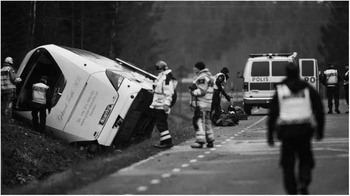
The study encompasses the survivors of a major bus crash that occurred at 7:20 am on December 4, 2014, in Sweden. A bus with 57 passengers and a driver was traveling from Borås, Sweden to Copenhagen, Denmark when the driver suffered a brain hemorrhage while driving and lost control of the bus. The bus went off the road at a high speed (100 km/h) and overturned, leaving the road and hitting a trench on its left side (Figure 1).
The Crash Situation.

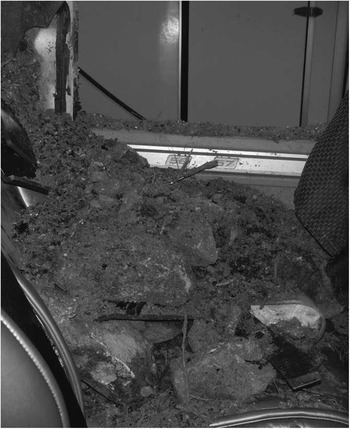
All the glass windows on the left side of the bus were shattered as the bus slid along the rocky terrain for about 50 m. Shattered glass showered over the passengers and soil, plant material, and stones (up to 40 cm in diameter) were thrown with high energy into the bus through the broken windows (Figure 2).
Inside the Bus - Seat Covered with Stones and Soil.Reference Keskinen-Rosenqvist, Michélsen, Schulman and Wahlström 26

Shortly after the crash, four persons who had been driving behind the bus stopped at the scene and started helping passengers, both inside and outside of the bus. Rescue services and police arrived after approximately 13 minutes, and ambulances arrived approximately 15 minutes after crash. The outside temperature was around 0°C.Reference Keskinen-Rosenqvist, Michélsen, Schulman and Wahlström 26
The Swedish Accident Investigation Authority (SAIA; Stockholm, Sweden) initiated an investigation of the bus crash, and two of the authors (ID and UB) were involved in this study as consultants. The participants were recruited on behalf of SAIA, and data for this study were collected during the SAIA investigation. The SAIA, by law, has full access to all data and records, including medical records, on passengers. The SAIA gave permission to the authors to use the data for this study. The data collection and analysis followed the ethical guidelines of the Declaration of Helsinki, and the study has received ethical approval from the Regional Ethics Committee in Umeå, Sweden (No. 2015-279-32M). Participants gave verbal informed consent prior to their interviews.
Participants
The participants in the study included nearly all of the survivors (N=56): eight men and 48 women. Their ages ranged from 19 to 96, with a mean of 57 years. Of the 56 surviving passengers in the study, 54 were subject to a complete follow-up and an interview by telephone.
Quantitative Data Collection
Medical Records and Injury Classification—Quantitative data on all the survivors’ type and severity of injuries were collected from medical records from the three hospitals and two health care centers involved. In addition, complementary data on minor injuries or the absence of injuries were collected in the qualitative data collection process.
Participants’ injuries were sorted with the Abbreviated Injury Scale (AIS). The AIS classification can be described as follows: 0, no injury; 1, minor injury (for example, a superficial laceration or a nose fracture); 2, moderate injury (for example, a concussion, or a “common” fracture); and 3 to 6, serious, severe, critical, and maximal injuries. The Maximum AIS (MAIS) for each participant represented the person’s injury with the highest AIS value. 27
Verbal Screening Questionnaire
During semi-structured interviews, quantitative data on mental status were collected with the use of a verbal version of the Trauma Screening Questionnaire (TSQ). 28 The TSQ is a 10-item questionnaire developed for the early identification of persons at-risk for PTSD after potentially traumatic experiences. It consists of self-assessment questions to which the respondents answer (in this case, verbally) “yes” or “no.” The questions cover two of the PTSD criteria: re-experiencing and arousal symptoms. If a respondent gives six or more yes answers, he or she may be at-risk of developing PTSD and should consider additional psychological support. 28 The TSQ data were collected for all 54 respondents who were interviewed.
Qualitative Data Collection
Interviews
The first author collected qualitative data through taped, semi-structured telephone interviews, focusing on the respondents’ experiences of the crash, their injuries, and their overall care and recovery. Interviews were conducted one to three months after the bus crash with the 54 survivors who were reachable by telephone. The two passengers who were not interviewed had only minor injuries (MAIS 1), but their TSQ data are missing. The length of the interviews varied from 10 to 60 minutes. Extensive notes were taken during the interviews and were compiled into 54 interview summaries.
Data Analysis
Quantitative Data
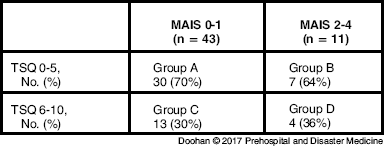
Descriptive statistics were used to present quantitative data. The MAIS and TSQ scores were sorted and combined for all participants and a cross table summarizes the passengers’ outcomes in terms of MAIS and TSQ using four groups (Table 1).
Distribution of MAIS and TSQ

Abbreviations: MAIS, Maximum Abbreviated Injury Scale; TSQ, Trauma Screening Questionnaire.
Qualitative Data
A thematic analysis was conducted to identify and describe patterns in the qualitative data that could offer more insight into the quantitative results.Reference Andrew and Halcomb 19 , Reference Brewin, Rose and Andrews 29 A sample of the 54 interviews was selected prior to the analysis. The four groups from the quantitative analysis (Table 1) were the starting point for the sample selection, and within each group, three to four interviews were selected based on the depth and richness of the interviews. Thirteen interviews were selected for analysis; Groups A, B, C, and D had four, three, three, and three cases, respectively (Table 1). Prior to analysis, the selected interviews were transcribed verbatim.
The first phase of the analysis included reading and re-reading the text to become familiar with the content. The second phase, the coding process, aimed to identify repeated thematic patterns within the specific areas: physical injuries, mental health, and recovery.Reference Brewin, Rose and Andrews 29 In the third phase, the codes were sorted into potential main themes and sub-themes that represented the selected interviews. These themes were then reviewed, refined, and named to capture their essence.Reference Brewin, Rose and Andrews 29 In the last phase, the results of the 13 interviews were validated by re-reading the remaining written interview summaries and listening to the remaining interview audio files (n=41). During the validation phase, the themes were adjusted and refined.
Mixed-Methods Analysis
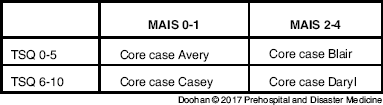
The quantitative results present an overview of the short-term physical and mental consequences for survivors from the four groups in Table 1. All remaining interview summaries were placed in one of the four groups (Table 1) and were re-read to see how prevalent the themes were in the different groups. The four groups, with their existing quantitative characteristics, were expanded using prevalent themes from the qualitative analysis. After jointly interpreting and combining quantitative and qualitative results from the groups, each group was abstracted into a representative “core case” (Table 2). The core cases illustrate the types of survivors who share certain experiences and characteristics, such as injury severity, mental well-being, ways of recovery, and prominent qualitative themes.
Core Cases Integrated from MAIS and TSQ

Abbreviations: MAIS, Maximum Abbreviated Injury Scale; TSQ, Trauma Screening Questionnaire.
Results
Quantitative Results: Injury Mechanisms and Physical Injuries
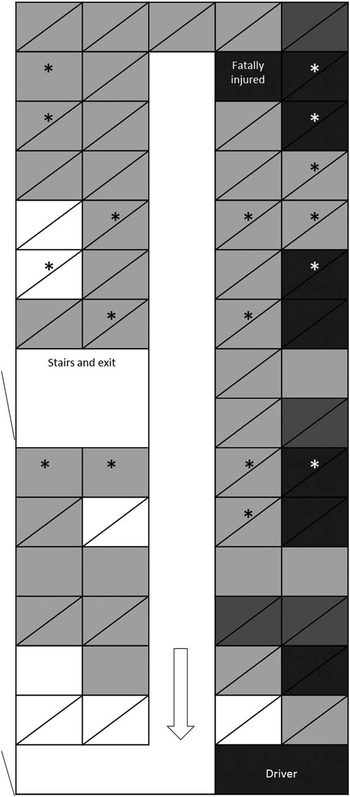
On the left side of the bus (from the inside perspective), the passengers’ upper extremities, heads, and chests were injured as they scraped against sharp stones and rocks on the ground. The seat belt usage among passengers was 79%. Contributing to a tendency to fall out through the windows was the location of the chest part of the seat belt anchor. It was placed in the inboard position, so it did not prevent the passengers’ upper bodies from falling out when the side of the bus hit the ground. A passenger in the back of the bus died inside the bus, shortly after the crash, due to massive injuries to the head, throat, and neck after being hit by a large stone. The driver of the bus suffered a hemorrhagic stroke and died later on the day of the crash, due to a combination of the stroke and chest injuries. All seriously and severely injured passengers were sitting on the left side of the bus (Figure 3).
Seat Belt Use and Distribution of Injury Severity and High TSQ Scores in the Bus. Note: The colors represent the injury severity (black: MAIS 3+; dark gray: MAIS 2; light grey: MAIS 1; and white=MAIS 0). Passengers with TSQ≥6 are marked with asterisks. Passengers wearing a seat belt have diagonal lines across their seats. Abbreviations: MAIS, Maximum Abbreviated Injury Scale; TSQ, Trauma Screening Questionnaire.

Seven passengers (12%) sustained serious or severe injuries (MAIS 3 or 4); four passengers (7%) had moderate injuries (MAIS 2), 38 (68%) had minor injuries (MAIS 1), and the remaining seven (12%) had no physical injuries. The 49 injured survivors had a total of 122 defined injuries, mostly fractures (17%), wounds, and contusions. The upper extremities were the most frequently affected body parts (39% of all injuries), followed by the head (32%). Two victims had massive lacerations/crush injuries—causing severe medical impairment in the long-term—on their left arms, which were caught between the bus and the ground for more than an hour.
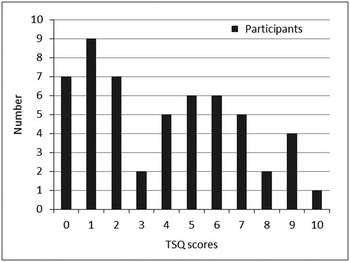
The distribution of TSQ scores (indicating risk for PTSD) for the 54 interviewed passengers is shown in Figure 4. Thirty-seven (69%) of the 54 respondents had low risk (TSQ<6) for PTSD, and 17 (31%) had a high risk (TSQ≥6) for PTSD.
Distribution of TSQ for the 54 Interviewed Passengers. Abbreviation: TSQ, Trauma Screening Questionnaire.

The relationship between injury severity and TSQ is shown in Table 1. Of the respondents who had no or minor injuries (MAIS 0 or 1), 30% were at-risk for PTSD (TSQ≥6)—Group C; comparatively, 36% of those with moderate to severe injuries (MAIS 2-4) were at-risk for PTSD—Group D. If the MAIS 1 cases for survivors who were not interviewed are taken into account, the percentage for the minor injury group will not be outside the interval of a 29% to 33% risk for PTSD.
Qualitative Results
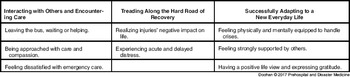
The thematic analysis resulted in three themes and eight sub-themes covering varying consequences and aspects that affected survivors’ recoveries (Table 3).
Themes and Sub-Themes

Interacting with Others and Encountering Care
The first theme covers the actions and interaction in the bus and among passengers as well as the survivors’ different experiences regarding prehospital and hospital care.
Leaving the bus, waiting, or helping were three main patterns of action that emerged among the survivors during the first minutes after the crash. Many of those who had been sitting on the left outboard side managed to avoid more severe injuries since they tried to protect themselves when the bus went off the road. Many of the survivors felt a strong urge to leave the bus as quickly as possible. They feared that it was dangerous to stay inside the bus due to perceived risks, such as the bus catching fire or falling over. In some cases, the urge to leave was so strong that persons left their travel companions behind. On the other hand, survivors who were traveling in groups stayed with those who were injured; they described feeling rational, calm, and capable. Their first thoughts immediately after the crash were to make sure that their family members or friends were safe. Many of the injured persons focused on themselves and did not notice anything around them. Some survivors stayed in their seats and waited for someone to help them to leave the bus, either due to injuries or due to being stuck in their belts. A few survivors were unable to move due to being in shock. One survivor stated:
There are many thoughts. You have a very clear head. Very clear head. And I had an ice-cold mind. [...] You are very focused and you reason. [...] I checked the surroundings, I fixed things, and I kept an eye on my injured husband. (Participant 42)
Being approached with care and compassion was experienced by a majority of the survivors as the emergency responders were perceived as competent and effective. However, most of the survivors with minor or no injuries had limited contact with emergency responders. Survivors who had evacuated from the bus looked after each other and were guided by rescue services or police personnel to a gathering place. After finding a warm place to sit, having something to eat and someone to talk to was highly appreciated. One positive aspect of care that stood out was compassion. Small empathetic acts by fellow passengers, lay responders, and emergency responders, such as sitting next to an injured person, or holding that person’s hand, resulted in feelings of calmness and safety, reducing pain and stress among the survivors. The survivors greatly appreciated these acts of compassion, and some considered it the most important aspect of support during the day of the crash. One survivor noted:
It was helpful when a man from the rescue services arrived, it helped me a lot that he sat next to me. [...] I was in pain, but someone was there with me. […] He sat down so quietly and calmly and held me. He made sure that uninjured and injured passengers did not fall down on top of me, since they walked on the seats over me. (Participant 40)
Feeling dissatisfied with emergency care was described, although most of the survivors were satisfied with the emergency care offered. There were several shortcomings, such as moderate and severe injuries not being recognized, perceiving a lack of compassion, or being stuck in the bus for a very long time. One example is a survivor’s serious face injury, which initially was not triaged as serious because the injured person was able to leave the bus and walk around.
The need to stay close to an injured family member or a close friend for as long as possible was in some cases not met. Not being able to follow these companions to the hospital or ending up alone after the crash caused distress. A survivor recounted this experience:
When I saw that my sister was placed on the stretcher I went up to her and it looked as if she was dead. Then I panicked [...] two persons came and took me away, and took me to the other gathering bus. I asked if I could go with her in the ambulance, but I was not allowed to. It was not until after eight hours I was told that she was alive. I was in panic, complete panic. (Participant 13)
However, most of the shortcomings were evident after arrival at the hospitals. Examples included survivors having to wait for hours for pain relief and one survivor being mistreated by a physician. A few persons could not comprehend the information given to them about their injuries and were not able to ask further questions at the hospital because they were in shock. Family members of seriously injured survivors had to wait for hours before receiving any information.
Treading Along the Hard Road of Recovery
This was the second theme that emerged. Daily struggles characterized the first couple of months for many of the survivors as they tried to recover from their physical injuries and mental distress.
Realizing injuries’ negative impact on life as their serious to severe injuries greatly affected the everyday life. It was difficult for them to accept that their injuries stopped them from going back to the life they had before. They felt restrained due to constant pains and reduced mobility. Difficulties included daily activities such as eating, getting dressed, driving, cooking, and shopping as well as meaningful activities such as playing the piano. Participants had to rely heavily on their family members. Survivors experienced frustration and irritation over how their pain affected their family members in a negative way. One survivor explained:
The accident has affected everything. Just everything (sounds sad). I cannot do anything by myself. [...] Right now, anyway, because my right arm does not work. I cannot go anywhere. I have been offered transportation service, but I feel that it would be quite degrading to me [...] so I do not want it. I have to rely on friends or my husband for a ride. […] It is terribly hard mentally, I don’t recognize myself in some ways, and I don’t know what will happen with the arm. (Participant 8)
Despite most survivors feeling satisfied with the medical care offered at the hospitals and health care centers, there are many instances of survivors not receiving the medical care they felt they needed during the first couple of months. Many survivors wanted someone to follow-up on their injuries and mental state, but they had not received any follow-up.
Experiencing acute and delayed distress was seen as many of the survivors were significantly troubled by nightmares, flashbacks, and feelings of sadness or depression. They spoke of being constantly reminded of the bus crash, leading to bodily reactions such as aches, shivering, and nausea. They were not able to travel by bus any longer. Their sense of security was shattered, and they started to worry extensively about everyday events and about the future. Some no longer enjoyed being around others or doing activities that normally brought them joy. Survivors described how their mental state shifted from one day to another, going back and forth like waves. One respondent detailed this phenomenon:
I thought: oh, I don’t need help, I can do this. I can handle the mental issues. But somehow it has caught up with me afterwards. It took me about a month before I realized that I needed help, and I needed to talk to someone. [...] I have huge problems daily; I go by bus and I’m so observant, and at the slightest thing, I feel a strong pain in the stomach, as if there’s a knot in the stomach. Travelling by bus is still very hard. [...] I cannot sleep and I wake up at night. The smell of grass, from after the accident when all the windows were gone and I was lying there waiting for help, can appear at any time. And the smell of fire from the firefighter, it can appear all of a sudden. (Participant 52)
Survivors with moderate to severe injuries experienced long periods of physical recovery, and at the time of the interviews, many were still struggling with rehabilitation after major injuries. Some realized that when they started to feel better physically, they experienced an onset of mental distress.
Mental well-being is in some cases closely linked with a family member’s or friend’s trajectory of physical recovery and well-being. Survivors described the constant reminders of another person’s pain or impairment due to injuries or mental distress as hindering their own recovery. In some cases, guilt over being uninjured increased their discomfort. Still, the desire to be supportive overrode the negative effects on their well-being. A survivor discussed this desire:
I visit my friend at the hospital every day or we talk on the phone. However, I wouldn’t want to stop doing it, because we’ve talked a lot before the accident as well [...] but it’s clear that this is being kept alive in a different way than if I had not talked to her. However, I have chosen to do so myself [...] and I feel that I am a support to them. [...] The days when I see that she both looks better and feels better [...] it is contagious, and we make up plans of what we want to do [...] then the days come when she is not feeling well, like right now, and it affects me. It does. (Participant 36)
Successfully Adapting to a New Everyday Life
This was the last theme that emerged. A group from the impacted population experienced a functional recovery during the first couple of weeks and months. Different aspects—such as mentality, sources of support, and attitude towards life—facilitated a return to an everyday life, with or without injuries.
Feeling physically and mentally equipped to handle crises were seen. Personal traits, such as feeling stable, confident, and calm, had a positive impact on recovery. Previous experiences, such as working in a school, a church, or any other environment where crises are common, seemed to facilitate recovery for many. One survivor explained:
I’m a pretty strong person in myself. Pretty balanced, so to speak, and have a good basic sense of safety. I think people around me also see me as a strong person. I also think that I have talked about it a lot and I have not repressed it, it has been allowed to come out. If I wanted to cry, I could cry, so to speak. I let everything come out and I do not push it away. (Participant 44)
Feeling strongly supported by others (ie, to have access to strong social support from family, friends, and colleagues) was an important aspect of a positive recovery. Survivors explained that during the first couple of weeks, they had a distinct feeling of only wanting to be close to and talk to their families, their closest friends, and those who had experienced the same event. Some even felt that the best support came from those who had shared the experience. Survivors greatly appreciated having a family member who could follow them and stay with them from day one to offer support, as a survivor noted:
The best thing that could happen was that my husband could be there (at the hospital after the crash), he stayed with me for five nights because I was completely out of balance. You know, I was so worried I wanted to crawl out of my own body [...] so he handled much of what I needed to get out of me. [...] It was he who took the nights with me and not the hospital staff. It has meant a lot that he was allowed to stay with me. We got a private room and an extra bed so he could be with me. Otherwise I would not have managed the situation as well as I have. (Participant 8)
Having a positive life view and expressing gratitude was something the survivors thought of as a reason for their hopeful early recovery. Their life views were influenced by faith, religion, and spirituality. One of the repeated patterns was to express feelings of gratitude toward life and for the fact that they had survived:
I am so incredibly happy and pleased with the outcome. [...] I’m thinking that it was so close. The stone or whatever it was that hit my jaw, I mean, had it hit me five centimeters further down it could have hit the carotid artery or if it had hit me further up I might have suffered brain damage. And I am on my way to recover. [...] I really appreciate being outdoors. I think it’s fantastic to get the opportunity to be outdoors again. (Participant 43)Reference Ben-Ishay, Mitaritonno, Catena, Sartelli, Ansaloni and Kluger 3
Integration: Core Cases
Core Case Avery: Minor Injuries and Temporarily Affected
Avery represents a survivor who sustained no or minor injuries, who for example was hanging in a seat belt or thrown against an armrest. Avery sat in the front of the bus on the right side (Figure 3) together with a family member or a friend who had only minor injuries. Avery and a companion were both able to leave the bus shortly after the crash, and they did not experience many potentially traumatic impressions. Outside the bus, Avery remained calm and sat in a group of people until being directed to a warm gathering place by emergency personnel. Despite having to wait for a long time and having little contact with ambulance personnel, Avery was satisfied with the care offered. Avery experienced that the personnel, lay responders, and fellow passengers were caring and compassionate. Avery attributed social support, feelings of strength, a positive outlook on life, and previous experience in crises to a successful early recovery. Survivors like Avery had low scores on the TSQ, demonstrating minimal risk of developing PTSD.
Core Case Blair: Moderate Injuries and Temporarily Affected
Blair represents a survivor with a moderate injury who sat in the front of the bus on the left side (Figure 3). The left arm and head were pulled along the ground or hit by stones, causing moderate injuries. Blair was able to leave despite being injured, which minimized the exposure to potentially traumatic impressions. Blair received medical attention and support from family members and emergency personnel, which decreased harmful stress levels. Blair shared the same characteristics of resilience as Avery (eg, feeling strong and capable, having knowledge of crises, and having a positive and grateful approach to life). Due to ample social support, Blair was able to readjust to a new life and recovered well from a short-term perspective, as reaffirmed by low scores on the TSQ.
Core Case Casey: Minor Injuries and Highly Affected
Casey sustained minor injuries but had a family member or friend who was seriously or severely injured. Shattered glass, stones, and impacts with the bus interior caused the minor injuries. Casey represents a survivor who was sitting in the back of the bus (on either the left or the right side), in the center of a potentially traumatic situation (Figure 3). Casey tried to help other injured persons or stayed in the bus to wait for help. Casey was disappointed with the emergency care and experienced a lack of medical care and support, either for oneself or for a family member or friend. Casey’s well-being was also linked to that of a family member’s or a friend’s recovery from injuries. Social support was available for Casey, but mental distress affected daily life. Casey got a high score on the TSQ and was at-risk of developing PTSD.
Core Case Daryl: Serious Injuries and Highly Affected
Daryl represents a survivor who sat on the left outboard side of the bus and suffered from a serious to severe injury (Figure 3). The injury was caused by sliding out of the seat belt toward the ground, seriously injuring an arm or head. Daryl was exposed to a highly stressful situation and experienced a long wait for help. Later, the injury had a big impact on everyday life, leaving Daryl to readjust to a restrained life at home. Daryl was in need of practical help and mental support from family members. Overall health and well-being also were affected by worries and distress among family members and friends. Daryl got a high score on the TSQ, indicating a risk of developing PTSD.
Discussion
The main results discussed are injury mechanisms, aspects hindering recovery, and aspects facilitating recovery.
Injury Mechanisms
Both physical injuries and mental consequences could be reduced through different injury mitigation measures. In the crash phase, stones flying into the bus from the rocky roadside terrain contributed to the most serious injuries. This injury mechanism is not yet fully recognized. In the absence of roadside fences, softer roadside material and vegetation may be used as buffers. Road safety audits (RSAs) are conducted in many countries to ensure that road safety standards are good. In Sweden, RSAs are used on the largest roads but, strangely enough, are not used on the rest of the road network where most of the serious and fatal crashes occur.Reference Braun and Clarke 30
Another noteworthy injury mechanism was being thrown against (and sometimes through) the windows when the side of the bus hit the ground. This was due to the upper anchor point of the chest portion of the seat belt being placed on the inboard side; thus, it did not restrict the body’s movement against the side of the bus. The shattered, tempered-glass windows caused many cuts. An anti-lacerative window with an inner plastic layer would probably have reduced these injuries and prevented the ejection of body parts. An injury mitigation measure taken instinctively by many of the passengers was to protect themselves during the crash phase (eg, covering their heads and turning away from the windows).
In the post-crash phase, the four persons from the car behind the bus did an admirable first effort, turning off the engine and starting the evacuation of the bus. This quickened the rescue operation and the feeling that they were being helped alleviated the survivors’ distress. The rescue service personnel had undergone special training in handling a large bus crash, which contributed to SAIA assessing the rescue operation as well-executed, with one exception. The bus should have been lifted earlier so as to release survivors who had their arms caught between the bus and the ground. In this case, it took over an hour before the last survivor was released.Reference Keskinen-Rosenqvist, Michélsen, Schulman and Wahlström 26
Due to the first sorting triage system, 31 a couple of the survivors who had moderate to severe injuries but who were walking felt overlooked, as the system defines those who can walk as Priority 3 (green). The priority was later changed during a second examination in the ambulance using the ordinary system,Reference Hodgetts and Mackaway-Jones 32 and the injuries were treated accordingly. This switch caused some confusion at the receiving hospitals, which were unaware of the changes, as the number of Priority 1 cases reported to them doubled. This justifies SAIA’s proposal to review the use of different triage systems in Sweden.Reference Keskinen-Rosenqvist, Michélsen, Schulman and Wahlström 26
Aspects Hindering Recovery
One aspect that seems to have had an impact on the survivors’ subsequent recovery is their exposure to potentially traumatic impressions. A perceived threat to one’s own life or to the life of a family member or a friend after a MCI increases the risk of both physical and mental problems. 33 , Reference Johannesson, Arinell and Arnberg 34 It is likely that core cases Casey and Daryl perceived such life threats, which may have contributed to their slower mental recoveries. For core case Casey, all of the survivors shared an interesting pattern: they sat in clustered groups, close to a person with moderate to severe injuries or close to the dead passenger, whom they may or may not have known previously (Figure 3). This proximity may have affected their subsequent recovery in a negative way. In addition, Casey did not feel that personal needs or the needs of a family member or a friend were fully met. Having one’s basic needs attended has been shown to be highly important for existential health.Reference Bonanno and Diminich 17 Previous studies have pointed to the importance of attentive and compassionate care after MCIs.Reference Bonanno and Diminich 17 , Reference Arnberg, Michel and Lundin 35 A study on bus crash survivors showed that a perceived lack of compassion can affect a survivor to the extent that it remains one of the strongest and most negative experiences of the crash.Reference Arnberg, Michel and Lundin 35
Casey represents the group of survivors in greatest need of empathetic and specialized care, mainly after the crash but also in the long-term. Facilitating closeness to family or friends will alleviate initial distress. Casey will not have visible injuries or obvious reasons to contact health care, which highlights the need for active follow-up for all. In the present study, the limited follow-up calls came from municipality crisis groups; they were sporadic and did not reach the survivors who probably needed such calls the most.
Survivors’ mental well-being was not related to their injury severity, as one-third of the survivors with no or minor injuries showed a similar risk of future psychiatric problems (TSQ≥6) as survivors with MAIS 2-4. In a study on the risk of PTSD and depression after an airplane crash, no association was found between the course of PTSD symptoms after the crash and either injury severity or hospitalization.Reference Doohan and Saveman 36 Similar results have been found after motor vehicle crashes.Reference Gouweloos, Postma, Te Brake, Sijbrandij, Kleber and Goslings 37 Following up during the subsequent weeks and months is particularly important to those who have no or minor injuries.Reference Doohan and Saveman 36
However, for those with moderate to severe injuries, life can still be highly challenging. For those in core case Daryl, their injuries’ severity caused a major impact on their lives and on the lives of their families. Being seriously injured is known to affect mental well-being and cause sadness and grief.Reference Arnberg, Hultman, Michel and Lundin 25 These survivors were no longer able to do their day-to-day activities, which affected them greatly. A physical strain may very well evolve into an existential strain from a long-term perspective.Reference Bonanno and Diminich 17 Previous studies described how mental health problems can be kept alive due to constant reminders of the events.Reference Arnberg, Hultman, Michel and Lundin 25 , Reference Fujita and Nishida 38 For those living with moderate to severe physical injuries (Daryl) or with a partner who sustained moderate to severe injuries (Casey), this could explain why they are struggling with mental distress. The social context and the relationships among the survivors seemed imperative, both immediately after the crash and during the weeks that followed.
The survivors’ personal and societal resources to adapt are imperative to their ability to recover.Reference Ben-Ishay, Mitaritonno, Catena, Sartelli, Ansaloni and Kluger 3 What stands out throughout the process of recovery is the interconnection among the survivors. Their recoveries seemed to be linked to the well-being of an affected family member or friend. Not being able to stay with an injured significant other caused severe distress for the person left behind (ie, Casey). One of the cornerstones in crisis support is to enable togetherness among affected persons after a MCI, as this will reduce stress and facilitate recovery.Reference Dyb, Jensen and Nygaard 7
Aspects Facilitating Recovery
Core cases Avery and Blair, representing the majority of the survivors, had mainly adaptive and unselfish responses immediately after the crash. These responses are in line with previous research on behaviors after disasters.Reference Andrews, Brewin, Philpott and Stewart 39 Avery and Blair expressed some dissatisfaction with prehospital and hospital care, but in the big picture, they felt that care and support was sufficient for their needs. They also possessed resources that helped them recover. Survivors who seem to recover quickly after experiencing a MCI (eg, Avery) usually have a relatively mild and temporary stress reaction and perceive that they have the ability to continue normal levels of functioning. This reaction is called “minimal-impact resilience,” and it is the most common outcome observed after potentially traumatic events.Reference van der Berg, Grievink and van der Velden 16 Resilience can broadly be defined as the capacity to recover and return to healthy, symptom-free functioning after a potentially traumatic event.Reference Grimm, Hulse, Preiss and Schmidt 40 Within research on stress reactions after MCIs, this perspective has been somewhat dualistic. It has been suggested that the prevailing perspective provides a simplified description of reality in which the absence of disease, in combination with access to social support, suggests resilience.Reference van der Berg, Grievink and van der Velden 16 Describing resilience as the absence of mental illness is as blunt as defining health as the absence of disease, according to this critique.Reference Bonanno, Galea, Bucciarelli and Vlahov 41
A binary approach simply places all survivors who do not fall into the spectrum of being at-risk for PTSD (in this study’s core cases, Avery and Blair) into a homogenous and rather unexplored category.Reference van der Berg, Grievink and van der Velden 16 In reality, there are a myriad experiences and consequences affecting their well-being. Some of them had minimal-impact resilience and were able to return quickly to a life with social activities and minimal distress. However, within core cases Avery and Blair, some survivors suffered from physical and mental difficulties in everyday life—just not as many as in core cases Casey and Daryl. A mixed-methods approach enables a comprehensive understanding of this resilient group of survivors.
Strong empirical evidence of the beneficial factors of social support exists,Reference Dyb, Jensen and Nygaard 7 , Reference Almedom and Glandon 42 , Reference Rehnsfeldt and Arman 43 and in this case, social support was available for a majority of the survivors. However, the results indicate that there are more aspects to a successful recovery than the presence of social support. The availability of social support may not be enough to explain the survivors’ different trajectories of recovery. Other aspects have surfaced to set Avery and Blair apart from the other core cases. Positivity, faith, previous experiences in dealing with crises, and physical and mental strength contributed to these survivors’ successful recoveries. The interconnection among survivors (and especially within families) also was apparent in facilitating recovery. Interestingly, spouses who were traveling together often shared some of these positive aspects. Feeling grateful toward life is another recurring pattern among the healthy survivors, and this aspect also has been found in disaster studies.Reference Polit and Beck 24 Positive emotions and an optimistic outlook on life have previously been associated with better adjustments and more adaptive coping after adverse events.Reference Grimm, Hulse, Preiss and Schmidt 40 Personality traits and a perceived capability to connect with ample social support most likely created a strong basis of recovery for the survivors in core cases Avery and Blair. Although many of these beneficial aspects are relatively fixed dimensions, answers on how to increase resilience and stimulate recovery may very well lie within this group of survivors.
Strengths and Limitations
A major strength of this study is the study population. Interviewing all but two persons out of the total population increases the study’s transferability and robustness. Representative quotations that can be traced back to the original interviews add to the transparency and trustworthiness of the qualitative analysis as well as to its internal validity. Detailed descriptions of study context, participants, and methods support transferability to another case.Reference Cooper, Porter and Endacott 23 One limitation lay within the use of the TSQ, which is validated previously 28 , Reference Thoits 44 , Reference Brewin 45 but not yet in a Swedish context. The purpose of choosing TSQ was to achieve, in a simple way, an indication of the participants’ mental well-being, not to determine diagnoses or to validate TSQ.
Conclusion
The present study provides a multi-faceted understanding of MCI survivors (ie, having minor injuries does not always correspond to minimal risk for PTSD and moderate to severe injuries do not always correspond to increased risk for PTSD). Injury mitigation measures (eg, safer roadside material and anti-lacerative windows) would reduce the consequences of bus crashes. A well-educated rescue team and a compassionate and competent social environment will facilitate recovery.
Acknowledgements
The authors are grateful to all of the participants for sharing their experiences and to the Swedish Accident Investigation Authority for making this study possible. They would also like to thank Johanna Björnstig for transcribing interviews. Umeå University, the Swedish National Board of Health and Welfare, Kempe Foundations, and Wallenberg Foundation have supported this work.