Introduction
Although production and demand for the tool materials such as sintered carbides, ceramic materials, and extremely hard materials increased dramatically in recent years, high-speed steels (HSSs) are still one of the main materials used for the production of cutting and plastic working tools, because of their excellent integrated performance, such as high hardness, satisfactory ductility, and good machinability [Reference Pirtovšek, Kugler, Godec and Terčelj1, Reference Guo, Ai, Wang, Feng, Wan and Yang2, Reference Vitry, Nardone, Breyer, Sinnaeve and Delaunois3]. Such properties are derived from the microstructure comprising heavily twinned martensite matrix strengthened by evenly distributed nanosized precipitates, and a population of primary carbides [Reference Deng, Zhu, Tieu, Zhu, Reid, Saleh, Su, Ta, Zhang, Lu, Wu and Sun4, Reference Serna and Rossi5, Reference Zhou, Fang, Li and Jiang6]. However, due to the slow cooling rate in conventional ingot metallurgy (IM), many coarse primary carbides such as dentrite and conglomeration fishbone eutectic carbide are typically precipitated from melt, leading to damage toughness and ductility. Even though these carbides can be broken up during hot working process, the formed angular carbide with zonal distribution will reduce isotropy and decrease toughness in the transverse direction [Reference Bombač, Terčelj, Fazarinc and Kugler7, Reference Mesquita and Barbosa8]. To solve this problem, powder metallurgy (PM) has been successfully developed to fabricate HSSs with refined microstructures and uniform distribution of carbides, and it has properties that are normally superior to the cast-wrought products [Reference Shen, Yu, Li, He, Zhang, Zhang, Jiang and Lin9, Reference Garcia, Romero, Herranz, Blanco and Martin10, Reference Zhang, Li, Xie, Xiao and Yin11, Reference Trabadelo, Giménez and Iturriza12]. However, PM typically includes a number of complicated processes and high costs associated with hot isostatic pressing and low yields [Reference Lavernia and Srivatsan13]. Alternatively, spray forming (SF) has been proposed for fabricating high-alloyed HSSs with low-level macrosegregation and cost-effectiveness, due to its high cooling rate during atomization and single processing of deposition [Reference Zhang, Yuan, Jiao, Li, Zhang and Liu14, Reference Jesus, Jesus and Rossi15, Reference Grant16, Reference Lu, Hou, Zhang, Wang, Cui, Huang, Zhang and Zhang17, Reference Mesquita and Barbosa18].
During the past decades, the demand for producing cost-effective HSSs with high performance has motivated a number of attempts to investigate the possibility of substituting the part of the relatively expensive alloying elements (W, Mo, V) with cheaper and more easily available ones: Si, Ti, Al, Nb, for instance [Reference Kim, Park, Lee, Kim, Kim and Yang19, Reference Pan, Ding, Zhou, Kang and Edmonds20, Reference Chaus21, Reference Park, Lee and Lee22, Reference Dobrzański and Zarychta23, Reference Mesquita and Kestenbach24, Reference Filipovic, Kamberovic, Korac and Gavrilovski25, Reference Hamidzadeh, Meratian and Zahrani26]. Among elements, Nb is a strong carbide-forming element that has a higher affinity with carbon than V and can form very stable MC-type carbides during solidification. There are quite a lot of studies showing that the cast structures of HSSs were refined and improved properties could be acquired by adding a small amount of Nb [Reference Chaus21, Reference Dobrzański and Zarychta23, Reference Filipovic, Kamberovic, Korac and Gavrilovski25, Reference Hamidzadeh, Meratian and Zahrani26]. But other reports have mentioned that in steels with more than 2 wt% Nb, larger block NbC generated from the melt first, these carbides are very stable and not affected under subsequent heat treatment (HT), and the toughness of steels will be deteriorated [Reference Zhi, Xing, Fu and Xiao27, Reference Coelho, Golczewski and Fischmeister28]. This phenomenon can be eliminated effectively by adopting an integrated approach of SF and thermal-mechanical treatment. It is well known that metastable M 2C carbides can be decomposed into a mixture of fine MC and M 6C carbides during annealing beyond 1000 °C [Reference Pan, Wang, Tang, Wu, Liu and Cheng29, Reference Fredriksson, Hillert and Nica30, Reference Lee, Park, Baik and Ahn31] and the plate-like M 2C in spray-deposited (SD) steels is much thinner than those in ingots fabricated by conventional IM. These thin M 2C plates can be decomposed easily for their shorter reaction diffusion path during decomposition treatment; therefore, it is expected that the finer and more uniform distribution of carbides can be obtained by M 2C decomposed. Some publications have reported the decomposition behavior of the M 2C carbide, e.g., in a unidirectionally solidified M2 HSS [Reference Fredriksson, Hillert and Nica30], a spray-formed ASP30 HSS [Reference Lee, Park, Baik and Ahn31, Reference Lee, Park, Jung and Ahn32], and centrifugal casting HSS rolls [Reference Kim, Park, Lee, Kim, Kim and Yang19], and Lee et al. have reported the presence of refined carbide in spray-formed ASP30 HSS after sufficient decomposition at high temperature [Reference Lee, Park, Jung and Ahn32]. However, the effect of Nb on the decomposition behavior of M 2C in the spray-formed HSSs has been rarely reported; previous studies have shown that 0.5% Nb addition can facilitate the decomposition of M 2C carbides during annealing at 1000–1100 °C, but evolution of carbides during thermal-mechanical treatment and its effect on the properties still remain unclear. In this work, M3:2 HSS billets with 0–2 wt% Nb addition aiming at improving the antiabrasive properties and tool life were prepared by SF; subsequently, selected as-deposited materials were processed through decomposing–hot forging treatment to optimize the microstructure and properties. The microstructure evolution and mechanical properties of the investigated steels after thermal-mechanical processing were studied in detail.
Results and discussion
Microstructures of the as-deposited HSSs
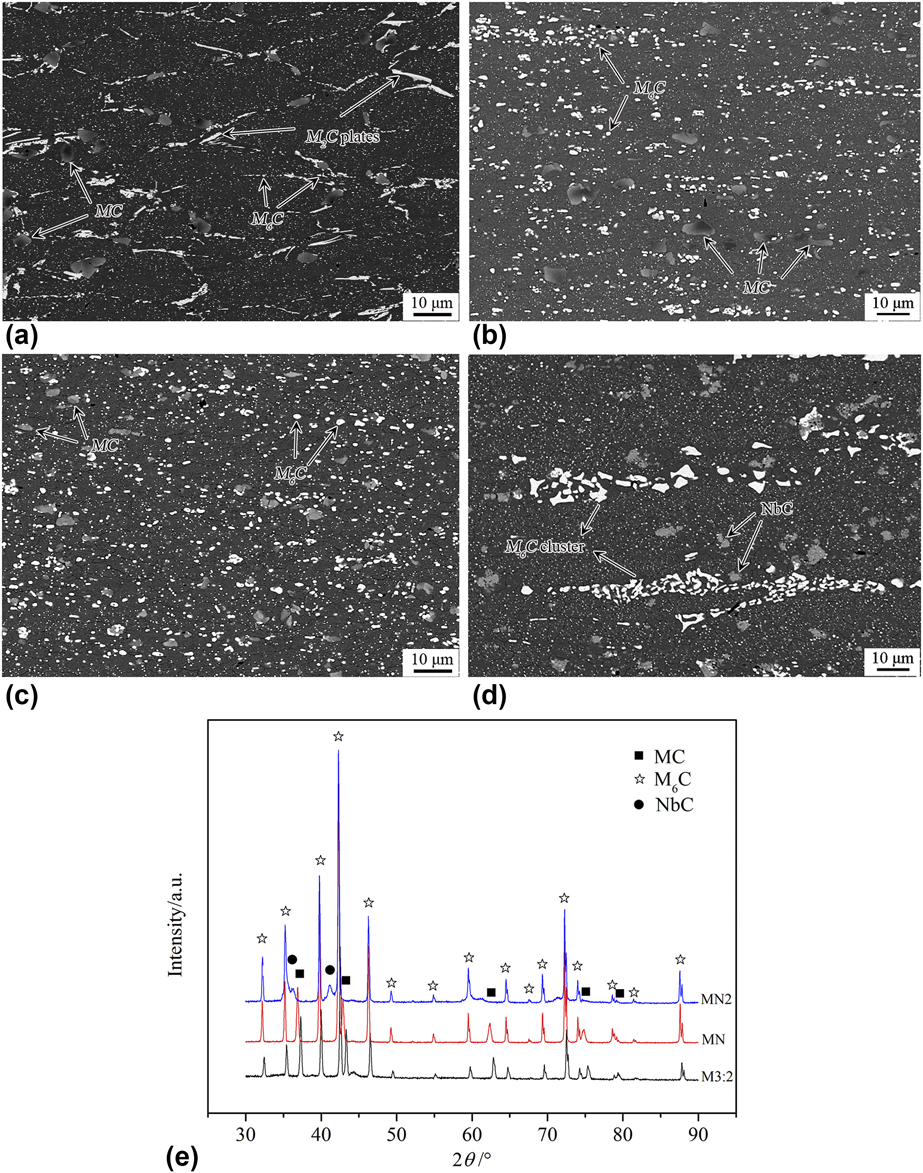
Figure 1 illustrates the solidification microstructure of spray-formed steels made in this study. Generally, all samples contain equiaxed grains separated by intergranular eutectic carbides. As shown in Fig. 1(a), the eutectic carbides in M3:2 present discontinuous plate-like (white, marked by arrow A) or irregular blocky shape (gray, marked by arrow B). The results of SEM and XRD in this study indicate that the plate-like and blocky carbides are M 2C and MC, respectively. The grain size ranges from 10 to 35 μm with a mean of approximately 25 μm. And the average width of the M 2C films and the approximate size of irregular MC particles are approximately 2 μm and 8 μm, respectively. These carbides are significantly smaller than those observed in conventionally cast ingots which are comprised of large dentrite grains of size several hundred micrometers and a coarse, fishbone-like eutectic carbide network [Reference Mesquita and Barbosa8, Reference Kim, Park, Lee, Kim, Kim and Yang19]. Figure 1(b) shows the microstructure of as-deposited MN. It can be found that the morphology and distribution of carbides have been changed by 0.5% Nb addition. The plate-like M 2C carbides became thin and fine, and the irregular MC carbides observed in M3:2 were replaced by the more uniformly distributed spherical MC carbides with an approximate size of 4–6 μm. Occasionally, some MC carbides can be observed inside the austenite grains, and these particles are relatively smaller than those located at grain boundaries. The mean sizes of M 2C eutectic carbides and austenite grains appeared in the MN are measured to be approximately 1 μm and 18 μm, respectively. With 0.5% Nb addition, the volume fraction of M 2C eutectic carbides decreased from 7.3 to 3.67%; accordingly, the MC carbide volume fraction increased from 1.38 to 3.87%. Figures 1(c) and 1(d) demonstrate the typical microstructure of as-deposited MN2. It can be clearly seen that the noticeable microstructure alternation has been occurred with 2% Nb addition. The prior austenite grains (approximately 12 μm) are significantly finer than the one presented in the M3:2 and MN, and the carbides characterized as continuous films at grain boundaries are identified as M 6C-type carbides; additionally, MC (NbC) carbides are found to be uniformly distributed throughout the microstructure, and the MC phases within grains (approximately 0.5–1 μm) were finer, more uniform, and denser than those located at grain boundaries (approximately 2 μm).
Representative microstructures of the spray-formed HSS billet: (a) M3:2; (b) MN; (c) MN2; (d) high magnification of (c); (e) XRD profiles of the as-deposited HSSs.

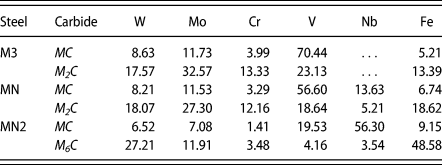
Figure 1(e) shows the XRD patterns of the as-deposited HSSs. M 2C, MC, γ-austenite, α-Fe phases were detected in the M3:2 and MN samples; by contrast, the types of primary carbides presented in MN2 are M 6C and NbC, which correspond to the microstructures observed in Figs. 1(c) and 1(d). It can be noted that the peak positions of MC-type carbides for MN2 are moved to lower diffraction angles and the peak width increases, indicating that the lattice parameters of MC phase increased and the grain size of MC particles decreased with 2% Nb addition. The calculation results for the lattice constant of MC reveal an increase from 0.4202 nm (M3:2) to 0.4389 nm (MN2), which is very close to the lattice parameter of NbC (0.447 nm). It means that the V-rich MC carbides in M3:2 steel have changed to totally NbC-type carbides with 2% Nb addition. Average substitutional elements in primary carbides for various steels, as determined by EDX microanalysis, are shown in Table I. In M3:2 steel, MC are V-rich carbides containing mostly V with small amounts of W, Mo, Cr, and Fe; M 2C carbides mainly contain Mo and V. With 0.5% Nb addition, nearly 14% V in the MC carbides was substituted with the same amount of Nb. It should be noted that a trace of Nb (approximately 5%) can also be detected in M 2C carbide, and the contents of Mo and V in these carbides are lower, while Fe content is higher compared to those in M3:2. With 2% Nb addition, the Nb content of MC carbides increased to 56%, while the proportion of V decreased to 20%. Additionally, a small quantity of Nb (approximately 3%) was also detected in the M 6C carbides, as shown in Table I.
Quantitative EDX analysis results of primary carbides in HSSs (atomic percent, %).

From the above analysis, it can be concluded that the spray-formed HSSs consist of uniform equiaxed grains and fine carbides. 0.5% Nb addition can refine the prior austenite grains, modify eutectic carbides by reducing both the sizes and volume fraction of M 2C carbides, and refine the morphology and distribution of MC carbides. Adding 2% Nb not only makes MC carbides refined and uniformly distributed, but also is in favor of the formation of M 6C carbides. In addition, the size of prior austenite grains could be reduced prominently with 2% Nb addition. Therefore, it is considered that the SF process combined with Nb alloying can effectively modify the solidified microstructures of HSSs.
According to the phase diagram of Fe–W–Mo–Cr–V–C pseudobinary system, for HSSs with carbon content exceeding 1.2%, the nucleation of primary austenite phase starts at the liquidus temperature [Reference Luan, Song, Bai, Kang and Li33, Reference Mclaughlin, Kraft and Goldstein34]. The fraction of austenite increases with the decrease in the melt temperature, and simultaneously, the remaining liquid is saturated with carbon and alloying elements. Finally, the ledeburite eutectic constituent (γ + C, where C = M 2C and/or M 6C, possibly also MC) is formed as a result of the eutectic transformation (L → γ + C) at the eutectic temperature, which completes the solidification process [Reference Barkalow, Kraft and Goldstein35]. Figure 2 shows an overview of the equilibrium phases, their amounts, and the temperature ranges using Thermo-Calc with the OTCFE database, confirming the results previously reported by Barkalow et al. [Reference Barkalow, Kraft and Goldstein35]: Austenite formation starts at 1370 °C from the liquid for M3:2 steel, followed by precipitation of primary M 6C and MC carbides at 1253–1270 °C, and then solidification is completed at 1232 °C [Fig. 2(a)]. With 0.5% Nb addition, the MC carbide and solidus temperatures are increased to 1317 °C and 1241 °C, respectively [Fig. 2(b)]. With the Nb content increased to 2%, it can be noted that the temperature of the generation of MC carbide was increased to 1417 °C, which is higher than austenite temperature. Additionally, the M 6C carbide and solidus temperatures were also increased to 1282 °C and 1258 °C, respectively.
Thermo-Calc simulation of the equilibrium phases for HSSs: (a) M3:2; (b) MN; (c) MN2.

For M3:2, irregular MC and plate-shaped M 2C carbides are found to be coexisted in the austenite grain boundaries [Fig. 1(a)], and it can be attributed to the simultaneous formation of the interdentritic eutectic MC and M 2C carbides during eutectic transformation [Fig. 2(a)]. However, with 0.5% Nb addition, the monocarbide MC nucleates before the onset of the ledeburite crystallization [Fig. 2(b)]. In such cases, the amount of MC carbides increased and they floated in the front of solid–liquid interface, restraining the growth of prior austenite grains as well as the generation of M 2C eutectic carbide. Evidence of primary MC nucleation is found in the form of spherical MC particles embedded in the austenite grain boundaries, as shown in Fig. 1(b), and the refined grains and M 2C eutectic carbides can be obtained. Similar observations have been reported by Fischmeister [Reference Fischmeister, Riedl and Karagöz36]. In the case of MN2, a Nb content of 2% is already sufficient to lead to the crystallization of NbC from the melt [Fig. 2(c)]. NbC crystals floating in the melt can be pushed ahead of the tip of dentrite front, where they can grow to larger sizes before they are finally trapped. Notably, it is interesting to note that the NbC particles presented in MN2 are extremely fine and dense and that the eutectic carbide has changed from M 2C to M 6C type. Recently, a solidification model for the SF steels proposed by Zepon et al. stated that the solidified droplets were partially remelted and/or redissolved until attaining the equilibrium liquid fraction and that the solidification sequence continued in near equilibrium conditions [Reference Zepon, Ellendt, Uhlenwinkel and Bolfarini37]. Based on this assumption, when the droplets are partially remelted, some remelting carbon and Nb from NbC nuclei are present in the primary austenite, which leads to the precipitation of small NbC particles, as shown in Figs. 1(c) and 1(d). And such statement is well supported also by the appearance of the refined MC carbides present inside the austenite grains in MN. Nb can react with carbon better than vanadium. As a result, the major content of carbon is consumed for NbC formation; thus, eutectic M 6C appears besides NbC in the as-deposited microstructure instead of eutectic M 2C carbide.
Effect of Nb on the decomposition behavior of M 2C carbide
The M 2C carbides in the as-deposited microstructure is a metastable phase that can decompose into a mixture of M 6C and MC carbides after annealing at high temperature. And the decomposed carbide particles are refined and more uniformly distributed, which improves mechanical properties. Therefore, it would be expected that a more favorable carbide distribution and great potential for acquiring superior performance can be achieved by the M 2C decomposition (DEC) treatment prior to hot forging. To explore this possibility, it is necessary to investigate the effect of Nb on the decomposition behavior of M 2C carbide. Figure 3 shows the carbide microstructure evolution of SD HSSs annealed at 1050–1150 °C for 1 h. When the temperature is 1050 °C, no obvious decomposed M 2C carbide was observed in M3:2, as shown in Fig. 3(a). By contrast, most of the M 2C plates in MN have been decomposed [Fig. 3(b)]; some small gray dots were discovered to form either inside the M 2C plates or at the M 2C/austenite interface, as previously reported by Fredriksson [Reference Fredriksson, Hillert and Nica30], and these dots were the V-rich MC carbides. In the case of annealing at 1100 °C, most of the M 2C carbides in M3:2 began to decompose except for a few of the coarsed ones distributed on the center of eutectic cells [Fig. 3(c)]. In contrast, the M 2C carbides in MN were fully decomposed into M 6C and MC carbides, and some necked area was observed in apart of thin plates [Fig. 3(d)]. With the temperature increased to 1150 °C, partially decomposed M 2C carbides were still observed in the microstructure of M3:2 [Fig. 3(e)], while the decomposed M 6C carbides in MN started to divide and disembody themselves, as shown in Fig. 3(f). Most of the M 6C carbides finally changed into spherical particles, and necked region appeared frequently at the interface of M 6C and MC or the thinner regions of plates. This implies that the degree of decomposition was increased with the increased temperatures and that the breakup and spheroidization of the decomposed carbides can be achieved by the decomposition treatment. It is interesting to note that the M 2C decomposition rate was accelerated with Nb addition.
Decomposition behavior of M 2C carbide in the as-deposited M3:2 (a, c, e) and MN (b, d, f) steels during annealing for 1 h at: 1050 °C (a, b), 1100 °C (c, d), and 1150 °C (e, f).

The decomposition of M 2C can be classified as a quasi-peritectoid reaction: M 2C + γ → M 6C + MC. Nucleation of M 6C occurs firstly at the M 2C/γ interfaces as reported by Fredriksson and Lee [Reference Fredriksson, Hillert and Nica30, Reference Lee, Park, Baik and Ahn31]. And small MC particles nucleate either at the M 6C/γ or inside the M 6C carbides in the secondary stage. Finally, the subsequent spheroidization of M 6C and general coarsening of all the carbides took place [Reference Fischmeister, Riedl and Karagöz36]. In light of this, the rate of the decomposition process could depend upon the diffusion of alloying elements. Generally, M 6C carbide needs Fe from the austenite and W/Mo from M 2C [Reference Lu, Hou, Zhang, Wang, Cui, Huang, Zhang and Zhang17, Reference Fredriksson, Hillert and Nica30]. Thus, the thin M 2C plates can be composed faster than the coarse ones due to the relatively shorter diffusion paths need to be covered. As mentioned before, the lamellar M 2C structure becomes shorter and finer by 0.5% Nb addition. Therefore, the decomposition rate of M 2C carbides in MN steel could be faster than that in M3:2 steel. In addition, the varying decomposition behavior can be explained by the thermodynamic stability of the M 2C carbides. As shown in Table I, the V and Mo content of M 2C carbide in M3:2 is higher than those in MN, while the M 2C carbide in MN steel possesses a high content of Fe. According to the results reported by Karogöz [Reference Karagöz and Fischmeister38], the free formation enthalpy of Mo2C and V2C is far below that of Fe2C. Hence, the stability of M 2C carbide which contains a lower V and Mo content and a high Fe content in MN steel would be less than that of the Nb-free steel, and the corresponding decomposition process could be performed easily.
Hot forging and mechanical properties
The eutectic carbide networks formed during solidification have an adverse impact on the mechanical properties, so it is important to control the shape and distribution of carbides. Although the M 2C plates can be transformed into refined MC and M 6C carbides after decomposition treatment, the newly generated carbides are formed along original M 2C plates and grain boundaries. To overcome the problem of inhomogeneity of carbides, a certain degree of hot forging (HF) was performed at 950–1150 °C. Figure 4(a) shows the microstructure of as-deformed M3:2 without decomposed treatment; the M 2C eutectic carbides were broken up during HF, but these carbides are relatively coarse and distributed in an elongated cellular pattern even after such extensive HF. In the M3:2 steel decomposed at 1150 °C and forged [Fig. 4(b)], it was observed that the decomposed M 6C carbide was also broken up during subsequent HF, but these particles were unevenly distributed and aligned parallel to the hot working direction. On the other hand, the MC carbide remained irregular and its size ranged from 3 to 8 μm. Compared with M3:2, the carbides in as-forged MN steel are refined and more uniformly distributed, as shown in Fig. 4(c). The M 6C and MC carbide sizes were approximately 1–3 μm and 2–5 μm, respectively, which is attributed to the refined eutectic carbides and low thermodynamic stability of M 2C carbide induced by Nb addition, as mentioned previously.
Comparison of the carbide distributions of the forged HSSs with or without annealing treatment prior to HF: (a) M3:2, without decomposition; (b) M3:2, decomposed at 1150 °C; (c) MN, decomposed at 1150 °C; (d) MN2, without decomposition; (e) XRD profiles of extracted carbides in forged HSSs.

Figure 4(e) shows the XRD profiles of the carbides extracted from the forged HSSs. It suggests that the carbides in M3:2 and MN are only MC and M 6C carbides. Compared with the XRD patterns of as-deposited HSSs [Fig. 1(e)], it indicates that the M 2C carbides have been completely decomposed into MC and M 6C carbides after HF, which is consistent with the microstructure observed in Figs. 4(b) and 4(c). Figure 4(d) presents the carbide distribution of the forged MN2 steel [Reference Wang, Hou, Zhang, Lu, Cui, Huang and Zhang39]. It shows that the M 6C eutectic networks underwent fragmentation during HF, but the carbide shape remained irregular and its size ranged from 2 to 6 μm. In addition, the blocky arrangement of eutectic carbides appeared as carbide clusters and a band-shaped structure along the forging direction. The carbide particles of forged MN2 can be identified as NbC and M 6C, and the intensities of M 6C peaks are much stronger than those in the other two steels [Fig. 4(e)]. It means that the M 6C carbide is the dominant phase in the as-forged MN2 steel. Considering the above analysis, it can be concluded that much more favorable carbide distribution can be expected by the combination of obtaining initial M 2C carbide structure and its subsequent decomposition before HF.
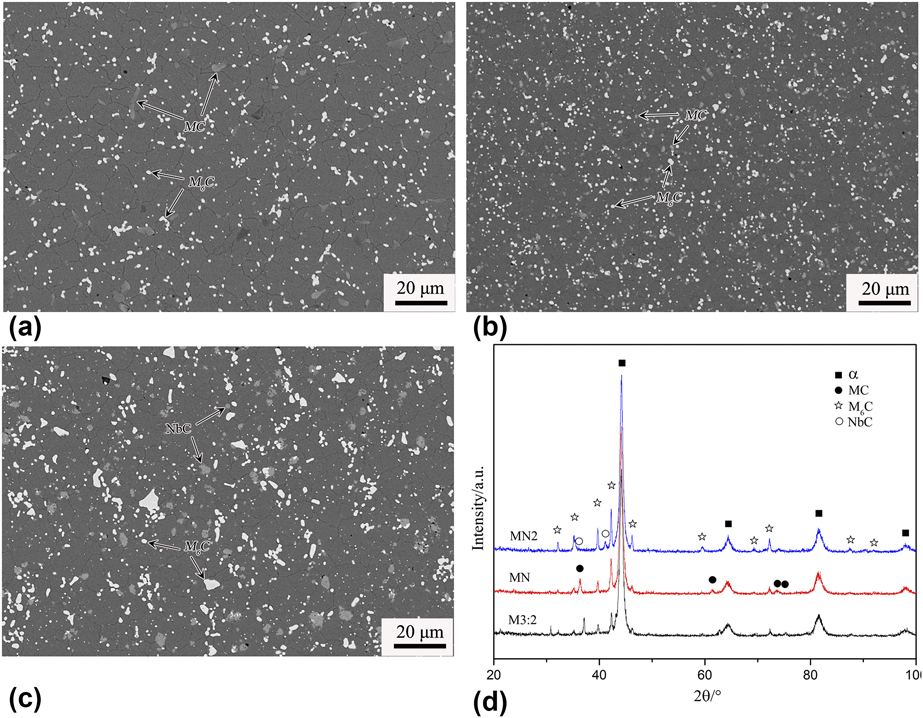
To acquire high-strength martensite and more uniform monocarbides, hot-forged steels were subjected to HT. It is expected that plenty of monocarbides of MC and M 6C can be dissolved into matrix during quenching, and a large amount of secondary carbides precipitates from tempered martensite after tempering. Figure 5 shows the microstructure of heat-treated steels, in which fine spherical carbides are evenly distributed in the matrix. From the corresponding XRD patterns of steels illustrated in Fig. 5(d), it can be found that all the austenite has transformed into martensite, and the type of carbides for all steels is similar to that before HT. However, the diffraction signals of secondary precipitates are not observed due to their low volume and very small size. It is also found that the carbides in M3:2 and MN are smaller than those in MN2. Especially in MN, the more uniform-sized (approximately 2–3 μm) monocarbides of MC and M 6C were evenly distributed in the martensite. By contrast, the mean sizes of carbides in M3:2 and MN2 are approximately 3–4 μm and 5–6 μm, respectively. The mean grain diameters of HSSs after HT are in the range of 7.5–9.6 μm, which indicates that the refined grains can be acquired by thermal-mechanical processing and there is no significant grain coarsening in the present case. Refined spheroidal M 6C carbide for M3:2 and MN can dissolve easily, and coarsed austenite grains can be generated during austenitizing courses at 1180–1220 °C. By contrast, the grain size and morphology of blocky M 6C carbide distributed in grain boundaries in MN2 have no obvious change after austenitization. The detailed results are not listed here, and further research is in progress to establish the exact role of Nb addition in the thermodynamics and dissolution kinetics of carbides.
The final microstructure of the spray-formed HSSs after HT: (a) M3:2; (b) MN; (c) MN2; (d) XRD profiles of the HSSs after HT.

Figure 6 shows the effect of thermal-mechanical treatment on the bend strength and impact toughness of steels. They both prominently increased bend strength and impact toughness of the steels that underwent HF, which implied the positive effect of HF on these properties. This is due to the high density of materials, as well as the refined and homogenized carbides distributed in the as-deformed steels. It can be noted that the higher bend strength and impact toughness were obtained for the M3:2 and MN that underwent decomposition treatment prior to HF. Especially for MN, the bend strength and toughness can reach 3580 MPa and 22 J, respectively, which surpassed even ASP23 HSS processed by PM (bending strength 2690 MPa, impact toughness 28 J) [Reference Wang, Hou, Zhang, Lu, Yu, Cui and Zhang40]. In a conventional casting/forging route, V content over 3% will result in serious segregation in the microstructure, and the typical bending strength is only 2520 MPa for conventionally wrought M3:2 steel [Reference Mesquita and Barbosa18]. The results shown in Fig. 6 are directly related to the microstructure and carbide distribution. In the MN steel, the enhanced bend strength is closely associated with the refined size and uniform distribution of carbides, as well as the much higher volume fraction of hard MC carbides compared with the M3:2 steel. For MN2 steel, the high hardness of NbC and high volume fraction of MC and M 6C carbides can result in very high bending strength in the state of SD–HF–HT; however, this strength value has no obvious change after decomposition treatment due to the presence of highly thermodynamic M 6C eutectic carbides. Notably, the fracture toughness of MN2 is lower than those of the other two steels. Based on some reports [Reference Mesquita and Barbosa8, Reference Mesquita and Barbosa18], fracture typically occurs when cracks propagate parallel to carbide cells or stringers; therefore, the coarse M 6C carbide networks of MN2 steel are preferential locations for crack propagation, thus decreasing toughness. It is apparent that the bend strength of spray-formed specimen is improved by Nb addition and thermal-mechanical treatment. And more importantly, SF materials possess a high degree of isotropy in mechanical properties comparable with that of PM products. A study of SF M3:2 HSS compared with cast-wrought product has shown that while the SF product retains 89% isotropy, conventional cast M3:2 retains only 54% isotropy [Reference Mesquita and Barbosa18]. In this case, SF HSS with better isotropy will increase their tool performance during complex states of stresses. In summary, it can be concluded that spray-formed HSSs with excellent bend strength and toughness could be accomplished by combination of Nb alloying and proper thermal-mechanical treatment. In particular, SF has an unique characteristic of the production of large billets with high efficiency [Reference Henein, Uhlenwinkel and Fritsching41]; thus, the present results provide an alternative way to prepare HSSs with good properties and low cost.
Bending strength (a) and impact toughness (b) of the spray-formed HSSs after different processes.

Conclusions
The microstructures and mechanical properties of spray-formed M3:2 HSSs with 0–2% Nb addition were investigated, and the emphasis is the solidified carbide morphology, decomposition behavior of M 2C, carbide distribution, and mechanical properties after forging and HT. The SD M3:2 HSS microstructure is characterized as equiaxed austenite grains with a mean size of approximately 25 μm, intergranularly distributed discontinuous M 2C plates, and irregular MC carbides. With 0.5% Nb addition, the size of M 2C plates refined and the volume fraction of MC carbides increased from 1.38% to 3.87%. 2% Nb addition is in favor of forming M 6C carbide and uniform distribution of NbC. After annealing at 1050–1150 °C for 1 h, the metastable M 2C carbide can be decomposed into fine MC and M 6C carbides. 0.5% Nb addition can accelerate the decomposition rate of M 2C due to the thinner M 2C plates and their lower thermodynamic stability. With proper thermal-mechanical treatment (1150 °C annealing for 1 h, subsequently HF and HT), the MC and M 6C carbides become refined with more uniform distribution and the bending strength reaches 3580 MPa, which are better than the properties of ASP23 HSS prepared by PM.
Experimental procedure
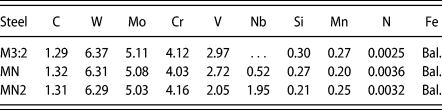
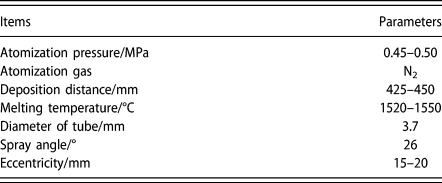
The chemical compositions of the studied HSSs are presented in Table II. The billets of alloys were spray-formed using SF facility at University of Science and Technology Beijing (USTB), and a summary of the processing parameters used is given Table III. Both the master alloy and intermediate alloys were remelted in a medium-frequency induction furnace, and the molten alloys were held for 10–15 min between 1520 and 1550 °C to eliminate any unmelted elements or high-temperature compounds, which could reduce the fluidity of alloy melts and affect the atomization process. An annular close-coupled atomizer placed at the bottom of tundish was utilized to obtain a spray of microsized droplets. And the atomized droplets were deposited onto a rotating and withdrawing ceramic substrate positioned at a predetermined distance from the tundish nozzle, resulting in a cylinder preform with dimensions Ф180 × 150 mm.
Chemical composition of the spray-formed steels (weight fraction, %).

Main spray forming parameters for the investigated steels.

The cylindrical bars with a size of Ф60 × 80 mm cut from billets were isothermally annealed in argon atmosphere at 1150 °C for 1 h, to decompose the M 2C carbide. Then, the annealed samples were hot-forged to Ф16 mm bars at 950–1150 °C. For comparison, bars of billets without decomposition treatment were hot-forged in the same procedure. Before the hardening treatment, all the specimens were heated to 860 °C with a heating rate of 100 °C/h and soaked for 4 h followed by slow cooling to 750 °C and holding at 750 °C for 6 h; subsequently, the specimens were cooled to 500 °C with a cooling rate of 20 °C/h and then cooled down in air. The HT is comprised of austenitizing at 1180 °C for 10 min, followed by oil quenching and standard commercial triple tempering for 1 h at 560 °C. To reduce decarburization and oxidation of the specimens, all samples were sealed in quartz tubes filled with argon.
The microstructures of various samples after SF and thermal-mechanical processing were characterized using scanning electron microscopy (SEM) and X-ray diffraction (XRD). For metallographic analysis, the samples were prepared by mechanical polishing and chemical etching, and the etchant used was a solution of 4 vol% nitric acid and 96 vol% ethanol. The volume fraction of monocarbides and grain sizes were measured by image analysis software (Image-Pro Plus, Media Cybernetics, Inc., Rockville, MD), and ten SEM photographs were used for each specimen. Energy-dispersive X-ray spectroscopy (EDX) was used to determine the average compositions of various carbides, and thirty different particles for each carbide type were measured to ensure accuracy. The extraction of carbide was performed using electrolysis, operating at 3 V and 0 °C with an electrolyte comprising 15 g sodium citrate, 1.2 g potassium bromide, 30 g citric acid, and 100 cm3 distilled water. Phase constitution was examined using a Rigaku X-ray Diffractometer (D/MAX-RB, Rigaku Corporation, Tokyo, Japan) with Cu Kα radiation at 12 KW. The four-point bending tests and impact toughness were carried out using specimens with dimensions of 5 × 5 × 50 mm and 10 × 10 × 55 mm, respectively.
Acknowledgments
This research was financially supported by the State Key Development Program for Basic Research of China (Grant No. 2011CB606303), Open Foundation of State Key Laboratory for Advanced Metals and Materials, University of Science and Technology Beijing (Grant No. 2018-Z01), Program of the University Students’ Innovation and Pioneering (Grant No. XZG-16-08-15), and Ph.D. Research Startup Project of Jiangxi University of Science and Technology (Grant No. 3401223322). The authors thank Dr. Lin Lu, Dr. Jinxiang Zhang, Dr. Zhigang Wang, Mr. Xiyu He, Ms. Panpan Jiang, Ms. Xinger Wen, and Ms. Lili Zhao for their help with material preparation and academic discussions.