Introduction
Brazil is the third largest producer and the largest exporter of broilers in the world. In 2013, the country accounted for 3.892 million tons of the global chicken meat market, mainly for the Chinese market and Arab countries. Even with this significant share of the world market, in the same year 68.4% of the Brazilian production was allocated to the domestic market (UBABEF, 2014), a fact that shows the growing need for input related to nutrition and management. The current dependence on soybean meal, the main protein source for feed, and the competitive use of this vegetal product in other animal species diet, leads to the search for viable alternatives.
Edible insects have been part of the diet of populations in over 113 countries worldwide for centuries (Mac Evilly, Reference MAC EVILLY2000). Similarly, they provide nutrients to several animal species such as birds and fish (Vantomme et al., Reference VANTOMME, MERTENS, VAN HUIS and KLUNDER2012). Commercial insect rearing aiming to provide food to humans or animals is still an emerging practice. However, it is developing because of the growing research conducted by public and private institutions around the world (Van Huis, Reference VAN HUIS2013). Insect rearing appears to be a viable alternative to protein production and supply, given the environmental factors such as greenhouse gas emissions, waste generation, direct and indirect demands (pollution) of water resources, and extensive use of areas both for animal breeding and food production (grains and pastures). These facts limit the increasingly intensive production of poultry (Sanches-Muros et al., Reference SANCHES-MUROS, BARROSO and MANZANO-AGUGLIARO2014).
The FAO, in partnership with countries such as The Netherlands (Wageningen University), China, Laos and the United Kingdom published a report ‘Assessing the Potential of Insects as Food and Feed in assuring Food Security’ to identify alternatives to food production (Vantomme et al., Reference VANTOMME, MERTENS, VAN HUIS and KLUNDER2012). Among the different technical, scientific and institutional (regulations and policies) contributions, the review presents five desirable features for selecting the insect species for breeding on an industrial scale, and that should guide the planning of insect use as alternative to poultry production in Brazil.
The motivation for evaluating insect meal focuses on many factors: importance of poultry production for Brazilian and world agribusiness; the global pressures for sustainable meat production systems (Vaarst et al., Reference VAARST, STEENFELDT and HORSTED2015) due to the scarcity of natural resources and polluting potential of this activity. In addition, the sector vulnerability in relying almost exclusively on soybean meal as a protein source; the possibility to reduce environmental impact in poultry producing regions through the use of poultry waste as substrate for larvae; and social issues related to rural work and income generation. The decision regarding insect species must take into account those that can promote a sustainable production system beyond the value of producing protein for animal (broilers) feed. The coordination model of the production chain in the Brazilian poultry industry is vertical integration (UBABEF, 2014). In this arrangement producers and the industry share environmental responsibilities, which due to the large volume of waste generated daily, are hampering production in the Southern region. Using organic waste as feed for insects can reduce environmental pollution allowing more sustainable meat production.
This review addresses technical (nutritional and productive), environmental (climate), health and institutional issues related to rearing and using housefly (Musca domestica) and black soldier fly (BSF) Hermetia illucens larvae as alternatives for nutritional management in the Brazilian poultry industry. The review uses the five features suggested by FAO to determine those insect species with the potential to be used in animal feed.
Insect industrial scale production to the broiler industry
According to Vantomme et al. (Reference VANTOMME, MERTENS, VAN HUIS and KLUNDER2012), the production of at least one ton of insects per day or 365 tons per year is considered to be industrial scale. However, there are challenges to the worldwide expansion of this type of production. These include the correct selection of the species or strains; choice of economically viable substrates (organic wastes, when possible); disease control and the establishment of sanitary procedures; establishing regular supply, development of innovative production technologies; growing methods; animal welfare assurance (ethical issues); the development of an industrial code of practices and standards; and finally, product quality assurance. The correct selection of species or strains should take into consideration the following matters: Technical issues related to climate (temperature, humidity, ventilation and lighting), environment (biodiversity, substrates and water availability, greenhouse gas emissions) (Vantomme et al., Reference VANTOMME, MERTENS, VAN HUIS and KLUNDER2012; Van Huis, Reference VAN HUIS2013), and nutritional value, depending on the species they intend to breed (Khusro et al., Reference KHUSRO, ANDREW and NICHOLAS2012).
Housefly and BSF larvae are species with potential for growth and development in decomposing organic materials (fruits and vegetables), and human and animal waste (Diener et al., Reference DIENER, ZURBRÜGG, GUTIÉRREZ, NGUYEN, MOREL, KOOTTATEP and TOCKNER2011; Van Huis et al., Reference VAN HUIS, ITTERBEECK, KLUNDER, MERTENS, HALLORAN, MUIR and VANTOMME2013). This particular feature, in addition to enabling insect production in waste generated by poultry production, brings positive environmental effects to the sector. It allows up to 58% reduction in waste volume (Sheppard et al., Reference SHEPPARD, NEWTON, THOMPSON and SAVAGE1994; Hwangbo et al., Reference HWANGBO, HONG, JANG, KANG, OH, KIM and PARK2009), reduction in nitrogen and phosphorus compounds in the order of 50% and 70%, respectively (Myers et al., Reference MYERS, TOMBERLIN, LAMBERT and KATTES2008) as well as reduced waste odours from bacterial growth restrictions (Van Huis et al., Reference VAN HUIS, ITTERBEECK, KLUNDER, MERTENS, HALLORAN, MUIR and VANTOMME2013).
Specific BSF larvae rearing brings another advantage to the system since, by promoting a greater liquefaction of poultry manure, it inhibits housefly oviposition - an important disease vector - and interrupts larval development as well as reducing the proliferation of this insect from 94 to 100% in intensive production systems (Sheppard et al., Reference SHEPPARD, NEWTON, THOMPSON and SAVAGE1994). Hence both health and productivity gains can be substantiated through the management of this biological waste (Noorman, Reference NOORMAN2001).
In addition, providing protein content to animal diets, insect rearing and processing generate other by-products to be taken into consideration in the feasibility analysis of activities such as the lipid composition of the larvae bred on organic substrates, which allows the processing geared towards biodiesel production (Li et al., Reference LI, ZHENG, HOU and YU2011). Larvae feed conversion efficiency ensures that organic wastes are partially converted into biomass and that the end product generated in this process, the bio-fertiliser, can be safely used in agriculture (Oonincx and De Boer, Reference OONINCX and DE BOER2012; Van Zanten et al., Reference VAN ZANTEN, MOLLENHORST, OONINCX, BIKKER, MEERBURG and DE BOER2015). The larvae feed conversion (2.2 kg/kg live weight) was higher than that of other animal species: 2.5 kg, 5 kg and 10 kg for poultry, pig and beef cattle, respectively (Smil, Reference SMIL2002; Oonincx and De boer, Reference OONINCX and DE BOER2012; and Van Huis, Reference VAN HUIS2013).
Annual poultry waste production in Brazil is estimated at 3.5 million tons, given the annual slaughter of 5.4 billion birds (IBGE, 2014) and the production of 1.3 kg of waste per bird in each production cycle (Bellaver and Palhares, Reference BELLAVER and PALHARES2003). Considering data from Sheppard et al. (Reference SHEPPARD, NEWTON, THOMPSON and SAVAGE1994), it would generate 1.47 million tons of compounds to be used as bio-fertiliser.
The Southern region of Brazil is the main producer of poultry in the country, and faces the saturation of phosphorus and nitrogen which degrades soil, and affects water quality and agricultural yield (Scherer et al., Reference SCHERER, NESI and MASSOTTI2010). Allocating large amounts of poultry litter to feed larvae will result in reduced volumes of bio-fertiliser which can be transported and commercialised in poorly fertilised areas of Brazil, generating rural income to smallholders which can diversify their revenue and contribute to social sustainability (Correa and Miele, Reference CORREA and MIELE2011).
Chitin and its derivatives, such as chitosan, are among the by-products available from insect processing and has been the subject of countless studies related to increased immunity and disease resistance in different species (Swiatkiewicz et al., Reference SWIATKIEWICZ, SWIATKIEWCZ, ARCZEWSKA-WLOSEKK and JOZEFIAK2015) and has been explored by pharmaceutical, aesthetic and paper industries (Veldkamp et al., Reference VELDKAMP, VAN DUINKERKEN, VAN HUIS, IAKERMOND, OTTEVANGER, BOSCH and VAN BOEKEL2012). However, it is beyond the scope of this review to cover such research - merely to mention it as a useful compound obtainable from insect larvae farming.
Proteins obtained from animals have been banned from farm animal feed in certain countries due to outbreaks such as bovine spongiform encephalopathy. Since then, food safety, hygiene, and health issues have limited the immediate acceptance of alternatives. The wide taxonomic distance between men and insects, when compared to commercially bred species (poultry, swine, and cattle), suggests lower risks of zoonotic infections (Van Huis et al., Reference VAN HUIS, ITTERBEECK, KLUNDER, MERTENS, HALLORAN, MUIR and VANTOMME2013) however, this still requires further investigation.
Insect rearing and processing face challenges related to health, food safety, economic (automation to reduce costs) and institutional issues (laws and regulations) (Van Huis et al., Reference VAN HUIS, ITTERBEECK, KLUNDER, MERTENS, HALLORAN, MUIR and VANTOMME2013). The lack of specific guidelines to control the use of insects in animal diets impairs the commercial use of such technology. However, efforts from public and private institutions, in several countries, have helped the short-term inclusion (five years) of this technological innovation (Veldkamp et al., Reference VELDKAMP, VAN DUINKERKEN, VAN HUIS, IAKERMOND, OTTEVANGER, BOSCH and VAN BOEKEL2012).
In recent research analysing larvae meal of the domestic fly, Van Zanten et al. (Reference VAN ZANTEN, MOLLENHORST, OONINCX, BIKKER, MEERBURG and DE BOER2015) focussed on the trade-off between decreasing land use and increasing global warming potential and energy use. However, Brazilian climatic conditions show some advantages in an insect production process. Solar energy can contribute to an industrial scale production reducing energy use especially in regions where temperatures are elevated.
Selecting insect species compared to Housefly and BSF larvae
Van Huis et al. (Reference VAN HUIS, ITTERBEECK, KLUNDER, MERTENS, HALLORAN, MUIR and VANTOMME2013) reported that the most promising insect species for animal feed production are BSF and housefly larvae, mealworm (Tenebrio) and silkworm, although crickets and termites are also feasible on a smaller scale. Due to the positive external environmental factors aforementioned, the current study selected BSF and housefly larvae as ‘bioreactors’ due to their natural capacity to process organic manure from broilers. This section compares their features with the five desirable characteristics (DC) identified for species selection according to the FAO.
dc#1: high intrinsic rate of increase (rm)
The intrinsic increase rate addresses the search for insect species that have a short development cycle, high immature specimen survival, and high oviposition rates. These features favour the fast development of insects by reducing losses in the early growth stages.
The BSF (Hermetia illucens) is dipterous from the family Stratiomyidae. It is native to tropical, subtropical and warm temperate climates in the Americas, and is currently found in regions between 45º N and 40º S (Diener et al., Reference DIENER, ZURBRÜGG, GUTIÉRREZ, NGUYEN, MOREL, KOOTTATEP and TOCKNER2011; Makkar et al., Reference MAKKAR, TRAN, HEUZÉ and ANKERS2014) with hot temperatures. The larvae of this fly feeds at a fast rate (25-500 mg/larvae/day) from a large number of organic substrates, including poultry, pig, cattle and human wastes (Hardouin and Mahoux, Reference HARDOUIN and MAHOUX2003; Van Huis et al., Reference VAN HUIS, ITTERBEECK, KLUNDER, MERTENS, HALLORAN, MUIR and VANTOMME2013).
Oviposition takes place two days after fertilisation and larval development may range from two to four weeks, or even longer, if there is no available food (Myers et al., Reference MYERS, TOMBERLIN, LAMBERT and KATTES2008; Diener et al., Reference DIENER, ZURBRÜGG, GUTIÉRREZ, NGUYEN, MOREL, KOOTTATEP and TOCKNER2011). Eggs and larvae are preferably kept at temperatures near 27°C, but they tolerate great variations (Sheppard et al., Reference SHEPPARD, TOMBERLIN, JOYCE, KISER and SUMNER2002). BSF is extremely resistant to harsh environmental conditions such as drought, food shortage or oxygen deficiency (Diener et al., Reference DIENER, ZURBRÜGG, GUTIÉRREZ, NGUYEN, MOREL, KOOTTATEP and TOCKNER2011). The larvae of this species require hot environments to degrade the food substrate. Thus, their life cycle varies depending on this climatic factor (Veldkamp et al., Reference VELDKAMP, VAN DUINKERKEN, VAN HUIS, IAKERMOND, OTTEVANGER, BOSCH and VAN BOEKEL2012).
BSF is characterised by degrading large volumes of organic material due to its powerful jaw and digestive system during the larval stage (Erens et al., Reference ERENS, VAN ES, HAVERKORT, KAPSOMENOU and LUIJBEN2012), has high resistance to adverse conditions and huge production capacity even in high densities.
The life cycle stages of the housefly from the family Muscidae consists of egg, larvae, pupa and adult. Such stages may last between seven and 10 days in hot climate areas during summer and between 40 and 49 days in colder temperatures (El Boushy, Reference EL BOUSHY1991). Noorman (Reference NOORMAN2001) described that full development of the species takes place between the 14th and 18th day at 25°C and results in its permanent reproduction in tropical and subtropical climate countries. However, larvae and pupae go into hibernation at lower temperatures and only resume their development when the temperature rises.
Considering Brazilian climatic conditions, decomposing organic waste shows potential for a shorter development cycle throughout the year favoured by high temperatures. M. domestica larvae show several features that make them suitable for mass production, such as precocity and prolificacy. Female larvae are capable of spawning up to 2,000 eggs in natural and controlled conditions, depending on the environmental temperature and humidity (Makkar et al., Reference MAKKAR, TRAN, HEUZÉ and ANKERS2014).
The humidity range required for housefly larval development lies between 60% and 75% which provides excellent conditions for industrial rearing when combined with ideal temperatures (above 20°C) (Miller et al., Reference MILLER, TEOTIA and THATCHER1974). Given Brazilian climatic conditions, Weigert et al. (Reference WEIGERT, FIGUEIREDO, LOEBMANN, NUNES and SANTOS2002) demonstrated that higher temperatures (29ºC and 32ºC) negatively interfere in housefly larval development, and that heavier larvae are produced in temperatures ranging from 20°C to 26°C.
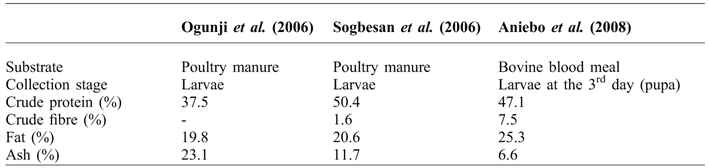
Table 1 shows the variation in nutritional content dependent on the collection phase (larvae or pupa), the drying and processing methods and to the substrate on which the larvae is bred (Pretorius, Reference PRETORIUS2011).
Comparison between the larval and pupae composition of housefly bred on different substrates (based on DM).

Source: adapted from Pretorius (Reference PRETORIUS2011).
According to the data, Brazilian climatic conditions and the large volume of available poultry waste favour the high intrinsic increase rate of M. domestica larvae. Choosing the collection phase as well as the processing method requires studies related to local production conditions and the animal for which the feed material is intended (nutritional composition).
dc#2: high potential of biomass increase per day
Insects can be sustainably produced with a much smaller ecological footprint than that of most domesticated species (Oonincx et al., Reference OONINCX, VAN ITTERBEECK, HEETKAMP, VAN DEN BRAND, VAN LOON and VAN HUIS2010). Comparatively, cattle consume 8 g of feed for each g of weight gain, whereas insects may need less than 2 g (Vogel, Reference VOGEL2010). These ‘bioreactors’ are very efficient in biotransforming a wide variety of organic compounds into edible biomass (high feed conversion rate).
The BSF is not considered a pest because it is not attracted to human habitats or food in its adult stage. The adult insect does not need to feed since it survives from its own body fat stored during the larval stage, during which time it is a voracious consumer of decomposing organic matter, including kitchen waste, spoiled food, and manure converting into biomass (Newton et al., Reference NEWTON, SHEPPARD, WATSON, BURTLE and DOVE2005).
The potential of the BSF is shown by the volume of waste that can be biodegraded, and its chemical composition depends on the type of substrate. Larvae show fat content between 15-25% (Sheppard et al., Reference SHEPPARD, NEWTON, THOMPSON and SAVAGE1994) and 36-48% protein (Sheppard et al., Reference SHEPPARD, NEWTON, THOMPSON and SAVAGE1994; Diener et al., Reference DIENER, ZURBRÜGG, GUTIÉRREZ, NGUYEN, MOREL, KOOTTATEP and TOCKNER2011) of body weight when bred in poultry waste.
Diener et al. (Reference DIENER, ZURBRÜGG and TOCKNER2009), using larval density of 5 larvae/cm² and managed to collect 2.5 kg/m² of prepupa (DM) per insect life cycle (145 g/m²/day), using 100 mg of chicken manure daily per larvae as substrate. On the other hand, Sheppard et al. (Reference SHEPPARD, NEWTON, THOMPSON and SAVAGE1994) reported prepupa production of 46 g per kg of poultry manure used as substrate. BSF larvae have protein levels between 36-48% and 31-33% fat DM basis (Diener et al., Reference DIENER, ZURBRÜGG, GUTIÉRREZ, NGUYEN, MOREL, KOOTTATEP and TOCKNER2011). This variation in nutritional values (amino acid content) demonstrates the importance of properly defining the substrate and the larval development phase in which the insect is processed.
M. domestica, as well as other dipterous larvae, has the ability to convert organic wastes into biomass. The increase in body weight depends on factors such as temperature and type of substrate (Weigert et al., Reference WEIGERT, FIGUEIREDO, LOEBMANN, NUNES and SANTOS2002). Barnard et al. (Reference BARNARD, HARMS and SLOAN1998) found a reduction in the volume of poultry manure in the order of 64.4%, 80.3%, and 59.1% by inoculating, respectively; 300, 600, and 900 larvae in each 100 g of manure. Cickova et al. (Reference CICKOVA, PASTOR, KOZÁNEK, MARTINEZ-SÁNCHEZ, ROJO and TAKÁC2012) reported larvae biomass production from 3-4 g/100 g of poultry manure. Kenis et al. (Reference KENIS, KONÉ, CHRYSOSTOME, DEVIC, KOKO, CLOTTEY, NACAMBO and MENSAH2014) described unpublished experimental data by Nzamujo that reported the production of 3-4 kg of M. domestica larvae in four days, based on 10-15 kg dry matter animal waste.
The nutritional value of M. domestica biomass, both at the larval and pupal stages, is considered high and it ranges from 40 to 61.4% crude protein (El Boushy, Reference EL BOUSHY1991; Heuzé and Tran, Reference HEUZÉ and TRAN2013) and 9-25% lipid content in the dry matter (Aniebo et al., Reference ANIEBO, ERONDU and OWEN2008). The housefly shows higher lipid and lower protein content in advanced larval and pupal stages. By evaluating different processing methods, it is possible to state that sun-dried larvae have less protein and more lipids than those dried in ovens (Aniebo and Owen, Reference ANIEBO and OWEN2010).
dc#3: high conversion rate (kg biomass gain/kg feedstock)
The feed conversion of insect larvae is a major feature and it demonstrates the advantages of its potential use for animal feed production as shown by the high biomass production per kg of food. The main issue to be taken into consideration in feed conversion, compared to other species, is the type of substrate used by these larvae to generate biomass and protein for animal feed. Among the insect species, fly larvae, due to their coprophagous characteristics, are able to convert potentially high pollution residues, such as wastes, into high protein food or feed (Van Huis, Reference VAN HUIS2013). The BSF larva has an average feed conversion efficiency of 29.6% (Diener et al., Reference DIENER, ZURBRÜGG and TOCKNER2009). Even when larvae are bred on different substrates, such as chicken feed, market wastes, population organic wastes and faecal mud, they showed high biomass conversion capacity as well as substrate volume reduction capacity (Diener et al., Reference DIENER, ZURBRÜGG, GUTIÉRREZ, NGUYEN, MOREL, KOOTTATEP and TOCKNER2011).
The bio-fertiliser resulting from the digestion of organic wastes by the larvae is another environmental advantage of choosing BSF. Whenever this organic waste is used in agriculture, it achieves satisfactory results in the growth of plants (Newton et al., Reference NEWTON, SHEPPARD, WATSON, BURTLE and DOVE2005; Van Huis et al., Reference VAN HUIS, ITTERBEECK, KLUNDER, MERTENS, HALLORAN, MUIR and VANTOMME2013), thus adding value to this by-product.
Large populations of housefly, likewise, may be obtained from relatively small amounts of substrates (Makkar et al., Reference MAKKAR, TRAN, HEUZÉ and ANKERS2014). El Boushy (Reference EL BOUSHY1991) reported that an inoculation ratio of 3 g of insect eggs incubated in 4 kg of fresh manure (mixed with water) at 35°C. Every 7 days 17,500 kg of wet manure from a selected farm was inoculated with 52,500 eggs of M. domestica (3,000 eggs/kg) resulting in larvae for use in broiler diets. Hardouin and Mahoux (Reference HARDOUIN and MAHOUX2003) described the production of 1,500 larvae in 450 g of manure. Poultry manure was the most cited substrate in the currently available literature on M. domestica rearing.
dc#4: ability to live in high-density environments (kg biomass/m²)
BSF naturally occur in high densities and, compared with other species, form into groups (Zhang et al., Reference ZHANG, HUANG, HE, TOMBERLIN, LI, LEI, SUN, LIU and YU2010). This feature allows them to convert large amounts of waste into biomass (Van Huis et al., Reference VAN HUIS, ITTERBEECK, KLUNDER, MERTENS, HALLORAN, MUIR and VANTOMME2013). In a study on animal welfare related to insect rearing, Erens et al. (Reference ERENS, VAN ES, HAVERKORT, KAPSOMENOU and LUIJBEN2012) stated that there is no animal freedom violation and discomfort due to the high population density. However, they suggest further studies using different densities to assess its possible impact on the animals’ productivity and well-being (behaviour).
Another advantage of the high density in BSF rearing is its ability to limit the spread of M. domestica, which may be a vector of pathogenic agents in intensive production systems (Sheppard et al., Reference SHEPPARD, NEWTON, THOMPSON and SAVAGE1994). Unlike the natural spread of this insect, larvae rearing in controlled environments may be used as a manure management and disease prevention technique.
High density rearing can suit the behaviour of M. domestica females, that prefer depositing their eggs in clusters in cracks within the growing substrate, thus protecting them from desiccation and predation. Noorman (Reference NOORMAN2001) reported that the odour of eggs collected up to 30 minutes after oviposition was attractive to pregnant females and it stimulated new oviposition in the same place, thus suggesting the presence of a stimulating pheromone. Erens et al. (Reference ERENS, VAN ES, HAVERKORT, KAPSOMENOU and LUIJBEN2012) reported that rearing high numbers of larvae creates more efficient digestion, due to the excretion of enzymes, and reduces the spread of diseases since the larvae excreta has antifungal and antibacterial properties.
dc#5: low vulnerability to diseases (resistance);
BSF larvae rearing modifies the manure microflora, thus potentially reducing the power of harmful bacteria such as Escherichia coli and Salmonella spp. (Erickson et al., Reference ERICKSON, ISLAM, SHEPPARD, LIAO and DOYLE2004). It suggests that these larvae secrete natural antimicrobial agents (Van Huis et al., Reference VAN HUIS, ITTERBEECK, KLUNDER, MERTENS, HALLORAN, MUIR and VANTOMME2013). However, larvae rearing reports focused on vulnerability indicators show that rodents, frogs, birds and other insects, such as ants, may be potential predators in production systems, as well as parasites to which larvae are susceptible. Rearing in controlled environments limits these predators access to the system, thus reducing vulnerability.
Another favourable feature to the rearing of this species is the short life in adulthood (five to eight days), and the fact that it does not eat at this stage, which consequently keeps the larvae away from human habitats and food, thus reducing its exposure to insecticides, unlike the housefly (Tomberlin et al., Reference TOMBERLIN, SHEPPARD and JOYCE2002).
The housefly is one of the species with greater capacity to develop resistance to insecticides due to genetic, biological and operational factors (Keiding, Reference KEIDING1999), thus showing a potential advantage to the species survival even in controlled environments. Although several authors have conducted surveys on parasitoids and predators to muscoid diptera of veterinary importance in Brazil (Mendes and Linhares, Reference MENDES and LINHARES1999), the knowledge on the taxonomy and biology of these insects is still in the early stages.
In addition to the parasitoids, a great diversity of predators inhabits the environment composed of rearing-derived manure and feed on immature muscoid diptera (Borges, Reference BORGES2006). Among the main predators, we can highlight the coleoptera from the families Histeridae, Tenebrionidae, Staphylinidae, Dermaptera (earwigs) and the mites from the families Macrochelidae, Uropodidae and Parasitidae spp. (Geden, Reference GEDEN1990).
In manure accumulated in poultry farm sheds, there are several dipteran parasitoid species that are usually used as biological components in integrated pest management programs. The excess moisture found in poultry manure affects the colonisation by parasitoids (Borges, Reference BORGES2006) and it allows the control and viability in a controlled rearing scenario.
Conclusions
Black soldier fly and housefly larvae have been identified as two potential species for protein production intended for poultry feed. Environmental (waste generation and treatment) and productive features of the Brazilian poultry industry was decisive in the choice of insect species with the potential to be produced on an industrial scale.
Features such as high productivity (biomass generation), feed conversion efficiency, organic waste use (from farms) and capacity to convert these potentially polluting wastes into high value-added by-products (high-protein and lipid feed and bio-fertiliser) show the feasibility of using these species. Despite their vulnerability to pathogens and predators, these species have high potential to supply part of the protein demands of the Brazilian poultry industry, when grown in controlled environments. The environmental and nutritional benefits of this technology for other species’ diet requires specific research, however it expands the possibilities in other agribusiness production chains.
There are several fundamental issues related to potential and challenges to the rearing and processing of fly larvae for feed in the Brazilian poultry industry that require more discussion and planning throughout the poultry supply chain. Specifics of integrated production systems from the Brazilian poultry industry can facilitate the insertion of this new technology in the short term in Brazil, but would still need input from researchers and discussion among global institutions, producers, the industry and consumers.