Most of the ordinary tasks in daily life require monitoring the past, present, or future successfully. For example, the act of remembering can be viewed as a mental time travel to what happened in the past; contemplating our current activities usually requires some conscious effort to perceive and understand the present context; and making a plan or setting goals requires an evaluation of future outcomes. In recent research, individual differences in the extent to which a person predominantly considers a certain frame of time have been identified (Zimbardo & Boyd, Reference Zimbardo and Boyd1999). An individual’s preferred frame of time in organizing and attributing meaning to life experience is called time perspective (Holman & Zimbardo, Reference Holman and Zimbardo2009).
Considerations on psychological perspectives of time have a long history dating back to James (1890/1950), however, recently, a scale developed by Zimbardo and Boyd (Reference Zimbardo and Boyd1999) received much attention. The Zimbardo Time Perspective Inventory (ZTPI) is a self-report scale measuring individual differences in tendency to focus on various temporal aspects of one’s life. Five dimensions were originally identified in the ZTPI: Past Negative (PN) is indicative of an undesirable and pessimistic view of the past; Past Positive (PP) reflects a favorable and nostalgic view of the past; Present Hedonistic (PH) is marked with focusing on the current short-term pleasures and excitements, and also taking risks without much consideration of their future outcomes; Present Fatalistic (PF) is conceptualized as a pessimistic attitude towards what lies in the future; and finally Future (F) is characterized by a general orientation towards achieving long-term goals while resisting the temptations for immediate pleasures for the sake of bigger rewards in the future. A tendency to strongly prefer one temporal dimension over the others characterizes an individual’s dominant time perspective. Such temporal predispositions are believed to start developing at early ages through family, culture, education, and religion (Keough, Zimbardo, & Boyd, Reference Keough, Zimbardo and Boyd1999).
According to the time perspective theory, an individual employs these temporal frames to encode, store and reminiscence the past while keeping them as templates for the present and future desires, goals and expectations (Zimbardo & Boyd, Reference Zimbardo and Boyd1999). In addition, an individual makes use of these temporal frames for categorizing personal and social experiences into a meaningful personal story that helps making sense of personal past as well as setting goals and priorities for the present and future. In other words, subjective perception of time continuously shapes how individuals relate to the world (Holman & Zimbardo, Reference Holman and Zimbardo2009).
It is worth noting that time perspective theory does not categorize the five dimensions as “positive” or “negative” in the sense that some of the perspectives are better or superior than the others. All individuals have a score for each of the time perspectives however what varies is the extent to which they utilize each one. An optimal combination of the five perspectives have been suggested and named as the Balanced Time Perspective (BTP) (Boniwell & Zimbardo, Reference Boniwell, Zimbardo, Linley and Joseph2004; Drake, Duncan, Sutherland, Abernethy, & Henry, Reference Drake, Duncan, Sutherland, Abernethy and Henry2008; Stolarski, Bitner, & Zimbardo, Reference Stolarski, Bitner and Zimbardo2011). One is believed to have a BTP if the scale scores for PN and PF are low but scores on PP, PH, and F dimensions are high (Boniwell & Zimbardo, Reference Boniwell, Zimbardo, Linley and Joseph2004; for other operationalizations of BTP see also Boniwell, Osin, Alex Linley, & Ivanchenko, 2010, and Wiberg, Sircova, Wiberg, & Carelli, Reference Wiberg, Sircova, Wiberg and Carelli2012). BTP is believed to reflect the flexibility and success in switching between temporal dimensions depending on the personal needs and goals, and situational demands (Boniwell & Zimbardo, Reference Boniwell, Zimbardo, Linley and Joseph2004; Drake et al., Reference Drake, Duncan, Sutherland, Abernethy and Henry2008). Thus, an individual with a BTP is not preoccupied or stuck only with a single temporal dimension but she/he is able to consider all of the dimensions when a need arises. Previous studies associated subjective well-being with BTP (Boniwell et al., Reference Boniwell, Osin, Alex Linley and Ivanchenko2010; Drake et al., Reference Drake, Duncan, Sutherland, Abernethy and Henry2008) indicating the adaptive role of having a BTP compared to deviations from a balanced perspective. The deviations from BTP occur when PN and PF scale scores increase and/or scale scores on PP, PH, and F decrease. Thus, larger deviations from BTP are associated with pessimistic perceptions of the past, present, and future. Such an unbalanced view implies a more negative evaluation of the personal and social experiences. Those individuals are more likely to process the past and present life events with a pessimistic attitude in the absence of constructive future expectations.
Time perspective is a crucial process that links our personal history with our consciousness of the present and expectations from the future in an ever-changing world. Perceptions of the self, interpersonal relationships and life experiences are likely to be processed through this mechanism. In line with this conceptualization of time perspective, previous findings indicated that ZTPI was related to personality characteristics (Dunkel & Weber, Reference Dunkel and Weber2010; van Beek, Berghuis, Kerkhof, & Beekman, Reference van Beek, Berghuis, Kerkhof and Beekman2011), self-esteem (Zimbardo & Boyd, Reference Zimbardo and Boyd1999), and social relationships (Holman & Zimbardo, Reference Holman and Zimbardo2009). Specifically, PP was related to high self-esteem, long-lasting relationships with larger network size, and high life satisfaction; however PN was related to lower self-esteem, less family support and higher relational conflict (Holman & Zimbardo, Reference Holman and Zimbardo2009; Zhang & Howell, Reference Zhang and Howell2011; Zimbardo & Boyd, Reference Zimbardo and Boyd1999). Moreover, PN and PF were related to high neuroticism, and low extraversion. In contrast, PP was related to low neuroticism, high extraversion, and high openness to new experiences (van Beek et al., Reference van Beek, Berghuis, Kerkhof and Beekman2011). Similarly, PH was positively related to extraversion, openness to new experiences, and novelty seeking (Zimbardo & Boyd, Reference Zimbardo and Boyd1999). Finally, F was positively related to conscientiousness and self-esteem, but negatively to trait anxiety, aggression, and depression (Zimbardo & Boyd, Reference Zimbardo and Boyd1999). Overall these findings imply that PP, PH, and (to some degree) F are associated with a more positive perception of the self, however PN and PF are associated with a more negative perception of the self. Nevertheless, the relationship between personality variables and BTP hasn’t been examined in these studies. Thus, the contribution of personality characteristics on the development of a BTP remains yet to be understood.
One’s conceptualization of time reflects not only perceptions of self but also perceptions of social relationships. For this reason, quality of interpersonal relationships is likely to influence and be influenced by the time perspective. It is well known that the early interpersonal relationships formed with parents, i.e., attachment orientations, affect the kinds of relationships formed later on in life (Ainsworth, Blehar, Waters, & Wall, Reference Ainsworth, Blehar, Waters and Wall1978; Bowlby, Reference Bowlby1980). As Bowlby (Reference Bowlby1980) suggested, early relationships with primary attachment figures provide cognitive maps of environment to explore, make predictions, and set and achieve goals. According to his attachment theory, the infant learns what to expect from the mother in terms of responsiveness to his/her needs. Gradually such expectations get generalized and serve as working models of what to expect from others and the physical world, observable as different attachment styles (Ainsworth et al., Reference Ainsworth, Blehar, Waters and Wall1978). Along with this knowledge, it can be hypothesized that securely attached individuals who get enough satisfaction of their emotional and physical needs within early interactions with their primary care-giver may be more likely to perceive the past positively and have positive expectations from the present and future. Therefore, they may be more willing to engage in new experiences and thus focus dominantly on the present and future. On the other hand, individuals who have insecure attachment style due to early relationships with less responsive or intrusive/abusive caregivers are more likely to have negative perceptions about the past, present and future. They are likely to have a more anxious and/or avoidant style in relating to the environment because of their negative expectations, and may rely heavily on their negative experiences of the past in responding to present and future. These expectations link BTP partially to early positive experiences with primary caregivers as a means of establishing a cognitive schema in relating to the world. The association between time perspective and attachment orientations was measured only in one study to my knowledge. Laghi, D’Alessio, Pallini, and Baiocco (Reference Laghi, D’Alessio, Pallini and Baiocco2009) reported relationships between attachment security and PP, PH, and F. Securely attached individuals had lower PN and PF scores indicating that adopting a negative or a positive temporal attitude is likely to be related to how one conceives childhood experiences in the present time, and extend these old experiences to the current relationships. More importantly, such positive childhood experiences may be the basis for developing a BTP. Such a hypothesis can be grounded on the theory of relational self, according to which attachment patterns to primary caregivers are maintained and extended in our current close relationships (Saribay & Andersen, Reference Saribay and Andersen2007). Thus, an individual with a history of negative experiences with parents is likely to not only perceive the primary parental figures negative but also transfer such relational pattern to current close relationships. For example, Gilbert and Sifers (Reference Gilbert and Sifers2011) found that college students with insecure attachment to parents experienced more anxiety towards relationships after a break up compared to the securely attached students. From this point of view, parental attachment and/or ones’ perception of quality of parental relationships seems important in understanding the development of BTP and how it is reflected in the adult relationship patterns.
Although time perspective has been linked to various personality and attachment measures and BTP was linked to subjective health, the mechanisms underlying these effects are not very clear, especially the antecedents of adopting a BTP. In time perspective therapy (see Time Cure from Zimbardo, Sword, & Sword, Reference Zimbardo, Sword and Sword2012 for more details), BTP is encouraged through increasing positive past and present thinking, setting future goals and decreasing pessimistic thinking about the past and future. Thus, some preliminary information in regards to increasing the tendency for BTP has been suggested in the literature, however, the existing differences in regards to BTP have not been investigated. The present study examined the influences of perceptions of self and of interpersonal relationships in the development of a BTP. The purpose of the study was (a) to gain insights into the development of one’s preference for each of the temporal dimensions, and (b) to have a better understanding of how BTP was related to one’s evaluation of self and of interpersonal relationships. The complex relationship between BTP and attachment quality has not been examined in previous studies. Assuming that the development of BTP partially depends on the nature of events that happened in the past, early relationships with parents are likely to influence the development of time perspective. Specifically, individuals with secure attachment are likely to possess a BTP and maintain more positive interpersonal relationships in their close relationships compared to individuals with insecure attachment. Therefore, in the current study, optimistic perceptions of the interpersonal relationships were expected to be associated with a BTP, whereas deviation from a BTP was expected for those who had lower attachment security.
In addition, cross cultural validity of a Turkish adaptation of the ZTPI was examined through assessing the reliabilities of the subscales and examining how scale scores were related to the variables measured in the study. A prior study had tested the reliability and validity of the Turkish version of the original ZTPI on a large college sample (Erginbilgic, unpublished data; also see Holman & Zimbardo, Reference Holman and Zimbardo2009). The present study was an attempt to provide additional psychometric information on the validity of this translation of the scale.
Personality variables such as extraversion, neuroticism, and self-esteem were measured as indicators of perceptions of self. In addition, parent and peer attachment qualities, and evaluations of a romantic partner were measured as indicators of perceptions of interpersonal relationships. The aim was to understand the kinds of relational experiences that are associated with each time perspective and how they contribute to the development of a BTP. Specifically, BTP was expected to be associated with a positive representation of the self (i.e., high scores on extraversion and self-esteem; low scores on neuroticism) and of the interpersonal relationships (i.e., high scores on perceived parent, peer and romantic attachment qualities).
Method
Participants
A sample of 178 undergraduate psychology students (88.1% female, mean age 21.89, SD = 3.27; range 18–43) from Istanbul Bilgi University participated in the study in exchange for partial course credit. All of the students were Turkish.
Materials
Time Perspective
A Turkish version of the Zimbardo Time Perspective Inventory was used. This version of the scale was translated by Erginbilgic and her colleagues (unpublished data) using standard translate and back translate method. The original ZTPI consists of 56 items divided into 5 subscales (Zimbardo & Boyd, Reference Zimbardo and Boyd1999): Past Negative (“Painful past experiences keep being replayed in my mind”), Past Positive (“It gives me pleasure to think about my past”), Present Hedonistic (“Taking risks keeps my life from becoming boring”), Present Fatalistic (“Fate determines much in my life”), and Future (“I am able to resist temptations when I know that there is work to be done”). Participants respond on a scale of 1 (very uncharacteristic) – 5 (very characteristic).
Because the main interest in the current study was to understand the extent to which individuals’ perceptions of self and of interpersonal relationships are related to Balanced Time Perspective (BTP), the operationalization of Balanced Time Perspective (BTP) that favors assessment of individual differences was adopted (Stolarski et al., Reference Stolarski, Bitner and Zimbardo2011). In this operationalization, the deviation from balanced time perspective (i.e., DBTP scores) is calculated by subtracting each participants’ measured time perspective scale scores from the expected scores, taking their squares, adding all of them up and finally taking the square root of the final result. The expected scores for each of the time perspectives are as follows: High scores on PP (4.60), PH (3.90), F (4.00), and low scores on PN (1.95), and PF (1.50). In essence, the higher the DBTP score, the larger the deviation from the BTP. Thus, lower scores are indicative of individuals with a balanced distribution of the five time perspectives.
Personality
The Turkish version of the Eyesenck Personality Questionnaire: Abbreviated Form (EPQR-A) was used (Francis, Brown, & Philipchalk, Reference Francis, Brown and Philipchalk1992; Karanci, Dirik, & Yorulmaz, Reference Karanci, Dirik and Yorulmaz2007). The inventory consists of a total of 24 items with 6 items for each of the four subscales: extraversion, neuroticism, psychoticism, and lie. Participants were asked to respond to the items as Yes (1) or No (0). For each personality dimension, a participant can get a score between 0–6. Only neuroticism and extraversion subscales were used in the regression analyses. Psychoticism and lie subscales were not included in these analyses because no a priori predictions exist on how they might be related to time perspective. However, their inter-correlations with other measures were reported for exploratory purposes.
Self-Esteem
Perceived self-esteem was measured by the Rosenberg Self-Esteem Scale (RSE, Rosenberg, 1965). The scale was adapted to Turkish by Cuhadaroglu (Reference Cuhadaroglu1986) and has high internal consistency (α = .89). RSE is a 10-item questionnaire and participants are asked whether they agree or not with the given items on a 4-point scale.
Attachment to Parents and Peers
The short form of the Inventory of Parent and Peer Attachment (IPPA) was applied (Raja, McGee, & Stanton, Reference Raja, McGee and Stanton1992). Participants respond in a 1 (never) –7 (always) Likert format. The items measure the quality and perceived security of father, mother and peer attachments. Lower scores are indicative of insecure attachment whereas higher scores are indicative of secure attachment. The Cronbach’s alpha values were found to be .88 and .90 respectively for mother and father versions in the Turkish version (Gunaydin, Selcuk, Sumer, & Uysal, Reference Gunaydin, Selcuk, Sumer and Uysal2005). Although the original scale has three subscales (communication, trust, and alienation), these factors were not confirmed in the Turkish version and thus were disregarded in the current study. Mother, father, and peer versions have 12 items each, producing three different attachment scores.
Romantic Relationship
Perceived quality of adult attachment was measured by the 12-item Experiences in Close Relationships-Revised scale (ECR-R) (Wei, Russell, Mallinckrodt, & Vogel, Reference Wei, Russell, Mallinckrodt and Vogel2007). Participants respond on a 1 (strongly disagree) –7 (strongly agree) Likert-type scale. Participants are asked to think about their current romantic partner and if they do not currently have one, they are asked to respond by assuming that they are in a romantic relationship. The validated Turkish version of the scale was applied (Selcuk, Gunaydin, Sumer, & Uysal, Reference Selcuk, Gunaydin, Sumer and Uysal2005). Two dimensions are confirmed in this scale: Romantic anxiety and romantic avoidance. Higher scores on these dimensions designate higher anxiety and avoidance felt towards a romantic partner.
Procedure
A survey booklet containing all of the aforementioned questionnaires was prepared and distributed to the students enrolled in the psychology courses. The survey included a cover page informing the participants about the nature of the study and explaining that their participation would be voluntary and that their responses would stay anonymous and confidential. The questionnaires take approximately 25 minutes to complete.
Results
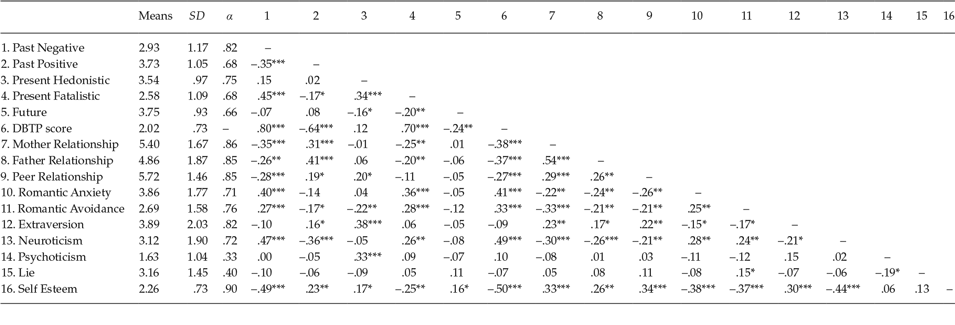
The descriptive statistics, Cronbach alpha values for the scales and correlation coefficients of the measured variables were shown in Table 1. The reliability of the Turkish version of the ZTPI scale was assessed by checking the internal consistencies of each subscale. The reliability coefficients for the ZTPI subscales ranged between .66 and .82. PN had the highest internal reliability estimate with Cronbach’s alpha of 82 and F had the lowest internal reliability estimate with Cronbach’s alpha of .66. When the inter-correlations between the ZTPI factors were examined (see Table 1), it was found that PN was negatively correlated with PP, but positively correlated with PF. The correlation coefficient between PN and PF were strongest (r = .45) among the ZTPI dimensions and it was decided to statistically control for neuroticism scores because both dimensions correlated with neuroticism and also involved negative emotions. The association between PN and PF still remained significant (r = .39) when neuroticism was partialed out indicating that neuroticism alone cannot explain the shared variance. Although PN was correlated positively with PH, the results of the analysis failed to reach the criterion for statistical significance (p = .06). In addition, PF scale correlated negatively with PP but positively with PH. Finally, F was negatively correlated with both PH and PF. Overall, the inter-correlations between the ZTPI factors were in line with the previous findings with the following two exceptions: (1) PH was not associated with PP, and (2) F was not associated with PP and PN. These results implied that in the Turkish sample, PH dimension involved a much less nostalgic view of the past and F dimension did not involve much consideration of the past. A confirmatory factor analysis (CFA) was conducted to examine the fit values of the five-factor structure obtained from the Turkish data. The purpose was to provide fit values however it was not aimed at comparing different competing models. The fit indices yielded poor to acceptable model fit (CFI = .568, SRMR = .099, RMSEA = .065 with 90% CI = .061–.070, NNFI = .548) with a χ2 = 2589.24 and df = 1474.
Descriptive Statistics, Reliability Estimates, and Correlations for the Measured Variables in the Study

Note: Sample size range from 172–178 due to missing data; DBTP = Deviation from balanced time perspective. *p < .05; **p < .01: ***p < .001.
The association between ZTPI factors and perceived quality of interpersonal relationships were in the predicted directions. PN scale had negative associations with the quality of mother, father and peer attachment scores but positive associations with romantic anxiety and romantic avoidance scores. In contrast, PP scale had positive associations with the quality of mother, father and peer attachment scores. Although PP scale was negatively associated to romantic anxiety and avoidance, only romantic avoidance reached the significance criterion. PH was characterized by positive association with peer attachment quality and negative association with romantic avoidance scores while PF was characterized by negative association with mother and parent attachment quality, but positive association with romantic avoidance and romantic anxiety scores. F dimension was not related to any of the variables measuring interpersonal relationship quality. More importantly, DBTP scores were negatively correlated with perceived mother, father and peer attachment quality, but positively correlated with romantic avoidance and romantic anxiety scores indicating that the larger the deviation from BTP, the greater the perceived disruptions of interpersonal relationships.
When measures assessing perceptions of self were examined, the findings were as follows: PN was associated positively with neuroticism, but negatively with self-esteem; PP was associated positively with extraversion and self-esteem, but negatively with neuroticism; PH was associated positively with extraversion, psychoticism, and self-esteem; PF was associated positively with neuroticism and self-esteem; and F was associated positively only with self-esteem. Finally, the DBTP scores were positively correlated with neuroticism but negatively correlated with self-esteem indicating that individuals with BTP had higher self-esteem and lower neuroticism scores compared to individuals who deviate more from BTP.
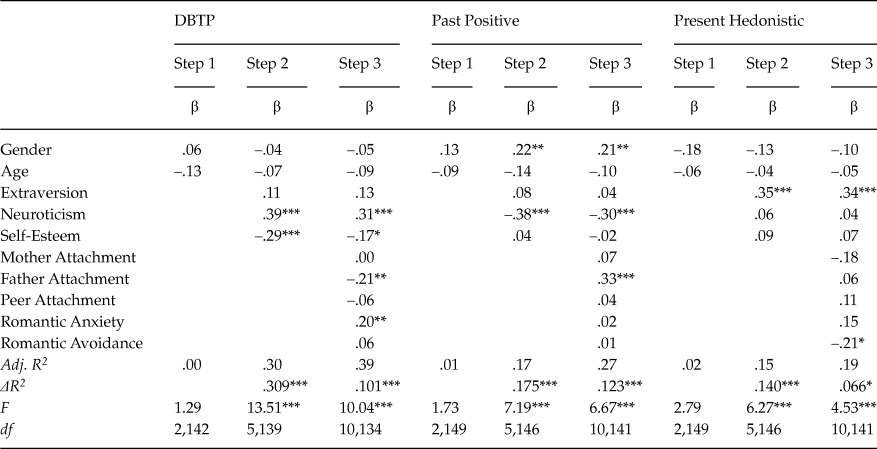
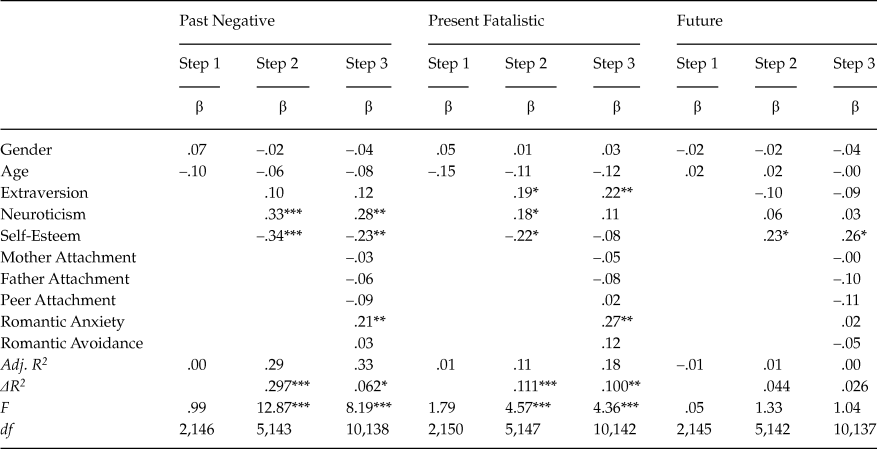
Because neuroticism, self-esteem, and extraversion scores were found to be highly correlated with the factors of the ZTPI and also with measures of attachment quality, it was decided to perform a regression analyses in order to control for the shared variance among these variables. For this purpose, six hierarchical regression analyses were conducted in order to examine how perceptions of interpersonal relationships predict each time perspective and DBTP scores when age, gender, personality variables were statistically controlled. To accomplish this goal, age and gender were entered into the model at Step 1, extraversion, neuroticism and self-esteem scores were entered into the model at Step 2, and perceived attachment quality scores were entered into the model at Step 3 to examine their unique contribution. Before the analyses, all variables were mean centered (Aiken & West, Reference Aiken and West1991). The results indicated that in five out of the six regression models, perceptions of self and of interpersonal relationships uniquely contributed to explaining variance in time perspective (see Tables 2 and 3). Participants’ age did not significantly predict any of the time perspectives. Similarly gender did not predict any of the time perspectives except for PP indicating that males tended to have slightly higher positive perceptions of the past compared to females. As shown in Table 2, the results of the regression analysis demonstrated that personality variables accounted for 30% of the variance in DBTP scores in Step 2 and perceived attachment quality measures accounted for an additional 10% of the variance after controlling for age, gender, and personality variables in Step 3. As for the effect sizes, Cohen’s f 2 (Cohen, Reference Cohen1988) was computed both for the overall regression model at Step 3 and for the unique contribution of attachment variables in Step 3 relative to the variables entered in Step 2. The results showed that the overall model had a large effect size (f 2 = .75) and the perceived attachment quality measures had a moderate effect size (f 2 = .18) over and above other variables in the model. These results implied that individuals with smaller deviations from BTP tended to have lower neuroticism and higher self-esteem scores, and perceived their attachment quality with their father higher and experienced less romantic anxiety compared to individuals with larger deviations from BTP. When the regression analyses for each of the time perspectives were examined, the results showed that personality variables accounted for 18%, 14%, 30%, and 11% of the variance respectively in PP, PH, PN, and PF in Step 2. Finally, after controlling for age, gender and personality variables, perceptions of interpersonal relationships accounted for an additional 12%, 7%, 6%, and 10% of the variance respectively in PP, PH, PN, and PF in Step 3. Only when F was regressed on the aforementioned variables, no significant relationship was found.
Predicting Deviation from Balanced Time Perspective (DBTP), Past Positive, and Present Hedonistic Scores with Personality Variables and Parent, Peer and, Adult Attachment Scores

Note: Gender was coded as 1 (female) and 2 (male). *p ≤ .05; **p ≤ .01; ***p ≤ .001.
Predicting Past Negative, Present Fatalistic, and Future Scores with Personality Variables and Parent, Peer and, Adult Attachment Scores

Note: Gender was coded as 1 (female) 2 (male). *p ≤ .05; **p ≤ .01; ***p ≤ .001.
Discussion
The purpose of the present study was to examine how perceptions of self and of interpersonal relationships are related to time perspective. Perception of self was operationalized with the measures of personality variables and perception of interpersonal relationships was operationalized with the measures of attachment quality. It was predicted that having a positive view of the self and of interpersonal relationships would be linked to smaller deviations from BTP. The present findings were consistent with this hypothesis indicating that personality characteristics and quality of interpersonal relationships have an important role in the development of a BTP. More specifically, having a BTP was found to be strongly connected to having high self-esteem, being less neurotic, having a higher father attachment security, and decreased romantic anxiety. Although previous literature linked BTP to subjective health (Boniwell & Zimbardo, Reference Boniwell, Zimbardo, Linley and Joseph2004; Drake et al., Reference Drake, Duncan, Sutherland, Abernethy and Henry2008), there was not much work on antecedents of BTP. The present study is one of the first studies contributing to our understanding of the mechanisms underlying the BTP as well as how each time perspective is shaped by personality characteristics and quality of interpersonal relationships.
Time perspective theory assumes that one’s perspective of time is continuously shaped by family, education, cultural and environmental factors, and social experiences (Holman & Zimbardo, Reference Holman and Zimbardo2009; Keough et al., Reference Keough, Zimbardo and Boyd1999). The present findings highlight the role of interpersonal relationship quality in the development of time perspective. The quality of father attachment and anxiety felt towards a romantic partner were found to be significant predictors of DBTP scores when age, gender, and personality variables were statistically controlled. Thus, having a more secure father attachment and feeling less anxious in a romantic relationship seem to contribute to maintaining a more BTP. Although attachment orientations are relatively stable, they may change over time due to experiences (Gilbert & Sifers, Reference Gilbert and Sifers2011). Because the present study is correlational, it is not clear whether attachment security leads to BTP or, alternatively, adopting a BTP leads to construing past relationships with the parents as more secure at the present time. Nevertheless present findings are important in two ways. First, parental relationships seem to have differential effects on the BTP with fathers having a more prominent role than mothers. It should be noted that the current sample consisted mostly of female participants and thus the influential role of mothers on sons may be masked due to the sample characteristics. Future research should investigate such possibility on a larger male sample in order to assess the differential role of father and mother attachment orientations on BTP. Secondly, the quality of adult attachment (i.e., attachment towards a romantic partner) was related to BTP. Specifically, BTP was associated with lower romantic anxiety scores indicating that quality of adult attachment is an important factor in understanding BTP. These results also have certain clinical implications such that therapeutic work concentrating on the quality of relationship with father and also anxiety felt towards a romantic partner is likely to help an individual in adopting a BTP.
Current findings are consistent with the hypothesis that BTP develops from a more positive perception of interpersonal relationships. A secure attachment to parents is likely to bolster secure attachment to romantic partners (Saribay & Andersen, Reference Saribay and Andersen2007) and thus would enable individuals to focus more on the present and future rather than unresolved issues in the past. Previous findings indicated that perceived security of parental attachment is connected to well-being (Raja, McGee, & Stanton, Reference Raja, McGee and Stanton1992), well-being is connected to BTP (Boniwell & Zimbardo, Reference Boniwell, Zimbardo, Linley and Joseph2004), and the present findings showed that perceptions of parental attachment are associated with BTP. Together, these findings suggest that there might be a mediating and/or moderating relationship among these variables. For example, BTP could have a mediating or moderating role in the relationship between attachment and well-being. Future research on the nature of relationship among perceived parental attachment, BTP, and subjective well-being should explore the direction of influence.
Qualities of interpersonal relationships were also significant predictors of each time perspective except the F dimension. Results of the separate regression analyses implied that each time perspective is affected by different interpersonal relationships. Romantic anxiety influenced the PN and PF scores indicating that higher scores in these dimensions were associated with higher romantic anxiety. Romantic anxiety also seemed to predict PH scores however this relationship failed to reach statistical significance (p = .071) in the regression analysis. In contrast to PF, romantic avoidance was negatively related to PH. Both PF and PH seemed to be associated with high romantic anxiety but only PH scores were negatively associated with romantic avoidance. These results suggest that higher PF scores are associated with higher romantic anxiety and avoidance whereas higher PH scores are associated with higher romantic anxiety but lower romantic avoidance. Based on these results, individuals high on PH seemed to have a more ambivalent adult attachment such that they might be feeling more secure in their relationships and more likely to disclose and openly share their feelings, fears, and anxiety with their romantic partner but also feel very anxious in doing so. In contrast, individuals high on PF seemed to have a more avoidant adult attachment such that they are less likely to share concerns of their relationships with their romantic partner and, in addition, more likely to feel anxious and scared in their relationships. Finally, PP dimension was characterized less by adult attachment but more with higher quality of father attachment indicating that a secure father attachment is connected to having a positive perspective of the past. It was surprising that F was not related to any of the interpersonal relationship measures. One implication of this finding is that the development of future orientation may be independent of previous or current social relationship security. Future orientation has been shown to be strongly related with delay of gratification (Jacobsen, Huss, Fendrich, Kruesi, & Ziegenhain, Reference Jacobsen, Huss, Fendrich, Kruesi and Ziegenhain1997). The reason for F to be not associated with the attachment scores in the present study could be that F dimension as measured by the ZTPI seems to be more related with achievement orientation rather than relationship security. Future studies need to confirm this conjecture. Nevertheless, interaction with parents and parenting styles has been suggested to influence future orientation (Seginer, Reference Seginer2003). The current findings highlight the importance of social relationships in the development of BTP, however, they also indicate that F dimension is less sensitive to interpersonal relationship quality by itself. Such findings bolster the consideration of all of the time perspectives in relation to each other (i.e., a multidimensional approach focusing on the combination of time perspectives) rather than focusing on each dimension separately (also see Wiberg et al., Reference Wiberg, Sircova, Wiberg and Carelli2012 for a similar suggestion).
In line with previous studies, personality measures were strongly related to time perspective dimensions and they were found to explain a large amount of variance in the DBTP scores. Specifically, smaller deviations from BTP were associated with lower neuroticism, higher self-esteem, and higher extraversion (p = .056) scores. Thus, BTP seemed to be related with a more positive perception of the self, consistent with the initial hypothesis. Previous findings demonstrated the connection between BTP and subjective health (Boniwell & Zimbardo, Reference Boniwell, Zimbardo, Linley and Joseph2004). The present study contributes to the literature by linking BTP to a positive self perception. In addition results of the regression analysis indicated that PP scores were associated with lower neuroticism; PN scores were associated with higher neuroticism and lower self-esteem; PH and PF scores were associated with higher extraversion; and F scores were associated with higher self-esteem.
Overall, these findings suggest that larger deviations from BTP were related to negative perception of interpersonal relationships. More research is needed to understand the complex mechanisms underlying the relationship between attachment orientations and time perspective. However, current study contributes to a literature linking the temporal perspectives to attachment orientations and personality characteristics. The most important conclusion of the present study is that positive evaluations of the self and of interpersonal relationships were associated with smaller deviation from BTP. This result is in line with previous studies linking larger deviations from BTP to poor subjective health (Boniwell, et al., Reference Boniwell, Osin, Alex Linley and Ivanchenko2010; Drake et al., Reference Drake, Duncan, Sutherland, Abernethy and Henry2008), and to reduced tendency to delay gratification (Stolarski et al., Reference Stolarski, Bitner and Zimbardo2011) and positive time perceptions to secure attachment orientations (Laghi et al., Reference Laghi, D’Alessio, Pallini and Baiocco2009).
Finally, the current study evaluated the reliability and construct validity of the Turkish version of the ZTPI. The reliability coefficients were in the acceptable ranges with PN and PH having higher but PP, PF, and F having lower reliability estimates. The pattern of associations among the ZTPI dimensions, personality characteristics, and self-reported attachment orientations further supported the validity of the scale. Overall, a strong relationship between negative personality characteristics, and PN and PF were found, whereas the direction of the relationships was reversed for PP. Although PN and PF were strongly related with neuroticism, negative emotions or negative thinking cannot be the only source of their shared commonalities based on the results of partial correlation analysis. Future work concentrating on the similarities and differences between these dimensions will greatly contribute to improving the psychometric properties of the ZTPI as well as to establishing a clear theoretical distinction between the two dimensions. Present findings are supported by the existing data on the relationship between personality and time perspective (Zhang & Howell, Reference Zhang and Howell2011). The only notable difference is the lack of association between F scores and the other measures in the study except self-esteem. Such result is partly due to low reliability of the scale and also partly due to lower sample size employed in the present study compared to similar studies in the literature. The initial expectations regarding the relationship between the ZTPI dimensions and attachment orientations were also confirmed. Specifically, both PN and PF were negatively associated with perceived father, mother, and peer attachment scores, and in addition, positively associated with romantic anxiety and romantic avoidance scores. In contrast, PP was positively associated with father, mother, and peer attachment scores. Finally, PH was not associated with mother and father attachment scores, but was positively associated with peer attachment and negatively associated with romantic avoidance. Thus, PH dimension seemed to be more concerned about current relationships rather than the past ones. Finally when the correlations between DBTP and other measures were examined, the compound score indicating the deviation from a balanced time perspective was negatively associated with parent and peer attachment scores but positively associated with romantic anxiety and romantic avoidance scores. Thus, positive perception of interpersonal relationships is related to smaller deviation from BTP. The only personality variable having a significant association with DBTP scores was neuroticism indicating a disruption of the balance with increased neuroticism scores. Finally, DBTP scores were negatively associated with self-esteem such that higher self-esteem scores were tended to be associated with BTP. In addition to these inter-correlations, a CFA was conducted to provide fit indices for the five-factor solution of the Turkish version of the ZTPI. The model fit was found to be poor, but within the range of model fit indices reported from other studies (Carelli, Wiberg, & Wiberg, Reference Carelli, Wiberg and Wiberg2011; Liniauskaitė & Kairys, Reference Liniauskaitė and Kairys2009; Worrell & Mello, Reference Worrell and Mello2007). In its present form, the Turkish version of the ZTPI can be used to assess individual differences in perspectives of time . However, it shares similar strengths and shortcomings of the original scale and its adaptations notably the low reliability estimates of some of the subscales. Conducting comparable studies and improving the scale further through evaluation of weak or culturally biased items are likely to resolve such discrepancies.
Although the present study contributes important findings to the time perspective literature, it is limited in certain aspects. The present study was correlational in nature so no causal conclusions should be deduced. It could also be the case that having a BTP might influence how one perceives self and interpersonal relationships. It is very difficult to pinpoint any direction for a causal relationship based on the current findings. The results are consistent with both of the explanations. However, the present study tested the plausibility of the influence of interpersonal relationships on time perspective and found that one’s perception of interpersonal relationships contributes significantly to BTP when personality characteristics are statistically controlled. Future studies should also investigate other personality characteristics to understand how personality is entangled with time perspective. Surprisingly, F was not related to the personality traits and attachment scores measured in this study. However it is probably related with other aspects of personality and thus needs to be explored further. For example, F was found to be strongly related to conscientiousness in other studies (Zimbardo & Boyd, Reference Zimbardo and Boyd1999). The influence of attachment quality on time perspective should be investigated further using different measures so that the generality of the present findings could be assessed. All of the current measures were self-report and thus were subject to various sorts of distortions. Finally, the sample was composed of mostly female college students and thus these results may have only limited generalizability.
My special thanks go to Gulcan Akirmak and Diane Sunar for providing great insight and feedback on the manuscript. I thank Basak Ince, Banu Femir, Sevilay Alhan, and Seydanur Tezcan, for their help in data collection and Cansu Alozkan for her help in Turkish-English translations.