This essay represents my return to a subject with which I have been concerned for the better part of three decades.Footnote 1 It does not revisit the article on Monteverdi's mimetic art that I published in the first volume of this journal in 1989 – a new take on that article will be forthcoming eventually – but rather one that appeared four years before that in another venue, ‘Seneca and the Interpretation of L'Incoronazione di Poppea’.Footnote 2 My return to Seneca is intended nonetheless to fulfil one of the criteria suggested by the new editors of COJ for this anniversary issue, namely, to illustrate how research and criticism in the field of Baroque opera studies have evolved in the two decades since COJ began publication.
The impetus for my original article was the challenge to interpretation posed by Monteverdi's last opera. As critics have remarked uncomfortably ever since the work was discovered in the late nineteenth century, L'incoronazione di Poppea appears to celebrate the triumph of vice over virtue, of ambition and sexual licence over stoic restraint and respect for law: the philosopher dies, the legitimate empress is exiled and the courtesan is crowned.
Some commentators offered a historical antidote to the disturbing moral implications of the work, pointing out that Poppaea and Nero were soon to die, whereas Seneca's philosophy was to enjoy a continuing life for many centuries. Other interpreters attempted to complicate the virtue–vice binary by noting the co-existence of elements of both in many, even most, of the characters.
Indeed, it seemed to me that Seneca himself might offer a key to the interpretation of the work as a whole, and that he could perhaps supply what the opera otherwise seemed to lack: a heroic protagonist, or at least a character with redeeming moral value. Paradoxically, the fact that he died halfway through the opera seemed to enhance rather than diminish his significance.
My focus on Seneca was initially stimulated by the only performance then available on video, namely the production conducted by Nicholas Harnencourt and directed by Jean-Pierre Ponelle. In that highly stylised interpretation, I was troubled by what seemed an overemphasis on Seneca's pomposity and a trivialisation of his death, epitomised by the fact that after his dying was ridiculed by his followers, his casket, covered in maroon velvet, remained on stage until the end of the second act, with life being carried on blithely and obliviously around it.
As with most of Ponelle's interpretative decisions, however, this one was based, at least in part, on evidence in the text. There were indeed grounds for depicting Seneca as impotent and pompous; he was ridiculed as such by Nerone's soldiers and Ottavia's page. Nonetheless, he was also honoured and revered – by the gods and by his followers – and he died heroically, a martyr to his beliefs.
In my first take on this argument – and still – I see Seneca as central to the meaning of Monteverdi's opera, but my ideas have evolved considerably, and now I feel in a better position to defend them – and him. In my earlier article I argued that the contradictions in Seneca's characterisation were the result of conflicting interpretations on the part of librettist and composer, the one, relying on historical sources, seeing the philosopher as a deeply flawed, ambiguous figure, the other viewing the philosopher unambiguously as a hero. The numerous critical responses to my ideas and to the opera itself over the past twenty years have stimulated me to rethink my position, in part to accommodate the opposition, in part to strengthen my case.
As I noted in my original article, the depiction of Seneca's failings, which threaten to undermine his power as a moral force, has strong historical roots. Two of the main ancient biographical sources, Tacitus and Suetonius, emphasise his role as teacher and advisor to Nero, without dwelling on any unsavoury aspects of that role. Although Tacitus hints at some scandal, mentioning an episode of adultery and some suspicious financial dealings, it is Dio Cassius who concluded from these hints that Seneca failed to live up to his reputation as a stoic.Footnote 3 The composite view is neatly summed up centuries later by Petrarch in his Epistolae familiares: his letter to Seneca explicitly addresses the dichotomy between the philosopher's life and his thought, the one worthy of reproof, the other of praise.Footnote 4 It is a view repeated almost verbatim by Nerone's soldiers in Poppea.
These are the sources on which the librettist Gian Francesco Busenello drew for the events in Seneca's life and for his ambiguous characterisation. His major departure from the historical account, highly significant for the interpretation of the opera, as we shall see, involved his chronological displacement of Seneca's suicide. He anticipates the act so that it coincides with the other events in the opera, rather than following them by several years, as was actually the case.
Seneca's ambiguous reputation in history certainly shaped his characterisation in the opera. But in my earlier study, I ascribed it primarily to the libretto, as a function of Busenello's particular cultural background: his membership in the sceptical group of patricians known as the Accademia degli Incogniti, who delighted in arguing multiple sides of any intellectual question – and for whom Seneca represented an ideal topic for philosophical debate. Monteverdi's interpretation, I suggested, was different. Anti-academic and musical psychologist par excellence, the composer rejected rhetorical dialectics, reinforced Seneca's positive qualities and, emphasising his acceptance of death, assured his reception as a serious, even tragic, character. I believed Monteverdi, availing myself of Joseph Kerman's now well-worn refrain: ‘in opera the composer is the dramatist’.Footnote 5 The world in which such a character could die, while his murderers lived, was indeed perverse, upside down (carnivalesque, as numerous authors have pointed out).Footnote 6 I could then conclude, as I still do, that the opera was a cautionary tale, that the triumph of decadence in Rome, however temporary, was intended to remind a modern Venetian audience of the opposite, the virtue of their own long-lasting Republic.
Some subsequent scholars lent support to my view of Seneca, accepting him as serious and acknowledging his centrality, if not explicitly accepting the cautionary reading of the opera. Eric Chafe regards Seneca as the embodiment of Virtue, emphasising his isolation from surrounding events, and crediting his bass voice for the ‘tone of gravity that tends toward the pompous at times’.Footnote 7 Peter Miller and Iain Fenlon go far beyond me in arguing Seneca's seriousness. His lack of efficacy, according to Miller, is a failure of others to understand him, a rejection of Stoicism rather than a failure of communication on his part. Miller terms Seneca a perfect embodiment of Neostoic constancy, which is defeated by Love in the opera.Footnote 8 Robert Holzer advocates a still more serious reading of Seneca, discounting the critical remarks of the soldiers and the page because, as inferior characters, they are untrustworthy; he likens them to the unreliable witnesses in Tacitus's rendering of the events.Footnote 9
Other critics, however, have based their interpretations of the opera on Seneca's weakness rather than his strength. Susan McClary, for instance, characterises him, along with the other males in the opera – ‘the traditional repositories of patriarchal authority’ – as profoundly passive and impotent; and she accuses him of habitually reverting ‘to silly madrigalisms, which destroy the rhetorical effect of most of his statements’.Footnote 10 This, according to McClary, is in contrast to Poppea, who ‘usurps and perverts to her own ends the tools of patriarchal persuasion’, thereby indicating a historically significant shift in gender representation in the work.
A pompous and incompetent Seneca is likewise central to Wendy Heller's view of the opera. She is struck by the philosopher's ‘inability to muster his famed rhetorical powers in the service of a coherent oration … Seneca, oblivious to the nature of beauty, is an incompetent rhetorician and musician. Unable to coordinate word and sound’, she concludes, ‘he is thus an unlikely hero for an opera by Monteverdi’.Footnote 11 (I will have more to say about this critique later.)
Tim Carter reluctantly acknowledges an ambiguous Seneca, but he is not sure whom to credit: ‘These two sides to Seneca are certainly present in the libretto of Poppea and’, he allows, ‘perhaps even in the music’. But, in the end, Carter minimises the heroic side by deliberately denying the effect of Seneca's death.Footnote 12 (I will return to this, too.)
To be sure, both supporters and detractors equivocate to a certain extent: Chafe calls Seneca pompous at times, McClary indicts most but not all of his statements, Carter grants that his music veers between seriousness and pompous vacuity, and Heller, somewhat belatedly, recognises the positive value of Seneca's ‘corrupt’ rhetorical style as necessary to Monteverdi's interpretation.
However much these critical responses may fail to coincide with my original interpretation of Seneca (and the opera), their similarity is striking. In the event, they have inspired me to look again, to see whether and how my reading might be altered to accommodate them. And so we come to the core of this article. I would like now to retrace some of the steps that led to my original interpretation, modifying and I think strengthening it along the way.
As I have already said, then – and now – I see the stoic philosopher Seneca as a central character, arguably the central character of Poppea. He is the moral fulcrum of the work. He makes two appearances, in two groups of scenes: Act I scenes 6–9 (of thirteen) and Act II scenes 1–4 (of thirteen). His death, at the midpoint, bisects the drama and sets its moral opening against its immoral conclusion.Footnote 13 While alive, Seneca seems the only bulwark against decadence, sustaining conscience in others: Ottavia's piety initially prevents her from avenging herself, despite her rage against Nerone. Ottone's self-respect initially restrains him from the temptation of killing Poppea for her betrayal. Even Arnalta's conscience initially bothers her; she cannot condone Poppea's immoral ambition and feels pity for Ottone. It is Nerone who confronts Seneca's moral force most directly; but, despite his struggle, even he cannot counter the moral logic of his old tutor.
Once Seneca is dead, however, immorality runs rampant, gradually and systematically infecting the entire world of the opera, all of its characters and relationships. Ottavia can now plan a murder and become a blackmailer; Ottone can agree to kill Poppea and exploit Drusilla by making her an accessory to the murder; Arnalta can accept Poppea's ambitious expediency, and focus on the rewards of her new status. And Nerone, justified by the failed murder attempt, can now feel free to repudiate Ottavia, the very action Seneca had refused to countenance.
The importance of Seneca's death for Busenello's drama is underscored by two identical references to it in Act II: ‘Or che Seneca è morto’, sings Nerone to Lucano (scene 6); ‘Or che Seneca è morto’, sings Poppea to Arnalta (scene 12). His death (in scene 4) is very much on their minds.Footnote 14 But its meaning is inflected by the moral ambiguity of Seneca's own character, as portrayed by the librettist. That ambiguity is skilfully established from the very beginning, as Seneca gradually reveals a mixture of admirable and less admirable traits.
We first encounter the stoic philosopher through the eyes of Nerone's soldiers, who indict him for failing to follow his own precepts. They call him a pedant, a greedy old man, a cunning fox, a villainous flatterer who increases his earnings by betraying his friends, an evil architect who builds his own house on other men's graves. Valletto's evaluation of him is hardly more flattering. He calls him a Jove-cheater, a philosophical miniaturist of pretty notions, who lines his pockets on the ignorance of others and does the opposite of what he preaches; he disparages Seneca's philosophical advice to Ottavia as empty – an opinion she herself echoes – accusing him of impotence, and labelling his promises specious, affected and useless.Footnote 15 (I would argue, pace Holzer, that here and elsewhere, far from being untrustworthy witnesses, comic characters in opera say things as they actually are.)
Although Seneca subsequently reveals himself a worthy antagonist for Nerone and a committed champion of philosophical principle, even his most heroic act, his suicide, is tainted by ambivalence. His eloquent plea to his followers to accept his death as the natural culmination of his life's work falls on deaf or nearly deaf ears. Not only do they refuse to accept his stoic gesture, urging him to rescind it, they are unconvinced by its meaning. They would not do the same, they say. Life is too sweet. There is nothing worth dying for. Their reaction casts doubt on the very foundations of Stoicism, and the doubt is not theirs alone. Seneca's famigliari speak for the librettist.Footnote 16
Busenello's characterisation of Seneca emerges first and foremost from the poetry he gives him, something I did not register fully enough in my earlier treatment of the subject.
Seneca's text
Busenello's Seneca is exceedingly long-winded, repeatedly delivering himself of extended precepts, some of them quoting actual Senecan texts. He expounds these precepts almost exclusively in lengthy passages of versi sciolti – a poetic style that conventionally called for recitative setting. The single potential aria in his entire role (two stanzas of quinari) occurs in the scene following his death, which was not set to music. Although an occasional rhymed couplet, especially at the end of a speech, may add emphasis to a particularly pertinent – often literally Senecan – formulation, his texts are prose-like, surprisingly lacking in rhyme.
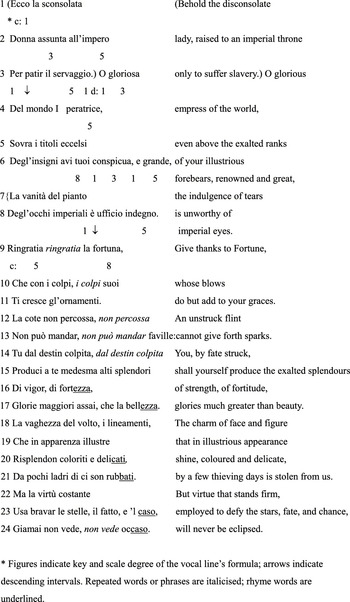
More than half his opening speech, a 24-verse address to Ottavia in Act I scene 6 (Fig. 1), is without rhyme (the rhymes, beginning at verse sixteen, are underlined), and equivalent unrhymed passages can be found in several of his other speeches as well.
Act I, scene 6.

Even when rhyme does occur more frequently, Busenello minimises its effect by avoiding paired lines of equal lengths. In addition to mimicking prose, the infrequency of rhyme or other potential devices of closure tends to leave it up to the composer to find occasions for lyricism. Significantly, as we shall see, for Seneca such occasions are limited.
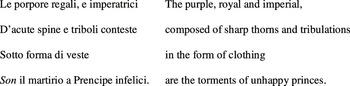
Rhymed or not, Seneca's language remains excessively formal, even pompous in its tone and verbosity. Especially in the scene with Ottavia and the following one, he expresses himself in long, convoluted sentences in which adjective and noun tend to be awkwardly separated (Fig. 1, vv. 3–4: ‘o gloriosa / Del mondo Imperatrice’, and vv. 5–6 ‘sovra i titoli eccelsi / Degl'insigni avi tuoi conspicua e grande’); on other occasions a succession of modifiers repeatedly postpones the point until the end (vv. 18–21: ‘La vaghezza del volto, i lineamenti, / Che'in apparenza illustre / Risplendon coloriti e delicati, / Da pochi ladri di ci son rubati’). Such stilted rhetoric bespeaks a lack of personal engagement with Ottavia, an aloofness emphasised by his adoption of synecdoche in his fruitless efforts to comfort her (vv. 7–8: ‘La vanità del pianto / Degl'occhi imperiali, è ufficio indegno’).
Seneca continues to deliver stiff philosophical platitudes in his soliloquy in the following scene (I.7), as he ‘speculates on the transitory grandeur of this world’. Note how the verb of the sentence is withheld until the end (italicised in Fig. 2).
Act I, scene 7.

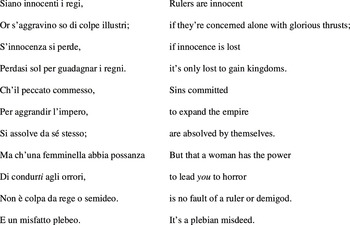
But when Minerva appears to warn him of his imminent death (I.8), Seneca for once responds directly and personally, vowing to overcome his fear with strength and constancy (‘costante, e forte / vincerò gli accidenti, e le paure’), only to conclude the scene in his more characteristic, objective mode with a typically convoluted generalisation: ‘Doppo il girar delle giornate oscure / E di giorno infinito alba la morte’. His subsequent confrontation with Nerone (I.9) is likewise filled with sententious proverbs. Only rarely addressing the emperor personally, he deflects each of Nerone's angry thrusts with a generalisation, the philosopher's cool reason contrasting strongly with the emperor's passionate fury. His concluding eleven-line speech has but a single personal pronoun (italicised in v. 9), introduced after a lengthy series of objective statements (Fig. 3).
Act I, scene 8.

Following this confrontation with Nerone, Seneca is not heard from again until the beginning of Act II. Over the course of these four scenes – alone, with Mercurio, with Liberto, and finally with his followers – Seneca's language becomes consistently more direct and more personal. As he faces the imminent prospect of dying, he undergoes a pronoun conversion; he begins to speak of (and to) himself in the first person, and to others in the second. He opens the act with a prayer to solitude: ‘A te [solitudine amata] l'anima mia lieta sen viene … la Corte … insolente, e superba fa della mia patienza anotomia' ‘M’ assido in grembo della pace mia.’ (‘To you, beloved solitude, my happy soul comes; the insolent and proud court tests my patience.’ ‘I sit here in the lap of my peace.’) His response to Mercurio's warning that death is near is immediate and direct: ‘O me felice’, he says, and then proceeds to explain why he welcomes death: ‘or confermo i miei scritti, / Autentico i miei studi’ (‘Now I can confirm my writings, authenticate my studies’). When Liberto arrives to deliver Nerone's actual death decree, Seneca interrupts and anticipates the message, thanks the unwilling messenger and joyfully embraces his fate (Fig. 4; pronouns italicised).
Act II, scene 2.

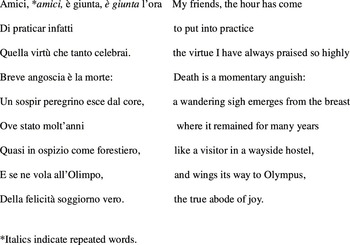
The aloof objectivity of his earlier interactions is replaced by a kind of genuine compassion, a quality that reaches its apex in the scene of farewell to his followers, when he explains proudly to them, as he did to Mercurio, that dying will enable him to realise his philosophy, to fulfil his stoical aspirations. If he resorts once more, temporarily, to the formal language of Senecan precepts – death is but a brief anguish (which echoes a passage from ancient Seneca's De providentia) – his personal belief in them is clear: the stoic philosopher realises himself in the dying man (Fig. 5).
Act II, scene 3.

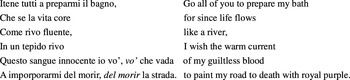
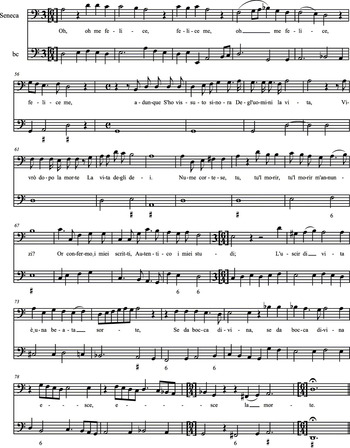
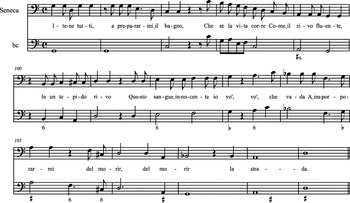
Although he cannot resist a final rhetorical analogy of life to a flowing stream, his last words direct his followers to prepare his bath, explaining that he wishes his flowing blood to purple his path to death (Fig. 6).
Act II, scene 3.

I have gone on at length here because the change in Seneca's behaviour and language incorporated in Busenello's text clearly affected the character as conceived and portrayed by Monteverdi; and this, I think, helps to explain the disparity of interpretations of Seneca with which I began.
Seneca's music
Monteverdi's interpretation of his characters is usually revealed in the words he chooses to emphasise – and the ways he does so. Emphasis can take the form of simple repetition, and/or the application of a madrigalism, or it can involve more complex musical choices. A shift in metre, for instance, or in melodic style – from conjunct to disjunct motion – can highlight a particular textual passage. To judge from the ways in which he chose to set the text, the composer might seem to have been initially uninspired by Seneca. Undoubtedly constrained by the range and physiognomy of the bass voice – and especially its vulnerability to being doubled by the basso continuo – the composer reacts somewhat formulaically to Seneca's generally formulaic text. Four different speeches begin similarly, in duple metre on a single reciting tone – usually D – doubled in the bass, which is extended over the course of several bars before rising to the fifth above, and then falling back to the tonic. This initial gesture is usually balanced by a symmetrical motion in the opposite direction, a stepwise descent to the lower fifth, which then returns to the tonic for a cadence, and the whole formula may then be repeated in its entirety or in an expanded form.
Act I scene 6: This pattern is established in Seneca's very first speech, in I.6, the offending address to Ottavia (Fig. 1: ‘Ecco la sconsolata donna’); it recurs in his subsequent reflection on that speech (Fig. 2 ‘Le porpore regali’), in I.7; in his longest response to Nerone (Fig. 3 ‘Siano innocenti i regi’), in I.9; and in his soliloquy (‘Solitudine amata’) at the beginning of Act II. Although significantly elaborated, it even forms the basis of his final speech of farewell to his followers, in II.3 (Fig. 6).
In the speech to Ottavia, the standard formula, on C, lays out the tonal and melodic space of an opening section of nineteen bars, setting the first eight lines of text (cf. in Fig. 1, numbers beneath the text outlining the formula by scale degree). The formula is reiterated (in bar 8) on a second tonal level, D, to distinguish the lines actually addressed to Ottavia: (beginning in v. 3, ‘O gloriosa del mondo’) from the previous aside (‘Ecco la sconsolata donna’ vv. 1–3), although the distinction is not maintained, and the speech soon reverts to C, the key of the aside (at verse 9), where it remains. When the bass is not completely stationary, it merely doubles the only slightly more rhythmically active vocal line.
In contrast to the rather austere declamation of this opening section, the remainder of the setting, some forty bars, is remarkably active – too active, one might say – and discontinuous. Though it remains centred on C, the music meanders disconcertingly back and forth between extremes of range, and is frequently stalled by authentic cadences involving large (cadential) leaps of fourths, fifths and octaves. Continuity is further undermined by several metric shifts, by phrases that vary unpredictably between extremes of brevity and length (from two to ten bars), and by a succession of exaggerated, excessively literal musical imitations of various kinds. Several disparate images involving conflict, opposition or force (‘i colpi suoi’, ‘La cote non percossa’, ‘dal destin colpita’) are enacted in conflicts between voice and bass – syncopations, accent displacement. Verbs or phrases describing increase or growth (‘Ti cresce gl'ornamenti’, ‘Tu … produci … alti splendori / Di vigor, di fortezza / Glorie maggiori’) are accompanied by ascending linear motion; and melismas decorate a number of expressive – and some not-so-expressive – words: ‘faville’, and ‘glorie’. The composer finds occasions for other isolated, conventional madrigalisms as well – reiterated long notes on ‘costante’, an ascending leap to a melodic highpoint on ‘stelle’ – before reaching a final cadence that involves the largest leap of the speech, a descending major ninth. Some of the musical images are patently unsuitable to the text they accompany. We may note, for instance, that the most extended melisma of all occurs on the article ‘la’, in v. 17, instead of on the following noun, ‘bellezza’, where it belongs. And, likewise, the setting of v. 18, ‘la vaghezza del volto’, places an offending melisma on the noun ‘volto’ instead of on the preceding noun ‘vaghezza’. But even those musical images that do reflect the accompanying text are poorly integrated with one another. As a result, they fail to communicate a coherent message.
The impression of superficiality or disjunction in the relationship of music to text in this speech is heightened by the ineffective use of two of the composer's most trusted expressive techniques: the repetition of key words to encapsulate the essence of an argument, and the shift to song-like triple metre to convey moments of heightened feeling. The words and phrases chosen for repetition here (in italics in Fig. 1) are neither rhetorically nor dramatically important. Emphasising individual words at the expense of thought, the sheer density of these repetitions (five different text fragments are repeated within a six-line passage of text, vv. 9–14) makes their artificiality plain indeed, almost comical. (One remembers nostalgically Nerone's powerful use of this device when he concludes his confrontation with Seneca by declaring: ‘Poppea sarà mia moglie, sarà mia moglia, sarà mia moglie’). And the two brief triple-metre passages (the first beginning at v. 9, ‘Ringratia la fortuna’, the second at v. 18, ‘la vaghezza del volto’) seem unmotivated: generalised responses to mere words rather than expressions of feeling. Indeed, because it is so fragmented by the succession of musical images, and so unjustified, song here ironically seems to reflect the very opposite of feeling: cold calculation, mere words.
The composer's setting emphasises Seneca's worst qualities: his pedantry, his reliance on formulas and clichés, and especially his lack of personal engagement. The absence of an overall controlling structure in the setting of this speech – its fragmented syntax – heightens the artificiality of Seneca's words and undermines his message. His failure to comfort Ottavia is musical as well as textual.
This setting is hardly eloquent; but it eloquently justifies Gary Tomlinson's disparaging critique of Monteverdi's late manner as Marinist, or rather for the ways in which individual words and images tend to be singled out by abrupt changes of style to produce a disjointed succession of discrete images and emotions.Footnote 17 It is no wonder that, whether explicitly or implicitly, just about every negative critique of Seneca focuses on this speech. I quote again from Heller, this time more fully:
Seneca fails to persuade or comfort Ottavia not only because of the apparent futility of his arguments, but also by his utter inability to muster his famed rhetorical powers in the service of a coherent oration. Such blatant contrivances as the melisma on ‘faville’, the syncopations on ‘colpita’, and the ascent illustrating ‘Glorie’ seem … like academic exercises in madrigalesque imitation. This catalogue of musical devices dissuades rather than persuades, distracting the listener from the intention of the speech as a whole, raising suspicions not only about Seneca's oratory but also about the validity of his philosophical stance. The meaninglessness and inappropriateness of such gestures is particularly apparent in the absurdly long melisma … placed on the article ‘la’, rather than on the noun ‘bellezza’. Seneca, oblivious to the nature of beauty, is an incompetent rhetorician and musician. Unable to coordinate word and sound, he is thus an unlikely hero for an opera by Monteverdi.Footnote 18
Carter, too, is disturbed by the rhetoric of this speech, citing it as evidence of Seneca's ‘worrying tendency to engage in vapid musical gestures, whether to support his words (a melisma on “faville”, “sparks”) or even to contradict them (more than three bars of running semiquavers on the definite article “la”)’.Footnote 19
Perhaps the most telling critique, however, comes from John Elliot Gardiner, who introduces a big cut in his performance of this speech (vv. 14–17), eliminating, among other things, the melisma on ‘la’.Footnote 20
There is nothing wrong with these musical techniques per se. But, as I have already noted, they heighten the artificiality of this text. In fact, all of the elements that misfire in Seneca's address to Ottavia are deployed more effectively in his later speeches. In response to the change in rhetoric introduced by the librettist, Monteverdi combines a variety of structural and expressive devices to shape the philosopher's successive responses to Minerva, Mercurio, Liberto and finally to his followers. As he becomes increasingly involved in his personal fate, Seneca's music becomes more highly organised and expressively focused: melodies are more carefully controlled with respect to high and low points; words are selected for repetition and other special treatment in order to encapsulate the central theme or emotional essence of the speech; musical images are appropriate to the meaning of the text and are integrated within the overall dramatic context; and triple metre is deployed for its expressive potential, to communicate intensified feeling. Seneca's increased personal involvement is matched by Monteverdi's. The composer warms to Seneca the martyr, who heroically, and alone, welcomes death.Footnote 21
Act II scene 1: Text interpretation is also effectively synchronised with musical structure in Seneca's soliloquy at the opening of Act II, prior to the entrance of Mercurio. Carefully plotted melodic extremes coincide with appropriate textual passages. High C, the culmination of a rising octave scale on ‘imagini celesti’ (‘celestial images’), is balanced by low A, a moment later, on ‘ignobili terene’ (‘base realms’); and the key word, ‘lieta’ (‘happy’), which encapsulates Seneca's emotional state, receives a long melisma that is gracefully extended in the repetition by the most supple of sequences, eased along by a freshly chromatic bass.
It is worth noting that, ever since Seneca's misappropriation of song in his speech to Ottavia, Monteverdi has not allowed him to express himself in triple metre. The ban is briefly lifted in his response to Mercurio's announcement of his imminent death. In the shaping of this speech, metric contrast, in addition to sequence, melodic structure and expressive text repetition, plays an important role. Once Mercurio delivers his message, Seneca immediately breaks into triple metre for a joyful four-fold repetition of the key phrase 'o me felice', set to a gently descending series of melodic curves in D minor. They are all the more moving for being melodically distinct. A shift to duple metre and a more sober, speech-like style culminates in a strongly cadential statement over a rhythmically active bass, as Seneca explains his welcome embrace of death: ‘Or confermo i miei scritti, / Autentico i miei studi’, he declares (a passage notable, as we have seen, for its personal pronouns). Seneca's final peroration on his happiness brings with it a return to triple metre and expansive song style. The sequential melismas here are expressively suitable, if not specifically word-inspired (Ex. 1).
Seneca, ‘O me felice’ (L'incoronazione di Poppea, Act II scene 1).

Act II scene 2: Equally fitting, triple metre once again combines with mimetic text setting and a beautifully curved melody in Seneca's reaction to Liberto's reluctant message in the next scene. Not only is he expecting his fate, he welcomes it. Recitative setting of the first seven lines of his speech culminates in a concise but telling setting of the final line in triple metre. ‘Rido, mentre mi porti un si bel dono’ (‘I laugh as you bring me so beautiful a gift’) is initiated by a descending mimetic melisma on ‘rido’ that is balanced by another shorter melisma at the end, the phrase returning to the highpoint, high C, before settling on the D minor cadence (Ex. 2).
Seneca, ‘Rido’ (L'incoronazione di Poppea, Act II scene 2).

Act II scene 3: Seneca finally finds his singing voice in his farewell address to his followers in Act II scene 3 (refer to Fig. 5). Monteverdi sets this sequence of nine versi sciolti, ‘Amici è giunta l'ora’ (‘Friends, the time has come’), not as recitative, but as an aria. It is Seneca's only aria. Here triple metre finally matches Seneca's feelings. Song aptly conveys his joy at the prospect of achieving the goal of his philosophy, and dying for his beliefs. In just over twenty bars, the aria displays all the hallmarks of a rhetorically convincing, musically coherent farewell. Music and text meet more closely, and in a more sustained way, than in any of Seneca's previous speeches. Taking as its structural foundation the basic formula that underlies most of Seneca's earlier speeches in recitative, centring around d, the aria is both rhetorically and musically effective. And Seneca's eagerness to communicate with his followers is figured by word repetition at the outset (‘Amici, amici, è giunta, è giunta l'ora’).
A carefully balanced pair of phrases (bars 1–8, 9–16), the first tracing a double ascending curve, the second a triple descending one, lead to a third and final phrase, setting the two concluding lines of text. Here Seneca's eloquence reaches its apex. Text painting is calibrated to coincide with melodic and rhythmic structure so that Seneca's music actually enacts his ascent to and then his sojourn on Olympus. A long rising melisma on ‘vola’ culminates on a highpoint on ‘Olimpo’, which is then just slightly surpassed by an upper-neighbour B accidental on ‘soggiorno’, emphasised by a little expressive melismatic turn before resolving, in Seneca's characteristic fashion, by a descending fifth leap to the cadence (Ex. 3).
Seneca, ‘E se ne vola’ (L'incoronazione di Poppea, Act II scene 3).

Equal eloquence marks Seneca's final utterance, his directive to his followers to prepare his fatal bath. His line is constructed so that the highpoint, C, is touched twice, the first time as the start of a rapid stepwise linear descent of a twelfth that poignantly anticipates (as it imitates) the flowing of blood from Seneca's open veins. The second time it at once caps an ascent and initiates another descent, which is both more gradual and more abrupt than the first one, since it occurs in three stages, each involving a descending fourth leap. Two small word-repetitions (‘vo, vo’ and ‘del morir, del morir’) capture the essence of Seneca's message, his desire to die, and the enactment of that death is mimed in the second melodic descent, slowed by a built-in retard from quaver to crotchet, and finally minim and semibreve motion suggesting his gradual weakening (Ex. 4).
Seneca, ‘Itene tutti’ (L'incoronazione di Poppea, Act II scene 3).

The followers' unappreciative reaction to Seneca's gesture has already been mentioned. In my earlier interpretation I distinguished between the two parts of their response: the chromatic ‘Non morir’ and the canzonetta-like ‘Io per me’. Tim Carter, as part of his ‘re-reading’ of Poppea, intended to counter my interpretation, pointed out the close connection between ‘non morir’ and a frankly lascivious madrigal in Monteverdi's Eighth Book, ‘Non partir ritrosetta’.Footnote 22 Even if the different stylistic, generic and textual environments are taken into account, Carter suggests, ‘at the very least there now is the possibility of playing “non morir Seneca” not so seriously’.Footnote 23 ‘The connection’, he concludes, ‘works against Rosand's reading of the scene and therefore, perhaps of Monteverdi's Seneca as a whole: the composer may be no less detached from, or even cynical about, the character than some of his colleagues in the Accademia degli Incogniti’.Footnote 24 But rather than working against my reading, the inter-textual influence of a trivial love song actually strengthens it. It emphasises even further not so much the failure of stoicism, but the gulf between the philosopher and his followers, the heroic loneliness of the practising Stoic. The indifference of Seneca's followers is a major irony. It heightens the nobility and pathos of his final act.
That Busenello intended Seneca's suicide to be taken seriously is surely confirmed by the scene that follows it in the libretto, cut from the opera: in it the philosopher ascends to Heaven accompanied by a chorus of Virtues. Still clearer confirmation, however, is offered by what actually happens in the opera (‘or che Seneca è morto’): Seneca's death is immediately followed by a love scene between Valletto and Damigella, a kind of dancing on the grave that can only appear sacrilegious in the context. The breathtaking irony of this juxtaposition could hardly have been lost on the original audience – though it is certainly lost on Carter, who interprets it as confirming the irrelevance of Seneca's death for the plot.
But remember, Busenello deliberately rewrote history to locate Seneca's suicide within the timeframe of his libretto's plot. He had the two characters who gained most from it independently announce that death, and he made the moral world of his drama pivot on that death. No action is more relevant to this opera, no character more central to its meaning.
Clearly, then, I still regard Seneca as a hero. However, acknowledging the scepticism of recent critics, I would now argue that he earns that status gradually over the course of his life in the opera, through both text and music; that he develops from impotent and pompous rhetorician who speaks in proverbs to tragic and increasingly isolated hero, willing to die for his beliefs, abandoned by his followers but befriended by the gods. From insufferable philosopher he grows to suffering man. Rather than contradicting the librettist's interpretation, Monteverdi's setting now seems to me to strengthen it. By exacerbating Seneca's pomposity with unintegrated, exaggerated text setting and withholding sustained, expressive lyricism until his final tragic gesture, the composer created music that compassionately represented the complex historical and moral ambiguity of the philosopher. Like Orpheus, Seneca moved Monteverdi because he was a man.
Postscript: other heroes, other interpretations
In the three decades since my original article was published, scholars have brought further data and contextual evidence to bear on this problematic work, and productions of the opera have aired a variety of new interpretations on stage. But the same linked questions still swirl around it: what does it mean and is there a hero or moral exemplar? While, as we have seen, some interpreters have attempted to deny or diminish Seneca's status/stature as the chief moral protagonist (McClary, Heller, Carter), others have proposed alternative candidates for the position – among them Drusilla, Ottone and Poppea, both as a puppet of Amore and on her own.
Fenlon and Miller, for instance, volunteer Drusilla, citing her as an emblem of constancy and linking her selfless love of Ottone with Seneca's embodiment of Neostoic virtue. They base much of their argument, however, on equating Drusilla with Ariosto's character of the same name, an association that cannot be substantiated.Footnote 25 Moreover, her significance as a focal point is limited by her late entry and only sporadic participation in the plot and her failure to undergo any development over the course of the drama.
In directly addressing my arguments in favour of Seneca, Giulio Ongaro complicates the question of finding a moral protagonist, concerning himself rather with identifying a character with whom the public can sympathise or identify.Footnote 26 Rejecting Seneca as someone Venetian audiences would have seen ‘not as a sympathetic character, but as one in a long line of similar “pedanti”, more useful for a good laugh than for a true moral lesson’, he offers Ottone instead. Thanks to Busenello's elaboration of history, Poppea's rejected lover not only appears more often than any of the other characters, but his confrontation with Ottavia in Act II scene 9 is pivotal to the plot, precipitating its subsequent development. Indeed, Ongaro argues that, since it occurs roughly at the midpoint of Act II, it is even more formally central than Seneca's death scene.Footnote 27 And its structural significance is enhanced by its emotional impact. When Ottone acquiesces to Ottavia's demand that he kill Poppea, Ongaro suggests, he is participating in a relationship with a patron that would have been familiar to Venetian audiences. Moreover, Ottone's hesitations on this occasion, echoed and intensified by his many subsequent conflicts, would have elicited the audience's ‘compassione e terrore’. In a related argument affirming Ottone's centrality, Mauro Calcagno points out that it is he who provides the point of view for the audience: they see the action through Ottone's eyes.Footnote 28
Though his virtue (like Seneca's) may be ambiguous – however hard the struggle, he ultimately agrees to murder Poppea – there are indeed grounds for investing Ottone with moral significance within the drama. Like Seneca, Ottone falls as a casualty of the victory of Love – and Fortune. His moral struggle, however, like the philosopher's, engages and finally moves the audience. It provides a counterweight, some redeeming value in a morally topsy-turvy world.
But redeeming moral value does not necessarily make a hero. In his candidate for that role, Poppea, Robert Ketterer sidesteps the issue altogether. He does this through generic sleight-of-hand: because the love of Poppea and Nerone is affirmed at the end, following the removal of all obstacles, he finds the dramatic structure to be fundamentally comic, ‘however reprehensible the characters and their means of achieving it’.Footnote 29 He then proceeds tautologically to use this generic cover to dismiss the effect of Seneca's stoicism: ‘since the structure of the opera is comic, moralising old age cannot triumph: Seneca stands in a long line of sensible father figures who must somehow be circumvented or removed; his point of view is structurally unsuitable to bear the light and heat of love’.Footnote 30
Ketterer's conclusion, once again invoking the genre card, directly – actually indirectly – counters my interpretation of Seneca:
An old scholarly debate about which character is the hero of the opera has variously identified Nerone, Seneca, or Ottone. Perhaps out of moral distaste, Poppea was largely left out of the discussion. But if we must chose a hero in an opera titled the Coronation of Poppea, in which the prologue makes the coronation the goal of the plot and the scena ultima celebrates the achievement of that goal, that hero should surely be Poppea herself. Characters who disappear in the second act or are banished from the stage before the end cannot be regarded the heroes of what is structurally a comedy.Footnote 31
Emphasising the carnivalesque mockery that pervades the opera (‘Not everyone has been convinced, however, that Stoic values triumph, and some may even feel that the opera has, to adapt Tim Carter's words, been treated with less levity than it deserves’), Ketterer concludes that ‘Poppea is a funny [sic] reply to Giulio Strozzi's glorification of the connection between Rome and Venice in two contemporary works’.Footnote 32 Levity aside, I am not convinced of the necessity of finding an established literary genre with which to categorise the opera. To force it into the mould of a classical comedy surely flattens its remarkable ambiguity and minimises the librettist's self-conscious play with the concept of genre itself.
Whether or not we want to invest her with ‘heroic’ qualities, Poppea is indeed arguably the central character of the work, and without the cover of genre. Pietro Moretti invokes contemporary poetic and political theory to make an explicit and convincing case for Poppea's heroism. He sees her as representing the concept of ‘idolo’ articulated by the Renaissance literary critic Jacopo Mazzoni; she is the true subject of poetic imitation, a poetic icon. Like a poet-orator, she persuades her audience – Nerone, but also all of us – to accept her as its new empress. It is her imitation (particularisation) of sensual love that enchants her observers/listeners and defeats Seneca's virtue, unable to move the ‘appetites’ of the moderns.Footnote 33 Moretti's Poppea is not only a poetic icon, however, but also a Machiavellian political heroine, whose every action, however immoral, is justified, as long as it promotes the well-being of the state (‘ragione di stato’). ‘Like a head of state, she simulates and dissimulates – through song – in order to acquire and expand her reign.’Footnote 34
Although I am even more convinced now of Seneca's centrality to L'incoronazione di Poppea – and I thank his detractors for having spurred me to delve deeper into the music and text to reconsider and strengthen my claims – I am also ready to admit many of the other interpretations advanced over the past several decades. While the questions ‘what does it mean?’, and ‘who is the “hero”?’ are still asked – must be asked – every time one seeks to produce or to write about the opera, a variety of answers present themselves as ever more acceptable, and the work emerges as ever more challenging and mysterious. L'incoronazione di Poppea not only allows a multiplicity of interpretation, it requires it.