Kaspar Elm and Bernard Hamilton in memoriam
A Note on Sources
As part of his long-standing work on the ‘Oriens pontificius’, the edition of the papal charters issued before 1198 in favour of the Latin churches and religious institutions founded in medieval Syria and Palestine in the aftermath of the First Crusade, Rudolf Hiestand has repeatedly stressed the extensive loss of source material pertaining to the history of the ecclesiastical establishments of the Latin Levant.Footnote 1 Because of the Muslim reconquest of the so-called Crusader States and the concomitant destruction or complicated transfer of archives to Cyprus, Apulia, Sicily or France, scholars of the crusades and the Latin East are in many respects lacking the diversity and quantity of documentation generally produced by the Church in Western Europe during the Central Middle Ages. No monastic annals, no episcopal chronicles and hardly any hagiographical texts, theological treatises or sermons from Outremer have come down to us, with only very few exceptions such as the inventio narrating the discovery of the relics of the Patriarchs Abraham, Isaac and Jacob in Hebron, the poems revolving around the history of the Temple by Prior Achard and Abbot Geoffrey of the Templum Domini, the descriptions of the Holy Land by Rorgo Fretellus of Nazareth/Antioch and the writings of Gerard of Nazareth, bishop of Laodicea.Footnote 2 In light of the scarcity of literary sources directly associated with the clerical or monastic corporations of the Latin East, documentary evidence becomes all the more important, yet for the vast majority of the churches of Outremer, a handful of charters and fragments of cartularies are the only written records that survived the fall of Jerusalem in 1187/1244 and/or Acre in 1291. As a result, modern research has tended to focus on the most important religious orders (Hospitallers, Templars, Teutonic Knights, and to a lesser extent the Carmelites and the canons of the Holy Sepulchre), while relying on papal charters/registers, liturgical manuscripts and the multitude of pilgrimage accounts as additional sources of information. It is against this background that the following selection of themes and topics – aimed at providing a useful introduction into the history of the Latin Church of the mainland Crusader States – should be assessed.
The Birth of the Latin Patriarchates of Antioch and Jerusalem
When the crusaders advanced through Asia Minor into Syria and Palestine in 1098/99, they encountered a multifaceted religious universe including various different Christian denominations, and after their conquest of considerable parts of what they considered the lands of the Bible, the new secular and ecclesiastical rulers faced fundamental decisions with respect to the governance of the many churches and holy sites now under their dominion.Footnote 3
In accordance with the ecclesiological vision of Pope Urban II, his (re)conciliatory church policy towards Byzantium,Footnote 4 as well as in keeping with the agreements concluded with Emperor Alexios Komnenos in Constantinople, the Westerners initially respected the authority of the Orthodox Patriarchs John IV the Oxite of Antioch and Symeon II of Jerusalem. Both had apparently suffered from mistreatment on the part of the local Muslim lords because they had been suspected of collaboration with the Christian armies,Footnote 5 and not completely without reason, for contact between the crusaders and Symeon, who had fled to Cyprus, was indeed established right at the outset of the siege of Antioch in October 1097 or even slightly earlier.Footnote 6 As a result of these consultations, two letters of, allegedly, joint Greek and Latin authorship were seemingly directed towards the West in October 1097 and January 1098, calling for help and reinforcements.Footnote 7 During the protracted and fierce battles for control of the city, John IV the Oxite endured severe corporal hardships, earning him the repute of vir christianissimus (most holy man) and verus confessor (true confessor), as well as the eventual reinstatement as rightful patriarch.Footnote 8
This state of affairs was not to last very long. When Adhémar of Le Puy, the papal legate on the crusade and main advocate of a propitiatory course, passed away on 1 August 1098, the remaining leaders of the campaign adopted a different ecclesiastical policy, which culminated in the establishment of a Latin Church hierarchy in the East. On 11 September 1098, they issued a remarkable letter, which invited Urban II ‒ now that his representative had deceased ‒ to finish what he had started and to come to Antioch in person because the city had recently surrendered to the Roman faith, in order to occupy, as vicarius Petri, the first and original throne of the prince of the Apostles and to wipe out all the heresies, be they Greek, Armenian, Syriac or Jacobite.Footnote 9
Against this spiritual and ideological background, it appears as if it was only a matter of time before Byzantine and Melkite prelates were removed from their positions of power, before cathedral churches and important pilgrimage shrines were handed over to Latin clerics and monks, and before the Orthodox anaphora and hymnographical canon were replaced by the ordo missae and the divinum officium for the performance of a Latin liturgy according to Roman or Western rites and traditions.Footnote 10 After all, the crusaders, in their own eyes, had miraculously managed to liberate the churches of the East, accomplishing, with God’s help, what Urban II had called for several years earlier. Judging from the substantial body of narrative source material, they not only perceived themselves as the new Israelites, but also as the true successors of the Apostles, who, after a long exile and numerous trials and tribulations, ultimately returned to their ancestral homeland when they captured Christ’s inheritance (Jerusalem) on the very day their forefathers had been dispersed throughout the world (15 July 1099; divisio apostolorum).Footnote 11 As Guibert of Nogent expressed it, the Latins inherited the right to rule from the ever-fickle Greeks, who had deviated from the authority of the Church Fathers, thus finally restoring the orientalis ecclesia to its former glory by means of the occidentalium labor fidelium.Footnote 12
In reality, the relationship and dealings between the different Christian confessions turned out to be far more nuanced and blurred, but clearly there was more to the wide-ranging appeal of 11 September 1098 than mere political necessity, despite an obvious vacuum in leadership and rival parties vying for command over Antioch.Footnote 13 Much more so, the document captured the prevailing religious sentiments and crusading ideas of many a Western noble and knight.Footnote 14 Notwithstanding his pro-Byzantine stance in secular matters, it was Raymond of Saint-Gilles, one of the addressors of the letter, who, in September 1098, appointed the first Latin bishop in the territories conquered by the crusaders, entrusting the newly created see of Albara to Peter of Narbonne ‒ possibly for military reasons,Footnote 15 but also because his Provençal retinue might have preferred a Latin bishop over a Greek.Footnote 16 Peter was sent to Antioch to be duly consecrated, yet we are left in the dark as to which bishop was supposed to perform the ordination; quite probably it was not John IV the Oxite.Footnote 17 Later on in the twelfth century, William of Tyre would retrospectively indicate that Latin clerics had been installed basically everywhere and that the crusaders refrained from appointing a rival Latin patriarch only on canonical grounds.Footnote 18
In any case, the Orthodox incumbent was not finally driven from office until the summer of 1100 as part of Bohemond of Taranto’s plans to constitute a principality independent of any Byzantine interference.Footnote 19 As the son of Robert Guiscard, his background very possibly factored into this decision, since the Normans had already gathered some experience with respect to the establishment of a Latin Church hierarchy in the formerly Orthodox regions of southern Italy.
It is hard to tell to what extent Urban II, upon receiving the letter from Antioch, actually disapproved of its far-reaching implications and to which end he considered journeying to the East like his predecessor Gregory VII had envisaged in 1074.Footnote 20 In a brief note of 1113, Paschal II related how, during the Council of Clermont, Urban II had decreed that all churches in newly acquired territories belonged to the princes who conquered these lands.Footnote 21 Fulcher of Chartres, in his historia, additionally invoked a council held in Antioch in 1098, which had supposedly repeated Urban’s decision.Footnote 22 To be sure, Paschal very probably referred to a statement that originally applied to the Western Mediterranean, and Fulcher was primarily interested in legitimising Paschal’s allocation of Tyre to the Latin patriarchate of Jerusalem on the basis of that very same (hypothetical) canonical decree.Footnote 23 Yet it seems at least possible that some of the crusaders in 1098 had been thinking along the same lines, to the effect that they might have believed they were acting in conformity with Urban’s plans in handling church affairs.
There is tentative evidence to suggest that one year later, in summer 1099, Symeon II of Jerusalem, who supplied the crusaders with foodstuffs during the siege of the city,Footnote 24 had good reason to hope that, just like John IV the Oxite, he would eventually be able to reclaim his former patriarchal throne. Indeed, the wording of the first recension of the chronicle of Fulcher of Chartres, in a passage that was later reworked, suggests that the conquerors initially intended to temporarily prolong the tenure of the (current) patriarch until the arrival of a papal ruling on this delicate issue.Footnote 25 Yet during the lengthy and controversial discussions about the exact nature and relationship between the future secular and ecclesiastical powers, they ultimately decided otherwise, since almost all narrative sources, in one form or another, attest to the election of a Latin cleric, Arnulf of Choques, as either patriarch, quasi-patriarch or, more specifically and accurately, as procurator and custodian of the church relics and the offerings of the faithful.Footnote 26 It is worth noting, however, that Arnulf was very probably neither consecrated nor was he even once called an elect, so his appointment, too, resembled nothing more than a provisional solution while the crusaders awaited judgement from the pope or the successor of Adhémar of Le Puy as new papal legate to the East.Footnote 27 At the same time, Arnulf’s undefined canonical status, together with his responsibilities as keeper and guardian of the church treasures, explain his leading role in the invention of the most precious object in all of Christendom, the relic of the crux vera Domini (True Cross), the discovery of which strengthened his own position as well as the conquerors’ claim to succession of the Greeks.Footnote 28 The expropriation of the Orthodox clergy seems to have been initiated correspondingly, but only formally sanctioned at Christmas 1099, though it remains unclear whether the non-Latin religious were ever completely expelled from the Holy Sepulchre.Footnote 29 The permanent establishment of a Latin patriarchate of Jerusalem seems to have been irreversibly cemented through the institution of two separate chapters of (secular) canons which were officially entrusted with the celebration of the perennial divine service in the Church of the Holy Sepulchre and the Temple of the Lord. Depending on the exact chronology of events, the foundation of both communities of Latin clerics might have even predated and predetermined the appointment of a Latin bishop.Footnote 30
Church Structure, Diocesan Hierarchy and Senior Clergy
Medieval Syria, Palestine and Arabia hardly represented a blank spot with respect to church history. As former provinces of the Roman Empire, they featured an age-old pattern of metropolitan sees and suffragan bishoprics, involving a complex web of special prerogatives and honorary titles attributed to individual churches or monasteries. The ecclesiastical traditions inherited by the Latins were a constant point of reference, and some form of knowledge, for example, via the translation of episcopal lists, even reached the papal Curia,Footnote 31 yet a lack of experience with respect to the Eastern patriarchates is straightforwardly alluded to in papal letters of the early twelfth century.Footnote 32 Overall, the church structure implemented by the new rulers betrays both respect to the former Orthodox configuration as well as a marked influence of Western spiritual ideas, and hence a concomitance of continuity and change.Footnote 33 The creation of the bishopric of Bethlehem in 1108 and the translocation of the metropolitan see of Scythopolis to Nazareth (1125–29) are typical examples as far as Latin innovations are concerned. In both instances, the perceived dignity of the holy sites justified a raise in status, since the churches above the grotto of the Nativity and the place of the Annunciation were intimately connected to the humanity of Christ, one of the focal points within twelfth-century (crusading) spirituality.Footnote 34 The archbishopric of Galilee (Palaestina II) was transferred to Nazareth out of reverence for the place of the Lord’s conception,Footnote 35 while the Church of the Nativity held additional importance on account of its Davidic associations, that is, as a focus of royal power and stage for the coronation of the new, Latin kings of Judea.Footnote 36
There were rival claimants, of course, and the genesis of a Latin diocesan hierarchy was fiercely contested, most vehemently in the case of the archbishopric of Tyre.Footnote 37 The latter had virtually been split up in the crusader period, because diocesan borders, by way of a decree of Paschal II of 1110, were to align with political boundaries, meaning that the metropolis itself and all its territory conquered by Baldwin I and his successors belonged to the kingdom and patriarchate of Jerusalem, while Tyre’s northern suffragans remained subordinate to the primate of Antioch as in Byzantine and Muslim times. Unsurprisingly, the Latin patriarchs of Antioch never consented to this situation, and the archbishops of Tyre, likewise, strove for a unification of their archdiocese. Ultimately, the affair was never properly settled, not even when Innocent II, in December 1139/January 1140, threatened to place the whole church province under the immediate control of the pope, producing a good deal of the extant communication between the papal Curia and the Latin East in the process.Footnote 38 Against this background, the dispute over the title of principal metropolis in either patriarchate, an honorary status sought by both Tyre and Caesarea, represented only a minor issue.
Statistically speaking, ten archbishoprics and about twenty bishoprics – most of which already existed in the Byzantine/Muslim era – were (re)occupied in mainland Syria and Palestine over the course of the twelfth century, for roughly 100–150,000 Latin inhabitants in the patriarchates of Antioch and Jerusalem respectively. This adds up to an almost equal proportion of fifteen dioceses in the northern and southern principalities, at a ratio of about 10–15,000 parishioners per episcopal see. On their own, quantitative estimations such as these seem fairly vague and inexpressive, but they can be contrasted, for example, with the Angevin Empire, where a comparable number of sixteen bishoprics stretched over a territory far more spacious than the kingdom of Jerusalem, or with southern Italy, where a similarly dense network of episcopal sees served a much more numerous Christian population.Footnote 39 Still, Jacques de Vitry believed the Latins had drastically reduced the number of bishoprics to improve their economic conditions – an assertion which appears to be valid in relation to the distant pre-Muslim past rather than the more immediate pre-crusader realities of the eleventh century.Footnote 40
On a local level, by contrast, the web of parish churches was indeed quite loose when compared to Western standards. Despite a fundamental reconceptualisation of ‘Frankish’ settlement patterns over the last two decades,Footnote 41 the vast majority of the Latins undoubtedly lived in urban and/or fortified centres, and most cities, towns and castles managed with only one Latin parish church, except when settlement extended beyond the walled area into the faubourgs of Jaffa, Nablus, Acre, Crac des Chevaliers or Montréal.Footnote 42 The same goes for Jerusalem and its lone altare parrochiale ad caput sancti sepulchri, where the canons of the cathedral chapter administered the sacraments in direct connection to the Holy Sepulchre at the western end of the aedicule.Footnote 43 As a general rule, parish rights hinged on the Latin titular church of the diocese, and in quite a few cases religious communities in possession of the episcopal/parish church and its highly coveted tithes opposed the formal re-establishment of the bishopric, leading to the peculiar construction of what Hans E. Mayer called Stiftsbistümer, that is, bishoprics administered by the (regular) canons of the Holy Sepulchre (Jaffa, Jericho) or the Templum Domini (Nablus, Kerak).Footnote 44
As was the case in contemporary medieval Europe, the history of the orientalis ecclesia was shaped by individuals just as much as by institutions, and the personal background and career of incumbents are two aspects worth considering when focusing on the prosopography of the (senior) clergy of the Crusader States.Footnote 45 Reliable biographical information is, admittedly, only available for the higher-ranking members of the secular and regular church, who largely originated from the West, in the sense that influential offices, if not whole factions, of cathedral chapters and bigger monasteries, as well as important convents of religious orders, were staffed with clerics or laymen who had come to the East from Italy, Spain, the Low Countries, the British Isles or the Holy Roman Empire, but above all from France. Judging from onomastic data, only about half of the lower clergy hailed from the mainland Crusader States. This phenomenon is neither restricted to the first generation of Latin settlement nor merely a consequence of what should be imagined, to a certain extent, as an immigrant society, but also the result of a shortage of surplus male offspring and, especially in the case of the episcopate, a lack of educational centres, let alone universities. There is good evidence for intellectual activity and productive scriptoria, both in twelfth-century Antioch and Jerusalem, as well as in thirteenth-century Acre,Footnote 46 but those members of cathedral chapters bearing the title of magister were mainly responsible for the schooling of the novices, with the aid of such classical works of Latin grammar and poetry listed in the library catalogue of the regular canons of Nazareth and widely used for basic reading, learning and teaching.Footnote 47 Whoever intended to build on this elementary training, people of the calibre of William of Tyre, had to look towards the West to complete their studies.Footnote 48
Consequently, candidates with the necessary education and administrative training were frequently recruited from among the groups of newcomers or, on occasion, even elected when they happened to be present in the East as pilgrims or legates, as in the case of three of the first six Latin patriarchs of Jerusalem, that is, Daibert, archbishop of Pisa (1099), Gibelin, archbishop of Arles (1109/10), and Stephen, abbot of the regular canons of Saint-Jean-en-Vallée outside the walls of Chartres (1128). Aimery of Limoges, Latin patriarch of Antioch for more than half a century (1140–96), had equally arrived only a few years before his appointment, whereas Fulcher, abbot of the regular canons of Cellefrouin, and Frederick of Laroche, archdeacon of Liège, after entering the chapters of the Holy Sepulchre and the Templum Domini respectively, rose to the most eminent positions in the kingdom of Jerusalem to become bishops of Acre, Tyre and Jerusalem.
Monasticism, Religious Life and Spirituality
Not only the Church and the Christian religion as a whole, but also all institutionalised forms of Christian perfection and asceticism derived their origins, at least ideally, from the lands of ancient Palestine, Syria, Arabia and Egypt. Throughout the Early Middle Ages, connections between the Eastern Mediterranean and Western Europe were probably never completely cut off, and both pilgrims and Latin religious of some sort or another – hermits, monks, clerics – continued to visit and cling to the Holy Places of the Bible in spite of all geopolitical changes brought about, in part, by the rise of Islam.Footnote 49 According to the register of Gregory I, in 603 the pope promoted the foundation of two Latin hospices in Jerusalem and on Mt Sinai, and a census of all Westerners serving at Christian cult centres in the Holy Land was conducted at the time of Charlemagne.Footnote 50 When the crusaders arrived, there still were Latin religious communities located in Jerusalem and its environs, including a colony of hermits on the Mount of Olives, some of whom Arnulf of Chocques and Peter the Hermit may have consulted during the siege of the city.Footnote 51 Likewise, there may have existed a Hungarian hospice of the eleventh century, as well as two monasteries (S. Maria Latina and S. Maria maior) close to the Holy Sepulchre, together with an adjacent hospice of St John, the nucleus of the future order of the Hospitallers.Footnote 52 In a charter of 1112, Paschal II, probably at the instigation of the monks of St Mary of the Latins, confirmed the unbroken tradition of the community and its ties to the hospital dating back to the pre-crusader period, although all three institutions, after severe destruction during the reign of the Fatimid caliph al-Hakim (1009/10), had most likely been (re)erected by the Amalfitans between the 1060s and 1080s and later officially separated from one another following the Frankish conquest of 1099.Footnote 53
Looking back on the approximately 200 years of Frankish rule in Syria and Palestine, one cannot fail but notice a unique flourishing of professed religious life (vita religiosa) at the easternmost extremities of Latin Christendom, in both institutional and in architectural terms.Footnote 54 During the crusader period, the Holy Places across the sea attracted numerous believers from all over Western Europe who strove to lead a life devoted to God in close proximity to the original setting of salvation history.Footnote 55 Before long, they were to withdraw to the monasteries at Mary’s burial place (S. Maria in Valle Jehosaphat) or her parents’ house (S. Anna), to join the Orthodox hermits in their mountainous refuge near Haifa (Mt Carmel) or Antioch (Black Mountain), to cater for the needs of the sick and the poor in the Hungarian or German hospital in Jerusalem, or to commemorate Christ’s life, death and work of redemption at the authentic sites of his birth (Bethlehem), Crucifixion (Calvary) or Ascension (Mount of Olives).Footnote 56 Thus the Crusader States, in a relatively short time span, generated a whole plethora of well and lesser known communities of male and female religious, be it Benedictine monks or nuns, recluses, or secular or regular canons. Some of these houses were founded as dependencies of Western orders like the Premonstratensians, the Cistercians or the canons of Saint-Ruf d’Avignon, others followed or took over the customs of Cluny (Palmarea, Mount Thabor) or Montecassino (S. Maria Latina),Footnote 57 yet the vast majority were independent and able to set up their own extensive network of priories in the West through the sustained favour of pilgrims and crusaders alike. Most famous among the ‘indigenous’ establishments of the Latin East are the Templars, Hospitallers and Teutonic Knights, as well as the Knights of St Lazarus or St Thomas of Acre, not least because of their innovative and controversial conflation of monasticism and warfare.Footnote 58 Only the reformed vita canonica of clerics living in poverty and communion (in keeping with the Augustinian rule) enjoyed a comparable success in the Crusader States, with eight communities of regular canons (Holy Sepulchre, Templum Domini, Mount Sion, Mount of Olives, Bethlehem, Nazareth, Hebron, Sebaste) developing into congregations of international repute.Footnote 59
While much has been written about the spirituality of crusading, the pious ideas which lay at the core of religious life in Latin Syria and Palestine have received very limited systematic attention.Footnote 60 As mentioned above, evidence of spiritual reflexion is admittedly scanty, yet the dedication of churches, the contents and forms of divine worship, and the self-perception of clerical or monastic orders, as well as the material expressions of faith and belief – including artistic patronage – go a long way towards illustrating the Latins’ profound occupation with the sacred topography of Galilee or Judea and their sustained attempts at conceptualising their possession of the Promised Land.Footnote 61 In much the same way as the early crusaders had been likened to the Maccabees, so were the Templars in Bernard of Clairvaux’s De laude novae militiae, which contains a lengthy, yet often forgotten catalogue of the Holy Places protected and defended by the brethren.Footnote 62 The Carmelites, in turn, identified the prophet Elias as the founding figure of their order, and the various communities of regular canons, in fierce competition with one another, each conceived of themselves as the true successors of the Apostles and the ecclesia primitiva.Footnote 63 Confronted with the immediate presence of Christendom’s most venerable loca sancta on a daily basis, spiritual sentiments were deeply infused by the cultural landscape and its rich biblical and ecclesiastical traditions, hence the prevalent impetus to faithfully replicate, recollect and re-enact the Old Testament and gospel narratives in text, image, ritual and architecture, as well as on coins, seals, maps, capitals or pilgrims’ flasks.Footnote 64
Religious practices in the Latin East, both official and private, were thus characterised by an even stronger involvement of visible and tangible remnants of sacred history than in Western Europe, including authenticated relics as well as more mundane vestiges like soil, liquids and a good many stones marked by the footprints of Christ,Footnote 65 such as the holy rock inside the Templum Domini, which had to be covered up in marble by the local canons on account of the many pilgrims breaking off bits and pieces.Footnote 66 The veneration of the desired objects was promoted, first and foremost, by the religious institutions who watched over the treasures and skilfully staged their adoration and display as part of their divine service. Such was the case with the crux vera Domini, particles of which were serially chipped off and cased into double-armed cross reliquaries in a workshop close to the Holy Sepulchre to be presented as precious gifts to honourable guests and benefactors by the canons, who, since their reform of 1114, theoretically enjoyed the sole privilege to safeguard the holy relic, except on Good Friday and some unspecified (military or diplomatic) occasions when the patriarch was allowed to carry it.Footnote 67
This at times obsessive aspiration of recreating the life and times of Jesus, his disciples and the early days of the Church, together with the considerable increase in pilgrim traffic and the constant military threat of Muslim powers, created the basis for a certain predominance of religious vows and obligations directed towards the Christian neighbour and the world outside the cloister,Footnote 68 which may be subsumed under the rubric of vita activa, with hospital care, priestly ministry, evangelical mission (in case of the Mendicants) and the fight against Christian enemies evolving into the most characteristic traits of religious life in the Latin East.Footnote 69
The Papacy and the Latin Churches of the East
The First Crusade was initiated, sanctioned and directed by the pope, and although Urban II had probably neither planned nor anticipated the foundation of Latin churches in Syria and Palestine, it seemed only natural for contemporaries to presume that the bishop of Rome would oversee the immediate outcome of the military-religious enterprise, especially since the papacy had slowly but surely accumulated universal powers within Western Christendom as part of the eleventh-century ‘Gregorian’ reform movement. For the dissemination and implementation of their political and ecclesiastical agenda, the popes routinely appointed legates, who, throughout the twelfth and thirteenth centuries, acted as papal representatives and spiritual leaders both on crusade and in the Frankish territories of the Levant.Footnote 70 Dealing with the orientalis ecclesia, however, proved to be a delicate matter.
Once the relationship between the Latin patriarchates of the East and the West had to be balanced out, papal authority faced opposition from the prelates in Outremer unheard of anywhere else in medieval Europe, to the extent that the supremacy of the bishop of Rome was overtly called into question, at least during the twelfth century.Footnote 71 This was not only due to the difficulties of communication across the Mediterranean, with the Crusader States being far removed from the confines of Italy or France, but a matter of (perceived) status. After the conquest of Antioch and Jerusalem, the old concept of the pentarchy of the patriarchates suddenly became sharply relevant again, and the return of the (Catholic) church to the places of Christian origins – reinforced by the spiritual ideas sketched out above – fostered an unrivalled self-esteem among the Latin bishops of the Holy Land. Antioch, after all, deserved special reputation as the first and original see of St Peter, while Jerusalem figured even more prominently as the throne of James, brother of the Lord and mother of all churches, a title only contested by the primitiva et ecclesiarum mater sancta Syon, identified as the first ever Christian church founded by the Apostles after Christ’s Crucifixion.Footnote 72
Needless to say, attempts by the pope to induce the primates of Antioch or Jerusalem to personally collect their pallium from him were met with resistance. After his election as patriarch of Jerusalem in 1118, Warmund of Picquigny waited more than two years before he sent envoys to Rome to ask for his pallium, and he probably would have delayed the matter even further had he not preferred to take no chances with his scheme of creating a fait accompli in Tyre, which entailed the nomination of an archbishop far in advance of the conquest of the city in 1124.Footnote 73 Only on account of his reverence towards the sepulchre of the Lord did Calixtus II grudgingly agree to hand out the pallium, harshly reminding the clergy, king, nobility and people of Jerusalem that this was against the custom of the Roman Church. On top of that, the pope very revealingly felt compelled to urge the Jerusalem faithful to stay in union with, and obedient to, their Roman mother, who, with the blood of her children, had liberated the church of Jerusalem.Footnote 74 But the pope’s rebuke went unheard and Warmund remained obstinate, for only a few years later, in 1128, he planned to invest William I of Tyre with the pallium himself.Footnote 75 It should come as no surprise, then, that the equally ambitious Diego Gelmírez, bishop of Santiago de Compostela (1100–40), consulted his fellow brother in Jerusalem in his grand design to have his cathedral raised to the see of not only a metropolis, but a patriarchate.Footnote 76
In Antioch, dealings with Rome were further complicated by the Petrine origin of both sees. As demonstrated by a letter of 1128 from cardinal bishop Giles of Tusculum to Bernard of Valence, first Latin patriarch of Antioch (1100–35), the differences literally shook the foundations of Western church doctrine, in as much as the papal legate found himself forced to assemble a whole array of biblical quotations to defend the papal position against assertions that Antioch took precedence over Rome due to the seniority of its Petrine tradition.Footnote 77 His efforts, however, came to nothing, for Ralph of Domfront, Bernard’s successor, symbolically assumed office in 1135 by single-handedly taking his predecessor’s pallium from the main altar of St Peter’s Cathedral in Antioch – without regard for the Church of Rome, as William of Tyre later remarked.Footnote 78 Even a figure such as Archbishop Robert I of Nazareth (1138–51), who otherwise remains almost completely obscure, cared very little about papal decisions. In a controversy with the Abbey of St Mary of Jehoshaphat over the parish church of Ligio, he was famously accused of exclaiming that the orders of the pope were of no concern to him.Footnote 79 His canons, equally self-confident and unimpressed, went as far as dragging the monks out of the local church in front of a crowd of believers while they (the monks) were singing mass.
There is some indication to suggest that the popes, therefore, treated the Latin churches of the Levant with an unusual degree of caution. During the twelfth century, there were no permanent legates nor any judge delegates appointed for any of the Crusader States,Footnote 80 and apart from crusading appeals the special esteem of the venerable churches of Syria and Palestine was mainly emphasised in times of severe crisis, that is, during the papal schisms of the 1130s and 1160s, when rival candidates (Innocent II and Anacletus II; Alexander III and Victor IV) exploited the support of the orientalis ecclesia to win out over their adversaries.Footnote 81 In addition, the number of papal privileges issued on behalf of religious institutions of the Latin East hardly matched the amount of confirmations obtained by monasteries or convents in Western Europe, with the exception of the military religious orders and the canons of the Holy Sepulchre.Footnote 82 We must not forget that the passage to Italy was costly, approximately equalling the annual rent of an entire Frankish village, so, with that in mind, appeals to the Roman Curia were still quite frequent.Footnote 83 Since the times of Paschal II, the popes were in fact commonly called upon to intervene in both worldly and ecclesiastical affairs,Footnote 84 and there can be no doubt that they were seriously worried about the state of the Latin Church in the Holy Land, not least because early scandals threatened to jeopardise the prophetic promise, inherent in the successful crusader conquest, that – as the chancery of Paschal II put it – Jerusalem, situated in the middle of nations, would be the place of probation and eventual triumph of Christianity, in general, and of Latinity, in particular.Footnote 85
Relations with the Greek Orthodox and Separated Oriental Churches
Whereas the defamatory language initially deployed after the conquest of Antioch with regard to non-Latin Christians seems to have been abandoned rather quickly, the eschatological vision displayed by Paschal II in 1107 testifies to the firm conviction that, in the era inaugurated by the advent of the Crusaders, all claims to ecclesiastical authority rightfully passed over to the representatives of the Church of Rome. In Jerusalem and elsewhere, Greek Orthodox and Melkite officials lost their privileged position, which, due to the intervention and protection of the Byzantine emperor in Constantinople, they had been able to retain in the later Fatimid period.Footnote 86 The system of liberties granted to the different Christian confessions under Muslim rule was effectively a thing of the past, even though the Crusaders inherited many of the age-old problems of a diverse and polyphonous religious population. The new social regime of ‘rough tolerance’ implemented by the Franks lacked the juridical foundation and precision characteristic of the dhimmi concept of Islamic law.Footnote 87
Overall, scholarship has tended to hover between segregationist and assimilationist conceptualisations of interreligious and inter-confessional life in Outremer, not least because the picture that emerges from our sources is inconsistent and often conflicting.Footnote 88 In any case, the ruling class itself was almost exclusively made up of Latins, that is, Chalcedonian Christians of Roman obedience, irrespective of the fact that, in most parts of both city and countryside, they formed a demographic minority. Members of other religious groups, Muslims, Jews, Samaritans and Zoroastrians, as well as Greek Orthodox Christians and their various separated coreligionists (Armenians, Georgians, Nestorians, Maronites, Jacobites, Copts, Ethiopians, etc.), were forced into the role of second-class citizens with limited rights of local, intracommunal self-government.Footnote 89 As far as non-Christians are concerned, the extent to which they were actually allowed to publicly or privately practise their belief is still debated.Footnote 90 For the many Christian communities, however, their subjection did not preclude a revindication of lost property and a return to their former places of worship from which they had been expelled either by the Fatimids during the approach of the Crusader army or by the Franks, who, by right of conquest or inheritance, claimed for themselves some or all of the property of many a Greek or Oriental Church or monastery.
In Jerusalem, where we are best informed about inter-Christian relations, the possession of the Orthodox patriarchate, comprising the whole north-western quarter of the city around the Holy Sepulchre, officially passed into the hands of Daibert of Pisa, first consecrated Latin patriarch (1099–1102/06), on Christmas Day 1099.Footnote 91 But despite the lament of Matthew of Edessa over the expulsion of all non-Latin religious from their Jerusalemite monasteries,Footnote 92 the latter were probably never deterred from officiating at major shrine churches like the Cathedral of the Holy Sepulchre, for they are mentioned in historiographical as well as in pilgrimage accounts as taking part in the Easter liturgy during the first decade of Frankish rule.Footnote 93 The Greek clergy had been expropriated, as Raymond of Aguilers, too, seems to suggest,Footnote 94 stripped of their church treasures, as in the case of the True Cross,Footnote 95 and there is even some rare charter evidence of 1135/40 documenting the efforts of the Latin canons of the Holy Sepulchre to recover certain commodities and revenues their church had held in the city of Antioch in tempore Graecorum.Footnote 96 Dispossession, however, did not involve outright banishment from the Holy Places. The Russian abbot Daniel, who witnessed the famous miracle of the Holy Fire in Jerusalem in 1108,Footnote 97 reports that the age-old Greek convent of the spoudaei, whose members had served at the Holy Sepulchre for centuries, was still intact.Footnote 98 In addition, the typicon of the Anastasis of 1122, which records the Orthodox liturgy to be celebrated at the cathedral church during Holy Week, contains references to some of the officials of the Greek patriarchal clergy resident in Jerusalem towards the beginning of the crusader period.Footnote 99 One of the colophons of the manuscript mentions a certain Georgios, who commissioned the codex and who combined in his person the secular and ecclesiastical duties of archon and chartophylax, probably because of the precarious state of the local Melkite community.
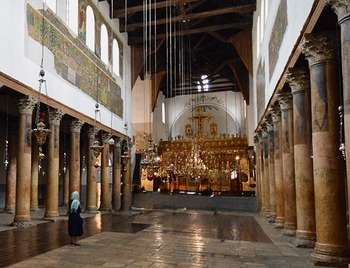
On the whole, historians should be careful not to be misled by the amazement with which foreign travellers like the German pilgrims John of Würzburg and Theoderic took notice of the multitude of Christian confessions present in Outremer in the latter half of the twelfth century.Footnote 100 Pragmatism, if not indifference, commonly ruled the day, both in the political and the ecclesiastical sphere. Armenian or Georgian religious institutions benefitted from the alliances their kings had forged with Frankish nobles; others, like the Maronites and again the Armenians, hoped for betterment of their prospects by agreeing to engage in negotiations for church unity with the popes in Rome; and the translocation of Syrian Orthodox settlers to Jerusalem for the repopulation of a partly ruined city during the reign of Baldwin I (1110–18) may have contributed to a ‘renaissance’ of Jacobite monasticism and literature.Footnote 101 There were shared sacred spaces, joint colonies of Eastern and Western hermits, Latins in Greek monasteries, Frankish queens who endowed Orthodox or Oriental convents, and Byzantine emperors who embellished crusader cathedrals (see Figure 4.1).Footnote 102
Church of the Holy Nativity, Bethlehem, with mosaics created under the patronage of Emperor Manuel Komnenos, King Amalric of Jerusalem and Bishop Ralph of Bethlehem, and with columns featuring twelfth-century paintings of Eastern and Western saints.

Yet, far from being equal, non-Latin Christians were tolerated rather than respected, and their access to the most prominent cult centres was regarded as a generous concession on the part of Frankish ecclesiastics, not as an acknowledgment of rival claims and titles. Plus, Latin prelates, as judges and supervisors, were quick in exploiting the centuries-old reservations between Greeks and Melkites on the one hand and non-Chalcedonian Christians on the other, as in the case of the synod of Jerusalem in 1141.Footnote 103
In retrospect, the arrival of the crusaders might not have dramatically altered the fate of the so-called Oriental Christians, but for the Greek Orthodox the Latin rise to power resulted in their displacement from key positions of the Church hierarchy because there could be only one Chalcedonian bishop in what was still, in theory, a united Catholic/Orthodox ecumene.Footnote 104 From among the corpus of Melkite writing produced under Crusader rule, there is evidence which attests to the fact that the Greek Orthodox prelates clearly resented the discrimination they faced on the part of the Latins.Footnote 105 Their grievance was expressed not in openly hostile invectives, but in the no less characteristic literary form of fictive dialogues set in Crusader Jerusalem and concerned with the traditional bone of contention between Latins and Byzantines, the azyme controversy. The two texts in question can be attributed to John VIII, who, as former Greek Orthodox bishop of Tyre, had to take refuge in Frankish Jerusalem in c. 1106, where he was elected patriarch by the local Melkite community with the consent of Baldwin I. Nevertheless, in his disputations, his Latin counterparts, very probably high-ranking churchmen, are depicted as suppressors. What is more, in his choice of literary form he was following an established tradition, since his predecessor Symeon II and his contemporary John IV the Oxite had already before him reverted to the pen in order to polemically process – on the basis of the question of the Eucharistic use of leavened or unleavened bread – the problem of religious difference. The latter, to be sure, may have been an issue of theological dogma for the most educated few, but for the vast majority of Christian believers in the Crusader States, whether Latin, Greek Orthodox or separated non-Chalcedonian, it was a matter, first and foremost, of daily ritual practice and, thus, possibly, more a hindrance than a cause for rupture.
The Thirteenth Century – A Protracted Epilogue?
When studying the history of the Latin Church in Outremer between 1187 and 1291, scholars are in many ways facing a world that was altogether different from the previous century.Footnote 106 Because of the conquests of Saladin and the huge losses of territory, most of the bishops and cathedral chapters of the Frankish Levant had been cast into exile and reduced to the status of mere titulars hoping for recovery of their former estates and improvement of their financial hardships.Footnote 107 After the Third Crusade, the majority of the monastic orders and clerical communities of Outremer found refuge in Acre, the commercial hub and new capital of the so-called second kingdom of Jerusalem, which became crowded with convents from all over the Crusader States.Footnote 108 From there, owing to a steady deterioration of ecclesiastical affairs, the religious eventually moved on to their order’s priories in the West, but not before the Latin East had been affected by fundamental changes within the Roman Church as a whole, such as the evolution of the Mendicant orders, the steady universalisation of the papacy and new ideas of approaching the religious other.
Deprived of large parts of their revenues, their communities shrunk to a handful of resident brethren and their spiritual centre in enemy hands for decades, the outlook may indeed have appeared bleak for many a Latin priest or chaplain, and the papal registers are full of laments, complaints, appeals for help and disputes over incomes and prebends.Footnote 109 Yet the impression of a prolonged fading of the political and ecclesiastical institutions of the Crusader States is at least partly a result of a teleological and ultimately flawed perspective that is informed by our knowledge of the seemingly inevitable fall of Acre in 1291. The destiny of the Latin East, however, was far from predetermined, and there was room to manoeuvre, with crusading enterprises of European kings and nobles opening up additional lines of action, especially on a diplomatic level.Footnote 110 Only few communities, however, took advantage of these opportunities, possibly for safety reasons. For example, there is no conclusive evidence that the canons of either the Holy Sepulchre or the Church of the Nativity ever returned to their former mother houses after the Christians had regained control over Jerusalem and Bethlehem in 1229 as per the truce between Emperor Frederick II and Sultan al-Kamil of Egypt.Footnote 111 The canons of the Church of the Annunciation still resided in Acre, when Louis IX of France visited Nazareth in 1251 after the city had been restored to the Franks as part of the king’s peace agreements during the Seventh Crusade.Footnote 112 The bishop and cathedral chapter subsequently drew up a veritable reform charter for their church, but they would never again take up their duties in and above the house of the Holy Family, allegedly because of the military threat of the Muslims.Footnote 113
The structural problems of the Latin Church of the thirteenth-century Levant were undoubtedly manifold. During Saladin’s conquests (1187–91), the episcopate had died out almost completely, increasing the demand for able churchmen from the West. The canonical right of devolution was frequently exercised, and the practice of papal provisions brought more and more Italian bishops and curial chaplains to the East, some of whom were very well educated.Footnote 114 Compared with a career in the West, however, the available offices seemed rather unattractive, leading to prolonged vacancies due to papal familiars delaying their transfer to Syria or Palestine. From about the middle of the thirteenth century onwards, the popes thus turned to the mendicants as special agents of the supreme pontiff, who were at the same time engaged with their order’s apostolic mission in Asia.Footnote 115
As former patriarch of Jerusalem, Pope Urban IV (1261–64) sought to remedy some of the deficiencies by uniting the sees of Acre and Jerusalem, thereby addressing the financial straits of the head of the Latin Church of Outremer as well as the hierarchical anomaly that the senior ecclesiastic of the realm permanently resided within the diocese of his most powerful suffragan, the bishop of Acre.Footnote 116 Similarly, the smaller religious establishments of the Crusader States tried desperately to maintain institutional cohesion within their order. Until the very last years of Frankish rule, the abbot of the Templum Domini would apparently summon the subordinate priors of his church’s Western dependencies to Acre, and only in 1289 did the abbot of the chapter of Mt Sion finally surrender to the administrative challenges of a transmediterranean church regime.Footnote 117 Impoverished and incapable of visiting his scattered European possessions, with only one canon left in whose person the right of the whole community was vested, he found himself forced to pledge the rights and revenues of his order’s French daughter-houses to the bishop of Valania because of ‘the nature of these imminent times’ and ‘the severity of his day and age’.Footnote 118 What he could not foresee is that the Latin churches of Palestine and Syria would survive the catastrophe of 1291, in Messina, Barletta and Perugia, as well as in Orléans, Troyes, London and Barcelona, where the institutional memory of a religious life in direct connection to the Holy Places was upheld well into the Early Modern period.Footnote 119
In this somewhat diasporic process, the island of Cyprus, conquered by Richard the Lionheart in 1191 and tied to the fate of the mainland Crusader States for roughly a century, served as a natural stepping stone for many of the religious institutions of Outremer.Footnote 120 In September 1195, even before the formal recognition of a Latin church and kingdom of Cyprus by Pope Celestine III and Emperor Henry VI in the following year, the canons of the Templum Domini were the first to receive endowments in Nicosia and its environs by Aimery of Lusignan, whose family, vassals and high-ranking nobles had been deeply invested in the territories of Latin Syria and Palestine on a personal, genealogical and political level.Footnote 121 Over the course of the thirteenth century, most of the Benedictine, Augustinian or Mendicant houses of the Latin East followed suit by establishing themselves on the island, and it is here, in their dependencies in Famagusta, Paphos, Limassol, Bellapais and elsewhere, that many religious found refuge after the fall of Acre in 1291. However, not all of the monastic orders of the Latin Levant simultaneously transferred their mother houses to Cyprus; in many cases, preference was given to some of the older priories in the West, where the monks and canons had been well-received by the faithful for over a century.