Introduction
Predation affects the organization of ecological communities by generating avoidance responses in prey species. These responses may involve biochemical, physiological, or behavioural strategies (MacDonald et al. Reference MacDonald, Frost, MacNeil, Hamilton and Barbeau2014; Jermacz et al. Reference Jermacz, Nowakowska, Kletkiewicz and Kobak2020). To enable amphipods to detect the presence of a predator, they can perceive numerous stimuli, including chemical, visual, and/or mechanical cues. In aquatic environments, chemical cues are the most important (Jermacz & Kobak Reference Jermacz and Kobak2018). The gammarid Corophium volutator (Pallas, 1766) curtails its surface crawling activity markedly in the presence of the migratory predator, Callidris pusilla Linnaeus, 1766 and goes deeper into its burrow to reduce the risk of being eaten; this generates a spatial distribution that differs from their distribution in the absence of predators (MacDonald et al. Reference MacDonald, Frost, MacNeil, Hamilton and Barbeau2014).
Some parasites with complex life cycles requiring trophic transmission can alter the behaviour of their intermediate host and thus increase their probability of being transmitted by predation to the suitable definitive host (Moore Reference Moore2002; Cézilly et al. Reference Cézilly, Thomas, Médoc and Perrot-Minnot2010; Poulin Reference Poulin, Brockmann, Roper, Naguib, Wynne-Edwards, Mitani and Leigh2010; Friesen et al. Reference Friesen, Poulin and Lagrue2017). Several altered traits such as visual appearance, behaviour, life cycle, and physiological characteristics have recently been described in reviews of parasitic manipulation by acanthocephalans (Bakker et al. Reference Bakker, Frommen and Thünken2017; Fayard et al. Reference Fayard, Dechaume‐Moncharmont, Wattier and Perrot‐Minnot2020). Behavioural changes recorded in infected amphipods include negative geotaxis, increased clinging to floating vegetation (Bauer et al. Reference Bauer, Haine, Perrot-Minnot and Rigaud2005; Lagrue et al. Reference Lagrue, Heaphy, Presswell and Poulin2016), positive phototaxis (Rauque et al. Reference Rauque, Paterson, Poulin and Tompkins2011), increased activity (Friesen et al. Reference Friesen, Poulin and Lagrue2017), and increased bioturbation (Williams et al. Reference Williams, Donohue, Picard and O’Keeffe2019). Studies of intermediate host behaviour in South America are scarce. For Hyalella patagonica Ortmann, 1911 [should be added as authority Hyallela patagonica] in particular, it has been reported that infection by the nematode Hedruris suttonae Brugni and Viozzi, 2010 causes an increase in phototaxis levels (Casalins et al. Reference Casalins, Brugni and Rauque2015), and infection by the acanthocephalans Pseudocorynosoma enrietti Molfi and Freitas Fernandes 1953 and Acanthocephalus tumescens (von Linstow, 1896) alters the reproductive behaviour and gonad development of the amphipod (Rauque & Semenas Reference Rauque and Semenas2009).
Predation and parasite manipulation can impact the organization of ecological communities and the survival strategies of prey species. Understanding how prey species perceive and respond to predators and parasites helps us to be aware of the diversity of anti-predator strategies and their impact on community structure (Paterson et al. Reference Paterson, Dick, Pritchard, Ennis, Hatcher and Dunn2015). To avoid being transferred to a dead-end predator, the parasite manipulates the intermediate host to guarantee transmission to a suitable definitive host (Moore Reference Moore2002). Anti-predatory mechanisms would interfere with this parasite manipulation because avoidance mechanisms help preserve the prey, whereas manipulation contributes to increased predation. Benesh et al. (Reference Benesh, Kitchen, Pulkkinen, Hakala and Valtonen2008) found that the behavioural manipulation of Pallasea quadrispina Sars, 1867 by the acanthocephalan Echinorhynchus borealis Linstow, 1901 was detectable only when predator signals were introduced into the experiment.
In the cold-temperate freshwater environments of Patagonia, H. patagonica acts as an intermediate host for several helminth species (Rauque & De Los Ríos Escalante Reference Rauque and De Los Ríos Escalante2013). In Lake Mascardi, P. enrietti is a bird parasite found in amphipods mainly during spring and summer (Rauque et al. Reference Rauque, Flores and Semenas2022), when it reaches prevalence values of around 30% (Rauque & Semanas Reference Rauque and Semenas2007). So far, few studies have focused on how parasite infection affects prey–predator interactions in freshwater organisms. In the present work, therefore, we explore the effect of predator signals on the behaviour of H. patagonica, study the behavioural changes in this amphipod species induced by P. enrietti infection, and evaluate whether the parasite infection interferes with H. patagonica response to the predator signals. We evaluated behavioural alteration by measuring four amphipod behavioural traits: activity, phototaxis, geotaxis, and clinging. We expect that (i) amphipods will respond to chemical signals from predators, (ii) the acanthocephalan will alter amphipod behaviour, and (iii) amphipod anti-predator behaviour will be affected by this parasite.
Materials and methods
Collection of the animals
Amphipods were collected from Lake Mascardi (41°21’38’’S; 71°34’21’’W), Patagonia, Argentina. This oligotrophic lake is of glacial origin. Anatids such as Chloephaga picta (Gmelin, 1789) and Chloephaga poliocephala Sclater, 1857, among other waterfowl (Narosky & Yzurieta Reference Narosky and Izurieta2010), are common inhabitants of this lake. The Chloephaga spp. are mainly vegetarian, feeding on leaves, stems, grass and sedge seeds (del Hoyo et al. Reference del Hoyo, Elliott, Sartagal, del Hoyo, Elliott and Sartagal1992); they acquire P. enrietti infection by accidental ingestion of parasitized amphipods. In January 2019 (austral summer), we collected amphipods and categorized them in the field by size and infection status. Specimens were sampled using sieves and transported live to the laboratory along with lake water and aquatic vegetation. They were kept under conditions similar to the natural environment: a controlled temperature of 16°C and a photoperiod of 14 light/10 dark. Amphipods were kept with supplementary aeration, and aquatic vegetation from the lake was provided as food. All experiments were performed at room temperature (18°C) within 72 hours of amphipod collection.
Behavioural assays
Experiments were performed to evaluate four behavioural traits: activity, phototaxis, geotaxis, and clinging to floating vegetation. We chose these traits because they are measurable and determine the position of the amphipod in the water column, which provides an indication of their likelihood of escape from the predator, as observed in other amphipods (Benesh et al. Reference Benesh, Kitchen, Pulkkinen, Hakala and Valtonen2008; Jacquin et al. Reference Jacquin, Mori, Pause, Steffen and Medoc2014; Jermacz & Kobak Reference Jermacz and Kobak2018). Furthermore, these traits are among the most frequently affected by parasites (Bakker et al. Reference Bakker, Frommen and Thünken2017; Fayard et al. Reference Fayard, Dechaume‐Moncharmont, Wattier and Perrot‐Minnot2020). These studies were carried out in both the absence and presence of chemical signals that mimic the presence of a waterfowl. We measured the behaviour of each individual amphipod in the absence of waterfowl signals for 40 minutes; after these experiments, each amphipod was left to rest for 30 minutes in the tube. Most of the water was then removed from the tube, leaving only 5 ml to prevent stressful drying out for the amphipod. The tube was then filled with water containing predator signals, and a new set of experiments was carried out for another 40 minutes. Due to stress and possible behavioural changes generated in amphipods by the presence of predators, we chose to start the experiment without the predator signals and then add them, as in the procedure of Benesh et al. (Reference Benesh, Kitchen, Pulkkinen, Hakala and Valtonen2008).
Without chemical signal from predator
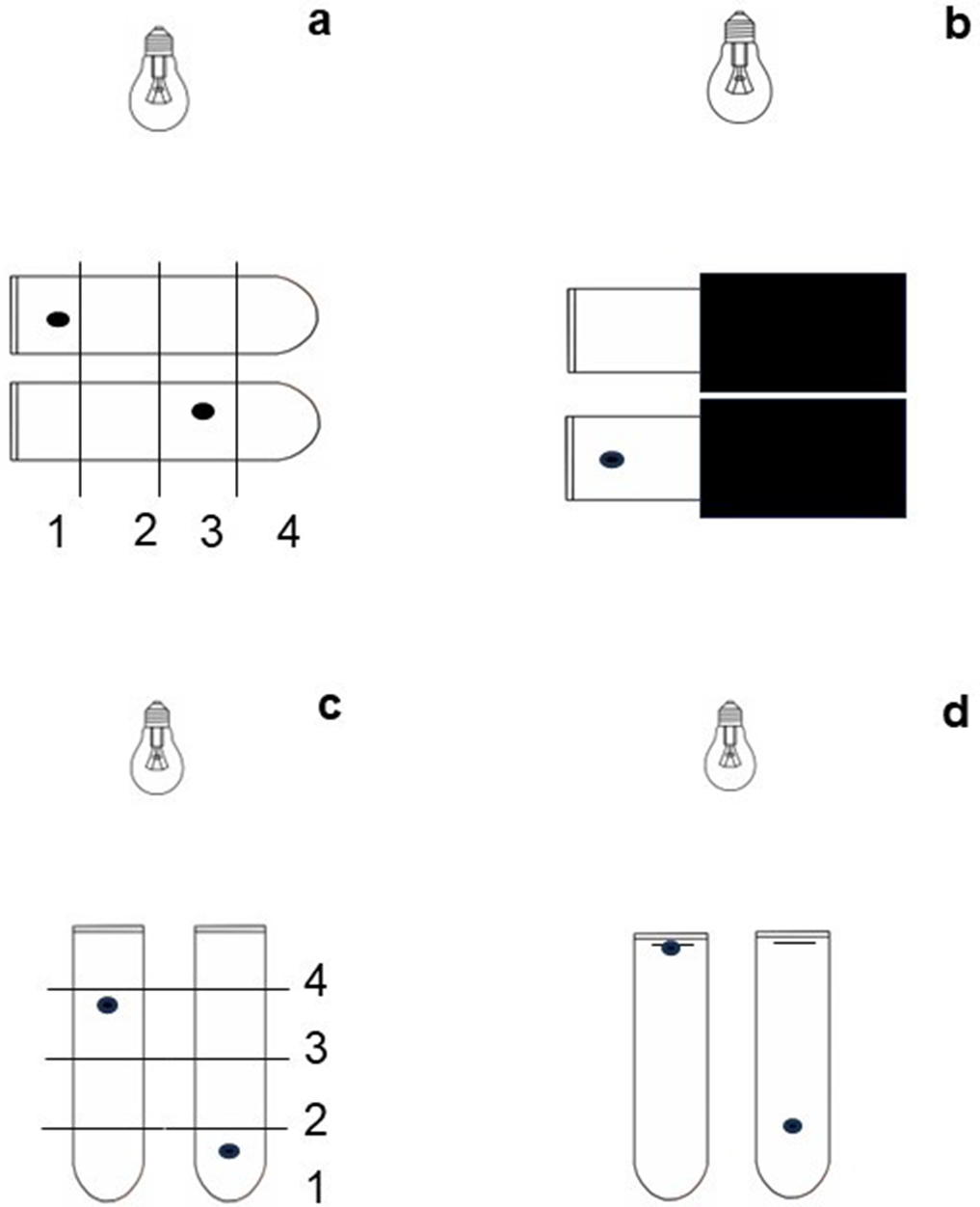
Following Rauque et al. (Reference Rauque, Paterson, Poulin and Tompkins2011) and Casalins et al. (Reference Casalins, Brugni and Rauque2015), activity levels (Figure 1A) were measured by first placing each amphipod in a 22.5 ml glass tube (18 cm in height, 1.5 cm in diameter) with dechlorinated water and then sealing the tube with plastic film (Pro-Film). Each tube was located horizontally on a grid divided into 4 equal zones (zones 1, 2, 3, and 4) and illuminated with a cold light lamp of 80 W, which wasa located at a height of 45 cm. After an acclimatization period of 5 minutes, the presence of the amphipod in one of the four zones was recorded at 30-second intervals for 5 minutes (11 readings, with the first reading at 0 seconds). Activity was calculated from these readings of amphipod position by registering the changes in position at each reading (10 differences with values varying between 0 and 3). The sum of these 10 differences could vary between 0 for non-active individuals and 30 for those that were very active.
Schematic view of the experimental design to measure behavioural traits; a black dot represents an individual amphipod of Hyalella patagonica in the tube. (A) Activity: the amphipod is located in zone 1 in the upper tube and in zone 3 in the lower tube. (B) Phototaxis: the amphipod is located in the dark zone in the upper tube and in the clear zone in the lower tube. (C) Geotaxis: the amphipod is located in zone 3 in the left tube and in zone 1 in the right tube. (D) Clinging: the amphipod is attached to the stem in the left tube, and it swims freely in the water column in the right tube.

To characterize phototaxis (Figure 1B), the tube with the specimen used previously (activity trial) was covered with a paper cap (9 cm in height, 2 cm in diameter), which generated a light zone (half tube) and a dark zone (half tube). After an acclimatization period of 5 minutes, the presence of the amphipod in the light zone was recorded (at intervals of 30 seconds for 5 minutes). A value of 1 was assigned when the animal was present in the light zone, and a value of 0 was assigned when the animal was absent. The total for each amphipod ranged from 0 for amphipods with negative phototaxis (always in the dark side) and 11 for those with positive phototaxis (always in the light zone).
To measure geotaxis (Figure 1C), the same tube with the same amphipod was placed vertically, was divided by a grid into 4 zones representing 4 heights, and was illuminated as before. After an acclimatization period of 5 minutes, the presence of the amphipod was recorded in one of the four zones (zone 1 at the bottom and zone 4 at the top) at intervals of 30 seconds for 5 minutes (11 readings). The preferred height of the amphipod was calculated from these readings. The total for each amphipod ranged from 11 for individuals positioned always at the bottom and 44 for those located always at the top.
To assess clinging to the floating vegetation (Figure 1D), the tube was opened and a floating plant stem was placed on the surface. After an acclimatization period of 5 minutes, we recorded whether the amphipod was clinging to the stem at intervals of 30 seconds for 5 minutes; we assigned a value of 1 when the animal was holding on to the stem and a value of 0 when it was not. The total for each amphipod was 0 for those never clinging and 11 for those always clinging to the stem.
With chemical signals from predator
After the first series of experiments, each of the amphipods was subjected to another series of similar experiments. On the same day as amphipod collection, fresh feces of Chloephaga sp. were collected from a nearby coast of the same lake (41°21’26’’S; 71°34’10’’W); the feces were brought to the laboratory, cooled, and kept in the refrigerator at 8°C until used. To simulate the presence of bird predators, we partially followed the methodology of Arnal et al. (Reference Arnal, Anaïs, Elguero, Ducasse, Sánchez, Lefevre, Dorothée, Bédèrina, Vittecoq, Daoust and Thomas2015). Feces of Chloephaga sp. were added at a concentration of 1 g/l. Following the tests, all amphipods were fixed in 2% formaldehyde and then examined under stereoscopic microscope to determine head length (for several amphipod species, this measure has proved to be an indicator of body size (Rauque et al. Reference Rauque, Paterson, Poulin and Tompkins2011; Wilhelm & Lasenby Reference Wilhelm and Lasenby1998)), sex (male or female), and the presence of acanthocephalans.
Statistics
To analyse the effect of sex on behavioural traits, a Kruskal-Wallis Test was performed for the following categories: uninfected females, infected females, uninfected males, and infected males; an a posteriori Multiple Comparison test was also performed when necessary. The effect of amphipod head length on the behavioural scores was analysed using a Spearman Rank Correlation Test. The influence of sex and head length on the behavioural scores was analysed for amphipods before adding the predator signals.
To analyse the response of amphipods to chemical signals from predators (anti-predator behaviour), we performed a Wilcoxon Test (before and after values) for two paired samples. To analyse the effect of acanthocephalan presence on amphipod behaviour, a Mann-Whitney U Test was performed. From the results of these tests, we determined whether the amphipod anti-predator behaviour was altered by the parasite infection. We applied the Bonferroni correction to the threshold value of p. The statistical analyses were conducted using the software StatSoft Statistica 8.
Results
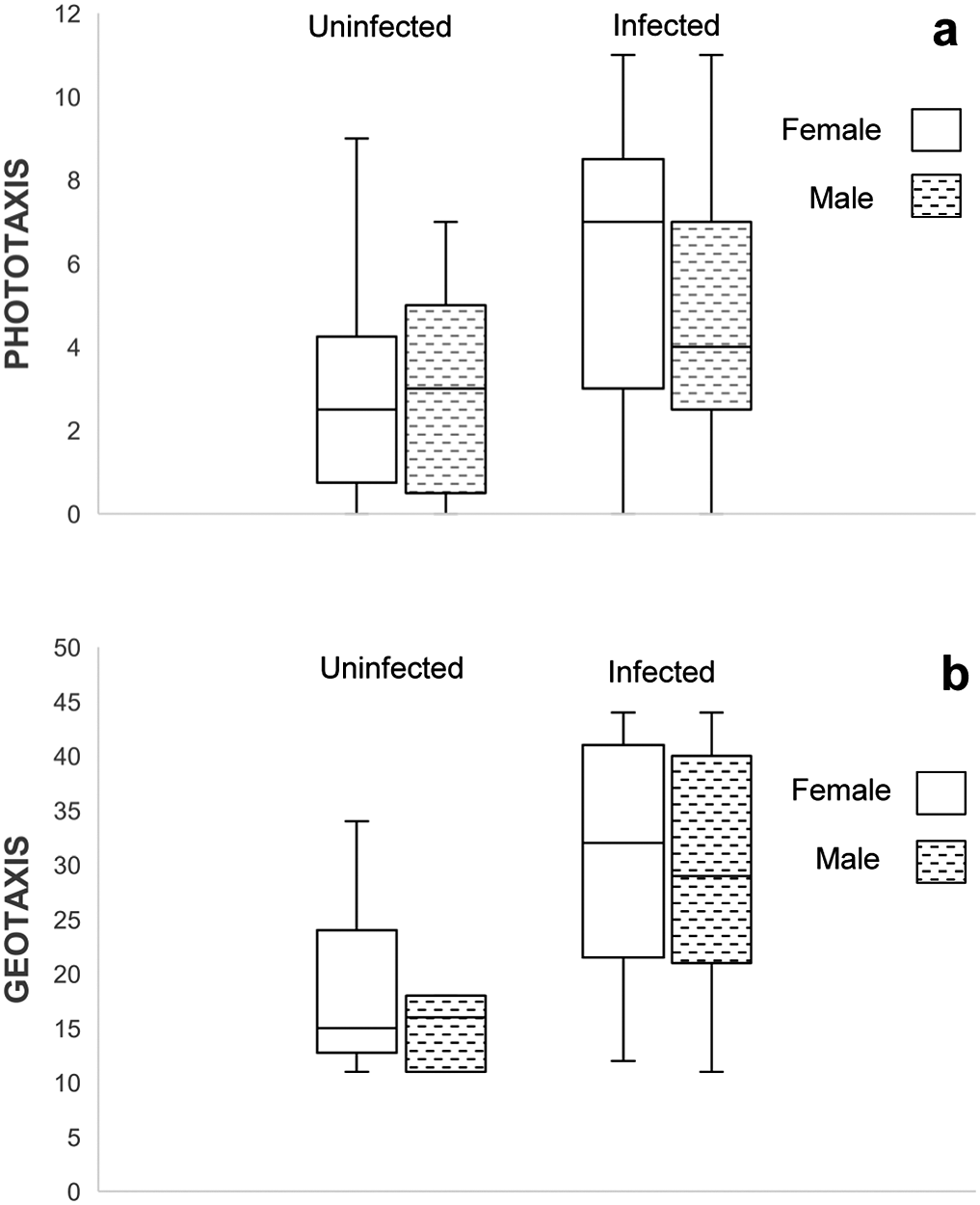
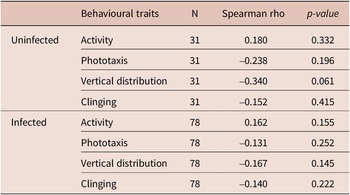
A total of 109 amphipods were used for the experimental trials (71 females and 38 males); 78 were infected by cystacanths of P. enrietti, and 31 were uninfected. The effect of sex on the behavioural scores was significantly independent: activity and clinging showed no significant differences, whereas phototaxis and geotaxis showed differences only between infected and uninfected amphipods (Table 1; Figure 2). Female head length varied between 700 and 1000 μm for uninfected specimens and 650 and 925 μm for infected specimens; in males, head length was 800–1000 μm for uninfected specimens and 700–1000 μm for infected specimens. All the behavioural scores were significantly independent of head length (Table 2).
Kruskal-Wallis test to evaluate the association between sex and behavioural traits of uninfected and infected amphipods (Hyalella patagonica) before adding predator signals (considering p = 0.00625 as the critical value of the test, using a Bonferroni correction)

Association between sex and (A) phototaxis and (B) geotaxis scores for uninfected and infected amphipods before adding predator signals. Median (line), quartiles, and range.

Spearman Rank Correlation Test to evaluate the association between head length and behavioural traits of uninfected and infected amphipods (Hyalella patagonica) before adding predator signals

Behavioural effects
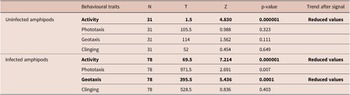
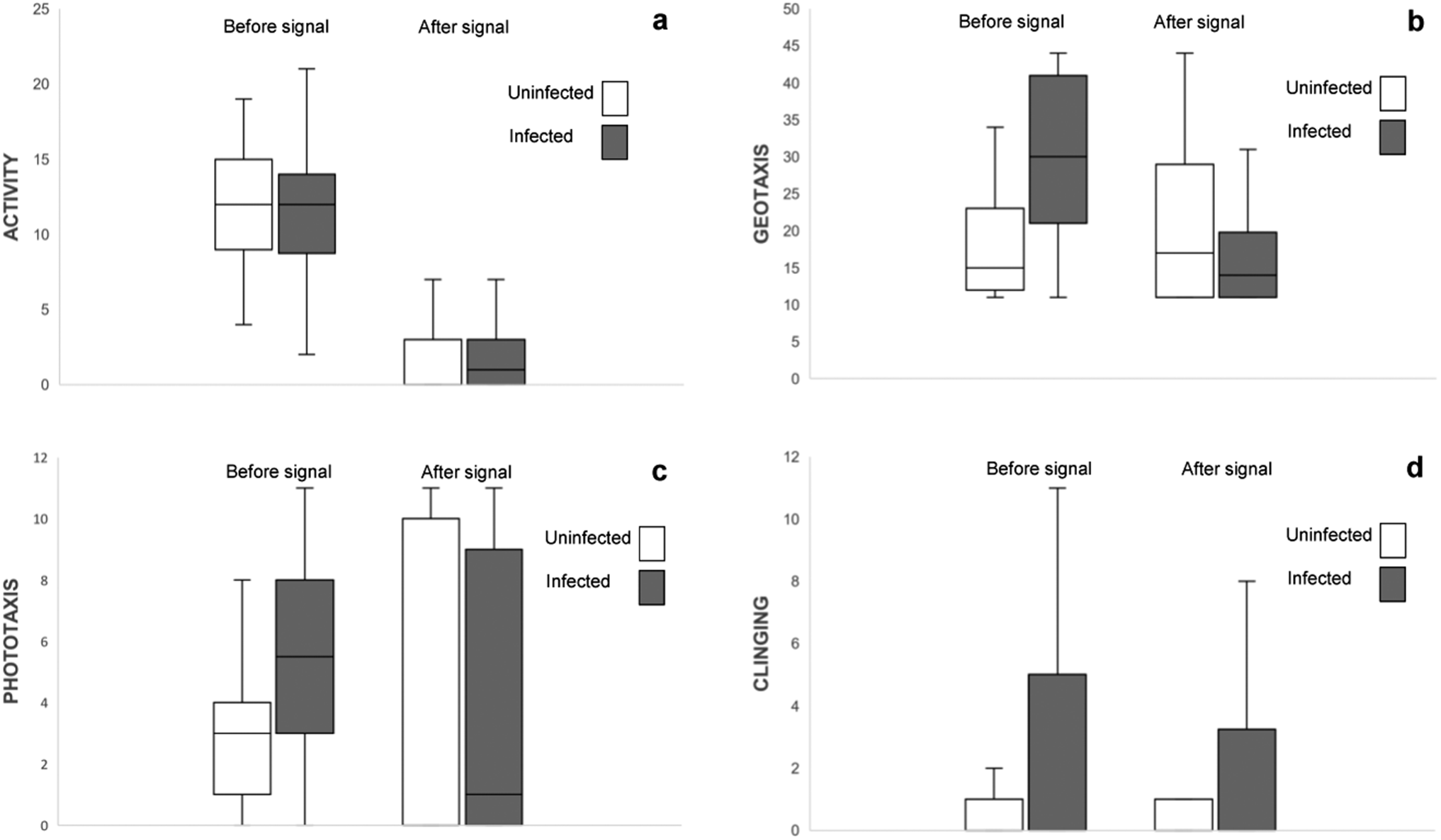
For uninfected amphipods, activity was the only behavioural trait affected and showed a significant decrease in values after the addition of predator signals. For infected amphipods, activity and geotaxis showed significantly lower values after the addition of predator cues (Table 3, Figure 3A, C).
Wilcoxon Test to evaluate behavioural traits in uninfected amphipods (Hyalella patagonica) before and after adding predator signals, and in infected specimens (considering p = 0.00625 as the critical value of the test, using a Bonferroni correction)

Behavioural traits in uninfected and infected amphipods (Hyalella patagonica) before and after adding predator signals: (A) activity, (B) phototaxis, (C) geotaxis, and (D) clinging. Median (line), quartiles, and range.

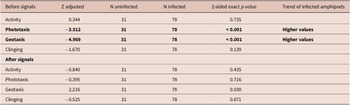
Before adding signals, P. enrietti infection significantly increased phototaxis and geotaxis (Table 4, Figure 3B, C). After including predator signals, no significant differences were found between infected and uninfected amphipods (Table 4, Figure 3).
Mann-Whitney U Test to evaluate behavioural traits in uninfected and infected amphipods (Hyalella patagonica) before and after adding predator signals (considering p = 0.0083 as the critical value of the test, using a Bonferroni correction)

Addition of the predator signals generated a decrease in the activity levels of both uninfected and infected amphipods; infected individuals also showed positive geotaxis (Table 3).
Discussion
The results of the current study reveal that amphipods exhibit anti-predator behaviour in response to waterfowl cues. It was also observed that P. enrietti induced behavioural changes in amphipods, but this alteration was only evident in the absence of predator cues. Furthermore, in the presence of signals, the anti-predator behaviour of infected amphipods differed from that of uninfected individuals.
In the present study, uninfected H. patagonica displayed anti-predator behaviour in response to waterfowl cues, which led to a decrease in their activity levels. To our knowledge, this is the first report of this behaviour in this particular species of amphipods and also the first experimental study on an amphipod of South America to include predator cues. The anti-predator behaviour exhibited by uninfected amphipods involves remaining motionless to avoid predation. Several studies conducted in other regions have demonstrated the impact of predators on amphipods – particularly fish predators – and have shown that the addition of signals typically results in a reduction in amphipod activity (Dezfuli et al. Reference Dezfuli, Maynard and Wellnitz2003; Wellnitz et al. Reference Wellnitz, Giari, Maynard and Dezfuli2003; Thünken et al. Reference Thünken, Baldauf, Bersau, Bakker, Kullmann and Frommen2010; Jacquin et al. Reference Jacquin, Mori, Pause, Steffen and Medoc2014; Arnal et al. Reference Arnal, Anaïs, Elguero, Ducasse, Sánchez, Lefevre, Dorothée, Bédèrina, Vittecoq, Daoust and Thomas2015). Research on the effect of bird cues on amphipod behaviour is scarce; however, a study on the amphipod species Echinogammarus berilloni (Catta, 1878) found that the presence of mallard cues induced repulsive behaviour toward predators in all individuals, as evidenced by a decrease in activity, changes in the time spent in mallard-scented water, and alterations in geotaxis (Jacquin et al. Reference Jacquin, Mori, Pause, Steffen and Medoc2014).
Infection with P. enrietti altered phototaxis and geotaxis and led the infected amphipods to prefer light and swim higher in the water column than uninfected individuals. This manipulation behaviour by the acanthocephalan would make H. patagonica more susceptible to predation by the water birds that are their definitive hosts by positioning them on the water surface in illuminated areas with greater risk of predation due to their increased visibility. Amphipods infected with P. enrietti are more conspicuous as they turn dark blue, and the parasite is bright orange and visible because of H. patagonica transparency (Rauque & Semenas Reference Rauque and Semenas2007). This is the first time behaviour alteration in H. patagonica has been detected for this parasite species. A similar situation was observed for Polymorphus minutus (Zeder, 1800) Lühe, 1911: infected amphipods aggregated on floating material, whereas uninfected individuals preferred sheltered microhabitat in the bottom substrate. Infected individuals thus moved closer to their definitive bird hosts and further away from dead-end predators like fish and invertebrates (Lagrue et al. Reference Lagrue, Güvenatam and Bollache2013).
Regarding the effect of P. enrietti infection on predator-avoidance behaviour after the addition of cues, both uninfected and infected amphipods showed decreased activity, but only infected individuals also showed positive geotaxis. This indicates that whereas the waterfowl (a suitable host predator for P. enrietti) induced an avoidance response in all the amphipods, only infected amphipods chose to escape to the bottom; this movement could facilitate their discovery by the predator (conspicuousness due to movement). In E. berilloni, following the introduction of predator signals, both uninfected amphipods and those infected by the acanthocephalan P. minutus decreased their activity and the time spent near the predator signal; however, geotaxis was negative in infected individuals (Jacquin et al. Reference Jacquin, Mori, Pause, Steffen and Medoc2014). Without predators, an amphipod infected with P. enrietti would be located in a microhabitat with a higher risk of predation than uninfected ones per se because they would tend to be located in well-lit areas and close to the surface. In uninfected Gammarus insensibilis Stock, 1966, the known anti-predator reaction is reduced activity and increased aggregation, but infected individuals do not show this behaviour; this suggests that parasitized gammarids do not respond to the predatory cues (Arnal et al. Reference Arnal, Anaïs, Elguero, Ducasse, Sánchez, Lefevre, Dorothée, Bédèrina, Vittecoq, Daoust and Thomas2015). The amphipod G. pulex infected with P. laevis is attracted by the smell of the fish predator Cottus gobbio Linnaeus, 1758, which is a suitable predator host (Perrot Minnot et al. Reference Perrot-Minnot, Kaldonski and Cézilly2007). In P. quadrispinosa infected by the acanthocephalan Echinorhynchus borealis Gmelin, 1791, the infection did not appear to alter the behaviour of the amphipod; however, after adding water conditioned with chemical predator signals, parasitized crustaceans spent less time hiding than uninfected individuals (Benesh et al. Reference Benesh, Kitchen, Pulkkinen, Hakala and Valtonen2008).
In the present study, infected amphipods show altered behaviour, which makes them more visible to predators as they swim in well-lit areas and on the water surface. In addition, the presence of predatory cues causes infected amphipods to drop to the bottom, which would also make them more visible, given their coloration. These findings could be attributed to a side effect of the infection due to the uptake of essential host resources by the parasite. In this context, infection by P. enrietti is associated with a reduction in the carotenoid concentration of H. patagonica (Rauque & Semenas Reference Rauque and Semenas2007). Because we do not know if the amphipods showed altered behaviour prior to infection and this led them to be infected, future studies should include experimental infection to distinguish between the cause and the effect of the infection. It would also be interesting to carry out experiments on a broader scale, such as mesocosm, and analyse, for example, the amphipod anti-predator response to different predator species, like insects and fishes such as the native G. maculatus or the introduced Oncorhynchus mykiss. The results of the present study enable us to perceive the intricate interplay among predators, parasites, and their intermediate hosts and advance our understanding of these complex ecological dynamics.
Acknowledgements
Samples were collected with the permission of Administración de Parques Nacionales (Argentina). We thank Audrey Shaw for proofreading the manuscript, and we thank the anonymous referees who significantly improve the manuscript.
Financial support
This work was supported by Consejo Nacional de Investigaciones Científicas y Técnicas (CONICET-PIP 0203); and Universidad Nacional del Comahue (B264), Argentina.
Competing interest
The authors declare none.
Ethical standard
The authors assert that all procedures contributing to this work comply with the ethical standards of the relevant national and institutional guides on the care and use of laboratory animals.