EVIPNet (Evidence-Informed Policy Network) Africa—a network of World Health Organization (WHO)-sponsored knowledge-translation (KT) platforms in seven sub-Saharan African countries—was launched at a meeting in Brazzaville, Congo, in March 2006 (1;Reference Hamid, Bustamante-Manaog and Truong2). EVIPNet Africa can trace its origins to resolutions from both the Ministerial Summit on Health Research (November 2004) and the World Health Assembly (May 2005) (10;11), the spirit of which was re-affirmed at the Global Ministerial Forum on Research for Health (November 2008) (13). The World Health Assembly called for “establishing or strengthening mechanisms to transfer knowledge in support of evidence-based public health and health care delivery systems and evidence-based related policies” (10). EVIPNet Africa can trace its inspiration to a more local development: the preparatory work that led to the establishment of the East African Community–sponsored Regional East African Community Health (REACH) Policy initiative, a KT platform involving Kenya, Tanzania, and Uganda (and more recently Burundi and Rwanda as well). REACH Policy is now part of the EVIPNet Africa family.
BUILDING CAPACITY
Typical of EVIPNet's pragmatic efforts to directly support evidence-informed health systems, a joint capacity-building workshop was convened in 2008 at the Ethiopian Health and Nutrition Research Institute. The workshop focused primarily on preparing and planning for the evaluation of policy briefs and secondarily on organizing and planning for the evaluation of national policy dialogues at which the policy briefs are discussed (Reference Lavis, Boyko, Oxman, Lewin and Fretheim5;Reference Lavis, Permanand, Oxman, Lewin and Fretheim8). In keeping with a “learning by doing together” approach, both a senior policy maker and a researcher from each of six EVIPNet Africa country teams (Burkina Faso, Cameroon, Central African Republic, Ethiopia, Mozambique, and Zambia, as well as the East African Community) produced a draft policy brief about how to address one of many current policy challenges: supporting the widespread use of artemisinin-based combination therapies (ACTs) to treat uncomplicated falciparum malaria in their respective countries.
The workshop provided an opportunity for checking in about progress since the publication of the 2006 WHO Guideline on Malaria Treatment (12). The guideline had delivered a comprehensive set of recommendations, each graded by the strength of the supporting evidence. The few pages devoted to addressing “operational issues in treatment management” had left significant scope for EVIPNet Africa to support health system managers and policy makers who were struggling with how to support in each of their specific country contexts the widespread use of ACTs to treat uncomplicated falciparum malaria.
The country teams began by confirming that there was widespread commitment to maintain ACT as the first-line drug therapy recommended for uncomplicated falciparum malaria in national treatment guidelines and/or the national malaria control policy. Country teams then moved on to consider whether to confirm or change the following: (i) delivery arrangements, including who should dispense ACT, who should be involved in surveillance and pharmacovigilance, and in the diagnosis and treatment of atypical cases; (ii) financial arrangements for patients, such as drug subsidies, and for prescribers, among others; and (iii) governance arrangements, including which ACT and other anti-malarial drugs (i.e., drugs, dosage regimens, and packaging) should be licensed for sale, how they can be marketed, who can prescribe them and who can sell or dispense them, and with what safeguards to protect against counterfeit or substandard drugs. Finally, country teams considered how best to support the necessary changes to the behavior of those involved in supporting the widespread use of ACT, including patients, caregivers, lay health workers, and health professionals.
PREPARING POLICY BRIEFS
The country teams each prepared a policy brief that presented three viable policy options for supporting the widespread use of ACT to treat uncomplicated falciparum malaria, each comprising different “bundles” of the aforementioned delivery, financial, and governance arrangements within their respective health systems, and potential strategies for supporting the implementation of the policy options (Reference Lavis, Wilson and Oxman9). Whereas these bundles typically focused on strengthening the role of community health workers (particularly in home-based management of malaria), working with and through the private sector, and enhancing government regulation, their precise operationalization and implementation often differed by country. For example, some country teams were focused only on pharmacists working in the private sector, whereas others were focused on all health professionals treating malaria in the private sector.
Each policy option was accompanied by an assessment about what can reasonably be expected (in terms of both costs and consequences) in the country's health system by pursuing each of the policy options, as well as a description of any gaps in our understanding about what can be expected (Reference Lavis, Wilson and Oxman9). The assessments were based on the best available research evidence that had been examined for its quality and local applicability and for equity and scaling up considerations. The country teams drew on several overviews of systematic reviews, six systematic reviews about ACT that had been published since the release of the WHO guideline, over a dozen systematic reviews of the effects of alternative delivery, financial, and governance arrangements, over a dozen systematic reviews about supporting behavioral change, and many single studies that had been conducted in their own country or region (Reference Lavis4;Reference Lavis, Oxman and Grimshaw7).
In early 2009, the policy briefs were further elaborated through a follow-up workshop where additional tools were introduced. These tools included a template to facilitate the communication of the benefits, harms, and costs of options and of potential implementation barriers (Reference Lavis, Wilson and Oxman9). Each KT platform convened a national policy dialogue, involving senior government officials and key stakeholders (including civil society groups), to discuss how both the public and private sector can best support the widespread use of ACT to treat uncomplicated falciparum malaria (Reference Lavis, Boyko, Oxman, Lewin and Fretheim5). The policy brief was a key input to this discussion, but so too was local information about on-the-ground realities and constraints, values, interest group dynamics, and institutional constraints.
ACHIEVING IMPACTS
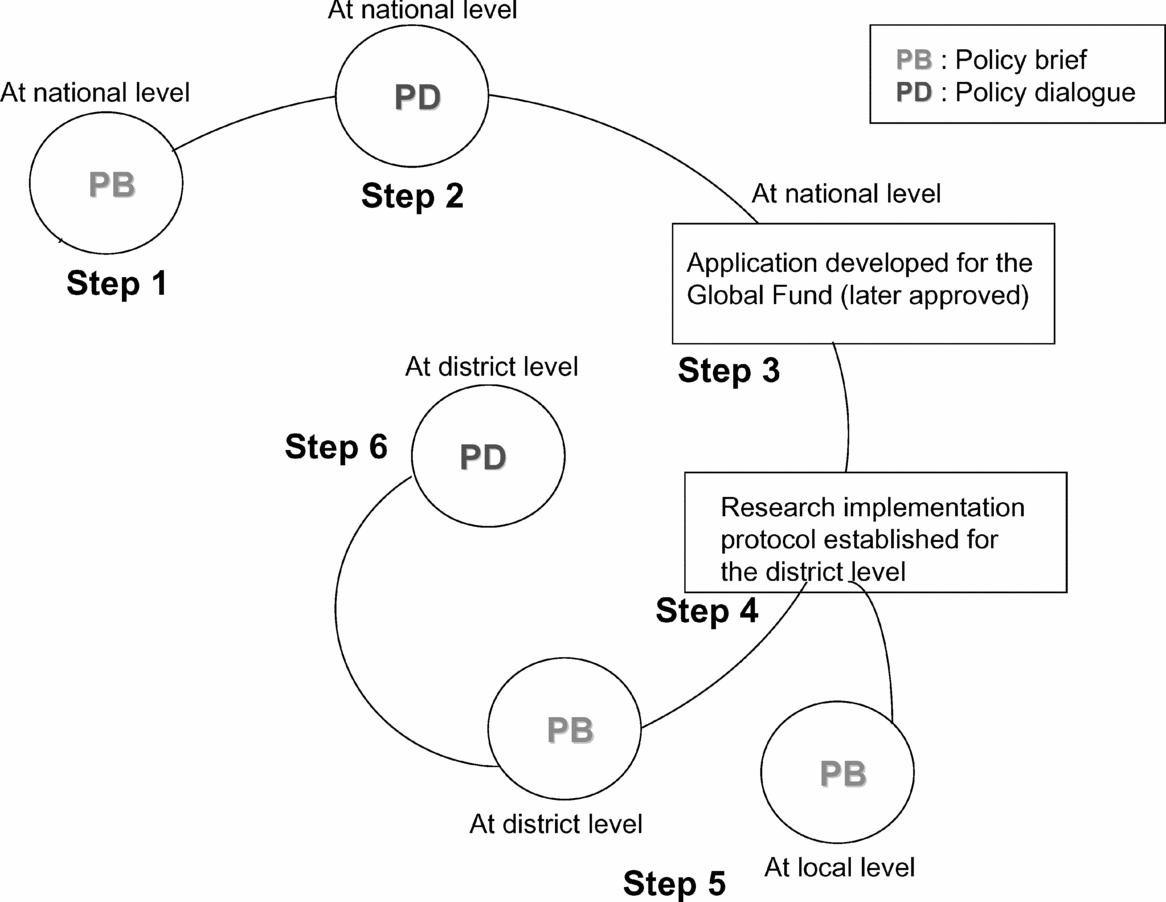
EVIPNet Burkina Faso is an example of a KT platform that took this process even farther. Its policy brief directly informed Burkina Faso's successful application to the 7th round of the Global Fund to Fight AIDS, Tuberculosis, and Malaria (GFATM). And EVIPNet Burkina Faso has now secured funding from WHO's EVIPNet Secretariat and from the Special Programme for Research and Training in Tropical Diseases (TDR) to evaluate the impact of community health workers (one of the three options presented in the policy brief) in three pilot projects at the district level. EVIPNet Burkina Faso is supporting evidence-informed health systems from the national to the district level (Figure 1).
EVIPNet Burkina Faso's efforts to use policy briefs and dialogues to improve the treatment of malaria at the district level.

“Operational issues in treatment management” are far too central to the success of malaria control programs to be dealt with in a cursory way and without the benefit of the best available research evidence or the input of both government officials and key stakeholders. EVIPNet Africa is rising to this challenge by supporting health system managers and policy makers in their respective countries to make informed decisions about all aspects of malaria control. As the Ethiopian Minister of Health wrote to WHO: “I strongly believe that th[ese] policy brief[s] will help policymakers to control. . .malaria in their respective countries.”
LEARNING FROM THE EXPERIENCE
Malaria control is just one of many domains where EVIPNet Africa is uniquely positioned to support evidence-informed health systems. Moreover, policy briefs (and the policy dialogues they are prepared to inform) are just one of the tools being used by the KT platforms. The policy briefs are not health technology assessments (HTA) per se, but they are highly relevant to the HTA community. The policy briefs help to focus discussion on those health system arrangements that can get cost-effective health technologies to those who need them (as was the case with the malaria policy briefs) (Reference Lavis, Permanand, Oxman, Lewin and Fretheim8). Moreover, there may be lessons to be drawn for HTAs from the way in which policy briefs present several options for deliberation, and not simply an implicit go/no go option. There may also be lessons to be drawn for HTAs from the way in which policy briefs are seen as the input to policy dialogues (where research evidence can be considered together with the views, experiences, and tacit knowledge of those who will be involved in, or affected by, future decisions), and not as an end in themselves (Reference Lavis, Boyko, Oxman, Lewin and Fretheim5;Reference Lavis, Permanand, Oxman, Lewin and Fretheim8).
The publication of EVIPNet Africa's first series of policy briefs will help to disseminate this and related advancements in mechanisms (such as policy dialogues) to support evidence-informed health systems in low- and middle-income countries. Feedback on the approach is welcome. A 5-year monitoring and evaluation project will build our understanding of how to match the design features of policy briefs (and policy dialogues) to particular issues and contexts (Reference Johnson and Lavis3;Reference Lavis, Lomas, Hamid and Sewankambo6). The project will also build our understanding of how to match any given KT platform's infrastructure, activities, and outputs to particular contexts to achieve the greatest outcomes and impact (Reference Johnson and Lavis3).
CONTACT INFORMATION
John N. Lavis, MD, PhD (lavisj@mcmaster.ca), Professor, Department of Clinical Epidemiology and Biostatistics, McMaster University, 1200 Main Street West, HSC-2D3, Hamilton, Ontario L8N 3Z5, Canada
Ulysses Panisset, MD, PhD (panissetu@who.int), Scientist, Department of Research Policy and Cooperation, World Health Organization, 20, Avenue Appia, CH-1211 Geneva 27, Switzerland