‘Social capital’ is the concept conventionally used to describe the links among guildsmen in pre-industrial times. Guilds have long been portrayed as closely knit groups, typical of pre-industrial communities, supported by ties of kinship, and proximity of parish or neighbourhood. More recently, however, historical research has shown that both English society and English guilds displayed more openness to newcomers than previously thought. This new emphasis does not preclude the use of social ties by individuals as tools for gaining a competitive advantage, whether to enable outsiders (prospective apprentices) to find a master, or to enable insiders (‘freemen’ as the members of a guild were known) to climb the ladder of power within the guild.
This article explores these possibilities by analysing the type of social capital that was used and by whom in the case of the Goldsmiths’ Company in seventeenth-century London. It rests on the creation of a new data set comprising two groups of goldsmiths who practised their trade in the second half of the seventeenth century, representing a population of 57 masters. The two groups correspond to the two main orientations of the company – ‘Bankers’ on the one hand and ‘Craftsmen and Retailers’ on the other. Although both groups belonged to the same guild, their activities gradually separated at the end of the seventeenth century, with the goldsmith bankers laying the foundations of British banking. Moreover, although the Bankers represented a minority in terms of the number of members of the guild, they were nonetheless very influential and relatively wealthy. Comparing the nature and breadth of the respective social ties of the two groups may help illuminate how British banking evolved subsequently.
Using geographical proximity, occupational proximity and kinship as proxy variables to measure social capital, this article compares the two populations within the Goldsmiths’ Company, ‘Bankers’ and ‘Craftsmen’. Results indicate that the Goldsmiths’ Company was on the whole open to individuals with no apparent previous contacts (be they geographical, occupational or kin). However, a freeman's upward mobility within the guild hinged on his belonging to the subgroup of goldsmiths who practised banking activities. These findings confirm the recent literature on openness but also bring new light to the processes of mobility and social capital within the guild of the London Goldsmiths’ Company. This emphasises that Bankers indeed constituted a kind of ‘aristocracy’ within the Goldsmiths’ Company.
We will proceed as follows: first, the literature describing guilds as closely knit networks will be reviewed along with more recent evaluations of the guilds’ openness that cast doubt on earlier narratives. We then discuss the evolution of the Goldsmiths’ Company at the end of the seventeenth century focusing on the emergence of ‘goldsmith banking’. We then present our samples for ‘Bankers’ and ‘Craftsmen and Retailers’. We then discuss systematically, within and across groups, geographical, occupational and kinship ties. We find that while the Bankers display slightly stronger ties than the Craftsmen and Retailers, this does not seem to stem necessarily from the demands of their activity. We end with conclusions and directions for future research.
I
The description of guilds as strongly interconnected communities owes much to the influential account of Adam Smith, who described them as a social insurance system. The German sociologist Ferdinand Tönnies (Reference Tönnies1887) also contributed to the vision of the guild as a community, as did Polanyi's (Reference Polanyi1957) depiction of the guild as an organisation holding out against the commercialisation of labour. Similar views are held today by economic sociologists who, following Mark Granovetter (Reference Granovetter1973), emphasise the social ‘embeddedness’ of economic organisation. More recently, following the lead of Douglass North, institutional economists, now dominant in the historical literature on the guilds, provide an economic perspective on trust and social norms, emphasising the economic functions of guilds (North Reference North1990; Greif Reference Greif2006). In this vein, we find the work of Tine de Moor (Reference Moor2008), who describes guilds as institutions for collective action, or Sheila Ogilvie (Reference OgilVie2004b), who emphasises interactions amongst guild members and the resulting ‘social capital’ they produced.Footnote 1
Against this backdrop, restrictions upon entering a guild provided significant control mechanisms and the analysis of social capital, understood as access to resources through a network, is a central focus of modern research. Guild regulations had an exclusionary character that may have favoured individuals with prior social ties to guildsmen. For instance, the Statute of Artificers (1562) allowed only the ‘children of masters and the holders of certain property qualifications’ to take an apprenticeship (Snell Reference Snell1996). The Goldsmiths’ Company provides a case in point. It required that apprentices be able to read and write and required mandatory payments or fees (Reddaway Reference Reddaway1962, p. 58). The literature on guilds suggests this created a general tendency for the sons of guildsmen to have an advantage. According to historian Richard Grassby, ‘the guilds system was a gerontocracy and patrimony [i.e. membership was inherited] and family preference gave all companies and trades a hereditary character’ (Grassby Reference Grassby1995, pp. 65–6).Footnote 2
Something similar has been described for hierarchical relations within the guilds themselves. Guilds were not horizontal groupings. Vertical distinctions existed inside the guilds between ‘yeomanries’ comprising smaller masters and ‘liveries’ formed of high-status freemen.Footnote 3 Opportunities within the guilds have been recorded as highly and increasingly unequal in the seventeenth century. The capacity of smaller masters to influence and be heard by the governing bodies of the guild weakened (Unwin Reference Unwin1908, pp. 217–42; Farr Reference Farr2000, pp. 161–4). The livery has been depicted as dominated by the mercantile interest, by opposition to the working craftsmen. Tensions between different groups have been noticed in the literature, breaking down the monolithic aspect of the guilds (Kaplan Reference Kaplan1986; Poni Reference Poni1989). According to James R. Farr (Reference Farr2000, pp. 35–6), promotion within the guilds to the livery and to the ruling councils may have required more social capital than mere entrance into the guild. The top levels of the guilds were also more involved in the higher politics of the guild and access to such powerful positions was restricted for artisans (Unwin Reference Unwin1908, p. 113; Farr Reference Farr2000, p. 188).
Interlocking relationships within the guild have been identified by previous scholars as having occurred through kin and amongst the ruling elite. Simona Cerutti's work on the Turin tailors’ guild shows the correspondence between family relationships and strategic occupational and economic positions (Cerutti Reference Cerutti and Woolf1991). Kaplan's study of Parisian guilds suggests that family ties ‘provided long-term continuity of dominion’ amongst the eldest and most powerful members (Kaplan Reference Kaplan1986, p. 633).
These general tendencies apply to the Goldsmiths’ Company, where liverymen participated in the process of designation of higher officials (‘prime wardens’) through their power to nominate two members only of the electoral body. These so-called ‘choosers’ were further required to have already served an office in the company as assistants, an intermediary court between the livery and the wardens. In other words, because of status barriers inside the guilds, progression within their ranks was likely to be influenced by social ties and social capital (Earle Reference Earle1989, p. 253).
Such phenomena make sense. As noted by Ogilvie, it would seem a priori plausible that guildsmen relied heavily on their kin and more generally on individuals with whom they maintained social ties, since trusted relationships would secure superior information flows, achieve higher levels of reputation and develop stronger enforcement capabilities (Grassby Reference Grassby2001; Ogilvie Reference OgilVie2004a, Reference OgilVie2004b). However, more recent scholarship (not only focused on Britain) has emphasised the limited reliance on social ties to enter the guilds, the weakness of the guild's enforcement powers and the limited endogamy between guildsmen. Geographical ties and occupational ties seem to have been limited in the seventeenth century given the diverse recruitment of apprentices amongst craftsmen but also traders, artisans and merchants and the long-distance migrations typically undertaken by apprentices (Shephard Reference Shephard, Kaplan and Koepp1986; Dolan Reference Dolan and Benedict1989). James R. Farr's analysis of artisan guilds in Dijon shows that more than 75 per cent of marriages were contracted with individuals unrelated to the guilds (Farr Reference Farr and Benedict1989). Cerutti's analysis emphasises the strategic aspect of marriage in Turin's tailors’ guild, but as a way for the guild elite to form alliances with trades and occupations beyond the guild, such as with Turin's merchants (1991). For London, Grassby (Reference Grassby1995, p. 155) shows that in 1690, 70 per cent of the London apprentices were still from outside the City. Another finding from the more recent literature is that the share of the gentry in mercantile activities increased during the sixteenth and seventeenth centuries while that of the husbandry and the yeomanry declined, a phenomenon that may be explained by the rise of entrance fees (Brooks Reference Brooks, Barry and Brooks1994, p. 61). In a similar vein, Leunig, Minns and Wallis (Reference Leunig, Minns and Wallis2011) show that English guilds were open to apprentices from ‘well-to-do’ families and whose fathers came from outside the craft sector. Thus, the apprenticeship regulations were far from benefiting guild insiders only.
The limited control that guild insiders seem to have had on access may be put in relation to the guild's effective powers, which were nominally extensive but more limited in practice. For instance, although the powers of the guild included such drastic capacities as outlawry from London, earlier research has recognised that the rise of London suburbs, the existence of the Liberties and a number of Parliamentary Acts gradually weakened the guilds’ exclusionary powers (Kellett Reference Kellett1958, p. 384; Reddaway Reference Reddaway1962). This period also witnessed the dilution of former identity between guild membership and the trade practised. The weakening of the guild community was exacerbated by the blurring of the distinction between citizens and non-citizens, the participation of the liveries in parallel markets, production in the suburbs and an increasing social differentiation within the guild (Ward Reference Ward1997, pp. 42 and 71; Archer Reference Archer1991, p. 188; Farr Reference Farr1997). The result was that guild members could straddle various networks, thereby extending their social ties beyond the guild.
II
The Worshipful Company of Goldsmiths, more commonly known as the Goldsmiths' Company, received its first royal charter in 1327. In 1478, it was granted jurisdiction over London and over the country in 1509. It received privileges and was requested by the King to perform specific functions such as supervision of the currency through assays, including foreign currency acquired through foreign trade and the coins issued by the Royal Mint. In effect, the Goldsmiths’ Company had the legal responsibility of monitoring all the import and export of precious metals into and out of the kingdom. Members of the company were engaged in many trades in relation to the consumption, transformation and exchange of gold and silver, including manufacturing religious items, supplying individuals with durable goods that had store-of-value qualities such as plate, silverware, etc., and the refining of gold and silver.
Until the second half of the seventeenth century, financial services provided by the goldsmiths were circumscribed to pawning and foreign exchange (Mitchell Reference Mitchell and Mitchell1995). However, the guild's role in the economic and social life of England experienced a great change in the second half of the seventeenth century with the development of banking. The result of a succession of innovations led to the development of new financial ‘technology’.Footnote 4 Although certain banking practices were much older than the seventeenth century and credit was already pervasive in economic exchanges, the development of banking activities was probably one of the most crucial evolutions for the Goldsmiths’ Company.Footnote 5 A change of attitudes towards the role of bankers and the attending usury laws, along with the development of the economy, trade and taxation, are factors commonly emphasised to explain how the growth of banking and financial services was triggered. The new intermediation role was not taken up solely by goldsmiths, but also by well-off merchants, wealthy aristocrats, moneylenders and scriveners with such wide-ranging and different purposes as receiving deposits, making remittances abroad or providing loans. However, according to D. M. Joslin,
the crucial innovations in English banking history seem to have been mainly the work of the goldsmith bankers in the middle decades of the seventeenth century. They accepted deposits both on current and time accounts from merchants and landowners; they made loans and discounted bills; above all they learnt to issue promissory notes and made their deposits transferable by ‘drawn note’ or cheque; so credit might be created either by note issue or by the creation of deposits, against which only a proportionate cash reserve was held.Footnote 6
Some goldsmiths became associated with the dramatic changes occurring in public finances in the seventeenth century, known after P. G. M. Dickson as the Financial Revolution. They catered to both mercantile and private clienteles (Dickson Reference Dickson1967; Laurence Reference Laurence2008). Practices changed very quickly, differing much from the traditional activities of the working goldsmiths and innovating greatly, even if it is usually acknowledged that it was only at the beginning of the eighteenth century that the artisan part of their activity experienced relative decline (Temin and Voth Reference Temin and Voth2006).
The formation of social ties at the company could have been affected by the long-term transformations of the seventeenth century. The growth of consumption required businesses to keep larger stocks and therefore implied higher levels of capitalisation and start-up costs (Earle Reference Earle1989, p. 107). Such capital requirements could keep competition at bay, promote entry into the guild of wealthy families and of those whose social ties would serve to decrease the total cost of becoming a member. Specialisation supported a subcontracting system that led to smaller producing households, perhaps limiting the development of social ties between masters, apprentices and journeymen (Farr Reference Farr1997; Clifford Reference Clifford2004). Social ties within the company must also have been particularly disrupted with the draft of men into the armies of Charles I, the plague of 1665 and the Great Fire of 1666. That last disaster also deprived the company of the use of its hall, one of the centres of socialisation of the masters, and destroyed much of its property throughout London.
The implications of this specialisation for the social ties amongst goldsmiths are not self-evident. Many of them had started as Craftsmen before becoming Bankers. However, not all Bankers were goldsmiths or even guild members. Nonetheless, one key characteristic of this new activity was that it involved very high risks and required a very large flow of information, irrespective of the geographical distance or trade specialisation. Through their activities, goldsmith bankers operated on a bilateral system solely and did not act as a clearing-house, contrary to the Bank of England (Quinn Reference Quinn1997). Lacking centralisation, large overdrafts between goldsmiths could only be monitored with great difficulty. Institutional economics and a theory of social capital would therefore suggest that strong interactions would be beneficial to the Bankers, as Quinn has argued (Reference Quinn and Mitchell1995, p. 414). Filtering procedures among the Bankers were necessary to their trade and practised on a regular basis but it is hardly known whether selection was through kin, religion, parish or simply through the training of apprentices. The example of a few famous goldsmith bankers related through kin might suggest family relationships could also have prevailed. For instance, Richard Hoare entered into partnership with his son Henry in 1702 (Hutchings Reference Hutchings2004). His own sons eventually inherited the business. An identical configuration is observed for another major banker, Francis Child, who married the daughter of a goldsmith and entered into partnership with his father-in-law. The sons of Francis became active goldsmiths and one daughter married the son of the goldsmith banker Edward Backwell (Winterbottom Reference Winterbottom2004).
Nevertheless, goldsmith bankers who engaged with the mercantile community relied on a wide system of agents and merchants to obtain information and monitor behaviour that was not limited to the kin. According to Neal and Quinn, such networks ‘spanned nations, religions and trade specialisations. This business web was more diverse than the kin groups, religious connections or guilds that had supported the rise of international trade since the Middle Ages’ (Neal and Quinn Reference Neal and Quinn2001). During the seventeenth century, several crises would hit the goldsmiths and test the resilience of their system, namely the Stop of the Exchequer in 1672, the creation of the Bank of England in 1694, and eventually the South Sea Bubble in 1720, which marked the end of the public banking activities of the goldsmiths (Quinn Reference Quinn, Floud and Johnson2004). However, some banks formed initially by goldsmiths survived, such as Child's Bank and Hoare's Bank. They thrived in private banking by enlarging their clientele and extending their networks.
III
(a) Sources and samplesFootnote 7
The study of the social capital of London goldsmiths in the second half of the seventeenth century relies first on the identification of two groups of freemen or masters from the Goldsmiths’ Company. First, a sample of ‘Craftsmen and Retailers’ (Craftsmen) was drawn from the Court of Orphans’ Inventories between 1665 and 1729.Footnote 8 , Footnote 9 Inventories specify the assets of the deceased and thus help with identification. For instance, amongst other things, they indicate whether the master owned a shop, a working house, working tools and the type of wares in the shop.Footnote 10 Such ownership conclusively establishes that masters were Retailers (shop) or Craftsmen (working house and tools). In case of ambiguous evidence, we proceeded as follows: masters who could be identified in the Goldsmiths’ Company records and who were not described as goldsmith bankers in the secondary literature were selected (Quinn Reference Quinn1997). In total, our sample of Craftsmen and Retailers not involved in banking activities contains 25 individuals. We call this sample ‘Craftsmen’ in the rest of the data analysis. Compared to the total population of goldsmith masters, estimated by Kahl (Reference Kahl1956) at 290 freemen between 1690 and 1699, our sample is modest, especially since it draws individuals over a long time stretch (over a third of the masters in this group were indentured before 1650).Footnote 11
The second ‘sample’ is formed of 32 goldsmiths engaged in the banking activities described in the previous section. They are called ‘Bankers’. They are principally taken from a list provided in the 1677 London Directory, which refers to them as ‘goldsmiths that keep running cashes’ (Anonymous 1863).Footnote 12 Those of them who could be additionally confirmed in the secondary literature to be goldsmith bankers, and who could further be matched in the Goldsmiths’ Company records, form a group of 29 goldsmiths. A further three were found from the sampling of the Court of Orphans as a result of the procedure described above. Compared to the sample of Craftsmen, the sample of Bankers is large relative to the total population of goldsmith bankers.Footnote 13 The total size of the population may have constantly varied as many abandoned banking or went bankrupt (for instance, after the Stop of the Exchequer in 1672). Grassby counts 93 goldsmith bankers between 1670 and 1700 but only five remaining in 1700 (Grassby Reference Grassby1995, p. 253). On the other hand, F. G. Hilton Price counts 31 in 1670, 44 in 1677, 35 in 1687 and 42 in 1700 (Hilton Price Reference Price1890, pp. 182–5). The sample of Bankers also clusters at one point in time due to the sample construction procedure (all were practising in 1677, except the three Bankers who were added from the Court of Orphans random drawing).
In addition to the two samples of masters described above, a list of their apprentices was retrieved from the Records of Pairs of Masters and Apprentices held at the Goldsmiths’ Company and completed by a search in the Records of Freedom and Apprenticeship. It concerns 151 apprentices indentured to the sample of Bankers and 93 apprentices indentured to the sample of Craftsmen.Footnote 14 Finally, the wills from the Principal Court of Canterbury were searched and transcribed for seven Bankers and 12 Craftsmen. Wills proved at the Court of Canterbury belonged to individuals with some personal wealth, which creates a bias towards the wealthiest goldsmiths.Footnote 15 Additional secondary sources examined included Boyd's Inhabitants of London, Boyd's Family Units 1209–1948 and the 1692 Poll Tax database originally created by J. Alexander.Footnote 16
A note of caution should be struck with regards to specialisation of the activities of the goldsmiths. Owing to the existence of two literatures, one in banking history and the other in silver studies, a division has been created between the two aspects of the guild, when there are numerous examples of so-called goldsmith bankers who had retailing activities in plate and jewels, or who were involved in the import of precious stones. But the banking activity remained the important part of their trade. Similarly ‘shop-keeping goldsmiths’ (retailers and wholesalers) could be involved in pawns. However, their banking activities were never as consistent or as sophisticated as those of the goldsmith bankers referred to in the financial literature. It is accordingly possible to differentiate the two groups; one of Bankers, and another of Craftsmen and Retailers.Footnote 17
(b) Overview of the characteristics of the goldsmiths
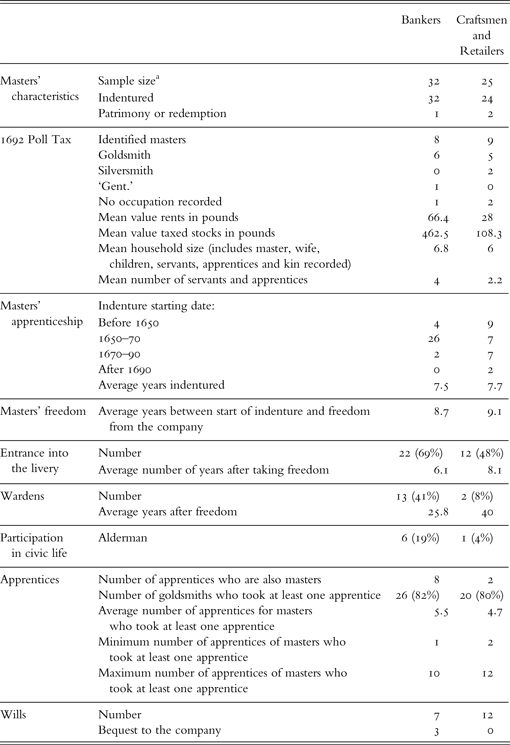
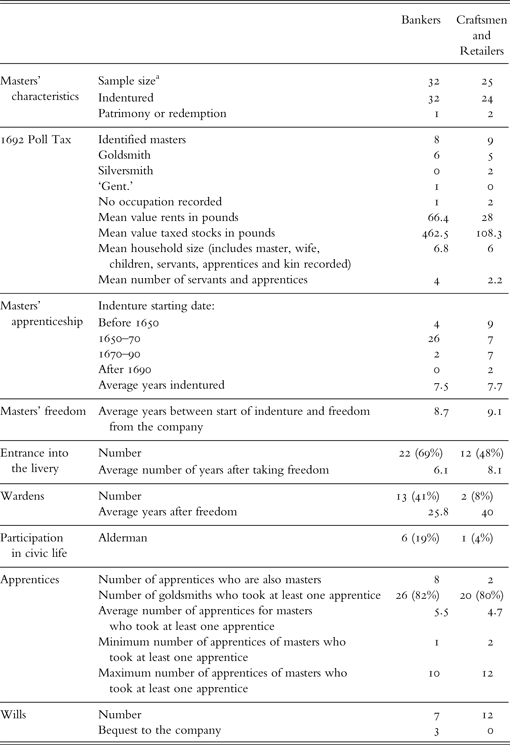
Table 1 summarises the characteristics of the two groups of masters (Bankers and Craftsmen), providing information about their career paths. Entrance as a full member into the guild was limited to former apprentices (‘indentured’), sons of masters (‘patrimony’) or those who would buy their entry (‘redemption’), thereby favouring kinship ties and well-off individuals. As seen, however, only a very small fraction of the goldsmiths entered the company through patrimony or redemption. We compiled estimates of real property from rack rent values and estimates of the value of working capital and goods not related to the household consumption from taxed stocks, derived from the 1692 Poll Tax (which identifies only a subset of our two groups). The estimates suggest, perhaps unsurprisingly, that the group of Bankers was much wealthier than the group of Craftsmen, with an average rental value more than twice as high and an average value of taxed stocks about four times higher than the Craftsmen's. Unless the Bankers came from extremely wealthy families or inherited in a disproportionate way in comparison with their Craftsmen counterparts, their activities must also have been more lucrative.
Descriptive statistics of the Bankers and Craftsmen
a [Text editor's note] The sum of the sub-items does not add up to reported totals. It has not been possible to identify the source of the discrepancy.
Source: See text.
The size of the household was higher for Bankers (6.8 against 6 for the Craftsmen). Note that Earle (Reference Earle1989, pp. 212–18) has shown that the size of the household depended as well on the age of the head of the household and the number of years after marriage. Because Craftsmen were identified using information from the Court of Orphans’ Inventories, it is possible that the average Craftsman household was younger than that of the average Banker. It is also possible that, being wealthier, Bankers had more dependants than Craftsmen. This may account for the greater number of servants or apprentices working in the households of Bankers (larger than Craftsmen by nearly two members).
On average, both Craftsmen and Bankers spent a comparable time of indenture and took their freedom shortly after the date they were supposed to finish apprenticeship (on average a year and a half after they had terminated their indentures, with no major discrepancy between the two groups). This is an extremely fast rate in comparison with Ben-Amos’ figures for Bristol at the beginning of the seventeenth century (with 40 per cent of the apprentices only taking the freedom two years or more after the end of the apprenticeship; see Ben-Amos Reference Ben-Amos1991, p. 159). Wealth, networks and social ties, specific to the population from which the Goldsmiths’ Company drew its members, could have helped the individuals in our sample to join the company relatively quickly.
Entrance into higher offices of the guild (the livery) is strikingly different between the two groups of goldsmiths, which again motivates our studying them separately. Some 69 per cent of the Bankers entered the livery, compared to only 48 per cent of the Craftsmen. Entrance into the livery was costly and this may be why Bankers, who were wealthier, had easier access.Footnote 18 At the level of warden or prime warden, the discrepancy is even wider: 41 per cent of the Bankers entered the office compared to only 8 per cent of the Craftsmen. The group of Bankers is therefore disproportionately represented in the highest positions of the company. Interestingly, Table 1 shows that, not only were the Bankers more numerous in the offices of the company, but they also entered them more quickly, suggesting that seniority was not the only criterion for holding the higher offices.
Bankers who took at least one apprentice recruited slightly more than the Craftsmen by nearly one apprentice on average. It is not possible to estimate whether it was due to a high turnover in the shops of the Bankers, whether their wealth enabled them to train more apprentices (including by requiring higher fees), whether they attracted more apprentices or simply accepted more apprentices. However, Bankers transferred their skills to their apprentices: 24 out of our 32 Bankers were trained by Bankers from a previous generation.Footnote 19
The Bankers come out as a distinctive group in the Goldsmiths’ Company. They were wealthier, recruited more apprentices in their shops and were promoted inside the company at a much faster and greater rate than the Craftsmen. Reaching such positions required talent, skill and probably wealth, but, as suggested by the literature on social capital, ties might be invaluable for gaining access to resources and positions. We will therefore now enquire where social capital was located in the company: who was accepted in the company, who was co-opted into the higher offices? What network or types of social capital were mobilised in order to enter into the company and progress within its hierarchy?
IV
(a) Geographical origins
If proximity is a measure of social capital then geographical mobility is an indicator of the openness of the Goldsmiths’ Company to newcomers. Masters and future apprentices or their fathers could have socialised as neighbours, by going to the same local tavern, coffee-house or the same club. Middling people knew each other well within the boundaries of their neighbourhoods. Geographical proximity was also useful for gathering information about available placements, the master's character and qualities, the apprentice's character and socio-economic background. In a nutshell, individuals with common geographical origins can easily develop stronger ties with each other.Footnote 20
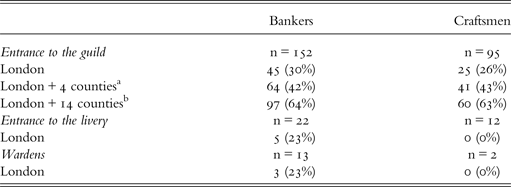
Table 2 confirms these arguments on geographical mobility in the second half of the seventeenth century. As can be seen, 26 per cent (Craftsmen) and 30 per cent (Bankers) came from London. The four counties adjacent to London accounted for another 14 percentage points. London and the surrounding 14 counties were the origin of a bit less than two-thirds of apprentices for both Craftsmen and Bankers. We notice hardly any differences between the Bankers and the Craftsmen, the former attracting only slightly more apprentices from London. Kahl (Reference Kahl1956) reports that 53 per cent of the goldsmiths between 1690 and 1699 were from London, which suggests a strongly decreasing geographical mobility in the very last decades of the seventeenth century and in the eighteenth century.Footnote 21 In broad terms, thus, the recruitment of apprentices in the second half of the seventeenth century was not limited to counties close to London.
Geographical origins of the goldsmiths
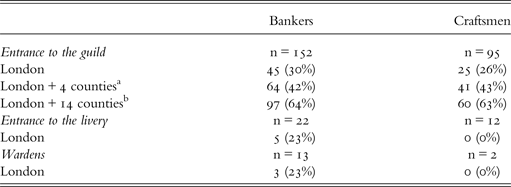
a London and four adjacent counties: Essex, Kent, Middlesex and Surrey.
b London and 14 adjacent counties: Essex, Kent, Middlesex, Surrey, Bedfordshire, Berkshire, Buckinghamshire, Cambridgeshire, Hertfordshire, Huntingdonshire, Northamptonshire, Oxfordshire, Southamptonshire (modern Hampshire) and Suffolk.
Source: See text.
Regarding mobility inside the guild, our exploration of the evidence shows that being a Londoner did not seem to increase the likelihood of being a member of the livery. Of the 34 individuals belonging to the livery during the period under study, only five came from London (15 per cent). With regards to the other counties, Bankers from the county of Wiltshire (15 per cent) are over-represented while Craftsmen from Warwick are also in greater proportion in the livery (17 per cent) than in the apprentices’ population (4 per cent). At the wardenship level, only three out of 15 wardens came from London (20 per cent). Few counties are over-represented, contrary to what one may have hypothesised if geographical ties were pervasive at higher levels of the company. Of course, these small samples must be taken with caution (as they have large standard errors).
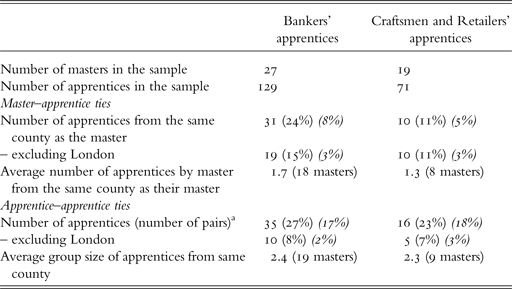
According to theories of chain migration, migrants draw on their network.Footnote 22 Table 3 indicates whether or not masters and their apprentices or fellow apprentices come from the same county and compares the results to theoretical results if masters and apprentices were matched by chance (number in italics).Footnote 23 The results from such pairing suggest only moderate rates of shared origins both between masters and apprentices and amongst apprentices. In the case of master–apprentice pairs, we observe that about a quarter of the Bankers’ apprentices came from the same county as their masters, while this rate is 11 per cent for the Craftsmen. This is three times as high (Bankers) and twice as high (Craftsmen) as would obtain with random matching. When one excludes London, this rate for Bankers’ apprentices coming from the same county as their masters is 15 per cent for Bankers and 11 per cent for Craftsmen. These proportions are about three times as high as the proportion obtained by random matching and this may look substantial.Footnote 24 However, factoring these results on the data in Table 1, we see that they mean that masters who shared a geographical origin with their apprentices did so with only slightly over one apprentice out of an average of about five enrolled apprentices. (This number is slightly greater for the Bankers but only marginally so when one excludes London.)
Chain migration: masters and apprentices
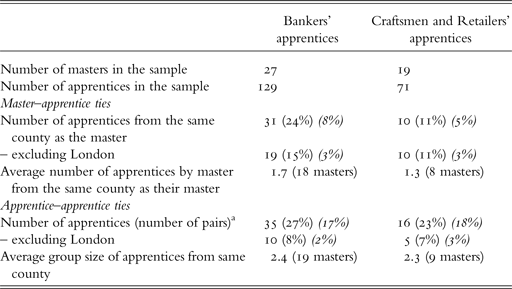
a If, for example, three apprentices came from London, and two from Wiltshire and Middlesex respectively, this counts as two pairs. This means that two apprentices share a tie with another fellow apprentice.
Source: See text.
Rates of shared origins among apprentices are slightly higher. Between 21 and 27 per cent of the apprentices of a given master came from the same county as another fellow apprentice. These proportions are less than twice as high as those expected by chance. After excluding London, the percentage of apprentices who share geographical origin with a fellow apprentice falls to 8 per cent for Bankers and 7 per cent for Craftsmen, respectively four times and twice as high as proportions obtained through random matching. Bankers’ apprentices seem to have slightly more geographical ties with one another than Craftsmen's apprentices, but only marginally so. Overall, for 70 per cent of the Bankers and 47 per cent of the Craftsmen, at least two of their apprentices were from the same county.
To conclude, both groups of masters and their apprentices entertain more ties than would be predicted through random matching. However, the rates are relatively low, especially when London is excluded. Bankers seem to have had a few more geographical ties than Craftsmen, especially between masters and apprentices coming from London.
(b) Occupational ties
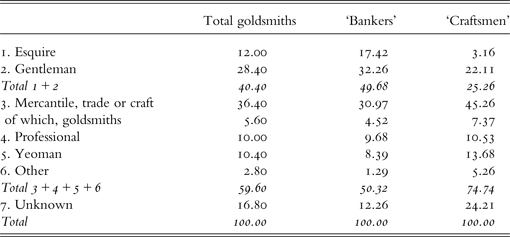
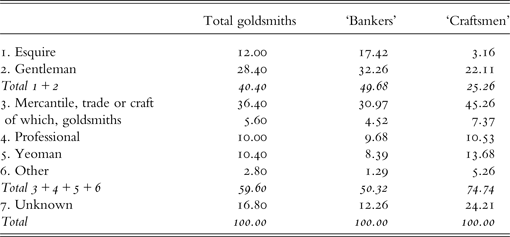
Individuals in occupations related to goldsmithing were likely to be acquainted with, or at least knowledgeable of, existing placement opportunities amongst goldsmiths. Conversely, status may provide resources enabling one to enter the guild and be successful after admission. Accordingly, looking at the background of apprentices may provide a useful perspective. The Apprenticeship Books at the Goldsmiths’ Company indicate paternal occupations or status and this enables us to construct Table 4, showing the origins of our population of apprentices. A few caveats are in order because the information in the Apprenticeship Books is far from being interpretable in a straightforward manner. For instance, fathers described as freemen of a company did not always practise the trade of their company. Status indications can also be misleading. For instance, ‘esquire’ was a denomination initially used to describe ‘sons of barons, knights, royal creations and their heirs’, but as Grassby remarks, it came to be adopted by the ‘doctors of law and divinity, officials, judges, sheriffs and [Justices of Peace]’. Likewise, ‘yeomen’ might have described either impoverished gentry or wealthy farmers (Grassby Reference Grassby1995, p. 142; see also pp. 141–4). The ‘gentry’ did not always map onto the landowning society. According to Christopher Brooks, up to 20 per cent of the ‘gent’ recruits were really sons of professional men and ‘well-to-do townsmen’, a phenomenon he describes as ‘status inflation’ in the seventeenth century (Brooks Reference Brooks, Barry and Brooks1994, p. 61).
Status and occupations of the apprentices’ fathers (percentage)
Source: See text.
Overall, goldsmiths drew about a third of their recruits from higher-status social groups (esquire and gentry) and another third from the mercantile occupations, trades and crafts. Noticeably, apprentices’ fathers in related occupations represent only about 10 per cent of the sample. Occupations in the primary sector are under-represented since only 10 per cent of the apprentices’ fathers show up as yeomen. Table 4 also shows that there are marked differences between the two subgroups comprised under goldsmithing. About 50 per cent of the fathers of Bankers’ apprentices were described as gentlemen or esquires, while this description was only used for 22 per cent of the fathers of Craftsmen's apprentices. As seen, Craftsmen did recruit more sons of traders, retailers and other mercantile activities than Bankers (45 per cent instead of 31 per cent respectively). The recruitment of the Bankers is centred on a higher stratum of society than that of the Craftsmen.Footnote 25 On the other hand, the lucrative prospects of the trade and lack of handicraft work may have been attractive for such groups. Banking was likely to be an occupation visible and known to the higher circles of the gentry, who shopped in the West End, or to the City and Royal officials who dealt with loans and securities traded by the Bankers. However, it is also possible that the greater share of individuals of high social status or wealth among Bankers’ apprentices could be due to the higher set-up costs required by banking, relative to the other goldsmith trades.Footnote 26 The percentage of fathers in the ‘professions’ (a category consisting mostly of clerks – they form 84 per cent of this group) was relatively high, at 10 per cent, compared to the London average of 2 per cent (Brooks Reference Brooks, Barry and Brooks1994, p. 59). One can speculate that sons of clerks had higher literacy and numeracy skills that were extremely useful for becoming a goldsmith and a banker: given contemporary developments in accounting, clerks may also be considered as having had a kind of occupational proximity to the goldsmiths.Footnote 27
In summary, one way to read those results is to say that Bankers and Craftsmen recruited apprentices from the population they catered for. Alternatively, the data suggest that occupational ties – in the narrow sense – were not discriminating, neither for the Bankers nor for the Craftsmen at entry into the guild, but social standing was. The Goldsmiths' Company was open to the sons of individuals in a large variety of trades yet there was selectivity towards the gentry. This group, through its social capital or wealth, maintained very high levels of entrance in the Bankers’ group. Whether it is a process of selection or self-selection is hard to tell, but it implies that the kind of connections that had to be mobilised by Bankers were relatively different from those needed for Craftsmen.
(c) Kin
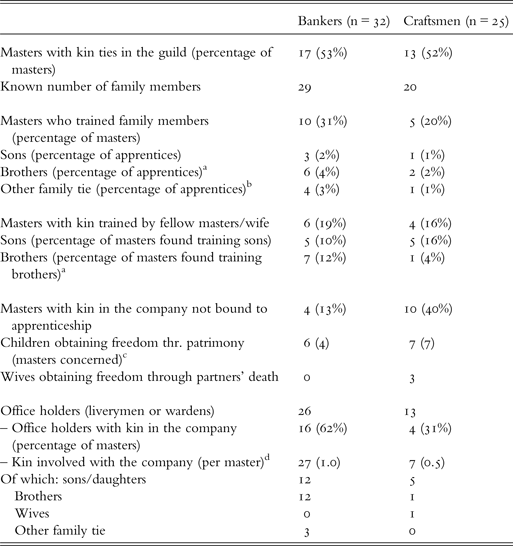
One of the striking results of Table 4 is the low proportion of sons of goldsmiths in the sample, compared to expectations: only about 6 per cent of apprentices’ fathers were goldsmiths. More remarkable still, perhaps, is the fact that the data show no sons of goldsmiths in our samples who showed up in the livery or became wardens. At the same time, our previous focus on sons does miss some of the action, as it excludes other forms of family relationships, for instance the training of younger brothers by uncles or the matrilineal line. Based on an additional search in the records of the Goldsmiths’ Company, kin relationships for the individuals described in Table 4 were further investigated. For this purpose, we considered that the master has another family member in the company when he shares a similar last name and comes from the same region as someone else in the company. Furthermore, two individuals are considered as brothers when their father's first name and occupation are identical (see the notes to Table 5 for precise definitions).
Kin of the Bankers and Craftsmen at the company
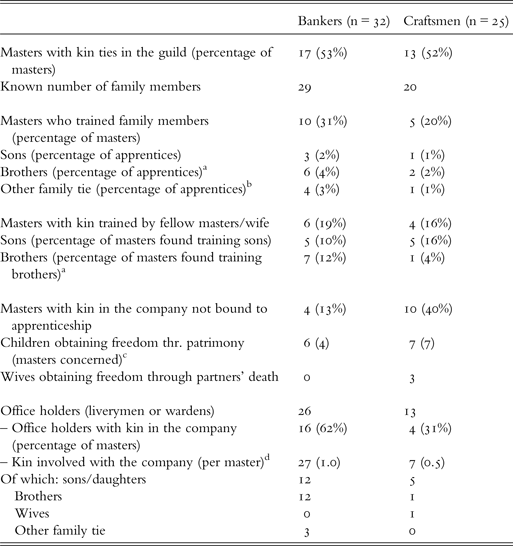
a ‘Brothers’: the apprentice's father and the master's father bear the same name, have a similar occupation and are from the same county.
b ‘Family tie’: apprentice and master come from same county and share same last name but they do not share any other known characteristics.
c ‘Patrimony’: when guild membership (‘freedom’) was obtained through ‘patrimony’ (‘inherited’), records do not indicate the name, occupation and county of the father. We relied on secondary sources when possible or limited shared last name.
d From wills of the Principal Court of Canterbury, records of the Goldsmiths’ Company, and secondary literature.
Sources: See text.
Table 5 presents the results from this supplemental investigation. The same percentage of Bankers and Craftsmen had kin members in the company (slightly above 50 per cent) but Bankers did train family members personally more often than Craftsmen (a third versus a fifth). In the population of apprentices, the proportion of sons trained personally is found to be extremely low for both groups (1 and 2 per cent). The share of brothers in this population is slightly higher and very close to the proportion of sons (2 and 4 per cent of the apprentices), and so is the share of other family ties (3 and 1 per cent).
Family members could also be bound to other goldsmiths or sometimes to the wife of the deceased goldsmith. In our sample, this is the case for family members of six Bankers (or 19 per cent of the Bankers) and four Craftsmen (16 per cent of the Craftsmen). Comparatively, more Bankers had their brothers trained by other masters, while more Craftsmen had their sons trained by other masters. Given that the data for Craftsmen have been generated from the records of the Court of Orphans, there might be here the echo of a master's family's response to such death.
Last, some family members became involved in the company but were not bound through apprenticeship. This was the case for individuals (children of masters) securing freedom through patrimony and for wives of deceased masters.Footnote 28 Craftsmen are much more numerous in this category than the Bankers and many more of their sons enter the company in this way. Three of the Craftsmen's wives are recorded as training some of their kin, both sons and brothers. Here again, the contrasted household strategy might be understood in relation to the economic constraints weighing on the household before and after the death of a master.
At the livery and wardenship level now, a substantially greater share of Bankers than Craftsmen had family members involved in the company (respectively 62 and 31 per cent), translating into an average of one kin and half a kin per master (Bankers and Craftsmen respectively). The difference arises from the higher number of brothers trained by Bankers and the predominance of Bankers in higher offices. If only one in two master craftsman had kin members in the higher echelons of the company, their children did not benefit greatly from their contacts inside the guild and their knowledge of the trade, especially since in our sample, Craftsmen's sons entered mainly through patrimony.
(d) Legacy
Trade continuity
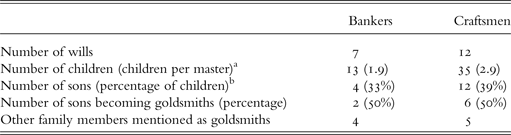
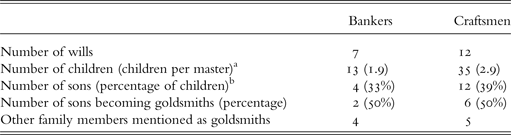
An interesting subject to investigate at this point is that of how many sons were oriented towards goldsmithing as a proportion of the children. We call this ‘trade continuity’. For this purpose, we use the groups of seven Bankers and 12 Craftsmen taken from the archives of the Prerogative Court of Canterbury (Table 6). We assume that all children (all sons and daughters) are mentioned in the wills. Although we cannot be sure that all children did inherit, the literature suggests that equal share among the children was a common approach amongst Craftsmen and the mercantile groups (Ben-Amos Reference Ben-Amos2008, p. 19). In this reduced sample of 19 goldsmiths, Bankers have an average of 1.9 children per household and Craftsmen a 2.9 average. In both samples, half of the sons (about 16 per cent of the children) become freemen of the Goldsmiths’ Company, either through apprenticeship or patrimony. It represents an extremely low rate of trade continuity, especially when one considers that freedom of the company does not imply practising the trade of goldsmith. This result is also particularly intriguing in the case of Bankers for it suggests that if goldsmith bankers needed trusted relationships in their activity, this was not achieved via the presence of kin members in the same activity. In particular, they do not seem to have encouraged their sons to join the trade any more than Craftsmen did.
Trade continuity
a All children mentioned in the wills or recorded by the Court of Orphans.
b Percentage calculated on the number of children whose sex was known.
Source: See text.
Integrative capacity of the Goldsmiths’ Company
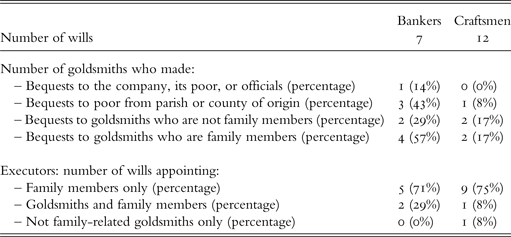
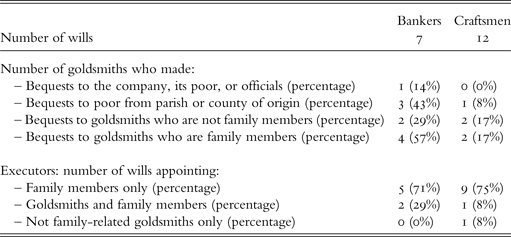
If the guild had been successful in creating a community and a strong feeling of brotherhood amongst guildsmen, the masters’ generosity to other guild members should perhaps have appeared in their wills. This is another reason for analysing the wills of the groups of Craftsmen and Bankers held in the archives of the Prerogative Court of Canterbury (Table 7). Yet this analysis reveals masters’ limited bequests to other goldsmiths and the poor of the company. Over the total sample of 19 wills, only one goldsmith donated to the poor of the company. Four other masters donated instead to the poor of their county of origin or parish of residence.Footnote 29 Bankers donate more to the poor, probably because of their wealth and other sample biases (two Bankers were childless) and more of them make bequests to both family members in the guild and non-family related fellow guildsmen. Given the relative proportions of the two types of donations (to guild members within and outside the family), family legacy loyalties trump guild loyalties. In effect, the most important and common pattern for both Bankers and Craftsmen is that the wills name the wife and the children as the main beneficiaries. Still, Bankers appear to have donated more often to non-family members who were goldsmiths. This pattern could be explained by two factors. First, their position in the company, as successful and powerful members, could have also been concomitant with greater social ties. Second, as members of the Bankers’ group, it might have been that greater ties were beneficial to their activities. However, it is noticeable that the ties they entertained were not exclusively with other Bankers, putting into question again the assumption that social ties were foremost an occupational strategy.
Bequests and wealth management
Source: See text.
Another measure of hierarchies of trust within a social network is the identity of the executor of the will. Indeed, executing a will was a crucial task. In our sample, only one testator appointed a goldsmith who was not family-related to the position of executor. Most executors were family-related and not members of the Goldsmiths’ Company (71 and 75 per cent for Bankers and Craftsmen respectively). In only three cases was this task shared with family members and goldsmiths. Most often the wife was to carry out this task alone or share the burden with the testator's brother and sons-in-law. Bankers designated goldsmiths as executors more often than Craftsmen did but we should bear in mind that more of their family members were in the guild. It therefore appears that the guild had a limited role in the management of a family's wealth following a death.
Bequests were probably dependent on individuals’ wealth and their links with other goldsmiths. In that respect, we find that the share of Bankers donating to other goldsmiths, either family members or friends, was larger than for Craftsmen. Craftsmen's tendency to make bequests to other goldsmiths (family members or not) was very low. The data give little support for the guild as a closely knit network of individuals with dense social ties, with some modest evidence at best for the Bankers.
In summary, this section has shown kinship ties before entering the guild to be a relatively weak explanatory variable to account for guild membership. Trade continuity was low for both groups. After entering the guild, Bankers have consistently come up as having more social ties with other goldsmiths after their entry into the guild than Craftsmen, visible in their kinship ties and their bequests to other goldsmiths. Wealth and the hierarchical position within the guild (vertical links) may have been a more important factor explaining social ties rather than guild membership (horizontal links). The specificity of the Bankers’ activity, especially their need for trusted relationships, does not seem to have triggered greater geographical, occupational or kinship ties per se. Last, household strategies could have played a role suggesting an encompassing approach that would read household decisions regarding guild membership as part of a broader set of choices.
V
This study has tried to assess the extent of geographical, occupational and kinship ties at the London Goldsmiths' Company in the second half of the seventeenth century. Contrary to the idea that guilds were communities of interlocking relationships, data analysis of the company records reveals significant openness to large sections of society both at entry and within the company although stronger occupational and kinship ties can be witnessed at the highest positions within the guild. Strikingly, only about 5 per cent of the apprentices’ fathers were goldsmiths and, counting generously, we find that about twice as many fathers were in occupations loosely related to the goldsmiths’ trade. Half of the goldsmiths had one or two family members at the company. Trade continuity appears to have been very low. Finally, the guild did not generate the cohesiveness suggested by the conventional rhetoric. Donations to the company are very limited and executors were mostly family members. The family trumped the guild.
With respect to the differences between Bankers on the one hand and Craftsmen and Retailers on the other, we found that the former did possess a few more geographical ties at entry (apprenticeship) between and amongst masters and apprentices. Still, geographical ties were limited and do not show up powerfully in the higher offices of the guild for either group. Both groups seem to have recruited a large number of apprentices from the type of clientele they were catering for. Social ties between each group and its clientele might have been more significant than social ties within similar occupations.
Our findings are also important for the light they shed on a key transformation of the company at the end of the seventeenth century, namely, the rise of its role as supplier of banking services and the historical importance this had for the development of the broader economy. If we follow the predictions of institutionalist approaches that emphasise the role of trust necessary to sustain banking activities, then we cannot help but notice the limited role of the recruitment of sons of fellow goldsmith bankers, scriveners or money-lenders. With regards to kin relationships, the Bankers seem to display moderately greater ties with other members of the company than the Craftsmen, through the marginally more important training of their brothers. Conversely, however, the brothers of Bankers did not necessarily practise banking activities (nor did their sons). The motivation for training sons or brothers might not necessarily be seen as a result of a need for greater trust in this activity but as economic strategies of the households taking into account wider considerations. Continuing down the same road, we find that the Bankers donated more often to non-family-related colleagues than the Craftsmen did. Their position within the guild might be a more sensible explanation for this pattern than reference to a greater ‘guild discipline’.
Further research is needed to understand the interactions of guildsmen, not only at entry into the guild or at the end of their lives but also during their working lives. A wider type of social ties, including religious and political affiliations, but also through the parish or the club will probably enrich our understanding of the social interactions in the pre-industrial corporate world. The three hypotheses to explain patterns of social ties (activity specificity, wealth and position in the guild, and households’ economic strategies) will also require further theoretical refinement. Nonetheless, the empirical evidence reported here does suggest that no single account is sufficient to describe the patterns of social ties at the Goldsmiths’ Company, be it internal to the guild (activity specificity, position in the guild, ethos) or external to it (households’ decisions, socio-economic and geographical background). It is the interrelation of such factors that could well be decisive.Footnote 30