Introduction
Monogenean parasites are problematic pathogens in aquacultural enterprises. Diseases resulting from monogenean infections are linked to their prevalence, mean intensity and abundance, as well as their microhabitat distribution on a host. Fisheries development programmes depend on the intensification of fish parasitological research so that improved fish yield can be achieved from healthy fish stock (Karvonen et al., Reference Karvonen, Hakalahti, Seppälä, Valtonen, Jalkanen and Nygren2005). Studies of parasitic infection of economically important freshwater fish species in their natural habitats are an area of interest (Boungou et al., Reference Boungou, Kabre, Marques and Sawadogo2008). However, compared with the vast literature available from temperate regions, there is little information on the ecology of parasites of freshwater fish in tropical countries (Barson et al., Reference Barson, Mulonga and Nhiwatiwa2008), with most studies being taxonomical (Tombi & Bilong Bilong, Reference Tombi and Bilong Bilong2004).
The Mozambique tilapia, Oreochromis mossambicus (Peters, 1852), contributes about 4% of the total tilapia aquaculture production worldwide. Native to southern Africa, it is a significant angling fish (Skelton, Reference Skelton2001). According to IUCN (the International Union for Conservation of Nature), it is listed as ‘Near Threatened’ on its Red Data List of Threatened Species and is likely to become locally extinct (Cambray & Swartz, Reference Cambray and Swartz2007) due to hybridization and competition with the introduced Nile tilapia, Oreochromis niloticus (Linnaeus, 1758). This hybridization may disrupt its genetic adaptations to resist drought, capacity to survive and reproduce in sea water, and to resist temperatures as low as 11°C (Moralee et al., Reference Moralee, Van Der Bank and Van Der Waal2000).
The results presented here are part of a comprehensive study of the ecological dynamics of five monogenetic gill parasites of O. mossambicus collected from the Nwanedi-Luphephe dams of the Limpopo River System. The aim of the study was to determine the microhabitat distribution and demographic profiles of these parasites in a near-natural site, in order to address the shortfalls in information concerning their ecology. Levels of infection by monogenean parasites as a function of time, sex, size and age of the host were also considered. This is essential to find ways of avoiding catastrophic losses often observed in planned intensive aquaculture.
Materials and methods
Collection and examination of fish and parasites
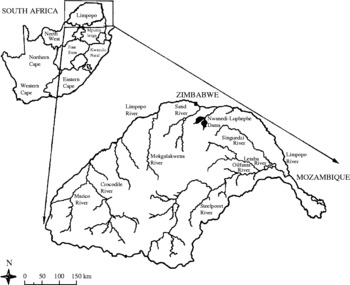
The Nwanedi-Luphephe dams (22°39′S, 30°25′E) are twin impoundments in the Limpopo Province of South Africa (fig. 1). The dams have a high level of endemism in plants and animals with no introduced species. Of particular importance is the dominance of O. mossambicus within the fish composition of these dams. Seasonal collections of hosts were made from spring 2007 to winter 2009 using gill nets of various mesh sizes. The standard length (SL) in centimetres, weight and sex of each fish specimen were recorded. Fish were killed by severing the spinal cord and the gills were excised, placed in Petri dishes containing dam water and examined for parasites using a dissecting microscope. For identification purposes, monogeneans were fixed on a slide either with a drop of Malmberg solution (ammonium picrate glycerine) or glycerine jelly.
The Nwanedi-Luphephe dams forming part of the Limpopo River System, South Africa.

Left and right gill arches were numbered from 1 to 4, gill arch 1 nearest the operculum and gill arch 4 nearest the midline (transverse partitioning). Each gill arch was divided antero-posteriorly and dorsoventrally into three approximately equal regions (anterior, median and posterior: longitudinal partitioning) and gill filaments were divided evenly into two zones: proximal and distal (vertical partitioning). Thus, six sections were defined as the smallest identifiable territorial units for monogeneans. The four gill arches on one side of a fish represented 24 sections, with six sections per gill arch. Parasites were counted per smallest identifiable territorial unit (48 in all), each describing gill arch number, the side of the gill, zone and region.
Data analysis
Data were normalized with log(x+1) transformations to satisfy homoscedasticity or linearity necessary to perform parametric tests (Ter Braak & Smilauer, Reference Ter Braak and Smilauer1998). Differences in intensity between left and right gill arches for each infracommunity were tested using Student's t-test. Analysis of variance (ANOVA) and multiple comparisons were used to compare infection levels between gill arches, zones and regions.
A generalized linear model (GLM) was used to test the influential variables associated with each monogenean species. This method is suitable where the analysis involves the relationship between continuous and non-continuous variables (Dunteman & Moon-Ho, Reference Dunteman and Moon-Ho2006). In this case, the effect of sex, size, weight, season (predictor variables) on abundance of individual species was tested. The Pearson chi-square statistic was used to evaluate overdispersion (Dunteman & Moon-Ho, Reference Dunteman and Moon-Ho2006). In the absence of overdispersion, the Pearson chi-square statistic should be approximately equal to the residual degrees of freedom (number of observations minus number of model parameters; Dunteman & Moon-Ho, Reference Dunteman and Moon-Ho2006). The significance of each coefficient (b) was evaluated by the Wald chi-square statistic. The Tukey's post-hoc test was performed using SPSS to determine the seasons that were significantly different from one another.
Spearman's rank correlation was used for measuring association of the different parasite species in the component community of O. mossambicus. All values of P ≤ 5% were considered significant. The SPSS 17.0 software package was used for all the data analyses (SPSS Inc., Chicogo, Illinois, USA).
Data were presented for the following three length classes of the host: < 15 cm, 15–19.9 cm and ≥ 20 cm. The values of these size groups were chosen in consideration of their age in years ( < 1.5 years, ≥ 1.5 years < 3 years, and ≥ 3 years) using the Von Bertalanffy growth curve of O. mossambicus from the Nwanedi-Luphephe impoundments (Hecht, Reference Hecht1980). Levels of parasite infections were analysed following ecological terms according to recommendations by Bush et al. (Reference Bush, Lafferty, Lotz and Shostak1997).
Results
A total of 157 host specimens were caught, ranging in length from 6.2 to 26.5 cm. According to the Von Bertalanffy growth curve (Hecht, Reference Hecht1980), this size range corresponds to the ages 6 months to 5+years. Forty-two fish (27%) were uninfected while seven (4%) had a monospecific infection. The remaining 108 fish (69%) revealed multispecific infections with 2–4 parasites each. Four species of Cichlidogyrus Paperna, 1960 were recovered from the host's gills, namely C. halli (Price and Kirk, 1967), C. sclerosus Paperna and Thurston, 1969, C. dossoui Douëllou, 1993 and C. tilapiae Paperna, 1960, and Scutogyrus longicornis (Paperna and Thurston, 1969).
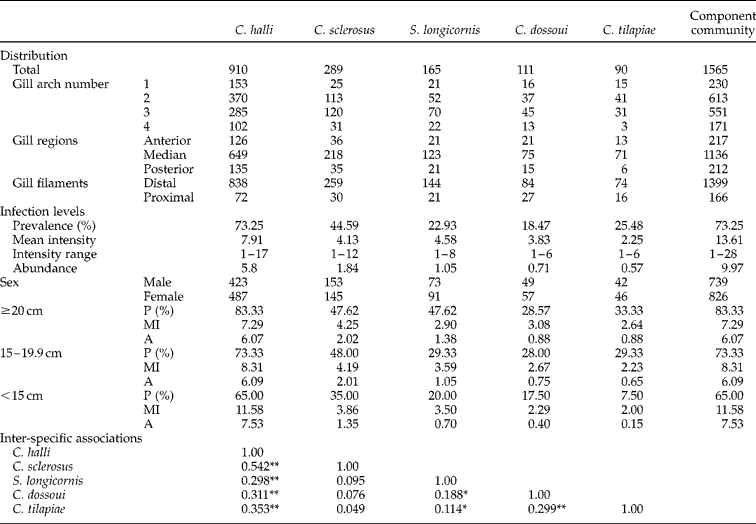
Of 1565 monogeneans collected, C. halli was the most numerically dominant (910) and C. tilapiae (90) was the least (table 1). There was a prevalence of 73.25% for C. halli while for each of the other four monogeneans it was less than 50%. The species with the highest intensity of infection was C. halli, with as many as 17 individuals per fish, while other monogenean species were rare, each with fewer than 13 parasites per fish. The number of parasites per infected fish ranged from 1 to 28 (table 1). An average of two monogenean species was found per host.
Distribution, infection levels and associations of monogenean species on the gills of Oreochromis mossambicus from the Nwanedi-Luphephe dams.
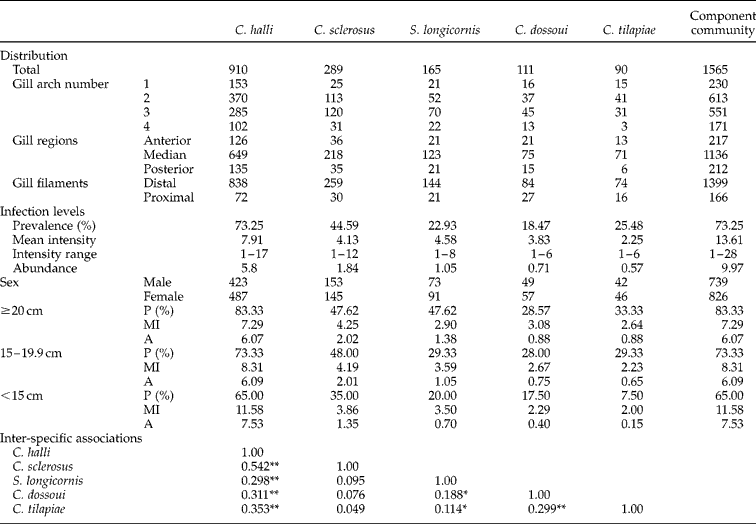
C., Cichlidogyrus; S., Scutogyrus; P, Prevalence (%); A, abundance; MI, mean intensity.* Correlation significant at the 0.05 level (two-tailed); ** correlation significant at the 0.01 level (two-tailed).
None of the monogenean species showed a preference for either the left or the right gills (Student's t-test, P>0.05). However, the distribution on the gills of all monogenean species indicated some site selection. They showed a preference for the second and third gill arches (ANOVA and multiple comparisons, P>0.05), the distal half of the gill filament (ANOVA and multiple comparisons, P>0.05), and for the middle region of the gill (table 1) (ANOVA and multiple comparisons, P < 0.05). In fact, monogeneans were found at the extremity of the gill filaments. Arches 1 and 4 were favoured less by monogeneans and no significant differences were found between gills 2 and 3 (table 1) (ANOVA and multiple comparisons, P>0.05).
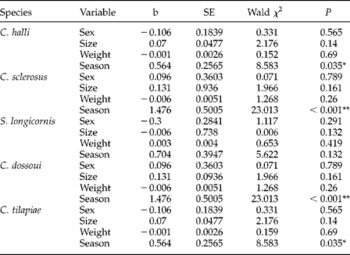
The GLM results indicated that seasons have a significant influence on the abundance of C. halli, C. sclerosus, C. dossoui and C. tilapiae, but not C. longicornis (table 2). Significant differences were found in the infection levels between summer and spring, summer and autumn, and winter and spring, as well as winter and autumn (Tukey's post-hoc test). However, there were no significant differences between winter and summer nor between autumn and spring (P>0.05). This suggests that the rate of infection was higher in summer and winter than in autumn and spring. The model also revealed that sex and size did not have significant influence on the abundance and intensity of any of the five monogenean species (P>0.05). However, size was a significant variable as far as prevalence was concerned (P < 0.05).
Generalized linear model results for the relationship between explanatory variables and the five gill monogenean species on Oreochromis mossambicus from the Nwanedi-Luphephe dams.

The overall goodness of fit tests are as follows: C. halli, χ2 = 1.270, P < 0.01; C. sclerosus χ2 = 4.893, P = 0.001; S. longicornis χ2 = 3.042, P = 0.096; C. dossoui χ2 = 4.893, P < 0.01; C. tilapiae χ2 = 1.270, P = 0.01. The Wald χ2 statistic tests the significance of each coefficient (b). Sex, df = 1; size, df = 2; weight, df = 2; season, df = 3. *, Statistically significant at P < 0.05 level; **, statistically significant at < 0.001.
The determination of inter-specific associations among the five monogenean species found on the gills revealed that all the ten pairwise comparisons of intensities illustrated positive associations, with seven being strong and significant, whereas the other three were weak and insignificant (table 1).
Discussion
The gill parasite community of O. mossambicus consisted of four congeneric species of the genus Cichlidogyrus and one of Scutogyrus. The exploitation of hosts by congeneric species reported by Boungou et al. (Reference Boungou, Kabre, Marques and Sawadogo2008) was hereby confirmed. Simultaneous infections and coexistence of the gill parasites are made possible by relatively low infection levels under natural conditions. Such low levels of infection result from the fact that niches are always available on the gill biotope (Šimková et al., Reference Šimková, Verneau, Gelnar and Morand2006). According to the classification of parasitic communities (Valtonen et al., Reference Valtonen, Holmes and Koskivaara1997), C. halli represented the only common species within the sample, the rest were intermediate species. All monogenean species found on O. mossambicus had low mean intensities and abundances. Obiekezie (Reference Obiekezie1991) and Luus-Powell et al. (Reference Luus-Powell, Mahlangu, Theron and Hattingh2009) also noted that in wild fish populations, monogeneans occurred at low intensities and in apparent equilibrium with their hosts, whereas under cultured conditions, these pathogens build up heavy worm burdens, which provoke epizootics.
Prevalence values increased with increasing host size. The smallest host examined was infected and this suggests that small fish become infected with gill parasites as early as when they start schooling with larger fish. No fish less than 6.2 cm (fish younger than 6 months) were caught because of the fishing gear used. Thus, no data were obtainable to construct a length/prevalence curve to determine the exact age and size when initial infection actually took place. While the mouth brooding habit of O. mossambicus allows it to nurture its young, it may also make the fry vulnerable to parasitic infections. However, Tombi & Bilong Bilong (Reference Tombi and Bilong Bilong2004) found a positive correlation between parasitic infections and host size and attributed this to increasing gill surface area and water flow through the gill chamber. Bakke et al. (Reference Bakke, Harris and Cable2002) observed a negative correlation between the infection levels of Gyrodactylus salaris and the age of salmonids and suggested that larger fish become less susceptible to infection as immunity increases with age.
The present study indicated that there were no significant differences in numbers of parasites in male and female hosts, thus confirming the findings of Tombi & Bilong Bilong (Reference Tombi and Bilong Bilong2004) and Boungou et al. (Reference Boungou, Kabre, Marques and Sawadogo2008). There were no significant differences regarding left or right gill preference. Rohde (Reference Rohde1993) asserts that preference for a particular gill side may be due to the asymmetrical body shape of many gill parasites. This may perhaps explain why the bilaterally symmetrical Cichlidogyrus species did not prefer either the right or left gill.
Although all the parasites colonized most of the gill surface, some microhabitats were preferred to others. The results indicated a marginal preference for the distal half of the gill filament and the middle region of the second and third gills. However, gills one and four were not avoided and the ability of these monogeneans to move rapidly makes them able to invade the entire gill. It may also be possible that factors such as respiratory current or gill surface area might have influenced the distribution of the parasites and should, thus, not be disregarded. In O. mossambicus, the fourth gill is shorter than the others, with fewer, shorter and thinner gill filaments. Gill number one is the first to receive ventilating currents but may possibly fail to retain more parasites because post-settlement migration may occur. Gills two and three may offer a hydrodynamically protected site (Lo et al., Reference Lo, Morand and Galzin2001) due to reduced turbulence in this area, leading to success of attachment.
The highest infection levels were recorded in summer and winter. This was probably due to a decrease in water volume during the dry season which caused nutritional imbalances resulting in lower production of food. A higher incidence of disease and increased infection levels in fish during the winter months have been reported previously (Rawson & Rogers, Reference Rawson and Rogers1972a, Reference Rawson and Rogersb; Khidr, Reference Khidr1990; Banu et al., Reference Banu, Hossain and Khan1993; Tsotetsi et al., Reference Tsotetsi, Avenant-Oldewage and Mashego2004). Marx & Avenant-Oldewage (Reference Marx and Avenant-Oldewage1996) suggested that reduced water levels in winter concentrate parasites and hosts, increasing the probability of infection. Mozambique tilapia aggregate in deep warmer waters with the onset of colder temperatures (Caulton & Hill, Reference Caulton and Hill1973; Bruton & Bolt, Reference Bruton and Bolt1975) and this behaviour might contribute to the rapid rise in infection at this time of the year.
Another possibility involves the effect of temperature on the immune response of the host to monogeneans. Peaks in infection levels at lower temperatures may occur because such temperatures are below levels at which antibodies are produced by the host, but above optimal temperatures required for parasite reproduction (Beckert & Allison, Reference Beckert and Allison1964; Cloutman, Reference Cloutman1978). The ability of the host to eliminate the parasite is therefore impeded by cold temperatures. The consequence of this is an increase in the survival rate of larval parasites that encounter the host.
The high infection levels observed during the summer months may be related to increasing temperatures, which would favour an increase in egg production, rapid development of eggs and rapid growth of parasitic larvae. In tropical waters, Mozambique tilapia breeds continuously throughout the year at temperatures over 20°C (Neil, Reference Neil1966; De Silva & Chandrasoma, Reference De Silva and Chandrasoma1980). However, it would be expected that breeding activities will be optimal during the summer months when environmental conditions are suitable and since the release of fry appears to be associated with cues to rainfall (Bruton & Bolt, Reference Bruton and Bolt1975). Schooling behaviour during the breeding season is an important factor that may possibly result in oncomiracidial larvae easily accessing new hosts. The abundant food availability and favourable temperature in the summer months may cause this high density of hosts and initiation of egg production, respectively, thus resulting in successful transfer of eggs and oncomiracidia from fish to fish.
Positive inter-specific associations were revealed in the present study and this may be the result of a similar mechanism of infection in situ (Lo et al., Reference Lo, Morand and Galzin2001). Additionally, one species may weaken a host and so make it more susceptible to infection with another species, or one species may ‘prepare’ the microhabitat for a second species, for instance, by making it easier for the latter species to feed (Hayward et al., Reference Hayward, Perera and Rohde1998). In the Nwanedi-Luphephe dams, O. mossambicus was infected by monogenean parasites throughout the entire year. The recruitment of these parasites, though relatively weak, was certainly continuous. This is probably because the success of the ‘simple’ monogenean is highly evolved and suitably adapted to enable these ectoparasites to locate, invade and establish on wild fish hosts. For captive fish, the direct life cycle is, at best, a nuisance and, at worst, can kill valuable stock (Luus-Powell et al., Reference Luus-Powell, Theron and Hattingh2006). The struggle against direct life-cycle parasites like Monogenea can be achieved by treatment of the host (Osman et al., Reference Osman, Borhn, Noor El Deen and Laya2008) or by breaking the development cycle. The latter can be achieved by washing basins periodically to reduce the eggs and infective stages (oncomiracidia). Fish genitors, even from the wild, must be disinfected before putting them in basins. Traditional treatments with chemicals and drugs, although effective, unavoidably cause problems related to environmental pollution, drug resistance and health issues. Alternative methods that are environmentally and ecologically sustainable, such as saline treatment, should also be developed and more widely applied. Reaching this long-term objective will depend on the co-operation of, and contributions from, fish parasitologists and fish farmers.
Cichlidogyrus and Scutogyrus species are recorded for the first time in the ichthyoparasitofauna of South Africa. The presence of C. dossoui and S. longicornis represent the first host records. This paper also addresses the theme of the host–parasite system. Our findings regarding this aspect conform to other parasitological investigations (Hayward et al., Reference Hayward, Perera and Rohde1998; Lo et al., Reference Lo, Morand and Galzin2001). By using statistical tests, the microhabitat preferences of monogeneans have been much better understood. Future studies should focus on ecological patterns of gill monogeneans on other cichlid fishes of South Africa.
Acknowledgements
We wish to thank Johan Theron, Hendrik Hattingh and Esau Mbokane for their assistance with fieldwork. We also thank Dr Maxwell Barson (University of Zimbabwe) and Wilbert Kadye (Rhodes University) for critically reading the manuscript. This study was funded by the National Research Foundation and the University of Limpopo (South Africa).