Introduction
QoL of PwD living in long-term care facilities remains a priority in dementia research (Moniz-Cook et al., Reference Moniz-Cook2008; Morley et al., Reference Morley2014a). QoL is a complex, multidimensional construct, and both objective components (e.g. behavioral competence and environment) and subjective components (perceived QoL and psychological well-being) are generally considered to be important for QoL of PwD (Lawton, Reference Lawton1994). Several studies showed that clinical conditions such as depressive and behavioral symptoms have a negative impact on QoL (Banerjee et al., Reference Banerjee2009; Beerens et al., Reference Beerens, Zwakhalen, Verbeek, Ruwaard and Hamers2013).
There is less knowledge about which aspects of daily life are important for QoL and how these aspects contribute to a good QoL. As proposed by a study including expert interviews and a literature study, daily life entails: (1) activities performed by PwD; (2) the physical environment PwD live in; (3) social interactions of PwD with others; and (4) emotional well-being (de Boer et al., Reference de Boer, Beerens, Zwakhalen, Tan, Hamers and Verbeek2016). Prior research suggests that PwD who engage in a variety of activities have a higher QoL than those who are inactive (Edvardsson et al., Reference Edvardsson, Petersson, Sjogren, Lindkvist and Sandman2013). Especially, activities related to personal hobbies (Giebel et al., Reference Giebel, Challis and Montaldi2014), reminiscence, leisure, expression, and vocational occupation (Smit et al., Reference Smit, Willemse, de Lange and Pot2014) have a large potential for QoL enhancement. In contrast, a low QoL is associated with passive activities, such as daytime sleep and sitting/standing without doing any activities (Kuhn et al., Reference Kuhn, Edelman and Fulton2005; Edvardsson et al., Reference Edvardsson, Petersson, Sjogren, Lindkvist and Sandman2013). Qualitative literature indicates that activity engagement is important because it may give PwD pleasure and enjoyment, contributes to a sense of connection and belonging, and helps them to retain a sense of autonomy and personal identity (Phinney et al., Reference Phinney, Chaudhury and O'Connor2007). Besides activities, PwD and their caregivers also consider aspects such as social relationships, physical movement, attachment and affect, control over life, and contributing to the community as important for PwD's QoL (Cahill and Diaz-Ponce, Reference Cahill and Diaz-Ponce2011; Moyle et al., Reference Moyle2011).
However, to date, it is unknown how the daily lives of PwD with a higher QoL differ from those with a lower QoL. More insight is essential because it will direct QoL improvement. It will inform caregivers on how to set priorities during daily caregiving, as daily life aspects such as social interaction and activity level can be improved without complex interventions (van der Ploeg et al., Reference van der Ploeg, Eppingstall, Camp, Runci, Taffe and O'Connor2013). Factors of daily life that contribute to a good QoL of PwD living in long-term care facilities are currently unknown. Prior research has not considered multiple aspects of daily life simultaneously. Furthermore, many studies used proxy questionnaires to investigate daily life and calculated sum scores. Such measures are prone to recall bias and do not consider the broad context in which daily life takes place. Caregivers may for example easily overestimate the time that PwD engage in activities (Smit et al., Reference Smit, de Lange, Willemse, Twisk and Pot2016).
Therefore, the current study investigates the direct context in which activity, engagement, social interaction, and other aspects of daily life naturally occur. It uses an ecological momentary assessment approach (Shiffman et al., Reference Shiffman, Stone and Hufford2008), taking snapshots of everyday life to picture PwD's life repeatedly. First, this study aimed to gain more insight into the daily lives of PwD of PwD living in long-term care facilities. Second, this study addressed two research questions specifically focusing on the relationship between QoL and everyday life: (1) How does the daily life of PwD living in long-term care facilities with a high QoL differ from those with a lower QoL?; and (2) Which aspects of the daily lives of PwD living in long-term care facilities are associated with QoL?
Methods
Design
This study has an observational study design and includes ecological momentary assessments of the daily lives of PwD (Shiffman et al., Reference Shiffman, Stone and Hufford2008).
Participants and setting
This study was part of a larger study looking at differences between long-term care facilities for PwD living in the Netherlands (de Boer et al., Reference de Boer, Hamers, Beerens, Zwakhalen, Tan and Verbeek2015). Eighteen wards in eight locations – accommodating 158 potential participants – in the southern provinces of the Netherlands participated. PwD of all types of long-term care facilities (e.g. large- and small-scaled) were eligible. All participants with a formal diagnosis of dementia were included, except if they had a primary psychiatric diagnosis. In total, the legal representatives of 115 of the 158 potential participants (73%) agreed to participation in the study.
Instruments
Dependent variable: quality of life
QoL was assessed by formal caregivers using the QoL-AD. This scale allows thirteen QoL domains to be rated on a 4-point Likert scale, ranging from 1 (poor) to 4 (excellent). Total scores range from 13 to 52, and higher scores indicate a better QoL (Logsdon et al., Reference Logsdon, Gibbons, McCurry and Teri2002).
Independent variables: aspects of daily life
The MEDLO-tool (de Boer et al., Reference de Boer, Beerens, Zwakhalen, Tan, Hamers and Verbeek2016), a tablet-based observational tool, was used to conduct momentary assessments (Shiffman et al., Reference Shiffman, Stone and Hufford2008) to gain insight in aspects of daily life. The MEDLO-tool demonstrated to be valid, reliable, and feasible for research purposes with on average 86% absolute agreement between observers (de Boer et al., Reference de Boer, Beerens, Zwakhalen, Tan, Hamers and Verbeek2016). The following daily life aspects of the MEDLO-tool were collected for this study: (1a) the activity performed by the participant or occurring in his/her vicinity; (1b) the extent to which the participant was engaged in this activity; (2) whether the participant had social interaction; (3) participant's level of physical effort; (4) the mood of the participant; and (5) participant's agitation level. Box 1 provides a full explanation of these aspects of daily life and accompanying operationalizations. A manual of the MEDLO-tool is available upon request.
Aspects of daily life and their operationalizations
1a. Activity taking place during the observation minute
(one of the five listed activities can be chosen as an activity that took place)
0 = activity did not take place
1 = activity took place

1b. Engagement in main activity that was chosen in step 1a
0 = no, not engaged: sleeping, staring, engagement in something else
1 = yes, engaged: active participation in activity or a focus on activity
2. Social interaction during observation minute
0 = no social interaction, attempted interaction without response
1 = yes, social interaction with one or more persons
3. Physical effort during observation minute
0 = none/minimal physical effort: lying or sitting quietly
1 = yes, physical effort: light-to-moderate sitting activity, standing activity, walking around, cycling, whole-body movements
4. Mood during observation minute
7-point Likert scale:
1. Great signs of negative mood
2. Considerable signs of negative mood
3. Small signs of negative mood
4. Neutral
5. Contentment and small signs of well-being
6. Considerable positive mood
7. Very high positive mood
5. Agitation during observation minute
Defined as aberrant vocalization, motor agitation, aggressiveness, or resisting care
5-point Likert scale:
0. No agitation
1. E.g. vocalization is not disruptive, seeking comfort, verbal threats, procrastination, or avoidance
2. E.g. vocalization is louder than usual, mildly intrusive movements, threatening gestures, rejection
3. E.g. loud vocalization, quick movements, physical toward material goods, pushing away
4. E.g. extremely loud vocalization, extreme movements, physical towards people, threshing
Activity and engagement were considered to be two distinct aspects of daily life. An activity occurring in the participant's vicinity does not imply that they are actually engaged in this activity. Therefore, we recorded (1a) the activity and (1b) participant's level of engagement in this activity. Engagement in active, expressive, and social activities was of particular interest and therefore, a combination variable connecting the activity cluster ‘active, expressive, and social activities’ (step 1a) and ‘yes, engagement’ (step 1b) was created.
For the dichotomous variables (activity, engagement, social interaction, physical effort), percentages of how frequently they occurred were calculated per participant. For the continuous variables (mood and agitation), mean scores were calculated per participant.
Background characteristics
Cognitive functioning was assessed using the Standardized Mini-Mental State Examination (S-MMSE). Total scores on this scale range from 0 to 30, with higher scores indicating better cognition (Molloy et al., Reference Molloy, Alemayehu and Roberts1991). Dependence in activities of daily living (ADL) was assessed using the Barthel Index. Total scores on this scale range from 0 to 20, with higher scores indicating more independency in ADL (de Haan et al., Reference de Haan, Limburg, Schuling, Broeshart, Jonkers and van Zuylen1993). Information on age, gender (male/female), and marital status (widowed/not widowed) was also collected.
Procedure
All data were collected by two researchers (the first and second authors) and a research assistant who spent a maximum of three weeks in every location. Within this period, all data were collected using two methods. First, standardized interviews were held with certified nursing assistants who provided hands-on care to participants (PwD's QoL and background characteristics) and PwD (cognition). Second, momentary assessments of the daily lives of PwD were carried out. PwD were not only observed in communal areas, but were followed wherever they went. If observers had the impression that they were too intrusive in the daily lives of PwD, they stepped back and recorded an observation as missing. To take privacy into account, PwD were not observed in private spaces such as the bathroom or the bedroom with a closed door.
Observations took place at one ward per observation day. The order of observations was randomized in advance. A randomized observation schedule ensured that every participant (with a maximum of eight per ward) was observed for one minute during every 20-minute period. After the end of each 1-minute observation period, the observer recorded the scores of all aspects of daily life that are shown in Box 1. Observations took place on seven days: two weekday mornings (07:00–11:30), two weekday afternoons (11:30–16:00), two weekday evenings (16:00–20:30), and one Saturday afternoon (11:30–16:00). There was a half-hour break within each 4.5 hour observation block. In total, data of (12 one-minute observation periods per day *7 observation days =) 84 momentary assessments were recorded per participant.
Analyses
First, the sample characteristics were described. Participants were assigned to one of two QoL groups according to whether their QoL-AD score was above or below the median of the sample (32.0). Differences in sample characteristics between PwD in the ‘higher QoL’ group and PwD in the ‘lower QoL’ group were assessed using χ 2 tests in the case of marital status and gender and independent samples t-tests for other variables.
Second, differences between the aspects of the daily lives of PwD with ‘higher QoL’ and PwD with ‘lower QoL’ were evaluated. Therefore, differences between the two QoL groups regarding activities, engagement, social interaction, physical effort, mood, and agitation were assessed using χ 2 tests.
Third, to assess which aspects of daily life contribute to QoL, a multiple linear regression analysis with the QoL-AD score as the dependent variable was conducted. The selection of independent variables went as follows: First, aspects of daily life that were not significantly different between the two QoL groups (see Table 2) were excluded (three activity categories, physical effort, and agitation). Second, whether or not a participant was actually engaged in activities such as musical activities, craft activities, or sports was considered most important. Therefore, we included the combination variable ‘engagement in active, expressive, and social activities.’ As a result, two closely related variables (‘active, expressive, or social activities’ and ‘engagement in all activities together’) were removed. The final set of independent variables related to aspects of daily life included: ‘passive/purposeless activity’; ‘engagement in active, expressive, or social activity’; ‘social interaction’; and ‘mood.’ We controlled for the potential effects of age, gender, cognitive status, and location as these variables might influence the range of activities in which participants are involved, their level of engagement or social interaction. All independent variables were entered in the model simultaneously.
All analyses used a significance level of α = 0.05 (two-tailed) and were conducted using SPSS version 22.0 (IBM SPSS Statistics, IBM Corporation, Chicago, IL).
Ethics
The study protocol was reviewed by the medical ethics committee of the Maastricht University Medical Center. They declared that the study was non-invasive for PwD according to the Medical Research Involving Human Subjects Act. Legal representatives of PwD received a letter with information about the study and an informed consent form. They were asked to return the form in which they filled out whether they provided informed consent or not. Next to this informed consent procedure, PwD were asked to assent to participation. This was defined as a verbal agreement to participate or a non-verbal indication of willingness to cooperate with the study.
Results
Sample characteristics
The mean age of participants was 84 years and most were female (75%) and widowed (66%). The mean S-MMSE score was 8.5, which indicates severe cognitive impairment. The mean Barthel Index score was 9.7, which indicates a limited ability to perform ADL activities independently.
The median QoL-AD score was 32.0 and the mean QoL-AD score was 31.7 (SD = 5.0). To gain insight in the difference between PwD with a higher and lower QoL, the sample was divided into two QoL groups using the median QoL-AD score as the boundary. The mean QoL-AD score was 35.9 (SD = 2.6) for the ‘higher QoL’ group (n = 59) and 27.3 (SD = 2.6) for the ‘lower QoL’ group (n = 56). Table 1 shows the sample characteristics for the sample as a whole and for the two QoL groups. PwD with higher QoL had significantly better cognition than those with lower QoL (p = 0.006).
Sample characteristics (groups defined relative to the median QoL-AD score)

QoL-AD = Quality of Life in Alzheimer's Disease scale, QoL = quality of life, SD = standard deviation.
*Independent samples t-test or χ 2 test of difference between the QoL groups.
Description of the daily lives of PwD
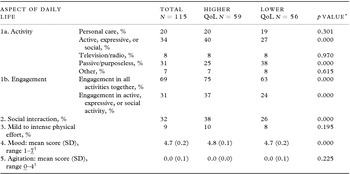
In total, (115 participants *84 observations per participant =) 9,660 observations were completed. Table 2 provides an overview of the percentage of times spent on activities, engagement, social interaction, physical effort, and the average mood and agitation scores of participating PwD during the observations. Active, expressive, or social activities such as household activities or musical activities or passive/purposeless activities such as sleeping, took place in the vicinity of the PwD during 34% and 31% of the observations, respectively. Less time was spent on activities related to personal care (20%), television or radio activities (8%), and other activities (7%). PwD were engaged in one of all these activities during 69% of the observations. However, engagement in active, expressive, or social activities occurred less frequently (31%). PwD had any form of social interaction such as talking or eye contact during 32% of the observations. Furthermore, PwD were lying or sitting passively during 91% of the observations, and were physically active (e.g. sitting with arm movements, standing, walking) during 9% of the observations. Overall, PwD were content and displayed small signs of happiness (mean mood score = 4.7) and agitation was rarely observed.
Aspects of daily life for the sample as a whole and grouped according to QoL-AD score

QoL-AD = Quality of Life in Alzheimer's Disease scale, QoL = quality of life, SD = standard deviation.
*Independent samples t-tests on difference between QoL groups.
†Underlined score is most favorable score.
The daily lives of PwD with higher and lower quality of life
Bivariate analyses
Table 2 presents an overview of the aspects of daily life of PwD with higher QoL in comparison to those with lower QoL. Active, expressive, or social activities such as household activities, musical activities or conversations with others occurred most frequently in the daily lives of PwD with high QoL (40%). In contrast, PwD with lower QoL spent more time on passive/purposeless activities such as sleeping, sitting without doing anything, or purposeless repetitive behavior (38%). The difference between the QoL groups was statistically significant for both activity categories (p < 0.001). Furthermore, PwD with a higher QoL were also more frequently engaged (active participation or clear focus) in active, expressive, or social activities (37% vs. 24%, p < 0.001), had more social interaction such as talking or eye contact with other people (38% vs. 26%, p < 0.001), and had higher mood scores (4.8 vs. 4.7, p < 0.001) than those with lower QoL.
Multivariate analyses
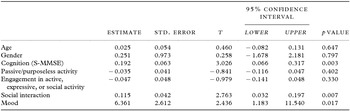
The result of the regression analysis that focused on the association between aspects of daily life and QoL is presented in Table 3. A higher QoL was associated with having frequent social interaction (p = 0.007), and higher mood scores (p = 0.017). In other words, PwD who had frequent social interaction or a good mood during their day were more likely to have a good QoL than PwD who had less social interaction or lower mood scores. In addition, PwD with higher QoL scores had better cognitive abilities than PwD with lower QoL (p = 0.003).
Association between aspects of daily life and QoL-AD score: regression analyses

QoL-AD = Quality of Life in Alzheimer's Disease scale, S-MMSE = Standardized Mini-Mental State Examination.
Discussion
This study showed that residents with a higher QoL carried out less passive/purposeless activities, were more engaged in active, expressive, and social activities, had more social interaction, and had better mood scores, than residents with a lower QoL. Corrected for age and cognition, having more social interaction and a positive mood were related to a higher QoL.
The finding that frequent social interaction is associated with higher QoL is in line with studies showing that social contact is essential for PwD and improves their QoL (Cahill and Diaz-Ponce, Reference Cahill and Diaz-Ponce2011; Moyle et al., Reference Moyle2011). However, evidence suggests that the need PwD have for social contact is often not met (Ward et al., Reference Ward, Vass, Aggarwal, Garfield and Cybyk2008). This concern is reflected by the observations of the daily lives of PwD in the current study, which show that PwD spend most of their time without social contact. The lack of social contact may be a result of the difficulties nursing staff experience in communicating with PwD. Evidence suggests that nurses have few interactions with PwD with little conversational capacity (Perkins and Nolan, Reference Perkins and Nolan1992), and find it difficult to cope with aggressive, hostile, stubborn, resistant, and unpredictable behavior (Brodaty et al., Reference Brodaty, Draper and Low2003).
The current study demonstrates an association between higher QoL and a better mood as observed in daily life. This result is in line with the majority of research that focused on concepts closely related to mood, for example depressive symptoms, affect, and happiness (Dröes et al., Reference Dröes2006; Banerjee et al., Reference Banerjee2009; Cahill and Diaz-Ponce, Reference Cahill and Diaz-Ponce2011). One could argue that the relationship between QoL and mood is also expected because mood is a part of the QoL construct as operationalized in the QoL-AD. The issue about whether factors such as mood should be considered correlates or a part of the QoL construct remains unresolved in the literature (Ettema et al., Reference Ettema, Droes, de Lange, Mellenbergh and Ribbe2005). However, it is plausible that a positive mood has a positive influence on a variety of QoL domains, e.g. social relationships and the overall judgment of QoL. Similarly, a negative mood is likely to negatively influence a variety of QoL domains such as functional abilities and social support.
It is widely recognized that it is important for PwD to be engaged in what they are doing (Morley et al., Reference Morley, Philpot, Gill and Berg-Weger2014b). Our finding that PwD with higher QoL were more engaged in active, expressive, and social activities and did less passive/purposeless activities than PwD with lower QoL underlines the importance of activity engagement. Unexpectedly, this finding was not detected in multivariate analyses correcting for age, gender, and cognition. Other studies focusing on activity involvement did suggest an association between QoL and activity engagement (Phinney et al., Reference Phinney, Chaudhury and O'Connor2007; Edvardsson et al., Reference Edvardsson, Petersson, Sjogren, Lindkvist and Sandman2013; Smit et al., Reference Smit, Willemse, de Lange and Pot2014). A possible reason for the discrepancy between the current study and other studies is that most were unable to perform multivariate analyses enabling correction for potential confounders such as cognitive ability. It might be true that PwD with better cognitive abilities do more daily activities than those with less cognitive capabilities and this could have influenced the relationship between QoL and activity engagement.
Behavioral symptoms, particularly agitation, are generally thought to have a negative impact on the QoL of PwD (Beerens et al., Reference Beerens, Zwakhalen, Verbeek, Ruwaard and Hamers2013). In the current study, agitation was rarely observed, which made it difficult to assess how agitation was related to QoL. This result is in line with another observational study which found that nursing home residents exhibited agitation sporadically (Kolanowski and Litaker, Reference Kolanowski and Litaker2006). A Dutch prevalence study using standardized questionnaires suggests that 85% of the PwD living in nursing homes display at least one symptom of agitation within one week (Zuidema et al., Reference Zuidema, Derksen, Verhey and Koopmans2007). Although this percentage appears relatively high, having one symptom within one week might be comparable to the low average agitation level in the current study.
A major strength of the current study was that the momentary assessments enabled us to build an extensive, rich picture of the daily lives of PwD. A variety of aspects of daily life that were considered potentially relevant to QoL could be observed simultaneously using one instrument. Recall bias, that can for example occur when asking nursing staff about how frequently PwD are engaged in activities (Smit et al., Reference Smit, de Lange, Willemse, Twisk and Pot2016), was avoided. This study does, however, have some limitations. QoL evaluation may be influenced by personal values which can lead to caregivers rating PwD's QoL different and often lower than PwD themselves (Gräske et al., Reference Gräske, Fischer, Kuhlmey and Wolf-Ostermann2012). It should be noted, however, that caregiver reports enabled the inclusion of all PwD living in long-term care facilities, whereas self-reports of QoL can only be obtained from PwD who are able to express themselves. In addition, the QoL-AD has been extensively investigated and validated (Logsdon et al., Reference Logsdon, Gibbons, McCurry and Teri2002; Thorgrimsen et al., Reference Thorgrimsen2003) and has been identified as the method of choice for evaluating QoL in PwD (Moniz-Cook et al., Reference Moniz-Cook2008). Another limitation is related to the nature of observational research as PwD's facial expressions were sometimes difficult to interpret. As a result, the observers may have influenced the recordings of subjective constructs such as mood. To overcome this observer bias as much as possible, care staff informed the observers about PwD's background and behaviors prior to the data collection. In addition, difficulties were discussed during weekly meetings with the research team. Finally, the influence of factors such as physical health on QoL was not assessed in this study. Doing this could have led to a richer insight into associations with QoL. On the other hand, a strength of the independent variables chosen for this study was that they were assessed using momentary assessments, which are less prone to proxy bias than caregiver questionnaires.
Conclusion and future directions
The results underline the importance of social activities and a positive mood for QoL of PwD living in long-term care facilities. Social interventions to achieve and maintain frequent meaningful interactions with PwD are recommended. To gain more insight into the association between social contact and QoL, future studies could incorporate information about the quality of the interaction or the identity of the interaction partner. Psychological interventions that address mood disturbances are also important. Low mood can be explained by individual factors such as unmet needs or environmental factors, so tailored guidance is preferred over a ‘one size fits all’ approach. It is recommended to investigate activity categories more into detail. For example, information relating the purposefulness of specific activities to specific personal characteristics (e.g. gender) would contribute to our understanding of the relationship between QoL and activities.
Fully exploiting momentary assessments by conducting hierarchical analyses would enable the assessment of the quality of the daily lives of PwD more into depth. In addition, analysis of associations between aspects of daily life and self-reported QoL is recommended.
Conflict of interest
None.
Description of author's roles
H.C. Beerens designed the study, collected data, and wrote the paper. B. de Boer designed the study, collected data, and wrote the paper. S.M.G. Zwakhalen supervised the data collection and wrote the paper. F.E.S. Tan assisted in data analyses and wrote the paper. D. Ruwaard supervised the data collection and wrote the paper. J.P.H. Hamers supervised the data collection and wrote the paper. H. Verbeek designed the study, supervised the data collection and wrote the paper. All authors have approved the final version of the manuscript.
Acknowledgments
This study was funded by Maastricht University and ZonMw (project 72801.0002). They had no role in the design of the study, data collection, data analysis, interpretation of the data, writing of the report, or the decision to submit the paper for publication.