INTRODUCTION
Since scuba diving was developed in 1942, recreational diving has become fully established and today involves 20 million divers worldwide (Garrod & Gössling, Reference Garrod, Gössling, Brian and Gössling2008). In the Mediterranean marine protected areas alone, it is estimated that a million dives per year take place (Cerrano et al., Reference Cerrano, Milanese and Ponti2016).
Invasive alien species (IAS) are a growing threat to biodiversity worldwide. The contribution of citizen scientists in reporting IAS in the Mediterranean Sea has multiplied in recent years (e.g. Karachle et al., Reference Karachle, Angelidis, Apostolopoulos, Ayas, Ballesteros, Bonnici, Brodersen, Castriota, Chalari, Cottalorda, Crocetta, Deidun, Đođo, Dogrammatzi, Dulčić, Fiorentino, Gönülal, Harmelin, Insacco, Izquierdo-Gómez, Izquierdo-Muñoz, Joksimović, Kavadas, Malaquias, Madrenas, Massi, Micarelli, Minchin, Önal, Ovalis, Poursanidis, Siapatis, Sperone, Spinelli, Stamouli, Tiralongo, Tunçer, Yaglioglu, Zava and Zenetos2016) as a result of the development of communication tools and the internet.
From 2000 onward, many citizen scientists (scuba divers and amateur shell collectors) have contributed to the records of marine alien species in Greek waters. By September 2014, it was estimated that records of 14 alien and cryptogenic species among marine IAS in Greek waters (6%) are attributed to citizen scientists (Zenetos et al., Reference Zenetos, Arianoutsou, Bazos, Balopoulou, Corsini-Foka, Dimiza, Drakopoulou, Katsanevakis, Kondylatos, Koutsikos, Kytinou, Lefkaditou, Pancucci-Papadopoulou, Salomidi, Simboura, Skoufas, Trachalakis, Triantaphyllou, Tsiamis, Xentidis and Poursanidis2015). This number has climbed to 20 with the records of six more species published in 2015–2016. The latest records are those of Diadema setosum (Leske, 1778) (Latsoudis in Tsiamis et al., Reference Latsoudis2015); Pterois miles (Bennett, 1828) (Corsini-Foka & Kondylatos, Reference Corsini-Foka and Kondylatos2015 in Crocetta et al., 2015); Synchiropus sechellensis Regan, 1908 (Kondylatos et al., Reference Kondylatos, Corsini-Foka, Apostolopoulos and Zenetos2016); Lutjanus sebae (Cuvier, 1816) (Zenetos et al., Reference Zenetos, Apostolopoulos and Crocetta2016); Oxyurichthys petersi (Klunzinger, 1871) and Scarus ghobban Forsskål, 1775 (Apostolopoulos & Karachle in Karachle et al., Reference Apostolopoulos and Karachle2016).
The contribution of citizen scientists is significant not only for recording new species, but also for recording their range expansion to new geographic areas within a country (Zenetos et al., Reference Zenetos, Koutsogiannopoulos, Ovalis and Poursanidis2013). The study area (Pserimos) is an islet in the Dodekanisa complex, Eastern Mediterranean Sea. The term Dodekanisa or ‘Twelve Islands’, denotes an archipelago in the south-eastern Aegean Sea, comprising 15 major islands – Agathonisi, Astypalaia, Kalymnos, Karpathos, Kasos, Kos, Kastellorizo, Leipsoi, Leros, Nisyros, Patmos, Rodos, Symi, Tilos, and Chalki – and 93 smaller islets (https://en.wikipedia.org/wiki/Dodecanese). Despite the position of Pserimos, one of the small Dodekanisa islets, in an area susceptible to marine biological invaders (Katsanevakis et al., Reference Katsanevakis, Zenetos, Poursanidis, Nunes, Deriu, Bogucarskis and Cardoso2013), the area has been unexplored and as such, no alien species had been reported until September 2014 (Corsini-Foka et al., Reference Corsini-Foka, Zenetos, Crocetta, Çinar, Koçak, Golani, Katsanevakis, Tsiamis, Cook, Froglia, Triandaphyllou, Lakkis, Kondylatos, Tricarico, Zuljevic, Almeida, Cardigos, Çağlar, Durucan, Fernandes, Ferrario, Haberle, Louizidou, Makris, Marić, Micu, Mifsud, Nall, Kytinou, Poursanidis, Spigoli, Stasolla, Yapici and Roy2015). The aim of this work was twofold: to enrich our knowledge with new data on the alien fauna and flora of Pserimos provided by citizen scientists, whose quality is controlled by the Ellenic Network on Aquatic Invasive Species (ELNAIS) taxonomists, and to review and update the diversity of IAS in the Dodekanisa complex.
MATERIALS AND METHODS
Pserimos lies between Kalymnos and Kos, two other Dodekanisa islands, off the coast of Turkey, Aegean Sea. The main industry of the island is tourism, with Greek and other European holidaymakers attracted by its remote location. A diving centre, based in Kos Island, takes tourists daily to Pserimos for snorkelling and scuba diving. The owners of the diving centre (A.L.) keep a rich photographic album as well as a series of videos shot over the years, which were gathered mostly by constantly returning to sites of interest as part of their dedication to the aquatic environment and its development. Being residents of the neighbouring island (Kos), it is noted that they monitor areas or species on a regular basis, thus providing more reliable data, as continuity is very important.
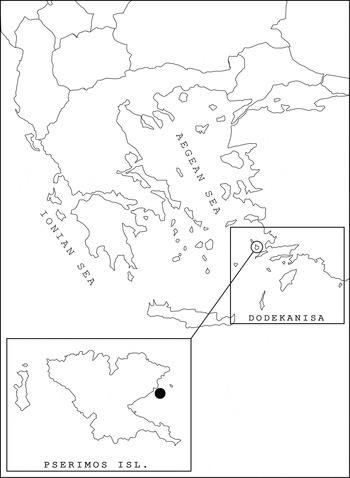
The data presented here are based on visual material collected between 2004 and 2016. The site regularly visited lies to the north-east of Pserimos (36.943264°N 27.164685°E) (Figure 1). The diving sites are located in shallow clear waters mostly between 2 and 25 m, on sandy, muddy and rocky substrata.
Location of Dodekanisa complex and Pserimos sampling site.

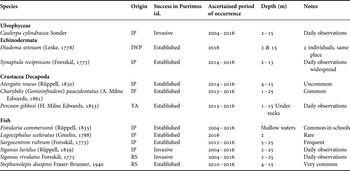
All photographic material was identified by the ELNAIS taxonomic experts and results are archived on the ELNAIS website (http://elnais.hcmr.gr/). This validation practice is a necessary step in partnership with a professional organization. Table 1 presents the first observation year as well as the time span each species was encountered. Findings in successive years account for the establishment success of the species. In the case of invasive species such as Caulerpa cylindracea Sonder, Siganus luridus (Rüppell, 1829) and Siganus rivulatus Forsskål, 1775 their first record is arbitrarily allocated to year 2004, the first year of operation of the Liamis Dive Centre. The wider study area (Dodekanisa) acts as a hotspot for the introduction of tropical alien species in the eastern Mediterranean Sea. Following the extensive review of IAS in the Dodecanese complex, its diversity is re-evaluated according to data published in the 2015–2016 period, plus new data on the alien fauna and flora of Pserimos.
List of alien species observed in Pserimos island. Origin: IP = Indo-Pacific, RS = Red Sea, IWP-IndoWest Pacific, TA = Tropical Atlantic.

RESULTS
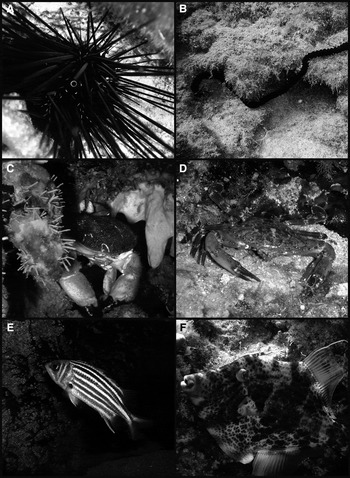
The occurrence of 12 alien species has been documented for the first time along the coasts of Pserimos: one macroalgal, two echinoderms, three brachyurans and six fish species (Table 1). Notes on their occurrence and depth range are also provided in Table 1. Photos of selected species are presented in Figure 2. The species C. cylindracea, Percnon gibbesi (H. Milne Edwards, 1853), S. luridus, S. rivulatus, Fistularia commersonii Rüppell, 1838 and Lagocephalus sceleratus (Gmelin, 1789), all common in the Southern Aegean and with distinctive features that make them easily recognizable, are not given here but are available upon request.
Photos of selected alien species observed in Pserimos Island. (A) Diadema setosum; (B) Synaptula reciprocans; (C) Atergatis roseus; (D) Charybdis (Gonioinfradens) paucidentatus; (E) Sargocentron rubrum; (F) Stephanolepis diaspros.

With the exception of P. gibbesi, originating from the Atlantic, all the other species found in Pserimos are of Indo-Pacific or Red Sea origin.
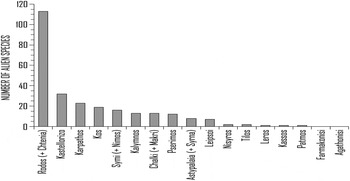
The new findings from Pserimos and the latest publications allow us to update our knowledge on the dispersion of IAS in the Dodekanisa complex (Figure 3). With regards to their diversity, although most of the records are concentrated in Rodos, the capital of the complex (see Corsini-Foka et al., Reference Corsini-Foka, Zenetos, Crocetta, Çinar, Koçak, Golani, Katsanevakis, Tsiamis, Cook, Froglia, Triandaphyllou, Lakkis, Kondylatos, Tricarico, Zuljevic, Almeida, Cardigos, Çağlar, Durucan, Fernandes, Ferrario, Haberle, Louizidou, Makris, Marić, Micu, Mifsud, Nall, Kytinou, Poursanidis, Spigoli, Stasolla, Yapici and Roy2015), the alien species listed here place Pserimos in eighth position, on a par with larger or more known islands, such as Kalymnos, Chalki or Symi. Until October 2016, the waters of the Dodekanisa counted 135 alien and cryptogenic species (119 ‘true’ alien, 15 cryptogenic, 1 pseudoindigenous species).
Distribution of alien species in the Dodekanisa Islands complex.

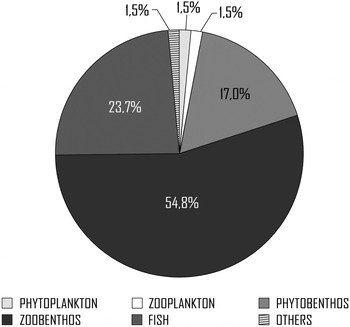
The majority of aliens and cryptogenic species listed for the Dodekanisa belong to zoobenthos, followed by fish and phytobenthos (Figure 4). Among the 74 zoobenthic species, 26 are Mollusca, 22 Crustacea, 13 Polychaeta, 3 Foraminifera, 3 Bryozoa, 3 Echinodermata, 2 Cnidaria and 2 Tunicata. Alien phytobenthos is represented by 23 species, 1 Phanerogama, 2 Phaeophyceae, 17 Rhodophyta and 3 Ulvophyceae species.
Contribution of taxonomic groups to the alien species in Dodekanisa Islands complex.

DISCUSSION
The majority of alien species recorded in Pserimos are considered invasive in Hellenic waters and all are already well-known from Rodos (Corsini-Foka et al., Reference Corsini-Foka, Kondylatos and Santorinios2014, Reference Corsini-Foka, Zenetos, Crocetta, Çinar, Koçak, Golani, Katsanevakis, Tsiamis, Cook, Froglia, Triandaphyllou, Lakkis, Kondylatos, Tricarico, Zuljevic, Almeida, Cardigos, Çağlar, Durucan, Fernandes, Ferrario, Haberle, Louizidou, Makris, Marić, Micu, Mifsud, Nall, Kytinou, Poursanidis, Spigoli, Stasolla, Yapici and Roy2015). Some of them have also been reported from Kos by Bianchi et al. (Reference Bianchi, Corsini-Foka, Morri and Zenetos2014).
The occurrence of C. cylindracea in Pserimos was expected, since this invasive macroalgal species has spread along the Aegean Sea from south to north (Zenetos et al., Reference Zenetos, Arianoutsou, Bazos, Balopoulou, Corsini-Foka, Dimiza, Drakopoulou, Katsanevakis, Kondylatos, Koutsikos, Kytinou, Lefkaditou, Pancucci-Papadopoulou, Salomidi, Simboura, Skoufas, Trachalakis, Triantaphyllou, Tsiamis, Xentidis and Poursanidis2015). The finding of the holothurian Synaptula reciprocans (Forsskål, 1775) represents its northern limit in the Dodekanisa complex and the Aegean Sea (Antoniadou & Vafidis, Reference Antoniadou and Vafidis2009; Öztoprak et al., Reference Öztoprak, Doğan and Dağli2014; ELNAIS, 2016), while the record of the crab P. gibbesi fills the gap between Rodos and Chios (Katsanevakis et al., Reference Katsanevakis, Poursanidis, Issaris, Tsiamis, Salomidi, Maroulakis, Kytinou, Thessalou-Legaki and Zenetos2010) along the eastern Aegean coasts of Greece.
The finding of Diadema setosum (Leske, 1778) in Pserimos is also noteworthy. It was first recorded in 2006 at Kaş Peninsula, south-western coasts of Turkey, and in 2014, it reached as far west as Gökova Bay, Aegean Sea, Turkey (Yapici et al., Reference Yapici, Acar and Türker2014 in Katsanevakis et al., 2014 and references therein). In Greek waters, the species was first found in the Levantine waters of Kastellorizo in 2014 (Latsoudis, Reference Latsoudis2015 in Tsiamis et al., 2015), one year later in the Aegean, at Rodos (Kondylatos & Corsini-Foka, Reference Kondylatos and Corsini-Foka2015 in Crocetta et al., 2015) and in 2016, in northern Kriti (Dounas & Krystalas, Reference Dounas and Krystalas2016 in Mytilineou et al., 2016). These recent records of D. setosum concentrated in few years could indicate that the environmental conditions of the Aegean are suitable for a fast expansion of this alien sea-urchin northward and southward of the basin.
Furthermore, the findings of the two brachyurans Atergatis roseus (Rüppell, 1830) and Charybdis (Gonioinfradens) paucidentatus (A. Milne Edwards, 1861) are particularly interesting. The occurrence of A. roseus in the southern Aegean Sea was first reported in 2004 along the coasts of Datça Peninsula (Yokes et al., Reference Yokes, Karhan, Okus, Yüksek, Aslan-Yilmaz, Yilmaz, Demirel, Demir and Galil2007) and in 2009 from Rodos (Corsini-Foka & Pancucci-Papadopoulou, Reference Corsini-Foka and Pancucci-Papadopoulou2010), where it is common (Corsini-Foka et al., Reference Corsini-Foka, Kondylatos and Santorinios2014). The latest records of A. roseus on the Aegean Turkish coast are from Yapici & Çelik (in Mytilineou et al., Reference Yapici and Çelik2016) and Ateş et al. (Reference Ateş, Çelik, Cerim and Yapici2016). The presence of C. paucidentatus has been reported for the first time in the Mediterranean from Rodos as Gonioinfradens paucidentatus (Corsini-Foka et al., Reference Corsini-Foka, Pancucci-Papadopoulou, Kondylatos and Kalogirou2010). Subsequent findings in Rodos have confirmed a large population, which has spread to many habitats in the shallow waters of the island and is caught by gill nets and trammel nets (Corsini-Foka et al., Reference Corsini-Foka, Zenetos, Crocetta, Çinar, Koçak, Golani, Katsanevakis, Tsiamis, Cook, Froglia, Triandaphyllou, Lakkis, Kondylatos, Tricarico, Zuljevic, Almeida, Cardigos, Çağlar, Durucan, Fernandes, Ferrario, Haberle, Louizidou, Makris, Marić, Micu, Mifsud, Nall, Kytinou, Poursanidis, Spigoli, Stasolla, Yapici and Roy2015). The species has been also reported from the Kaş-Kekova Specially Protected Area, southern Turkey, by Karhan & Yokeş (Reference Karhan and Yokeş2012). The present findings of C. paucidentatus at Pserimos support its invasive character already indicated in Corsini-Foka et al. (Reference Corsini-Foka, Kondylatos and Santorinios2014). The record of the two aforementioned alien crabs in Pserimos is the first documenting their expansion north of the south-eastern ‘limit’ area of Rodos Island (ELNAIS, 2016).
All the alien fish reported from Pserimos are Lessepsian immigrants. Sargocentron rubrum (Forsskål, 1775), S. luridus, S. rivulatus, Stephanolepis diaspros Fraser-Brunner, 1940 are old introductions in the south-eastern Aegean waters, while F. commersonii and L. sceleratus are more recent invaders (Corsini-Foka et al., Reference Corsini-Foka, Kondylatos and Santorinios2014). The occurrence of the above species in the area under study was anticipated; their populations are already widely distributed in the Aegean basin (ELNAIS, 2016). However, sightings by divers are dated later than those of the local fishermen, i.e. while L. sceleratus was observed only in 2016, fishermen confirm its presence at least since 2012. The same holds for F. commersonii, which is known to the fishermen of the area since 2000.
It is surprising that no alien molluscan species have been reported yet, although they constitute the highest percentage of marine IAS in the Mediterranean as well as in Greece (Zenetos et al., Reference Zenetos, Gofas, Verlaque, Çinar, García Raso, Azzurro, Bilecenoğlu, Froglia, Siokou, Bianchi, Morri, Sfriso, San Martin, Giandgrande, Katağan, Ballesteros, Ramos-Esplá, Mastrototaro, Ocaña, Zingone, Gambi and Streftaris2010, Reference Zenetos, Katsanevakis, Poursanidis, Crocetta, Damalas, Apostolopoulos, Gravili, Vardala-Theodorou and Malaquias2011). Similarly, macroalgae (except C. cylindracea) and Polychaeta are missing from the Pserimos AS list. This can be partly attributed to the habitat (most macroalgae inhabit rocky substrata in the intertidal zone) but mostly to the poor knowledge of macroalgae that citizen scientists and amateur divers have with respect to fish or large, popular invertebrates. Another limiting factor is the potential of visual census techniques. It has been shown that the number of fish taxa was significantly greater when assessed by strip transects than stationary points (Guidetti et al., Reference Guidetti, Verginella, Viva, Odorico and Boero2005). It is anticipated that further research in Pserimos will reveal a plethora of alien species as yet unrecorded.
Since 1894, a total number of 262 first records of AS have been collected throughout the Dodekanisa complex, and the exact date of first observation or the date range of first observation has been ascertained for 250 of these records. A huge increase of records was noted in the period 2001–2016, corresponding to 63% of total records with ascertained date. This increase is partly due to the observations of citizen scientists on alien occurrences, which are regularly entered in ELNAIS, after confirmation by its taxonomic experts’ network. These records are the result of an open interchange of ELNAIS experts with Citizen Scientists for guidance, advice and further education.
In parallel with scientific surveys and publication of records, the support of citizen scientists has contributed to the collection of information from various localities of the Archipelago (e.g. Latsoudis, Reference Latsoudis2015 in Tsiamis et al., 2015; Apostolopoulos & Karachle, Reference Apostolopoulos and Karachle2016 in Karachle et al., 2016). However, the role of climate change in the range expansion of species, already introduced in the wider area, should not be ignored. It has been shown that the introduction rate of IAS in the wider study area (Dodekanisa) parallels the significant increase in sea temperatures (Pancucci-Papadopoulou et al., Reference Pancucci-Papadopoulou, Raitsos and Corsini-Foka2012).
With the present records of 12 IAS, Pserimos, a remote islet, climbs to the 8th position among the Dodekanisa invaded by alien species. Monitoring by citizen scientists is of importance for both species and their habitat. Motivated divers could explore areas that are not of particular interest for tourists but no less important to marine research. The results obtained from Pserimos divers highlight not only the need for further investigation of the island, but also justify the need to pay attention to the wider Dodekanisa marine region, which is difficult to study, because of the multitude of islands and islets.
ACKNOWLEDGEMENTS
This study of the alien species from Greece was partially funded by the East and South European Network for Invasive Alien Species – a tool to support the management of alien species in Bulgaria (ESENIAS-TOOLS) project (EEA funded – Contract No. D-33-51/30.06.2015). This work would not be possible without the careful observations and collaboration of the Liamis Dive Centre staff (http://www.liamisdivecentre.com/).