INTRODUCTION
The Risso's dolphin, Grampus griseus (Cuvier, Reference Cuvier1812), is a widespread species and well-known from the major ocean basins of the world (Leatherwood et al., Reference Leatherwood, Perrin, Kirby, Hubb and Dahlheim1980; Kruse et al., Reference Kruse, Caldwell, Caldwell, Ridgway and Harrison1999; Baird, Reference Baird, Perrin, Wursig and Thewissen2008). However, until recently, the details of the global distribution of Risso's dolphins were not well known, and there appears to be some inconsistency in recent literature on the topic of the species’ global range and habitat preferences (Jefferson et al., Reference Jefferson, Weir, Anderson, Ballance, Kenney and Kiszka2014). In a recent review of the global distribution, Jefferson et al. (Reference Jefferson, Weir, Anderson, Ballance, Kenney and Kiszka2014) demonstrated that G. griseus occupies both continental shelf/slope and oceanic waters throughout its range, but shows a clear preference for outer continental shelf and slope water depths and mid-latitudes. They pointed that in some relatively unstudied areas (like the South Atlantic Ocean), where the species’ densities are apparently lower; a more complete examination is needed. In the Western South Atlantic (WSA) the occurrence of Risso's dolphin is still poorly documented. Most of the existing data comes from stranded animals (Goodall & Schiavini, Reference Goodall and Schiavini1992; Maia-Nogueira, Reference Maia-Nogueira2000), especially between Peninsula Valdés and Tierra del Fuego, southern Argentina (Riccialdelli et al., Reference Riccialdelli, Torres, Goodall, Dellabianca, Pimper, Reyes, Fernández-Ajó and Bastida2011).
Despite the current status of ‘least concern’ by the IUCN, threats that could cause widespread declines include high levels of anthropogenic sound, especially military sonar and seismic surveys, and bycatch (Taylor et al., Reference Taylor, Baird, Barlow, Dawson, Ford, Mead, Notarbartolo di Sciara, Wade and Pitman2012). In some countries of Asia and South America, Risso's dolphins are used for food and fish bait (Kruse et al., Reference Kruse, Caldwell, Caldwell, Ridgway and Harrison1999; García-Godos & Cardich, Reference García-Godos and Cardich2010), which may adversely affect local populations (Taylor et al., Reference Taylor, Baird, Barlow, Dawson, Ford, Mead, Notarbartolo di Sciara, Wade and Pitman2012).
In this paper we aim to: (1) report a new record of G. griseus on the north-eastern coast of Brazil, providing information of measurements and causes of death; and (2) comment on the distribution of the species in WSA, based on the review of confirmed stranding records in the region.
MATERIAL AND METHODS
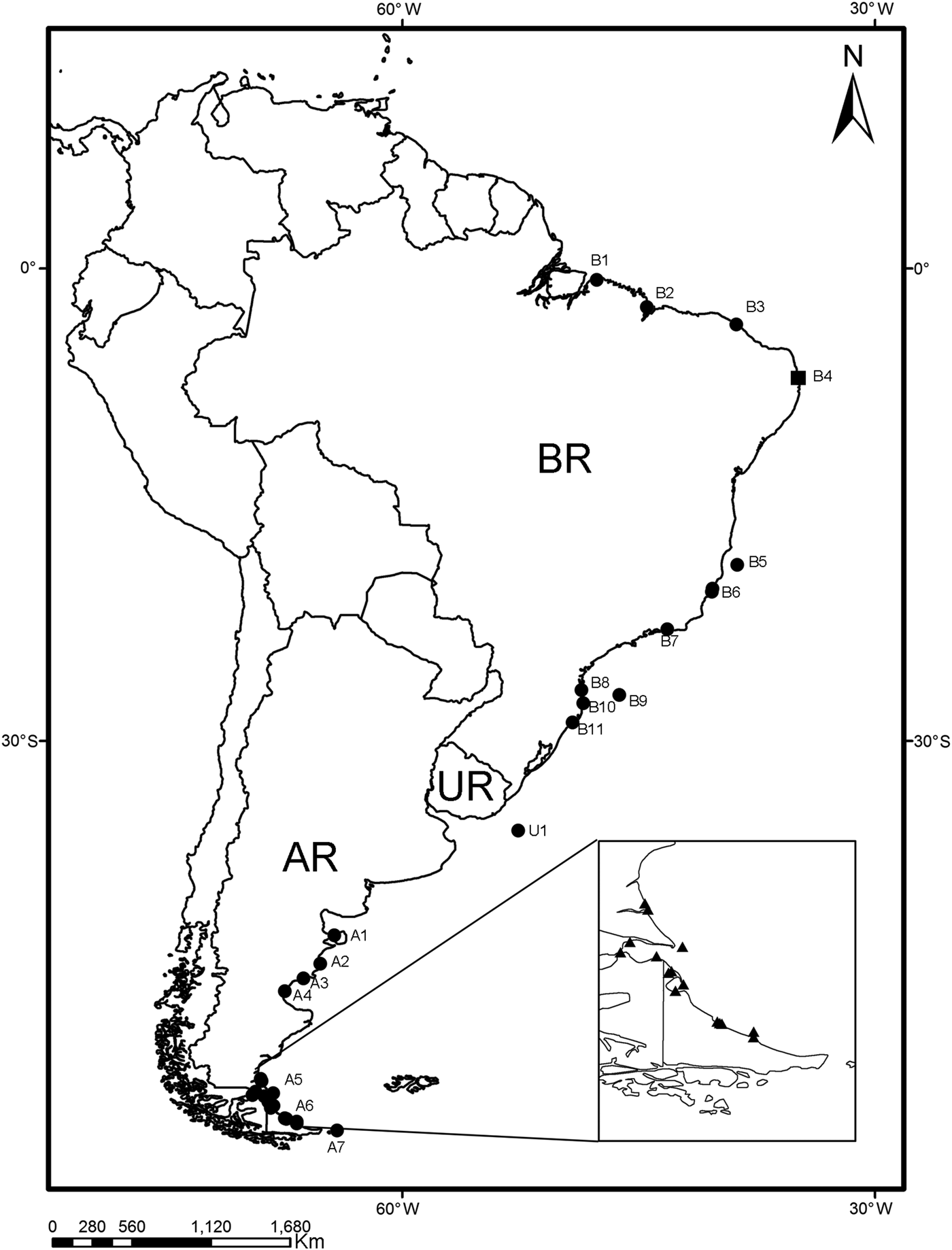
On 30 April 2010, a Risso's dolphin was found stranded alive near the mouth of the Paraíba River (6°57′45″S 34°51′28″W), Paraíba state, Brazil (Figure 1). The animal was found by the local population and carried by the Fire Department to the Brazilian Wild Fauna Rehabilitation Center (CETAS/IBAMA-PB), but died on the way. The necropsy was made by the authors, following protocols of Geraci & Lounsbury (Reference Geraci and Lounsbury2005) and IBAMA (2005). The specimen, identified according to its external morphological and skull features (White & Norris, Reference White and Norris1978; Kruse et al., Reference Kruse, Caldwell, Caldwell, Ridgway and Harrison1999), is deposited at the Mammal Collection of DSE/UFPB, museum number UFPB 6083.
Strandings and accidental catch sites of Risso's dolphins, Grampus griseus (Cuvier, Reference Cuvier1812), off Western South Atlantic Ocean between 1960 and 2011. Legend: ■ = new record; • = previous records; ▴ = magnified records. Brazil: B1 = Praia Grande de Marapanim, Pará; B2 = Alcântara, Maranhão; B3 = Pecém, Ceará; B4 = Cabedelo, Paraíba; B5 = Salvador, Bahia; B6 = Vila Velha, Espírito Santo; B7 = Rio de Janeiro, Rio de Janeiro; B8 = Piçarras, Santa Catarina; B9 = Brazilian pelagic waters; B10 = Florianópolis, Santa Catarina; B11 = Içara, Santa Catarina. Uruguay: U1 = Uruguaian pelagic waters. Argentina: A1 = Peninsula Valdés, Chubut; A2 = Chubut; A3 = Chubut; A4 = Golfo San Jorge, Santa Cruz; A5 = Estrecho de Magallanes; A6 = Tierra del Fuego; A7 = Staten Island.

Standard measurements were taken according to: Norris (Reference Norris1961) external; and Perrin (Reference Perrin1975), skeletal.
RESULTS
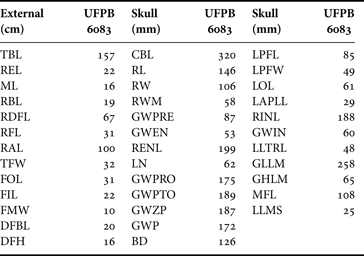
The Risso's dolphin was a male calf, measuring 157 cm in total body length (TBL). Other measurements, external and skeletal, are shown in Table 1. The specimen presents all characteristics expected in a calf: few scars over the head and body, non erupted teeth and initial stage of bone fusion (Figures 2 & 3).
Risso's dolphin, Grampus griseus (Cuvier, Reference Cuvier1812), stranded in Cabedelo, Paraíba State, Brazil (UFPB 6083: calf male, 157 cm total length): (A) ventral view; (B) lateral view of head; (C) dorsal view of head; (D) open mouth without erupted teeth; (E) injury by piercing object.
Risso's dolphin, Grampus griseus (Cuvier, Reference Cuvier1812), stranded in Cabedelo, Paraíba State, Brazil (UFPB 6083: calf male, 320 mm condylobasal length). Views of cranium: dorsal (A), ventral (B), lateral (C), occipital (D). Mandible (E), vertebrae (F). Scale bar: 10 cm.
External body measurements (following Norris, Reference Norris1961) and skull measurements (following Perrin, Reference Perrin1975) of Risso's dolphins, Grampus griseus (Cuvier, Reference Cuvier1812), record in Cabedelo, Paraíba, Brazil (6°57′45″S 34°51′28″W).
External body measurements: DFBL, Basal length of dorsal fin; DFH, Height of dorsal fin; FIL, Flipper inner length; FOL, Flipper outer length; FMW, Maximum width of flipper; ML, Mouth length; RAL, Rostrum-anal length, tip of rostrum to centre of anus; RBL, Rostrum-blowhole length, tip of rostrum to centre of blowhole; RDFL, Rostrum-dorsal fin length, from the tip of rostrum to anterior insertion of the dorsal fin; REL, Rostrum-eye length, from tip of rostrum to centre of eye; RFL, Rostrum-flipper length: tip of rostrum to anterior insertion of flipper; TBL, Total body length, from the tip of rostrum to tail notch; TFW, Total fluke width. Skull measurements: BD, Braincase depth; CBL, Condylobasal length; GHLM, Greatest height of left mandible; GLLM, Greatest length of left mandible; GWEN, Greatest width of external nares; GWIN, Greatest width of internal nares; GWP, Greatest parietal width; GWPRE, Greatest width of premaxillaries; GWPRO, Greatest preorbital width; GWPTO, Greatest postorbital width; GWZP, Greatest width across zygomatic processes; LAPLL, Length of antorbital process of left lacrimal; LLMS, Length of left mandibular symphysis; LLTRL, Length of lower left tooth row; LN, Length of nasals; LOL, Left orbit length; LPFL, Greatest length of left posttemporal fossa; RL, Rostral length; RW, Rostrum width; RWM, Rostrum width at mid-length; RENL, Length from the tip of rostrum to right external nares; LPFW, Greatest width of left posttemporal fossa; MFL, Length of left mandibular fossa; RINL, Length from the tip of rostrum to internal nares.
The internal organs and tissues were apparently healthy, presenting normal colorations and texture, indicating no signs of diseases. Only traces of gastric juice and marine sediments were found in the stomach. Also, no macroparasites were detected and the lungs were not filled with water, discarding death by drowning. Two injuries of 2.5 cm long each, caused by a piercing object (probably a harpoon), were observed in the ventral and lateral regions of the head (Figure 2). Although it didn't reach any organ, the object penetrated deep into the muscles, affecting blood vessels and causing intense haemorrhage, causing the death of the animal.
DISCUSSION
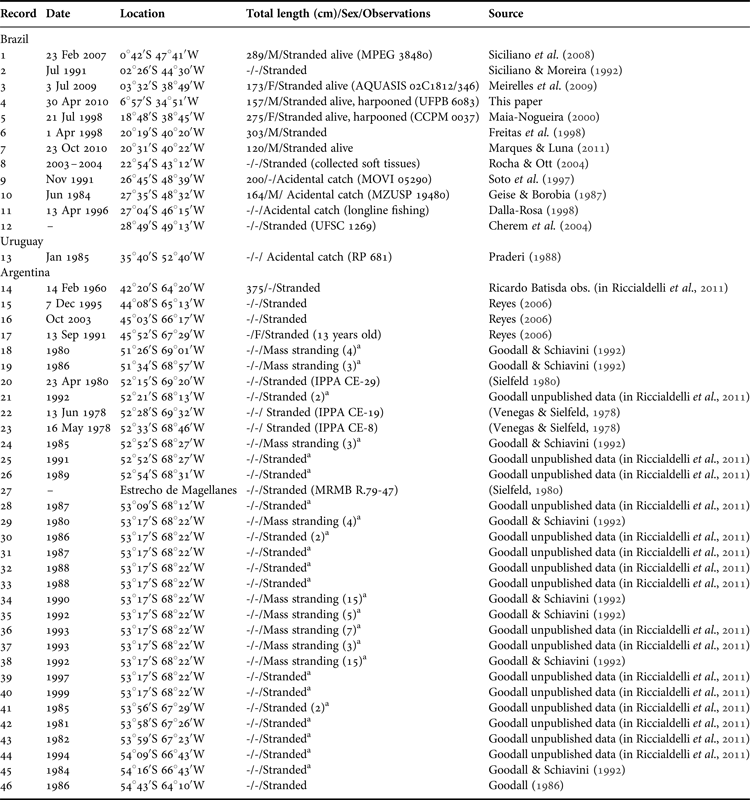
Records of Risso's dolphins are not so common in the WSA, compared to other oceanic basins (Jefferson et al., Reference Jefferson, Weir, Anderson, Ballance, Kenney and Kiszka2014). This is the first stranding record of the species in the state of Paraíba, the 12th for Brazil and the 4th for the north-eastern region (Table 2). Moreover, this report fills the largest gap (more than 1600 km) of strandings of Grampus griseus in the WSA, between northern and southern Brazil (Figure 1).
Strandings and accidental catches of Risso's dolphin, Grampus griseus (Cuvier, Reference Cuvier1812), off Western South Atlantic Ocean, between 1960 and 2011.
a Specimens kept at Collection R. Natalie P. Goodall, Museo Acatushún de Aves y Mamíferos Marinos Australes, Tierra del Fuego, Argentina.
AQUASIS, Associação de Pesquisa e Conservação de Ecossistemas Aquáticos; CCPM, Coleção Científica, Instituto Mamíferos Aquáticos; IPPA, Instituto de la Patagonia; MOVI, Museu Oceanográfico UNIVALI; MEPG, Museu Paraense Emílio Goeldi; MRMB, Museo Regional ‘Mayorino Borgotello’ de La Congregacion Salesiana; MZUSP, Museu de Zoologia da Universidade de São Paulo; UFPB, Universidade Federal da Paraíba; UFSC, Universidade Federal de Santa Catarina; RP, Ricardo Praderi.
Reviewing previous publications, 46 records of G. griseus in the WSA were found. With the inclusion of the present record, it seems clear that the species’ distribution is continuous, from 0°42′S, Pará State, Brazil, to 54°13′S, Tierra del Fuego, Argentina, with the first record on 14 February 1960, at Península Valdés, 42°20′S.
Records are scarce in northern Brazil, Uruguay and northern Argentina. Most of the strandings were reported between 51° and 54°S, with 29 records (Riccialdelli et al., Reference Riccialdelli, Torres, Goodall, Dellabianca, Pimper, Reyes, Fernández-Ajó and Bastida2011). Of these, twelve involved 2 to 17 dolphins, and in South America, other mass strandings were reported in Chilean (Olavarría et al., Reference Olavarría, Aguayo-Lobo and Bernal2001) and Peruvian (García-Godos & Cardich, Reference García-Godos and Cardich2010) waters. Mass strandings of the species are uncommon (Baird, Reference Baird, Perrin, Wursig and Thewissen2008), but their increasing frequency in recent years makes it seem more common, at least in this region.
Jefferson et al. (Reference Jefferson, Weir, Anderson, Ballance, Kenney and Kiszka2014) concluded that the Risso's dolphin appear to favour mid-latitudes ranging from 30° to 45°, however, the data available for the WSA show that the records were more frequent in sub-Antarctic waters. Strandings in Tierra del Fuego have traditionally been treated as extralimital (Kruse et al., Reference Kruse, Caldwell, Caldwell, Ridgway and Harrison1999), however, based on the data presented, this claim needs to be revised.
Gaps along the WSA are probably a methodological artifact. Jefferson et al. (Reference Jefferson, Weir, Anderson, Ballance, Kenney and Kiszka2014) found only eight sightings north of Península Valdés and related this to the lack of sampling effort. The preference for continental outer shelf and slope water depths may be explained by a higher aggregation of potential prey (Baumgartner, Reference Baumgartner1997). The few documented sightings for Brazil were recorded mainly in areas of economic interest (oil exploration) and monitored systematically, as in the Campos (RJ) and Santos (SP) Basins (Engel et al., Reference Engel, Rocha-Campos, César and Marini-Filho2006; Rocha-Campos et al., Reference Rocha-Campos, Marini-Filho and Engel2007). Likewise, the number of strandings were higher in south-eastern and southern Brazil, where marine mammal research has been developed since the 1980s.
In Argentina, according to Riccialdelli et al. (Reference Riccialdelli, Torres, Goodall, Dellabianca, Pimper, Reyes, Fernández-Ajó and Bastida2011), the two gaps (one in the northern region, and another between the Gulf of San Jorge and the Strait of Magellan) also represent a limited survey effort carried out in those areas. The same authors comment that off the Peninsula Valdes, where diving and whale-watching activities surveys have taken place earlier than in any other areas, cetacean records have always been more numerous than for other areas. The same occurs in Tierra del Fuego, where beach surveys began in the 1970s.
The causa mortis of the calf found in Paraíba was due to haemorrhage, resulting from injuries caused by harpooning. Worldwide, Risso's dolphins are constant targets of bycatch, however, occasional direct killing has occurred to provide meat for human consumption and fish bait, especially in Sri Lanka, the Caribbean, Indonesia, the Philippines, Japan and Peru (García-Godos & Cardich, Reference García-Godos and Cardich2010; Taylor et al., Reference Taylor, Baird, Barlow, Dawson, Ford, Mead, Notarbartolo di Sciara, Wade and Pitman2012). The available information for the WSA showed that negative interactions between Risso's dolphins and fisheries are more frequent in Brazil. From the 12 records in the country, three were due to bycatch (Geise & Borobia, Reference Geise and Borobia1987; Soto et al., Reference Soto, Caseca-Santos and Ternes-Silva1997; Dalla-Rosa, Reference Dalla-Rosa1998) and two had evidence of intentional catches by harpoon (Maia-Nogueira, Reference Maia-Nogueira2000; present study). The traditional use and commercialization of small cetaceans, including meat for consumption or fish bait, is a relatively common practice in the coastal communities of Brazil, but is usually restricted to freshwater species, Sotalia fluviatilis and Inia geoffrensis, or the coastal Sotalia guianensis (Alves et al., Reference Alves, Campos, Toledo, Mourão, Barboza, Souto, Pearce and Correa2010), due to the ease of catch and also because these dolphins are considered direct competitors for fish (Silva & Best, Reference Silva and Best1996). The use of oceanic species like G. griseus reported here is probably an opportunistic event, in which some people benefit from the stranded specimen's inability to move.
The data summarized in this report contributes to the understanding about the distribution and conservation of G. griseus in the WSA. The review of strandings confirms the continuous distribution to sub-Antarctic waters in this region and that the gap areas need further studies, especially with dedicated surveys and the establishment of stranding networks, for a more complete analysis of the species’ range patterns. Despite the laws and rules for full protection, cases of accidental and intentional catch of Risso's dolphins were reported for the region, especially in Brazil. Therefore, conservation actions that include more effective surveillance and environmental education are strongly recommended for minimizing these threats.
ACKNOWLEDGEMENTS
We are extremely grateful to Tarsila Cavalcanti and all CETAS/IBAMA-PB staff for donating the specimen. We also wish to give thanks to Telton Ramos for support with the specimen transportation and to Ludmilla Nascimento for assisting during the necropsy. Thanks to Eduardo Juri (MNHN/Montevideo, Uruguay) and Jules Soto (MOVI/UNIVALI, Santa Catarina, Brazil) for the bibliography provided. This research received no specific grant from any funding agency, commercial or non-profit sectors.