Introduction
Herpes viruses are double-stranded DNA viruses, many of which cause lifelong infection, with intermittent latent and reactivation phases (Schmutzhard, Reference Schmutzhard2001). In the majority of individuals, infection is latent and clinically asymptomatic. However, these viruses are not necessarily harmless. DNA from herpes simplex virus type 1 (HSV-1) has been found in the frontotemporal gray matter in the brain among 34% of cases dying from non-neurological diseases, suggesting that the brain may be a favored site for latency (Jamieson et al. Reference Jamieson, Maitland, Wilcock, Craske and Itzhaki1991; Bertrand et al. Reference Bertrand, Guillaume, Hellauer, Dea, Lindsay, Kogan, Gauthier and Poirier1993; Baringer & Pisani, Reference Baringer and Pisani1994). Cytomegalovirus (CMV), another common herpes virus, infects a variety of organs including the brain (Taylor, Reference Taylor2003; Cheeran et al. Reference Cheeran, Lokensgard and Schleiss2009). HSV-1, CMV and herpes simplex virus type 2 (HSV-2), a related herpes virus, can all cause rare and fatal encephalitis, particularly in immune-compromised individuals or in neonates (Schmutzhard, Reference Schmutzhard2001; Cheeran et al. Reference Cheeran, Lokensgard and Schleiss2009). Cognitive and behavioral deficits have been observed among survivors of encephalitis (McGrath et al. Reference McGrath, Anderson, Croxson and Powell1997; Borgo et al. Reference Borgo, Sgaramella, Penello, L'Erario and Toso2000).
Cognitive impairment traceable to viral exposure can occur even without a history of encephalitis (Prasad et al. Reference Prasad, Watson, Dickerson, Yolken and Nimgaonkar2012). An association between HSV-1 exposure and lower total scores on the Repeatable Battery for the Assessment of Neuropsychological Status (RBANS) was noted in a relatively small sample of otherwise healthy individuals (odds ratio 3.2, 95% confidence interval 1.18–8.73, p < 0.03, n = 240) (Dickerson et al. Reference Dickerson, Stallings, Sullens, Origoni, Leister, Krivogorsky and Yolken2008). Another cohort-based study showed elevated rates of cognitive decline over 4 years among elderly Mexican-Americans with elevated CMV antibody titers (Aiello et al. Reference Aiello, Haan, Blythe, Moore, Gonzalez and Jagust2006). A study of Finnish patients with vascular disease suggested cumulative effects of joint exposure to CMV, HSV-1 and HSV-2 on cognition, but it is difficult to control for the effects of co-morbid diseases, particularly in older individuals (Strandberg et al. Reference Strandberg, Pitkala, Linnavuori and Tilvis2003). Additional risk factors are likely to be involved, as these investigators reported subsequently that the apoliprotein e4 genotype and educational status may act in combination with seropositivity to the herpes viruses (Strandberg et al. Reference Strandberg, Pitkala, Eerola, Tilvis and Tienari2005).
Several prior studies have sought links between exposure to herpes viruses and risk for schizophrenia (SZ) per se, but convincing evidence is not presently available (Delisi et al. Reference Delisi, Smith, Hamovit, Maxwell, Goldin, Dingman and Gershon1986; Brown & Derkits, Reference Brown and Derkits2010). Nevertheless, exposure to herpes viruses is consistently associated with cognitive impairment among young or middle-aged SZ patients (Dickerson et al. Reference Dickerson, Boronow, Stallings, Origoni, Ruslanova and Yolken2003, Reference Dickerson, Boronow, Stallings, Origoni, Cole, Krivogorsky and Yolken2004, Reference Dickerson, Stallings, Sullens, Origoni, Leister, Krivogorsky and Yolken2008; Shirts et al. Reference Shirts, Prasad, Pogue-Geile, Dickerson, Yolken and Nimgaonkar2008; Schretlen et al. Reference Schretlen, Vannorsdall, Winicki, Mushtaq, Hikida, Sawa, Yolken, Dickerson and Cascella2010). The impairments are particularly noticeable in individuals exposed to HSV-1 (Dickerson et al. Reference Dickerson, Boronow, Stallings, Origoni, Ruslanova and Yolken2003; Shirts et al. Reference Shirts, Prasad, Pogue-Geile, Dickerson, Yolken and Nimgaonkar2008; Schretlen et al. Reference Schretlen, Vannorsdall, Winicki, Mushtaq, Hikida, Sawa, Yolken, Dickerson and Cascella2010). The associations have medium effect sizes (Cohen's d = 0.5–0.65), after adjusting for age, sex and socio-economic status (SES) (Schretlen et al. Reference Schretlen, Vannorsdall, Winicki, Mushtaq, Hikida, Sawa, Yolken, Dickerson and Cascella2010). Such impairments are more prominently observed in the working memory and executive function domains, and also in psychomotor speed (Shirts et al. Reference Shirts, Prasad, Pogue-Geile, Dickerson, Yolken and Nimgaonkar2008; Schretlen et al. Reference Schretlen, Vannorsdall, Winicki, Mushtaq, Hikida, Sawa, Yolken, Dickerson and Cascella2010). Among individuals with SZ, exposure to HSV-1 is also associated with decreased gray matter volume in the prefrontal cortex, a region that plays a pivotal role in the regulation of working memory and executive functions (Prasad et al. Reference Prasad, Shirts, Yolken, Keshavan and Nimgaonkar2007; Schretlen et al. Reference Schretlen, Vannorsdall, Winicki, Mushtaq, Hikida, Sawa, Yolken, Dickerson and Cascella2010). Similar associations between cognitive impairments and exposure to CMV have also been reported (Shirts et al. Reference Shirts, Prasad, Pogue-Geile, Dickerson, Yolken and Nimgaonkar2008).
Studies evaluating close non-psychotic relatives of SZ individuals typically find that on average they perform better than their ill relatives, but significantly worse than population controls on several cognitive domains (Gur et al. Reference Gur, Nimgaonkar, Almasy, Calkins, Ragland, Pogue-Geile, Kanes, Blangero and Gur2007; Calkins et al. Reference Calkins, Tepper, Gur, Ragland, Klei, Wiener, Richard, Savage, Allen, O'Jile, Devlin, Kwentus, Aliyu, Bradford, Edwards, Lyons, Nimgaonkar, Santos, Go and Gur2010; Toulopoulou et al. Reference Toulopoulou, Goldberg, Mesa, Picchioni, Rijsdijk, Stahl, Cherny, Sham, Faraone, Tsuang, Weinberger, Seidman and Murray2010). These results are notable because the relatives are not exposed to antipsychotic drugs that could arguably impair cognitive performance and thus explain a portion of the impairment among the SZ cases.
To investigate whether the associations between herpes virus exposure and cognitive impairment can be generalized to other groups, particularly seemingly healthy persons, we investigated a large, well-characterized sample. Participants in this study were African-Americans from the Project Among African Americans to Explore Risks for Schizophrenia (PAARTNERS; Aliyu et al. Reference Aliyu, Calkins, Swanson, Lyons, Savage, May, Wiener, McLeod-Bryant, Nimgaonkar, Ragland, Gur, Gur, Bradford, Edwards, Kwentus, McEvoy, Santos, McCleod-Bryant, Tennison, Go and Allen2006; Calkins et al. Reference Calkins, Tepper, Gur, Ragland, Klei, Wiener, Richard, Savage, Allen, O'Jile, Devlin, Kwentus, Aliyu, Bradford, Edwards, Lyons, Nimgaonkar, Santos, Go and Gur2010). All participants were evaluated using the Penn Computerized Neurocognitive Battery (CNB), which encompasses several cognitive domains (Gur et al. Reference Gur, Ragland, Moberg, Turner, Bilker, Kohler, Siegel and Gur2001; Calkins et al. Reference Calkins, Tepper, Gur, Ragland, Klei, Wiener, Richard, Savage, Allen, O'Jile, Devlin, Kwentus, Aliyu, Bradford, Edwards, Lyons, Nimgaonkar, Santos, Go and Gur2010). Because the cognitive domains are inter-related, we derived a composite measure, the first principal component of heritability (PCH1), using a linear combination of the cognitive domains with maximized heritability (Ott & Rabinowitz, Reference Ott and Rabinowitz1999; Klei et al. Reference Klei, Luca, Devlin and Roeder2008; Wiener et al. Reference Wiener, Klei, Calkins, Wood, Nimgaonkar, Gur, Bradford, Richard, Edwards, Savage, Kwentus, Allen, McEvoy, Santos, Devlin and Go2012). Serum samples obtained from participants were tested with immunoassays to indicate prior viral exposure. As there are at least nine viruses within the Herpesviridae family (Schmutzhard, Reference Schmutzhard2001), we selected three agents previously suggested to impact cognitive function: HSV-1, HSV-2 and CMV.
Method
Participants
The investigation was conducted as an ancillary to PAARTNERS, the multi-site African American study. The recruitment and assessment of the sample is described elsewhere (Aliyu et al. Reference Aliyu, Calkins, Swanson, Lyons, Savage, May, Wiener, McLeod-Bryant, Nimgaonkar, Ragland, Gur, Gur, Bradford, Edwards, Kwentus, McEvoy, Santos, McCleod-Bryant, Tennison, Go and Allen2006). The sample included participants with SZ or schizo-affective disorder (SZA), their non-psychotic relatives and screened adult controls. The majority of families were nuclear units with one SZ proband, but some families included more than one SZ patient. After a complete description of the study to the subjects, written informed consent was obtained. All participants completed the Diagnostic Interview for Genetic Studies (DIGS), the Family Interview for Genetic Studies (FIGS) and the CNB (Aliyu et al. Reference Aliyu, Calkins, Swanson, Lyons, Savage, May, Wiener, McLeod-Bryant, Nimgaonkar, Ragland, Gur, Gur, Bradford, Edwards, Kwentus, McEvoy, Santos, McCleod-Bryant, Tennison, Go and Allen2006; Calkins et al. Reference Calkins, Tepper, Gur, Ragland, Klei, Wiener, Richard, Savage, Allen, O'Jile, Devlin, Kwentus, Aliyu, Bradford, Edwards, Lyons, Nimgaonkar, Santos, Go and Gur2010). The CNB measures performance accuracy and speed. Because accuracy and speed scores are generally correlated, only accuracy measures were used (Wiener et al. Reference Wiener, Klei, Irvin, Perry, Aliyu, Allen, Bradford, Calkins, Devlin, Edwards, Gur, Gur, Kwentus, Lyons, McEvoy, Nasrallah, Nimgaonkar, O'Jile, Santos, Savage and Go2009). Only participants who had serum available were investigated in this study. The subset of the participants who had no CNB data was excluded from the cognitive analysis.
Estimating viral exposure: serological analysis
Serum was obtained from peripheral venous blood samples. A microplate solid-phase enzyme-linked immunosorbent assay (ELISA) was used to measure immunoglobulin G (IgG) antibody levels to CMV, HSV-1 and HSV-2 (Dickerson et al. Reference Dickerson, Boronow, Stallings, Origoni, Ruslanova and Yolken2003). The glycoproteins used are highly specific and allowed for the differentiation of antibodies to serologically related viruses (Schretlen et al. Reference Schretlen, Vannorsdall, Winicki, Mushtaq, Hikida, Sawa, Yolken, Dickerson and Cascella2010). Reference samples placed on every plate were used to standardize the results. As serum IgG antibody titers for HSV-1 do not differ between humans with frequent and with rare reactivations (McKenna et al. Reference McKenna, Neill and Norval2001), the results were categorized into positive and negative exposure. Positive exposure was defined by comparing signal to cut-off values provided by the manufacturers (Dickerson et al. Reference Dickerson, Boronow, Stallings, Origoni, Ruslanova and Yolken2003).
Statistical analysis
Principal components of heritability (PCH)
PCH1 was derived by a two-step process as described elsewhere (Wiener et al. Reference Wiener, Klei, Calkins, Wood, Nimgaonkar, Gur, Bradford, Richard, Edwards, Savage, Kwentus, Allen, McEvoy, Santos, Devlin and Go2012). First, a mixed model was used to estimate the genetic and residual variance components. The components were used to determine the linear combination of the original phenotypes that yielded the PCH in the second step. We estimated the variance components for CNB Z scores based on a model that included fixed effects for overall mean, age and sex, and also random effects for individuals and residuals using the average information algorithm for determining restricted maximum likelihood estimates (AIREMLF90; http://nce.ads.uga.edu/~ignacy/newprograms.html). Observed phenotypes were then adjusted for age and sex to obtain residual values. Because PCH analysis requires no missing observations, we predicted missing residuals from the observed ones using the residual co-variance structure. Imputation was not performed when more than two of the nine residuals were missing; instead, such individuals were excluded from analysis. The linear transformation was subsequently used to calculate PCH. The most heritable of the set of PCH was denoted PCH1.
Building the models: initial analyses
Diagnostic groups
To simplify the models, we first sought to reduce the number of diagnostic categories. We noted that individuals with SZ, SZA depressed type and SZA disorder bipolar type did not differ significantly from each other with respect to mean cognitive phenotypes, hence these diagnoses were binned into one group. This reduction allows a simple encoding of three key, mutually exclusive variables in the data set, each with binary outcomes: SZ, which includes SZA for modeling purposes; non-psychotic relatives of an individual diagnosed with SZ/SZA; and control individuals, who have no symptoms of psychosis and no close relative with SZ/SZA. Note that binary encoding of any two of these variables also encodes the third. We chose to fit models with a variable for SZ/SZA and relative. In this scheme, the mean attributable to controls is identified by the model mean. To capture other diagnoses of interest, we included two other indicator variables: (1) the ‘mood’ group (n = 313), which encodes major depressive disorder, other non-psychotic mood-related disorders, and a small number of bipolar I disorder cases (n = 23); and (2) the ‘substance use disorders’ (SUD) group, which encodes disorders related to alcohol or substance abuse or dependence (n = 429). These latter two indicators could be + or – for an individual falling into the mutually exclusive sets (SZ, a relative or a control).
Socio-economic indices
Because rates of exposure are elevated in lower social economic groups (Smith & Robinson, Reference Smith and Robinson2002), we explored the relationship between virus exposure and two indices of socio-economic status (SES): years of individual education (EDU) and occupation. Conventionally, SES is indicated by a composite variable incorporating EDU and occupation, as in the Hollingshead Redlich Index (HRI). The occupational categories listed in the DIGS do not enable estimation of the HRI, hence EDU and occupation were analyzed separately. The DIGS includes 21 occupational categories that were grouped as follows: (1) managerial and professional specialty (DIGS 01–03), (2) technical, sales and administrative support (DIGS 04–06), (3) service (DIGS 07–09), (4) manual labor (DIGS 10–15), and (5) other (DIGS 16–21). As EDU and occupation can be impacted by the onset of psychotic disorders, they were nested separately within the three main sample groups (EDU|(SZ/SZA, relative, control); occupation|(SZ/SZA, relative, control).
Analyses relating PCH to infectious exposure
PCH1 was analyzed using mixed models with diagnostic (Dx) and sample categories, EDU within sample category (EDU|sample category) and exposure to infectious agents as fixed effects and the individual as a random effect. These models were analyzed using SOLAR, with a modeling procedure in which each effect is tested given that all others are in the model (Almasy & Blangero, Reference Almasy and Blangero1998). SOLAR also models genetic correlations among family members based on known relationships. The final derived model included only terms with p < 0.10. Parameter estimates were also generated for non-significant variables for comparison purposes.
Results
Demographic variables
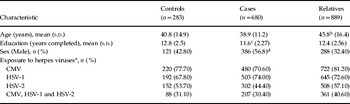
The overall sample included SZ/SZA cases (n = 680) and non-psychotic relatives (n = 889). Healthy, screened adult controls unrelated to the cases or the relatives were also analyzed (n = 283). They were significantly younger than the relatives (Table 1, t = − 4.51, p = 7.3 × 10⁻⁶). Men were significantly over-represented among the cases compared with controls (χ2 = 15.73, p = 9.4 × 10⁻⁵) or relatives (χ2 = 10.14, p = 0.002). There was significant correlation between the occupational groups and the duration of education (Spearman's ρ = −0.4, p = 7.45 × 10−63 among controls and non-psychotic relatives). The negative correlation is consistent with the classification of the occupational categories.
Characteristics of participants

CMV, Cytomegalovirus; HSV-1, herpes simplex virus type 1; HSV-2, herpes simplex virus type 2; s.d., standard deviation.
a Exposure is defined by antibody titers above manufacturers' cut-off levels.
b Non-psychotic relatives versus controls (t = − 4.51, p = 7.3 × 10⁻⁶).
c Schizophrenia/schizo-affective (SZ/SZA) cases versus controls (t = 7.229, p = 1.03 × 10⁻¹²).
d Males significantly over-represented among cases versus controls: χ2 = 15.73, p = 9.4 × 10⁻⁵, cases versus relatives: χ2 = 10.14, p = 0.002.
Prevalence of viral exposure: category-wise comparisons of antibody titers
Exposure levels to each virus are presented in Table 1. Exposure status for each virus was used as the outcome in separate analyses, with age, gender, years of education and category (case, relative or control) as covariates. We used the generalized estimating equation (GEE) to account for correlations among family members (Zeger & Liang, Reference Zeger and Liang1986) (see online Supplementary Tables S1–S3). The controls had significantly higher rates of exposure to CMV or HSV-2 in comparison with the cases (CMV: p = 0.024; HSV-2: p = 0.003). The relatives showed non-significant trends for the same agents in comparison with the controls. No significant group-wise differences were observed for HSV-1.
PCH
Individual virus exposure model
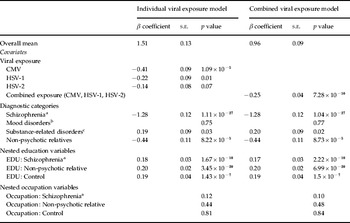
We modeled exposure to individual herpes viruses using a non-exclusive binary classification of exposure and non-exposure (‘individual exposure’ model). Associations between PCH1 and infectious exposure were assessed after accounting for diagnostic status (SZ/SZA case, relative or control), other psychiatric co-morbidity (mood and substance disorders) and education nested within diagnostic status. Age and gender were not included because they were regressed out in the estimation of PCH1. The mean neurocognitive performance of control individuals was significantly higher as measured by PCH1 (estimated by the overall mean in the model = 1.51, s.e. = 0.13; Table 2) relative to individuals diagnosed with SZ/SZA (β = −1.28, p = 1.11 × 10⁻²⁷), and that of the non-psychotic relatives (β = −0.44, p = 8.22 × 10⁻⁵). Individuals who had SUD had modestly enhanced performance (β = 0.19, p = 0.03). Significant effects are also observed for the nested EDU variable for all three diagnostic categories (EDU|SZ/SZA, p = 1.67 × 10⁻¹⁰; EDU|non-psychotic relatives, p = 3.45 × 10⁻²⁰; EDU|controls, p = 1.43 × 10⁻⁷) in relation to PCH1. No significant effects are observed for the nested occupation variable when analyzed in conjunction with educational status (Table 2). These analyses were repeated, incorporating educational status or occupation only, along with the other covariates. The pattern of associations with herpes viral exposure did not differ (data not shown).
Multivariate analysis of the first principal component of heritability (PCH1)

CMV, Cytomegalovirus; HSV-1, herpes simplex virus type 1; HSV-2, herpes simplex virus type 2; EDU, individual years of education; s.e., standard error.
a Includes schizophrenia and schizo-affective disorder.
b Major depressive disorder, other non-psychotic mood-related disorders, and a small number of bipolar disorder 1 cases.
c Alcohol and illicit substance abuse and dependence.
After adjusting for the covariates described above, neurocognitive performance, as measured by PCH1, still significantly decreased with exposure to CMV or HSV-1 (CMV: β = −0.41, p = 1.09 × 10⁻⁵; HSV-1: β = −0.22, p = 0.01). A smaller, non-significant decrease in PCH1 was observed for exposure to HSV-2 (β = −0.14, p = 0.07).
Combined viral exposure model
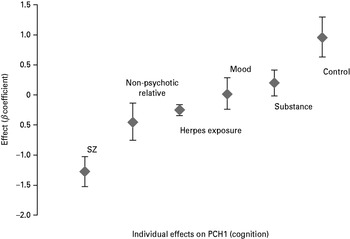
To evaluate the impact of combined (multiple) exposure on cognitive performance, we fit a model that includes a combined herpes virus exposure variable. This variable was encoded such that individuals with no exposure to any of the herpes viruses received a score of zero, exposure to one agent received a score of 1, exposure to any two received a score of 2 and individuals exposed to all three herpes viruses were assigned a score of 3. Covariates described previously were also included in the model, with PCH1 as the outcome variable (Table 2 and Fig. 1). In terms of covariates, the results are consistent with the individual exposure model. The negative impact of multiple viral exposure on PCH1 is more substantive and more significant (β = −0.25, p = 7.28 × 10⁻¹⁰) than for individual exposure, suggesting that the association with herpes virus exposure is cumulative.
Variables associated with the first principal component of heritability (PCH1). Covariates and levels of covariates include: SZ, schizophrenia/schizo-affective disorder; herpes virus exposure: exposure to cytomegalovirus (CMV), herpes simplex virus type 1 (HSV-1) and type 2 (HSV-2), rated 0–3 for exposure for none, one, two or three herpes viruses; mood disorders: major depressive disorder, depression not otherwise specified and bipolar I disorder; substance, substance use disorders (alcohol or substance abuse or dependence); control, screened adult control participants.

Do exposure and SZ/SZA status act independently?
It is possible that viral exposure has more salience in a subset of the three diagnostic groups, SZ/SZA, their relatives or controls. To evaluate this possibility we fit models including an interaction between exposure and group status. As none of the interactions were significant (data not shown), we conclude that exposure and diagnostic status have independent effects on neurocognitive performance.
Discussion
Using a highly heritable composite measure derived from representative cognitive domains, we find that exposure to herpes viruses diminishes neurocognitive performance, on average, relative to individuals who are not exposed (Table 2, Fig. 1). This effect is seen even in models that account for several covariates also affecting performance, including duration of education or occupational status. For example, one covariate encodes whether the individual is affected by psychosis (SZ/SZA), is a close relative of an individual affected by psychosis, or a control. As has been observed in several other studies, subjects with SZ/SZA show the greatest mean impairment and the mean performance of their non-psychotic relatives lies between the SZ/SZA subjects and controls. Other psychiatric co-morbidities have a negligible impact. As would be expected, level of educational achievement is substantially correlated with performance.
Although exposure itself is not elevated in the SZ/SZA group, the results from modeling reveal independent effects of viral exposure and affection status on neurocognitive performance. In fact, there is no significant interaction between the covariate accounting for SZ/SZA, relative or control status and exposure status. Thus, our results show that exposure to herpes virus could play an important role in the variability of cognitive performance. This is potentially important from a public health perspective, because exposure to CMV and HSV-1 is very common in the population. The prevalence of HSV-1 infection is less than 1% in US neonates, but rises to approximately 40% among children/teens and 40–70% among middle-aged adults (Smith & Robinson, Reference Smith and Robinson2002; www.cdc.gov/nchs/nhanes.htm). Similarly, the overall age-adjusted prevalence of CMV is about 60% (Staras et al. Reference Staras, Dollard, Radford, Flanders, Pass and Cannon2006). The rates of seropositivity reported here are consistent with those estimates. Thus, a proportion of cognitive impairment in middle-aged and older adults could be attributed to neurotropic viral exposure and may be treatable. It is uncertain how the present studies relate to a substantial literature linking herpes virus exposure to risk for Alzheimer's disease (Itzhaki, Reference Itzhaki2004; Carter, Reference Carter2011; Féart et al. Reference Féart, Helmer, Fleury, Béjot, Ritchie, Amouyel, Schraen-Maschke, Buée, Lambert, Letenneur and Dartigues2011; Licastro et al. Reference Licastro, Carbone, Ianni and Porcellini2011; Alvarez et al. Reference Alvarez, Aldudo, Alonso, Santana and Valdivieso2012). Longitudinal follow-up studies could address this question in the present sample.
Several pathological processes could explain the association between viral exposure and cognitive impairment. Although latent infection rarely produces behavioral changes, reactivation leads to cell death in humans (Whitley, Reference Whitley and Baron1996) and in animal models (Goodkin et al. Reference Goodkin, Morton and Blaho2004). These processes occur throughout the lifespan, so their cumulative effects could explain cognitive impairment. In support of this notion, we find that individuals exposed to more than one herpes virus have greater impairment than individuals exposed to one agent alone. Peripheral reactivation can also provoke the release of cytokines that could cross the blood brain barrier and damage neuronal membranes or alter neurotransmission (Steiner et al. Reference Steiner, Kennedy and Pachner2007).
It is not currently possible to identify herpes viruses directly in the brain in vivo. Although efforts are in progress to use radioactive tracers to detect viral particles, such methods are not widely available at present (Buursma et al. Reference Buursma, de Vries, Garssen, Kegler, van Waarde, Schirm, Hospers, Mulder, Vaalburg and Klein2005). Viral DNA can be detected in the blood or saliva using polymerase chain reaction (PCR) assays, but samples have to be collected repeatedly before exposure can be excluded (Kaufman et al. Reference Kaufman, Azcuy, Varnell, Sloop, Thompson and Hill2005). Moreover, they may not reflect the presence of viral particles in the brain. Therefore, assays that estimate antibodies to the infectious agents are used conventionally to indicate prior exposure. Post-mortem studies of humans and rodents suggest that the HSV-1 antibody titers are correlated with the presence of the infectious agent in the brain (Stevens et al. Reference Stevens, Haarr, Porter, Cook and Wagner1988). The assays are highly sensitive and specific but there are some shortcomings: (i) the titers do not indicate duration or timing of exposure; and (ii) antibody titers are elevated after 2 weeks and can remain elevated for prolonged periods; however, if reactivation does not occur for a long time the antibody titers may be lower than the cut-off. Thus, a minority of antibody-negative persons may in fact be exposed; such individuals would reduce the magnitude of the observed associations.
In conclusion, we report that exposure to three herpes viruses diminishes mean cognitive performance in a family-based sample of SZ patients, their unaffected relatives, and relatively young, otherwise healthy community dwellers. Models of the data suggest that the impact of exposure is similar regardless of whether the subject has SZ/SZA, is a relative of an SZ/SZA subject, or a control. We recognize that our results cannot be taken as proof of causality. Nevertheless, because herpes virus infections are common in the population, these observations could have a substantial impact on public health for older adults. Indeed, demonstrating causal links could motivate more aggressive treatment with anti-viral agents.
Supplementary material
For supplementary material accompanying this paper visit http://dx.doi.org/10.1017/S003329171200195X.
Acknowledgments
This work was supported by the National Institute of Mental Health at the National Institute of Health [RO1 grant numbers: MH66006 (L.D.B.), R01 MH66278 (B.D.), R01 MH-066049 (N.E.), R01MH66181-03 (R.C.P.G.), R01 MH66121 (R.E.G.), R01 MH066005 (J.K.), R01 MH66050 (J.P.M.), R01 MH66263 (V.L.N.), RO1 MH66004 (A.S.) and K08 MH79364 (M.E.C.).
We thank the study participants and research faculty and staff for their time and effort, and the Western Mental Health Center and Dr T. Hobbs for their support and contribution to recruitment in Ensley and Birmingham, AL.
The following research faculty and staff contributed at the PAARTNERS recruitment sites: University of Alabama (central administrative site): R. May, C. Swanson Jr., L. Montgomery-Barefield, T. Aduroja, R. Coleman, R. Garner, L. Prichett, T. Kelley and M. R. Dickson; Duke University: L. Blalock; University of Mississippi: K. Richardson; Morehouse School of Medicine: D. Evans-Cosby, G. W. Woods, K. Meadows, S. Cummings, C. Stephens and K. Baker; Medical University of South Carolina: S. Hendrix, C. Gilliard, W. Smalls-Smith and S. McLeod-Bryant; University of Pennsylvania: F. Da Silva, A. Duncan-Ramos, J. Gutman, C. Henry, P. Hughett, F. Irani, J. J. Greene, S. J. Kanes, C. Kohler, D. Rice, D. Seward, S. Siegel, B. Turetsky and R. Witalec; University of Pittsburgh: M. Miller and F. Fleischer; University of Tennessee: K. Beizai, M. Tobin, A. English, R. Sanders, S. A. Dempsey, M. Velez, M. Smith, M. Garriott, N. Fowler; D. W. Allen, P. Meyer and L. Heustess.
Declaration of Interest
Dr Kwentus receives grant support through collaborations of the University of Mississippi with Eli Lilly, AstraZeneca, Pfizer, Bristol Meyers, Johnson & Johnson and Takeda.