The combination of atrioventricular septal defect with common atrioventricular junction, interventricular shunting, and tetralogy of Fallot, is a real challenge for the paediatric cardiac surgeon. This association combines a non-restrictive defect opening to the inlet of the right ventricle, a common atrioventricular valve, anterocephalad deviation of the muscular outlet septum. and subpulmonary muscular obstruction.Reference Najm, Van Arsdell, Watzka, Hornberger, Coles and Williams1 The combination is said to account for up to one-tenth of those with atrioventricular septal defect and ventricular shunting,Reference Arciniegas, Hakimi, Farooki and Green2–Reference Uretzky, Puga and Danielson4 and up to one-twentieth of those with tetralogy of Fallot.Reference Arciniegas, Hakimi, Farooki and Green2–Reference Prifti, Bonacchi and Bernabei5 Early attempts at surgical correction were associated with mortality exceeding 20%.Reference Uretzky, Puga and Danielson4, Reference Vargas, Coto, Mayer, Jonas and Castaneda6 More recently, better results have been reported, with normal haemodynamics achieved in combination with rates of death below 10%.Reference Najm, Van Arsdell, Watzka, Hornberger, Coles and Williams1, Reference O’Blenes, Ross, Nanton and Murphy7 There is still great debate concerning the appropriate age for corrective surgery, the number of patches employed to close the septal defects, the approach to the obstructed right ventricle outflow tract, and the role, if any, of preliminary palliative surgery. In the last 8 years, we have used the two-patch technique combined with the transpulmonary approach to treat this combination of lesions. In this report, we describe the rationale of our surgical intervention, discuss the outcomes, and present our results compared to previously reported series.
Materials and methods
Between November, 1995, and January, 2004, we carried out corrective surgery in 8 consecutive children with an atrioventricular septal defect, common atrioventricular valve, ventricular shunting, and tetralogy of Fallot. These patients were part of a group of 40 cases presenting for corrective surgery over the same period with atrioventricular septal defect and common atrioventricular valve. We excluded from our study any children with unbalanced defects, and those with discordant atrioventricular or ventricular-arterial connections.
Characteristics
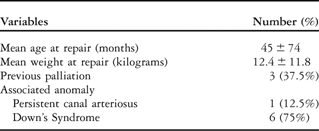
Diagnosis was based on Doppler-echocardiography. Cardiac catheterization was also carried out in all patients so as to exclude any coronary arterial malformations. In all, we identified a common atrioventricular junction guarded by a common valve, shunting at ventricular level to the inlet of the right ventricle, biventricular connection of the overriding aortic valve, and muscular subpulmonary obstruction due to antero-cephalad deviation of the muscular outlet septum. The age at surgery varied from 8 months to 20 years, with a mean of 45 months, and standard deviation of 74 months. The weight of the patients varied from 6.4 kilograms to 39 kilograms, with a mean of 12.4 kilograms, and standard deviation of 11.8 kilograms. Details were collected from medical records and operative findings. The preoperative characteristics are depicted in the Table 1. Follow-up was complete until January 2007, varying from 57 to 135 months, with a mean of 93.5 months, and standard deviation of 32 months.
Preoperative demographic and clinical data.

Palliative procedures
A systemic-to-pulmonary shunt, based on the Blalock-Taussig principle, was created in the patients who presented initially with cyanosis. The decision to undertake this procedure was based on the rationale that cyanotic patients would be more at risk of complications and mortality if submitted to a surgical trauma. Accordingly, a systemic-to-pulmonary shunt would give them time and opportunity to compensate their oxygen status. This was our approach initially, but later on, we changed to primary definitive correction.
Cardiopulmonary bypass
We used aorto-bicaval cardiopulmonary bypass with moderate hypothermia at 25 to 28 degrees Celsius in all patients. After the aorta was clamped transversally, we used intermittent antegrade cold blood cardioplegia in every patient for myocardial protection. We use an infant capillary membrane oxygenator, adding a prime of plasma and blood for the smaller children, the volume dependent on weight. We used heparin, at 4 milligrams per kilogram, for anticoagulation, inhibiting this later with protamine sulphate.
Surgical technique
We used a two-patch technique in all the patients to close the septal defects, approaching the obstructed right ventricular outflow tract through the pulmonary trunk. Access was through a full median sternotomy, and the atrioventricular lesion was exposed through a right atriotomy. The interventricular defect was closed first through the atriums using a semicircular pericardial patch attached with continuous and/or interrupted sutures of 6-0 polypropylene to the scooped-out crest of the muscular septum, continuing the patch into the outflow tract. The superior and inferior bridging leaflets were sutured to the top of the patch, again with 6-0 polypropylene.
Next, the obstructed right ventricular outflow tract was enlarged by placement of a patch across the ventriculo-pulmonary junction. A longitudinal right ventriculotomy was created initially, and the ventricular muscle bundles responsible for the outflow obstruction were removed extensively. The diameter of the pulmonary valvar orifice was then sized using Hegar dilators to determine the necessity of enlargement. This proved to be the case in all patients. The right ventricular incision was, therefore, extended across the ventriculo-pulmonary junction into the pulmonary trunk. A transjunctional patch was secured to the opened pulmonary trunk and infundibulum employing a continuous polypropylene suture. In all children, we incorporated a monocusp BiocardR valve in the patch.
We then injected saline into the ventricles so as to distend the common atrioventricular valve, permitting assessment of its functional state, and the exact site of division of the superior and inferior bridging leaflets to create new left and right atrioventricular valves. In all patients, we closed the zone of apposition between the left ventricular components of the bridging leaflets using “X” sutures of 7-0 polypropylene. If necessary, additional annuloplasty of the left valve was performed using 5-0 polypropilene sutures supported by bovine pericardial pledgets. The interatrial communication was then closed using either bovine or native pericardium. The coronary sinus was left to drain physiologically into the right atrium.
Results
Complete repair was possible in all patients. The mean period of cardiopulmonary by-pass time was 136 minutes, with standard deviation of 33 minutes. The mean stay in hospital was 11.8 days, with standard deviation of 8.2 days. There were no deaths related to the surgery, and no late deaths. All patients are alive and, as based on the last examination, in either the first or second of the classes established by the New York Heart Association, after a mean follow-up of 93.5 months, with standard deviation of 32 months. No patient thus far has required reoperation. Immediate postoperative complications included chylothorax in 2 patients, and pleural and pericardial effusions in another 2, all treated conservatively. Junctional rhythm developed in 2 patients, with one needing transitory pacemaking. Another patient developed sepsis, treated successfully with antibiotics and clinical support. We evaluated any residual defects using Doppler-echocardiogram in all patients after 6 months, and periodically thereafter. The data presented relates to the last examination. None of the patients had more than a trace of regurgitation across the left atrioventricular valve, and only one patient had a trace of regurgitation across the right valve. Pulmonary valvar insufficiency was considered severe in two patients, and moderate in another two. One patient had a discrete and clinically insignificant residual ventricular septal defect. None of these residual defects led to symptoms thus far deemed to require reintervention. There was no sub-aortic obstruction detected in the follow-up.
Discussion
The combination of atrioventricular septal defect with common atrioventricular junction and tetralogy of Fallot creates a challenging complex for surgical correction. The components of both anomalies interact in an interesting fashion. The interventricular defect has an unusual extensive subaortic extension.Reference O’Blenes, Ross, Nanton and Murphy7 Total correction of both anomalies is feasible and safe in a single surgical intervention. Postoperative morbidity and mortality are thought to be related to residual defects in the right and left atrioventricular valves, maintenance of obstruction within the subpulmonary outflow tract, and persistence of the interatrial and interventricular septal defects. The repair of tetralogy of Fallot commonly results in pulmonary valvar incompetence or, more rarely, stenosis. The consequent volume overload, or right ventricular hypertension, may worsen any regurgitation across the newly created right atrioventricular valve, with consequences in both the short and long term. Residual regurgitation across the left atrioventricular valve may increase the pulmonary arterial pressure, and worsen pulmonary valvar insufficiency.Reference Uretzky, Puga and Danielson4
Over the last 30 years, surgical results for correction of this combination of lesions was improved significantly. This can be attributed to better diagnostic resources, perioperative care, and surgical approaches. A recent review of reported series by Prifti et al.Reference Prifti, Bonacchi and Bernabei5 shows a significant decrease in postoperative mortality, from over 20% before 1990, to 10% in the following 12 years. Although our study includes a limited number of patients, the results are based on a homogeneous approach to the two malformations. We closed the atrioventricular septal defect in all patients using the two-patch technique, along with closure of the zone of apposition between the left ventricular components of the bridging leaflets, the so-called “cleft”. The superior bridging leaflet was divided in all cases, and the interventricular communication was closed transatrially, without the need to make a ventriculotomy. We also relieved the obstruction in the right ventricular outflow tract in uniform fashion, making an extensive infundibular resection and then placing a transjuctional pericardial patch incorporating a monocusp valve. We routinely explored the pulmonary valve and determined its size prior to making the transjunctional incision. In no patient, however, was it feasible to preserve the valve. Once we had decided to insert the transjunctional patch, we always incorporated a bovine pericardial monocusp valve in an attempt to avoid pulmonary valvar insufficiency in the postoperative period.
The two-patch technique is an accepted and proven approach compared with the previous one-patch technique,Reference Crawford and Stroud8 with many specialists considering it a technically easier option. An important question in the creation of the two separate valves is whether it is safe to divide the superior bridging leaflet. This issue has recently been addressed by Najm et al.,Reference Najm, Coles and Endo3 who made a retrospective analysis of 363 children. They found it was not a risk factor either for mortality or reoperation. Fortuna et al.,Reference Fortuna, Ashburn and De Oliveira9 on the other hand, did consider division of the bridging leaflets as a significant risk factor for postoperative atrioventricular valvar regurgitation and reoperation, this being especially important when regurgitation was present across the common valve before surgery.
The concern when dividing the leaflets is the possible damage to the fragile tissues, and consequent valvar incompetence. We believe that, as long the leaflets are coapting and are not under undue tension, division is safe and facilitates the approach to closure of the interventricular defect. Our patients were somewhat older than those reported by Fortuna and colleagues,Reference Fortuna, Ashburn and De Oliveira9 and this could account for more resistant tissues and safer manipulation. There is a trend for patients with associated tetralogy of Fallot to come to surgical correction later than those with atrioventricular septal defect and ventricular shunting seen in isolation. The musclar subpulmonary obstruction can protect against the development of pulmonary hypertension, as well as mitigating clinical symptoms. In addition to that, many of our patients were not referred to us until they had achieved an older age.
Nowadays closure of the zone of apposition between the left ventricular components of the bridging leaflets, the so-called “cleft”, is considered an obligatory step in approaching the newly created left atrioventricular valve. This approach is shown to reduce mortality,Reference Boening10 and presumably to enhance left atrioventricular valvar function. We perform this procedure using polypropylene stitches in all corrections of the common atrioventricular valve in the setting of atrioventricular septal defect, whether or not associated with tetralogy of Fallot.
With the decrease in surgical mortality, reoperation has become also a primary endpoint in most studies of atrioventricular septal defect accompanied by tetralogy of Fallot. Regurgitation across the left atrioventricular valve,Reference Prifti, Bonacchi and Bernabei5, Reference O’Blenes, Ross, Nanton and Murphy7, Reference Bertolini, Dalmonte and Bava11 and dysfunction in the right ventricular outflow tract, are the main indications for reintervention. Bando et al.,Reference Bando, Turrentine and Sun12 when studying atrioventricular septal defect in isolation, recognized as risk factors for reoperation the presence of double orifice left atrioventricular valve, severe atrioventricular regurgitation in the preoperative period, severe regurgitation across the left atrioventricular valve in the immediate postoperative period, and the presence of pulmonary hypertensive crises. In patients with associated tetralogy of Fallot, this last characteristic is rarely present. In their study,Reference Bando, Turrentine and Sun12 more than half of the reoperations were due to incompetence of the newly created left atrioventricular valve. Our group of patients experienced only mild regurgitation across this valve. Echo-Doppler follow-upReference Rhodes, Warner, Fulton, Romero, Schmid and Marx13 shows that there is a trend to stabilization of the regurgitation after the first month of surgery, so we are optimistic that no patient will develop severe regurgitation over the next years.
The main surgical step in treating tetralogy of Fallot is probably the relief of the obstruction in the right ventricular outflow tract. The optimal approach is still a matter of debate, as residual pulmonary regurgitation and right ventricle dysfunction are common issues in the long-term follow-up, and also causes of reoperation. The classical transpulmonary approach with or without ventriculotomy is a safe and efficacious option in dealing with the resection of the infundibular muscle bundles, and pulmonary valvar comissurotomy. Recently, the ventricular incision has been questioned as a possible cause of late right ventricular dysfunction and pulmonary regurgitation. An alternative approach, the “transatrial-transpulmonary” repair for tetralogy of Fallot, is gaining popularity, as it allows appropriate treatment of the obstruction and avoids incisions in the right ventricular musculature.Reference Hudspeth, Cordell and Johnston14 This repair certainly avoids incisions in the right ventricular musculature, but the infundibulum is still traumatized when resecting the obstructive muscle bundles. Najm et al.Reference Najm, Coles and Endo3 found no difference in hospital outcome and mortality when comparing whether or not a transjunctional patch was used in patients with atrioventricular septal defect and tetralogy of Fallot. We inserted such a patch in all of our patients. The ventriculo-pulmonary junction was stenotic, and required enlargement in all patients. The infundibulum was also severely compromised by hypertrophied muscle bundles. Because of this, we considered it appropriate to choose a well-known and classical technique. We did encounter severe pulmonary insufficiency in one-quarter of our patients in the late postoperative period. These patients are being followed closely, but thus far have not developed symptoms requiring re-intervention.
The unusually high proportion of this combination in our overall series of cases of atrioventricular septal defect with interventricular shunting may reflect our position as referral hospital for paediatric cardiac surgery in Rio de Janeiro. It is the more complex cases that are referred to us, and these include the more complex combinations.