

INTRODUCTION
After habitat loss, hunting is widely recognized as the most significant threat to faunal biodiversity in the Neotropics (Alvard et al. Reference Alvard, Robinson, Redford and Kaplan1997; Bodmer et al. Reference Bodmer, Eisenberg and Redford1997). Although conservationists advocate protected areas without human use (Redford & Sanderson Reference Redford and Sanderson2000), much of the remaining forest exists in areas that have been used for centuries by rural peoples, particularly indigenous societies (Redford & Mansour Reference Redford and Mansour1996). In many of these settings, hunted game is an important source of dietary protein, and the absence of sufficiently inexpensive alternatives often makes the reduction of wildlife harvests problematic (Milner-Gulland et al. Reference Milner-Gulland and Bennett2003). Given the reliance of rural peoples on hunted game, conservationists have responded by promoting sustainable harvests of wildlife species (Robinson & Redford Reference Robinson, Redford, Western and Wright1994). The focus on hunting patterns has become increasingly important in recent decades as integration into external markets, technological enhancements, increased population growth and sedentism, and the loss of hunting areas to incursions by outside settlers have altered the traditional hunting strategies of once isolated societies (Stearman Reference Stearman, Robinson and Bennett2000).
The conservation implications of hunting with firearms have received considerable attention (Alvard Reference Alvard1995a; Mena et al. Reference Mena, Stallings, Regalado, Cueva, Robinson and Bennett2000). By comparison, although researchers have devoted much less attention to the implications of hunting with dogs, the general impression is that dogs are detrimental to conservation efforts. Redford and Robinson (Reference Redford and Robinson1987) briefly noted that the use of dogs can increase the harvest of certain prey species. At the local level, Ventocilla et al. (Reference Ventocilla, Herrera and Nuñez1995) blamed the use of dogs for the localized extirpation of several wildlife species in the Panamanian interior. In the Brazilian state of Acre, the use of dogs for hunting is prohibited in some communities (Carneiro da Cunha & Almeida Reference Carneiro da Cunha and de Almeida2000; Minzenberg Reference Minzenberg2005). Reports indicate that hunters with dogs sometimes enter wildlife reserves (Koshear Reference Koshear1995; Cullen Reference Cullen Jr1997).
Despite these concerns, there are remarkably few data on the effects that dogs have on wildlife harvest profiles. Observational evidence suggests that dogs primarily aid hunters not by killing prey, but rather by detecting animals and by flushing them into locations (i.e. burrows, hollow trunks, waterways) where hunters can attack them (Alvard & Kaplan Reference Alvard, Kaplan and Stiner1991; Koster Reference Koster2008a). In an optimal foraging analysis of Mayangna and Miskito hunters, Koster (Reference Koster2008a) showed that both encounter rates and the profitability of prey types can vary dramatically between hunters with dogs and hunters without dogs; hunters with dogs encountered approximately nine times as many agoutis as unassisted hunters, and nocturnal species such as pacas (Cuniculus paca) and nine-banded armadillos (Dasypus novemcinctus) were typically encountered on day trips only when hunting with dogs (Koster Reference Koster2008a). Given those differences, it is reasonable to infer that the species composition of harvests varies between hunters with dogs and hunters without dogs.
Despite the importance of dogs in locating prey, however, reports of wildlife harvests typically indicate the technologies used to kill prey animals with less regard to how they were first detected. For instance, some report data on the percentage of prey killed by dogs, but not the number of animals corralled or flushed by dogs (Townsend Reference Townsend, Robinson and Bennett2000; Ohl-Schacherer et al. Reference Ohl-Schacherer, Shepard Jr, Kaplan, Peres, Levi and Yu2007). Other reports indicate the overall percentage of kills in which dogs provided assistance, but their harvest data do not indicate which species are particularly associated with the use of dogs (Smith Reference Smith1976; Jorgenson Reference Jorgenson1993).
These latter data are important because wildlife species vary in their susceptibility to overhunting and depletion, in large part owing to variation in life history characteristics (Bodmer et al. Reference Bodmer, Eisenberg and Redford1997). In addition, adult females have greater reproductive value than other age-sex classes (Alvard Reference Alvard1995b; Leeuwenberg & Robinson Reference Leeuwenberg, Robinson, Robinson and Bennett2000), and it is worthwhile to determine whether adult females are disproportionately represented in harvests by hunters with dogs. There has also been recent attention to hunting in agricultural landscapes (Daily et al. Reference Daily, Ceballos, Pacheco, Suzán and Sánchez-Azofeifa2003; Smith Reference Smith2005; Gavin Reference Gavin2007), in part because focused hunting in these areas could relieve pressure on wildlife populations in nearby mature forests.
Fast-breeding adaptable species tend to predominate in anthropogenic habitats (Escamilla et al. Reference Escamilla, Sanvicente, Sosa and Galindo-Leal2000; Naughton-Treves et al. Reference Naughton-Treves, Mena, Treves, Alvarez and Radeloff2003), and Robinson and Bennett (Reference Robinson and Bennett2004) therefore suggested that biomass production in these habitats may exceed production in unmodified forest habitats. Accordingly, Gavin (Reference Gavin2007) argued that hunting in anthropogenic habitats has greater potential for sustainable harvests. Yet, few studies have addressed the relationship between hunting technology and the geographic distribution of hunting. Although empirical data are limited, there are preliminary indications that dogs are comparatively valuable in the anthropogenic habitats near settlements (Sirén et al. Reference Sirén, Hamback and Machoa2004).
A setting in which hunters use multiple hunting technologies represents a natural experiment that allows researchers to investigate the relationship between technologies and the species composition of harvests. This study tests the hypothesis that the use of dogs is associated with variance in the composition of harvests in the Bosawas Reserve, Nicaragua. This paper also examines the effects of hunting with dogs on the sex ratio of harvested prey and the geographic distribution of kill sites. The sustainability of the harvest is assessed using the production model of Robinson and Redford (Reference Robinson, Redford, Robinson and Redford1991). Finally, the possibilities for incorporating dogs into wildlife management plans are discussed.
Study area
Nicaragua's Bosawas Biosphere Reserve, first created in 1991, is part of the largest tract of tropical rainforest north of Amazonia (Stocks Reference Stocks, Redford and Mansour1996). In 1993, The Nature Conservancy (TNC) assisted the land claims of the indigenous people (the Mayangna and Miskito) living in the reserve as they contended with incursions from non-indigenous settlers (Stocks Reference Stocks2003), culminating in the presentation of legal land title to the Reserve's five indigenous territories in May 2005 (Stocks Reference Stocks2005).
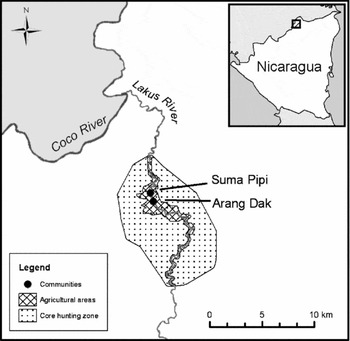
This research was based in Kipla Sait Tasbaika, one of those territories. Specifically, I worked in two communities, Arang Dak and Suma Pipi (Fig. 1). The populations of Arang Dak and Suma Pipi are 170 and 70, respectively. Situated along the Lakus River, a tributary of the Coco River, Arang Dak is located at 85°0′0″ W, 14°30′56″ N. Suma Pipi is located approximately one kilometre downstream of Arang Dak. The Lakus River flows from the undeveloped core of the Reserve, and there are no permanent settlements upstream of Arang Dak. Much of the Lakus River watershed is characterized by mature forest cover (Stocks et al. Reference Stocks, McMahan and Taber2007). Although the area was largely uninhabited during the Contra-Sandinista conflict (Nietschmann Reference Nietschmann1990), the communities have been continuously occupied since residents returned from Honduran refugee camps in 1991.
The location of the study area and the core hunting zone, including agricultural landscapes.

Dogs and 0.22-calibre rifles are the principal hunting technologies; machetes, lances and axes are also used, depending on the circumstances. Bows are designed for fishing and are seldom employed by hunters. Blowguns are altogether absent, and traps are used only to kill jaguars that attack village livestock. Hunting is primarily a male-oriented activity, but women occasionally kill game opportunistically. The hunters acquire most of the harvest on short trips originating in the community, although hunting parties sometimes embark on multi-day expeditions up the Lakus River, reaching a maximum distance of approximately 28 kilometres from the community. Nocturnal hunting is generally rare, but at certain times of the year a few hunters target pacas at night by waiting with a flashlight and a rifle at known feeding spots, particularly breadfruit trees (Artocarpus altilis). Similarly, hunters might visit their fields after dusk to ambush crop-raiding species such as deer, tapirs or raccoons.
The Mayangna and Miskito do not consider many of the species that they encounter to be edible. Among mammals larger than 1 kg in the Lakus River watershed, more than half are not eaten by residents of Arang Dak and Suma Pipi. Included in these aversions are most carnivores, opossums and all Xenarthrans with the noteworthy exception of the nine-banded armadillo (see Koster Reference Koster2008a for further details). Although the meat of spider monkeys (Ateles geoffroyi) is highly regarded, only a few families consume capuchin (Cebus capucinus) and howler (Alouatta palliata) monkeys, and hunters with rifles regularly bypass these last species despite evidence that pursuing them would raise the rate at which they acquire meat (Koster Reference Koster2007). Similarly, the meat of the coati (Nasua narica), the forest rabbit (Sylvilagus brasiliensis) and the puma (Puma concolor) is eaten by only a relatively small fraction of community members. Several species are killed to protect domestic animals, and a visiting hunter killed a caiman (Caiman crocodilus) in part because he hoped to sell the skin in his native Honduras.
METHODS
Hunting records
Indigenous research assistants were recruited to monitor the community for incoming fish and game resources. The assistants were provided spring scales and clipboards with data forms. Because of its larger size, three employees shared assistantship duties in Arang Dak, each working every third day. On the designated work day, employees would remain in the community during all daylight hours, ready to weigh incoming wildlife and fill out questionnaires. In Suma Pipi, there was one assistant, who was required to be present in the community from dawn until 07:30 and from 16:00 until darkness (when most of the resources were brought into the community). During the interim period, a woman in the community (the assistant's spouse) weighed any incoming fish and game, noting also the sex of hunted game. Upon returning to the community, the assistant from Suma Pipi would then add these data to the form and complete the interview with the hunter in question.
The hunting questionnaires included data on the hour of departure and return to the community, the names of participants, the technologies and dogs taken by each participant, and other resources brought back to the community (such as bananas and firewood). Hunting forms also included questions on encounters with possible prey items (including those that were not pursued), with specific questions pertaining to the number of animals encountered, whether the animal was pursued (and if not, why not), how many shots were fired (if applicable) and why the pursuit was abandoned (if applicable). For animals that were killed, the assistants also recorded the sex, weight and the technologies used to kill the prey item. Following a methodology developed by Smith (Reference Smith2003), the research assistants also drew sketch maps of kill sites by interviewing hunters and relating the sites to known landmarks, such as trails, fields, streams and ridgelines (see Koster Reference Koster2007 for more details on the sketch mapping process). For their participation in the study each month, households received the equivalent of a day's pay for agricultural labour.
Assistants were trained to work independently, but I also helped with numerous forms, especially on days when I was simultaneously collecting time allocation data. In total, I helped with 39% of the hunting forms. On days when the assistants in Arang Dak worked independently, I reviewed data sheets at the end of the day to look for errors or omissions. Data sheets from Suma Pipi were reviewed once per week, as the smaller number of forms made this time frame feasible.
Community members occasionally returned home after dark with fish or game, and they were hesitant to seek out the assistants to complete a form. To minimize data lost in such situations, each household was provided a clipboard and a weekly food form. At the beginning of each workday, assistants would visit each household to help fill out the form with the female head of household. For each day of the week, the form listed all regular sources of animal protein: hunted game, fish, beef, pork, poultry, eggs and milk. If one of the items had been consumed, assistants would record the type (for example species of wild game), amount, how it was acquired, the price (if applicable) and the original owner (in the case of gifts and purchases). If wild meat reported on the food forms lacked a corresponding hunting data form, the assistants would visit the household in question to collect the data. Because it was not possible at such times to weigh the hunted animal, either averages of already-weighed specimens or published estimates were used to calculate the harvested biomass.
After an initial training period, data collection in Arang Dak lasted from 1 September 2004 to 31 August 2005. For Suma Pipi, data are presented from 15 December 2004 to 31 August 2005. Because Suma Pipi participated in the study for less than a year, their annual harvest was estimated by projecting the observed harvest over an additional three and a half months.
Sustainability model
To explore the sustainability of the harvest, I used the production model of Robinson and Redford (Reference Robinson, Redford, Robinson and Redford1991). Because the maximum sustainable yield (MSY) values in this model are considered overestimates (Milner-Gulland & Akçakaya Reference Milner-Gulland and Akçakaya2001), documented harvests that exceed these values ostensibly demonstrate locally unsustainable exploitation. However, because actual population densities of wildlife species may be less than the model's predicted densities, the model cannot be used to conclusively demonstrate that harvests are sustainable.
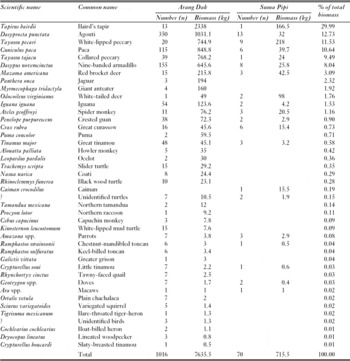
The projected annual harvest in this sustainability assessment includes animals that were reported injured during the study period, including two tapirs, two collared peccaries, two white-lipped peccaries, one red brocket deer, one spider monkey and two great tinamous (see Table 1 for species names).
Species composition of wildlife harvested in Arang Dak and Suma Pipi, by number, biomass and percentage of total biomass.

An important component in the model is the size of the hunting zone (Alvard et al. Reference Alvard, Robinson, Redford and Kaplan1997). To estimate the size of the hunting zone, I created a polygon in ArcGIS 9.2 that encompassed all kills made by hunters on day-long hunting trips from Arang Dak or Suma Pipi. I then buffered this polygon an additional 500 m to account for possible inaccuracies in the sketch mapping process. The result is an oblong polygon with an area of 77.6 km2 (see Fig. 1). Because the production model (Robinson & Redford Reference Robinson, Redford, Robinson and Redford1991) assumes that there is no immigration into the catchment area from unexploited areas, only those animals killed in the core hunting zone are included in the sustainability assessment (thus excluding about 8% of the animals, which were killed on overnight expeditions outside of the core zone).
Remote sensing and measurements with a global positioning system (GPS) unit indicate that 15% of the hunting zone is comprised of agricultural areas, including both actively-cultivated fields and fallows in various stages of regrowth. These agricultural landscapes are particularly concentrated along both sides of the river.
MSY estimates for white-faced capuchin monkeys, white-tailed deer (Odocoileus virginianus) and Baird's tapir (Tapirus bairdii) were not included in the original publication by Robinson and Redford (Reference Robinson, Redford, Robinson and Redford1991), but it was possible to calculate an estimate for the capuchins and white-tailed deer, as all necessary parameters were available (Robinson & Redford Reference Robinson and Redford1986a, Reference Robinson and Redfordb). Although there are published density estimates for Baird's tapir (Robinson & Redford Reference Robinson and Redford1986b), reproductive parameters were included only for South America's lowland tapir (Tapirus terrestris) (Robinson and Redford Reference Robinson and Redford1986a). Data on the reproduction of captive Baird's tapirs (Brown et al. Reference Brown, Citino, Shaw and Miller1994) suggest that the reproductive characteristics of Baird's tapir differ little from those of the lowland tapir (J. Brown, personal communication 2006). The maximum finite rate of natural increase (λmax in Robinson & Redford Reference Robinson, Redford, Robinson and Redford1991) would therefore be 1.22 for both species. Following Robinson and Redford (Reference Robinson, Redford, Robinson and Redford1991), I relied on the regression equations from Robinson and Redford (Reference Robinson and Redford1986b) to calculate predicted densities needed for the new MSY estimates (see also Koster Reference Koster2006).
Data analysis
To gauge the extent to which the harvest of game species is associated with different hunting technologies, kills are classified according to the accessories used to locate and dispatch the animals. The categories do not necessarily reflect the full suite of technologies available to the hunters at the time, only the technologies needed to detect and kill the animal. For example, while hunters with dogs also had rifles in many cases, the guns were seldom used for agouti kills and the kills were therefore classified as ‘dog’ kills. By contrast, the ‘dog and gun’ category signifies that both technologies were instrumental in the kill. The ‘gun’ category indicates that the animal was detected without the assistance of dogs and that rifles were the primary technology used for the kill. It is possible to make a gun kill even when hunting with dogs, as when hunters encounter and kill red brocket deer while their dogs are elsewhere. Finally, the ‘other’ category applies to kills made without either guns or dogs, usually by hunters using machetes, slingshots, lances or their bare hands. Two iguanas were excluded from the sample because it was not possible to identify the technologies used during the kills.
To test differences in the geographic distribution of kill sites and the sex ratio of harvested game species, Fisher's exact tests were used. However, the sample sizes of some species harvested by hunters without dogs are small, which precludes conclusive interpretations of insignificant results.
SPSS 14.0 was used for statistical testing.
RESULTS
Total offtake
Residents of Arang Dak and Suma Pipi killed at least 44 species, including 20 mammalian species, at least 19 species of birds and five reptilian species (Table 1). Both in terms of numbers and biomass, mammals dominate the combined sample, as they comprise 74% of the animals killed in the sample and 95% of the total biomass. The top eight contributors of consumed meat were mammals, and six of those species (tapir, agouti, white-lipped peccary, paca, collared peccary and nine-banded armadillo) together comprise 82% of the biomass in the overall harvest. Assuming that 65% of the harvested biomass is edible meat (Hill & Hawkes Reference Hill, Hawkes, Hames and Vickers1983), the per caput consumption of wild meat in Arang Dak is 0.09 kg consumer−1 day−1 and 0.03 kg consumer−1 day−1 in Suma Pipi (Koster Reference Koster2007). For this calculation, consumers are defined as individuals who are at least 3.5 years old (Alvard Reference Alvard1995a).
Of the 1086 animals taken in the two communities, 41% (representing 36% of the biomass) were acquired opportunistically in the course of activities other than hunting. Approximately 53% of the animals were killed on excursions in which members of the party also brought back bananas, manioc or firewood (although the hunters themselves were not always responsible for their acquisition).
Harvest by hunting technology
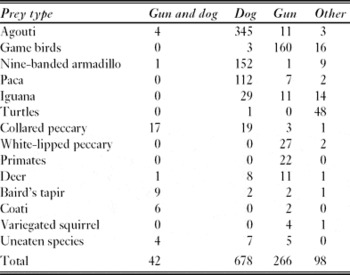
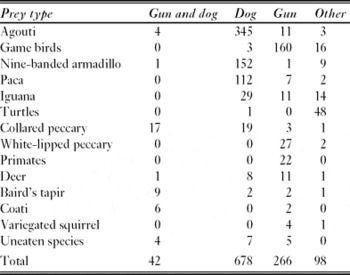
Chi-square testing for independence on the composition of the harvest by hunting technology (Table 2) indicates that the harvest of game species is associated with different technologies (χ2 = 1784.2; p < 0.0001; df = 39). Unsurprisingly, rifles are the weapon of choice when targeting birds and arboreal mammals. By comparison, the three most commonly-killed species (agoutis, armadillos and pacas) are almost overwhelmingly killed with dogs and hand technologies (for example a machete). The combination of firearms and dogs appears to be particularly valuable for hunting tapirs. In total, dogs contributed to 86% of mammalian prey kills. Among the reptiles, almost all turtles were captured with technologies other than dogs and guns, but more than half of the iguanas were taken with dogs and hand technologies.
Numerical harvest of prey types by hunting technologies.
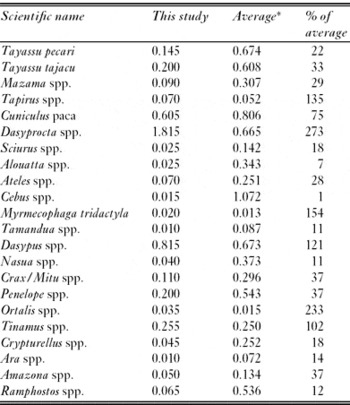
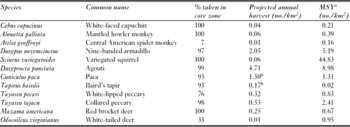
Compared to a cross-cultural sample of Neotropical harvest profiles, including many studies in which dogs were used sparingly (Peres Reference Peres2000), the annual per caput consumption in Arang Dak and Suma Pipi was below normal levels for many species (Table 3). For example, none of the primates or Artiodactyls were harvested at more than 33% of the Neotropical norm. By contrast, the harvest of tapirs, agoutis and armadillos exceeded normal levels. For the 14 mammalian species in Table 3, there was a correlation between the percentage of the Neotropical average and the percentage of harvested specimens that were initially detected by dogs (Table 3; Pearson's r = 0.572; p = 0.03). In other words, the deviations from Neotropical averages (either positive or negative) were significantly associated with the contributions of hunting dogs.
Per caput harvest rates (number of harvested animals per consumer) in Arang Dak and Suma Pipi compared to Neotropical norms. * From Peres (Reference Peres2000).

Sex profiles
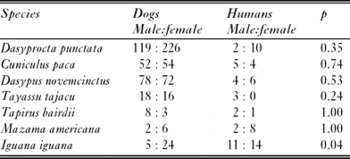
When compared to the harvests of rifle hunters, the use of dogs appears to have relatively little impact on the sex profiles of harvested game species. Of the seven game species that are first detected by either dogs or humans, a Fisher's exact test reveals a significant difference in the sex ratio only for iguanas (Table 4).
Harvests of males and females detected by dogs and by humans. The p values are from Fisher's exact tests.

However, the understanding of age and sex ratios of Neotropical species remains incomplete (Bodmer & Robinson Reference Bodmer, Robinson, Silvius, Bodmer and Fragoso2005). In this study, the female-biased harvest of agoutis deviates significantly from a 1:1 sex ratio (p < 0.001; Fisher's exact test). Given that almost 97% of the agoutis in the combined sample were first detected by dogs, it may be that dogs are particularly adept at locating and corralling females (and their offspring in some cases). However, a test of this hypothesis first requires additional evidence on the actual sex ratio of the agouti population.
Harvest by habitat
Of the 720 animals captured with the assistance of dogs, 45% were harvested in agricultural landscapes. By contrast, of the 266 animals harvested by rifle hunters without dogs, 30% were taken in agricultural landscapes. This difference is significant (p < 0.001; Fisher's exact test), which indicates that the use of dogs is associated with agricultural habitats.
Unsustainable harvests
The sustainability assessment suggests that the harvests of two species, namely tapirs and pacas, are unsustainable in the core zone (Table 5). However, it is noteworthy that, although 61% of the pacas were harvested in the agricultural zone near the communities, the paca population exhibited few signs of localized depletion. For example, while unsustainable harvests may result in a preponderance of juveniles in the heavily-hunted areas near settlements (Bodmer & Robinson Reference Bodmer, Robinson, Silvius, Bodmer and Fragoso2005), there was no correlation between the weight of harvested pacas and distance from the community (Pearson's r = −0.042; p = 0.696; n = 87).
Projected annual offtake rates in the core hunting zone, compared with estimates of maximum sustainable yield (MSY). aFrom Robinson and Redford (Reference Robinson, Redford, Robinson and Redford1991), see text for details. bHarvest > MSY.

It should be noted that the harvest of spider monkeys would also have exceeded sustainable limits if all individuals had been captured in the core hunting zone. In reality, only one spider monkey was taken on a day trip originating in Arang Dak. The remaining individuals in the sample were harvested between 15 and 30 km from the community by hunters on multi-day expeditions. Spider monkeys are rarely encountered near the communities, and previous overhunting is the most likely explanation for their low numbers in the core hunting zone.
Overall, for the ten Neotropical prey types that are found in the Reserve and listed by Robinson (Reference Robinson, Robinson and Bennett2000), there is a significant correlation between the percentage of harvested animals that were detected by dogs in this study and the maximum percentage sustainable offtake of the population (Spearman's ρ = 0.747; p = 0.013; n = 10). That is, the prey species that are particularly associated with the use of dogs tend to be those that can withstand comparatively high offtakes.
DISCUSSION
Hunting dogs and conservation
From a conservation perspective, there are both advantages and disadvantages to the use of hunting dogs. An obvious disadvantage is that dogs are very effective at detecting many terrestrial species, including agoutis, pacas, nine-banded armadillos, collared peccaries and tapirs. Evidence suggests that the rate at which several of these species are encountered when hunting with dogs is considerably greater than the encounter rates of rifle hunters (Koster Reference Koster2008a), and the harvest data suggest that the hunting of these animals is closely associated with the use of dogs. Iguanas are also vulnerable to hunters with dogs, and this is especially true when egg-laden females come to the riverside in March.
An additional downside of dogs is their indiscriminate pursuit of wildlife species, including animals that their owners would prefer not to hunt, such as giant anteaters (Myrmecophaga tridactyla), northern tamanduas (Tamandua mexicana) and greater grison (Galictis vittata). The Miskito and Mayangna do not eat these species, and hunters generally kill these animals only when they pose a threat to their dogs (Koster Reference Koster2008b; see also Hames Reference Hames1979). Similarly, all of the jaguars were killed following attacks on dogs, and one of the ocelots was killed after an altercation with dogs. Because these feline predators reportedly pose a threat to other domestic animals, the residents of the Reserve attempt to kill them when possible, and the use of dogs seems to increase encounters with the predatory cats, particularly jaguars. The risk of jaguar attacks is one reason hunters with dogs may remain closer to the community than rifle hunters (see also Dunn Reference Dunn2004).
Although useful in pursuits of terrestrial animals, dogs provide little assistance in pursuits of arboreal prey, including primates and game birds (Kaplan & Kopischke Reference Kaplan, Kopischke, Redford and Padoch1992). Because of their comparatively long life history strategies, primates are particularly vulnerable to overhunting (Bodmer et al. Reference Bodmer, Eisenberg and Redford1997). The use of dogs may therefore relieve pressure on these easily overexploited primate populations. Dogs are also little use in pursuits of white-lipped peccaries, which are increasingly endangered in the Neotropics because of hunting and habitat loss (Peres Reference Peres1996).
In terms of wildlife management, an overall reduction in hunting pressure remains the ideal conservation strategy. For a variety of reasons, however, such reductions may not be feasible in many rural settings (Milner-Gulland et al. Reference Milner-Gulland and Bennett2003). Instead, limitations on the use of certain hunting technologies, especially firearms, may be a worthwhile strategy. Although the subject remains debated, anthropological evidence suggests that hunters harvest comparable amounts of meat regardless of what technologies they use (Hames Reference Hames1979; Alvard Reference Alvard1995a). Given a constant biomass of hunted game, a harvest profile that is weighted toward species that are routinely hunted with the assistance of dogs may be associated with positive conservationist outcomes. The usefulness of dogs in agricultural areas may also facilitate the establishment of ‘no-take areas’ away from settlements (Sirén et al. Reference Sirén, Hamback and Machoa2004).
One challenge to mandating the use of hunting technologies is the hunters' reluctance to forego the use of superior weaponry. For example, hunters may be reluctant to endorse restrictions against rifles and shotguns given the demonstrably superior returns of firearms to traditional technologies, such as bows and blowguns (Stearman Reference Stearman, Robinson and Bennett2000). In Arang Dak and Suma Pipi, however, there are no significant differences between the return rates of hunting with only dogs and hand technologies (such as machetes), hunting with rifles and hunting with both dogs and rifles (Koster Reference Koster2008a). That is, neither rifles nor dogs provide significantly more meat per hour of hunting. Preliminary quantitative data suggest that dogs can be similarly effective at other Neotropical sites (Romanoff Reference Romanoff1984; Forline Reference Forline1997), but it is also important to acknowledge reports that dogs are not used for hunting because they detract from the possibilities afforded by hunting with projectile weapons (Wagley Reference Wagley1977; Hugh-Jones Reference Hugh-Jones1979; Lizot Reference Lizot and Coppens1988). Promoting the use of dogs might not be feasible in settings with low densities of species that can be hunted with dogs, such as pacas, agoutis and nine-banded armadillos.
Virtually all Mayangna and Miskito hunters would like to own a rifle, including those who already own dogs. When hunting with dogs, rifles notably increase the likelihood of killing tapirs (and other species to a lesser extent), and the guns also provide a measure of protection against jaguar attacks on the dogs. However, rifles are prohibitively expensive for most households, and only 26% of the households in Arang Dak and Suma Pipi own a rifle. By contrast, even the poorest households can usually afford to purchase puppies, which are typically sold for the equivalent of a day's labour. As a result, hunting with dogs is frequently the more economical option for many households. If the acquisition costs were sufficiently low, it is likely that other Neotropical societies would welcome additional dogs, especially since they are also valuable as watchdogs and sources of entertainment.
Hunting sustainability
The unsustainable harvest of tapirs is not surprising, as a number of researchers have reported similar results for lowland tapirs in South America (Bodmer Reference Bodmer, Western and Wright1994; Alvard et al. Reference Alvard, Robinson, Redford and Kaplan1997; Townsend Reference Townsend, Robinson and Bennett2000). Novaro et al. (Reference Novaro, Redford and Bodmer2000) contended that tapirs persist at these sites because the depletion is balanced by the immigration of animals from unexploited areas, a dynamic known as a source-sink system (Pulliam Reference Pulliam1988; see also Salas and Kim Reference Salas and Kim2002). The influx of tapirs from lightly hunted areas upstream of the communities likewise seems to explain the persistence of tapirs in the core hunting zone around Arang Dak and Suma Pipi. This conclusion is consistent with linear transect evidence that tapirs are significantly more abundant as distance from the communities increases (Williams-Guillén et al. Reference Williams-Guillén, Griffith, Polisar, Camilo and Bauman2006).
As with tapirs, it is possible that immigration from unhunted areas is replenishing the paca population in the core hunting zone. Unlike tapirs, however, the linear transect evidence reveals no significant differences between the density of pacas in the heavily-used areas near the communities and the density in rarely-hunted areas (Williams-Guillén et al. Reference Williams-Guillén, Griffith, Polisar, Camilo and Bauman2006). Given the overall absence of localized depletion in the paca population, an alternative explanation is that enhanced foraging opportunities in agricultural areas may allow pacas to exist at comparatively high densities. It is worth noting that researchers have documented pacas' consumption of numerous crops that are common in the reserve, including manioc (Manihot esculenta), maize (Zea mays), bananas and plantains (Musa spp.), cacao (Theobroma cacao), avocados (Persea americana) and peach palms (Bactris gasipaes), some of which are available year-round (Jorgenson Reference Jorgenson1993; Beck-King et al. Reference Beck-King, von Helversen and Beck-King1999). In addition, jaguars, which prey on pacas (Emmons Reference Emmons1987), exhibit significantly lower densities in high-use areas than in lightly-used areas (Williams-Guillén et al. Reference Williams-Guillén, Griffith, Polisar, Camilo and Bauman2006), which could likewise contribute to relatively high paca densities around the communities. In short, the MSY estimate in the Robinson and Redford (Reference Robinson, Redford, Robinson and Redford1991) model may underestimate the production of the paca population in this setting.
As noted, the Robinson and Redford (Reference Robinson, Redford, Robinson and Redford1991) production model cannot be used to confirm that harvests are sustainable because the possibility exists that the densities of wildlife populations are less than the predicted values. However, other than tapirs and pacas, no species is harvested at more than 55% of the estimated MSY. This suggests that the harvests are likely to be sustainable, and the presence of nearby unhunted areas increases the likelihood of sustainable use.
CONCLUSIONS
Although they were once absent from much of Amazonia (Schwartz Reference Schwartz1997), hunting dogs are now common throughout the Neotropics (Koster Reference Koster2007). In settings where the costs of firearms and ammunition are prohibitive, hunting with dogs may be a preferred alternative. The increasing fragmentation of Neotropical forests could also increase preferences for hunting dogs because the species that persist in human-dominated landscapes are often those that can be hunted with dogs (such as pacas and agoutis) whereas the species that are extirpated locally, such as primates and white-lipped peccaries, are more easily harvested with firearms (Daily et al. Reference Daily, Ceballos, Pacheco, Suzán and Sánchez-Azofeifa2003). For these reasons, the relative prevalence of hunting with dogs is unlikely to decline in the future. Yet, there has been little systematic research on the impact of hunting dogs on the composition of wildlife harvests. This study indicates that there is a significant association between the use of dogs and the harvest of several terrestrial species, and it is important to collect comparable data at other Neotropical sites.
This research also has implications for applications of catch-per-unit effort (CPUE) studies to conservation problems (for example see Vickers Reference Vickers, Robinson and Redford1991). A critical assumption of these diachronic studies is that effort is constant because, if hunting technologies were to change, the measure of offtake per effort would not be constant across time (Bodmer & Robinson Reference Bodmer, Robinson, Silvius, Bodmer and Fragoso2005). This study demonstrates that the use of dogs alters the composition of the harvest, and researchers must account for this variable when making comparisons. Additional research on the spatial patterns of hunting and the age-sex profiles of harvested game species will also be needed to fully understand the conservation implications of hunting with dogs.
ACKNOWLEDGEMENTS
This research was supported by a Fulbright student grant, the National Science Foundation (Dissertation Improvement Award #0413037), the Hill Foundation, and a Sanders Dissertation Grant. I thank the Saint Louis Zoo's Proyecto Biodiversidad for assistance and support throughout my research. Stephen Matter provided thoughtful perspectives on the analysis, and I thank three anonymous reviewers for their comments and suggestions.