Introduction
n-3-polyunsaturated fatty acids (n-3 PUFA) play an important role in human nutrition since they help to reduce the incidence of such lifestyle diseases as coronary artery diseases, hypertension and diabetes, as well as certain inflammatory diseases such as arthritis and dermatitis (Simopoulos, Reference Simopoulos2000). These diseases are an increasing problem in countries of the Middle East and North Africa, due to the dominance of animal fats and partially hydrogenated vegetable oils in the meals of the people of these countries.
Enrichment of n-3 PUFA in the eggs of laying hens is a successful strategy to ensure an adequate supply of n-3 PUFA for the greater population. Production of such eggs is feasible and could be realised by adding common sources of n-3 PUFA (i.e. fish oil, marine algae or linseed, etc.) to the layers diet (Baucells et al., Reference Baucells, Crespo, Barroeta, Lo’pez-Ferrer and Grashorn2000). By supplementing hen diets with 3% to 7% fish oil, eggs containing more than 200 mg of n-3 were obtained (Farrell, Reference Farrell1994). Furthermore, in many countries the consumption of marine products is low; hence, the benefit that could be derived from a diet rich in n-3 PUFA does not reach the majority of the population. Therefore, fish oils are common feed ingredients used in layers diet to increase egg-yolk n-3 PUFA (Shimizu et al., Reference Shimizu, Arai, Ise and Shimasaki2001).
Contradictory results have been reported concerning the possible effects of such n-3-enriched diets on layer performance. According to Schreiner et al. (Reference Schreiner, Hulan, Razzazi-Fazeli, Bohm and Iben2004), egg production was not significantly affected because of including fish oil in commercial layer diets. However, Cortinas et al. (Reference Cortinas, Galobart, Barroeta, Baucells and Grashorn2003) summarised that egg production was significantly higher when laying hens were fed diets containing 4% fish oil or flaxseed oil. Contrarily, other researchers have reported impaired production parameters in hens fed fish products, and particularly reduced egg weight (Pappas et al., Reference Pappas, Acamovic, Sparks, Surai and McDevitt2005).
n-3 PUFA are more prone to oxidation because of their double bonds and may confer this undesirable trait to the n-3-enriched product. Furthermore, the highly polyunsaturated long-chain fatty acids (i.e. eicosapentaenoic acid (EPA), 20 : 5(n-3) and docosahexaenoic acid (DHA), 22 : 6(n-3)) of fish oils are extremely susceptible to lipid peroxidation, even in the presence of added dietary antioxidants (Gonzalez et al., Reference Gonzalez, Gray, Schemmel, Dugan and Welsch1992). The data evaluating the effect of fish oil n-3 PUFA on oxidative stress and lipid peroxidation markers in vivo vary with both animal and clinical studies reporting increased oxidation (Ibrahim et al., Reference Ibrahim, Lee, Yeh, Szabo, Bruckner and Chow1997), no effect on oxidation (Nenseter et al., Reference Nenseter, Rustan, Lund-Katz, Søyland, Mælandsmo, Phillips and Drevon1992) and even some indication of decreased susceptibility to induced oxidation (Yuan and Kitts, Reference Yuan and Kitts2002).
Dietary n-3 PUFA are incorporated into cellular lipids where they exert essential effects on many biological systems, such as immune reactions, blood platelet aggregation and growth regulation of some cell types (De Pablo et al., Reference De Pablo, Puertollano and de Alvarez de Cienfuegos2002). In fact, the immunomodulatory functions of dietary n-3 PUFA have been widely studied in mammals, but research on poultry is limited. Moreover, in poultry, there are conflicting results on the effect of dietary lipids on immune functions. In general, published reports indicated that increasing the consumption of n-3 PUFA in diets has been shown to either increase or decrease immunological parameters of both humoral and cell-mediated immunity (Wang et al., Reference Wang, Field and Sim2000).
Therefore, the objective of the current study was to research the effects of different levels of supplemented dietary fish oil (0%, 1.25%, 2.5%, 3.5% or 5%) on ovarian follicular development, serum lipid peroxidation, antioxidative status and immune response in laying hens. In addition, the cholesterol, n-3 PUFA and n-6 PUFA levels in produced eggs were determined.
Material and methods
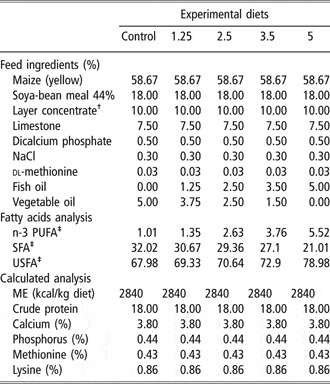
A total of 105 white Bovens hens at 24 weeks of age with 83.12 ± 8.9% egg production were housed individually in laying cages in an open-sided building under a 16 h light : 8 h dark lighting schedule in the research farm, Faculty of Agriculture, Kafrelsheikh University, Egypt. Hens were randomly divided into five experimental treatments. Each treatment (21 hens) was further randomly divided into three replicates of seven hens (i.e. seven adjacently individually caged hens serving as a replicate). Birds were fed, ad libitum, diets containing 0% (control), 1.25%, 2.5%, 3.5% or 5.0% fish oil from 24 to 36 weeks of age. Experimental diets were formulated to have the same metabolisable energy (ME). The birds were fed a standard layer diet (17% crude protein; 2850 kcal ME per kg diet, Table 1). The diets were calculated to meet the recommendations of the National Research Council for laying hens. Feed intake was measured weekly, whereas egg production and weight were recorded daily throughout the trail.
Composition of experimental diets

†Layer concentrate provide per kg of diet containing the following: 50% crude protein; metabolisable energy, 2400 kcal; 3% available phosphorus; 7.15% calcium; 3% lysine; 1.8% methionine; 1200 IU vitamin A; 20 mg vitamin E; 2500 IU vitamin D3; 25 mg vitamin B6; 10 mg vitamin B1 and 50 mg vitamin B2.
‡n-3 PUFA = n-3 fatty acids; SFA = saturated fatty acids; USFA = unsaturated fatty acids.
During the last 2 weeks of the experimental period (35 and 36 weeks of age), 15 eggs were taken at random from each treatment to determine the yolk lipid profile and cholesterol content. Yolks were carefully separated without albumen and pooled for colorimetric cholesterol assay according to Watson (Reference Watson1960) and yolk fatty acids were quantified using the method of Radwan (Reference Radwan1978). Briefly, total lipids were extracted with chloroform: methanol (2 : 1 vol/vol) from 0.8 g of yolk. Total lipids were converted to fatty acid methyl esters and yolk fatty acids were quantified by gas liquid chromatography using Shimadzu gas chromatograph GC-4 CM (PFE) equipped with a flame ionisation detector. An analytical glass column (3 m × 3 mm internal diameter) was packed with 5% diethyl glycol succinct on 80/100. The chromatography conditions were as follows: 180°C column temperature, 270°C injector temperature and 270°C detector temperature. Gas flow rates (ml/min) were as follows: nitrogen 30, hydrogen 1, air 0.5 and chart speed was 0.5 mm/min. A standard mixture of methyl esters was analysed under identical conditions prior to running the samples. The retention times of the unknown sample of methyl esters were compared with those of the standard. The concentration of methyl esters were calculated by the triangulation method (Radwan, Reference Radwan1978).
Total antibody titres against sheep red blood cells (SRBC) were measured by the 12th week of dietary treatments. Humoral immunity is an organism’s antibody response to pathogens. Antibody response to a T-dependent (both T- and B-cells must recognise antigen) antigen was assessed by measuring serum antibody titre following a primary intramuscular injection of 0.5 ml of a 40% SRBC suspension (in phosphate-buffered saline) in the right pectoral muscle. Antiserum to SRBC was collected 7 days after challenge. Antibody titres to SRBC were measured using a microhaemagglutination assay by the method of Wegmann and Smithies (Reference Wegmann and Smithies1966).
At the end of the experimental period, 10 females from each treatment were randomly chosen, weighed, anaesthetised and killed by decapitation. Blood plasma and liver samples were taken and stored at −40°C for subsequent analysis. The abdominal cavity was opened and the ovary and oviduct were removed and weighed. The number and weight of normal large yellow follicles (LYF) (>10 mm diameter), and the number of small yellow follicles (SYF) (5 to 10 mm diameter), large white follicles (LWF) (3 to 5 mm diameter) and medium white follicles (MWF) (1 to 3 mm diameter) were recorded. Follicle size classifications were based on Renema et al. (Reference Renema, Robinson, Melnychuk, Hardin, Bagley, Emmerson and Blackman1995). The stroma weight comprising the ovarian tissue remaining after the LYF were counted and removed.
Lipid peroxidation in the serum and liver was measured in the form of thiobarbituric acid-reactive substance (TBARS) according to Richard et al. (Reference Richard, Portal, Meo, Coudray, Hadjian and Favier1992). Activity of the antioxidative enzyme glutathione peroxidase (GSH-Px) activity was determined by the method of Levander et al. (Reference Levander, Deloach, Morris and Moser1983).
The differences among treatments were statistically analysed by one-way anova in a completely randomised designed using Statistical Packages for the Social Sciences (2001). The significant differences among means of treatments were compared by Duncan’s new multiple-range test. P ⩽ 0.05 was set as limit of significance.
Results
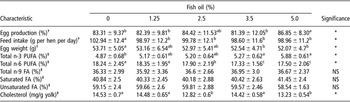
Results concerning the effect of fish oil supplementation on hen-day egg production, egg weight, yolk cholesterol content, total n-3 PUFA and total n-6 PUFA are presented in Table 2. Supplemented dietary fish oil showed an effect on layer performance. Fish oil addition did not cause a decrease in egg production but no clear trend was observed. However, fish oil supplementation had a significantly negative effect on egg weight. The egg weight decreased concomitantly with the increase of fish oil supplement. As shown in Table 2, dietary fish oil has also been found to decrease feed intake (P ⩽ 0.05). Data in the present study showed that incorporation of n-3 PUFA in the egg yolks has been successful by using dietary fish oil. Generally, the fatty acids composition of the yolks reflected the dietary fat levels (Table 2). Feeding fish oil to birds resulted in a proportional increment of the total n-3 PUFA concentrations (P ⩽ 0.05) in egg yolk lipids, whereas concentrations of the total n-6 PUFA decreased as dietary fish oil increased (P ⩽ 0.05). Egg yolk cholesterol content significantly differed due to dietary fish oil treatment; however, no clear trend was observed (Table 2). Hens fed 2.5% fish oil had the lowest egg cholesterol value (12.82 mg/g yolk) compared with control (14.53 mg/g yolk).
Effects of feeding graded levels of supplemental dietary fish oil on egg production, feed intake, egg weight and fatty acid composition of eggs

a,b,cMean values followed by different letters in the same row are significantly different (P ⩽ 0.05).
*P ⩽ 0.05. NS = non-significant.
†n = 21.
‡n = 10.
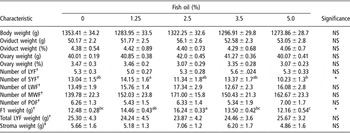
Most ovarian morphological parameters were not significantly affected by supplemented fish oil except for the number of SYF and F1 follicles. Results presented in Table 3 indicated that ovary and oviduct weights, expressed in either absolute terms or relative to body weight, were not significantly affected by dietary fish oil. The numbers and total weights of LYF in the ovary were not significantly affected by fish oil supplementation, while the weight of the F1 (largest) follicle was significantly heavier in the 2.5% fish oil treatment than in other treatments (Table 3) where no specific trend was observed. Also, the number of SYF was significantly affected by dietary fish oil (P ⩽ 0.05); however, no specific trend was observed. The numbers of LWF and postovulatory follicles (POF) were not significantly changed by dietary fish oil. The number of MWF was numerically, but not significantly, affected by fish oil supplementation. The weight of ovarian stroma did not differ among the different dietary levels of fish oil (Table 3).
Effects of feeding graded levels of supplemental dietary fish oil on different reproductive morphology parameters

Values presented are means and their standard error of 10 per treatment.
a,b,cMean values followed by different letters in the same row are significantly different (P ⩽ 0.05).
*P ⩽ 0.05.
†NS = non-significant; LYF = large yellow follicle (>10 mm diameter); SYF = small yellow follicle (5 to 10 mm diameter); LWF = large white follicle (3 to 5 mm diameter); MWF = medium white follicle (1 to 3 mm diameter); POF = postovulatory follicle; F1 = the largest yellow follicle; LYF = weight without F1 follicle.
‡The stroma weight comprised the ovarian tissue remaining after the LYF were counted and removed.
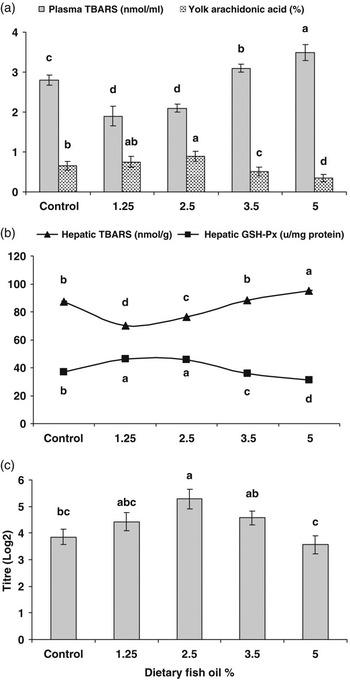
With respect to the effect of dietary fish oil level on lipid peroxidation index in blood plasma and liver as well as the oxidative stress biomarker GSH-Px (Figure 1a and b), it could be observed that both plasma and hepatic TBARS reflect that lipid peroxidation increased significantly in a dose-dependent manner when fish oil was supplemented at levels higher than 2.5%. Also, results of GSH-Px activity (Figure 1b) declared that dietary fish oil more than 2.5% significantly reduced the GSH-Px activity, while addition of 1.25% to 2.5% fish oil enhanced the GSH-Px activity significantly as compared with the control.
Effects of feeding graded levels of fish oil on (a) plasma thiobarbituric acid-reactive substance (TBARS) and yolk arachidonic acid (20 : 4(n-6)), (b) hepatic TBARS and glutathione peroxidase (GSH-Px) activity and (c) antibody titre. Values are expressed as mean ± standard deviation error; mean values with different letters are significantly different from each other (P ⩽ 0.05).

Results of immune response, presented graphically in (Figure 1c), show that different levels of dietary fish oil had a positive effect on humoral immunity as measured by antibody titres against SRBC when compared with control (P ⩽ 0.05). It is also interesting to note that at dietary fish oil levels below 3.5%, an increase in antibody titre takes place as fish oil concentration of the diet increases.
Discussion
Virtually, commercial table eggs contain a high proportion of n-6 PUFA but are a poor source of n-3 fatty acids. The inclusion of n-3 PUFA into yolk lipids is feasible and achieved by feeding diets rich in n-3 PUFA to hens. Fish oils are common feed ingredients used to increase yolk n-3 PUFA in layers (Leskanich and Noble, Reference Leskanich and Noble1997). Including fish oil in commercial layer diets does not usually affect body weight gain, feed intake or egg production (Gonzalez-Esquerra and Leeson, Reference Gonzalez-Esquerra and Leeson2000). In the current study, no clear specific trend was observed in hen-day egg production by using fish oil supplementation and this could be due to insufficient replicates. However, it could be noted that dietary fish oil did not cause a significant decrease in egg production. Baucells et al. (Reference Baucells, Crespo, Barroeta, Lo’pez-Ferrer and Grashorn2000) stated that the use of fish oil at any percentage (0% to 4%) in diets never led to poorer performance of the layers. On the other hand, Cortinas et al. (Reference Cortinas, Galobart, Barroeta, Baucells and Grashorn2003) reported that egg production was significantly higher when laying hens were fed diets containing 4% fish oil.
Fish oil supplementation had a significantly negative effect on egg weight. However, no significant differences were detected among control, 1.25% and 2.5% fish oil, whereas using dietary fish oil more than 2.5% resulted in concomitant reduction in egg weight (Table 2). This response was similar to observations by Gonzalez-Esquerra and Leeson (Reference Gonzalez-Esquerra and Leeson2000) who reported that egg weight decreased (P ⩽ 0.05) linearly with increasing menhaden oil (2%, 4% and 6%). Also, Pappas et al. (Reference Pappas, Acamovic, Sparks, Surai and McDevitt2005) established that inclusion of fish oil significantly reduced the weight of the egg that was laid, as well as of its component parts. These results were in agreement with some published work (Nash et al., Reference Nash, Hamilton and Hulan1995) but contradicted other research (Basmacioglu et al., Reference Basmacioglu, Cabuk, Unal, Ozkan, Akkan and Yalcin2003). A possible explanation for this has been suggested by Gonzalez-Esquerra and Leeson (Reference Gonzalez-Esquerra and Leeson2000) who elucidated that it might refer to the lower plasma triglycerides in the fish oil-fed treatments, a result of the hypotriglyceridemic effect of n-3 PUFA, as it has been observed in other studies (Van Elswyk, Reference Van Elswyk1997). Moreover, Van Elswyk (Reference Van Elswyk1997) suggested that a decrease in circulating triglycerides of birds due to n-3 PUFA consumption could limit the availability of lipids for yolk formation. He also suggested that n-3 PUFA could affect circulating estradiol. Similarly, Scheideler and Froning (Reference Scheideler and Froning1996) observed that the decrease in egg size was accompanied by a decrease in plasma estradiol concentration and postulated a nutritional control of the dietary long-chain fatty acids on the hormonal metabolism of the birds. These effects could partially explain the lower egg weight found in birds fed 3.5% and 5.0% fish oil in the current experiment. Furthermore, in the present study, the reduced feed intake observed in hens fed fish oil v. the control diet could have also played a role (Table 2). It is important to mention that, during the formulation of the experimental diets, vegetable fat was substituted directly for experimental fish oil on the assumption that they had the same ME. It is possible that fish oil had a slightly higher ME value than vegetable fat, which may account for the decreased feed intake. This effect was not tested.
No significant effects were detected in ovary, oviduct, LYF and stroma weights when laying hens were fed different levels of fish oils. Also, the numbers of LYF, LWF, MWF and POF were not significantly affected by fish oil supplementation (Table 3). Therefore, data of the present study indicated that the level of the additional dietary fish oil did not have a negative influence on the different reproductive morphology parameters. In fact, among the studies dealing with the enrichment of eggs with n-3 PUFA, to our knowledge, no data have been published on ovary morphology in laying hens. However, several studies in mammals revealed that feeding or infusing different types of fat with varying PUFA content to females can alter the number and size of ovarian follicles, the ovulation rate and progesterone production by the corpus luteum (Robinson, et al., Reference Robinson, Pushpakumara, Cheng, Peters, Abayasekara and Wathes2002). Robinson, et al. (Reference Robinson, Pushpakumara, Cheng, Peters, Abayasekara and Wathes2002) indicated that the number and diameter of follicles were increased in the PUFA-fed cows. This finding is consistent with other reports in which various types of fat supplementation consistently increased both the number and size of ovarian follicles (Thomas et al., Reference Thomas, Bao and Williams1997). However, Petit et al. (Reference Petit, Dewhurst, Scollan, Proulx, Khalid, Haresign, Twagiramungu and Mann2002) proved that there were no significant effects of PUFA treatments on the mean number or the mean size of follicles.
Alteration of yolk fatty acid profile could be achieved by adding fish products to the hens’ feed (Gonzalez-Esquerra and Leeson, Reference Gonzalez-Esquerra and Leeson2000). Similar findings were detected in the present study (Table 2). Generally, the concentrations of n-3 PUFA increased, whereas n-6 PUFA tended to decrease in yolk lipids, and the fatty acid composition of the yolks reflected the dietary fish oil levels. The changes in yolk n-3 PUFA shown here due to feeding graded levels of fish oil (Table 2) are in agreement with previous reports (Meluzzi et al., Reference Meluzzi, Sirri, Manfreda, Tallarico and Franchini2000; Gonzalez-Esquerra and Leeson, Reference Gonzalez-Esquerra and Leeson2000). Meluzzi et al. (Reference Meluzzi, Sirri, Manfreda, Tallarico and Franchini2000) indicated that the treatment with 3% fish oil caused a dramatic increase (P ⩽ 0.01) in all n-3 fatty acids of the yolk, particularly EPA and DHA, and caused an appreciable decrease in arachidonic acid (ARA, 20 : 4(n-6)). Similar results were reported by Huang et al. (1990) who found that the n-3 PUFA content of the yolk is positively related to the addition of fish oil at the rate of 2%, 3% or 4% to the diet. Also, the present study indicates a concomitant decrease (P ⩽ 0.05) in ARA in the egg yolk lipids (Figure 1a). Meluzzi et al. (Reference Meluzzi, Sirri, Manfreda, Tallarico and Franchini2000) indicated that the ARA content was significantly lower in 3% fish oil treatments. This phenomenon is probably due to the greater utilisation of Δ-6-desaturase in the n-3 fatty acid pathway with respect to the n-6 pathway, as this enzyme acts in both pathways. High concentrations of dietary n-3 fatty acids reduce the activity of the enzyme in the n-6 pathway and the conversion of linoleic into ARA. The decrease in ARA content could be important for human health, as this acid is a precursor of some proinflammatory eicosanoids (Simopoulos, Reference Simopoulos2000).
The egg cholesterol content significantly differed due to dietary fish oil treatment (Table 2). Our results indicated that no clear trend was observed in egg cholesterol content; however, hens fed 2.5% fish oil had the lowest egg cholesterol value. Lewis et al. (Reference Lewis, Seburg and Flanagan2000) noted that cholesterol content in the modified egg has also been reduced to 180 mg/egg, compared with the standard egg value of 210 mg/egg. However, Hargis (Reference Hargis1988) suggested that egg yolk cholesterol showed little or no variation in response to genetic, pharmacological or dietary manipulation. Moreover, Schreiner et al. (Reference Schreiner, Hulan, Razzazi-Fazeli, Bohm and Iben2004) did not find any differences in the yolk cholesterol content in response to dietary n-3 PUFA.
Using supplemental levels of fish oil (1.25% and 2.5%) significantly decreased (P ⩽ 0.05) lipid peroxidation in both blood serum and liver compared with control (Figure 1a and b). This may refer to the hypolipidemic effects of dietary fish oil, which are fairly consistent in lowering plasma triacylglycerols, with variable effects on total and low-density lipoprotein (LDL) cholesterol concentrations (Yuan and Kitts, Reference Yuan and Kitts2002). Additionally, n-3 PUFA produces lower abdominal fat deposition than saturated or monounsaturated fatty acids (Crespo and Esteve-Garcia, Reference Crespo and Esteve-Garcia2001). This in turn will reduce the free radicals attack on these lipids, and consequently reduce lipid peroxidation. Not surprising, the same trend was observed in hepatic GSH-Px activity (Figure 1b). Supplemented fish oil (more than 2.5%) significantly reduced the hepatic GSH-Px activity, but addition of 1.25% to 2.5% significantly enhanced the activity compared with the control. This decline in the GSH-Px activity in high levels of fish oil treatments could be explained by the presence of high levels of the free radicals, which induced oxidative stress in all the body due to high levels of n-3 PUFA. Taking into account the involvement of GSH-Px in the immune function, it is important to note that the antioxidative enzyme GSH-Pxs are likely to protect neutrophils from oxygen-derived radicals that are produced to kill ingested foreign organisms (Arthur, Reference Arthur2000). Furthermore, GSH-Px plays an important role in regulation of the biosynthesis of prostaglandins from their precursor, ARA; however, the precise nature of GSH-Px involvement in eicosanoid metabolism is not fully understood (Pappas et al., Reference Pappas, Acamovic, Sparks, Surai and McDevitt2005). Interestingly, it is important to mention that fish oil can decrease the oxidation products generated by the inflammatory cells which accompany ischaemic reperfusion. Moreover, Constant (Reference Constant2004) concluded that when concentrated n-3 PUFA is fed to animals no peroxides are produced, and so no antioxidants are necessary. Therefore, it could be documented that enriching chicken eggs with n-3 PUFA using fish oil not more than 2.5% may enhance the antioxidative status and reduce lipid peroxidation, which probably resulted in improving the immune responsiveness in laying hens in the present study.
The current study demonstrated that the levels of dietary n-3 PUFA affected immunity in laying hens (Figure 1c). It is also interesting to note that with dietary fish oil levels below 3.5%, an increase in antibody titre against a non-replicating antigen, SRBC, in laying hens takes place as fish oil concentration of the diet increases. This response is similar to observations by Fritsche et al. (Reference Fritsche, Cassity and Huang1991) who showed that 2% fish oil gave the highest antibody titre in birds challenged with SRBC. Moreover, Wang et al. (Reference Wang, Field and Sim2000) reported similar results in which birds fed n-3 PUFA (fish oil diet) had a significantly higher antibody production than those fed linseed oil or animal fat at 8 weeks of age. Furthermore, studies have demonstrated that dietary PUFA can modulate a wide range of immune responses in poultry. Apparently, diets enriched with fish oil rich in long-chain n-3 PUFA (EPA and DHA) have anti-inflammatory properties (Surette et al., Reference Surette, Whelan, Lu, Hardard’ottir and Kinsella1995), increase delayed-type hyper-sensitivity (Korver and Klasing, Reference Korver and Klasing1997), increase in antibody responses (Friedman and Sklan, Reference Friedman and Sklan1995) and decrease in lymphocyte proliferation (Fritsche et al., Reference Fritsche, Cassity and Huang1991). Further experiments by Wang et al. (Reference Wang, Field and Sim2000) demonstrated that diets enriched with fish oil suppress ARA-derived prostaglandin E2 (PGE2) production. Therefore, it could be assumed that addition of anti-inflammatory lipids, such as fish oil, has also been shown to be beneficial for birds’ health. In fact, the immunomodulatory functions of dietary PUFA have been widely studied in mammals; however, research on poultry is limited. Moreover, in poultry, there are conflicting results on the effect of dietary lipids on immune functions. Several studies indicated that increasing the consumption of n-3 PUFA in diets has been shown to either increase or decrease immunological parameters of both humoral and cell-mediated immunity (Wang et al., Reference Wang, Field and Sim2000). Suppression of the inflammatory response could be beneficial to poultry in minimising the catabolic effect from both pathogens and environmental immunogens (Korver and Klasing, Reference Korver and Klasing1997). Furthermore, it has been reported that feeding high levels of n-3 PUFA (5% to 7% fish oil in the diet) suppressed the cell-mediated immune response, as measured by in vitro lymphocyte proliferation in laying hens (Wang et al., Reference Wang, Field and Sim2000). Parmentier et al. (1997) showed that antibody responses to different antigens were decreased by dietary n-3 PUFA. In addition, consuming n-3 PUFA resulted in a reduction in the production of cytokines such as interleukin-1, interleukin-2 and tumour necrosis factor-α, which are important in cell-mediated and inflammatory immune responses (Endres et al., Reference Endres, Meydani, Ghorbani, Schindler and Dinarello1993). Likewise, Korver and Klasing (Reference Korver and Klasing1997) reported that fish oil suppresses the release of interleukin-1 and tumour necrosis factor-α in chicken. Collectively, researchers observed that fish oil has also been shown to be immunosuppressive at high concentrations and immunostimulatory at lower concentration in chickens (Fritsche et al., Reference Fritsche, Cassity and Huang1991; Korver and Klasing, Reference Korver and Klasing1997; Wang et al., Reference Wang, Field and Sim2000). Korver and Klasing (Reference Korver and Klasing1997) declared that inclusion of low levels of n-3 PUFA (⩽2% fish oil) in broiler chick diets improved or did not change indices of the cell-mediated immune response. Similarly, Fritsche et al. (Reference Fritsche, Cassity and Huang1991) have also shown that 2% fish oil gave the highest antibody titre in birds challenged with SRBC. Therefore, it is worth noting that the effect of n-3 PUFA on immune responses in our study appeared to be dependent on their dietary levels. Also, by taking into account our results in lipid peroxidation and antioxidative properties, it could be concluded that the optimum level of dietary fish oil may be not more than 2.5%.
Based on the data presented above, it could be concluded that inclusion of fish oil in laying hen diets at moderate levels increased the n-3 fatty acids content in eggs, improved antioxidative status, reduced lipid peroxidation and enhanced the antibody response in laying hens. Additionally, the current study confirmed that the dietary fish oil did not have a negative influence on different reproductive morphology parameters.
Acknowledgements
The authors wish to acknowledge the helpful suggestions of Professor Mohamed El-Habbak, Department of Poultry Production, Faculty of Agriculture, Kafrelsheikh University, Egypt.