

Stable and heavy isotope ratios, including oxygen (18O/16O, or δ18O), hydrogen (δD), and strontium (87Sr/86Sr), make it possible to empirically investigate the past mobility patterns of people and geographic sources of their food. For example, researchers have used δ18O ratios to investigate past residential mobility patterns in Peru (Buzon, Conlee, and Bowen Reference Buzon, Conlee and Bowen2011; Webb, White, and Longstaffe Reference Webb, White and Longstaffe2013), identify sources of ancient textile materials (Benson et al. Reference Benson, Hattori, Taylor, Poulson and Jolie2006), clarify migration at Stonehenge (Evans, Chenery, and Fitzpatrick Reference Evans, Chenery and Fitzpatrick2006), and determine irrigation patterns for prehispanic maize farming in Utah (Williams et al. Reference Williams, Coltrain, Lott, English and Ehleringer2005). However, in order to use these tools to interpret data from the archaeological or fossil record, we must first determine the modern isotopic variation, often through the collection of modern water, plant, or faunal specimens in the area of interest (Benson Reference Benson2010; Knudson et al. Reference Knudson, Williams, Buikstra, Tomczak, Gordon and Anbar2010; Rubenstein and Hobson Reference Rubenstein and Hobson2004). These modern comparative datasets allow researchers to ascertain the isotopic signatures of potential sources and quantify both expected variation and uncertainty within those sources (Lightfoot and O'Connell Reference Lightfoot and O'Connell2016).
Isotopic analyses have become important for modeling resource procurement strategies at Chaco Canyon during the Bonito phase (ca. AD 800 to 1200), when the canyon emerged as the core of a regional socioeconomic system extending across the Colorado Plateau (Lekson Reference Lekson and Lekson2006). Strontium isotope analyses are prominent in these approaches (Benson et al. Reference Benson, Cordell, Vincent, Taylor, Stein, Lang Farmer and Futa2003; Benson et al. Reference Benson, Hattori, Taylor, Poulson and Jolie2006; English et al. Reference English, Betancourt, Dean and Quade2001; Grimstead et al. Reference Grimstead, Buck, Vierra and Benson2015; Guiterman, Swetnam, and Dean Reference Guiterman, Swetnam and Dean2016; Reynolds et al. Reference Reynolds, Betancourt, Quade, Jonathan Patchett, Dean and Stein2005) but with ambiguous results because 87Sr/86Sr ratios do not clearly differentiate Chaco Canyon from other potential long-distance sources (Drake et al. Reference Drake, Wills, Hamilton and Dorshow2014; Wills, Drake, and Dorshow Reference Wills, Lee Drake and Dorshow2014). Grimstead, Quade, and Stiner (Reference Grimstead, Quade and Stiner2016) have used oxygen isotope analyses to assess the importation of animal resources into Chaco, but they did not include (or have access to) modern fauna from Chaco Canyon. This limits the reliability of their conclusions (Badenhorst, Driver, and Maxwell Reference Badenhorst, Driver, Maxwell and Crown2016:208–209).
Because Chaco Canyon lacks a permanent drainage that would have supported irrigation agriculture, many researchers have questioned whether the resident population was able to sustain a subsistence living, much less generate the agricultural surpluses that often underwrite emergent complexity in other parts of the world (e.g., Benson Reference Benson2011). Some have also suggested that Chacoans altered the local environment by cutting down trees for construction and fuel and hunted out the local fauna (Benson Reference Benson2016; Betancourt and Van Devender Reference Betancourt and Van Devender1981; Diamond Reference Diamond2005). Consequently, the acquisition of resources from outside the canyon has great significance for models of economic production during the Bonito phase (AD 800–1200).
Over the past several decades, zooarchaeologists have proposed that animal procurement during the Bonito phase was a combination of capturing local low-return species (primarily rodents such as prairie dogs [Cynomis sp.] and rabbits [Lepus sp./Sylvilagus sp.]) and long-distance hunting of (or exchange for) large mammals such as deer (Odocoileus sp.) and antelope (Antilocapra americana; Akins Reference Akins, Schelberg and Judge1984, Reference Akins, Joan Mathien and Windes1987; Speth and Scott Reference Speth, Scott and Kent1989; Vivian et al. Reference Vivian, Van West, Dean, Akins, Toll, Windes and Lekson2006; Watson Reference Watson2012). Researchers in the Southwest assume that hunting pressure from population growth and increased residential sedentism resulted in the local depletion of large mammals but that rodents and other small mammals were less impacted due to high reproductive rates and possible food inputs from human gardens (Cannon Reference Cannon2003; Driver Reference Driver, Varien and Wilshusen2002; Potter and Ortman Reference Potter, Ortman and Mills2004; Szuter and Gillespie Reference Szuter, Gillespie, Wills and Leonard1994). Over the course of the Bonito phase, large-game abundance declined in archaeological contexts, and turkeys appear at the very end as a likely protein source (Akins Reference Akins, Schelberg and Judge1984, Reference Akins and Joan Mathien1985, Reference Akins, Joan Mathien and Windes1987). Akins (Reference Akins, Schelberg and Judge1984) suggested that a shift from deer to antelope around AD 1100 probably indicates a shift from source areas in higher forested elevations to open grasslands south of Chaco.
Isotopic analyses have been promoted as a means for refining our understanding of where the animals found in Chacoan sites originated. In particular, Grimstead, Quade, and Stiner (Reference Grimstead, Quade and Stiner2016) argue that oxygen isotopes can distinguish local from long-distance procurement strategies and thus provide a test of the general assumption that small game were local and large game were not (and were thus expensive to obtain). As a substitute for modern comparative fauna from Chaco, Grimstead, Quade, and Stiner (Reference Grimstead, Quade and Stiner2016) used δ18O ratios from modern small mammals around the greater San Juan Basin to develop regression models with significant trends correlating the isotopic ratios to the elevation at which each specimen was collected. This altitude effect is well established (Ambach et al. Reference Ambach, Dansgaard, Eisner and Møller1968; Bowen and Wilkinson Reference Bowen and Wilkinson2002; Gonfiantini et al. Reference Gonfiantini, Roche, Olivry, Fontes and Maria Zuppi2001). As water vapor continues to condense and rain out as air masses climb elevational gradients, the enriched oxygen isotopes (18O) precipitate first, resulting in a lower δ18O ratio at higher elevations. The magnitude of this altitude effect changes with temperature and location but generally is around 2‰ per 1 km of elevational gain (Bowen and Wilkinson Reference Bowen and Wilkinson2002; Chamberlain and Poage Reference Chamberlain and Poage2000; Gonfiantini et al. Reference Gonfiantini, Roche, Olivry, Fontes and Maria Zuppi2001). Seasonal variation on the Colorado Plateau, including Chaco Canyon, is at least four times greater than this, at 8‰ throughout the year (Asmerom et al. Reference Asmerom, Polyak, Burns and Rassmussen2007).
Surprisingly, given earlier zooarchaeological interpretations, Grimstead, Quade, and Stiner (Reference Grimstead, Quade and Stiner2016) conclude that all sampled specimens, both small and large animals, produced results indicating long-distance acquisition, minimally 40 km for all specimens and 70 to 100+ km for some deer. Few specialists would likely disagree with the sourcing of large game outside Chaco Canyon, but Badenhorst, Driver, and Maxwell (Reference Badenhorst, Driver, Maxwell and Crown2016) have challenged the conclusion that small animals were imported. Here we use modern fauna from Chaco to test the null hypothesis, rather than fit archaeological fauna to an elevational model. These specimens were collected between 2013 and 2015 expressly to provide researchers with a comparative modern database for isotopic studies of archaeological materials. This study was conceived and designed to illustrate the utility of the materials that have been obtained thus far as part of ongoing field investigations at Chaco Canyon by the University of New Mexico.
Methods
Oxygen Isotope Analysis Background
Stable oxygen isotopes come in three forms: 16O, 17O, and 18O. The most widely used ratio is 16O/18O, or δ18O, and is evaluated against the Vienna Pee Dee Belemnite (VPDB) standard for carbonates or the Vienna Standard Mean Ocean Water standard for water. Oxygen isotopes primarily fractionate as a consequence of temperature changes. Assuming no changes in ocean salinity or ice volume, a temperature decrease of 1°C is equivalent to a δ18O increase of 0.22‰ (Epstein and Mayeda Reference Epstein and Mayeda1953). Oxygen isotopes from bone and tooth enamel phosphates and carbonates can thus be used to reconstruct past temperatures (Alley Reference Alley2004). There are additional fractionation effects at the leaf level for plants (McCarroll and Loader Reference McCarroll and Loader2004), but the primary input is temperature at the time of fractionation.
If meteoric water is held constant, δ18O is a rich source of environmental information. However, meteoric water on the Colorado Plateau is not isotopically constant. The Colorado Plateau has two distinctive precipitation seasons: winter snowfall derived from the Pacific Ocean and summer rainfall derived from the Gulf of Mexico during summer monsoons. These two precipitation regimes are highly differentiated isotopically, with winter snowfall averaging −11‰ and summer monsoonal rain averaging −3‰ (Asmerom et al. Reference Asmerom, Polyak, Burns and Rassmussen2007; Bowen and Wilkinson Reference Bowen and Wilkinson2002; Hoy and Gross Reference Hoy and Wolfgang Gross1982; Liu, Bowen, and Welker Reference Liu, Bowen and Welker2010; West, Sobek, and Ehleringer Reference West, Sobek and Ehleringer2008; Yapp Reference Yapp1985). Annual variation changes substantially from year to year, as documented by the lack of correlation between summer and winter precipitation in historical instrument records (Stahle et al. Reference Stahle, Cleaveland, Grissino-Mayer, Griffin, Fye, Therrell, Burnette, Meko and Diaz2009). Dutton and colleagues (Reference Dutton, Wilkinson, Welker, Bowen and Lohmann2005) show differences ranging from −5‰ to −7‰ in the δ18O of rivers and precipitation on the Colorado Plateau, among the most extreme residuals in the continental United States, and deviations of 2‰ to 3‰ from latitude-elevation predictive models. They attribute these fluctuations from expected values to contributions from isotopically light winter snowmelt, even at low elevations, as well as more extensive catchment effects in the source region.
In addition to the highly variable nature of precipitation δ18O on the Colorado Plateau, oxygen isotope ratios in different fauna are influenced by numerous and often unequal environmental inputs. Factors such as drinking water sources, mean annual air temperature, seasonality, relative humidity, metabolic activity, diet, and water turnover rates can exert strong influences on the δ18O of mammals, rodents in particular (Bryant and Froelich Reference Bryant and Froelich1995; Iacumin and Longinelli Reference Iacumin and Longinelli2002; Kohn Reference Kohn1996; Kohn, Schoeninger, and Valley Reference Kohn, Schoeninger and Valley1996; Royer et al. Reference Royer, Lécuyer, Montuire, Amiot, Legendre, Cuenca-Bescós, Jeannet and Martineau2013). For obligate drinking animals, such as deer and elk, ingested water forms most of the body water pool from which phosphate and carbonate oxygen derives. The oxygen isotope ratio of these tissues correlates strongly with the oxygen isotope ratio of local meteoric water (Ayliffe and Chivas Reference Ayliffe and Chivas1990). For nonobligate drinking animals, such as most rodents, body water pools derive primarily from leaf water ingested as they eat. While the correlation with local meteoric water sources is less robust than for obligate drinkers, the oxygen isotope ratios of their tissues correlate with relative humidity (Huertas et al. Reference Huertas, Iacumin, Stenni, Sánchez Chillón and Longinelli1995).
The many factors potentially contributing to δ18O variation in Chaco Canyon highlight the necessity of comparing archaeological remains with modern fauna before ascribing causality to observed patterns. The only published oxygen isotope dataset for archaeological Chaco fauna that has been used to identify source areas (Grimstead, Quade, and Stiner Reference Grimstead, Quade and Stiner2016; see Akins Reference Akins, Schelberg and Judge1984; Badenhorst, Driver, and Maxwell Reference Badenhorst, Driver, Maxwell and Crown2016) does not include modern fauna from the canyon as a baseline. Understanding the expected variation within a local population is critical when examining potential long-distance sources for resources.
Modern and Archaeological Sample Description
Skeletal remains of wild small mammals and artiodactyls were collected from the modern ground surface at various locations in Chaco Culture National Historical Park. This collection of modern fauna was obtained opportunistically during pedestrian archaeological surveys across Chaco Canyon from 2010 to 2015 (Figure 1) as part of a University of New Mexico collaborative agreement with the National Park Service. All specimens were recovered from contexts that indicated recent death, and none were collected from the immediate vicinity of any archaeological site. Chaco Culture National Historical Park has been fenced since 1952, and we assume that all specimens reflect natural deaths, such as from disease or predators, rather than any human impacts. GPS coordinates and elevations were recorded using a Trimble GeoExplorer 2008 series handheld device with an error of approximately 3 m. Specimens were brought to the University of New Mexico Department of Anthropology zooarchaeology laboratory for processing and analysis.
Location and variation in δ18O for modern fauna in Chaco Canyon, New Mexico. Shaded areas indicate the canyon boundaries. Latitude and longitude are represented in decimal degrees.

The sample of archaeological small mammals came from two excavated contexts: Bc 57, a “small site,” in the parlance of Chaco archaeology, and Room 28 in Pueblo Bonito, one of the largest structures, or great houses, in Chaco Canyon, with an estimated 800 rooms. The rodents from Room 28 came from recent University of New Mexico re-excavation of a room originally excavated in 1896 (Pepper Reference Pepper1920) and then backfilled with matrix derived from surrounding (and roughly contemporaneous) rooms (Crown Forthcoming). Room 28 was occupied between about AD 900 and 1100. Bc 57 is a small site located on the south side of the canyon with nine rooms, four kivas, and a pithouse. Excavated by the University of New Mexico in the 1940s, the trash fill in the rooms from which samples were drawn suggests intermittent occupation between AD 800 and 1200 (Watson Reference Watson2012). The Room 28 specimens are curated by the National Park Service; collections from Bc 57 are housed at the Maxwell Museum of Anthropology. Emily Jones identified all modern and archaeological fauna specimens in this study sample.
We obtained δ18O values from the tooth enamel of modern fauna (prairie dogs [Cynomis sp.], jackrabbits [Lepus sp.], cottontail rabbits [Sylvilagus sp.], elk [Cervus sp.], and deer [Odocoileus sp.]) to determine local, wild δ18O variation. The small-mammal taxa in our sample are all dietary generalists and nonobligate drinkers with small home ranges, making them excellent proxies for locally available δ18O. Artiodactyls are seasonally obligate drinkers with large, elevation-driven migration routes and large home ranges. The bulk isotope ratios collected from molars represent an averaged signal over the period of enamel formation, which is long enough to capture migration or other mobility patterns leading to elevational gradient variation. Because of the dense crystalline structure of enamel, it is not readily subject to diagenetic alteration (Lee-Thorp and Sponheimer Reference Lee-Thorp and Sponheimer2003).
Sample Preparation
Approximately 10 mg of tooth enamel was removed from incisor or molar teeth as available on each specimen using a diamond-impregnated Dremel drill bit. Samples were washed in 3% H2O2 to remove organics, centrifuged, and rinsed three times with deionized water. We added 0.1M buffered acetic acid to remove labile carbonates, after which we rinsed samples with deionized water three times. The University of New Mexico's Center for Stable Isotopes measured isotopic ratios for each sample. Isotope data are expressed in delta (δ) notation, in which δ18O = 18O/16O. For each sample, the isotopic ratio is presented relative to the VPDB internationally accepted standard such that δ18O = [(δ18O sample / δ18O standard) − 1] × 1,000. The units for isotopic data are parts per thousand, or per mil (‰). Internal reference standards assign an analytical error (SD) of <0.2‰ for enamel δ18O measurements.
Our treatment protocols differ from those used on the comparative archaeological samples from the Pueblo Bonito middens measured and reported by Grimstead, Quade, and Stiner (Reference Grimstead, Quade and Stiner2016), in which isotopic differences due to variation in treatment regime were not thoroughly quantified. Results from Pellegrini and Snoeck (Reference Pellegrini and Snoeck2016) suggest that for enamel, treatment in 0.1M acetic acid (used for the samples we analyzed) leads to oxygen isotopic ratios that are enriched by approximately 0.36‰ compared with samples treated with 1M acetic acid (as in Grimstead, Quade, and Stiner Reference Grimstead, Quade and Stiner2016). Therefore, we added 0.36‰ to each value reported by Grimstead, Quade, and Stiner (Reference Grimstead, Quade and Stiner2016) to account for potential isotopic effects from the different treatment protocols (see Pellegrini and Snoeck Reference Pellegrini and Snoeck2016 for offset calculations and descriptions). Importantly, the results of this study remain the same with and without this correction.
In addition, Grimstead, Quade, and Stiner (Reference Grimstead, Quade and Stiner2016) sampled incisors exclusively, while our study includes both molars and incisors due to availability. Podlesak and colleagues (Reference Podlesak, Torregrossa, Ehle- ringer, Denise Dearing, Passey and Cerling2008) show that bushy-tailed wood rat (Neotoma cinerea) incisors reflect new isotopic states in two weeks, while Royer and colleagues (Reference Royer, Lécuyer, Montuire, Amiot, Legendre, Cuenca-Bescós, Jeannet and Martineau2013) show that Apodemus sp. (including all mice and rats) turn over entire teeth in 45–50 days. In either case, the isotopic composition of incisor enamel represents a snapshot in time just prior to the individual's death. Molars, on the other hand, mineralize just after birth, after which they are metabolically inert. Because the bulk of the modern sample are lagomorphs, which breed multiple times per year, the molar enamel samples may still represent a range of seasonal signals similar to that reflected in the incisors. Furthermore, if sampling different teeth biased the results, the expected bias would be to minimize the variation for molars due to a more constricted seasonal time frame of molar enamel mineralization, which is not the trend seen in the data.
Isotopic ratios of modern and archaeological fauna were compared using Welch two-sample t-tests after Shapiro-Wilk tests showed that neither archaeological nor modern datasets had significant deviations from the normal distribution. Standard parametric analyses are therefore appropriate for these data (Shapiro-Wilk normality test for all datasets, p > 0.05).
Results and Discussion
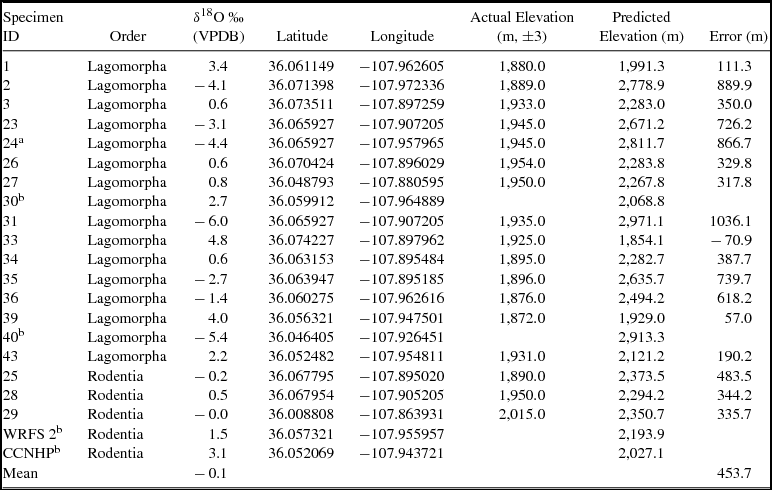
Modern small mammals from Chaco Canyon show wide variation in δ18O ratios (Figure 2a; Table 1). Modern lagomorphs range from −5.96‰ to 4.76‰ VPDB, and rodents range from −0.22‰ to 3.1‰ VPDB. These wide ranges in isotopic values, particularly for lagomorphs, exist despite small home ranges, their nonobligate drinking ecology, and a lack of any elevational differences in the origins of the specimens. The most likely explanation for this is the extreme seasonal shift of δ18O on the Colorado Plateau, from winter snowmelt measuring −11‰ to summer monsoonal rains measuring −3‰ (Asmerom et al. Reference Asmerom, Polyak, Burns and Rassmussen2007). The extent of this seasonal variation accounts for nearly the entire magnitude of variation observed in the modern dataset. There are no significant differences between modern rodents and modern lagomorphs (mean lagomorph δ18O = −0.45‰; mean rodent δ18O = 0.98‰ [Welch two-sample t-test, t = −1.3528; df = 17.563; p > 0.1]).
Box plots showing the distribution of enamel δ18O (VPDB) of (a) modern, local Chaco Canyon fauna and fauna from three archaeological sites within Chaco Canyon: (b) the Pueblo Bonito middens (from Grimstead, Quade, and Stiner Reference Grimstead, Quade and Stiner2016), (c) Pueblo Bonito's Room 28, and (d) Bc Site 57. Values from the Pueblo Bonito middens data reflect a correction of +0.36‰ to account for different treatment protocols (see text and Pellegrini and Snoeck Reference Pellegrini and Snoeck2016).

Modern Chaco Canyon Small-Mammal Faunal Data.

Note: δ18O ‰ (VPDB) values for modern fauna collected within Chaco Canyon, New Mexico. Table also shows elevation for each sample at the time of collection, the elevation predicted by oxygen isotope regression models (see Grimstead, Quade, and Stiner Reference Grimstead, Quade and Stiner2016), and the error between actual and predicted elevations.
a Specimen's latitude corrected to concurrently collected Specimen 23 due to transcription error.
b Specimens have approximate GPS coordinates and so were not included in elevation model calculations.
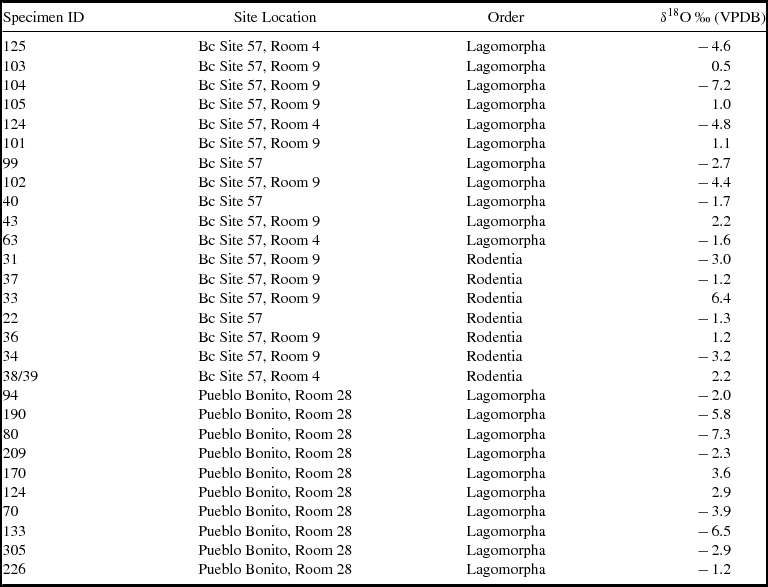
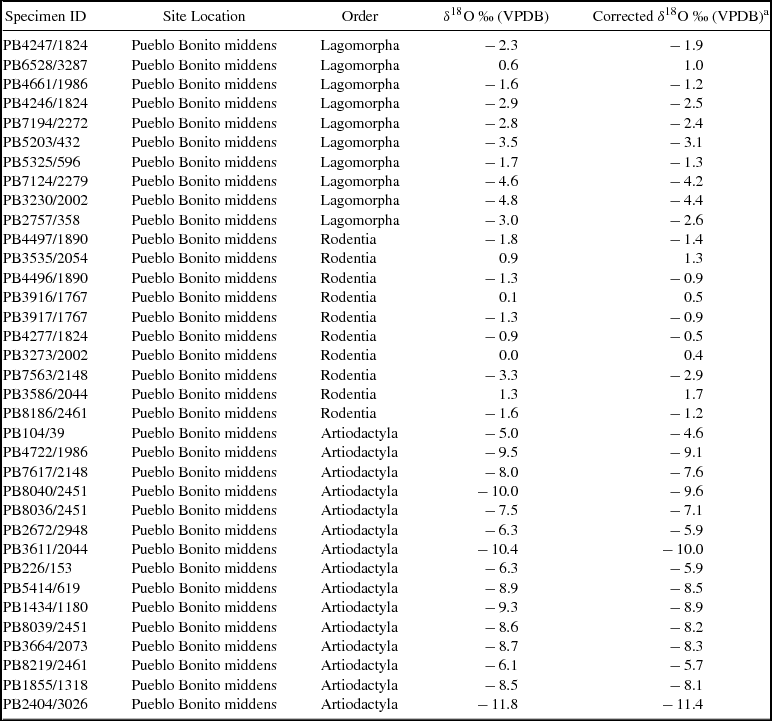
Archaeological small-mammal (lagomorph and rodent) specimens from Chaco Canyon range in values from −7.2‰ to 2.2‰ (lagomorphs) and −3.2‰ to 6.4‰ (rodents) at Bc 57, −7.3‰ to 3.6‰ (lagomorphs) from Room 28 of Pueblo Bonito, and −4.44‰ to 0.96‰ (lagomorphs) and −2.94‰ to 1.66‰ (rodents) in the Pueblo Bonito middens (data from Grimstead, Quade, and Stiner Reference Grimstead, Quade and Stiner2016, corrected for differing treatment protocols; Figure 2b–d; Tables 2 and 3). All of the variation observed in all three of these archaeological assemblages falls within the range of observed values for modern, wild Chaco Canyon fauna (Figure 3). One-way analysis of variance tests shows no significant differences between the δ18O values of the modern and archaeological lagomorphs (one-way analysis of variance, F = 1.463; df = 3; p > 0.1) or rodents (one-way analysis of variance, F = 0.26; df = 2; p > 0.1). There is no support for the inference that archaeological small mammals were imported to Chaco Canyon, because the entire range of oxygen isotope values observed in the archaeological assemblages is accounted for by variation within Chaco Canyon, as exemplified through our modern, local dataset.
Bc Site 57 and Pueblo Bonito Room 28 Faunal Data.

Pueblo Bonito Midden Faunal Data.

Note: Raw and corrected δ18O ‰ (VPDB) values from Pueblo Bonito middens (Grimstead, Quade, and Stiner Reference Grimstead, Quade and Stiner2016).
a 0.36‰ has been added to the original data to adjust for differing treatment protocols (see Pellegrini and Snoeck Reference Pellegrini and Snoeck2016 for details).
Box plots showing the distribution of enamel δ18O (VPDB) of (a) rodents, (b) lagomorphs, and (c) artiodactyls from modern, local Chaco Canyon fauna, Pueblo Bonito middens (from Grimstead, Quade, and Stiner Reference Grimstead, Quade and Stiner2016), Pueblo Bonito's Room 28, and Bc Site 57. Values from the Pueblo Bonito middens data reflect a correction of +0.36‰ to account for different treatment protocols (see text and Pellegrini and Snoeck Reference Pellegrini and Snoeck2016).

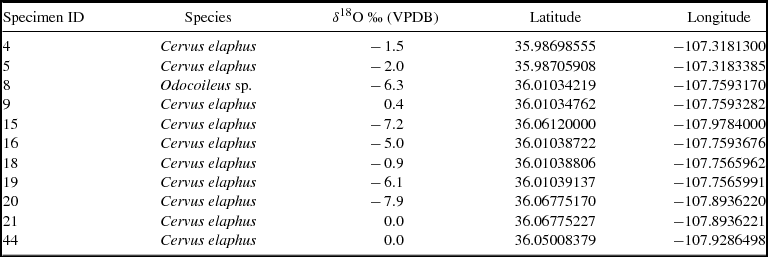
Modern artiodactyls have oxygen isotope values ranging from −7.86‰ to 0.43‰. This puts them significantly lower than modern rodents (Welch two-sample t-test, t = −7.8173; df = 15.78; p < 0.01) and modern lagomorphs (Welch two-sample t-test, t = −5.1783; df = 31.281; p < 0.01 [Figure 2a; Table 4]). This is likely due to the elevational gradient of their seasonal migration. These values are also significantly different from the values of archaeological artiodactyls excavated from Pueblo Bonito middens and reported by Grimstead, Quade, and Stiner (Reference Grimstead, Quade and Stiner2016), which range from −11.44‰ to −4.64‰ (data corrected for differing treatment protocols; Welch two-sample t-test, t = 4.6541; df = 14.746; p = 0.0006 [Figure 3c]). The archaeological samples have significantly lower ratios than those observed in modern artiodactyls, suggesting that unlike the small-mammal fauna, they may have been brought into the canyon from higher elevations, where the oxygen isotope ratios are expected to be more depleted.
Modern Chaco Canyon Artiodactyl Faunal Data.

Using δ18O values from our modern small-mammal (lagomorphs and rodents) dataset, we applied the regression models proposed by Grimstead, Quade, and Stiner (Reference Grimstead, Quade and Stiner2016) to calculate a predicted elevation for each specimen. These regression models consistently overestimated the elevational origins of the modern small mammals; only 17.6% of small-mammal specimens collected in Chaco Canyon were predicted to fall within their known elevational ranges (Table 1). If these were archaeological specimens, only three individuals would be correctly sourced, while 82.4% would be placed at higher elevations distant from the canyon. The average error in estimated elevation for modern, local small mammals was an overestimation of 494 m, with a maximum of 1,074 m. Based on this error rate, none of the archaeological small-mammal fauna can be convincingly placed at elevations outside of Chaco Canyon.
This is not to argue that oxygen isotope ratios are uninfluenced by elevation; rather, in this particular locality, the 8‰ annual range of seasonal isotopic variation when elevation is held constant is so large that isotopic signals from elevational differences are obscured. Elevation-only sourcing models fail to account for other factors such as extreme seasonal precipitation regimes that can lead to significant local δ18O variation. Modern datasets provide a method to establish what variation in the archaeological record is relevant to elevation and what is simply local variability. Unless there is a significant difference from known local values, as we see in the artiodactyls of Chaco Canyon, there is no basis for assigning elevation as the causal mechanism for the observed variation. δ18O variation in archaeological small mammals from Chaco Canyon does not differ from that observed in modern, endemic small-mammal fauna. Therefore the most parsimonious explanation for this variation is seasonal precipitation regimes leading to variable local δ18O both in the present and in the past.
Conclusion
Archaeological small mammals from Chaco Canyon do not differ in their oxygen isotope ratios from modern, local small mammals found within Chaco Canyon, while archaeological artiodactyls have significantly lower oxygen isotope ratios than their local, modern counterparts. Our analyses support well-established hypotheses (Akins Reference Akins, Schelberg and Judge1984; Badenhorst, Driver, and Maxwell Reference Badenhorst, Driver, Maxwell and Crown2016; Speth and Scott Reference Speth, Scott and Kent1989) about faunal procurement: Chacoans hunted rodents and lagomorphs close to their homes but acquired artiodactyls from more distant localities. The mechanisms for long-distance procurement are not evident in these data but surely involved a mix of direct acquisition by canyon-based hunters and exchange between dispersed farming communities (Akins Reference Akins, Schelberg and Judge1984).
Isotope analysis is a powerful tool for investigating past patterns and behaviors associated with faunal resource acquisition, but this study highlights the necessity of including analogous modern datasets when using archaeological isotope samples. In particular, when using oxygen isotopes to establish provenance in archaeological contexts, it is imperative to (1) empirically define expected modern variation in local flora/fauna samples, (2) demonstrate an effect size in archaeological samples that exceeds the measured modern variation, and (3) establish a causal mechanism to explain these results. With this groundwork established, oxygen isotopes provide a useful proxy for either migration or transport.
Acknowledgments
All modern faunal specimens were collected under Natural Resources Permit No. CHCU-2013-SCI-0001 to W. H. Wills and Emily Jones. Patricia Crown directed the Room 28 excavations with funding from the National Endowment for the Humanities (RZ-51417-13) and the National Geographic Society (9276-13), permitted by the National Park Service (ARPA Permit 13-CHCU-01); some of the stable isotope analyses were funded by the National Endowment for the Humanities grant. Permission to analyze specimens from Bc 57 was obtained from the Maxwell Museum of Anthropology. W. H. Wills directed the Pueblo Bonito trash mound excavations with funding from the National Science Foundation (BCS-0408720), the National Geographic Society, the Western National Parks Association, and the University of New Mexico. This study is based partially upon work supported by the National Science Foundation Graduate Research Fellowship to Marian Hamilton under Grant No. DGE-0903444. We are deeply grateful for assistance from Jim Von Haden, Dabney Ford, and Roger Moore of the National Park Service and Dr. David Phillips and Karen Price of the Maxwell Museum of Anthropology. Drs. Laura Burkemper, Viorel Atudorai, and Seth Newsome assisted with processing samples at the University of New Mexico Center for Stable Isotopes. We would also like to thank Dr. Maria Franco de Gomez for providing translations, Samantha Ascoli for assistance with faunal identification, and Dr. Sherry Nelson for valuable advice and input.
Data Availability Statement
All data are available in tables within the article. All R code used for analyses and figure development code will be made available upon e-mail request to the lead author.