Implications
Sheep farmers face financial, production and environmental challenges as they seek to develop their farms; therefore, grass-based systems need forage species that will aid farmers in meeting these challenges. Multispecies swards have the potential to increase dry matter production from lower nitrogen inputs while increasing ewe and lamb performance in terms of (a) higher average daily gains; (b) reduced days to slaughter; (c) heavier ewe weight and body condition score and (d) reducing the requirement for chemical anthelmintic administration, which may aid the sustainable control of helminths.
Introduction
Sheep production systems in temperate regions of the world are predominantly grass-based, where herbage can supply up to 95% of dietary energy requirements (Davies and Penning, Reference Davies and Penning1996; Earle et al., Reference Earle, McHugh, Boland and Creighton2017). Swards are dominated by perennial ryegrass (Lolium perenne) with small quantities of white clover (Trifolium repens) in some instances (Waghorn and Clark, Reference Waghorn and Clark2004). Optimising the proportion of grazed herbage used in the system can increase the profitability of sheep production due to the lower production cost of grass compared to alternative feeds (Bohan et al., Reference Bohan, Shalloo, Creighton, Earle, Boland and McHugh2018).
Perennial ryegrass swards are highly productive under high nitrogen (N) input levels, with the potential to grow between 12 and 15 tonnes of dry matter (DM) per hectare (DM/ha) in Ireland (O’Donovan et al., Reference O’Donovan, Lewis and O’Kiely2011) and are of high nutritional value, with a CP content of 221 to 240 g/kg DM and a metabolisable energy content of 9.9 to 10 MJ/kg DM (Fulkerson et al., Reference Fulkerson, Neal, Clark, Horadagoda, Nandra and Barchia2007). Multispecies swards (with grasses, legumes and herbs) can produce higher DM yields from lower N inputs (Jing et al., Reference Jing, Soegaard, Cong and Eriksen2017), with concurrent improvements in feeding value in herb/clover containing swards (Kemp et al., Reference Kemp, Kenyon and Morris2010). Recent studies indicate that herbs (ribwort plantain (Plantago lanceolata), chicory (Cichorium intybus), and clover (white and red clover (Trifolium pratense)) containing swards support improved ewe and lamb performance during lactation (Kenyon et al., Reference Kenyon, Kemp, Stafford, West and Morris2010; Hutton et al., Reference Hutton, Kenyon, Bedi, Kemp, Stafford, West and Morris2011) and for finishing the weaned lamb (Golding et al., Reference Golding, Wilson, Kemp, Pain, Kenyon, Morris and Hutton2011; Somasiri, Reference Somasiri2014).
Internal parasites (including Nematodirus and Trichostrongylus which dominate in Ireland (Kelly et al., Reference Kelly, Good, Hanrahan, Fitzpatrick and DeWaal2009)) cause significant production and economic losses in sheep flocks primarily due to sub-clinical infection and can reduce lamb growth rate by up to 40% (Marley et al., Reference Marley, Cook, Kearinge, Barrett and Lampkin2003). The rapid and widespread development of anthelmintic resistance within gastrointestinal parasites necessitates development of alternative control strategies (McRae et al., Reference McRae, Stear, Good and Keane2015). The inclusion of herbs and other alternative species can reduce the parasitic burden of grazing animals. Studies conducted by Marley et al. (Reference Marley, Cook, Kearinge, Barrett and Lampkin2003) and Pena-Espinoza et al. (Reference Pena-Espinoza, Thamsborg, Desrues, Hansen and Enemark2016) show a reduction in internal parasites (Teledorsagia and Trichostrongylus spp.) in ruminants grazing chicory. Reduction in internal parasites and 42% lower faecal egg counts (FEC) in studies feeding ribwort plantain to ewes (Teledorsagia spp.; Judson et al., Reference Judson, McAnulty and Sedcole2009) and a 49% lower helminth parasitic intensity when feeding birdsfoot trefoil (Lotus corniculatus) to lambs have also been reported (Marley et al., Reference Marley, Cook, Kearinge, Barrett and Lampkin2003).
To date, the potential of multispecies swards containing a combination of grasses, legumes and herbs to improve ewe and lamb performance and lamb FEC throughout the entire production year has not been investigated. It was hypothesised that multispecies swards would improve ewe (increased weight and body condition score (BCS)) and lamb (increased average daily gain (ADG) and reduced days to slaughter) performance compared to perennial ryegrass only swards, and that the herb containing pastures would reduce the parasitic burden and subsequent requirement for chemical anthelmintics. In the current study, the effect of grass, legume and herb containing swards on ewe and lamb performance and lamb FEC compared to perennial ryegrass only swards was investigated.
Materials and methods
The study was conducted over two consecutive grazing seasons from April to December 2015 and from March to November 2016 at University College Dublin, Lyons Farm (53°17 N, 6°31 W, and 230 m above sea level) with a shallow, calp limestone soil.
Experimental design
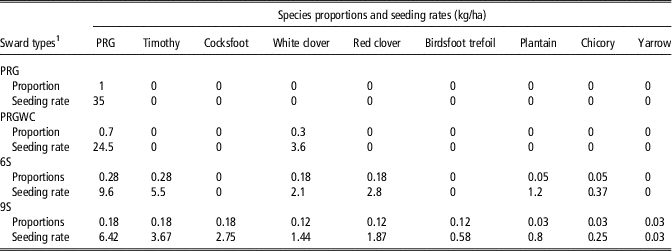
A complete randomised block design was used to investigate the effect of four sward types on ewe and lamb performance. Four experimental farmlets were established in early September 2014. The four sward types were: perennial ryegrass only, receiving 163 kg nitrogen per hectare per year (kg N/ha/yr) (PRG); perennial ryegrass and white clover sward receiving 90 kg N/ha/yr (PRGWC); a six species sward containing two grasses (perennial ryegrass and timothy (Phleum pratense)), two legumes (white and red clover) and two herbs (ribwort plantain and chicory) receiving 90 kg N/ha/yr (6S); a nine species sward (9S) contained each of the species included in the 6S sward and an additional grass, legume and herb, that is cocksfoot (Dactylis glomerata), greater birdsfoot trefoil (Lotus pedunculatus) and yarrow (Achillea millefolium) receiving 90 kg N/ha/yr. Seeding rates for individual species are presented in Table 1. For each species included, three varieties were included in equal proportions (excluding greater birdsfoot trefoil, ribwort plantain and yarrow where only two varieties of each was available). The varieties used were as follows: perennial ryegrass: Tyrella, Kintyre and Aberchoice; timothy: Presto, Alma and Erecta; cocksfoot: Prato, Beluga and Lidacta; white clover: Chieftain, Barblanca and Crusader; red clover: Merviot, Milvus and Austur; birdsfoot trefoil: German Landrace and Cascade; plantain: Tonic and Endurance; chicory: Puna, Choice and Chico; and yarrow: German Landrace and Wild-type. Inorganic nutrients, based on soil test results, were applied uniformly across the experimental area annually as follows: 250 kg granulated lime/ha and 19 kg phosphorus (P)/ha in the form of super 16P (16% P).
The proportions and the seeding rate (kg/ha) sown of each species per sward type

1 PRG = perennial ryegrass only; PRGWC = perennial ryegrass and white clover; 6S = 6 species (perennial ryegrass, timothy, white clover, red clover, plantain and chicory); 9S = 9 species (perennial ryegrass, timothy, cocksfoot, white clover, red clover, birdsfoot trefoil, plantain, chicory and yarrow).
An area of 9.6 ha was used for the duration of the experiment. The area was divided into five blocks and each block is divided into four paddocks, with one paddock per block randomly assigned to one of four sward types. Five paddocks of each sward type represented a farmlet, resulting in four farmlets. Each farmlet consisted of 2.4 ha and was managed in a five-paddock rotational system. Each farmlet was stocked at a stocking rate of 12.5 ewes/ha.
Animal management
Each year 120 (n = 30 per sward type) twin-rearing ewes and their associated 240 (n = 60 per sward type) lambs were enrolled in the study. All animals remained on their allocated sward type for the duration of the grazing season unless they were culled or died, in which case replacement ewes and lambs were introduced to maintain the stocking rate. Measurements were not taken from replacement animals. Ewes were blocked for combined litter birth weight (10.7 ± 1.83 kg) and balanced for BW (77.6 ± 10.43 kg), BCS 24 h post-lambing (PL) (2.90 ± 0.296 BCS), age (3.75 ± 1.233 years), ewe sire breed, lamb sire breed and lamb gender. Male lambs were castrated 24 h PL. Ewes and lambs were of mixed breed (Suffolk, Texel, Vendeen and Charolais). Animals were introduced to experimental farmlets 28 days PL in 2015 and 48 h PL in 2016.
Grazing management
The experiment started at animal turnout to pasture annually and continued until all lambs reached slaughter weight and the ewes were housed. Housing took place in early December in 2015 and late November in 2016. Pre-grazing herbage biomass was measured by taking three quadrat (0.25 m2) (Golding et al., Reference Golding, Wilson, Kemp, Pain, Kenyon, Morris and Hutton2011) cuts to a height of 4 cm above ground level (validated using a sward stick) and all harvested herbage was weighed before each grazing event. A 100 g sub-sample of the harvested herbage was dried in a draught oven at 55°C for 72 h for DM determination and then used to calculate herbage biomass. The dried sample was subsequently ground through a 1 mm sieve (Christy and Norris Hammer Mill, Chelmsford, England) and stored before chemical composition analysis.
Target pre-grazing herbage biomass was 1200 kg DM/ha for the duration of the experiment. Target post-grazing sward height (PGSH) was 4 cm for all rotations. Post-weaning, a leader–follower system was operated with lambs grazing ahead of the ewes within their allocated sward type. Lambs were removed from paddocks at a PGSH of 5 cm, with ewes immediately introduced to achieve a PGSH of 4 cm. Sward height was measured by taking 50 compressed sward height measurements (walking in a W pattern across the paddock) using a rising platemeter (diameter 355 mm and 3.2 kg/m²; Jenquip, Feilding New Zealand) after each grazing event to obtain the PGSH. In early September (6 weeks pre-breeding) each year, the leader–follower system ceased and the ewes were given access to pasture with a target pre-grazing herbage biomass of 1200 kg DM/ha from early September until housing. Average rotation length was 35 days (± 3.6) and average residency time in each paddock was 6.2 days (± 0.8). Fresh water was continuously available.
Herbage supply was measured weekly using the farm cover technique described by O’Donovan (Reference O’Donovan2000). When the grazing days ahead dropped below 10 and herbage production was lower than demand, the lambs were supplemented with concentrates (17% CP commercial lamb ration consisting of 37% barley, 12% distillers dried grains, 11% soya bean meal, 11% soya hulls, 8% maize, 7% corn gluten and 6% molasses, 3% pollard pellets, 3% limestone, 0.9% salt, 0.6% oil and 0.5% minerals on a DM basis). In year 1, the levels of concentrates supplemented per sward type were as follows: PRG: 8 kg/ewe, PRGWC: 19 kg/ewe, 6S: 7 kg/ewe and 9S: 18 kg/ewe. Lambs received 100 g/lamb/day for the first 2 days of supplementation, 200 g/lamb/day for the next 2 days of supplementation and 300 g/lamb/day until the grass supply was equal to demand. When daily herbage growth was greater than demand, concentrates were removed. There was no requirement for concentrate supplementation in year 2. Surplus herbage was conserved as baled silage when there was >25 grazing days ahead.
Herbage botanical composition
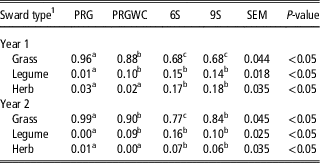
A pre-grazing quadrat (0.25 m2, above 4 cm) sample of herbage was taken using Gardena hand shears (Accu 60, Gardena International GmbH, Ulm, Germany) at a random location in each paddock before each grazing event in the first rotation. The sample was mixed thoroughly and a 150 g sample was removed and separated into grass, legume and herb fractions. Fractions were dried at 45°C for 48 h to determine the DM proportions of each functional group. Proportions of each functional group (grass, legume and herb) in the first grazing rotation of each year per sward type are presented in Table 2.
The proportions of each functional group in the first grazing rotation of each year (year 1 and 2) per sward type

a,b,c Within rows, means with differing superscripts differ significantly.
1 PRG = perennial ryegrass only; PRGWC = perennial ryegrass and white clover; 6S = 6 species (perennial ryegrass, timothy, white clover, red clover, plantain and chicory); 9S = 9 species (perennial ryegrass, timothy, cocksfoot, white clover, red clover, birdsfoot trefoil, plantain, chicory and yarrow).
Herbage chemical composition
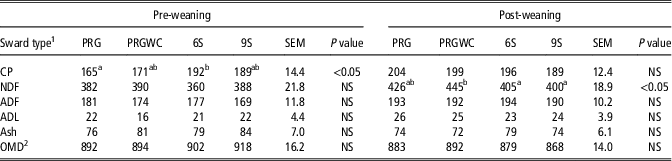
Dried herbage samples were bulked by rotation within sward type and subsequently analysed for absolute DM, ash, NDF, ADF, ADL, CP, as described by Campion et al. (Reference Campion, McGovern, Lott, Fahey, Creighton and Boland2016), and organic matter digestibility (OMD) using the in vitro method described by Tilley and Terry (Reference Tilley and Terry1963). The nutritive composition of the offered herbage pre- and post-weaning is presented in Table 3.
The effect of sward type on the nutritive composition of grazed herbage pre- and post-weaning (g per kg DM; least square means ± SEM)

NS = non-significant (P > 0.05).
a,b Within rows, means with differing superscripts differ significantly.
1 PRG = perennial ryegrass only; PRGWC = perennial ryegrass and white clover; 6S = 6 species (perennial ryegrass, timothy, white clover, red clover, plantain and chicory); 9S = 9 species (perennial ryegrass, timothy, cocksfoot, white clover, red clover, birdsfoot trefoil, plantain, chicory and yarrow).
2 OMD = organic matter digestibility.
Animal measurements
Ewe measurements
Ewes were weighed using a portable electronic scale (Prattley, Temuka, New Zealand) and live weight was recorded electronically (Tru-Test Group, Auckland, New Zealand) fortnightly following turnout to weaning (14 weeks PL) and every 4 weeks from weaning to housing. Ewe BCS was recorded at 24 h PL, 6 weeks PL, weaning, breeding (mid-October) and housing. BCS assessments were made by a single trained observer annually and ewes were scored on a scale of 1 to 5 at 0.25 increments according to Russel et al. (Reference Russel, Doney and Gunn1969).
Lamb measurements
Lambs were weighed fortnightly as described earlier. Weights were used to calculate ADG by regression of live weight on time. Lambs were drafted for slaughter at 45 kg live weight. Any lambs drafted before or after this weight was achieved had their days to slaughter corrected for live weight before statistical analysis. At slaughter, cold carcass weights were recorded and subsequently used to calculate kill-out percentage (KO%). KO% was calculated as cold carcass weight (kg) divided by pre-slaughter live weight (kg) multiplied by 100. Carcass confirmation was scored using the five-point scale, EUROP grid system (E = excellent and P = poor) and external fat score was scored using a 1 to 5 scoring system in order of increasing fatness (1 = low fat cover; 5 = high fat cover) in which class 4 was divided into a low (L) and high (H) sub-class. For purposes of statistical analysis, the conformation classes were recoded as 1 to 5 (1 = P to 5 = E) and fat classes coded as 1, 2, 3, 3.75, 4.25, 5 (corresponding to 1, 2, 3, 4L, 4H and 5, respectively), as described by Hanrahan (Reference Hanrahan1999).
Faecal egg count
Beginning at 6 weeks of age, faecal samples were collected from each individual lamb fortnightly. Faecal samples were collected per rectum if lambs were not observed defecating and FEC were determined using the modified McMaster method described by Kelly et al. (Reference Kelly, Good, Hanrahan, Fitzpatrick and DeWaal2009). Parasitic eggs were distinguished as Nematodirus and Trichostrongylus.
All lambs received anthelmintic treatment at 12 weeks of age to combat Nematodirus infection (75 mg levamisole/10 kg BW), and subsequent anthelmintic treatments were administered in response to group parasite challenge (when a threshold of 400 eggs per gram was reached) as defined by FEC.
Statistical analysis
Data were analysed as a complete randomised block design using the mixed model procedure (PROC MIXED) in SAS (SAS, version 9.4, Inst. Inc., Cary, NC, USA). Individual ewe was the experimental unit for all ewe and lamb parameters analysed until weaning and changed to the individual lamb thereafter. Data distributions were analysed to fit the assumptions of normality using the UNIVARIATE procedure. The initial statistical model used for all parameters included the fixed effect of sward type, year, ewe breed and age and random effect of ewe, while the ewe data were adjusted for live weight and BCS at the beginning of the experiment by covariance. Any variable with a P-value of >0.25 was removed. The final statistical model used included the fixed effect of sward type, ewe breed and age and random effect of ewe. Lamb birth weight was fitted as a covariate for all lamb parameters analysed and repeated measure analysis was performed on lamb live weight, ADG and FEC data. Fixed effects of lamb age, sex and birth date were significant and included in the model. The repeated measures were fit using variance–covariance structures with the most appropriate (lowest Bayesian information criterion values) used for each analysis. The limitations of sward type and flock replication in this study were overcome by repeating the study over two consecutive years, with no sward type by year interactions observed. All data presented in the tables are expressed as least squares means ± SEM. The probability value which denotes statistical significance is P⩽0.05 and tendencies are denoted by P⩽0.10.
Results
Provisional results from year 1 of this study were presented as a conference paper in 2016 (Grace et al., Reference Grace, Boland, Fritch, Sheridan and Lynch2016).
Ewe performance
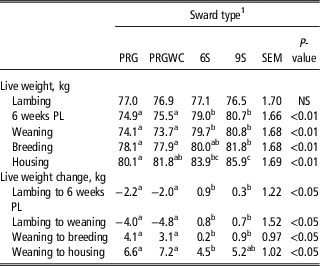
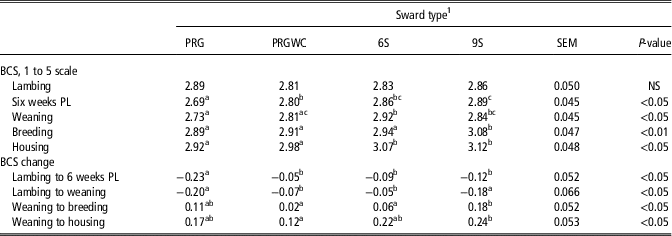
The effects of sward type on ewe live weight and live weight change and BCS and BCS change are presented in Tables 4 and 5, respectively. Ewes grazing the 6S and 9S swards had significantly heavier (P < 0.01) live weights 6 weeks PL and at weaning than ewes grazing the PRG or PRGWC swards. Ewes grazing the 6S and 9S swards gained weight from lambing to weaning compared to the ewes grazing the PRG and PRGWC swards which lost weight (P < 0.05). At breeding and housing, ewes grazing the 6S and 9S swards had heavier (P < 0.01) live weights than the ewes grazing the PRG sward.
The effect of sward type on ewe (ovine) live weight and live weight change at 6 weeks post-lambing (6 weeks PL), weaning, breeding and housing (least square means ± SEM)

NS = non-significant (P > 0.05).
a,b,c Within rows, means with differing superscripts differ significantly.
1 PRG = perennial ryegrass only; PRGWC = perennial ryegrass and white clover; 6S = 6 species (perennial ryegrass, timothy, white clover, red clover, plantain and chicory); 9S = 9 species (perennial ryegrass, timothy, cocksfoot, white clover, red clover, birdsfoot trefoil, plantain, chicory and yarrow).
The effect of sward type on ewe (ovine) body condition score (BCS) and BCS change at 6 weeks post-lambing (6 weeks PL), weaning, breeding and housing (least square means ± SEM)

NS = non-significant (P > 0.05).
a,b,c Within rows, means with differing superscripts differ significantly.
1 PRG = perennial ryegrass only; PRGWC = perennial ryegrass and white clover; 6S = 6 species (perennial ryegrass, timothy, white clover, red clover, plantain and chicory); 9S = 9 species (perennial ryegrass, timothy, cocksfoot, white clover, red clover, birdsfoot trefoil, plantain, chicory and yarrow).
Ewes grazing the 6S and 9S swards had higher BCS than the ewes grazing the PRG sward 6 weeks PL, at weaning and at housing (P < 0.05). At breeding, ewes grazing the 9S sward had higher (P < 0.01) BCS than ewes grazing all other swards. Ewes grazing the PRG sward lost more BCS than ewes grazing all other sward types from lambing to 6 weeks PL (P < 0.05).
Lamb performance
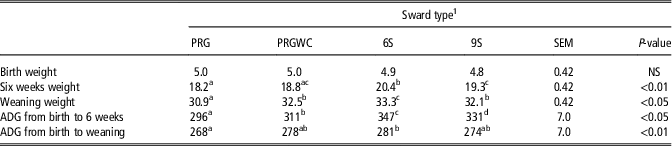
The effect of sward type on lamb live weight and ADG is presented in Table 6. Lambs grazing the 6S sward had significantly heavier live weights at 6 weeks old (P < 0.01) compared to the PRG, PRGWC and 9S swards. Lambs grazing the PRG sward had lighter (P < 0.05) weaning weights compared to the lambs grazing all other swards. Lambs grazing the PRG sward had the lowest ADG from birth to weaning and was lower (P < 0.01) than the lambs grazing all other sward types, which did not differ from each other (P > 0.05).
The effect of sward type on lamb (ovine) live weight (kg) at birth, at 6 weeks and 14 weeks and lamb average daily gain (ADG, g/day) (least square means ± SEM)

NS = non-significant (P > 0.05).
a,b,c,d Within rows, means with differing superscripts differ significantly.
1 PRG = perennial ryegrass only; PRGWC = perennial ryegrass and white clover; 6S = 6 species (perennial ryegrass, timothy, white clover, red clover, plantain and chicory); 9S = 9 species (perennial ryegrass, timothy, cocksfoot, white clover, red clover, birdsfoot trefoil, plantain, chicory and yarrow).
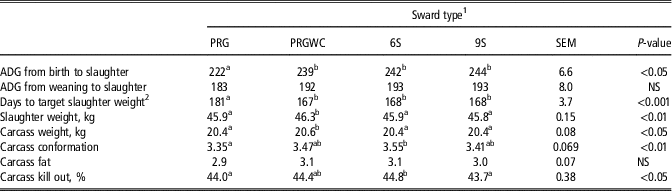
The effect of sward type on the lifetime ADG, the number of days to reach target slaughter weight and carcass traits are presented in Table 7. Lambs grazing the PRG sward had the lowest ADG from birth to slaughter (P < 0.05) and lambs grazing all other sward types did not differ (P > 0.05). As a result, lambs grazing the PRG sward had the longest number of days to slaughter (P < 0.001) with other sward types not differing from one another (P > 0.05). Lambs grazing the PRGWC sward had the heaviest slaughter weight (P < 0.01) which resulted in a heavier carcass weight (P < 0.05). Lambs grazing the PRG sward had the lowest carcass conformation (P < 0.05). Lambs on the 6S sward had a higher KO% than lambs on the PRG and 9S swards (P < 0.05) but did not differ from the lambs grazing the PRGWC sward.
The effect of sward type on the lambs (ovine) post-weaning and lifetime average daily gain (ADG, g/day), days to slaughter and carcass traits (least square means ± SEM)

a,b Within rows, means with differing superscripts differ significantly.
1 PRG = perennial ryegrass only; PRGWC = perennial ryegrass and white clover; 6S = 6 species (perennial ryegrass, timothy, white clover, red clover, plantain and chicory); 9S = 9 species (perennial ryegrass, timothy, cocksfoot, white clover, red clover, birdsfoot trefoil, plantain, chicory and yarrow); NS = non significant (P > 0.05).
Lamb faecal egg count
The effect of sward type on the Trichostrongylus FEC at 12 weeks old, the days between anthelmintic treatments and the number of anthelmintic treatments required is presented in Table 8. At 12 weeks old, the Trichostrongylus FEC was lowest (P < 0.05) in the lambs grazing the PRGWC and 6S swards. The interval between the requirement for a first and second treatment was greatest for the lambs grazing the 9S sward (59 days), followed by the lambs grazing the 6S sward (51 days), the PRGWC sward (41 days) and the PRG sward (36 days; P < 0.05). A similar trend occurred for the requirement for a third anthelmintic treatment; however, there was no requirement for administration of a third treatment to the lambs grazing the 9S sward. Subsequently, lambs grazing the 6S and 9S swards received fewer anthelmintic treatments than the lambs grazing the PRG and PRGWC swards (P < 0.001).
The effect of sward type on Trichostrongylus faecal egg count (FEC) at 12 weeks old, the days between anthelmintic treatments and the total number of anthelmintic treatments administered to lambs (ovine) (least square means ± SEM)

a,b,c,d Within rows, means with differing superscripts differ significantly.
1 PRG = perennial ryegrass only; PRGWC = perennial ryegrass and white clover; 6S = 6 species (perennial ryegrass, timothy, white clover, red clover, plantain and chicory); 9S = 9 species (perennial ryegrass, timothy, cocksfoot, white clover, red clover, birdsfoot trefoil, plantain, chicory and yarrow).
2 epg: Eggs per gram.
Discussion
It was hypothesised that multispecies swards would improve ewe and lamb performance compared to perennial ryegrass only swards and that the herb containing swards would reduce the parasitic burden and reduce the requirement for chemical anthelmintic treatment. This hypothesis is accepted.
Ewes grazing herb/clover mixes have increased live weight and BCS during early lactation compared to ewes grazing ryegrass and white clover swards (Kenyon et al., Reference Kenyon, Kemp, Stafford, West and Morris2010; Hutton et al., Reference Hutton, Kenyon, Bedi, Kemp, Stafford, West and Morris2011; Corner-Thomas et al., Reference Corner-Thomas, Kemp, Morris and Kenyon2014). Similar responses were achieved in the current study despite the fact that the multispecies swards were dominated by the grass proportion of the sward indicating that lower inclusion levels of these species (herb and legumes) than reported heretofore can still elicit positive ewe performance responses. Heavier live weight at the end of lactation from the ewes grazing the 6S and 9S swards in this study were similar to that found by Kenyon et al. (Reference Kenyon, Kemp, Stafford, West and Morris2010) and were reported as likely to improve ewe productivity the following year (Hutton et al., Reference Hutton, Kenyon, Bedi, Kemp, Stafford, West and Morris2011). No intake measurements were conducted in the current study, however, Barry (Reference Barry1998) reported higher voluntary feed intake, in addition to enhanced nutritive value of the herbage of herb/clover mixes relative to perennial ryegrass only swards. In the current study the potential nutritional benefit of herb and legume inclusion in the multispecies swards was likely partially diluted by the inclusion of grass species in these swards also. Despite this, the lower NDF and higher CP content in the 6S and 9S swards (Grace et al., Reference Grace, Boland, Sheridan, Lott, Brennan, Fritch and Lynch2018) may have contributed to an improvement in the overall feeding value potentially increasing intakes of sheep grazing these swards thus increasing animal performance. The elevated lamb performance to 6 weeks old and the more favourable BCS profile of the ewes offered multispecies swards points to a more positive nutritional scenario for these ewes compared to their counterparts grazing perennial ryegrass only.
Ewe milk yield and composition explains the greatest proportion of lamb live weight gain to 42 days old (Danso et al., Reference Danso, Morel, Kenyon and Blair2016) as the lamb is largely dependent on milk intake to meet its nutritional requirements. Therefore, heavier lamb weights at 6 weeks old would suggest better performance in lactation by their dams. Ewes grazing herb/clover mixes produced between 17 and 25% more milk than ewes grazing ryegrass and white clover swards up to day 21 of lactation (Hutton et al., Reference Hutton, Kenyon, Bedi, Kemp, Stafford, West and Morris2011) with similar increases reported for dairy cows (Waghorn and Clark, Reference Waghorn and Clark2004; Roca-Fernandez et al., Reference Roca-Fernandez, Peyraud, Delaby and Delagarde2016).
Any increase in sward complexity, beyond perennial ryegrass only, elevated lamb performance to 6 weeks old in this study and the lack of difference in ADG from 6 weeks to weaning (226, 228, 223 and 221 g/day for the PRG, PRGWC, 6S and 9S, respectively) indicates that the lighter live weight at weaning of the lambs grazing PRG relative to all other sward types is largely linked to the weight differences present at 6 weeks old. In agreement, Hutton et al. (Reference Hutton, Kenyon, Bedi, Kemp, Stafford, West and Morris2011) and Corner-Thomas et al. (Reference Corner-Thomas, Kemp, Morris and Kenyon2014) reported elevated ADG to weaning for lambs grazing herb/clover mixes and subsequently heavier weaning weights.
As lactation progresses, milk production declines and herbage intake constitutes a higher proportion of the lamb’s daily intake (Van der Linden et al., Reference Van der Linden, Kenyon, Blair, Lopez-Villalobos, Jenkinson, Peterson and MacKensie2009). Therefore, herbage quality and availability will have a significant influence on lamb growth rate in the late pre-weaning period (Coop et al., Reference Coop, Clark and Claro1972). The lack of difference in lamb performance from 6 weeks old until weaning indicates that differences in sward quality at this time of the season were minimal as supported by Grace et al. (Reference Grace, Boland, Sheridan, Lott, Brennan, Fritch and Lynch2018).
Studies with lambs grazing herb/clover mixes post-weaning have shown higher growth rates (Golding et al., Reference Golding, Wilson, Kemp, Pain, Kenyon, Morris and Hutton2011; Somasiri, Reference Somasiri2014) relative to perennial ryegrass dominant swards, but those ADG improvements were not recorded in this study. It is important to note, however, that in the current study, the PRG sward was of higher quality than that of the perennial ryegrass swards in the aforementioned studies (OMD for the post-weaning period was 883 g/kg in the current study compared to 641 and 683 g/kg in Golding et al. (Reference Golding, Wilson, Kemp, Pain, Kenyon, Morris and Hutton2011) and Somasiri (Reference Somasiri2014), respectively) and also based on the botanical composition completed that the multispecies swards in the current study were dominated by grasses. The improvements in days to slaughter for lambs grazing the PRGWC, 6S and 9S swards were a result of increased ADG from birth to slaughter, however, there is very little evidence in the literature reporting time to slaughter of lambs grazing herb/clover mixes as there is a paucity of systems studies that follow the lamb from birth to slaughter. Mean days to slaughter in the current study (166 to 181 days) compare favourably with systems work carried out by Earle et al. (Reference Earle, McHugh, Boland and Creighton2017) who report days to slaughter for spring born lambs on a grass-based system of between 215 and 230 days. Reduced days to slaughter in the current study is likely a result of the high weaning weights achieved by lambs on all sward types (Galvani et al., Reference Galvani, Pires, Hübner, Carvalho and Wommer2014). For meat producers, accelerated slaughter date increases system efficiency and a consequence of this efficiency is reduced methane produced per unit weight gain by the lamb (Waghorn et al., Reference Waghorn, Tavendale and Woodfield2002). In addition, the herbage saved by the earlier lamb slaughter can be allocated to breeding animals (Kemp et al., Reference Kemp, Kenyon and Morris2010).
The reduced carcass conformation of the lambs on the PRG sward compared to lambs grazing the other sward types and the improved carcass KO% with the lambs grazing the PRGWC and 6S swards are similar to results from studies by Somasiri (Reference Somasiri2014) and Golding et al. (Reference Golding, Wilson, Kemp, Pain, Kenyon, Morris and Hutton2011). Higher KO%, carcass weight and GR soft tissue depths (thickness of tissue over the 12th rib 110 mm from the midline of the carcass, measure of conformation in New Zealand) in lambs grazing herb/clover swards compared to lambs grazing ryegrass only swards were achieved in those studies, suggesting that the higher nutritive value of the herb/clover mixes resulted in the lambs having more energy for growth and maintenance compared to the lambs grazing the perennial ryegrass dominant swards (Golding et al., Reference Golding, Wilson, Kemp, Pain, Kenyon, Morris and Hutton2011; Somasiri, Reference Somasiri2014). There were minimal differences in the quality of the herbage consumed across sward types in the current study (Grace et al., Reference Grace, Boland, Sheridan, Lott, Brennan, Fritch and Lynch2018) with the exception of lower NDF content during the summer season and higher CP content pre-weaning for the 6S sward. However, a direct relationship is known to exist between NDF content and intake (Pain et al., Reference Pain, Corkran, Kenyon, Morris and Kemp2015) and potentially this supported higher intakes and hence more energy available for finishing this cohort of lambs. Grace et al. (Reference Grace, Boland, Sheridan, Lott, Brennan, Fritch and Lynch2018) reported similar herbage production from all swards in this study but higher utilisation rates in the 6S and 9S swards insinuating higher intakes from these swards compared to the other sward types.
Emergence of resistance to chemical anthelmintics forces farmers to seek alternative and more sustainable parasitic control methods (McRae et al., Reference McRae, Stear, Good and Keane2015). In the current study, there was a reduced requirement for anthelmintic usage in the herb containing swards (6S and 9S swards based on the botanical composition completed) supported by reported reductions in FECs in lambs grazing chicory (Marley et al., Reference Marley, Cook, Kearinge, Barrett and Lampkin2003) and plantain (Judson et al., Reference Judson, McAnulty and Sedcole2009). This may be due to chicory and plantain’s secondary compound content, that is condensed tannins (Waghorn et al., Reference Waghorn, Charleston, Niezen and Robertson1995) which are proposed to have anthelmintic properties or by improved protein utilisation of the host animal (Judson et al., Reference Judson, McAnulty and Sedcole2009). Marley et al. (Reference Marley, Cook, Kearinge, Barrett and Lampkin2003) also proposed that improved mineral and trace element status of the animals due to the elevated trace element concentrations of herbs (Pirhofer-Walz et al., Reference Pirhofer-Walz, Soegaard, Hogh‐Jensen, Eriksen, Sanderson and Rasmussen2011) may contribute to reduced parasitic burden or improved immunity to helminth parasites.
Conclusion
Results indicate that there are production advantages of grazing ewes and lambs on multispecies swards compared to perennial ryegrass only swards throughout the production year. Further research is required to develop management blueprints to ensure the successful incorporation of multispecies swards into pasture-based sheep production systems.
Acknowledgements
This work was funded by the Irish Government under the National Development Plan 2007 to 2013 through the Department of Agriculture Food and the Marine Research Stimulus Fund: RSF 11/S/147: Smartgrass.
Declaration of interest
The authors declare they have no competing interests.
Ethics statement
All procedures involving animals in this study were conducted under experimental licence from the Health Products Regulatory Authority in accordance with the European Union (protection of animals used for scientific purposes) regulations 2012 (S.I. No. 543 of 2012).
Software and data repository resources
The model was not deposited in an official repository.