Introduction
Laboratory bioassays and field trials conducted with the entomopathogenic nematode Steinernema yirgalemense Nguyen, Tesfamariam, Gozel, Gaugler & Adams, 2004 have shown that the species is superior to other nematodes in virulence against specific insect pests of deciduous fruit, grapes and citrus (De Waal et al., Reference De Waal, Malan and Addison2011; Malan et al., Reference Malan, Knoetze and Moore2011; Le Vieux & Malan, Reference Le Vieux and Malan2013). To date, more than 84 Steinernema spp. have been described. Steinernema yirgalemense was first described from samples collected in Ethiopia and, since then, has only been isolated in Kenya and South Africa (Nguyen et al., Reference Nguyen, Tesfamariam, Gozel, Gaugler and Adams2004; Mekete et al., Reference Mekete, Gaugler, Nguyen, Mandefro and Tessera2005; Mwaniki et al., Reference Mwaniki, Nderitu, Olubayo, Kimenju and Nguyen2008; Malan et al., Reference Malan, Knoetze and Moore2011). Steinernema yirgalemense groups with six other nematode species in the bicornutum-group with two distinct horn-like structures on the cephalic region (Nguyen et al., Reference Nguyen, Tesfamariam, Gozel, Gaugler and Adams2004), i.e. Steinernema abbasi Elawad, Ahmad & Reid, 1997; Steinernema bicornutum Tallosi, Peters & Ehlers, 1995; Steinernema ceratophorum Jian, Reid & Hunt, 1997; Steinernema costaricense Uribe-Lorío, Mora & Stock, 2007; Steinernema pakistanense Shahina, Anis, Reid, Rowe & Maqbool, 2001; and Steinernema riobrave Cabanillas, Poinar & Raulston, 1994.
Gram-negative bacteria of the genus Xenorhabdus are closely associated with Steinernema spp., co-existing as a pure culture in a mutually beneficial relationship with the nematode (Thomas & Poinar, Reference Thomas and Poinar1979; Akhurst & Boemare, Reference Akhurst and Boemare1988). Xenorhabdus indica Stackebrand, 2006 (Somvanshi et al., Reference De Waal, Malan and Addison2006) is closely associated with Steinernema thermophilum Ganguli & Singh, 2000, now regarded as a junior synonym of S. abbasi (Hunt, Reference Hunt, Nguyen and Hunt2007). Steinernema abbasi and S. thermophilum were originally recovered from soils in India and the Sultanate of Oman (Elawad et al., Reference Elawad, Ahmad and Reid1997; Nuyen & Adams, Reference Nguyen and Adams2003).
Xenorhabdus indica is a symbiont of S. abbasi (Tailliez et al., Reference Tailliez, Pagès, Ginibre and Boemare2006). As far as we could determine, the bacterial symbiont of S. yirgalemense has not been described. In this study we provide proof that X. indica is also associated with S. yirgalemense. Xenorhabdus indica (strain 157-C) was isolated from juveniles of S. yirgalemense, collected from a citrus orchard near Nelspruit in the Mpumalanga province of South Africa (Malan et al., Reference Malan, Knoetze and Moore2011).
Materials and methods
Isolation of bacteria and maintenance of cultures
Galleria mellonella (L.) (Lepidoptera: Pyralidae) were exposed to infective juveniles of S. yirgalemense, collected from a citrus orchard near Nelspruit in the Mpumalanga province of South Africa (Malan et al., Reference Malan, Knoetze and Moore2011). After exposure for 16 h haemolymph of G. mellonella was plated on to nutrient agar (Biolab, Biolab Diagnostics, Midrand, South Africa), supplemented with 0.004% (w/v) triphenyltetrazolium chloride and 0.025% (w/v) bromothymol blue (referred to as NBTA), and the plates were then incubated at 30°C. Colonies that absorbed bromothymol blue were regarded as members of the genus Xenorhabdus, as defined by Boemare & Akhurst (Reference Boemare and Akhurst1988). Isolates from randomly selected colonies were Gram stained and their morphology studied with the aid of a research microscope (1000 × magnification).
Xenorhabdus isolates were maintained by subculturing in Tryptone Soy Broth (TSB) (Biolab), Luria Bertani (LB) Broth (Biolab) or Nutrient Broth (NB) (Biolab). Escherichia coli transformants were grown in LB, supplemented with 100 μg/ml ampicillin. Bacillus subtilis subsp. subtilis DSM 10T was cultured in NB. Strains were stored at − 80°C in TSB containing 40% (v/v) glycerol.
Phylogenetic relatedness of Xenorhabdus isolates
Genomic DNA of the Xenorhabdus isolates was extracted using a ZR fungal/bacterial DNA kit (Zymo Research Corporation, Irvine, California, USA). Polymerase chain reactions (PCR) were performed using TaKaRa Ex Taq™, 10 × Ex Taq™ buffer and deoxynucleoside triphosphate (dNTP) mixture (Takara Bio Inc., Shiga, Japan), as recommended by the manufacturer. The 16S rRNA gene of Xenorhabdus isolates was partially amplified using primer pair 8F and 1512R (Felske et al., Reference Felske, Rheims, Wolterink, Stackebrandt and Akkermans1997). Amplification of the genes encoding recombinase A (recA), DNA polymerase III beta chain (dnaN), glutamyl-tRNA synthetase catalytic subunit (gltX), DNA gyrase subunit B (gyrB) and initiation factor B (infB) of Xenorhabdus isolates and reference species within the genus were performed as described by Tailliez et al. (Reference Tailliez, Laroui, Ginibre, Paule, Pagès and Boemare2010, Reference Tailliez, Pagès, Edgington, Tymo and Buddie2011). Amplified products were ligated into pGEM®-T Easy vector (Promega Corporation, Madison, Wisconsin, USA), cloned into E. coli and sequenced (Ferreira et al., Reference Ferreira, Van Reenen, Endo, Spröer, Malan and Dicks2013a, Reference Ferreira, Van Reenen, Pagès, Tailliez, Malan and Dicksb). Sequences were analysed using BLAST (Basic Local Alignment Search Tool, National Center for Biotechnology Information, National Library of Medicine, Bethesda, Maryland, USA) and compared with known sequences in GenBank.
Genetic and phenotypic characteristics of bacterial isolates
The genetic relatedness between Xenorhabdus isolates and X. indica DSM 17 382 was determined by means of DNA–DNA hybridizations. The thermal denaturation method, with SYBR green (Kapa Biosystems, Wilmington, North Carolina, USA), as described by Gonzalez & Saiz-Jimenez (Reference Gonzalez and Saiz-Jimenez2005), was used. Xenorhabdus miraniensis DSM 17 902 was used as the control. DNA–DNA hybridizations were performed as described by De Ley et al. (Reference De Ley, Cattoir and Reynaerts1970), in triplicate.
Growth between 24°C and 42°C was determined by inoculating equal cell densities (OD600nm= 0.03) of Xenorhabdus isolates into TSB and NB, respectively. Carbohydrate fermentation reactions were recorded using API 20NE and API 50CH E test strips (BioMérieux, Marcy l'Etoile, France), inoculated according to the manufacturer's instructions. Reactions were recorded after 10 days of incubation at 30°C. Results were compared with those that were recorded for other Xenorhabdus spp. (Boemare & Akhurst, Reference Boemare and Akhurst1988).
Nitrate reduction and indole production were recorded after 48 h. The presence or absence of bioluminescence, colony pigmentation, lipase activity (Tween 20, Tween 40, Tween 60 and Tween 80), DNAse activity, haemolysis of sheep and horse blood, lecithinase activity, ampicillin resistance, catalase and oxidase production were determined as described by Ferreira et al. (Reference Ferreira, Van Reenen, Endo, Spröer, Malan and Dicks2013a), Sierra (Reference Sierra1957) and Somogyi et al. (Reference Somogyi, Saskoi, Furgani, Lengyel, Mathe and Fodor2002). Antimicrobial activity was tested as described by Ferreira et al. (Reference Ferreira, Van Reenen, Pagès, Tailliez, Malan and Dicks2013b), with B. subtilis subsp. subtilis DSM 10T as the target organism.
Results and discussion
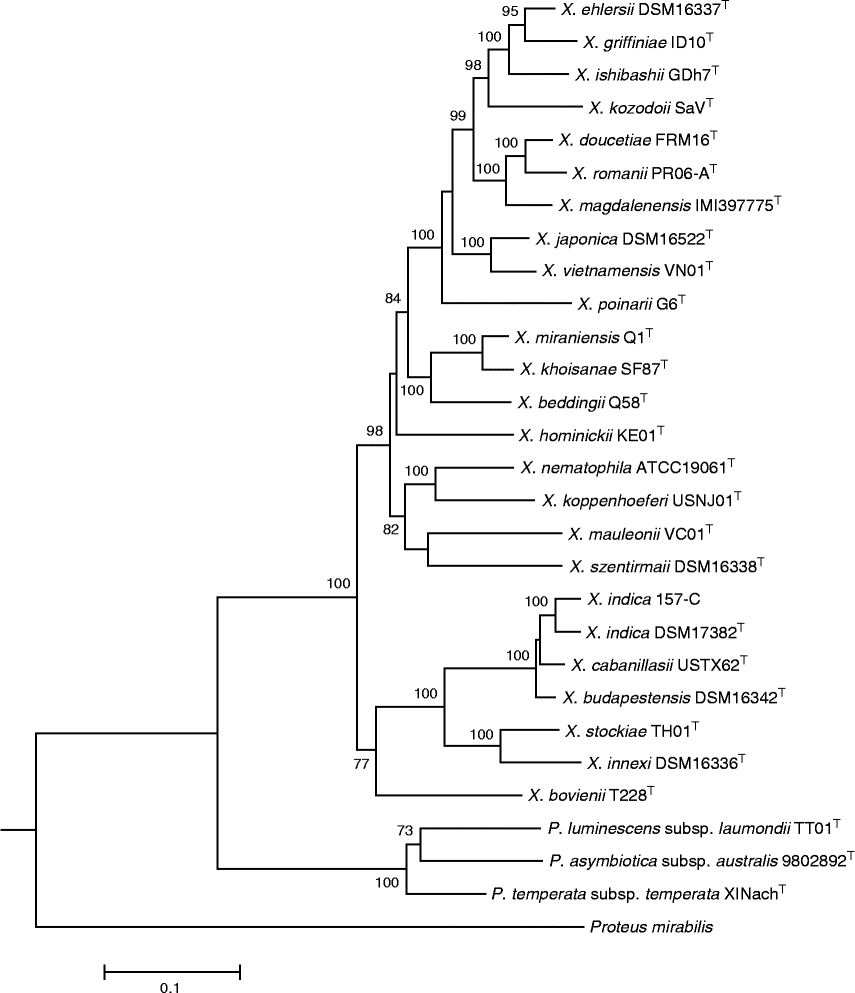
All colonies absorbed bromothymol blue. All isolates were Gram-negative rods (2.8–5.5 μm × 0.5–0.8 μm) and represented a pure culture. Isolate 157-C was selected for further studies. The 16S rRNA, recA, dnaN, gltX, gyrB and infB gene sequences of strain 157-C were compared with sequences of representative strains of the different species within the genus Xenorhabdus. All sequences from strain 157-C showed a high percentage of homology (96–98%) to the sequences derived from X. indica, suggesting that they belong to the same phylogenetic group (fig. 1).
Phylogenetic position of strain 157-C within the genus Xenorhabdus. The maximum likelihood tree is based on five concatenated protein-coding sequences (gyrB, recA, dnaN, gltX and infB). Sequences of Photorhabdus and Proteus mirabilis are used as closely related outgroups. Bootstrap values (percentages of 100 replicates) of more than 70% are shown at the nodes. Sequences corresponding to type strains are indicated by the number of the strain followed by T. The bar indicates 10% sequence divergence.

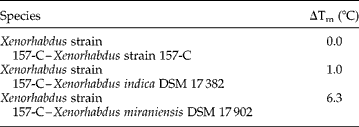
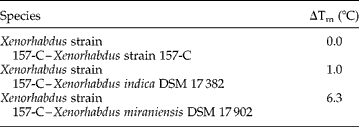
The thermal denaturation technique determines homology based on the difference in temperature at which hybridized DNA denatures. The denaturation temperature (Tm value) of hybrid DNA strands and homologous DNA strands of strains belonging to the same species differs by 5°C or less. Differences in Tm values greater than 5°C indicate that the strains belong to different species. The difference in Tm value recorded for homologous DNA strands and hybrid DNA (strands from strain 157-C and X. indica DSM 17 382) was 1°C (table 1), indicating that the two strains are genetically closely related. The Tm difference of 6.3°C recorded with X. miraniensis DSM 17 902 (table 1) indicated that strain 157-C is genetically less related to this species.
Comparison of DNA–DNA relatedness of Xenorhabdus strain 157-C to closely related species, as determined by hybridization and thermal denaturation; ΔTm indicates the difference between melting temperature of the reference strain DNA–DNA hybridization and the hybrid DNA–DNA hybridization.
The optimum growth temperature of strain 157-C in NB and TSB was 30°C. Strain 157-C exhibited strong antibacterial activity towards B. subtilis subsp. subtilis DSM 10T, was non-bioluminescent, catalase negative, oxidase negative and absorbed dye on NBTA and McConkey agar. DNAse activity was observed, but not lecithinase or lipase activity. Total haemolysis was observed on horse blood, but not sheep blood. Strain 157-C was resistant to high concentrations of ampicillin, both in liquid broth (>200 μg/ml) and on agar plates (>150 μg/ml).
Strain 157-C produced acid from glycerol, glucose, fructose, mannose, inositol, N-acetyl-glucosamine and 5-ketogluconate, and was weakly positive for erythritol, d-ribose, esculin, d-maltose and gluconate. Nitrate was not reduced. Indole production was negative. Esculin and gelatin were hydrolysed. Glucose, mannose, N-acetyl-glucosamine, maltose, gluconate and malic acid were assimilated.
Strain 157-C was deposited in the American Type Culture Collection (ATCC BAA-2478) and the Deutsche Sammlung von Mikroorganismen und Zellkulturen (DSM 26 379). The GenBank/EMBL/DDBJ accession numbers for the partial 16S rRNA, recA, dnaN, gltX, gyrB and infB gene sequences of X. indica 157-C are KC479153–KC479158, respectively. Strain 157-C, which is representative of the bacteria isolated from the entomopathogenic nematode S. yirgalemense, is a member of the species X. indica. This is the first report of X. indica in a symbiotic relationship with S. yirgalemense.
Acknowledgements
The Biolog system was used at the Directorate Inspection Services, Department of Agriculture, Forestry and Fisheries, Stellenbosch, South Africa. We thank Zorina Dawood for permission and Serialong Moshesh for technical assistance.
Financial support
The study received no financial support from any public or private institution.
Conflict of interest
None.