Introduction
Obsessive–compulsive disorder (OCD) is a common chronic mental disorder defined as repetitive behaviors or mental acts that the individual feels driven to perform in response to an obsession, according to rigid rules, or to achieve a sense of completeness (Stein et al., Reference Stein, Kogan, Atmaca, Fineberg, Fontenelle, Grant and Reed2016). OCD is characterized by repetitive and intrusive thoughts, urges, images or fears (obsessions) and repetitive behaviors or mental acts (compulsions) (Brakoulias et al., Reference Brakoulias, Starcevic, Albert, Arumugham, Bailey, Belloch and Fineberg2019). OCD is also a common psychiatric disorder with an estimated prevalence of 1%~2% and the lifetime prevalence of OCD is 1%–3%. Approximately 50%–60% of the patients with OCD had an age of onset in childhood or adolescence (Geller, Reference Geller2006; Nissen et al., Reference Nissen, Powell, Koch, Crowley, Matthiesen, Grice and Parner2017; Park, Storch, Pinto, & Lewin, Reference Park, Storch, Pinto and Lewin2016). Because of the incomplete development of adolescent cognitive functions, OCD can cause significant and impaired functioning in a wide range of domains in children and adolescents, including school functioning, peer and family relationships, and daily household living (Lavell, Farrell, Waters, & Cadman, Reference Lavell, Farrell, Waters and Cadman2016; Torp et al., Reference Torp, Dahl, Skarphedinsson, Compton, Thomsen, Weidle and Ivarsson2015). Also, OCD not only brings anxiety and painful feelings to teenagers but can be seriously disabling (Brakoulias et al., Reference Brakoulias, Starcevic, Belloch, Brown, Ferrao, Fontenelle and Viswasam2017; Nissen & Parner, Reference Nissen and Parner2018). Therefore, it is important to accurately measure the predictors and mechanisms of OCD in adolescents. Not only that, but we also measure family factors and personality traits that affect adolescent OCD. In addition to using logistic regression to report the statistical association between the three, quantile regression is also used to better understand the nuances of these associations.
There is accumulating evidence that parenting and family environment may influence the development of OCD (Wilcox et al., Reference Wilcox, Grados, Samuels, Riddle, Bienvenu, Pinto and Nestadt2008). Especially in the context of Chinese education, parental rearing has a great influence on their children. Parental rearing is generally divided into positive rearing (emotional warmth) and negative rearing (rejection, controlling, over-intervention, and overprotection). It was found that the lack of parental emotional warmth, parental rejection, severe punishment, increased parental control, and overprotection were significantly correlated with the OCD of adolescents (Brander, Pérez-Vigil, Larsson, & Mataix-Cols, Reference Brander, Pérez-Vigil, Larsson and Mataix-Cols2016; Lennertz et al., Reference Lennertz, Grabe, Ruhrmann, Rampacher, Vogeley, Schulze-Rauschenbach and Wagner2010). Family studies have also shown that children with the hoarding subtype of OCD, in particular, report a lack of parental emotional warmth (Alonso et al., Reference Alonso, Menchón, Mataix-Cols, Pifarré, Urretavizcaya, Crespo and Vallejo2004; Cath, van Grootheest, Willemsen, van Oppen, & Boomsma, Reference Cath, van Grootheest, Willemsen, van Oppen and Boomsma2008). In negative parental rearing, families with parental rejection and overprotection (Alonso et al., Reference Alonso, Menchón, Mataix-Cols, Pifarré, Urretavizcaya, Crespo and Vallejo2004; Ehiobuche, Reference Ehiobuche1988), parental controlling and manipulation (Aycicegi, Harris, & Dinn, Reference Aycicegi, Harris and Dinn2002), parental overprotection (Abedi & Vostanis, Reference Abedi and Vostanis2010) and parental over-intervention (Smári, Martinsson, & Einarsson, Reference Smári, Martinsson and Einarsson2010) scored higher in adolescent OCD.
It is well established that patients with OCD frequently meet criteria for personality disorders, and OCD patients showed a more specific pattern of personality pathology(Wu, Clark, & Watson, Reference Wu, Clark and Watson2006). Some studies have suggested that OCD is a constellation of maladaptive personality traits, which represents one of the most common personality disorders in the general population (Fineberg et al., Reference Fineberg, Day, de Koenigswarter, Reghunandanan, Kolli, Jefferies-Sewell and Laws2015). Research has also found that personality traits have been implicated in OCD and may influence treatment outcomes in children/adolescents with OCD (Nissen & Parner, Reference Nissen and Parner2018). Individuals with a higher OCD score would be high in competence, order, dutifulness, achievement-striving, self-discipline, and deliberation from the conscientiousness domain; high in anxiety and low in impulsivity (from neuroticism); low in openness to feelings, actions, ideas, and values; low in warmth and excitement seeking (from extraversion) (Samuel, Riddell, Lynam, Miller, & Widiger, Reference Samuel, Riddell, Lynam, Miller and Widiger2012). Studies using the five factors of personality to characterize the general and maladaptive personality traits and their relation to OCD found that children and adolescents with high OCD scores were characterized by elevated neuroticism and lower extraversion scores (Aelterman, De Clercq, De Bolle, & De Fruyt, Reference Aelterman, De Clercq, De Bolle and De Fruyt2011; Samuel et al., Reference Samuel, Riddell, Lynam, Miller and Widiger2012).
A large number of empirical studies have shown that, on the one hand, parental rearing and personality traits are correlated with OCD in adolescents. Their limitations are, however, that they only report the average effect of correlation and ignore the differences in OCD at different levels – OCD levels vary substantially not only by different parental rearing but also under the same parental rearing. There is reason to believe that parental rearing and personality traits may be particularly weaker or have more potent correlates at different levels of OCD. For instance, neuroticism may exist strongly in the range of severe OCD but also may be present even in the absence of OCD. Therefore, to measure the range of correlation between OCD and these relative factors, we can take targeted intervention and improvement measures. In this context, this study used quantile regression methods to reexamine the established parental rearing and relative personality trait factors for OCD and to provide evidence to guide future research in the area. On the other hand, a study found that parental behavior, especially concerning the ability to express affection and emotional warmth and avoid excessive protection, control, and criticism, seems to be important in the development of a healthy personality (Alonso et al., Reference Alonso, Menchón, Mataix-Cols, Pifarré, Urretavizcaya, Crespo and Vallejo2004). Chen et al. (Reference Chen, Bienvenu, Krasnow, Wang, Grados, Cullen and Samuels2017) found that parental rearing is related to a variety of psychopathology, including general personality characteristics. Research suggested that parental rearing, as an environmental factor, can also affect children's personality characteristics, especially dysfunctional rearing, which can make children prone to psychiatric disorders in their later life (Oshino, Suzuki, Ishii, & Otani, Reference Oshino, Suzuki, Ishii and Otani2007). According to the literature, parental rearing affects the healthy development of children's personality and leads to behavioral problems (Ijeoma, Reference Ijeoma2016). However, the associations by which parental rearing influences the development of personality traits in adolescent, and hence the generation of OCD, are unknown. To address these questions, we used the structural equation model method to clarify the mechanism. Consequently, the present study hypothesized that (a) parental rearing and personality traits act as predictors of differing magnitude at varying levels of OCD, and (b) different parental rearing may further affect adolescent OCD through indirect effects of different personality traits.
Method
Participants and procedures
This study comprises multiple cross-sectional studies. A total of 3438 middle school students in four schools selected in a district of Harbin city, China were invited to participate in the study from the years 1999, 2006, 2009, and 2016. The study's design includes two stages. First of all, four schools that had different academic rankings, based on the quality of teaching and learning outcomes, were randomly selected in the district of Harbin. Then in the second stage, cluster sampling was conducted by grades. In Grades 7 to 11 (except Grade 9), two classes were selected from each grade, and eight classes were selected from each school so that 32 classes of students formed the sample. The four investigations were conducted using the above-mentioned investigation procedures. The effective response sample was 3345 participants, and the effective rate was 97.2%. All 3345 participants (aged 12 to 20 years) were middle school students (52.2% of female students and 47.8% of male students). Grade 9 students were excluded because they were preparing for their entrance examinations. Students who did not receive permission from their parents or their parents did not submit their consent were also excluded from the study. Although the survey period was over 16 years, but every survey followed a strict investigation procedure to complete. This study was approved by the Ethics Committee of Harbin Medical University.
Psychometric assessment
Participants were requested to provide demographic information and complete three self-report questionnaires. Symptom Checklist-90-Revision (SCL-90-R). SCL-90-R, also known as Hopkin's Symptom Checklist, is the most commonly used version compiled by Derogatis, Lipman, and Covi (Reference Derogatis, Lipman and Covi1973). The SCL-90-R is a 90-item self-report measure that includes 10 psychological symptom factors. The 10-item OCD subscale was extracted from the SCL-90-R. All items were rated on a 5-point Likert scale (1 = Never: no symptoms or problems; 2 = Infrequently: consciously have the symptoms, but the impact is slight; 3 = Sometimes: consciously have the symptoms, have a certain impact on their own; 4 = Frequently: consciously often have the symptoms, and the symptoms are moderate to severe; 5 = Always: the frequency and intensity of self-conscious symptoms are very serious, which has a profound impact on oneself). The higher the score on the OCD, the more serious it is. The SCL-90-R assesses respondents’ feelings in the last two weeks. The reliability of SCL-90-R at four time points (1999, 2006, 2009, and 2016) was 0.95, 0.96, 0.96, and 0.96, respectively. The OCD subscale demonstrated strong psychometric properties and excellent internal consistency in the present study. Alpha coefficients for OCD at four time points was found to be 0.91, 0.93, 0.91, and 0.92 respectively. In this study, factor analysis was used to assess its construction validity, and factor loading was between 0.51 and 0.74.
Egna Minnen av Barndoms Uppfostran (EMBU)
The EMBU scale was developed by Prerris in 1980 to assess one's memory of parental rearing and consists of four replicate dimensions: rejection, emotional warmth, overprotection, and favoritism – reduced from 11 aspects of parental behavior and attitudes: father rearing (emotional warmth, F1; punitive, F2; over-involved, F3; favoritism, F4; rejection, F5; overprotection, F6) and mother rearing (emotional warmth, M1; over-involved and overprotection, M2; rejection, M3; punitive, M4; favoritism, M5). Parental favoritism was considered unsuited to China's conditions and excluded. It is a self-report scale composed of 66 items. Participants rated how well each of the items described their parental attitudes and behaviors on a 4-point Likert-type scale ranging from never (1) to always (4). The EMBU scale has been widely used in China for its reliability and validity. In this study, it was found that the coefficient of internal consistency in paternal rearing and maternal rearing were 0.87 and 0.79, respectively, and each factor loading was greater than 0.77 and 0.86, respectively.
Eysenck Personality Questionnaire-Revised (EPQ-R)
EPQ-R was officially released by British psychologist H. J. Eysenck, S. B. G. Eysenck, and Paul Barret (Eysenck, Eysenck, & Barrett, Reference Eysenck, Eysenck and Barrett1985). EPQ consists of 88 items including adult questionnaires (for children aged 16 and over) and children questionnaires (for children aged 7–15), based on a three-factor model including neuroticism (N dimension), extroversion (E dimension), psychoticism (P dimension), and the lie scale (L dimension). The participants answered “yes” or “no” and scored the rough score of each scale according to the scoring keys of E, N, P, and L in the manual. They then get a standard T score taken into account for their gender and age. The higher the score of each dimension, the more inclined it is tantamount to this personality trait. The L scale was excluded from the study because it measured the subjects’ concealment, hypo tropism, or self-concealment, and as a stable character function itself. EPQ has been proved to have good validity and reliability standards in further studies (Xiuqin et al., Reference Xiuqin, Huimin, Mengchen, Jinan, Ying and Ran2010). Total Cronbach's coefficient alpha of the adult and child questionnaires in this study were 0.88 and 0.86, respectively.
Statistical analysis
Given that only 2.8% of individuals (n = 93) had missing data on the survey, we excluded those individuals. The data were coded in Epidata and analyzed using Statistical Analysis System (SAS) software (version 9.3). SAS software was used for correlation, linear regression, and quantile regression analysis. AMOS (version 21.0) software was devoted to the construction and fitting of the structural equation model. p < .05 was considered significant.
Results
Pearson correlation analysis of variables between parental rearing, personality traits, and OCD are listed in Table 1. Overall, parental rearing was related to OCD, among which F1 and M1 were negatively correlated with OCD, with a correlation of −0.13 and −0.07. A significant positive correlation was found between other negative parental rearing and OCD, with a range of correlation of 0.20–0.34. The correlations of N, P, and OCD were 0.52 and 0.27, respectively, while the correlation of E and OCD was not significant. Then multiple linear regression analysis (Enter regression method), was conducted to identify that the factors existing in parental rearing and personality traits could significantly predict OCD after controlling for grade, survey years and sex in the model (Table 2). The analysis showed that F1, F2, F6, M1, M2, M3, E, N, and P were significantly linked with OCD scores, while F3, F5, and M4 were not significant for predictive OCD.
Pearson correlations between obsessive–compulsive disorder (OCD), parental rearing and personality traits variables

Note: F1 = paternal rearing, emotional warmth; F2 = punitive; F3 = over-involved; F5 = rejection; F6 = overprotection; M1 = maternal rearing, emotional warmth; M2 = over-involved and overprotection; M3 = rejection; M4 = punitive; E = extroversion; N = neuroticism; P = psychoticism; OCD = obsessive–compulsive disorder.
*p < .01, **p < .001.
Regression results predicting the youth obsessive–compulsive disorder (OCD)

Note: Although the p value of M1 was 0.52, we still brought into the M1 independent variable in the model.
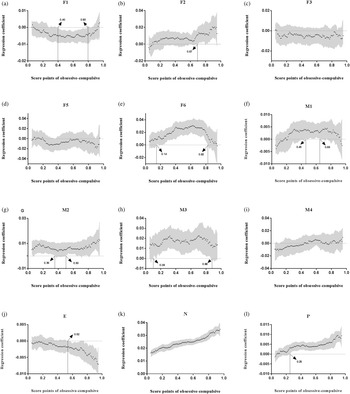
To further analyze the correlation of parental rearing and personality traits on OCD and provide more data and information, this study used the method of quantile regression to analyze the prediction of OCD of variables in the 0.05–0.95 quantile (Figure 1). The results showed that F1 was only negatively correlated with OCD at the quantile of 0.40–0.80. Also, the association of OCD and F2 was found to be significant at the 0.67–0.95 quantile. However, F3 and F5 were not correlated with the OCD in the QR model. And the correlation of OCD and F6 was significant at the 0.14–0.82 quantile. In the analysis of the regression coefficient between maternal rearing and OCD, it was found that M1 was positively correlated with the OCD at the 0.45–0.69 quantile. M2 had a positive effect on OCD at 0.05–0.36 and >0.50 quantiles. M3 was positively correlated with the OCD at the 0.08–0.88 quantile. There was no correlation between M4 and OCD on the entire quantile. In addition, N and P were positively correlated with OCD in the entire quantile and the above 0.25 quantile, while E was negatively correlated with OCD in the above 0.52 quantile.
Quantile regressions predicting obsessive–compulsive disorder (OCD) at the 0.05–0.95 quantile. The Y-axis represents the regression coefficients of independent variables at different quantile, and the X-axis is the quantile interval of 0.05–0.95. The black solid horizontal line represents = 0, black dots represent the estimated coefficients and the grey area represents 95%CI of the corresponding parameters. All estimations were adjusted for grades, sex, and survey years.

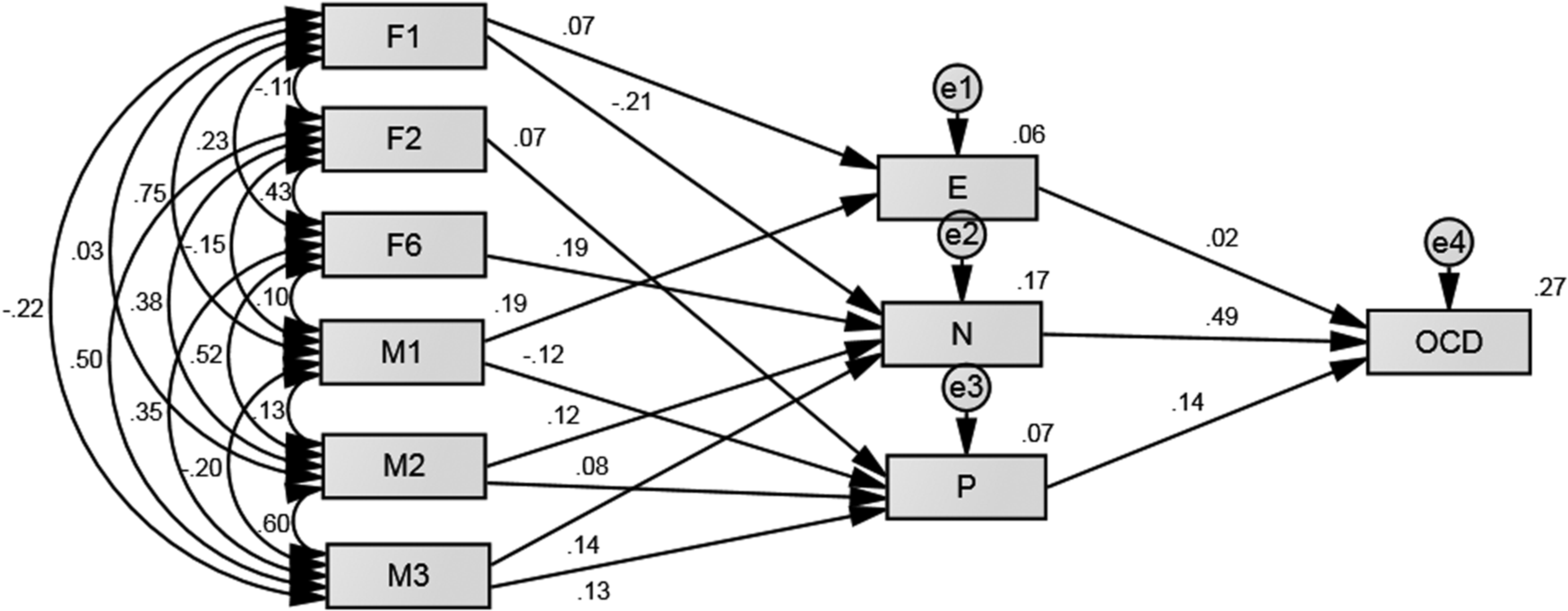
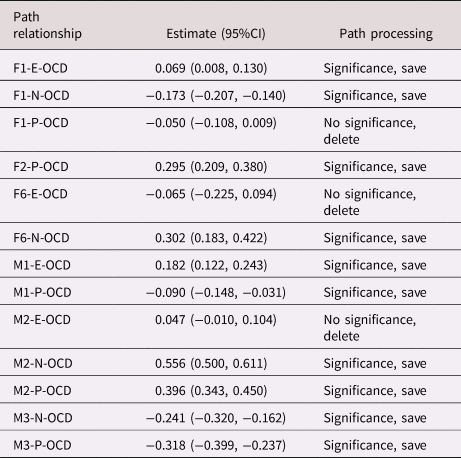
According to relevant theoretical research and regression analysis results, a structural equation model (SEM) of parental rearing indirectly affecting OCD through neuroticism, psychoticism and extroversion personality is established. The path relationship and model parameters of the SEM are presented in Figure 2. The mediating effect refers to the full mediation effect. The results showed that different parental rearing can indirectly impact OCD through E, N, and P personality, and the squared multiple correlations of OCD had a value of 0.27. Tables 3–5, respectively, described the goodness-of-fit statistics, standardized total effects and the significance test of mediation effects of the SEM model.
Parental rearing through personality traits influence the structural equation model of obsessive–compulsive disorder (OCD). The error terms were described by e1, e2, e3, and e4. The mediating effect refers to the full mediation effect.
The goodness-of-fit indices of obsessive–compulsive disorder (OCD) structural equation model

CMIN/DF = relative chi-square / degree of freedom; GFI = goodness of fit index; AGFI = adjusted goodness-of-fit index; NFI = normed fit index; TLI = Tucker–Lewis index; CFI = comparative fit index; RMSEA = root mean square error of approximation.
Standardized total effects of the obsessive–compulsive disorder (OCD) structural equation model
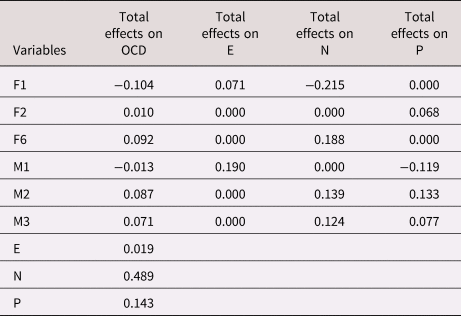
Note: The total mediating effect refers to the full mediation effect.
The significance test of mediation effects
Discussion
Through these results, we extend several interesting findings that differed from previous studies and clarified the mechanism by which parental rearing influences OCD through personality traits. In this population-based study, we found that the same paternal and maternal rearing differed in magnitude based on levels of OCD. There is a correlation between parental rearing within a specific range of OCD, but F3, F5, and M4 are not significant. The personality traits, especially neuroticism, are more related to OCD. The effects found using quantile regression showed specific associations between predictors and OCD at different levels. Importantly, it is found that parental rearing affects the path relationship of OCD through personality traits and confirmed the mediating effect.
The study also confirmed the different effects of parental emotional warmth on OCD in adolescents. The quantile regression results showed that paternal emotional warmth was negatively correlated with OCD at the level of the 0.40–0.80 quantile, while maternal emotional warmth was only positively connected with the OCD in the 0.45–0.69 quantile. Chen, Liu, and Li (Reference Chen, Liu and Li2000) have pointed out that children are more likely to turn to mothers for emotional support, physical need, and help in dealing with problems of daily life, while paternal emotional warmth allows children to explore their environments and thus may be linked to the development of feelings of security, confidence, trust, and positive orientation towards others. Lennertz et al. (Reference Lennertz, Grabe, Ruhrmann, Rampacher, Vogeley, Schulze-Rauschenbach and Wagner2010) also found only paternal warmth could predict symmetry and order of OCD. Thus, children seem to need more emotional warmth from their fathers when they experience emotional distress similar to OCD. Moreover, quantile regression results also clarified the correlation range between them. In the SEM, our results might suggest that parental emotional warmth is conducive to their children's formation of self-confidence, self-esteem, and extroversion personality characteristics, as well as the generation of positive emotions(Sun, Li, Buys, Storch, & Wang, Reference Sun, Li, Buys, Storch and Wang2014), which has beneficial effects on their children's OCD.
We found that paternal punitive rearing was a significant effect on OCD over 0.67 quantiles, while it is striking that, in the entire sample, the relationship was found only for paternal, not maternal. When mothers adopt punitive rearing, children may focus on specific methods, such as washing and checking, to avoid reprimands about undesirable outcomes. However, paternal punitive rearing is described as overcautious, demanding, and perfectionistic, which creates high expectations in children and is therefore associated with OCD (Aycicegi et al., Reference Aycicegi, Harris and Dinn2002). SEM results also show that paternal punitive rearing may lead to suspicious, indifferent, and stubborn psychological traits (psychoticism) and thus is closely related to the development of OCD (duRivage et al., Reference duRivage, Keyes, Leray, Pez, Bitfoi, Koç and Kovess-Masfety2015). Meanwhile, OCD patients also show high sensitivity to punitive parenting through personality features (Fullana et al., Reference Fullana, Mataix-Cols, Caseras, Alonso, Manuel Menchón, Vallejo and Torrubia2004a).
Compared to paternal rejection, maternal rejection seems to have a greater impact on children's OCD. Our finding showed that paternal rejection rearing was not significantly correlated with OCD, while maternal rejection was correlated with OCD at the 0.08–0.88 quantile. A systematic review of risk factors for OCD found that parental rejection was associated with OCD (Brander et al., Reference Brander, Pérez-Vigil, Larsson and Mataix-Cols2016). Parental rejection includes unfair treatment and punishment, shaming, and blaming(Lennertz et al., Reference Lennertz, Grabe, Ruhrmann, Rampacher, Vogeley, Schulze-Rauschenbach and Wagner2010). Thus, children feel inferior to others, and parental rejection makes children express demanding, critical, compulsive checking, cleaning, and perfectionistic (Ehiobuche, Reference Ehiobuche1988). Furthermore, maternal rejection rearing may lead to emotional instability and abnormal behavior of adolescents, and then induce OCD. Further studies are needed to examine the role of maternal rejection than paternal rejection in the development of childhood OCD.
Paternal overprotection, maternal overprotection, and over-intervention not only directly affect OCD but also have a path relationship that affects OCD through personality traits. Paternal over-intervention was not associated with the development of OCD. Previous studies have indicated that parental overprotection and over-interference will easily lead to overdependence, increase in anxiety, and low self-esteem as well as the development of social skills (Yoshida, Taga, Matsumoto, & Fukui, Reference Yoshida, Taga, Matsumoto and Fukui2005). However, this study only found the role of parental overprotection and did not find the correlation between parental over-interference and OCD, which clarified the misunderstanding. As children grow older to reach puberty, the contradiction between the development of their self-image and paternal overprotection, the resulting anxiety, and low self-esteem may be the important factors for the occurrence of OCD (Yoshida et al., Reference Yoshida, Taga, Matsumoto and Fukui2005). However, to cope with anxiety and low self-esteem, adolescents will develop morbid personality, which to some extent exacerbates the occurrence of OCD (Aycicegi et al., Reference Aycicegi, Harris and Dinn2002). The finding of the present study of the significant effect of perceived maternal overprotection in the prediction of OCD is consistent with the findings in the literature(Haciomeroglu & Karanci, Reference Haciomeroglu and Karanci2013). We also found that maternal overprotection and over-intervention may act as a vulnerability factor more specifically related to OCD through neuroticism and psychoticism. Overprotection and over-intervention in parental rearing may lead the child to perceive the world as threatening, dangerous, but at the same time controllable, and the child may perceive themself as incompetent to deal with such danger (Haciomeroglu & Karanci, Reference Haciomeroglu and Karanci2013). As their roles and self-image change during adolescence, they develop morbid personality traits that lead to an OCD diagnosis. Pathway relationships contribute to the explanation of “to what extent” and “how” perceived parental overprotection and over-intervention leads to the development of OCD.
Results show that neuroticism is the most important personality factor affecting OCD. In addition, psychoticism and extraversion personality traits are also correlated with compulsive symptoms in different quantile ranges. A considerable body of research has also indicated that extraversion and neuroticism are positively associated with OCD (Boerema et al., Reference Boerema, de Boer, van Balkom, Eikelenboom, Visser and van Oppen2019; LaSalle-Ricci et al., Reference LaSalle-Ricci, Arnkoff, Glass, Crawley, Ronquillo and Murphy2006; Wu et al., Reference Wu, Clark and Watson2006). Neuroticism, the tendency to experience increased vulnerability to stress and negative emotions, has been associated with various types of psychopathology (Hezel & Hooley, Reference Hezel and Hooley2014). Extraversion measures the preference for interpersonal interaction, activity, the need for stimulation, and the ability to experience joy. Low levels of extraversion, such as being less outgoing or talkative, lacking energy, and failing to generate enthusiasm, reduced engagement and enjoyment for activities(Wu et al., Reference Wu, Clark and Watson2006). Psychoticism is associated with impulsiveness and novelty seeking, and is considered the strongest predictor of the presence of an OCD diagnosis because of its merciless and antisocial personality traits (Fullana et al., Reference Fullana, Mataix-Cols, Trujillo, Caseras, Serrano, Alonso and Torrubia2004b). As described by psychodynamic theory, OCD and personality traits were linked closely, and OCD patients showed a more specific pattern of personality pathology(Wu et al., Reference Wu, Clark and Watson2006). The study clarifies the differential association between neuroticism, psychoticism, extroversion personality traits, and OCD scores.
The current study is subject to several limitations. Firstly, although the OCD subscale of SCL-90 cannot be considered as a diagnostic tool that covers all various obsessions and compulsions, it can be used as a proxy for a screening of OCD in children and adolescents for research purposes. Secondly, the study used retrospective self-report measures of parental rearing rather than direct questioning of parents to investigate parenting attitudes and direct observations. Thirdly, the four cross-sectional surveys took place at intervals over 16 years, and we included the survey years as covariant into the model, but the OCD may be disturbed by social development. Finally, we should note that the quantile regression and structural equation models are two methods. Future research is needed to demonstrate whether parental rearing still influences the presence of OCD through personality characteristics in different quantiles.
Taken together, knowing psychosocial factors may facilitate treatment and contribute to the development of intervention strategies for at-risk children. Our results provide evidence from a new perspective that the improvement of specific parental rearing and personality traits is particularly effective for the development of OCD in adolescents. It has a positive effect on family education and the cultivation of children's healthy personality, so it is necessary to conduct further investigations to determine the observed causal relationship and potential mechanism.
Acknowledgments
We want to thank Ms Lin Lin for her help in preparing and administering all four surveys. The authors are also thankful for the active cooperation and support from Qingxia Zhao, Pengfei Gu, Xiuzhen Ma, Chuanren Na, Guang Yang, and Hong Zhu.
Funding Statement
This work was supported by the Humanities and Social Sciences Research and Planning Fund of the Ministry of Education of China [grant number 15YJAZH073].
Conflicts of Interest
None.