Introduction
The World Health Organization estimates that, by 2020, schizophrenia will account for 1.3% of the total disease burden (Murray and Lopez, Reference Murray and Lopez1996). In China, 6 million individuals suffer from schizophrenia: 80% of them with moderate to severe disability; 40% of them have never received treatment (Phillips et al., Reference Phillips, Zhang, Shi, Song, Ding, Pang, Li, Zhang and Wang2009). Rapidly rising treatment costs and the social hardships experienced by patients and their families (Xu et al., Reference Xu, Yu and Wang2013) have made schizophrenia a major public health crisis in China (Xiang et al., Reference Xiang, Yu, Sartorius, Ungvari and Chiu2012). However, the community mental health service sector in China is underdeveloped (Phillips, Reference Phillips2004) and lacking integration or coordination among service providers (Liu et al., Reference Liu, Ma, He, Xie, Xu, Tang, Li, Hao, Wang, Zhang, Ng, Goding, Fraser, Herrman, Chiu, Chan, Chiu and Yu2011). Other daunting factors include shortages of trained mental health personnel and allied professionals, inadequate and outdated training, the low level of public awareness about mental illness, and widespread stigma and discrimination against individuals with mental illnesses and their families (Xiang et al., Reference Xiang, Yu, Sartorius, Ungvari and Chiu2012).
Recent efforts to address these problems included the passage of China's first National Mental Health Law in 2013 (Chen et al., Reference Chen, Phillips, Cheng, Chen, Chen, Fralick, Zhang, Liu, Huang and Bueber2012; Phillips et al., Reference Phillips, Chen, Diesfeld, Xie, Cheng, Mellsop and Liu2013), and growing prioritization of mental health funding in the National Five-Year Plan for Health (Tse et al., Reference Tse, Ran, Huang and Zhu2013; Xiong and Phillips, Reference Xiong and Phillips2016). Development of the ‘686 project’ in 2005 – the world's largest community case-management program for individuals with severe mental illnesses (SMI) (Good and Good, Reference Good and Good2012) has by now registered up to one-half of the people with SMI in the country, providing some of them with free psychiatric medications and quarterly follow-up at home or in a clinic. It has identified extreme cases and ‘unlocked’ many individuals who had previously been held in chains and restraints within their homes due to a lack of treatment options (Guan et al., Reference Guan, Liu, Wu, Chen, Wang, Ma, Wang, Good, Ma, Yu and Good2015). Despite these improvements, a recent study suggests that at least 20% of the individuals with SMI in China remain hard to treat and do not adhere to medications, resulting in severe social dysfunction and burden (Wang et al., Reference Wang, Zhang, Ma, Guan, Law, Yu and Ma2016).
Assertive Community Treatment (ACT) is well-studied and considered by many the ‘gold standard’ treatment for people with SMI (Dixon, Reference Dixon2000). However, there are on-going debates whether ACT is universally effective. While results of randomized controlled trials (RCT) in North America and Australia have consistently found that ACT is effective in reducing hospitalization rates and improve patient functioning (e.g. Issakidis et al., Reference Issakidis, Sanderson, Teesson, Johnston and Buhrich1999; Bond et al., Reference Bond, Drake, Muesser and Latimer2001; Dixon et al., Reference Dixon, Dickerson, Bellack, Bennett, Dickinson, Goldberg, Lehman, Tenhula, Calmes, Pasillas, Peer and Kreyenbuhl2010), research in Europe, particularly those from the UK did not support the same (e.g. Burns, Reference Burns2010; Dieterich et al., Reference Dieterich, Irving, Bergman, Khokhar, Park and Marshall2017). With this backdrop of controversy taking place in western, high-income countries, there are notable ACT research in other parts of the world, in culturally and economically diverse settings, such as the RCTs in Japan (Ito et al., Reference Ito, Oshima, Nishio, Sono, Suzuki, Horiuchi, Niekawa, Ogawa, Setoya, Hisanaga, Kouda and Tsukada2011) and South Africa (Botha et al., Reference Botha, Koen, Galal, Jordaan and Niehaus2014), and non-RCTs in Singapore (Low et al., Reference Low, Tan, Lim, Poon and Lee2013), Korea (Kim et al., Reference Kim, Jeong, Kim, Kim, Seo and Hong2015), and Hong Kong (Liem and Lee, Reference Liem and Lee2013). However, it remains unknown whether ACT is effective in mainland China, where social, cultural, and economic factors are vastly different. To address this issue, we carried out an uncontrolled, 6-month pilot study to explore the feasibility of ACT in mainland China (Zhao et al., Reference Zhao, Law, Luo, Chow, Zhang, Zhu, Liu, Ma, Yao and Wang2015). This pilot also focused on making family psychoeducation and consultation a core part of the ACT services to reflect the culturally distinct needs of the Chinese setting, and found significant positive results. The current paper aims to further contribute to the global examination of the ACT model, and reports on the results of a subsequent 12-month RCT – the first RCT study of ACT in China.
Methods
Study design
This parallel-group RCT compared the effectiveness of ACT for schizophrenia to that of treatment as usual. The study was approved by the Ethics Committee of the Second Xiangya Hospital of Central South University, and was registered at the Chinese Clinical Trials Registry Center (ChiCTR-TRC-13003407).
Study population and recruitment
The trial was carried out in two urban districts of Changsha, a mid-sized city in the south-central province of Hunan, China, with 475 663 and 523, 730 inhabitants (2010 census), respectively. The inclusion criteria for patients were: (1) age 18–45 years; (2) diagnosis of schizophrenia based on the Diagnostic and Statistical Manual of Mental Disorders-Fourth Edition (DSM-IV); (3) no organic brain disorder, mental retardation, severe head trauma, or personality disorder [based on chart reviews and using Semi-structured Clinical Interview for DSM-IV for personality disorders (SCID-II)]; (4) significant functional impairment; (5) have one or more indicators of a need for continuous high level of services [criteria for (4) and (5) were based on standard ACT Manual description (Allness and Knoedler, Reference Allness and Knoedler2003) and confirmed by clinical assessment, see details in the online Supplementary materials]; (6) no co-residing family member with a mental illness [using SCID Interview for DSM-IV-TR Axis I Disorders Non-patient Edition (SCID-I/NP)]; and (7) both the patient and a co-residing family caregiver provide written informed consent to participate. The participating family caregivers were 18 years of age or older and had to be living with and caring for the patient for at least the last 3 months.
Between April 2013 and July 2013, we recruited 60 patients with schizophrenia from a list of 1023 patients registered in their local community health offices in the two districts. The qualified participants completed the baseline interviews and were randomly assigned to the ACT intervention group (n = 30) or the standard-care control group (n = 30). The randomization protocol was implemented by two researchers unaffiliated with this study: one prepared an SPSS-generated restricted random assignment sequence to balance time of study entry and sample sizes on each arm of the study, and the other prepared sequentially numbered, opaque sealed envelopes for concealing the randomization sequence. Participants were informed of their group assignment at the end of the baseline interview after the written informed consent was signed. Figure 1 shows the CONSORT flowchart for the study. The high rate of refusal to participate [47% (478/1023)] is common in community-based psychiatric studies in mainland China, likely reflecting a heavy sense of stigma, and mistrust and unfamiliarity with mental health research (Zhang et al., Reference Zhang, Wieczorek, Jiang, Zhou, Jia, Sun, Jin and Conwell2002).
CONSORT flowchart of the study. ACT, Assertive Community Treatment; PSP, Personal and Social Performance Scale; PANSS, Positive and Negative Syndrome Scale; UPSA-B, Performance Skill Assessment-Brief; CGI, Clinical Global Impression; WHOQOL – BREF, WHO Brief Quality of Life; SDSS, Social Disability Screening Schedule; FAD, Family Assessment Device.

Study intervention and follow up
ACT: The intervention group received free culturally adapted ACT services that included two to three community/home visits per week to deliver usual ACT care. The ACT services were individually tailored, informed by Recovery principles (Salyers and Tsemberis, Reference Salyers and Tsemberis2007) and aimed to improve both clinical outcome and quality of lives for patients. The services generally included clinical assessments and crisis intervention (e.g. timely responses and home visits), psychosocial assistance, supportive counseling, and family support (e.g. teaching strategies coping with stigma, setting goals for employment, empowering for treatment decisions, etc.), and functional assistance (accompanied medical appointments, social entitlement securements, etc.) and 2-h family psychoeducation sessions per month for 12 months (Chow et al., Reference Chow, Law, Andermann, Yang, Leszcz, Wong and Sadavoy2010; Zhao et al., Reference Zhao, Law, Luo, Chow, Zhang, Zhu, Liu, Ma, Yao and Wang2015). All participants and their family caregivers in the ACT intervention group completed the 1-year study. The intervention was carried out by the ACT team from the Second Xiangya Hospital in Changsha, Hunan. The team consisted of a team leader who was a psychiatrist, a part-time psychiatrist, a part-time psychiatric nurse, two full-time clinical psychologists, three full-time social workers, and a part-time employment specialist. Experts from an established ACT team from Mount Sinai Hospital, Toronto, Canada provided training and supervision for the treatment team; one of whom also performed an on-site assessment of the fidelity of the study ACT program using the Tool for Measurement of Assertive Community Treatment (TMACT, Monroe-DeVita et al., Reference Monroe-DeVita, Teague and Moser2011). The results of this assessment were used to provide feedback and to improve the quality of the services.
Treatment as usual (TAU): Participants assigned to the TAU group received existing ‘686 program’ community mental health services available in their communities free of charge. In theory this treatment includes outpatient visits to a psychiatric clinic every 1–3 months (offered by the Ministry of Civil Affairs), and home visits by public health professionals every 1–3 months (offered by ‘686 program’); during these visits the target individual is assessed, provided non-specific counselling, and given free psychotropic medications. However, not all individuals enrolled in the ‘686 program’ actually receive these services (due to lack of local mental health manpower and unwillingness on the part of the patient or the family). To ensure that all patients in the control group obtained standard ‘686 program’ level of care, the study team did a follow-up telephone call with each individual monthly and a home visit every 3 months over the 12-month follow-up period. Of the 30 controls, 26 completed the study, one could not be located after the baseline assessment, one moved out of the district after the baseline assessment, and two could not be contacted after the 9-month assessment. The two patients who were not follow-up right after baseline were not included in the modified intent-to-treat outcome analyses. For the two participants who were lost after the 9-month assessment, they are included in the analyses proposed in the study. Their data for the 12-month were regarded as missing.
Study outcomes and data collection
Mean per patient readmission days in each group was the primary outcome variable. As is true for community-dwelling individuals with severe mental illness throughout China, hospitalization decisions were made by the patients’ family members and other caregivers based on the severity of their symptoms and level of social dysfunction; the ACT treatment teams did not unilaterally admit or send patients to the hospital.
Other outcomes included:
Relapse days. The number of days over the 12-months the individual experienced any of the following: hospitalized for a psychiatric problem; an increase of 25% or more over baseline in the total score of the Positive and Negative Symptoms Scale (PANSS, Kay et al., Reference Kay, Fiszbein and Opler1987) or – if the baseline score was less than 40 – an increase of 10 points or more in the total PANSS score; deliberate self-injury; suicidal or homicidal ideation that the investigator judged as clinically significant; violent behavior resulting in clinically significant injury to another person or property damage; or a rating on the Clinical Global Impression (CGI) of 6 (‘much worse’) or 7 (‘very much worse’) (Guy, Reference Guy1976). Days in relapse were recorded based on reports of the patient and his/her family members at the time of assessment.
Re-employment days. Number of days of any form of paid employment, whether temporary or regular over the 12-months.
Severity of psychiatric symptoms and social dysfunction. Patients’ psychiatric symptoms and social functioning were evaluated at baseline and every 3 months thereafter using PANSS, CGI, the Personal and Social Performance Scale (PSP, Tianmei et al., Reference Tianmei, Liang, Yun'ai, Chenghua, Jun, Jia, Xueni, Qi, Yantao, Weihua and Hongyan2011) and the Social Disability Screening Schedule (SDSS, World Health Organization, 1988). At baseline and at the 12-month follow-up, patients also completed the Family Assessment Device (FAD, Mansfield et al., Reference Mansfield, Keitner and Dealy2015) and the UCSD Performance-Based Skills Assessment-Brief form (UPSA-B, Mausbach et al., Reference Mausbach, Harvey, Goldman, Jeste and Patterson2007).
Family relationships and the caregiver quality of life. At baseline and at the 12-month follow-up, the family caregiver completed the FAD, and the World Health Organization Quality of Life (WHOQOL – BREF) scale (The WHOQOL Group, 1998).
These evaluations were carried out by two evaluators who were unaffiliated with the study and their blinding about the treatment status of patients was strictly maintained throughout the study.
Statistical analysis
Data analyses were performed using SPSS version 18.0 (SPSS, Chicago, IL, USA) and STATA 14.0 (Stata Corp LP, College Station, TX, USA). Consistent with statistical methods employed by other ACT RCT studies, differences between the groups at baseline were compared using independent-samples t tests or nonparametric tests (i.e. Mann–Whitney U tests); the proportions of patients in the two groups that experienced readmission/relapse/reemployment over the follow-up period were compared using Fisher's exact tests.
In addition, Cox regression was employed to examine the relationship of ACT treatment on the risk (hazard) of readmission, relapse, and reemployment after controlling for social demographic and clinical characteristics (i.e. age, duration of illness, number of prior hospitalizations, and baseline PANSS and SDSS total scores). Time to first relapse, readmission, and reemployment after the baseline assessment were assessed using Kaplan–Meier survival analysis, censored at 365 days if the event did not occur during the full 12 months of follow-up. Mixed effect model was used to analyze the results for variables assessed at baseline and at 3, 6, 9, and 12 months of follow-up (i.e. PANSS, PSP, SDSS, and CGI), with the baseline score and the duration of illness used as covariates to obtain estimates of change from baseline – the ‘intervention effect’. UNIANOVA was used to analyze variables assessed at baseline and at the 12-month follow-up (i.e. UPSA-B and FAD for patients; and WHOQOL–BREF and FAD for family caregivers). We used Holm–Bonferroni test to check for multiple comparison type I errors.
Results
Fidelity of the ACT program
The mean per item score of the 47-item TMACT fidelity assessment (range 1–5) is classified as ‘not certified’ (less than 3), ‘basic fidelity’ (3.0–3.6), ‘moderate fidelity’ (3.7–4.2), or ‘high fidelity’ (4.3 or higher). The study team had a score of 3.8, indicating low-moderate fidelity. However, 6 of the 47 TMACT items are culturally less relevant in China – the provision of supportive housing (item EP8), availability of a substance abuse specialist (items ST1, ST2, and ST3), and programming for dual diagnosis patients (item EP1 and EP4) – because virtually all patients with severe mental illness live with family members, and alcohol and drug abuse (consequently, dual diagnosis) is extremely rare (none for the study participants had dual diagnoses). When these six items are removed the revised 41-item TMACT fidelity score increased to 4.1, suggesting high-moderate fidelity (see online Supplementary Table S1). Of note, the study team received a TMACT score of 3 or less on the following: ‘Team Leader On Team’, ‘Office Based Program Assistance’, and ‘Frequency of Contact’ (due to lack of human resources and funding for fuller staffing and services); ‘Peer Specialist on Team’ (due to non-availability of such professional identity in China and broader stigma issues); and ‘Full responsibility for ‘Psychiatric Services’, and ‘Crisis Services’ (due to funding and systemic and cultural practices that families took on typical responsibility for help seeking with anyone and at any time they wish, not solely relying on ACT team).
Demographic, socio-economic, and baseline clinical characteristics of client and caregiver participants
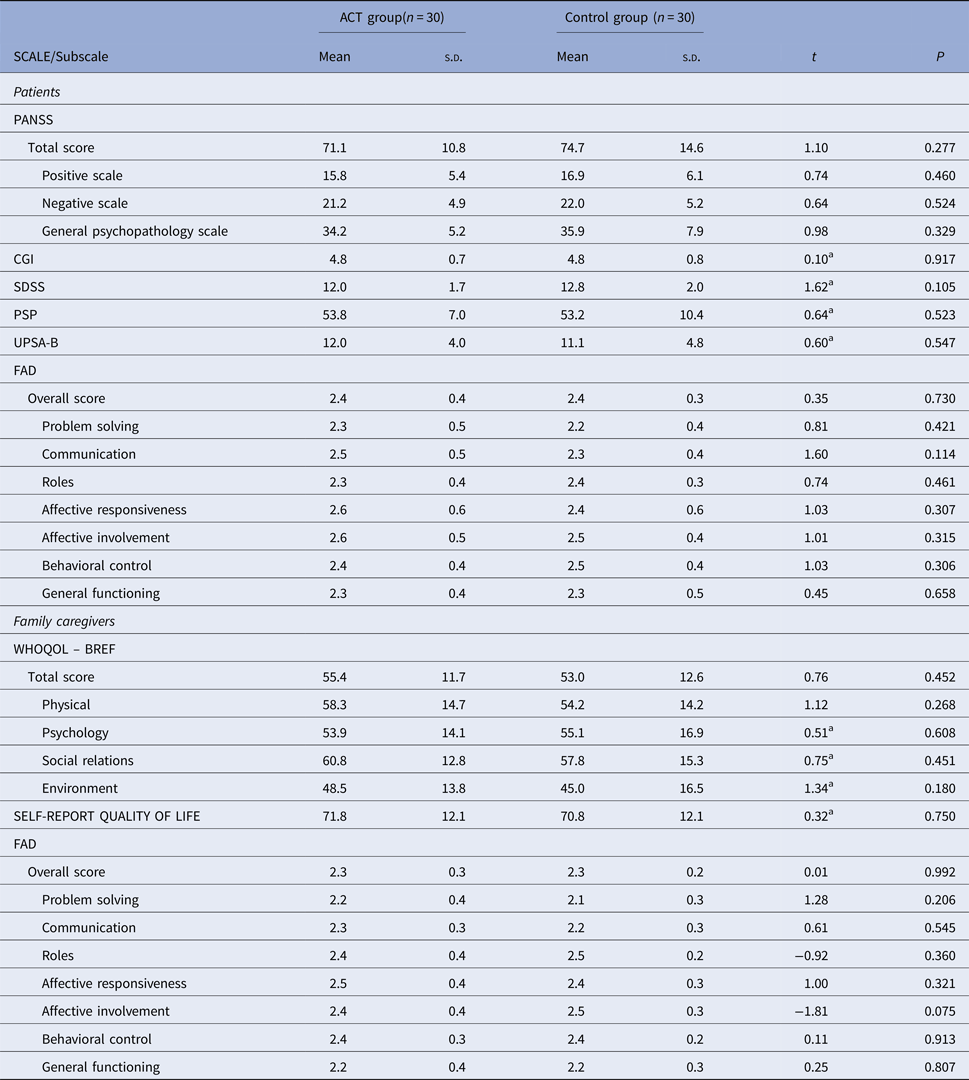
As shown in Table 1, with the exception of a longer mean (s.d.) duration of illness in the ACT group compared with that in the control group [9.8 (3.6) v. 7.5 (4.4) years, t = 2.09, p = 0.037], there were no significant demographic differences between the patients in the two groups. There were also no significant differences in the age of the family caregiver, the relationship of the family caregiver with the patient, or the economic status of the patients’ families. Table 2 shows that there were no significant differences at baseline between the two groups in terms of clinical symptoms, social functioning, family functioning, and quality of life of the caregivers.
Demographic, socio-economic, and clinical characteristics of patients and their caregivers in the ACT (Assertive Community Treatment) and control groups

a Low-income family refers to the family being entitled to basic living allowances for urban residents in Changsha. Significant P values (< 0.05) are in bold.
Comparison of the mean (s.d.) scores of the various clinical and social functioning measures at baseline in the Assertive Community Treatment (ACT) and control groups

PANSS, Positive and Negative Syndrome Scale; CGI, Clinical Global Impression; SDSS, Social Disability Screening Schedule; PSP, Personal and Social Performance Scale; UPSA-B, Performance Skill Assessment-Brief; WHOQOL – BREF, WHO Brief Quality of Life; FAD, Family Assessment Device.
a 2-independent samples nonparametric test (Mann–Whitney U test) for the non-normally distributed variables
Occurrence, duration, and timing of hospital admission, relapse, and re-employment
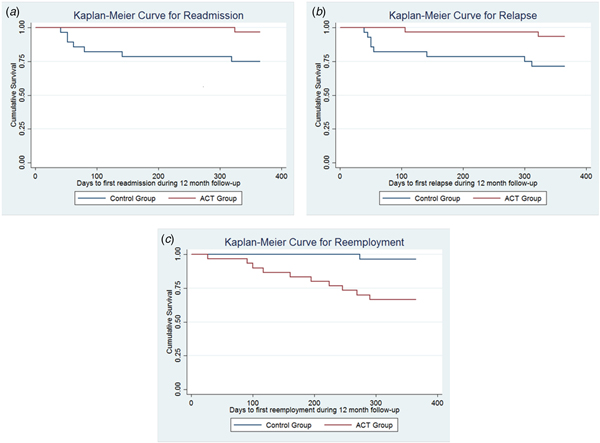
One of the 30 patients in the ACT group and seven of the 28 patients in the control group were readmitted to hospital over the follow-up period: total admission days in the ACT and control groups were 73 and 859, respectively. The proportion of readmissions was significantly lower in the ACT group than in the control group (3.3% v. 25.0%, Fisher's exact test p = 0.023). The mean (s.d.) day of readmission in the ACT group was 2.4 (13.3) days, while it was 30.7 (66.9) days in the control group. The Kaplan–Meier survival analysis for time to readmission (see Panel A of Fig. 2) found that the mean (s.e.) time to the first admission was significantly longer in the ACT group than in the control group [364 (1.3) v. 300 (22.9) days, log-rank χ2 = 5.89, p = 0.015].
Survival curves for the Assertive Community Treatment (ACT) and control (usual care) groups showing ‘survival’ to first (a) readmission, (b) relapse, and (c) reemployment during 12-month follow-up.

Two patients in the ACT group and eight patients in the control group met the ‘relapse’ definition over the 12-month follow-up (total days in relapse were 105 and 963, respectively). The proportion of patients who relapsed was significantly lower in the ACT group than in the control group (6.7% v. 28.6%, Fisher's exact test p = 0.038). The mean (s.d.) day of relapse was 3.5 (14.6) in the ACT group, while it was 34.4 (70.6) days in the control group. The Kaplan–Meier survival analysis for time to first relapse (see Panel B of Fig. 2) found that the mean (s.e.) time to first relapse was significantly longer in the ACT group than in the control group [355 (8.6) v. 296 (23.4) days, log rank χ2 = 5.09, p = 0.024].
Ten patients in the ACT group and one patient in the control group returned to wage-earning employment (four patients in the ACT group got competitive employment and other six were in transitional employment) over the 12-month follow-up: total days at work in the two groups were 1436 and 84, respectively. The proportion of patients who were re-employed was significantly greater in the ACT group than in the control group (33.3% v. 3.6%, Fisher's exact test p = 0.006). The mean (s.d.) day of re-employment was 47.9 (89.1) in the ACT group, while it was 3.0 (15.9) days in the control group. The Kaplan–Meier survival analysis for time to first re-employment (see Panel C of Fig. 2) found that the mean (s.e.) time to re-employment was significantly shorter in the ACT group than in the control group [301 (18.8) v. 362 (3.2) days, log-rank χ2 = 8.47, p = 0.004].
Cox regression analysis of readmission, relapse, and re-employment
As shown in Table 3, after controlling for age, duration of illness, number of prior hospitalizations, and the baseline PANSS and SDSS total scores in a Cox regression analysis, the adjusted hazard ratio for readmission is 0.072 (p = 0.024), indicating that the likelihood (risk) of readmission was reduced by 92.8% in the ACT group compared with that in the control group. Similarly, the adjusted hazard ratio for relapse was 0.114 (p = 0.014), indicating that the likelihood of relapse was reduced by 88.6% in the ACT group compared with that in the control group, and individuals with more prior hospitalizations were more likely to relapse. The Cox regression analysis for re-employment indicated a 30-fold increase in the occurrence of re-employment in the ACT group compared with that in the control group, and patients with a longer duration of illness or with higher baseline scores of PANSS/SDSS were significantly less likely to be re-employed over the follow-up period (see detailed analyses in online Supplementary Tables S2–S4).
Hazard ratio for readmission, relapse, and reemployment during 12-month follow-up

Significant P values (< 0.05) are in bold.
Clinical and social outcomes
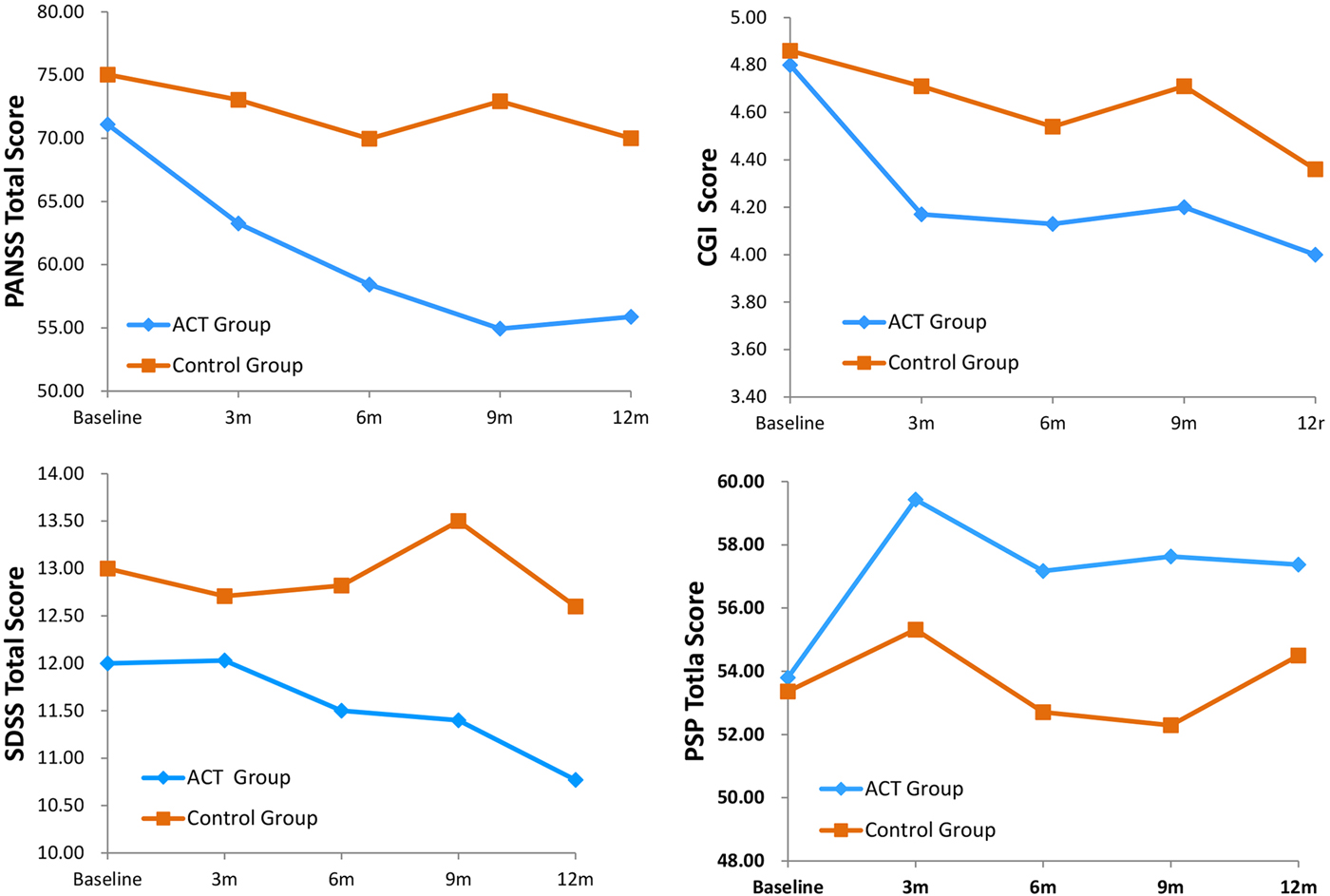
The main results for the four clinical and social functioning scales assessed at the five assessment times (at baseline and after 3, 6, 9, and 12 months) are presented in Fig. 3. Detailed results of mixed effect model analyses are shown in online Supplementary Table S3. After controlling for the baseline scores and the baseline differences in the duration of illness, the PANSS total score and subscale scores all showed a significant intervention effect (p = 0.001 ~ 0.016) and a significant intervention by time interaction effect (p = 0.001 ~ 0.049). The CGI measure also had a significant ACT intervention effect at month 3 (p = 0.003), and the difference was relatively stabilized at each follow-up assessment (intervention × time interaction, p = 0.634).
Total score at baseline and 3, 6, 9, and 12 months of follow-up for the Assertive Community Treatment (ACT) and control groups of (a) Positive and Negative Syndrome Scale (PANSS), (b) Clinical Global Impression (CGI), (c) Personal and Social Performance Scale (PAP), and (d) Social Disability Screening Schedule (SDSS).

The social functioning of the patients, as measured by PSP and SDSS total scores, also showed significantly greater improvement in the ACT group than that in the control group at month 3 (p = 0.003; p = 0.001). Compared with TAU, the 1-year ACT intervention significantly decreased patients’ social disability (as assessed by SDSS) at each of the follow-up, but the difference was relatively stable for social performance, as measured by PSP, at months 6, 9, and 12.
The UNIANOVA analysis of UPSA-B, FAD, and WHOQOL-BREF results are presented in online Supplementary Table S4. After controlling for baseline scores and baseline differences in the duration of illness, patients’ functioning, family functioning and caregivers’ quality of life all show significantly greater improvement at the time of the 1-year follow-up in the ACT group than in the control group (p = <0.001 ~ 0.011).
Discussion
The recent expansion of the ‘686 project’ in China has substantially increased the availability of free community-based services for individuals with SMI (Phillips, Reference Phillips2013). However, given the lack of resources and well-trained mental health professionals in the community, both the coverage and quality of the services provided remain inadequate. This study, the first RCT of ACT in China, intentionally focusses on severely disabled patients who live in the community – those most in need of more intensive services – and assesses the relative benefit of ACT over the services currently provided by the 686 system for such patients in an urban setting. We found that ACT significantly reduced the occurrence and duration of re-hospitalization and relapse, increased the occurrence and duration of employment, and improved the clinical symptoms, daily functioning, family relationships, family functioning, and caretakers’ quality of life. The results provide robust evidence that a culturally adapted ACT intervention can be both feasible and effective in urban China.
There are likely numerous factors contributing to these positive outcomes. Broadly speaking, international research shows that high fidelity ACT teams perform better, associated with the model's high service intensity, multi-discipline team approach, among other features (Winter and Calsyn, Reference Winter and Calsyn2000). This study team's moderately high fidelity in implementing the high-intensity, multi-disciplinary ACT services likely contributed to the overall success. More unique to the study setting, the cultural adaptation of the ACT program for use in China also likely played a role in its success. In China, over 90% of individuals with SMI reside with family members; patients who receive treatment are almost always brought to care by family members; and these patients rarely have comorbid substance abuse or other dual diagnoses [even cigarette smoking is lower than in the general population (Wang et al., Reference Wang, Xiang, Weng, Bo, Chiu, Chan, Lee and Ungvari2010)]. The current ACT study addressed these aspects by prioritizing intensive family psycho-education and support, and directed fewer resources to substance-related issues which are more intensively covered in the west. While the western ACT model also advocates family psychoeducation and support as a form of best-practice (Buchanan et al., Reference Buchanan, Kreyenbuhl, Kelly, Noel, Boggs, Fischer, Himelhoch, Fang, Peterson, Aquino and Keller2010), in the current study family supports were systematically implemented and received focused attention as a core feature of ACT. This finding builds on Asian research in ACT (Sono et al., Reference Sono, Oshima and Ito2008; Ito et al., Reference Ito, Oshima, Nishio, Sono, Suzuki, Horiuchi, Niekawa, Ogawa, Setoya, Hisanaga, Kouda and Tsukada2011; Liem and Lee, Reference Liem and Lee2013; Low et al., Reference Low, Tan, Lim, Poon and Lee2013; Kim et al., Reference Kim, Jeong, Kim, Kim, Seo and Hong2015) and general psychiatric care (Chien and Wong, Reference Chien and Wong2007; Chan et al., Reference Chan, Yip, Tso, Cheng and Tam2009; Ito et al., Reference Ito, Setoya and Suzuki2012) that emphasizes the centrality of family psychoeducation in a variety of mental health services. More broadly, the current study's results highlight the need to consider the role of culture in clinical practice, and points to a need to adjust measures of fidelity when assessing ACT or other holistic interventions in non-western settings.
It is difficult to isolate the specific ingredients responsible for the ACT model's general success in a wide range of settings (Bond and Drake, Reference Bond and Drake2015), primarily because it is a highly structured model, with pre-determined team structure, resource and operational requirements, and personalized care philosophy, elements that cannot easily be separated from each other. The current study provides suggestive evidence that ACT's person-centered, recovery-oriented treatment practices and guiding philosophy (Salyers and Tsemberis, Reference Salyers and Tsemberis2007; Salyers et al., Reference Salyers, McGuire, Rollins, Bond, Mueser and Macy2010), has by design affected the underlying philosophy and nature of care for the treatment group. This difference goes beyond the frequency and intensity of treatment contacts, or medication-based treatment. To a significant extend, the core mandate of current standard community mental health care in China (such as the ‘686 project’) is to reduce the social and domestic disturbances caused by people with SMI, while individual recovery and quality of life issues are not prioritized (Guan et al., Reference Guan, Liu, Wu, Chen, Wang, Ma, Wang, Good, Ma, Yu and Good2015). In contrast, the study's ACT group benefitted from the individually tailored, respectful, quality of life-driven services prescribed by the model. These qualitative differences may have contributed to the positive outcomes, along with enhanced community integration and rehabilitation, and de-stigmatization of mental illness. In this sense, ACT is an embodiment of a newer attitude and approach to community care, with potentially far-reaching impact on how services could be delivered in China. Further qualitative studies to expand the understanding of this powerful new service philosophy are warranted.
Other positive contributing factors are likely interactive. The current study's findings that the ACT intervention has led to improvement of patients’ levels of social functioning, employment, families’ relationships, functioning, and family member's level of quality of life, may partly be the results of less severe psychopathology, as shown by the reductions in PANSS scores across several dimensions. There is a virtuous cycle where decreased interference from psychiatric symptoms contributes to patients’ ability to pursue life-enhancing activities, in turn lowering the interfering effects of psychopathology.
It is notable that this study found a significant reduction of negative symptoms and improvement of social functioning, as they go beyond the typical expectation. Negative psychotic symptoms are well-known to be recalcitrant, not treatable by anti-psychotic medications alone (Andreasen et al., Reference Andreasen, Flaum, Swayze, Tyrrell and Arndt1990; Erhart et al., Reference Erhart, Marder and Carpenter2006). The current study's ACT services may have achieved success by active and frequent engagements so patients are less emotionally withdrawn than the past, improved on inter-personal rapport, and become less socially ostracized and withdrawn. The multi-disciplinary, recovery-oriented, family inclusive, and assertive outreach services of ACT model that were sustained over a period of time seem plausible a mechanism for improving negative symptoms of schizophrenia. A major European study had also shown that ACT services confer long-lasting effect on social functioning improvement, beyond the reduction in hospitalization effect (Bertelsen et al., Reference Bertelsen, Jeppesen, Petersen, Thorup, Ohlenschlaeger, le Quach, Christensen, Krarup, Jorgensen and Nordentof2008). The current study's significant improvements in social functioning and reemployment show that ACT is not only able to reduce hospitalization and relapse rates in the Chinese setting, but also to improve patients’ daily living standards and social functioning capacity, and is likely to reduce overall social costs of schizophrenia treatment, an area needing urgent improvement (Xiang et al., Reference Xiang, Yu, Sartorius, Ungvari and Chiu2012).
The current study also has some methodological advantages. Most research studies on ACT have outcome measures limited to the realm of relapses and re-hospitalizations (Dixon, Reference Dixon2000; Bond and Drake, Reference Bond and Drake2015). Moreover, the use of the rate and duration of readmissions as primary outcome measures for ACT may become problematic in settings where administrative and resource changes are resulting in fewer, briefer readmissions. The current RCT study has improved on these limitations by simultaneously considering a wider array of clinical, social and familial outcome measures, and varied, informative statistical analyses. One insight was gained from the employment of survival analyses and the repeated measures analysis of the PANSS results that show patients in the ACT group were continuously clinically stable for longer periods than patients in the control group. Finally, the increased rate of gainful employment was an encouraging outcome that is not easily achieved in the SMI population which was also reported in successful studies of ACT in Europe (Bertelsen et al., Reference Bertelsen, Jeppesen, Petersen, Thorup, Ohlenschlaeger, le Quach, Christensen, Krarup, Jorgensen and Nordentof2008).
Several limitations of the study should be considered. Despite the adequate power to demonstrate statistical significance, this study has a relatively small sample size and very few outcome events occurred, limiting the robustness of the results. The generalizability is therefore potentially limited by operator dependent variables. The index of relapse days is based on the retrospective reports of the patient and his/her family members every month, which might affect the accuracy of the estimate. The intervention was only assessed for 1 year, so it is not possible to determine whether or not the reported relative benefits over routine care would persist over longer periods, or how much further improvement may occur. Further multi-site studies with larger samples that follow-up patients longer are warranted. The rapidly changing socio-cultural environment of urban China has been associated with a gradual transition from the traditional collectivist family-centered culture to a more individualistic person-centered culture, so it is likely that the culture-specific modifications of the ACT model used in this study will need to be periodically updated as the culture in China changes. Due to the loss of contact, two participants in the control group were excluded from the analysis. If the loss of contact were partially related to the occurrence of selected outcomes, the effect on the study results would have been biased towards underestimation.
Furthermore, given the current shortages of mental health resources in China, it is not realistic to provide ACT services to all suitable patients with SMI in the country, particularly to patients living in rural communities – however desirable such an outcome may appear based on this early data. The growing policy support for community-based health care at the national level in China (Xiong and Phillips, Reference Xiong and Phillips2016) adds to the relevance of this study: the highly effective ACT model could be added to the repertoire of strategies to selectively target the needs of severely disabled individuals whose needs are not being met by currently available programs.
Conclusion
This first RCT study in China finds that a culturally-adapted ACT program in urban China is both feasible and highly effective over a 1-year follow-up period for reducing relapses and re-hospitalizations, for increasing participants’ gainful employment, and for improving care givers’ quality of life. Replication of the study with larger samples that follow participants for longer periods of time are needed to determine the feasibility and potential benefits of providing this treatment to the millions of severely mentally ill individuals in this country.
Supplementary material
The supplementary material for this article can be found at https://doi.org/10.1017/S0033291718001629.
Acknowledgements
This work was supported by the Young Faculty Health Policy and System Science grant from the China Medical Board, USA (grant number CMB991) and by the New Century Excellent Talents in Universities Program from the Chinese Ministry of Education (grant number NCET-12–0557). The authors are grateful to Zhenglai Wu, M.D., Ph.D., for help with the design and data analysis of the study; and want to thank Dandan Zhu, Sha Ren, Yuehong Luo, and Youlin Zeng for providing the ACT intervention, and Jie He and Shuang Yan for the performing the clinical and psychological assessments.
Contributors
XW designed the study and supervized the data collection and analysis. XL was the lead psychiatrist on the trial and wrote the first draft with SFL. WZ, XM, and SL provided the ACT intervention for the patients and collected the data. XL, JS, and WZ analyzed the data. MP supervised the implementation of the whole study and contributed to the revision of the final draft of the report. All other authors reviewed the results, or contributed important intellectual content.
Declaration of interests
The authors declare no competing interests.