Introduction
The clawed lobster family Nephropidae Dana, Reference Dana1852, consists of 56 Recent and 79 fossil species, arrayed in 19 genera (10 Recent, five fossil, and four both fossil and extant). The Nephropidae has a fossil record extending back to the Lower Cretaceous (Valanginian, ca. 139.8–132.9 Myr).
The clawed lobster genus Homarus Weber, Reference Weber1795 is known by two Recent and six fossil species. In modern oceans, Homarus is represented by the American lobster, H. americanus Milne Edwards, Reference Milne Edwards1837, and the European lobster, H. gammarus (Linnaeus, Reference Linnaeus1758). These species are morphologically very similar, differing only in the spinosity of the rostrum; H. americanus having a spine or two on the underside, and H. gammarus lacking these (Beard and McGregor, Reference Beard and McGregor2004). The two are capable of artificial breeding (Hauge, Reference Hauge2010). Six fossil species of Homarus recognized herein, all European, give the genus a fossil record extending back to the Early Cretaceous (ca. 100 Ma).
To some extent, the extant Homarus resembles the extinct Hoploparia M’Coy, Reference M’Coy1849. Placement of species in these genera has been the subject of much discussion. The separateness of, and differences between, Homarus and Hoploparia have been long debated and are still not resolved. Many authors have considered Homarus and Hoploparia to be distinct (Mertin, Reference Mertin1941; Glaessner, Reference Glaessner1969; Feldmann, Reference Feldmann1974; Aguirre-Urreta et al., Reference Aguirre-Urreta, Olivero and Medina1991; Tshudy, Reference Tshudy1993; Feldmann and Crame, Reference Feldmann and Crame1998; Tshudy and Sorhannus, Reference Tshudy and Sorhannus2003; Ilyin, Reference Ilyin2005; Feldmann et al., Reference Feldmann, Schweitzer, Redman, Morris and Ward2007; De Grave et al., Reference De Grave, Pentcheff, Ahyong, Chan, Crandall, Dworschak, Felder, Feldmann, Fransen, Goulding, Lemaitre, Low, Martin, Ng, Schweitzer, Tan, Tshudy and Wetzer2009; Schweitzer et al., Reference Schweitzer, Feldmann, Garassino, Karasawa and Schweigert2010; Karasawa et al., Reference Karasawa, Schweitzer and Feldmann2013; and others). Woods (Reference Woods1931), Van Straelen (Reference Van Straelen1936), and Stenzel (Reference Stenzel1945) viewed the two genera as synonymous. The current view is to separate them. In our opinion, there is not a single character that can be used alone to distinguish the two genera. We use a total evidence approach in drawing generic boundaries—and, even then, with difficulty. Not surprisingly, in cladistic analyses, Homarus and Hoploparia plot out as sister groups (Tshudy, Reference Tshudy1993; Tshudy and Babcock, Reference Tshudy and Babcock1997; Ahyong, Reference Ahyong2006; Karasawa et al., Reference Karasawa, Schweitzer and Feldmann2013).
Hoploparia is most readily distinguished from Homarus (Fig. 1) by the ventral extension of the branchiocardiac groove (absent on Homarus) and the granulation of the exoskeleton (almost entirely absent on Homarus). In addition, the majority of Hoploparia display an antennal carina, whether short or long (absent on Homarus), as well as postantennal spines (absent on Homarus). Homarus lacks sculpture and ornamentation on its pleonal terga and pleura (some Hoploparia possess these). Claws of Homarus are much broader than those of nearly all Hoploparia (except for Hoploparia antarctica Wilckens, Reference Wilckens1907).
There are several species that, although referable to either Hoploparia or Homarus, more closely resemble the other genus in one or more features. For example, Homarus klebsi (Noetling, Reference Noetling1885) and Homarus morrisi Quayle, Reference Quayle1987 exhibit a ventral extension of the branchiocardiac groove, as is typical of Hoploparia, but are, otherwise, referable to Homarus. Conversely, some species referred to Hoploparia, such as H. collignoni (Van Straelen, Reference Van Straelen1949), lack the ventral extension of the branchiocardiac groove, but are otherwise characteristically Hoploparia. Reference is made to Tshudy (Reference Tshudy1993) for more examples and discussion.
In the present paper, we appraise the fossil record of Homarus. We summarize the taxonomic history of, and confusion between, Homarus and Hoploparia, provide a redefinition of Hoploparia, describe a new fossil species of Homarus, list the species recognized for both genera, tabulate all fossil species of the family Nephropidae, and discuss nephropid species diversity through time.
Geological setting
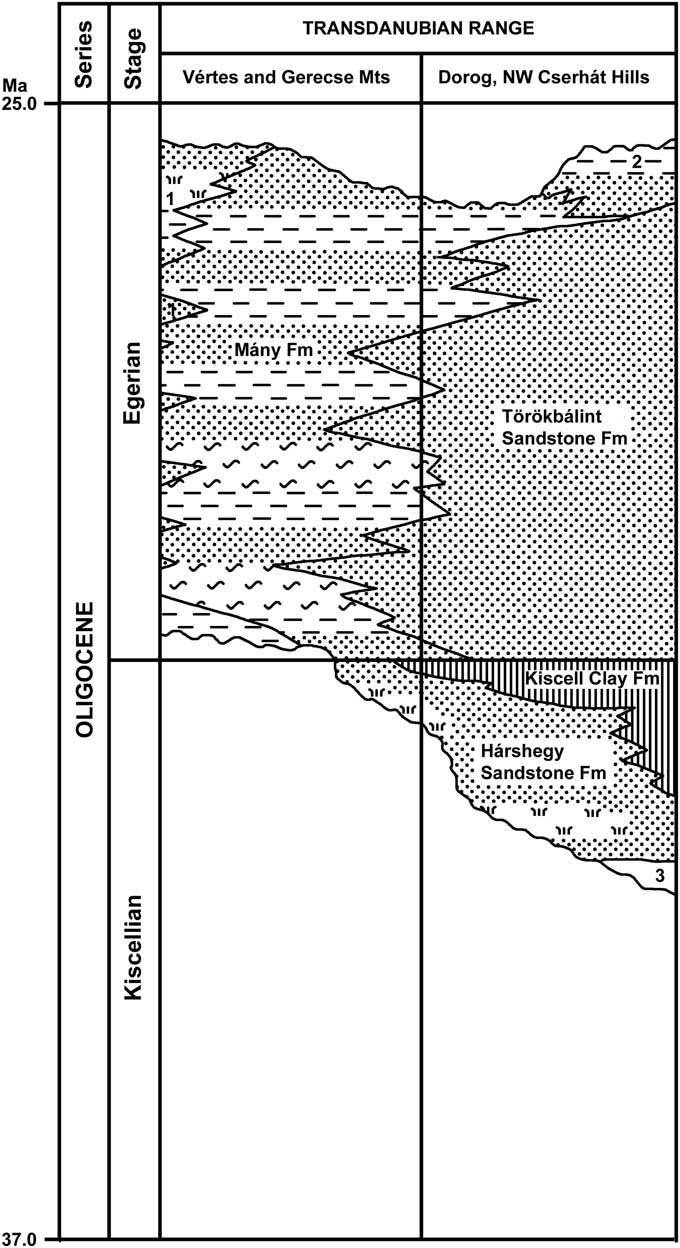
The new species presented herein was collected from the Mány Formation of north-central Hungary. The Mány Formation occurs mostly in the northeastern part of the Transdanubian Mountains. Patchy occurrences are known also from the western and eastern foreland of the Gerecse Mountains and in the Dorog Basin. The thickness of the formation varies between 200 and 600 m. The Mány Formation itself consists of alternating calcareous siltstone, clayey siltstone, cross-bedded sand and sandstone beds, with conglomerate coal stringers and variegated clay intercalations and coal bands (Nagymarosy and Gyalog in Császár, Reference Császár1997). The formation formed predominantly in the brackish water of a shallow-marine lagoon; however, intercalations with sediments of freshwater origin, as well as those from fully marine settings, are present here.
Deposition of the formation probably started at the end of the ‘Kiscellian’ (Rupelian, early Oligocene) and continued into the ‘Egerian’ (Chattian, late Oligocene) (Gyalog and Budai, Reference Gyalog and Budai2004). On the basis of the mollusc fauna, the maximum depositional depth of Mány Formation is 20–30 m (Báldi, Reference Báldi1973). According to some researchers (e.g., Sztanó et al., Reference Sztanó, Magyary and Nagymarosy1998), the Mány Formation should be integrated as a member of the Törökbálint Formation.
Previous occurrences of decapod crustaceans from the Mány Formation include the retroplumid crab Loerenthopluma lata Beschin et al., Reference Beschin, Busulini, De Angeli and Tessier1996 recovered from borehole Mány-15 (Hyžný and Müller, Reference Hyžný and Müller2010).
Repositories and institutional abbreviations
Hungarian Natural History Museum, Budapest (HNHM PAL); Natural History Museum, London (NHMUK).
Systematic paleontology
Order Decapoda Latreille, Reference Latreille1802
Infraorder Astacidea Latreille, Reference Latreille1802
Family Nephropidae Dana, Reference Dana1852
(sensu Tshudy et al., Reference Tshudy, Robles, Chan, Ho, Chu, Ahyong and Felder2009; inclusive of Thaumastochelidae Bate, Reference Bate1888)
Genus Homarus Weber, Reference Weber1795
Type species
Astacus marinus Fabricius, Reference Fabricius1775, p. 413 (see Holthuis, Reference Holthuis1974, for discussion).
Remarks
The original description (Weber, Reference Weber1795) of Homarus is in Latin. We follow here the emended definition of Holthuis (Reference Holthuis1974, p. 815–818).
Homarus benedeni Pelseneer, Reference Pelseneer1886; line drawing, in right lateral view, showing a morphology similar to that of Recent species of Homarus (modified from Pelseneer, Reference Pelseneer1886).

Homarus hungaricus new species
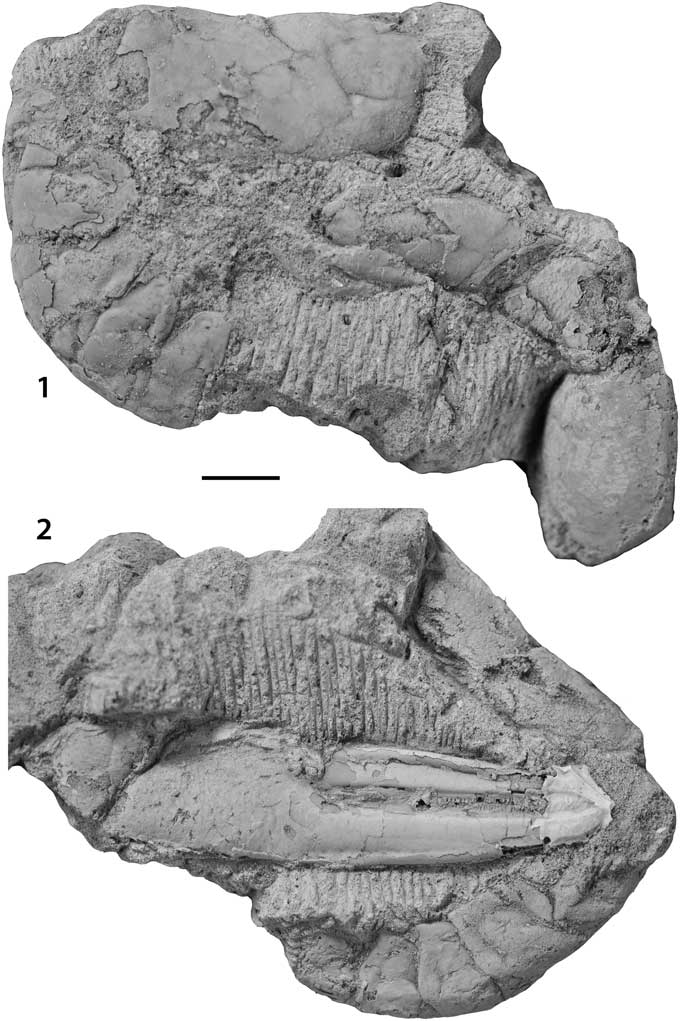
Homarus hungaricus n. sp. from the upper Oligocene (Chattian) Törökbálint Formation (HNHM PAL 2015.1): (1) pleon, and lower surface of incomplete, right cheliped; (2) left lateral view of pleon and lower surface of left (cutter) claw. Scale bar equals 10 mm.

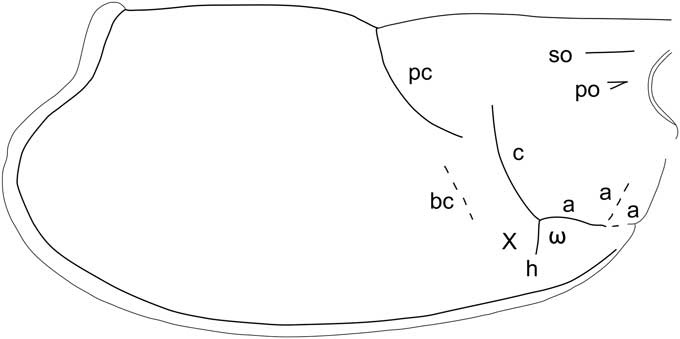
Line drawing (reconstruction) of Homarus hungaricus n. sp.; a, antennal groove; bc, branchiocardiac groove; c, cervical groove; h, hepatic groove; pc, postcervical groove; po, postorbital spine; so, supraorbital carina; χ, prominence chi; ω, prominence omega.

Holotype
The holotype and single known specimen of Homarus hungaricus n. sp. is from the upper Oligocene (Chattian) Mány Formation at Mány, northern Hungary. It is deposited in the Hungarian Natural History Museum, Budapest as HNHM PAL 2015.1.
Diagnosis
Homarus with narrow chelipeds and postcervical groove extending (as intercervical groove) toward, but not quite reaching, upper part of cervical groove.
Occurrence
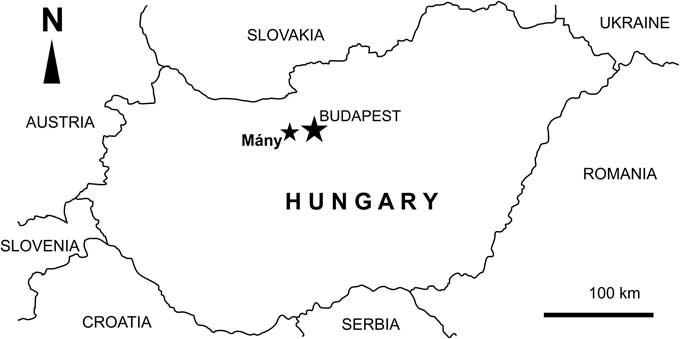
The specimen was recovered from borehole Mány-14 (Má-14), sunk near the village of Mány in north-central Hungary, west of Budapest (Fig. 4), from a depth interval of 401.2–406.7 m. The strata from 170.6–492.3 m belong to the upper Oligocene Mány Formation (Fig. 5).
Map showing the collecting locality of Homarus hungaricus n. sp. near Mány, in the northeast of Fejér County, in the Zsámbék Basin, north-central Hungary.

Stratigraphic column (pre-2012; see text) showing the Mány Formation and its lateral equivalent, the Törökbálint Sandstone Formation, as they occur in the Transdanubian Range, Hungary.

Description
Cephalothorax right side mostly preserved. Left side completely absent, beginning at dorsomedian. Cephalothorax posterior margin incomplete. Ventral margin indistinct; cephalothorax ~22 mm in height. While incomplete along margins, overall proportions and proportions of regions (as defined by grooves) are typical of Homarus-Hoploparia. Rostrum absent or not exposed.
Postcervical groove extends anteroventrally and concave-forward from (assumedly) dorsomedian (region poorly preserved). Extends anteroventrally (as intercervical groove) toward, but not quite reaching, upper part of cervical groove (Figs. 2, 3).
Region of upper/posterior branchiocardiac groove poorly preserved. Vague ventral extension of branchiocardiac groove extends from lower end of postcervical groove; groove becomes very indistinct along posterior side of subtly inflated prominence χ (terminology of Holthuis, Reference Holthuis1974, p. 734; this is the attachment of the adductor testis muscle insertion).
Hepatic groove indistinct as it loops under prominence χ, but better impressed where it separates prominences χ and ω (the mandibular external articulation; see Feldmann and Crame, Reference Feldmann and Crame1998). Prominence ω triangular, inflated; not underlined by inferior groove. Inferior groove completely absent.
Cervical groove subtly concave forward, angling anteroventrally.
Antennal groove distinct, nearly straight (slightly sinuous) over anterior side of prominence ω. At anteroventral corner of prominence ω, antennal groove becomes very faint, bifurcates. Upper branch extends a short distance in direction of base of rostrum. Lower branch extends toward anterior margin, effacing before reaching latter.
Antennal spine not preserved. Antennal and postantennal region smooth, uninflated. Gastro-orbital and buccal grooves absent.
Postantennal spine absent. Hepatic spine absent. Cervical and postcervical spines/spinules absent. Postorbital spine strong at base, angles antero-dorsally. Supraorbital spine region not preserved, but seems to be followed by a nodose, supraorbital carina.
Cuticle of cephalothorax smooth (not granulate), except ventrally, below level of prominence χ, where with low, rounded granules.
Pleon represented by segments one–five (both left and right sides of lobster specimen). All tergites appear to be without sculpture (i.e., lacking grooves, etc.) and with smooth cuticle lacking any surface ornamentation. Tergum-pleuron boundaries unmarked by any ridge, terrace, or other demarcation.
Pleuron one (left side) a parallelogram angling anteroventrally. Pleuron two (left side) subquadrate; anterior margin convex, posterior margin convex at top then concave for remainder. Anteroventral corner rounded; posteroventral corner pointed posteroventrally. Pleura three–five cordate, terminating in sharp, posteroventrally directed point. Pleuron two with broad, submarginal furrow bordering, but well inside, anterior and posterior margins. Pleura three and four with similar furrow bordering upper part of posterior margin. Each pleuron surface broadly, slightly inflated medially and along margin. Pleuron five gently convex overall. Pleura four and five (right side of lobster) with a few low, rounded nodes. Pleura two–five with a large pore near termination. At least the anteroventral margin of pleura three, four, and five with a very fine, rounded, bead for margin; shown best on pleuron five as viewed on right side of lobster, although pleura three, four, and five of left side also show this bead (a similar bead is seen on the anterior, but not posterior, sides of the pleura of Homarus americanus). On pleuron five, bead breaks into minute serrations near pleuron termination. Telson not preserved.
Specimen preserved with portions of right (crusher) and left (cutter) claws. Right cheliped rotated inward so that merus, carpus, and propodus lower (ventral) surface and propodus outer margin are exposed. Merus lower surface gently convex overall; cuticle smooth. Merus with strong spine at inner proximal and inner distal corners. Merus outer surface with granules. Carpus lower surface rather flat overall, with strong spine at inner and outer distal corner; cuticle smooth, but with large, transversely elongate pits. Propodus incomplete at approximately mid-length. Manus ovate in cross section. Manus outer margin narrowly squared-off proximally, becoming sharply rounded for most of length. Cuticle of lower surface smooth.
Left (cutter) claw lower surface exposed. Claw elongate, approximately 5x longer than wide (~74 mm long and estimated 15 mm wide). Propodus outer margin sharply rounded. Pollex subovate in crosssection, ~40 mm long, 8.4 mm at widest; thus 0.21x as wide as long. Dactylus ~30 mm long; dactylus subrectangular in cross section. Fingers rather straight, parallel but curving toward each other near terminations. Unsure if terminations occlude. Cuticle on fingers minutely, densely pitted, especially adjacent to dentition.
Denticles of left cheliped conical, slightly longer than wide, densely arranged, of varying sizes. Smallest ~0.15 mm diameter at base and about twice as long. Larger denticles ~0.3 mm wide at base, ~0.5 mm long. A very few much larger denticles; largest, located proximal of mid-length on pollex, is triangular, ~2 mm wide at base and equally long. Denticles mostly perpendicular to fingers. Largest denticle is distally directed.
Etymology
The species name derives from the collecting locality in Hungary.
Remarks
The new species is referred to Homarus, but with acknowledgement of similarities to the extinct Hoploparia. The new species has: (1) a generally smooth (not granulose) cephalothorax, pleon, and chelipeds; (2) smooth antennal and postantennal regions; (3) only indistinct ventral extension of the branchiocardiac groove; and (4) unsculptured pleonal tergites. Nothing on the cephalothorax or pleon is inconsistent with Homarus, but the fossil specimen’s cutter claw is elongate and Hoploparia-like, thus complicating the generic placement.
Below we compare the late Oligocene (ca. 30 Ma) specimen to all species of Homarus known from the Eocene epoch (56.0–33.9 Myr) to the Recent. Given the long history of taxonomic confusion surrounding Homarus and Hoploparia, we also compare (further below) the new species to all known Eocene–Recent species of Hoploparia. No existing species of either genus has a morphology matching that of the new Hungarian fossil.
Comparison to Oligocene (33.9–23.03 Myr) species
Homarus klebsi is known from the lower and upper Oligocene of northern Germany (and, according to specimen labels at the Institut royal des Sciences naturelles de Belgique at Brussels, from the Oligocene [‘Tongrien’] of formerly Palmnicken, eastern Prussia [now Kaliningrad, Russian Federation]). Homarus klebsi differs from the new species by: (1) its gigantic size, and in having (2) a distinct ventral extension of the branchiocardiac groove and (3) a suprahepatic groove (Noetling, Reference Noetling1885, pl. 7, fig. 1 [same figure in Freess, Reference Freess1992, pl. 4B]).
Homarus lehmanni Haas, Reference Haas1889 has been described from the lower Oligocene (Rupelian) of Germany. This species is known only by a fragmentary carpus and fragmentary merus and, therefore, is hardly comparable to the new material. Van Straelen (Reference Van Straelen1936) and Verheyden (Reference Verheyden2002) considered H. lehmanni to be a synonym of H. percyi Van Beneden, Reference Van Beneden1872.
Homarus percyi is known from the lower Oligocene (Rupelian) of northwest Belgium, Germany, and Russia. The claws of H. percyi are gigantic, and more robust in proportions than those of the new species; they also have spikes on the propodus upper and lower surface.
Comparison to Eocene (56–33.9 Myr) species
Homarus klebsi (as above). Homarus morrisi Quayle, Reference Quayle1987 from the Eocene of southern England was isolated from Hoploparia gammaroides M’Coy, Reference M’Coy1849. It differs from the new species in being conspicuously pitted, in having a more granulose prominence ω, a slightly different carapace groove configuration, and a more strongly pitted pleon surface.
Comparison to Recent species
Homarus americanus and H. gammarus: the fossil specimen is clearly distinct from the American Lobster, Homarus americanus (and the extremely similar European lobster, Homarus gammarus), differing in aspects of carapace and pleon ornamentation and, especially, cutter claw shape. Homarus americanus has no hint of a ventral extension of the branchiocardiac groove. The postorbital spine seems stronger on the fossil specimen than on H. americanus. The cephalothorax of H. americanus is less granulose below the cervical groove, except for below the antennal groove, where both H. americanus and the fossil are granulose. Homarus americanus also has, below the prominence χ, a reticulate pattern that is absent on the fossil specimen. Homarus americanus lacks a large pore near the termination of pleura two–five (this pore is common on Hoploparia and on some modern nephropid genera, such as Nephrops, Metanephrops Jenkins, Reference Jenkins1972, and Thymopides, but, strangely, not Homarus [nor on Nephropsis rosea Bate, Reference Bate1888]). On H. americanus, on the carpus lower surface, the spine on the inner distal corner is smaller.
The cutter claw of H. hungaricus n. sp. is very different from that of H. americanus and is, by far, the easiest way to distinguish the two species. The cutter claw pollex on H. americanus is, proportionately, twice as wide as that of the fossil. The pollex on H. americanus is extremely wide, with a width/length ratio of 0.44 (width=26.17 mm; length=59.81 mm) versus 0.21 on the fossil. There are no known fossil species of Homarus that have a pollex as wide as that on H. americanus. Homarus morrisi (with a broad crusher claw like that on H. americanus) has a cutter claw pollex (incomplete; unable to compute a width/length ratio; Quayle, Reference Quayle1987, pl. 64, fig. 7) more closely similar to that of the fossil than to H. americanus. The manus is also shaped differently, being proportionately wider on H. americanus (e.g., 0.72; width=34.71 mm; length=48.07 mm) than the fossil (0.61; width=15 mm; length=24.50 mm). The dentition is also very different. The cutter claw of H. americanus has small, variably sized denticles that are cylindrical to subconical, and each is concave (crater-like) at its termination (versus the conical, pointed dentition on the fossil).
Genus Hoploparia M’Coy, Reference M’Coy1849
Type species
Astacus longimanus Sowerby, Reference Sowerby1826, by subsequent designation of Rathbun, 1926.
Remarks
Hoploparia was erected by M’Coy (Reference M’Coy1849) as a genus of fossil lobsters that generally resembles Homarus, but has a more sculptured (grooved, locally inflated, etc.) and ornamented carapace. In fact, the name Hoploparia (armagena) refers to the lobster’s “spiny cheeks,” the locally inflated and ornamented regions on the anteroventral sides of the cephalothorax. Homarus lacks these locally inflated “cheeks” and is less spiny. M’Coy’s diagnosis (Reference M’Coy1849, p. 175–176) distinguished the type species, Hoploparia longimana (Sowerby, Reference Sowerby1826), from Homarus. Since 1849, the inclusion of more than 50 other fossil species has variously stretched and expanded the definition of Hoploparia to accommodate this or that spine, this or that carina, etc., to the point that Hoploparia is a genus that is difficult to characterize (Tshudy and Sorhannus, Reference Tshudy and Sorhannus2003).
Redefinition by Tshudy (Reference Tshudy1993)
Tshudy (Reference Tshudy1993, p. 71–72) redefined Hoploparia as follows: “Rostrum long, spinose. Postcervical groove well impressed over most of length; becomes subtler as it extends anteriorly toward cervical groove. Branchiocardiac groove (dorsally) usually present. Ventral extension of branchiocardiac groove typically extends to hepatic groove (see Tshudy, Reference Tshudy1993, p. 463–464; Tshudy and Babcock, Reference Tshudy and Babcock1997, p. 257, for a discussion of the homologies of the branchiocardiac and postcervical grooves). The groove patterns on Triassic and Jurassic Erymidae Van Straelen, Reference Van Straelen1925 and the Jurassic chilenophoberids (now Stenochiridae Beurlen, Reference Beurlen1928; see Karasawa et al., Reference Karasawa, Schweitzer and Feldmann2013), Chilenophoberus Chong and Förster, Reference Chong and Förster1976, Palaeophoberus Glaessner, Reference Glaessner1932, and Pseudastacus Oppel, Reference Oppel1861, show convincingly that the more ventrally directed branch of the postcervical groove (sensu Holthuis, Reference Holthuis1974) is actually part of the branchiocardiac groove.
Urogastric groove typically absent
Cervical groove well impressed; extends from level of orbit to junction of hepatic and antennal grooves. Median carina typically absent. Submedian carina present on a few species. Subdorsal carina present. Supraorbital spine present, typically followed by supraorbital carina. Postorbital spine typically present; gastrolateral and hepatic spine typically absent. Antennal carina absent, short, or extending to near cervical groove. Thoracic region lacks carinae.
Pleonal terga unornamented, mostly unsculptured; typically with a narrow transverse furrow along posterior margin. Pleura elongate, typically cordate, ending in a point. Telson surface with a pair of submedian ridges converging posteriorly. Telson without lateral spines, but with posterolateral spines. Scaphocerite present. Claws typically unequal; upper and lower surfaces lacking carinae. Exoskeleton generally granulated.”
Hoploparia: a wastebasket genus?
Tshudy and Sorhannus (Reference Tshudy and Sorhannus2003) proposed that Hoploparia is a “wastebasket” genus, one with a broad range of variation and, in cladistic analyses, containing non-Hoploparia. They presented the following points:
1. Hoploparia has been expanded in a de facto fashion to an extent that, today, there is so much variation among lobster species referred to Hoploparia that the genus is difficult to characterize and to code for cladistic analysis without using many polymorphic character states. Tshudy (Reference Tshudy1993) encountered this while attempting to write an emended diagnosis of the genus. His diagnosis (1993, p. 71–72; see above), by necessity, was rife with descriptions of how character states “typically” occur. Moreover, some of his other statements, such as “thoracic region lacks carinae,” are invalidated by one or a few species (e.g., presence of thoracic carinae on Hoploparia antarctica Wilckens, Reference Wilckens1907, and Hoploparia bearpawensis Feldmann in Feldmann, Bishop, and Kammer, Reference Feldmann, Bishop and Kammer1977).
2. Hoploparia has been expanded in a de facto fashion to an extent that, “the morphologies of some Recent genera (e.g., Eunephrops Smith, Reference Smith1885 and Nephropides Manning, Reference Manning1969) seem easily accommodated within the fossil genus Hoploparia” (Tshudy and Sorhannus, Reference Tshudy and Sorhannus2003, p. 700), and that, “if found in fossil form,”…“Nephropides and Eunephrops would very likely be referred to Hoploparia” (Tshudy and Sorhannus, Reference Tshudy and Sorhannus2003, p. 701; supporting details in their paper).
3. Hoploparia is paraphyletic. Cladistic results showed other nephropid genera scattered throughout the Hoploparia results.
To these points, we here add:
4. The range of variation in Hoploparia is inconsistent with that in Recent genera (i.e., species of Hoploparia are morphologically more different from each other than are some other nephropid genera). For example, the modern Thymopides Burukovsky and Averin, Reference Burukovsky and Averin1977, and Thymops Holthuis, Reference Holthuis1974 are, in external morphology, more closely similar to each other (seen best in a quick, comparative glance at each, but for details, see Tshudy, Reference Tshudy1993) than many species of Hoploparia are to each other. The same is true for Homarus and Homarinus Kornfield, Williams, and Steneck, Reference Kornfield, Williams and Steneck1995 (likewise, and details in Tshudy, Reference Tshudy1993), and especially Thaumastocheles Wood-Mason, Reference Wood-Mason1874 and Thaumastochelopsis Bruce, Reference Bruce1988.
Tshudy and Sorhannus (Reference Tshudy and Sorhannus2003) did not propose a solution to the problem (i.e., they did not present a revision of Hoploparia in that particular paper, but hoped to stimulate discussion and new characters and cladograms that would lead to a consensus and, subsequently, revision). Feldmann et al. (Reference Feldmann, Schweitzer, Redman, Morris and Ward2007, p. 702–703) rebuffed the idea that Hoploparia was a wastebasket genus, noting that they were “struck by how similar the species currently referred to Hoploparia are to one another.” But they did not comment directly on the points (above) made by Tshudy and Sorhannus (Reference Tshudy and Sorhannus2003). Thus, in our opinion, the definition and species composition of Hoploparia remain problematic.
It would seem that a consensus from species-level cladistic analyses would be a reasonable way of dividing the current contents of Hoploparia into smaller groups. We do not believe that a single published cladistic analysis or cluster analysis is a firm enough basis for disrupting the taxonomic stability of fossil lobsters. We cite, as an example of the apparent fallibility of computer analyses, a recently published (Schweitzer and Feldmann, Reference Schweitzer and Feldmann2014) cluster analysis of extant lobster genera. Among the curious results is that Thaumastocheles and Thaumastochelopsis are well separated, and each is paired with a lobster that looks much less like it than does its former family-mate (former family Thaumastochelidae). Indeed, Ahyong et al. (Reference Ahyong, Chu and Chan2007, p. 206–207) opined that the “differences between Thaumastocheles and Thaumastochelopsis are minor, and whether or not both genera should be recognized requires further study.” With results this strange, it seems unreasonable to make sweeping, formal changes to taxonomy on the basis of a single, computerized analysis.
Tshudy (Reference Tshudy1993) noted that, despite the range of variation among species of Hoploparia, there were no obvious correlations between character states that would make subdividing the genus easy. In other words, he did not (and we do not) see certain spines associated with certain thoracic carinae, etc. Instead, each species of Hoploparia seems like a random sample from a grab bag of character states. Feldmann et al. (Reference Feldmann, Schweitzer, Redman, Morris and Ward2007, p. 703) independently found the same.
Comparison of the new species to Miocene (23.03–5.33 Myr) Hoploparia species.—Hoploparia gazdzicki Feldmann and Crame, Reference Feldmann and Crame1998, from the lower Miocene of Antarctica, is a good Hoploparia that differs from the new species in having a granulose cephalothorax, a much more distinct ventral extension of the branchiocardiac groove, and a pleon with the tergum-pleuron surface separated by a distinct ridge.
Comparison of the new species to Eocene (56–33.9 Myr) Hoploparia species
Hoploparia alpinus (Van Straelen, Reference Van Straelen1936) from the lower Upper Eocene (‘Auversien’) of Switzerland is fairly complete and well preserved, and “clearly a Hoploparia” (Tshudy, Reference Tshudy1993, p. 73), but we cannot verify species identification without having seen the actual specimen or at least a whitened photograph. Tshudy (Reference Tshudy1993) was unable to locate the holotype and sole specimen known. Van Straelen (Reference Van Straelen1936) cited ‘Le Musée d’Histoire naturelle de la Ville de Neuchâtel’ as the repository. From the description and photocopied photographs in Van Straelen (Reference Van Straelen1936, figs. 1, 2), Hoploparia alpinus has pleonal pleura 3–5 narrower near the terminations than those of the new species. Hoploparia alpinus also appears to have relatively smaller chelipeds than those on the new species. Chelipeds on the new species are approximately 1.5x longer, or more, than the cephalothorax.
Hoploparia corneti Van Straelen, Reference Van Straelen1921, from the lower Eocene (Ypresian) of Belgium, is assigned to Hoploparia, based on granulation of the skeleton and the ventral extension of the branchiocardiac groove (Tshudy, Reference Tshudy1993, p. 109). Van Straelen (Reference Van Straelen1921, p. 138) wrote that H. corneti most closely resembles H. gammaroides. Tshudy (Reference Tshudy1993) was unable to locate material during his dissertation work; H. corneti differs from the new species in having granulation and a distinct branchiocardiac groove.
Hoploparia gammaroides M’Coy, Reference M’Coy1849, from the lower Eocene of England and Belgium, is a good Hoploparia that differs from the new species in having a granulose cephalothorax and pleonal pleura that are more sickle-shaped/hook-like (see especially pleuron 3 [e.g., NHMUK 59127 and 59118] and with posterior margins more indented).
Hoploparia groenlandica Ravn, Reference Ravn1903 has been recorded from the lower Eocene of Greenland. We have examined a latex cast; cephalothorax, pleon, and claws all support identification as Hoploparia. It differs from the new species in having a distinct ventral extension of the branchiocardiac groove, a carapace surface covered by slightly squamiform granulations, and perhaps a more distinct sculpture (grooves) on the pleon.
Hoploparia johnsoni Rathbun, Reference Rathbun1935, from the Middle Eocene of Alabama, U.S.A., is a good Hoploparia with a granular cephalothorax. It differs from the new species in having a granular cephalothorax, a better-defined ventral extension of the branchiocardiac groove, a hepatic spine, some spines on the postantennal region, and a better-defined sculpture (grooves) of the pleon.
Hoploparia wardi Quayle, Reference Quayle1987, from the lower Eocene of southern England, also is a good Hoploparia with a granular cephalothorax; Quayle removed it from H. gammaroides. It can be differentiated from the new species in having a granular cephalothorax, a hepatic spine, spines on the antennal region, and a more distinct ventral extension of the branchiocardiac groove.
Fossil record of Homarus and Hoploparia
The fossil record of Homarus is equivocal, depending on which species are referred to the genus. Six fossil species recognized herein, all European, give the genus a fossil record extending back to the Early Cretaceous (ca. 100 Ma). These are: Homarus benedeni Pelseneer, Reference Pelseneer1886 (Albian of France; Fig. 1), H. morrisi (Eocene of southern England), H. klebsi (late Eocene–late Oligocene of western Europe), H. percyi Van Beneden, Reference Van Beneden1872 (Oligocene of Europe), H. lehmanni Haas, Reference Haas1889 (early Oligocene of Germany), and H. hungaricus n. sp. (late Oligocene of Hungary). Schweitzer et al. (Reference Schweitzer, Feldmann, Garassino, Karasawa and Schweigert2010) listed eight species of Homarus, but their list contains several differences from ours (Appendix 1).
Its oldest, and sole Cretaceous, occurrence (H. benedeni, of Albian age) is based on material that we have not been able to examine first hand. Line drawings in Pelseneer (Reference Pelseneer1886, p. 49–50) show that H. benedeni is very Homarus-like and not at all suggestive of Hoploparia. Based on these line drawings, we are confident that Homarus is known from the Albian (ca. 100 Ma).
Some of the Paleogene occurrences exhibit a combination of Homarus- and Hoploparia-like morphological features (Appendix 1) (e.g., a ventral extension of the branchiocardiac groove [H. klebsi, H. morrisi] or a long subdorsal carina [H. klebsi]).
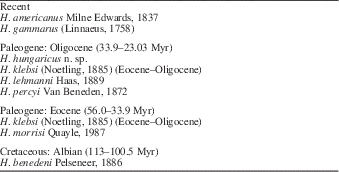
Table 1 presents the stratigraphic distribution of species of Homarus. Homarus first appears in the fossil record in the Early Cretaceous (Albian) and then is not known from the Late Cretaceous, despite the fact that nephropid lobsters in general are well known from that time interval. This stratigraphic distribution makes one wonder if we are looking at one lineage, or if the Paleogene species are convergent with the Albian form.
Stratigraphic distribution of species of Homarus.

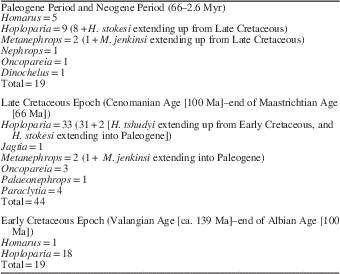
Hoploparia is the best known fossil genus of clawed lobster, with a record extending from the Lower Cretaceous (Valanginian) to the Neogene (Miocene). Fifty-eight species are known: 18 from the Lower Cretaceous, 33 from the Upper Cretaceous (31, plus one carryover from the Lower Cretaceous and one extending into the Paleogene), and nine Paleogene and Neogene (eight, plus one carryover from the Upper Cretaceous) (Table 2). Hoploparia was cosmopolitan in geographic range, extending from Canada (i.e., the Late Cretaceous H. bennetti Woodward, Reference Woodward1900 from Vancouver, and H. albertanensis Tshudy et al., Reference Tshudy, Donaldson, Collom, Feldmann and Schweitzer2005 from Alberta) and Greenland (i.e., the early Eocene H. groenlandica Ravn, Reference Ravn1903) to the Antarctic Peninsula (i.e., the Campanian–Maastrichtian H. antarctica, the Campanian–Paleocene H. stokesi (Weller, Reference Weller1903), and the early Miocene H. gazdzicki Feldmann and Crame, Reference Feldmann and Crame1998).
Stratigraphic distribution of species of the Nephropidae, compiled for three time intervals: Early Cretaceous, Late Cretaceous, and Paleogene and Neogene (data from Appendix 2).

Nephropid lobster diversity through time
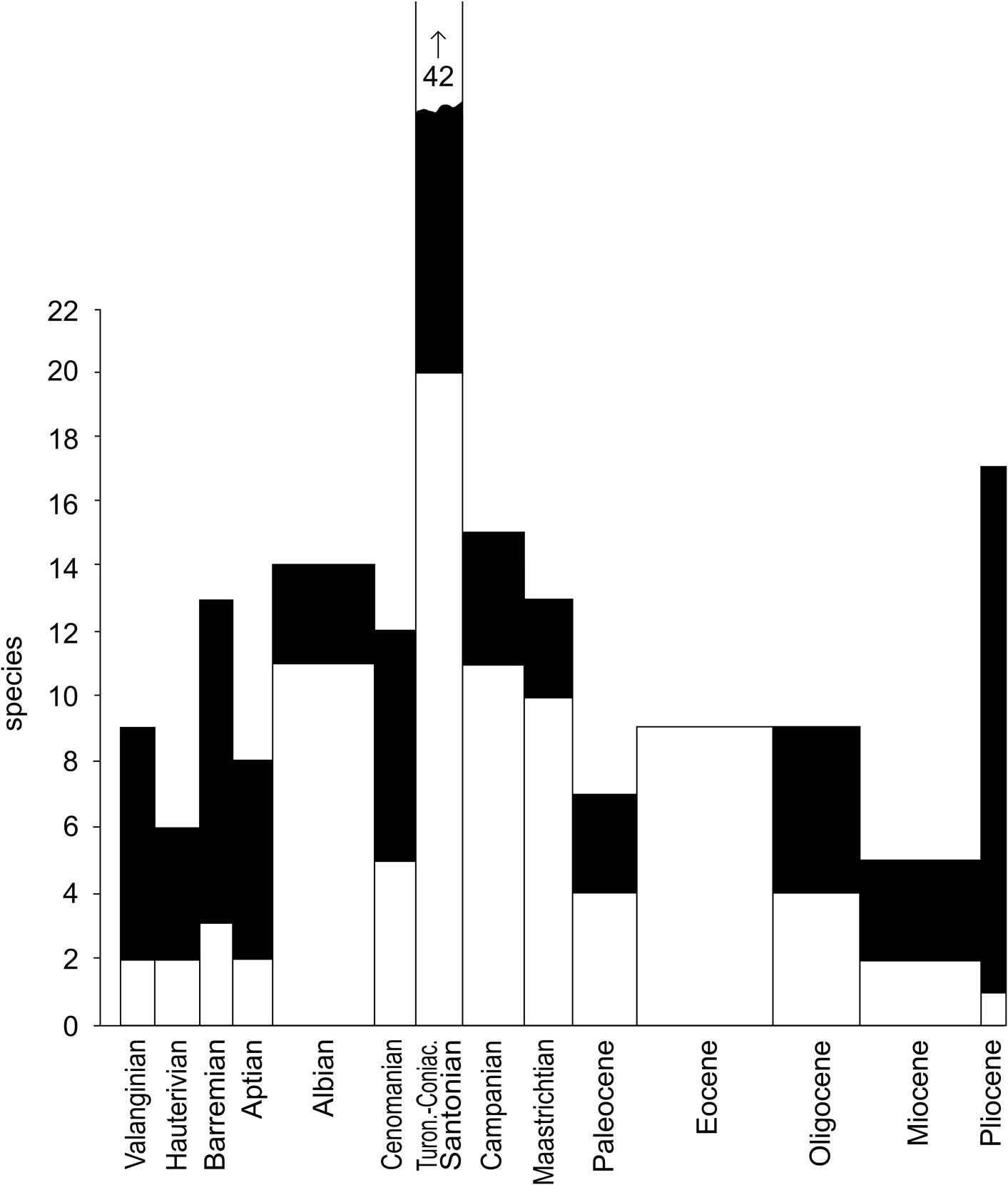
Moving beyond alpha taxonomy and phylogenetic studies, some recent papers have examined lobster diversity through time (Tshudy, Reference Tshudy2003 for the family Nephropidae; Schweitzer and Feldmann, Reference Schweitzer and Feldmann2014, Reference Schweitzer and Feldmann2015 for all lobsters). We revisit that herein for the family Nephropidae. A tally of fossil nephropid species per geological age is presented in Appendix 2, and diversity through time is graphed in Figure 6 (data and calculations in Appendix 3).
Known species diversity (white bars) for clawed lobsters of the family Nephropidae and diversity normalized for epicontinental sea coverage (black bars) using the sea-level curve of Vail et al. (Reference Vail, Mitchum and Thompson1978) for geological ages (Valanginian–Pliocene) as per Tshudy (Reference Tshudy2003). This figure updates that of Tshudy (Reference Tshudy2003).

The known diversity of fossil nephropids really only equates to known shelf-depth diversity (i.e., marginal shelf and epicontinental sea diversity) (Tshudy, Reference Tshudy2003). Lobsters that lived on the continental slope and at greater depths are never collected as fossils.
High sea levels, and therefore epicontinental seas, increase known fossil lobster diversity in two ways: (1) they increase lobster habitat, and (2) they fossilize lobsters where they can be collected today (those fossilized below modern sea level are not collected). Effect #1 produces a real increase in diversity (i.e., a real signal) and so, of course, should not be corrected for. Effect #2 biases the record in favor of time intervals (geological ages here) of high sea levels and, thus, we should at least attempt to correct for it.
In the absence of published information on rock exposure area per geological age, Tshudy (Reference Tshudy2003) normalized known species diversity for area of epicontinental sea coverage by using the sea level curve by Vail et al. (Reference Vail, Mitchum and Thompson1978). Figure 6 herein updates the results of Tshudy (Reference Tshudy2003) in the light of species-level taxonomic additions and changes (since 2003)—the Oligocene species count has increased from two to four, and the Turonian–Coniacian–Santonian count from 15 to 22. Figure 6 shows known species diversity (white bars) for clawed lobsters of the family Nephropidae and normalized diversity for epicontinental sea coverage (black bars).
As in the 2003 study, both known species diversity (i.e., raw numbers) and normalized numbers indicate that the diversity of shelf-dwelling nephropids was highest during the Late Cretaceous; higher than in the Early Cretaceous and the post-Cretaceous. Tshudy (Reference Tshudy2003) interpreted the reduction in the Paleogene and Neogene as resulting not from the end-Cretaceous extinction, but largely from the nephropid general abandonment of shelf depths in the Paleogene.
Schweitzer and Feldmann (Reference Schweitzer and Feldmann2014) compiled and interpreted (all) lobster diversity through time at the levels of infraorder, superfamily, family, and genus. Among the potential biases that they recognized was rock volume (first discussed by Raup, Reference Raup1976a, Reference Raupb; later by Signor, Reference Signor1985; and discussed in the context of nephropid lobsters by Tshudy, Reference Tshudy2003, p. 179). Tshudy (Reference Tshudy2003) considered rock volume as less important than rock exposure area in biasing the lobster record through time, in that only exposed rocks yield lobster fossils (with very few exceptions, e.g. the new species described here, lobsters are unrecognizable in drill cuttings). Schweitzer and Feldmann (Reference Schweitzer and Feldmann2015, p. 635) again noted the importance of the “uneven rock record” in interpreting diversity through time, this time acknowledging exposure area, albeit interchangeably with rock volume. In neither paper did they acknowledge the attempt by Tshudy (Reference Tshudy2003; “Vail Curve method”) at normalizing/correcting for exposure area. Also, Schweitzer and Feldmann (Reference Schweitzer and Feldmann2014, p. 823, fig. 1A) used “number of maps with outcrops of a given age” as a proxy for rock volume; neither is necessarily correlated with rock exposure area. Nonetheless, the work of Schweitzer and Feldmann (Reference Schweitzer and Feldmann2015), and now ours, corroborates the long-held hypothesis that, whatever the cause, clawed lobsters largely abandoned shallow-water environments over geological time.
Conclusion
Homarus is known by two Recent and six fossil species. The fossil species are all European, and give the genus a record extending back to the Early Cretaceous. Homarus makes its appearance in the fossil record in the Early Cretaceous (Albian) and then is not known again until the Paleogene, despite the fact that nephropid lobsters in general are well known from the Late Cretaceous.
The separateness of, and differences between, Homarus and the extinct Hoploparia have long been debated. In our opinion, Hoploparia is most readily distinguished from Homarus by the ventral extension of the branchiocardiac groove (absent on Homarus) and the granulation of the exoskeleton (almost entirely absent on Homarus). In addition, the majority of Hoploparia display an antennal carina (absent on Homarus), as well as postantennal spines (absent on Homarus). Homarus lacks sculpture and ornamentation on its pleonal terga and pleura (some Hoploparia possess these). Claws of Homarus are much broader than those of nearly all Hoploparia. Hoploparia, the best-known fossil genus of clawed lobster, is known by 58 species.
Diversity of shelf-dwelling nephropid lobsters was highest during the Late Cretaceous. Raw tallies of species diversity numbers, as well as numbers corrected (normalized) for epicontinental sea coverage, indicate that clawed lobsters largely abandoned shallow-water environments over geological time.
Acknowledgments
The specimen of Homarus hungaricus n. sp. came from the private collection of the late Dr. P.M. Müller (Budapest, Hungary), and was transferred to the Hungarian Natural History Museum, Budapest. We thank R. Feldmann for whitening and photographing the specimen, and D. Mitchell for Photoshop help. Feldmann also provided a helpful critique of an earlier version. Reviews by S. Charbonnie and G. Schweigert further improved the manuscript. Research of MH has been supported by the Austrian Science Fund (FWF; Lise Meitner Program M 1544-B25) and the Slovak Research and Development Agency under contract no. APVV-0436-12. MH and AD were supported by Hungarian Scientific Research Fund (OTKA K112708).
Accessibility of supplemental data
Data (appendices 2 and 3) available from the Dryad Digital Repository: http://doi.org/10.5061/dryad.qr818
APPENDIX 1 Alphabetical list of species of Homarus and Hoploparia.
Homarus – two Recent (R) and six fossil (F) species
1R. Homarus americanus H. Milne Edwards, Reference Milne Edwards1837.
2R. H. gammarus (Linnaeus, Reference Linnaeus1758). Schweitzer et al. (Reference Schweitzer, Feldmann, Garassino, Karasawa and Schweigert2010) listed this species as H. vulgaris H. Milne Edwards, Reference Milne Edwards1837; this is a junior synonym of H. gammarus.
1F. H. benedeni Pelseneer, Reference Pelseneer1886 (Albian, France). Schweitzer et al. (Reference Schweitzer, Feldmann, Garassino, Karasawa and Schweigert2010) listed this as Hoploparia benedeni. Tshudy (Reference Tshudy1993, p. 65) maintained Pelseneer’s (Reference Pelseneer1886) assignment to Homarus as based on very Homarus-like line drawings in the latter paper.
2F. H. hungaricus n. sp. (Oligocene, Hungary).
3F. H. klebsi (Noetling, Reference Noetling1885) (Eocene-Oligocene, northwest Europe). Schweitzer et al. (Reference Schweitzer, Feldmann, Garassino, Karasawa and Schweigert2010) listed this as Hoploparia klebsi, but Tshudy (Reference Tshudy1993, p. 68-69) assigned it to Homarus, albeit with reservation. Homarus klebsi is known from beautifully preserved and illustrated specimens (drawings in Noetling, Reference Noetling1885). Generic placement is a tough call; claws are like those of Recent Homarus, but cephalothorax and pleon have aspects fitting either Homarus or Hoploparia (Tshudy, Reference Tshudy1993, p. 68). Like Homarus: (1) absence of antennal carina; (2) absence of postantennal spines; (3) lack of sculpture on pleonal terga and pleura; (4) general lack of granulation on exoskeleton. Like Hoploparia: (1) distinct ventral extension of branchiocardiac groove; (2) long, subdorsal carina.
Most workers have retained the species in Hoploparia (Glaessner, Reference Glaessner1929; Bachmayer and Mundlos, Reference Bachmayer and Mundlos1968; Eichbaum, Reference Eichbaum1971; Förster and Mundlos, Reference Förster and Mundlos1982; Freess, Reference Freess1992; Verheyden, Reference Verheyden2002; Polkowsky, 2014). Van Straelen (Reference Van Straelen1936) transferred it to Homarus (as did one of us, DT), but he believed there was no difference between Homarus and Hoploparia. Moths and Braasch (Reference Moths and Braasch2005) referred the species to Homarus, noting the long-standing confusion of the genera but not explaining their generic assignment.
Homarus klebsi is a gigantic lobster, possibly synonymous with Homarus percyi. Reference is made to Moths and Braasch (Reference Moths and Braasch2005) for a list of synonyms. At least, the coincidence of great size (very unusual among fossil nephropids), claw morphology, and stratigraphic and geographic occurrence indicate that Homarus klebsi and H. percyi are very closely related. Verheyden (Reference Verheyden2002, p. 181-182) found no differences between the claws of the two species.
4F. H. lehmanni (Oligocene, Germany). This species is known by a fragmentary carpus and fragmentary merus (Haas, Reference Haas1889). Van Straelen (Reference Van Straelen1936) and Verheyden (Reference Verheyden2002) considered H. lehmanni to be a synonym of H. percyi. Tshudy (Reference Tshudy1993, p. 69) maintained Haas’ identification but did not examine the original material. Schweitzer et al. (Reference Schweitzer, Feldmann, Garassino, Karasawa and Schweigert2010) erroneously had the species double listed, under Homarus and Hoploparia.
5F. H. morrisi (Eocene, southern England). In 1990, one of us, DT, examined type and non-type specimens and supported Quayle’s removal of several specimens from Hoploparia gammaroides from the London Clay of southeast England, based on the general absence of granulation of the exoskeleton, absence of a supraorbital carina, antennal carina, and postantennal spines, the lack of sculpture on the pleonal terga and pleura, and the very robust morphology of the claws (Tshudy, Reference Tshudy1993, p. 70). The species does, however, resemble Hoploparia in having a ventral extension of the branchiocardiac groove.
6F. Homarus percyi (Oligocene, Europe). Schweitzer et al. (Reference Schweitzer, Feldmann, Garassino, Karasawa and Schweigert2010) listed this as Hoploparia, but Tshudy (Reference Tshudy1993, p. 71) maintained Van Beneden’s (Reference Van Beneden1872) original placement in Homarus, as did other workers (Delheid, Reference Delheid1895; Van Straelen, Reference Van Straelen1920, Reference Van Straelen1936; Geys and Marquet, Reference Geys and Marquet1983; Verheyden, Reference Verheyden2002); none to our knowledge has moved species percyi to Hoploparia. Reference is made to Verheyden (Reference Verheyden2002, p. 179) for list of synonyms and possible synonyms. The species is known mostly by its chelipeds, which, being very robust, are better referred to Homarus than Hoploparia. This species is very similar to H. klebsi; the two are unique among all nephropids for their gigantic size and their claw morphology. One Homarus percyi claw is 0.4 meters in length (Van Beneden, Reference Van Beneden1872).
Hoploparia – 58 fossil species
Eocene (n=6), Oligocene (n=0), and Miocene (n=1) occurrences are indicated because they are most relevant for morphological comparisons to Oligocene Homarus hungaricus n. sp.
1. Hoploparia albertaensis Tshudy, Donaldson, Collom, Feldmann and Schweitzer, Reference Tshudy, Donaldson, Collom, Feldmann and Schweitzer2005
2. H. alpinus (Van Straelen, Reference Van Straelen1936) – Eocene
3. H. antarctica Wilckens, Reference Wilckens1907
4. H. arbei Aguirre-Urreta, Reference Aguirre-Urreta1989
5. H. aspera Harbort, Reference Harbort1905
6. H. bearpawensis Feldmann, in Feldmann, Bishop and Kammer, Reference Feldmann, Bishop and Kammer1977
7. H. bennetti Woodward, Reference Woodward1900
8. H. beyrichi (Schlüter, Reference Schlüter1862)
9. H. biserialis Fritsch, 1887
10. H. blossomana Rathbun, Reference Rathbun1935
11. H. brittonestris (Stenzel, Reference Stenzel1945). Feldmann et al. (Reference Feldmann, Schweitzer, Redman, Morris and Ward2007) and Schweitzer et al. (Reference Schweitzer, Feldmann, Garassino, Karasawa and Schweigert2010) listed this as Homarus, but one of us (DT) had referred it to Hoploparia (Tshudy, Reference Tshudy1993, p. 103) as based on ornamentation of the cephalothorax and the shape and ornamentation of the claws. We (this paper) agree with Feldmann et al. (Reference Feldmann, Schweitzer, Redman, Morris and Ward2007, p. 702-703) that the species is Homarus-like in lacking a ventral extension of the branchiocardiac groove.
12. H. buntingi (Feldmann and Holland Jr, Reference Feldmann and Holland1971)
13. H. catalunica Garassino, Artal and Pasini, Reference Garassino, Artal and Pasini2009
14. H. collignoni (Van Straelen, Reference Van Straelen1949)
15. H. columbiana Beurlen, Reference Beurlen1938
16. H. corneti Van Straelen, Reference Van Straelen1921 – Eocene
17. H. davisi (Stenzel, Reference Stenzel1945). Feldmann et al. (Reference Feldmann, Schweitzer, Redman, Morris and Ward2007) and Schweitzer et al. (Reference Schweitzer, Feldmann, Garassino, Karasawa and Schweigert2010) listed this as Homarus, but one of us (DT) had referred it to Hoploparia as based on ornamentation of the cephalothorax (Tshudy, Reference Tshudy1993, p. 109). We agree with Feldmann et al. (Reference Feldmann, Schweitzer, Redman, Morris and Ward2007, p. 702-703), who said that species was Homarus-like in lacking a ventral extension of branchiocardiac groove.
18. H. dentata (Roemer, Reference Roemer1841)
19. H. dentonensis Rathbun, Reference Rathbun1935
20. H. edwardsi (Robineau-Desvoidy, Reference Robineau-Desvoidy1849)
21. H. fraasi (Böhm, Reference Böhm1891)
22. H. gabbi Pilsbry, Reference Pilsbry1901
23. H. gazdzicki Feldmann and Crame, Reference Feldmann and Crame1998 – Miocene
24. H. gammaroides McCoy, 1849 – Eocene
25. H. georgeana Rathbun, Reference Rathbun1935
26. H. gladiator Pilsbry, Reference Pilsbry1901
27. H. groenlandica Ravn, Reference Ravn1903 – Eocene
28. H. hakelensis (Fraas, Reference Fraas1878). Schweitzer et al. (Reference Schweitzer, Feldmann, Garassino, Karasawa and Schweigert2010) listed this as Homarus but one of us (DT) had supported Chong and Forster’s (1976) reference to Hoploparia; they noted its strong antennal ridge and unequal claws (Tshudy, Reference Tshudy1993, p. 127).
29. H. hemprichi (Mertin, Reference Mertin1941)
30. H. horrida Schweitzer and Feldmann, in Schweitzer et al. (Reference Schweitzer, Feldmann, Fam, Hessin, Hetrick, Nyborg and Ross2003)
31. H. intermedia Secrétan, Reference Secrétan1964 (According to Charbonnier et al., Reference Charbonnier, Garassino and Pasini2012, a junior synonym of H. collignoni. Tshudy, Reference Tshudy1993, p. 130, tentatively regarded the species as separate from H. collignoni).
32. H. johnsoni Rathbun, Reference Rathbun1935 – Eocene
33. H. kamimurai Kato and Karasawa, Reference Kato and Karasawa2006
34. H. kamuy Karasawa and Hayakawa, Reference Karasawa and Hayakawa2000
35. H. longimana (Sowerby, Reference Sowerby1826)
36. H. mcnairyensis Rathbun, Reference Rathbun1929
37. H. mesembria Etheridge, Jr., Reference Etheridge1917
38. H. mickelsoni Bishop, Reference Bishop1985. Schweitzer et al. (Reference Schweitzer, Feldmann, Garassino, Karasawa and Schweigert2010) listed this as Homarus, but one of us (DT) had referred it to Hoploparia (Tshudy, Reference Tshudy1993, p. 146) as based on cephalothorax ornamentation, including long subdorsal and supraorbital carinae. It does, however, lack a ventral extension of the branchiocardiac groove (as emphasized by Feldmann et al., Reference Feldmann, Schweitzer, Redman, Morris and Ward2007) and does possess a urogastric groove; both Homarus-like features.
39. H. minima de Tribolet, Reference Tribolet1876
40. H. miyamotoi Karasawa, Reference Karasawa1998
41. H. muncki Pelseneer, Reference Pelseneer1886
42. H. natsumiae Karasawa, Ohara and Kato, Reference Karasawa, Ohara and Kato2008
43. H. pelseneeri (Van Straelen, Reference Van Straelen1936)
44. H. pusilla Secrétan, Reference Secrétan1964
45. H. riddlensis Feldmann, Reference Feldmann1974
46. H. schlueteri Tribolet, Reference Tribolet1874
47. H. sculpta Secrétan, Reference Secrétan1964 (According to Charbonnier et al., Reference Charbonnier, Garassino and Pasini2012, a junior synonym of H. collignoni. Tshudy, Reference Tshudy1993, p. 150 regarded the species as distinguishable from H. collignoni based on its “distinctly different” abdomen.)
48. H. senonensis Forir, Reference Forir1887
49. H. shastensis (Rathbun, Reference Rathbun1929)
50. H. stokesi (Weller, Reference Weller1903)
51. H. tennesseensis Rathbun, in Wade, Reference Wade1926
52. H. travisensis (Stenzel, Reference Stenzel1945). Schweitzer et al. (Reference Schweitzer, Feldmann, Garassino, Karasawa and Schweigert2010) listed this as Homarus, but one of us (DT) had referred the species, known only by an incomplete palm, to Hoploparia (Tshudy, Reference Tshudy1993, p. 183).
53. H. triboleti Borissjak, Reference Borissjak1904
54. H. trigeri Van Straelen, Reference Van Straelen1936
55. H. tshudyi Schweitzer and Feldmann, Reference Schweitzer and Feldmann2001
56. H. uzbekensis Feldmann et al., Reference Feldmann, Schweitzer, Redman, Morris and Ward2007
57. H. wardi Quayle, Reference Quayle1987 – Eocene
Removed, as synonyms, from the list of Schweitzer et al. (Reference Schweitzer, Feldmann, Garassino, Karasawa and Schweigert2010)
1. H. belli M’Coy, Reference M’Coy1849 (syn. H. gammaroides) (see Tshudy, Reference Tshudy1993, p. 122)
2. H. saxbyi M’Coy, Reference M’Coy1854 (syn. H. longimana) (see Tshudy, Reference Tshudy1993, p. 131)
3. H. victoriae Quayle, Reference Quayle1987 (syn. H. gammaroides) (see Tshudy, Reference Tshudy1993, p. 122)
Referred to Hoploparia by Schweitzer et al. (Reference Schweitzer, Feldmann, Garassino, Karasawa and Schweigert2010), but here transferred to a genus other than Hoploparia or Homarus
1. Hoploparia nephropiformis Schlüter, Reference Schlüter1874 to Paraclytia Fritsch, 1887 (see Tshudy, Reference Tshudy1993, p. 314).
2. Hoploparia scabra Bell, Reference Bell1863 to Palaeastacus Bell, Reference Bell1850 (see Tshudy, Reference Tshudy1993, p. 371).
Genus uncertain
1. Homarus neptunianus Polkowsky, 2005 – known only by a single fixed finger (pollex), which could even belong to a crab claw (see also Polkowsky, 2014).
2. Hoploparia calcarifera Schlüter, Reference Schlüter1879 – holotype, and sole specimen known, is lost; identification at generic and specific levels is uncertain without examination of the original material (Tshudy, Reference Tshudy1993, p. 106).
3. Hoploparia eocaenica Lőrenthey, in Lőrenthey and Beurlen, Reference Lörenthey and Beurlen1929 – identity of the three specimens is unknown, but none is suggestive of Hoploparia (Tshudy, Reference Tshudy1993, p. 363). Referred to Hoploparia by Schweitzer et al. (Reference Schweitzer, Feldmann, Garassino, Karasawa and Schweigert2010).
4. Hoploparia falcifer Fritsch, in Fritsch and Kafka, Reference Fritsch and Kafka1887 – known only by claws; generic identity unknown (Tshudy, Reference Tshudy1993, p. 115). Referred to Hoploparia by Schweitzer et al. (Reference Schweitzer, Feldmann, Garassino, Karasawa and Schweigert2010).
5. Hoploparia heterodon – as used in Schweitzer et al. (Reference Schweitzer, Feldmann, Garassino, Karasawa and Schweigert2010). Oncopareia? heterodon Bosquet, Reference Bosquet1854 is known only by claw fingers which are now assumed to have belonged to a crab (Tshudy, Reference Tshudy1993, p. 371; Jagt et al., Reference Jagt, Fraaije and van Bakel2014).
6. Hoploparia? suecica Schlüter, Reference Schlüter1874 – we have been unable to locate the repository; an identification is impossible on the basis of the illustration in Schlüter (Reference Schlüter1874) alone (Tshudy, Reference Tshudy1993, p. 180). Referred to Hoploparia by Schweitzer et al. (Reference Schweitzer, Feldmann, Garassino, Karasawa and Schweigert2010).
7. Hoploparia? sulcicauda Schlüter, Reference Schlüter1874 – material is lost; the generic identity remains unknown (Tshudy, Reference Tshudy1993, p. 181). Referred to Hoploparia by Schweitzer et al. (Reference Schweitzer, Feldmann, Garassino, Karasawa and Schweigert2010).
8. Hoploparia tarrantensis Rathbun, Reference Rathbun1935 – we have examined the holotype; it probably is not a nephropid (Tshudy, Reference Tshudy1993, p. 364).