Introduction
Respect for individuals is required in order to recognize and address their needs, their wishes, and their values. Advance care planning (ACP) “is a process that supports adults at any age or stage of health in understanding and sharing their personal values, life goals, and preferences regarding future medical care” (Sudore et al., Reference Sudore2017). This process may lead to the formal documentation of preferences thorough advance directives, according to domestic laws (Mignani et al., Reference Mignani, Ingravallo, Mariani and Chattat2017).
ACP in the nursing home (NH) population has the potential to decrease hospitalization rates and increase medical treatments that are consistent with the patient's wishes (Martin et al., Reference Martin, Hayes, Gregorevic and Lim2016; Weathers et al., Reference Weathers2016). Consistently, US legislation requires that all individuals admitted to a care home should be offered ACP, while within European countries there are considerable disparities between legislations concerning the promotion of self-determination of older people (Council of Europe, 2009), and ACP dissemination in NHs still seems to be low (Gilissen et al., Reference Gilissen2017).
In particular, both legislation and programs supporting ACP are still lacking in Italy. Indeed, despite ACP being mentioned by the Italian Code of Medical Ethics, which states that physicians should report in the patient record the possible ACP in the case of a patient with progressive disease, ACP is still not recognized by the law. During the current legislature, several draft laws regarding patient consent and advance directives have been presented to both the Senate and the Chamber of Deputies (Ingravallo et al., Reference Ingravallo, Govi, Gnucci and Miccinesi2014), and a common text encompassing ACP is currently under discussion at the Senate, but it is uncertain whether it will be approved within the end of the legislature. In such a context, it is unclear to both patients and healthcare providers what the legal status of ACP is and whether patient preferences discussed during ACP should and would be respected. This is a serious concern, since in Italy there are 12 million people aged 65 years and over, equal to almost 20% of the Italian population, and it is estimated that people aged over 65 will be almost 34% of the Italian population in 2045–2050 (ISTAT, 2017). In addition, 75% of older people living in residential and long-term care facilities are dependent and require a middle-to-high intensity of care (ISTAT, 2015). Where ACP and advance directives are lacking, end-of-life (EOL) decisions are very difficult to make, especially in the case of residents with dementia who are likely to receive inappropriate treatments at the EOL (Di Giulio et al., Reference Di Giulio, Toscani, Villani, Brunelli, Gentile and Spadin2008).
Qualitative studies carried out in Australia, Belgium, Norway, United Kingdom, and the USA found that both NH residents and family members had generally positive opinions about ACP (Mignani et al., Reference Mignani, Ingravallo, Mariani and Chattat2017). However, very little is known about the NH population of other countries, especially of those in which ACP is not well recognized by law. In addition, despite the increasing number of studies on ACP (Rietjens et al., Reference Rietjens, Korfage and van der Heide2016), there is scarce evidence regarding when and in which manner NH residents and their family members would prefer to discuss ACP. Expanding our knowledge about these issues is of utmost importance because discrepancies between the traditional assumptions about ACP and the perspective of patients involved in the process have been reported since pioneering studies on ACP, and may in part explain difficulties in implementing ACP (Singer et al., Reference Singer, Martin, Lavery, Thiel, Kelner and Mendelssohn1998). For example, several studies found that the principle of autonomy and the one-to-one patient–clinician relationship, which are usually assumed as fundamental ACP components, are not considered of utmost importance by older people when considering ACP (Singer et al., Reference Singer, Martin, Lavery, Thiel, Kelner and Mendelssohn1998; Seymour et al. Reference Seymour, Gott, Bellamy, Ahmedzai and Clark2004; Gott et al., Reference Gott, Small, Barnes, Payne and Seamark2008; Gjerberg et al., Reference Gjerberg, Lillemoen, Førde and Pedersen2015).
Our study aimed to investigate the perspective of older people living in NHs and of family members, on the basis of the assumption that the process of ACP itself should be performed according to their values, goals and preferences, in a country where ACP is still barely deployed. In particular, the purposes of the study were: (1) to investigate experiences and attitudes regarding ACP of older residents and of family members, and (2) to explore their opinions as to the right time to broach the subject, the manner in which it should be approached, and the content of ACP.
Methods
Design
This was a qualitative study using face-to-face semi-structured interviews with older people living in NHs, and with family members of older NH residents.
Setting and participants
Four NHs (mean number of beds 80.5, range 60–108) located in two northern Italian towns were selected to take part in the study. NHs provided nursing, medical care, and rehabilitation programs for older people (65 years and over) or younger people with health problems that are treated as those of older people. To be admitted to the NH, a medium or high degree of lack of self-sufficiency was ascertained by a multidimensional evaluation unit.
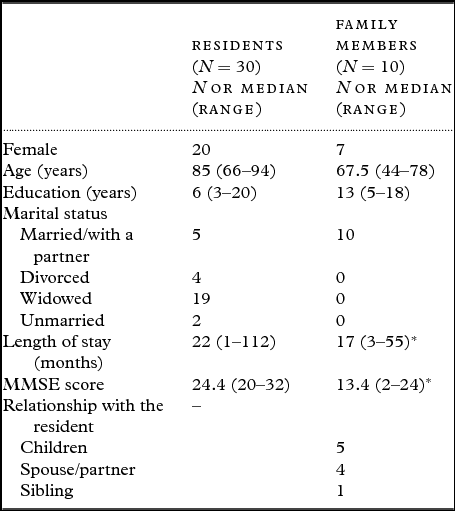
NH residents were eligible if they were above the age of 65, and if they were able to understand the aims and methods of the study and to participate in the interview. Family members were eligible if they had an older relative living in a NH, independently of the participation of the latter in the study. Potential participants were selected by a psychologist in charge of each NH, who briefly explained the focus of the study, and provided them with a study summary. At this stage, two residents declined the invitation, because they did not feel well. A subsequent meeting was planned with each of those who agreed to be contacted, in which a researcher (VM, who had been specifically trained to carry out the interviews) introduced herself and provided more information regarding the goals of the study. Overall, 30 residents (20 women and 10 men) with a median age of 85 years (range 66–94), and 10 family members (7 women and 3 men, including 5 adult children, 4 spouses/partner, and 1 sibling) with a median age of 67.5 years (range 44–78) were interviewed. Two of the family members who were interviewed were a son and the partner of two interviewed residents, respectively. Median education was 6 years for residents and 13 years for family members. The NH residents who were interviewed had a median Mini-Mental State Examination score of 24.4 (range 20–32), while the median score of the relatives of the interviewed family members was 13.4 (range 2–24) (Table 1). None of the authors had any previous connection with the participants.
Characteristics of the participants

* Data refers to the relatives of the interviewed family members.
MMSE: Mini-Mental State Examination.
Interviews
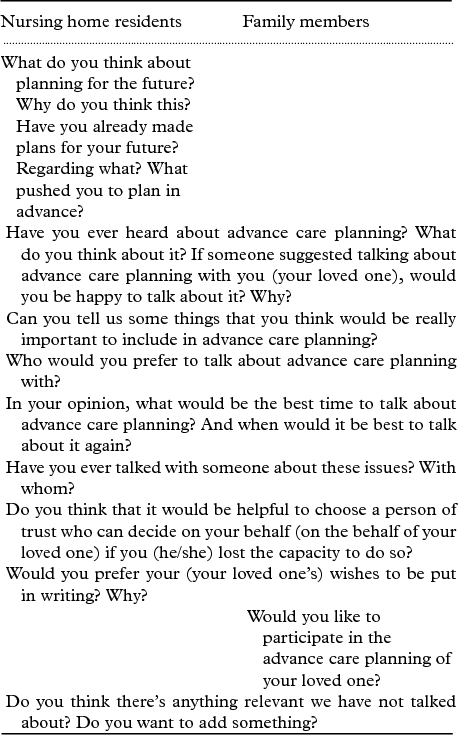
After reviewing the relevant literature, the interview guides (reported in Box 1) were developed by the research team, which encompassed a nurse (VM), three psychologists (EM, MCM, and GO), and two medical doctors with expertise in ethics and psychogeriatrics respectively (FI and RC).
Interview guides

Interviews were carried out from May to December 2015 by one researcher (VM), and took place in the guest room or in another dedicated room, according to the participants’ wishes. After the interview, participants were asked to indicate the degree of discomfort caused by the interview on a five-point Likert scale, ranging from 1 (not at all) to 5 (very much). A similar scale was used to investigate self-identified religious importance, considering its potential influence on attitudes toward ACP.
Data analysis
The interviews were audio-recorded, transcribed verbatim by one of the researchers (VM), and then analyzed using the conventional content analysis (Hsieh and Shannon, Reference Hsieh and Shannon2005). This type of approach was preferred due to limited knowledge as to the attitudes that residents of NHs in Italy and their family members had regarding ACP. Before coding, three researchers (FI, EM, and VM) repeatedly read all the interviews to become familiar with the data material and to obtain a sense of the whole. Then, they independently analyzed seven interviews, reading the transcripts word-by-word and highlighting the exact words from the text that appeared to capture key thoughts or concepts expressed by the participants. The concepts identified were labeled with appropriate codes and an initial coding scheme was developed. The scheme was discussed within the research team and was then used to code the remaining interviews. If new codes emerged or the scheme needed to be refined, it was discussed within the research team. Based on how the different codes were related and linked, they were sorted into categories. The categories that emerged were then organized and grouped into main themes.
Quotations from interviews are identified with the following codes: for residents, R identifies the participant, followed by gender and age; for family members, FM identifies the participant followed by his/her relationship with the resident.
Ethical considerations
The study was approved by the University of Bologna Bioethics Committee. All participants gave their written informed consent after receiving both oral and written information. Participants were informed that their participation was voluntary, and that they had the right to end the interview at any time without the need to provide reasons and without any consequences. Confidentiality and anonymity were ensured.
Results
During the interviews with NH residents, in 13 cases a staff member was in the room, while during interviews with family members, the wife of a family member (a brother) was present in one case. One resident refused permission for the audio recording; in this case the interviewer took written notes during the interview. The mean duration of the interviews was 30 minutes (range 9–55) for NH residents and 33 minutes (range 17–53) for family members. One resident asked for the interview to be interrupted because of fatigue. The mean level of self-reported religiosity was 2.2 (range 1–4) for residents and 2.7 (range 1–4) for family members. None of the participants expressed discomfort after the interview. On the contrary, several participants expressed appreciation for the study (one resident defined the study “a very up-to-date project”), and some of them stated that this study gave them the idea of discussing ACP. Some family members also outlined the need for public debate and legislation on the subject of ACP in Italy.
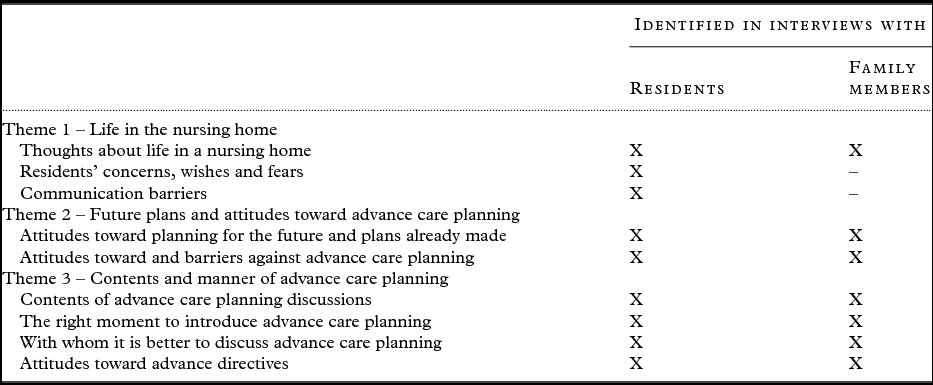
The analysis of the interviews led to the identification, both in the case of the residents and in that of family members, of several categories with the following three main themes: (1) life in the NH, (2) future plans and attitudes toward ACP, and (3) contents and manner of ACP (Table 2).
Categories and themes identified in interviews with residents and family members

Theme 1 – Life in the nursing home
Thoughts about life in a nursing home
Most residents expressed acceptance about living in the NH, realizing that their loved ones could not take care of them properly and that living in the NH was the best option. Many residents were well adapted to life in the NH and appreciated the structure, the staff, having company, and the recreational activities provided.
I came here not because I wanted to. . .but I understood that I had to do it for several reasons. . .I don't know how to explain. . .if I'm treated well where I am, I'm happy to stay there. . . (R7, female, 82 years)
However, some residents wanted to return to their homes and to their usual activities, as they experienced some difficulties in being made to live with other guests, or they complained about the organization of the NH.
. . .Yes, I'm here a little unwillingly. . .I can't go home anymore. . .I can't take part in things. . . (R6, female, 88 years)
Despite all family members reporting that they were satisfied with the NH staff and services, many of them expressed regret for having placed their loved one in a long-term facility. However, they acknowledged that this was the best option for the resident, and some family members reported that living in a NH would probably also be their fate.
If the same thing happened to me I might say, ‘Don't put me there’, but. . .now I realize that if I end up in a certain way my children can't keep me at home, they would be right to put me in a place like this. . .I know that one day it'll be us here if we live long enough. (FM7, wife)
Residents’ concerns, wishes, and fears
The residents were generally aware of their physical and cognitive deterioration, and were frightened by the progressive and inexorable ageing process.
I'm always a bit scared about getting worse. . .because for the moment, considering my age, I should be content because I see that there are younger people that are in a worse way than me. . .and so for now I should be happy, but will it last? (R11, female, 93 years)
When they thought about death, some residents said that they did not fear it, while others desired it, seeing it as liberation from a condition that they struggled to accept. Other residents wished, more positively, that death would arrive as late as possible. A major concern for many residents was suffering, and many of them expressed the desire to “go well,” avoiding any life-prolonging treatment.
In my opinion, when someone gets to the end and knows that his body is not able to walk or go out anymore, it's better to die. (R3, male, 81 years)
Some residents, finally, expressed concerns about their loved ones, thinking especially about difficult situations that their children are going through, and not wishing to be a burden on them.
Communication barriers
Many residents expressed little confidence in their communication skills, often because they are not used to speaking about their needs, or due to their low educational level, or because they feel they are no longer able to express themselves.
We were never used to speaking because, we didn't know things. . .not even (how to read) a book, nothing. . .we didn't know anything. . .we only knew when we were a bit hungry. (R6, female, 88 years)
At the same time many residents expressed a strong desire to be heard and understood by family members, NH staff and other residents.
Because when I told my doctor that I'm scared of suffering, he didn't explain anything to me. . .So I wouldn't know who to talk to about it. (R11, female, 93 years)
Theme 2 – Future plans and attitudes toward ACP
Attitudes toward planning for the future and plans already made
When asked to talk about their habits in planning, the majority of residents reported having made plans for the future in their past life, especially to ensure that their children would have the best life conditions possible. Most of the residents, however, no longer considered making plans because of their advanced age or because they preferred not to think about the future and “live for the day.”
My plan is to leave [the resident laughs]. . .we're at the age, now, at which you can't plan so much. (R11, female, 93 years)
Some residents did not plan for their future because they preferred to delegate the decisions that affected them to others, especially their children.
Lately I've left everything to others to do. . .my wife and my daughter and they do everything. . .I've left them with the administration. (R2, male, 85 years)
Except the practical aspects related to their death (e.g. where to be buried, cremation), cited by many informants, only a few residents had made plans for the future and those plans were mainly related to economic issues and inheritance.
According to the participants (both residents and family members), none of them had been involved by healthcare providers in structured ACP, but a few residents had spoken with their children or spouse about their future wishes, and a couple of them stated that NH staff were aware of their wishes. Many family members reported having had informal discussions about their own care preferences with relatives or friends.
For residents, the main reasons for not having discussed their care preferences in case of future incompetence were that they had never thought about it or had not considered it necessary because they thought they were still fairly healthy and preferred to postpone the issue or because it was an unpleasant/sad topic:
I have always thought and I still think that I'm lively enough not to have to think about such a situation. . .I think I'm still able to manage independently. . .I reckon I'm still on the ball. . . (R24, male, 78 years)
In addition, some residents and family members said that their children were not available for such discussions, and one male resident outlined that it was difficult to discuss this issue with healthy people.
Attitudes toward and barriers against ACP
When asked if they had ever heard of ACP, the majority of residents and family members answered that they had not; once explained what ACP is, most of the residents answered that they were willing to be involved in ACP and all family members but one answered that they would agree if ACP was offered to their loved one, and that they would be happy to be involved in the process. Residents placed emphasis on the opportunity that ACP gives them to express their opinion, while family members focused more on ACP usefulness:
I like it because when you have expressed your opinions you feel much better. (R19, female, 90 years)
These things will be helpful because, afterwards, if for any reason it's not easy to ask you certain things, we already know what you like to do. . . (FM1, son)
However, some residents expressed doubts about their “ability to understand” ACP options due to their memory problems, and several family members said that ACP was no longer feasible due to their loved one's cognitive impairment:
He has a cognitive impairment which has already been evident for some time, so I don't think he is able to make decisions. (FM2, partner)
In addition, some residents and family members outlined possible difficulties in understanding treatment options or expressing opinions on health issues due to the resident's low educational level. Finally, a few residents believed that these issues should be left to the doctor, because he/she had “studied,” while one male resident expressed a lack of confidence that his wishes would be heard and followed:
I would like it if it really counted. . .I would like it, but if what you say falls on deaf ears I don't like it because there's no point in talking to a brick wall. (R8, male, 82 years)
The only family member who was against the resident's involvement in ACP was a wife, who feared that ACP would upset her husband, and that he would think that the family wanted to get rid of him.
Theme 3 – Contents and manner of ACP
Contents of ACP discussions
When asked what is important to include in ACP discussions, residents and family members, with the exception of some residents that were not able to answer because that was a “hard question,” focused on the same aspects. For many NH residents and some family members, it was important to include after-death arrangements (e.g. the funeral, the place where they will be buried, cremation) and basic care aspects (e.g. guarantees of hygiene or “being looked after well”) in ACP.
The few residents who focused on medical issues reported a general aversion for the so-called “therapeutic obstinacy,” expressing the wish to be “allowed to go when their time comes” and to avoid suffering. Family members expressed the same wishes:
No, we don't want there to be therapeutic obstinacy. We only want the disease to follow its natural course and not to keep the person alive by mechanical means. . . (FM2, partner)
The only specification regarding unwanted medical treatments concerned cardiopulmonary resuscitation, reported by a wife, and artificial feeding, mentioned by one female resident and one son.
The right moment to introduce ACP
Some residents and one family member said that a person should think about care options only when facing impairment or at the beginning of the disease. Other residents believed that it is useful to introduce ACP when health conditions are “still good” or “before falling ill.” Other residents and several family members focused on cognitive impairment, highlighting the need to discuss ACP “as soon as possible” or “when one is still competent.”
A resident clearly described a dilemma about the right time for ACP discussions:
I don't like to think about it beforehand because it's frightening. . .beforehand you're frightened, but afterwards you don't have the capacity anymore. (R28, female, 83 years)
Finally, one male resident maintained that discussing ACP required “a certain maturity,” while a daughter stressed the need to disseminate information regarding ACP so that everyone can have the opportunity to decide at which age to discuss it. Both residents and family members agreed that it is better to renegotiate ACP periodically or when it is needed.
With whom it is better to discuss ACP
Regarding the person who it would be better to discuss ACP with, the physician, followed by the nurse, was the healthcare provider who was more frequently cited by residents, but some of them reported a lack of availability of physicians when discussing health issues, or that they did not have much time.
I reckon that with a doctor like that you can't do much. . .actually I think they're a bit against it. . .they can't be bothered to put themselves out and waste time. . .it's a waste of time for them. . . (R21, female, 89 years)
Family members tended to refer to physicians and nurses altogether, and a couple of them believed that the only healthcare provider able to perform ACP was the physician:
It's the doctor that has to plan, propose and explain both the positive and the negative consequences of a particular medical decision. . .I don't think that a nurse is able to do it. (FM2, partner)
Other participants (both residents and family members) stressed the importance of both closeness and trust when talking about these issues. For this reason, they indicated the nurse, the psychologist or only a family member to discuss ACP.
With a member of the family, definitely; I think that maybe if you're in a care home or in hospital you can talk to the people around you; with the nurse. . .there are nurses who make you feel at home. . . (R7, female, 82 years)
Finally, one daughter thought that, given the juridical situation in the country, a lawyer would be the right person to ensure that the patient's wishes were complied with.
Attitudes toward advance directives
With regard to advance directives, most of residents and family members believed that the appointment of a proxy was a good idea. Some residents had already asked their loved ones to take on this role or were able to indicate their preference:
There could be. . .a friend of mine who comes here often. . .she knows all my good and bad qualities by now; I've always called her when I have a medical appointment, she's almost always been there. (R8, male, 82 years)
Other residents expressed difficulty in finding the “right person,” or distrusted the option of advance directives via a proxy because there may be people who take advantage of their proxy role.
An older woman reported that there was nobody to ask, even if she did wish to have a proxy.
Many residents and family members were also in favor of written care directives (i.e. living wills), but some residents were concerned that someone might consider them “too demanding” if they put their wishes in writing or that such documents could be counterfeited.
Discussion
Findings from this study shed light on experiences and attitudes of NH residents and family members toward ACP, and indicate that they may provide valuable insights for both healthcare providers and policy-makers in view of developing and implementing ACP interventions according to a patient-oriented care framework.
Before addressing the findings of the study, it is important to highlight two issues that emerged. First, although the focus was on ACP for NH residents, the interviews revealed the residents’ need to tell, in an extensive manner, their experiences and feelings about living in the NH. Another factor that appeared was the tendency of many family members to express their perspectives on ACP with reference to themselves and their own future care, rather than with reference to their loved ones. This result may be in part explained by the fact that most of the family members interviewed were older people themselves, and suggests that issues related to ACP are important for people, regardless of their current health condition. We may also speculate that the family members’ tendency to report their own preferences during the interview reflects a lack of knowledge about their loved ones’ wishes, and may have some implications on family surrogate judgment.
Residents were willing to talk about ACP, and in line with previous studies they did not report discomfort for the interview (Piers et al., Reference Piers2013; Stone et al., Reference Stone, Kinley and Hockley2013; Gjerberg et al., Reference Gjerberg, Lillemoen, Førde and Pedersen2015). None of participants reported involvement in a structured ACP activated by healthcare providers, and only very few residents had had informal conversations about their preferences for future care, while such conversations were more commonly reported by family members. We may hypothesize that family members’ experiences with their loved ones, who in many cases had a severe cognitive impairment, may have stimulated both reflection and conversations concerning future care (Hirschman et al., Reference Hirschman, Kapo and Karlawish2008; Black et al., Reference Black2009).
The lack of involvement in a structured ACP process was mirrored by the fact that residents and families were unable to name specific medical treatments despite a higher likelihood of participants having had experience of treatments administered to other older residents within the NH. On the other hand, both residents and family members conveyed the wish to avoiding suffering and life-prolonging treatments, underlining the importance of palliative care at the EOL, and residents especially considered it important to plan in advance for practical aspects. These results are in accordance with the previous findings (Ott, Reference Ott2008; Black et al., Reference Black2009; Dickinson et al., Reference Dickinson, Bamford, Exley, Emmett, Hughes and Robinson2013; Piers et al., Reference Piers2013; Gjerberg et al., Reference Gjerberg, Lillemoen, Førde and Pedersen2015; Ashton et al., Reference Ashton, Roe, Jack and McClelland2016; Bollig et al., Reference Bollig, Gjengedal and Rosland2016). With regard to advance directives, participants in our study seemed to understand the subtle differences between ACP (as a process) and advance directives (as a possible outcome of the ACP process). Indeed, even if most participants considered advance directives as an opportunity, some residents seemed to be more interested in ACP conversations and informal planning rather than in formal advance directives, expressing some distrust toward both the appointment of a proxy and living wills. This distrust may be related to the unclear legal status of ACP and advance directives in Italy. On the other hand, the preference of older people for informal planning was also found in studies performed in countries in which both ACP and advance directives or advance statements are well recognized by the law (Dickinson et al., Reference Dickinson, Bamford, Exley, Emmett, Hughes and Robinson2013; Musa et al., Reference Musa, Seymour, Narayanasamy, Wada and Conroy2015).
As was found in previous qualitative studies, the majority of residents and family members considered ACP to be “a good idea” (Stewart et al., Reference Stewart, Goddard, Schiff and Hall2011; Piers et al., Reference Piers2013; Stone et al., Reference Stone, Kinley and Hockley2013; Gjerberg et al., Reference Gjerberg, Lillemoen, Førde and Pedersen2015), while a minority of residents believed that medical decisions should be taken by physicians or did not want to address the issue at all (Ott, Reference Ott2008; Stewart et al., Reference Stewart, Goddard, Schiff and Hall2011; Bollig et al., Reference Bollig, Gjengedal and Rosland2016). Interestingly, none of the participants, even if they declared themselves to be moderately religious, reported “the future being in God's hands” as reason not to plan (Piers et al., Reference Piers2013). This is a result of particular interest because Catholicism is the prevailing religion in Italy and is often invoked as one of the main hurdles in developing legislation on advance directives in Italy. Those interested in ACP recognized cognitive impairment as a main barrier to ACP (Hirschman et al., Reference Hirschman, Kapo and Karlawish2008; Black et al., Reference Black2009; Stewart et al., Reference Stewart, Goddard, Schiff and Hall2011; Goodman et al., Reference Goodman, Amador, Elmore, Machen and Mathie2013; Piers et al., Reference Piers2013). In addition, participants in this study mentioned a low educational level as a significant barrier to ACP. This finding, which was not frequently reported by other studies, points out the need for a personalized approach when discussing ACP. Indeed, it should be considered that the educational level of many NH residents who participated in our study, in line with that of the Italian population of the same age, was very low.
These findings indicate that ACP would be a welcome intervention for many NH residents and families on one hand, and confirm that there may be people who are unwilling or unable to discuss ACP on the other hand (Rietjens et al., Reference Rietjens, Korfage and van der Heide2016).
Despite some residents thinking that being in a NH does not mean that it is time to introduce ACP, most participants were aware that ACP cannot be performed when it is “too late.” The right time for ACP is still a debated topic, and recommendations about the time to introduce ACP vary according to different ACP approaches. While a more “psychosocially oriented” approach suggests carrying out the ACP discussion in the patient's own environment, and early on, before a crisis occurs, a trigger event such as diagnosis or NH admission may be the starting point for ACP within a more “organizationally oriented” ACP framework (Lund et al., Reference Lund, Richardson and May2015). In line with other studies (Dickinson et al., Reference Dickinson, Bamford, Exley, Emmett, Hughes and Robinson2013; Stone et al., Reference Stone, Kinley and Hockley2013; Gjerberg et al., Reference Gjerberg, Lillemoen, Førde and Pedersen2015), opinions as to the right time for ACP discussions differed among participants, but residents and family members who focused on cognitive impairment consistently reported that ACP should be discussed “early” (Hirschman et al., Reference Hirschman, Kapo and Karlawish2008; Stewart et al., Reference Stewart, Goddard, Schiff and Hall2011; Poppe et al., Reference Poppe, Burleigh and Banerjee2013). There is evidence that both diagnosis and NH admission could be stressful moments for residents and family (Dickinson et al., Reference Dickinson, Bamford, Exley, Emmett, Hughes and Robinson2013; Poppe et al., Reference Poppe, Burleigh and Banerjee2013; Stone et al., Reference Stone, Kinley and Hockley2013; Gjerberg et al., Reference Gjerberg, Lillemoen, Førde and Pedersen2015; Ashton et al., Reference Ashton, Roe, Jack and McClelland2016). In addition, as outlined by many family members, on admission to the NH, it would no longer be possible to involve some older people with dementia in ACP discussions (Robinson et al., Reference Robinson2012). Therefore, for people with dementia, it is essential to identify the right time for ACP discussions between diagnosis and NH admission.
Finally, regarding the participants’ preferences concerning the person with whom they would prefer to discuss ACP, several people (i.e. physician, nurse, psychologist, and family members) were indicated as persons of choice for ACP discussion. This finding may suggest that, instead of designating a single ACP provider, in the NH setting all staff and family members may have a valuable role in ACP discussion. However, residents complained about the lack of availability of physicians to discuss their health concerns, confirming that NH residents’ needs are often not recognized by NH doctors (Fosse et al., Reference Fosse, Schaufel, Ruths and Malterud2014). Several residents would have gladly discussed ACP also with a nurse, but some family members did not concede that nurses may have authority in ACP. In fact, one of the barriers to nurses’ involvement in ACP concerns the lack of perceived authority that nurses have in decision-making in EOL care (Cohen and Nirenberg, Reference Cohen and Nirenberg2011). Since we did not interview NH nurses, we do not have information about their perceived availability or authority to discuss ACP. Future studies should address this issue, also considering that only in recent years have nurses achieved greater decisional autonomy in Italy (Stievano et al., Reference Stievano, Marinis, Russo, Rocco and Alvaro2012).
Attention must be drawn to the fact that some participants indicated only family members as persons of choice for ACP discussion, indicating that both closeness and intimacy are of paramount importance for patients (Singer et al., Reference Singer, Martin, Lavery, Thiel, Kelner and Mendelssohn1998). At the same time, some residents and family members reported that their children were unwilling to talk about ACP. This result highlighted the need for the intervention of a facilitator outside the family, who can act as a primer and catalyst for ACP conversations.
Strengths and limitations
The strengths of this study included the multidisciplinary research team, the rigorous methodological approach, and the recruitment of participants from different NHs. However, some limitations should be taken into account. First, the organization of NHs and their provision of care and support services to residents and families may vary across the country. Since all the NHs involved were located in the same Italian region, the results of the study may not have grasped differences in the attitudes of residents living in NHs in other geographical areas. Secondly, the number of interviews was based on previous studies and the recruitment was independent from data saturation. However, the in-depth interviews carried out provided a considerable number of findings that were relevant for the study purposes, and we felt confident that no new relevant themes would emerge with a larger recruitment. Thirdly, even if all residents had at least a medium level of non-self-sufficiency, their level of functionality at the time of interview, which may have had a bearing on both participation and results, was not investigated. Finally, due to practical reasons and to the characteristics of the participants, interviews were not repeated, transcripts were not returned to participants, and there was no feedback from them. However, the study results were shared with NH staff during two structured meetings, in which possible doubts as to the meaning of some participants’ reports were clarified.
Conclusions
Despite the influence that culture has on the way people perceive, experience, and practice health and health plans (Johnstone and Kanitsaki, Reference Johnstone and Kanitsaki2009), the attitudes toward ACP of the participants to our study were consistent with those found by studies carried out in other countries. This may indicate that, notwithstanding cultural and legal differences, the construct of ACP could be universally perceived across cultures and countries. Talking about the issues concerning ACP did not cause discomfort or suffering, and did not upset most residents and family members, as NH staff may fear (Gilissen et al., Reference Gilissen2017). This result could be important for NH staff from other countries in which ACP is still not supported by the law.
Even if ACP was a welcome intervention for most NH residents and family, an individualized assessment of the person's readiness to be involved in ACP discussions is needed (Sudore et al., Reference Sudore2017). In addition, introducing ACP at NH admission may be too late for people with cognitive impairment. Finding the right time for ACP discussions with people with dementia and with their family remains challenging. Memory clinics may have a key role, providing advice as to the right time on the basis of their assessment of the progression of dementia (Poppe et al., Reference Poppe, Burleigh and Banerjee2013). Later, ACP should be reviewed on entry to a NH (Robinson et al., Reference Robinson2012). Indeed, people with cognitive impairment can still express their preferences about care plans, if properly approached (Dickinson et al., Reference Dickinson, Bamford, Exley, Emmett, Hughes and Robinson2013; Goodman et al., Reference Goodman, Amador, Elmore, Machen and Mathie2013). Participants to our study suggested that ACP should include both palliative care issues and practical issues that are important for the person (Mignani et al., Reference Mignani, Ingravallo, Mariani and Chattat2017), or in any case those that “make sense” to them (Dickinson et al., Reference Dickinson, Bamford, Exley, Emmett, Hughes and Robinson2013). We hypothesized that introducing these issues as a starting point for ACP discussion would also aid further conversations regarding medical treatment and care.
Conflict of interest
None.
Description of authors’ roles
All authors contributed to the conception and design of the study and the interpretation of data. VM performed the interviews. FI, EM, and VM carried out the data analysis. FI and VM drafted the manuscript. EM, MCM, GO, and RC critically reviewed the manuscript.
Acknowledgments
This work was supported by the Fondazione del Monte di Bologna e Ravenna that, as part of the project, awarded a grant to VM. We would like to acknowledge all nursing home residents and family members who participated in the study, and the nursing home staff. Without them this study would not have been possible.