Introduction
The genus Lecidea Ach. in its broad sense consists of species with hyaline, non-septate ascospores, lecideine apothecia, a chlorococcoid photobiont, and crustose thalli (e.g. Zahlbruckner Reference Zahlbruckner1925, Reference Zahlbruckner1940; Rambold Reference Rambold1989; Hertel & Printzen Reference Hertel, Printzen, Nash, Ryan, Diederich, Gries and Bungartz2004). It is the largest group of lichens with a worldwide distribution and diversity hot spots in temperate and polar regions of both hemispheres (e.g. Hertel Reference Hertel1997). The corticolous members of the group have received less attention than the saxicolous ones (e.g. Hertel Reference Hertel1967, Reference Hertel1984, Reference Hertel1995, Reference Buschbom and Mueller2006; Hafellner Reference Hafellner1984; Rambold Reference Rambold1989), and there are only a few, mostly regional, taxonomic revisions of non-saxicolous species (e.g. Coppins Reference Coppins1983; Brako Reference Brako1991; Timdal Reference Timdal1991; Printzen Reference Printzen1995; Printzen & Tønsberg Reference Printzen and Tønsberg1999; Printzen & Kantvilas Reference Printzen and Kantvilas2004; Czarnota Reference Czarnota2007; Kalb et al. Reference Kalb, Rivas Plata, Lücking and Lumbsch2011; Kantvilas & Elix Reference Kantvilas and Elix2013).
As a result of recent phylogenetic studies, it is known that most non-saxicolous lecideoid species are only distantly related to the saxicolous genus Lecidea s. str. and represent a polyphyletic assemblage (Schmitt et al. Reference Schmitt, Lumbsch and Søchting2003; Buschbom & Mueller Reference Buschbom and Mueller2004; Andersen & Ekman Reference Andersen and Ekman2005; Pérez-Ortega et al. Reference Pérez-Ortega, Spribille, Palice, Elix and Printzen2010; Schmull et al. Reference Schmull, Miądlikowska, Pelzer, Stocker-Wörgötter, Hofstetter, Fraker, Hodkinson, Reeb, Kukwa and Lumbsch2011). Because only a few species have been so far included in phylogenetic analyses, the systematic position of the majority of non-saxicolous genera and species described under the name Lecidea is still unclear and requires further study.
While studying the phylogeny and systematics of lecideoid non-saxicolous lichens from southern South America, we also examined material originally described as Lecidea glaucopa Hook. f. & Taylor (Hooker & Taylor Reference Hooker and Taylor1844). This species was later transferred to Biatora (Räsänen Reference Räsänen1932) and finally to Lecidella (Kalb Reference Kalb1984). However, its narrowly elongate, apically widened excipular hyphae did not fit those of any known Biatora species, and the narrow ascospores and conglutinate paraphyses distinguished it from typical representatives of Lecidella. The ascus type also did not match exactly with that of both genera.
The highly variable colour of the apothecia, ranging from light beige to black, often on the same apothecium, makes L. glaucopa superficially similar to the North American Lecanora schizochromatica Pérez-Ortega et al. This species has been assigned to the usnic acid containing members of Lecanora s. lat., the so-called Lecanora varia group (Choisy Reference Choisy1929; Śliwa & Wetmore Reference Śliwa and Wetmore2000; Printzen Reference Printzen2001). Recent studies have shown that this group is also not monophyletic and comprises several smaller clades distinguished by anatomical characters (Arup & Grube Reference Arup and Grube1998; Printzen Reference Printzen2001; Pérez-Ortega et al. Reference Pérez-Ortega, Spribille, Palice, Elix and Printzen2010). Based on DNA sequence data from the internal transcribed spacer of the nuclear ribosomal DNA repeat, Pérez-Ortega et al. (Reference Pérez-Ortega, Spribille, Palice, Elix and Printzen2010) found evidence of a close relationship between L. schizochromatica and L. filamentosa (Stirt.) Elix & Palice.
Here we introduce a new genus, Palicella Rodr. Flakus & Printzen, and investigate its phylogenetic affinities. We propose three new combinations, P. filamentosa (Stirt.) Rodr. Flakus & Printzen, P. glaucopa (Hook. f. & Taylor) Rodr. Flakus & Printzen and P. schizochromatica (Pérez-Ortega, T. Sprib. & Printzen) Rodr. Flakus & Printzen, and confirm by molecular phylogenetic data that Lecidea hercynica Hauck & Schmull is a synonym of P. filamentosa.
Material and Methods
Taxon sampling, morphology and chemistry
The description of P. glaucopa is mainly based on recent collections from Argentina and Chile deposited in FR. We studied herbarium material from BM, FH, G, H, H-Nyl., MICH, S, UPS and the private herbaria of K. Kalb (Neumarkt) and J. Etayo (Pamplona). Anatomical sections 15 µm thick were cut with a cryotome Zeiss HYRAX KS 34, mounted in water or lactophenol cotton blue for permanent slides and examined with a Zeiss stereomicroscope Stemi 2000 and Leitz DIAPLAN microscope. Microscopic measurements were carried out according to Printzen (Reference Printzen1995) and Printzen & May (Reference Printzen and May2002). Spore measurements for P. glaucopa are presented in the following way: (arithmetic mean – standard deviation) arithmetic mean (arithmetic mean + standard deviation), flanked by the minimal and maximal measurements in parentheses, followed by the number of measurements (n). The length/breadth ratio (l/b) and apothecial diameter are presented in the same way. Insoluble lichen pigments were tested according to Meyer & Printzen (Reference Meyer and Printzen2000). Secondary metabolites were identified using thin-layer chromatography (TLC) in solvents A, B and C, following the methods described by Culberson & Kristinsson (Reference Culberson and Kristinsson1970) and Orange et al. (Reference Orange, James and White2001). For confirmation of results and identification of xanthones, HPLC was used according to Feige et al. (Reference Feige, Lumbsch, Huneck and Elix1993).
DNA extraction, polymerase chain reaction (PCR) and DNA sequencing
DNA was isolated from two to three apothecia free from lichenicolous fungi with the DNeasyTM Plant Mini Kit (QIAGEN) following the manufacturer's instructions. We used the genomic DNA extract in PCR reactions of the mycobiont genes coding for: 1) the internal transcribed spacer of the nuclear ribosomal RNA repeat (ITS), and parts of the 2) mitochondrial ribosomal large subunit DNA (mrLSU), 3) nuclear ribosomal large subunit (nrLSU), 4) RNA Polymerase II largest subunit (RPB1), and 5) RNA Polymerase II second largest subunit (RPB2). Primers used for amplifications were: ITS4 (White et al. Reference White, Bruns, Lee, Taylor, Innis, Gelfand, Sninsky and White1990), ITS1F (Gardes & Bruns Reference Gardes and Bruns1993), LR7 (Vilgalys & Hester Reference Vilgalys and Hester1990), LR0R (Rehner & Samuels Reference Rehner and Samuels1994), mSSU1 (Zoller et al. Reference Zoller, Scheidegger and Sperisen1999), MSU7 (Zhou & Stanosz Reference Zhou and Stanosz2001), RPB1cr (Stiller & Hall Reference Stiller and Hall1997), RPB1Af (Matheny et al. Reference Matheny, Liu, Ammirati and Hall2002), RPB2-5F and RPB2-7cr (Liu et al. Reference Liu, Whelen and Hall1999). PCRs of ITS, mrSSU and nrLSU contained 5 µl of DNA extract, 1 µl of each primer (10 µM), 18 µl of distilled water and PCR PuReTaqTM Ready-To-GoTM Beads (GE Healthcare, USA). For RPB1 and RPB2 we used 15 µl of DNA extract and 5 µl of each primer. Thermal cycling parameters were: initial denaturation at 94°C (5 min), four cycles of 94°C (30 s), 54°C (30 s), 72°C (1 min), 32 cycles of 94°C (30 s), 48°C (30 s), 72°C (1 min) and a final extension of 10 min at 72°C for ITS, mrSSU and nrLSU; initial denaturation at 95°C (5 min), followed by eight cycles of 95°C (1 min), 58°C (1 min), 72°C (1·45 min), 34 cycles of 95°C (1 min), 50°C (1 min), 72°C (1·45 min) and a final extension of 10 min at 72°C for RPB1; and initial denaturation at 94°C (2 min), followed by eight cycles of 94°C (1 min), 59°C (1 min), 72°C (2 min), 33 cycles of 94°C (30 s), 50°C (30 s), 72°C (2 min) and a final extension of 10 min at 72°C for RPB2. PCR products were visualized on agarose gels under blue light, bands were cut out from the gels and purified using the QIAquick Gel Extration Kit (QIAGEN, Germany). Purified DNA was labelled with the BigDyeTM Terminator v3.1 Cycle Sequencing Kit (Applied Biosystems) and cycle sequenced at 94°C for 30 s, and 29 cycles of 95°C for 15 s, and 60°C for 4 min using the PCR primers and, for nrLSU, the additional internal primers LR6 (Vilgalys & Hester Reference Vilgalys and Hester1990) and LR3R (Vilgalys's laboratory, unpublished, http://www.botany.duke.edu/fungi/mycolab). Sequences were determined on an ABI PRISM 3730 DNA Analysis System (Applied Biosystem), and assembled and edited using Geneious Pro, version 5.0.4 (Biomatters Ltd).
Sequence alignment and phylogenetic reconstruction
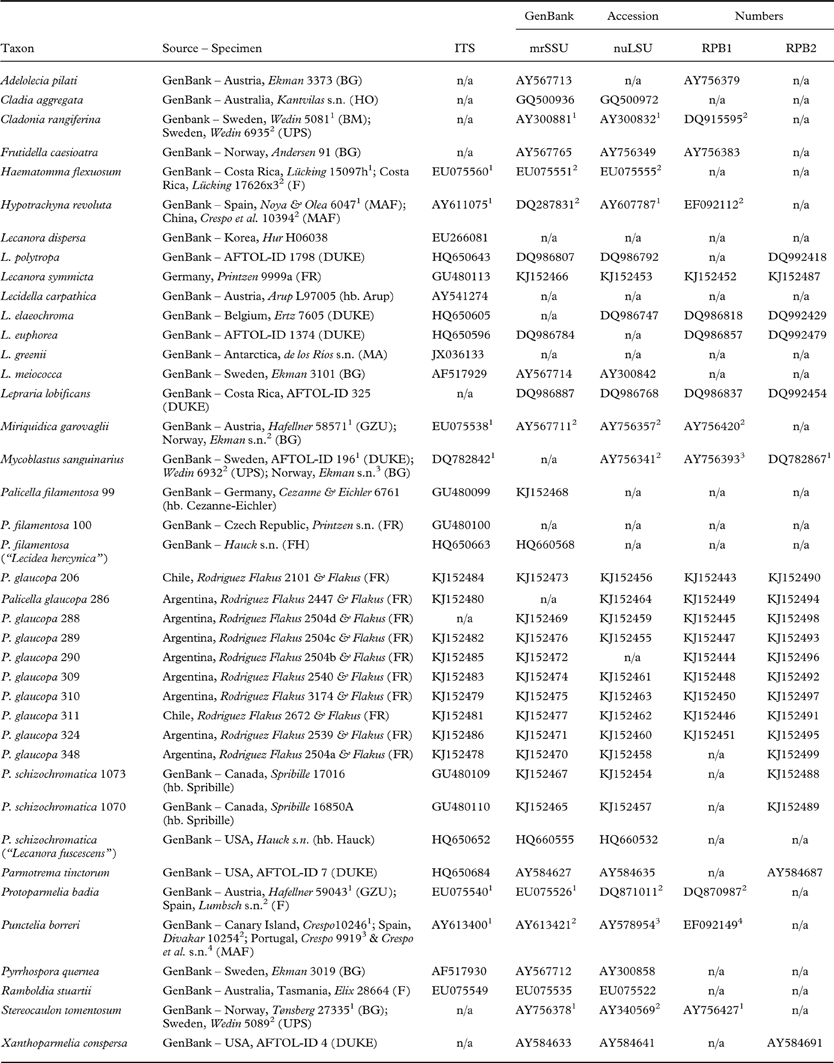
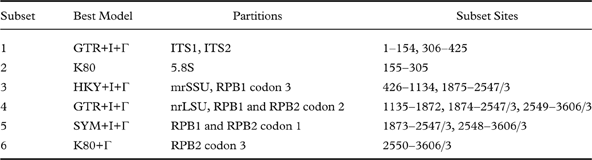
A total of 32 sequences for ITS, 33 sequences for mrSSU, 33 sequences for nrLSU, 24 sequences for RPB1 and 22 sequences for RPB2 were analyzed. BLAST searches in GenBank were performed to ascertain that all sequences used in the phylogenetic analyses originated from the lichens and not from contaminating organisms such as parasymbiotic fungi. The outgroup sequences from families of Cladoniaceae, Stereocaulaceae and Parmeliaceae were selected based on previous phylogenetic studies (Arup & Grube Reference Arup and Grube1998, Reference Arup and Grube2000; Miądlikowska et al. Reference Miądlikowska, Kauff, Hofstetter, Fraker, Grube, Hafellner, Reeb, Hodkinson, Kukwa and Lücking2006). The complete dataset including sequences downloaded from GenBank is described in Table 1. Sequences were aligned within Geneious Pro version 5.0.4 using the Muscle algorithm and default settings (Edgar Reference Edgar2004). We removed poorly or ambiguously aligned regions using Gblocks version 0.91b (Castresana Reference Castresana2000) with default settings but allowing gaps in 50% of the sequences. This resulted in five alignments of the following length: ITS-425 bp, mrSSU-709 bp, nrLSU-738 bp, RPB1-675 bp and RPB2-1059 bp. To select an optimal partitioning scheme and substitution models for the partitions, we concatenated the single gene dataset and used PartitionFinder version 1.0.1 (Lanfear et al. Reference Lanfear, Calcott, Ho and Guidon2012) with default settings using the Akaike Information Criterion for model selection and suggesting 11 data blocks (ITS1, 5.8S rDNA, ITS2, mrSSU, nrLSU, and three independent codon positions for RPB1 and RPB2).
GenBank accession numbers and voucher information for taxa and sequences used in this paper.

Before analyzing the concatenated dataset, we calculated phylogenetic trees for the single gene dataset, in order to detect potential conflicts. Phylogenetic analyses were carried out with MrBayes v.3.2 (Huelsenbeck & Ronquist Reference Huelsenbeck and Ronquist2003), using the substitution models inferred with PartitionFinder and default settings with the following exceptions. The ITS dataset was partitioned into two data partitions (ITS1+ITS2, 5.8S), and codon-specific partitions were used for RPB1and RPB2. All parameters of the substitution model were unlinked between partitions. Gamma distributed rates across sites were modelled as six discrete categories and with a mean 1 exponential prior, and an unconstrained, exponential branch length prior was used. The mean of this prior was inferred by calculating ML trees for the datasets using RaxMLGUI version 0.9 beta 2 (Stamatakis Reference Stamatakis2006; Silvestro & Michalak Reference Silvestro and Michalak2012) and applying either an unpartitioned GTRGAMMAI model (mrSSU, nrLSU) or a partitioned GTRGAMMAI (the rest) and 20 runs. The mean branch lengths of the ML trees were used as means of the exponential distributions. Two supported conflicts were detected by us. On the ITS tree, Parmotrema tinctorum grouped with Hypotrachyna revoluta, while mrSSU supported a relationship with Puntelia borreri. In ITS, Protoparmelia badia appeared as sister to Mycoblastus sanguinarius but grouped with H. revoluta and P. borreri in RPB1. Because both conflicts only involved outgroup taxa, we decided to also analyze the concatenated five-gene dataset.
The inferred branch length prior for the MCMC analysis of this dataset followed an exponential distribution with mean 1/18. MrBayes was set to sample every 1000th tree from three independent runs, each with four chains that were incrementally heated using a factor of 0·15. The average standard deviation of bipartition frequencies among runs was calculated every 1 000 000 generations to infer convergence of the Markov Chains, discarding the first 50% of the trees sampled as burn-in and including only those bipartitions with a frequency of at least 10%. The analysis was stopped after 3 000 000 generations when the standard deviation had dropped below 0·01. Finally, we also calculated a ML bootstrap tree (1000 replicates) for the concatenated dataset using RaxML version 7.2.6 (Stamatakis Reference Stamatakis2006), with the interface RaxMLGUI version 0.9 beta 2 (Silvestro & Michalak Reference Silvestro and Michalak2012) and unlinked GTRGAMMAI models for the six partitions inferred by PartitionFinder.
Results
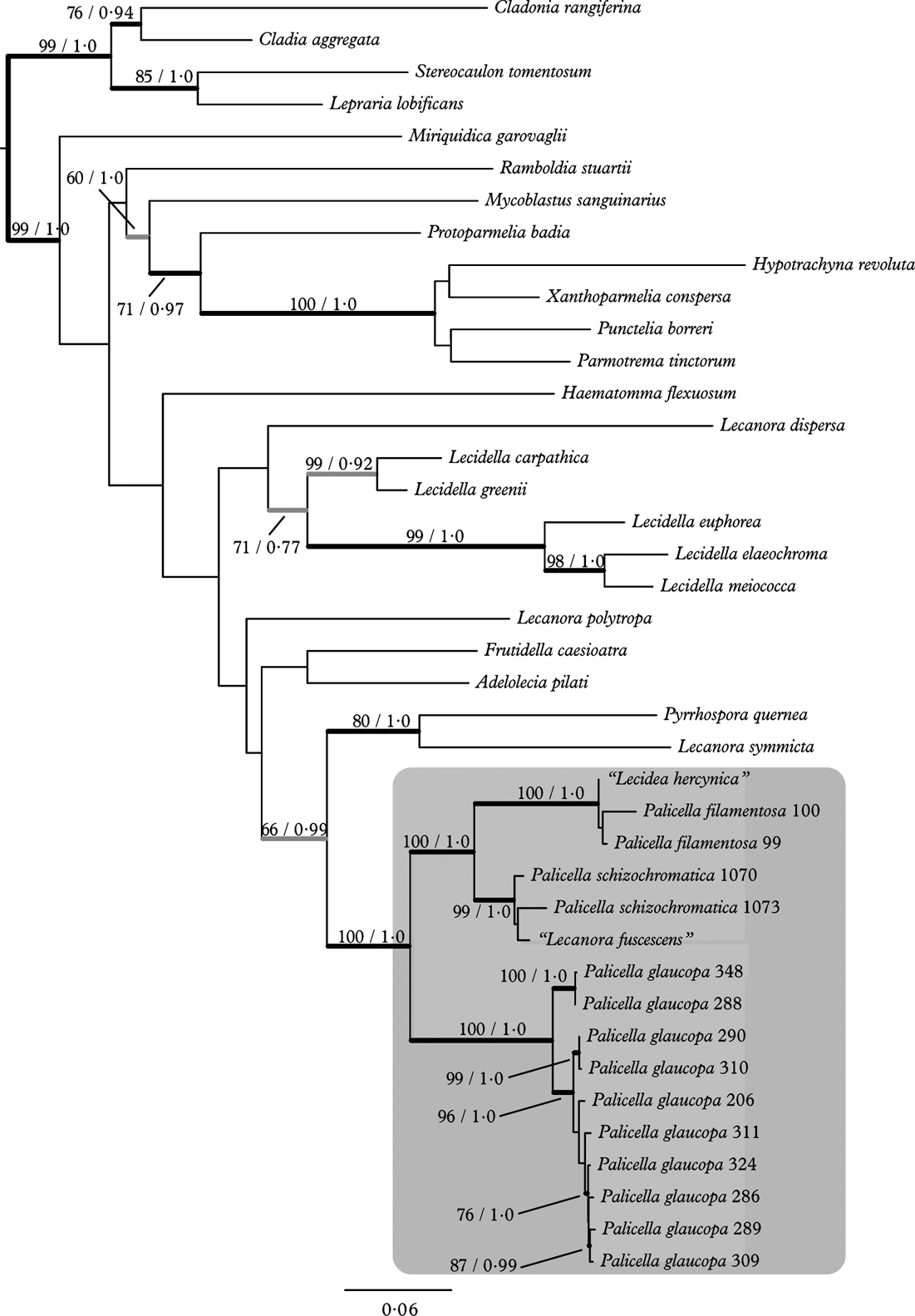
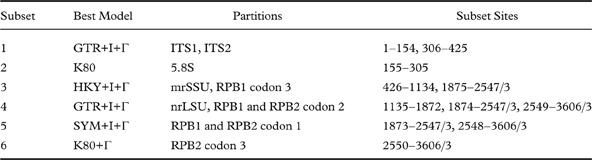
A total of 56 new DNA sequences were obtained for this study (Table 1). The final alignment contained 40 OTUs and 3606 unambiguously aligned nucleotide positions. The inferred optimal partitioning scheme and substitution models for the dataset are listed in Table 2. The total length of the ML tree was 4·20, the mean total branch length of the Bayesian consensus tree 3·13. Figure 1 shows the maximum likelihood tree with ML bootstrap values and posterior probabilities.
Optimal partitioning scheme and substitution models for each data partition
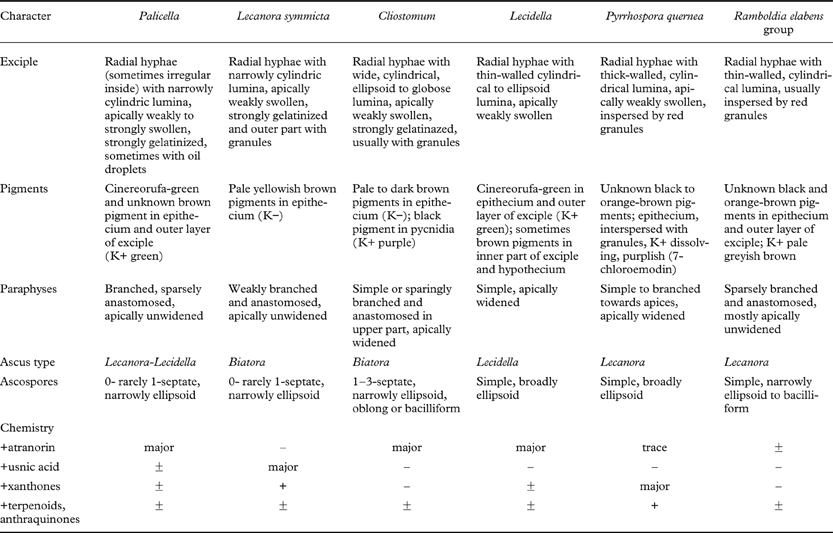
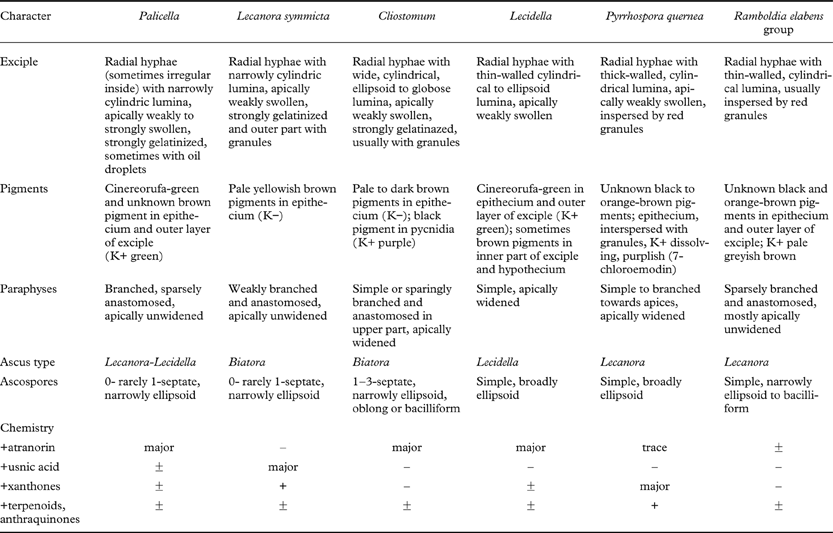
Characters distinguishing Palicella from similar genera.
Maximum likelihood consensus phylogram obtained from 40 species and five gene loci (ITS, nrLSU, mrSSU, RPB1, RPB2) of the Lecanoraceae clade. The families Cladoniaceae, Parmeliaceae and Stereocaulaceae were used as outgroups. Support values (in bold) are given above the branches. “Palicella” as a new genus with a value of (PP=1) for MCMC and ML bootstrap (BP=100).

The Southern Hemisphere specimens of Lecidea glaucopa Hook. f. & Taylor were grouped in a clade with high support values (BP=100 and PP=1·0), and are also anatomically and chemically differentiated from the other taxa in the dataset. A close relationship between L. glaucopa, Lecanora filamentosa and Lecanora schizochromatica is also supported with BP=100 and PP=1·0. Lecidea hercynica M. Hauck & Schmull groups with the two accessions of Palicella filamentosa (BP=100, PP=1·0). The short branches within this clade and anatomical similarities between the two taxa indicate that they are conspecific. Likewise, GenBank sequences of Lecanora fuscescens form a well-supported group (BP=99, PP=1·0) with two collections of P. schizochromatica.
Palicella appears as sister to a clade formed by Lecanora symmicta and Pyrrhospora quernea and is hence assigned to the family Lecanoraceae, although this relationship is only supported by the MCMC analysis (BP=66, PP=0·99). The distinction between Lecanoraceae and Parmeliaceae is not supported because the backbone of the tree lacks statistical support.
Taxonomic Treatment
Palicella Rodr. Flakus & Printzen gen. nov.
MycoBank No.: MB807126
Thallus crustose, rimose-areolate, partially continuous, initially endosubstratal; photobiont chlorococcoid. Apothecia very variable in colour from light yellow, pinkish brown, bluish grey to greenish black, epruinose to pruinose, margin always present but frequently reduced when old. Exciple hyaline or brownish inside, often with a pigmented outer layer (Cinereorufa-green and unknown brown pigment), composed of strongly gelatinized branched and anastomosing, sometimes apically widened hyphae, often inspersed with crystalline granules or oil droplets; young apothecia rarely surrounded by an additional thalline margin. Subhymenium and hypothecium colourless. Epihymenium with hyaline to pale ochre granules, and sometimes greenish black pigmented (Cinereorufa-green). Hymenium colourless or pale bluish green or ochre above, composed of gelatinized, weakly branched and anastomosing paraphyses, with not or slightly expanded apices. Asci 8-spored, tholus I+ blue with a wide axial body that is mostly surrounded by a distinct darker staining layer (Lecanora/Lecidella-type). Ascospores narrowly to rarely broadly ellipsoid, colourless, simple or rarely 1-septate. Major substances: atranorin.
Generic type: Palicella glaucopa (Hook. f. & Taylor) Rodr. Flakus & Printzen.
Etymology. The new genus is named in honour of the prominent Czech lichenologist, Dr Zdeněk Palice (Průhonice), for his substantial contributions to lichenology, especially regarding lecideoid members of Lecanora.
Palicella filamentosa (Stirt.) Rodr. Flakus & Printzen comb. nov.
MycoBank No.: MB807638
Lecidea filamentosa Stirt., Scottish Naturalist 5: 218 [‘1879’] (1880).—Lecanora filamentosa (Stirt.) Elix & Palice Mycol. Progress 9: 531 (2010); type: Scotland, Glen Lochay, Killin, 21 July 1879, Stirton s. n. [GLAM-NHB.1927.8.01010—lectotype, designated by Pérez-Ortega et al. (Reference Pérez-Ortega, Spribille, Palice, Elix and Printzen2010: 531); BM-731241—isolectotype]. For a full synonymy of the species see Palice et al. (Reference Palice, Printzen, Spribille and Elix2011).
Remarks
Within the genus, the species is characterized by pale ochre to charcoal grey, flat to convex apothecia with a biatorine margin that, in young apothecia, is sometimes surrounded by a thalline amphithecium, ascospores (10·0–)12·4–13·5(–16·0)×(3·5–)4·2–4·5(–5·0) µm, and the production of small amounts of usnic acid in addition to atranorin (Printzen & May Reference Printzen and May2002; Palice et al. Reference Palice, Printzen, Spribille and Elix2011).
Distribution and ecology
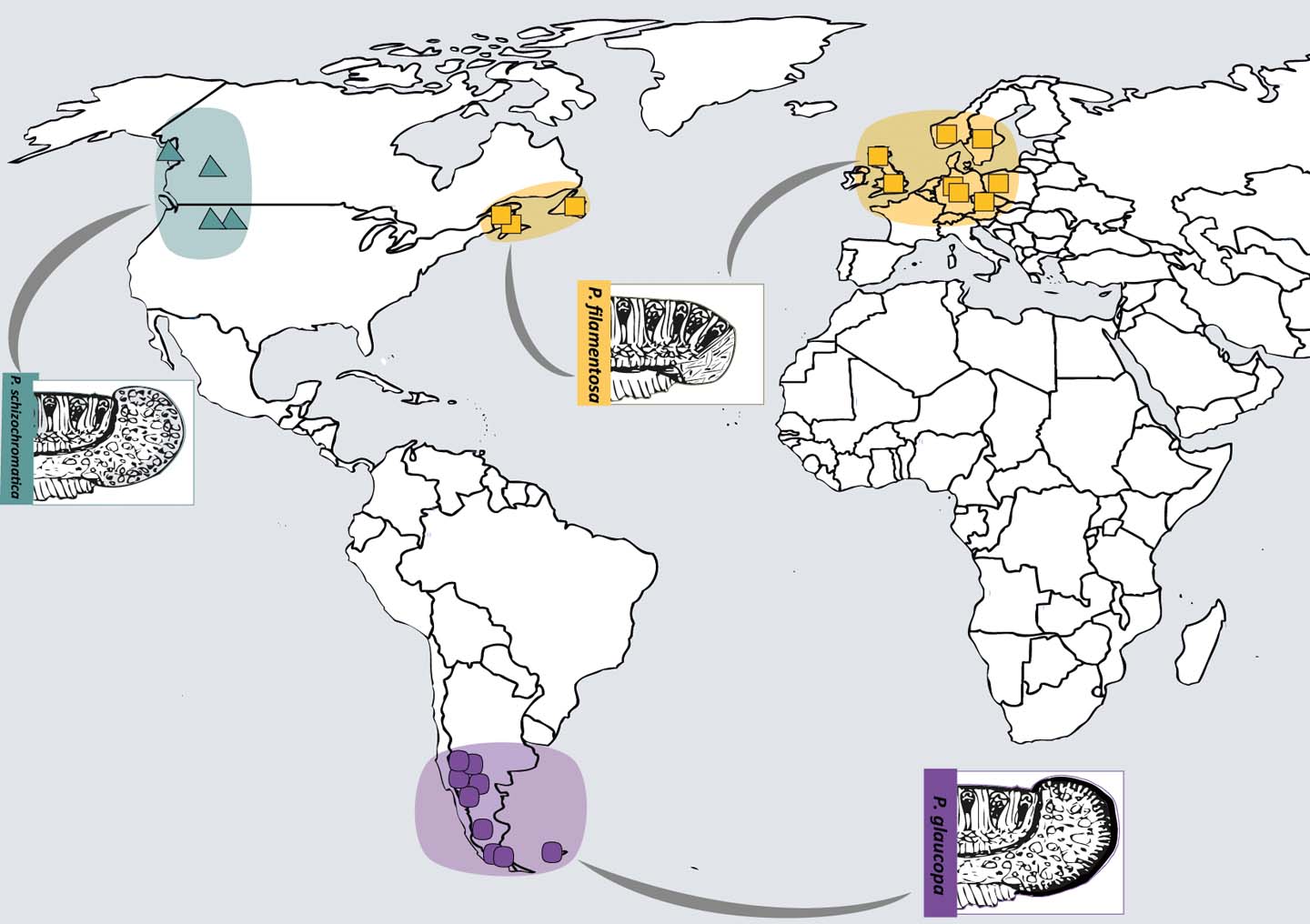
Palicella filamentosa is a rather widespread corticolous and lignicolous species known from Europe and eastern North America (Printzen & May Reference Printzen and May2002; Palice et al. Reference Palice, Printzen, Spribille and Elix2011).
Palicella glaucopa (Hook. f. & Taylor) Rodr. Flakus & Printzen comb. nov.
MycoBank No.: MB807639
Lecidea glaucopa Hook. f. & Taylor in Hook., London J. Bot. 3: 637 (1844).—Biatora glaucopa (Hook. f. & Taylor) Räsänen, Ann. Bot. Soc. Zool.-Bot. Fenn. Vanamo 2: 58 (Reference Räsänen1932).—Lecidella glaucopa (Hook. f. & Taylor) Kalb, Lichenes Neotropici, fascicle 8: 328 (Reference Kalb1984); type: Chile, Cape Horn, [March–September 1842, J. D. Hooker] (BM-1104684!—lectotype, designated here; FH-302837!, BM-1104685!—isolectotypes).
Lecidea conflectens Nyl., Lich. Fueg. Patag.: 15 (1888); type: [Argentina,] Fuegia, Ushuwaia, 1882, in Fago antarctica, Spegazzini (H-NYL-20244!—lectotype, designated here).
Lecidea oculans Nyl., Lich. Fueg. Patag.: 13 (1888).—Lecidea glaucopa var. oculans (Nyl.) Zahlbr., Cat. Lich. Univ. 3: 768 (1925).—Biatora glaucopa var. oculans (Nyl.) Räsänen, Ann. Bot. Soc. Zool.-Bot. Fenn. Vanamo 2: 58 (Reference Räsänen1932); type: [Argentina,] Fuegia, Wallamatu, 1882, fagicola, Spegazzini (H-NYL-21305!—lectotype, designated here).
Lecidea epichlorotica Müll. Arg., Miss. Sci. Cap Horn, Lich.: 164 (1889); type: [Chile], Cap Horn, Baie Orange, Ile Hoste, Terre de Feu, 1886, Fagus betuloides, Hariot S. 52 pr.p. (G!—lectotype, designated here; G!—paratypes).
Lecidea epichlorotica var. expallens Müll. Arg., Miss. Sci. Cap Horn, Lich.: 165 (1889); type: [Chile], Ile L'Hermite, Baie San Martin, Terre de Feu, 1886, cortex Fagi betuloidis, Hariot S. 34. (G!—lectotype, designated here; G!—paratype).
(Fig. 2)
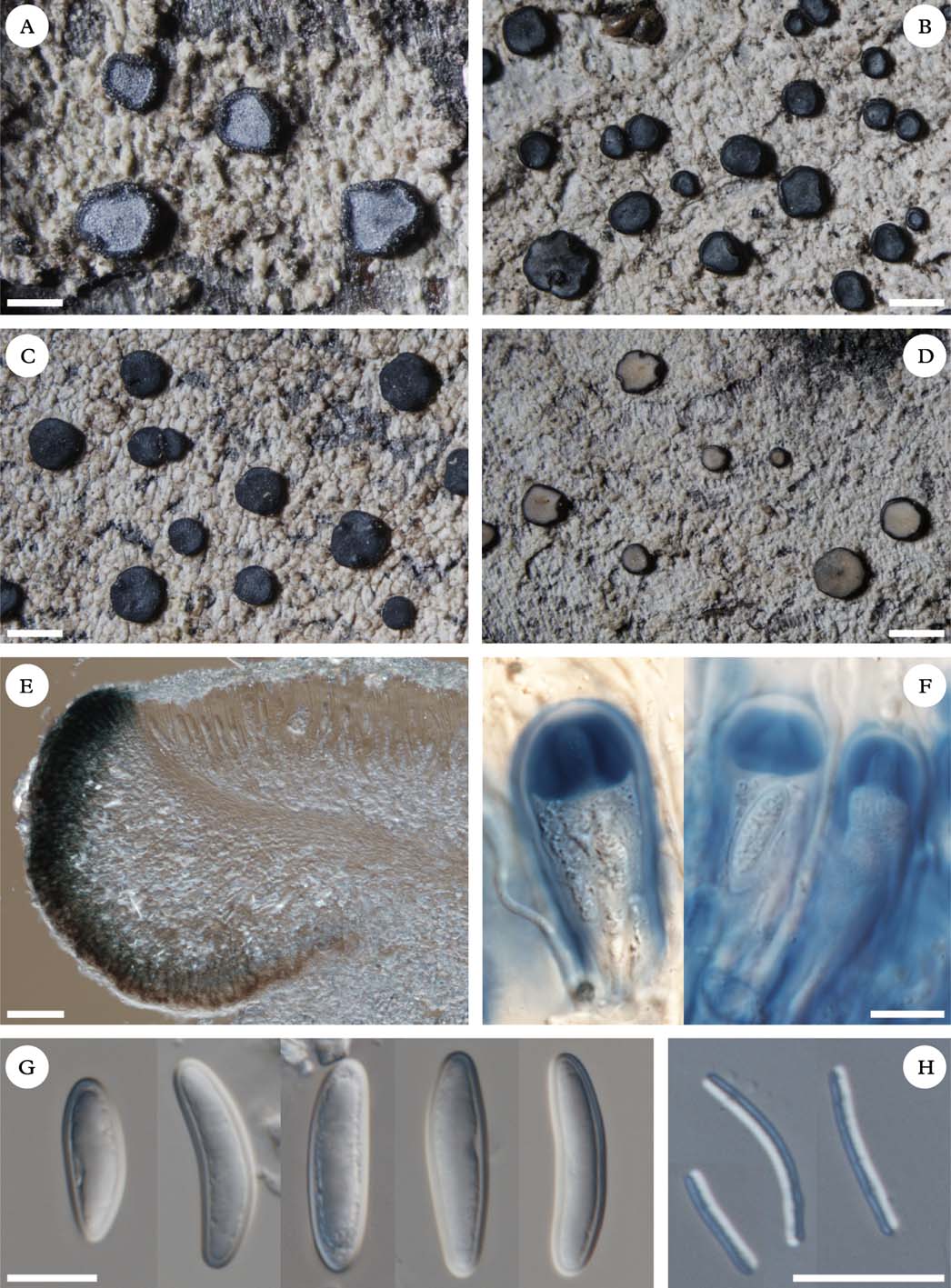
Palicella glaucopa, variation of apothecial characters; A, concave with strongly pruinose disc (Rodriguez Flakus 2973c); B, flat with evident margin and less pruinose disc (Rodriguez Flakus 2672b); C, convex with reduced margin (Rodriguez Flakus 2973b); D, epruinose with non-pigmented disc (Rodriguez Flakus 3046); E, exciple composed of pigmented cortical layer and hyaline interior inspersed by oil droplets and small crystals (Rodriguez Flakus 2499); F, asci showing amyloid ascus apex (mounted in K/I; Imshaug 39305); G, ascospores (Rodr. Flakus 2672b); H, conidia (Imshaug 39305). Scales: A=0·5 mm; B–D=1 mm; E=50 µm; F–H=10 µm.
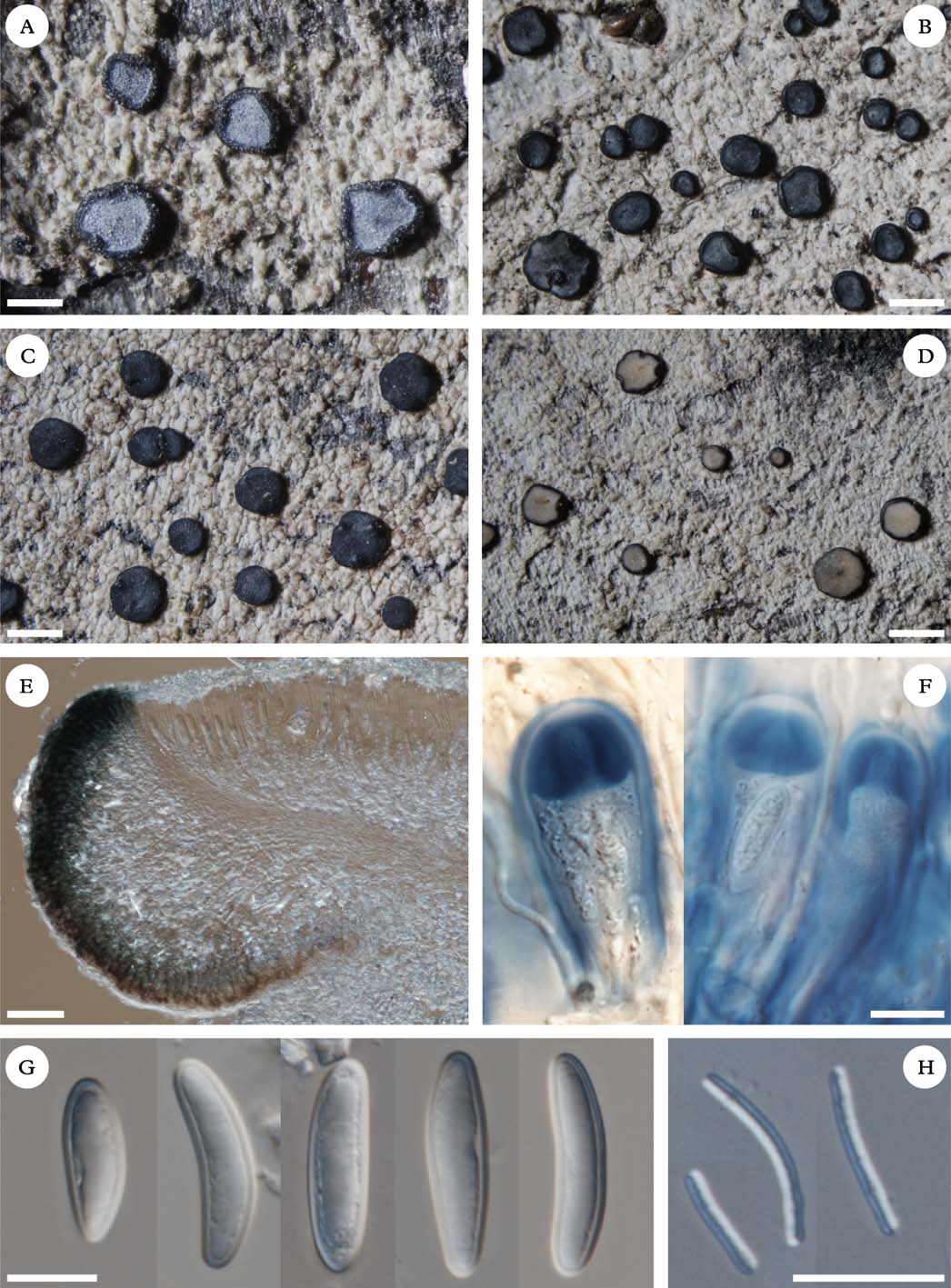
Thallus corticolous, up to 1·5 mm diam., crustose, initially endosubstratal, later rimulose-areolate, composed of dispersed to confluent, convex areoles up to 0·4 mm diam., partially continuous, 40–150 µm thick; surface matt, pale grey to white or yellowish white; prothallus sometimes present, white or black; pseudocortex very thin, indistinct, of loosely arranged gelatinized hyphae, 5–10 µm thick; medulla discontinuous, 30–60 µm thick or partially lacking, composed of c. 2 µm wide hyphae, with groups of chlorococcoid photobiont cells 9–19 µm diam.
Apothecia rounded to irregular, single, never aggregated in groups, sessile with constricted base (0·3–)0·5–0·7–1·0(–1·4) mm (n=10); disc variable in colour, from black, pale grey, pale yellowish brown to almost white, matt or shiny, flat to moderately convex (in old apothecia), greyish pruinose (especially young apothecia) or epruinose; margin prominent but often reduced when older, often becoming flexuose, shiny black; exciple laterally 40–160 µm wide, basally 70–220 µm wide, colourless within but strongly inspersed by oil droplets and small crystals (POL+), I−, outer layer with dark pigmentation (Cinereorufa-green; Meyer & Printzen Reference Meyer and Printzen2000, and unknown brown pigment), K+ green, N+ purple-red, composed inside of loosely arranged, narrow hyphae, 0·8–2·0 µm wide, that are apically widened to 5–8 µm (lumina c. 3–5 µm); hypothecium colourless to pale yellowish brown, 40–75 µm high, I+ blue; subhymenium 10–30 µm high, colourless, I+ blue; hymenium 50–90 µm high, colourless, conglutinate, I+ blue; epihymenium 8–20 µm thick, light yellow to greenish black, with Cinereorufa-green pigments and unidentified brown pigment, epipsamma of hyaline, sometimes also yellow, granules (POL+); paraphyses colourless, branched and anastomosed, conglutinate in water but easily separated in KOH, 1·0–1·5 µm, apically 1·5–2·5 µm wide; asci 8-spored, clavate, 47–75×11–20 µm, with K/I+ blue tholus resembling the Lecanora- or Lecidella-type, usually with a small unstained region at the top and a rather wide, apically closed axial body (occupying about 1/3 of the tholus width) that may almost penetrate the tholus and is surrounded by a strongly amyloid zone (less so in apical parts), ocular chamber of paraboloid to almost cylindrical or slightly clavate shape; ascospores colourless, simple to rarely 1-septate, narrowly ellipsoid, variable in shape, sometimes slightly curved or irregular, filled with large oil droplets, (9·0–)15·9–19·5–23·0(–32·0) × (4·8–)5·5–6·5–7·4(–9·5) µm, length-breadth index (1·6–)2·4–3·1–3·8(–5·6) µm (n=300), walls 0·5–1·5 µm thick.
Pycnidia rarely present, black, immersed in the thallus, marginal, walls paraplectenchymatous with brown wall, conidiophores unbranched, resembling type II–III of Vobis (Reference Vobis1980); conidia straight to very slightly curved, filiform, borne apically on elongated conidiogenous cells, non-septate, 9·5–14·0 × 1·0–1·5 µm.
Chemistry
Atranorin (major), chloroatranorin (minor), pannarin (major), isonorpannarin (minor), zeorin (major), ±arthothelin (minor), ±thiophanic acid (minor), ±ellagic acid (minor), ±several unknown terpenes (minor to major). Thallus K+ yellow, P+ yellow, C+ yellowish or orange or C−, KC+ yellowish to orange or KC−, UV−; apothecial disc K−, P+ rust orange, C+ orange or C−, KC+ orange or KC−, UV+ dull orange or UV−.
Remarks
The epithet “glaucopa” introduced by Hook. f. & Taylor (1844) refers to the glaucous pruina that often covers apothecia (Fig. 2A & B), but the apothecial colour of P. glaucopa is much more variable. Besides typical, black apothecia with blue-grey pruina, we have also observed pure black, shiny and epruinose, pale grey, pale yellowish brown to almost white discs (with black pigment located only in the margin). The shape of apothecia and margin is also very variable. Frequently on the same thallus, concave apothecia with a thick elevated margin, plane apothecia with an indistinct margin and strongly convex apothecia with a reduced margin can be found.
Palicella glaucopa can be recognized by the characteristic exciple with an outer layer of strongly swollen and dark pigmented hyphae (Cinereorufa-green) and a more or less unpigmented interior composed of narrow, loosely arranged hyphae, inspersed by oil droplets. Its characteristic type of ascus is somewhat intermediate between the Lecanora- and Lecidella-type. Palicella glaucopa differs chemically from P. filamentosa and P. schizochromatica by the lack of usnic acid, which is regularly observed in the other two species. The distribution of secondary substances in P. glaucopa is quite interesting. The thallus contains large quantities of atranorin (K+ yellow, P+ yellow) and varying concentrations of the xanthones arthothelin and thiophanic acid (C+ yellowish to orange or C−, KC+ yellowish to orange or KC−), whereas the apothecial discs always accumulate high concentrations of pannarin (P+ rust-orange) and variable amounts of xanthones (C+ yellowish or orange or C−, KC+ yellowish to orange or KC−, UV+ dull orange or UV−). We assume that the hyaline crystals which are always observed in the epithecium represent pannarin (P+ rust-orange). The exciple contains droplets of probably undetermined fatty acid (never observed on TLC plates). We also observed an additional, ink purple, granular pigment (K+ turquoise) in the exciple of several specimens. Specimens with this pigment were originally described as Lecidea conflectens Nyl. (Nylander Reference Nylander1888). We could not find any correlation between the occurrence of the additional ink-purple pigment, the presence of xanthones and any morphological or anatomical characters, and therefore assume that this represents intraspecific variation.
Palicella glaucopa can hardly be confused with other lecideoid species from the Lecanora varia group, such as L. symmicta (Ach.) Ach., which is easily distinguished by its yellowish to orange-brown apothecial disc with an indistinct margin, an exciple of narrowly cylindrical, apically only slightly widened hyphae, smaller ascospores and the production of usnic acid as a secondary substance (Printzen Reference Printzen2001). Superficially, Cliostomum griffithii (Sm.) Coppins resembles P. glaucopa because of its similarly variable apothecial colour ranging from pale pink, violaceous grey and brownish to pure black. It clearly differs by its conspicuous, relatively large black (K+ purple) pycnidia, an exciple composed of hyphae with thick gelatinized walls and cylindrical to globose lumina, 1-septate ascospores and Biatora-type asci (Ekman Reference Ekman, Nash, Ryan, Diederich, Gries and Bungartz2004). Distinguishing characters of P. filamentosa and P. schizochromatica are listed in the determination key below.
Distribution and ecology
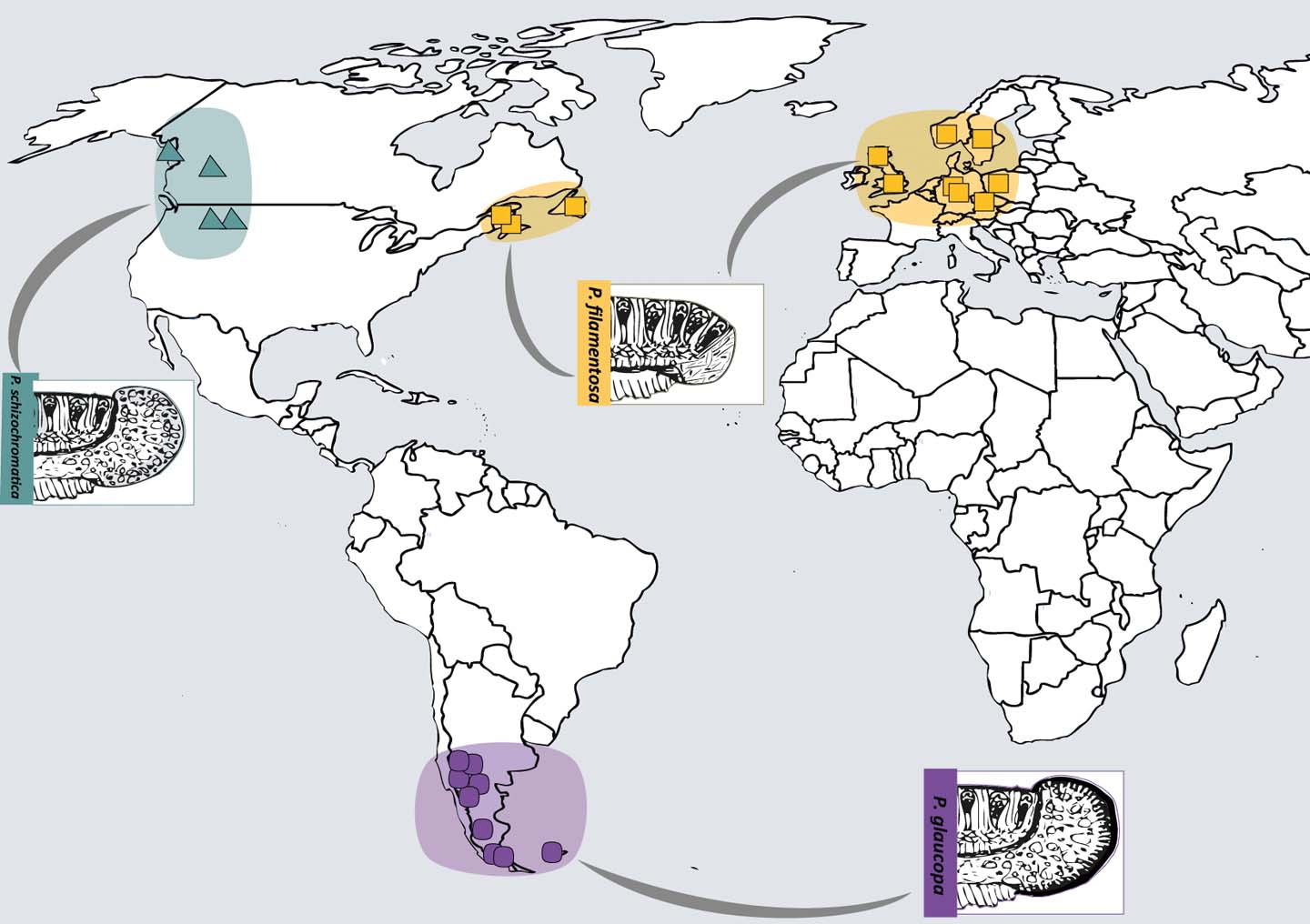
Palicella glaucopa is known from many localities in southern Chile and Argentina (Fig. 3), where it is common on tree trunks and branches in Nothofagus forests.
Distribution map of Palicella species: P. filamentosa (squares), P. glaucopa (circles), P. schizochromatica (triangles). In colour online
Selected specimens examined (of n=222). Argentina: Prov. Tierra del Fuego, Antártida e Islas del Atlantico Sur: Dept. Ushuahia, Tierra del Fuego National Park, near Rayadito area, alt. 14 m, 54°50′26·4″S, 68°33′22·2″W, P. Rodriguez Flakus 2423 & A. Flakus (FR); Guanaco Mountain, alt. 244 m, 54°49′11·8″S, 68°33′29·6″W, P. Rodriguez Flakus 2504a, 2504b, 2504c, 2504d, 2504e & A. Flakus (FR); Roca Lake, alt. 2 m, 54°49′26·8″S, 68°33′58·8″W, P. Rodriguez Flakus 2530 & A. Flakus (FR); near Ushuahia, alt. 200 m, R. Santesson 452 (S); 54°50′S, 68°28′W, H. Imshaug 55117 & K. Ohlsson (UPS); near Antuk Lake, 54°25′S, 67°25′W, R. Santesson 7070 (S); near Fagnano Lake, R. Santesson 7866 (S); near San Sebastian, P. Dusén 106 (S); Sierra Sorondo, alt. 853 m, 41°20′24·0″S, 71°35′12·3″W, P. Rodriguez Flakus 3098 & A. Flakus (FR); near Sierra Alvear, alt. 300 m, 54°43′S, 68°01′W, H. Imshaug 55217 & K. Ohlsson (MSC-121067); Isla de los Estados, near Puerto Vancouver, alt. 60 m, 54°47′S, 64°03′W, H. Imshaug 52035 & K. Ohlsson (FH); near Puerto Hoppner, alt. 90 m, 54°45′S, 64°25′W, H. Imshaug 53640 & K. Ohlsson (FH). Prov. Rio Negro: Dept. Bariloche, Nahuel Huapi National Park, near Cascada de los Duendes, alt. 819 m, 41°10′46·4″S, 71°24′51·1″W, P. Rodriguez Flakus 2976a & A. Flakus (FR); near Tronador Mountain, alt. 871 m, 54°15′15·0″S, 71°41′28·9″W, P. Rodriguez Flakus 3071 & A. Flakus (FR); Llao Llao Municipal Park, alt. 816 m, 41°03′02·0″S, 71°32′39·3″W, P. Rodriguez Flakus 2719 & A. Flakus (FR); Mascardi Lake, alt. 841 m, 41°20′32·7″S, 71°34′39·2″W, P. Rodriguez Flakus 3053 & A. Flakus (FR). Prov. Neuquen: Dept. Huiliches, Lanin National Park, near Lanin Mountain, 39°34′45·7″S, 71°27′14·3″W, P. Rodriguez Flakus 3277 & A. Flakus (FR); Aluminé Lake, alt. 1400 m, A. Kalela 156f (H).—Chile: Región Aysén: Prov. Coyhaique, Cerro Castillo National Reserve, road between El Blanco and Cerro Castillo village, alt. 870 m, 45°59′08·7″S, 71°54′43·2″W, P. Rodriguez Flakus 1748 & A. Flakus (FR); Queulat National Park, Sendero Encantado, alt. 474 m, 44°37′32·9″S, 72°27′04·1″W, P. Rodriguez Flakus 1526 & A. Flakus (FR). Region de la Araucania: Prov. Cautín, Huerquehue National Park, alt. 800 m, 39°09′09·3″S, 71°42′59″W, P. Rodriguez Flakus 2002 & A. Flakus (FR); Conguillío National Park, Captrén región, alt. 1180 m, 38°41′36·6″S, 71°41′25·3″W, P. Rodriguez Flakus 2052 & A. Flakus (FR); Prov. Malleco, Malalcahuello National Reserve, alt. 1359 m, 38°25′50·5″S, 71°32′14·6″W, P. Rodriguez Flakus 2100 & A. Flakus (FR); Baie Orange, Hariot s. n., (UPS-L533353); near Coyhaique bajo, Baquedano, R. Santesson 8418 (S); Prov. Malleco, Parque Nacional de Nahuelbuta, M. Mahu 2646 (FH). Región de Magallanes y de la Antártica Chilena: Prov. Magallanes, Península de Brunswick, road to Cabo Froward, alt. 5 m, 53°42′28·7″S, 70°58′05·6″W, P. Rodriguez Flakus 2617 & A. Flakus (FR); Punta Arenas, P. Dusén s. n. (H); near Tres Brazos river, alt. 160 m, 53°17′S, 71°03′W, H. Imshaug 49683 & K. Ohlsson (MSC); Seno Otway, bahía Camden, H. Imshaug 39144 & R. C. Harris (MSC); near Mina Rica, alt. 450 m, R. Santesson 5273 (S); Fuerte Bulnes, alt. 100 m, K. Kalb 10804 (hb. K. Kalb); Canal Whiteside, Puerto Yartou, R. Santesson 6851 (S); near Rio Rubens c. 50 km from Natales, R. Santesson 5628 (S).
Palicella schizochromatica (Pérez-Ortega et al.) Rodr. Flakus & Printzen comb. nov.
MycoBank No.: MB807640
Lecanora schizochromatica Pérez-Ortega et al., Mycol. Prog. 9: 531 (Reference Pérez-Ortega, Spribille, Palice, Elix and Printzen2010); type: Canada, British Columbia, Purcell Mountains, St. Mary's Alpine Provincial Park, trail to Mortar Lake, 2006, T. Spribille 19965 & V. Wagner (CANL—holotype; FR— isotype).
Remarks
Palicella schizochromatica is characterized by yellowish or pale brown to black, lecideine apothecia that are very variable in colour, small ascospores, 9·7-11·1×3·5-4·1 µm, and the production of atranorin together with usnic acid and paraensic acids C and D (Pérez-Ortega et al. Reference Pérez-Ortega, Spribille, Palice, Elix and Printzen2010).
Distribution and ecology
The species occurs on bark and wood of conifers from sea level to the timberline (2400 m) in north-western North America (Canada and USA).
Key to species of Palicella
-
1 Ascospores (average of 10) 16·0–23·0×5·5–7·5 µm; hymenium 50–90 µm tall, apothecial disc P+ rust-orange (pannarin), thallus without usnic acid; Southern Hemisphere ... P. glaucopa
Ascospores (average of 10) 9·5–14·5×3·5–4·5 µm; hymenium 40–60 µm tall, apothecial disc P-, thallus usually with usnic acid as accessory substance; Northern Hemisphere ... 2
-
2(1) Ascospores on average 12·0–14·5×4·0–4·5 µm; apothecial margin concolorous or slightly lighter than disc, young apothecia mostly with lecanorine margin; Europe and eastern North America ... P. filamentosa
Ascospores on average 9·5–11·5×3·5–4·5 µm; apothecial margin usually darker than disc, often entirely black, biatorine from the beginning; western North America ... P. schizochromatica
Discussion
Phylogenetic position and systematic novelties
In their study on species of the “Lecanora varia group”, Pérez-Ortega et al. (Reference Pérez-Ortega, Spribille, Palice, Elix and Printzen2010) resolved two of the three species treated in this study as part of a monophyletic group that they informally called “filamentosa group”. In order to formalize this distinction, we describe here the new genus Palicella. The genus comprises species that were formerly assigned to Lecidea and Lecanora. As traditionally circumscribed (Zahlbruckner Reference Zahlbruckner1925, Reference Zahlbruckner1928), these two genera are distinguished by the presence (in Lecanora) or absence (in Lecidea) of a lecanorine amphithecium around the apothecia. Lecanora symmicta and similar species were always difficult to place in this schematic concept, which is reflected by the confusing nomenclatural history of the older species of the group. Originally, L. symmicta was described as a variety of Lecanora varia (Acharius Reference Acharius1810), but recombined into Lecidea shortly afterwards (Acharius Reference Acharius1814). Zahlbruckner (Reference Zahlbruckner1928), however, kept it under Lecanora. Palicella filamentosa and its numerous synonyms were alternately ascribed to Lecanora (Zahlbruckner Reference Zahlbruckner1940; Palice et al. Reference Palice, Printzen, Spribille and Elix2011) or Lecidea (Stirton Reference Stirton1879; Hedlund Reference Hedlund1892; Schmull & Hauck Reference Schmull and Hauck2005). On the other hand, P. glaucopa was always treated as a member of Lecidea s. lat. Kalb (Reference Kalb1984) had already noted that it deviated from typical Lecidea and recombined it into Lecidella, with which it shares some similarities, such as a more or less Lecidella-type ascus, paraphyses that are easily separated in KOH and the presence of Cinereorufa-green in the exciple. The narrowly ellipsoid ascospores and strongly thickened excipular hyphae, however, indicate that it does not belong there but should rather be assigned to a new genus.
Our phylogenetic analyses based on five gene loci confirmed that P. glaucopa is distinct from Lecidella and instead forms a well-supported lineage together with P. filamentosa and P. schizochromatica within Lecanoraceae. An obvious similarity between these species is the apothecial pigmentation, which may vary strongly in all three species (Fig. 2; see also Printzen & May Reference Printzen and May2002, fig. 1; Pérez-Ortega et al. Reference Pérez-Ortega, Spribille, Palice, Elix and Printzen2010, fig. 3), especially due to varying concentrations of Cinereorufa-green. The relatively high number of synonyms of P. filamentosa and P. glaucopa reflects this extreme variability in apothecial colour.
Palicella appears as a sister clade to L. symmicta and Pyrrhospora quernea, which however is only supported by the Bayesian analysis. Pérez-Ortega et al. (Reference Pérez-Ortega, Spribille, Palice, Elix and Printzen2010) already inferred a close relationship between P. filamentosa and L. symmicta in a phylogenetic analysis involving ITS sequences from more Lecanora species than in this study. The analysis published by Kalb et al. (Reference Kalb, Staiger, Elix, Lange and Lumbsch2008) confirmed a close relationship between Pyrrhospora and several lineages of Lecanora and Lecidella. At present, the phylogenetic position of Palicella within Lecanoraceae remains unclear, similar to that of Miriquidica and Ramboldia (Kalb et al. Reference Kalb, Staiger, Elix, Lange and Lumbsch2008).
In order to improve this study, future work should be based on a broader taxon sampling to clarify the relationships between these genera, as well as Adelolecia, Frutidella, Haematomma, Miriquidica, Ramboldia and the Tephromelataceae (Spribille et al. Reference Spribille, Goffinet, Muggia, Obermayer and Mayrhofer2011). Likewise, the correlation between Palicella and lecideoid species groups within Lecanora, such as L. fuscescens (Sommerf.) Nyl., L. ghisleri (Hepp) Arnold, L. boligera (Th. Fr.) Hedl. and L. anopta Nyl., remains unclear and needs to be tested in a phylogenetic framework. Our results, however, indicate that even a five-gene dataset might not be sufficient to robustly infer the backbone of such a phylogeny.
It has been previously suggested that Lecidea hercynica is conspecific with P. filamentosa (Palice et al. Reference Palice, Printzen, Spribille and Elix2011) and our phylogenetic tree confirms this proposal with maximal support. A different case is probably that of Lecanora fuscescens, GenBank sequences of which appear firmly embedded in a clade of P. schizochromatica. Based on sequences from the same specimen, Schmull et al. (Reference Schmull, Miądlikowska, Pelzer, Stocker-Wörgötter, Hofstetter, Fraker, Hodkinson, Reeb, Kukwa and Lumbsch2011) reported Lecanora fuscescens as closely related (sister clade) to “Lecidea hercynica”. Because of anatomical and chemical differences between L. fuscescens and P. schizochromatica, we believe that its odd position on our tree is due to a misidentification. In L. fuscescens, excipular hyphae and paraphyses have capitate, pigmented apical cells and ascospores are broadly ellipsoid, while P. schizochromatica has unthickened and unpigmented excipular hyphae, mostly colourless and narrow paraphysis tips, and narrowly ellipsoid ascospores. Furthermore, L. fuscescens produces fumarprotocetraric and lobaric acids, while P. schizochromatica contains atranorin, usnic and paraensic acids C and D (Pérez-Ortega et al. Reference Pérez-Ortega, Spribille, Palice, Elix and Printzen2010). We were unable to re-examine the voucher on which GenBank sequences were based, but according to Markus Hauck (pers. comm.) it originated from Montana, where P. schizochromatica is one of the most common epiphytic lichens (T. Spribille, pers. comm.) and was collected before the latter species was described.
Comparison of Palicella to similar genera
Species of Palicella share superficial similarities with species from Cliostomum, Lecidella and Ramboldia, as well as Lecanora symmicta (Hertel Reference Hertel1983, Reference Hertel1984; Hafellner Reference Hafellner1984, Reference Hafellner1993; Knoph Reference Knoph1990; Kantvilas & Elix Reference Kantvilas and Elix1994; Printzen Reference Printzen2001; Ekman Reference Ekman, Nash, Ryan, Diederich, Gries and Bungartz2004). In particular, P. filamentosa and L. symmicta can be very similar in the field. Lecanora symmicta is best distinguished by the lack of atranorin, slightly shorter ascospores (7·0–13·5 µm vs. 10-16 µm in P. filamentosa) and longer conidia (18–25 µm vs. 9–17 µm in P. filamentosa) (Printzen & May Reference Printzen and May2002). On first view, the genus Lecidella appears almost identical with Palicella glaucopa and P. schizochromatica. It differs, however, in important anatomical details. The paraphyses are slightly capitate and almost unbranched, and ascospores are broadly ellipsoid (Knoph Reference Knoph1990; Knoph & Leuckert Reference Knoph, Leuckert, Nash, Ryan, Diederich, Gries and Bungartz2004). Typical Lecidella asci lack the non-amyloid zone above the axial body that seems to be typical for Palicella (Fig. 2F). Our phylogenetic analysis did not resolve the relationship between the two genera. Hence it is possible that they are in fact more closely related to each other than suggested by the phylogeny in Figure 1.
Morphologically, the Ramboldia elabens group is also similar to Palicella, having apothecia with dark brownish, matt to glossy discs and concolorous margins, as well as a biatorine exciple and narrowly ellipsoid ascospores (Elix Reference Elix2009). The species differ, however, by typical Lecanora-type asci (tholus with a strongly amyloid lateral part, and broad, apically diverging non-amyloid axial body), pale orange pigments inside the exciple (K−), hypothecial granules (K+ purple) and a lack of atranorin (Hafellner Reference Hafellner1993; Kalb et al. Reference Kalb, Staiger, Elix, Lange and Lumbsch2008; Elix Reference Elix2009).
Cliostomum griffithii may resemble collections of P. glaucopa and P. schizochromatica on account of the very variable apothecial pigmentation, but is readily distinguished by two-celled ascospores, strongly gelatinized excipular hyphae with rather wide and short lumina, the frequent formation of conspicuous black pycnidia reacting K+ purple, and a typical Biatora-type ascus (Ekman Reference Ekman1997, Reference Ekman, Nash, Ryan, Diederich, Gries and Bungartz2004).
The phylogenetically closely related Pyrrhospora quernea (Fig. 1) does not resemble any Palicella species and clearly differs by its farinose to granular-sorediate thallus, dark reddish brown apothecia with a reduced margin, the presence of the anthraquinone 7-chloroemodin (K+ reddish purple in section), and broadly ellipsoid ascospores (Kalb et al. Reference Kalb, Staiger, Elix, Lange and Lumbsch2008).
The authors would like to thank the curators of the herbaria cited above and Prof. Klaus Kalb for the loan of specimens, Prof. Gernot Vobis (Bariloche) and Reinaldo Vargas (Concepción) for their kind hospitality and help with permits and organization of field trips. The first author warmly thanks Dr Holger Thüs (London) for making specimens available for this study and for his kindness during her visit to BM, and Adam Flakus for help with the photographic documentation, TLC and fieldwork. Special thanks to Prof. Dr Imke Schmitt and Maria Albrecht for making available HPLC equipment and the staff of the Grunelius Möllgaard laboratory, particularly Heike Kappes, for assistance with molecular methods. This research received support from the DAAD (Deutscher Akademischer Austausch Dienst), and the SYNTHESYS Project http://www.synthesys.info/ (GB- TAF-2133) funded by the European Community Research Infrastructure Action under the FP7 “Capacities” Program. Financial support from the research funding programme “LOEWE – Landes-Offensive zur Entwicklung wissenschaftlich-ökonomischer Exzellenz” of Hesse's Ministry of Higher Education, Research, and the Arts is also gratefully acknowledged.