Introduction
Telemedicine is a term coined in the 1970s. The World Health Organization (WHO), in its 2010 review, defined telemedicine as “The delivery of health care services; where distance is a critical factor by all health care professionals using information and communication technologies for the exchange of valid information for diagnosis, treatment and prevention of disease and injuries, research and evaluation, and for the continuing education of health crew; all in the interests of advancing the health of individuals and their communities” (1).
Despite the multiple definitions that the telemedicine may have, its objective is well established, strengthening health systems, being one more weapon to achieve an accessible and high-quality health system. The incorporation of new advances in technology and the adaptation of different societies to the telemedicine facilitate health access of marginalized and more isolated communities (1). This is very useful in low-resource countries, where the distance between the population and the specialized health care is a barrier to access it (1–Reference Vinals, Mandujano, Vargas and Giuliano3). In developing countries where issues such as the lack of specialists and medical infrastructure prevail, using telemedicine provides multiple advantages such as capacitating the local health workers who are mostly paramedical personnel (Reference Macabasag, Mae, Magtubo, Portia-Grace and Fernandez2). However, it is important to differentiate the existing types of telemedicine and their main characteristics: synchronous telemedicine is the “real-time telemedicine,” and asynchronous telemedicine is the “store-and-forward telemedicine” (1). In recent years, there has been an increase in published studies on telemedicine in low-income countries. Many published studies showed the experience of asynchronous telemedicine in different countries with low resources (Reference Ndlovu, Littman-Quinn, Park, Dikai and Kovarik4–Reference Lipoff, Cobos, Kaddu and Kovarik8). Perhaps it is a type of telemedicine of easier applicability in low-income countries, due to the difficulty in accessing the internet and other cost-effectiveness studies have showed the benefits of the national implementation of telemedicine programs in countries such as Botswana or Cape Verde (Reference Ndlovu, Littman-Quinn, Park, Dikai and Kovarik4–Reference Martinez-Garcia, Bonnardot, Olson, Roggeveen, Karsten and Moons6). In Angola, in 2007, the PEDITEL project (Pediatric Telemedicine) was implemented, which was a synchronous telemedicine project. Cases of pediatric cardiology were discussed between the David Benardino Pediatric Hospital of Luanda and the Pediatric Hospital of Coimbra, with a total of 1,369 consultations made during the 6-year period (Reference Pedro de Oliveira9). But this profitable project stopped its activity when the economic subsidy ended without being able to give continuity to it. Other limitations and possibly the main barriers for synchronous telemedicine in countries with low resources are the infrastructure, the internet and its maintenance. This is indicated by Jefee-Bahloul in his telepsychiatry article in the Middle East (Reference Jefee-Bahlou10).
Angola is a country in reconstruction after three decades of civil war (1975–2002). It has a population of almost 26,000,000 inhabitants, of which 55 percent reside in urban areas, 48 percent of its population under the age of fifteen, and has an estimated life expectancy of 52 years (11;12). Approximately 37 percent of Angolans live below the poverty level and only 44.6 percent of the population has access to healthcare. Large areas of Angola have difficult access to health and limited specialized health personnel.
Since 1992, with the independence of Angola, and according to Presidential Decree, the National Health System (NHS) has been established, whose financing is public with economic participation by the user. The NHS is made up of 2,356 health units and there are 67,078 total health personnel. Angola has 1,527 doctors of which 85 percent are located in Luanda or in provincial capitals and 27,465 are qualified nurses. It is estimated that there is 1 doctor for every 10,000 inhabitants and 1.75 qualified nurses for every 1,000 inhabitants (13).
Since 2007, the Infectious Diseases Department of the Vall d'Hebron University Hospital (VHUH) and the Hospital Nossa Senhora da Paz (HNSP) have established a collaboration agreement. This agreement has been materialized in different ways: support through telemedicine sessions between HNSP and VHUH professionals, support in projects to create Directly Observed Treatment teams for tuberculosis patients, GenXpert contribution for the diagnosis of multidrug-resistant tuberculosis, research projects on tuberculosis, malaria, schistosomiasis and soil-transmitted helminths, and exchange between medical personnel in the field throughout the year to support the hospital. Within the collaboration between both hospitals, telemedicine sessions established since 2011 between both hospitals. These sessions are created with the mutual formative interest of the hospitals but to understand the scope and impact of these sessions, we must be aware of the reality of both hospitals.
In the city of Cubal, with a population of 317,000 inhabitants and with only two hospitals, we found the HNSP. HNSP is a private hospital belonging to the public health network through a cooperation agreement (14). It is an institution with a capacity of 300 beds and which only had two Spanish doctors along with sixty local nurses, who, given the precariousness of medical personnel, thirteen of them are qualified nursing staff trained for diagnosis and treatment and do the role of doctors. On the other hand, the VHUH is a tertiary hospital located in Barcelona (Spain) with more than 6,000 health professionals.
This study describes the experience of several years of synchronous telemedicine sessions between two hospitals located in different countries and with marked socioeconomic differences. These telemedicine sessions allow practical training for professionals from both hospitals, help the assistance of affected patients who present themselves, and guarantee the link between the two institutions.
Materials and Methods
A retrospective observational study of the experience of all telemedicine sessions conducted between the HNSP and the VHUH was carried out from January 2011 to December 2014. As mentioned in the Introduction, there is an agreement between the HNSP and the HUVH Infectious Unit. This agreement arises from the friendship between the health personnel of both hospitals. In 2007, this agreement was materialized, based on an altruistic, non-profit collaboration between both institutions.
The telemedicine sessions had a fortnightly periodicity, being included in the continuous training plan of both hospitals. These are synchronous telemedicine sessions carried out through the support of the Skype software (Skype version 5.1.0.104). The HNSP health personnel presented clinical cases of patients from their daily care in which doubts about the most appropriate management or simply because of the formative interest that the clinical case could present. The qualified nursing staff of HNSP trained for diagnosis and treatment was in charge of selecting the clinical cases to present. The medical staff of the Infectious Diseases Department of the HUVH was responsible for trying to address these concerns raised by the HNSP. Given their educational interest, these sessions were, and continue to be, included in the continuous training plan of both hospitals. The duration of the sessions ranged from 1 to 2 h depending on the number of presentations and the complexity of the clinical cases presented. After debating the cases, by the staff of both hospitals, an attempt was made to solve the doubts raised in the cases presented.
Patients were from the pediatric or adult hospitalization ward, emergency room, or gynecology ward. In the case that a patient was presented in more than one session, it was considered as a different case, because the presentations did not provide nominal identification data that would allow identifying patients.
The presentation of the cases (clinical information) was made in Microsoft PowerPoint, and photographic images of the patients could be provided as well as radiographies, ultrasound images, or microscope images, if these were helpful in the resolution of the case. The telemedicine sessions were synchronous and with Skype communication support, using internet connection of both hospitals.
A descriptive analysis of all the study variables was carried out. The analysis was performed with an SPSS v18 system. Percentages were used for categorical variables and mean with standard deviation or interquartile range for continuous variables, depending on whether the distribution was normal or not. The sources of information collection did not include any data that would allow identifying the patients. Since the presentations did not contain any identifying data, it was not possible to contact the patients to request informed consent. The management of the information was completely anonymous and was carried out under the ethical principles of the Declaration of Helsinki revised in 2013, and the official HNSP standards. The protocol was approved by the Ethical Review Board of the HUVH.
Results
During the study period, a total of seventy-two cases were presented in the telemedicine sessions. The average age of the patients was 18.02 (SD 13.75) years, of which 48.06 percent were younger than 15 years and were mostly women (54.38 percent). Of these seventy-two presentations, only ten did not follow the usual structure of clinical history. Nine presentations of these ten, consisted in photographic images (radiological images or dermatological pictures), necessary for the presentation of the clinical case. The sessions without the clinical history structure were presented mostly throughout 2014.
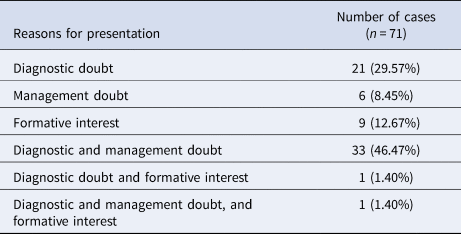
In the analysis of the reason that led to the case to be presented in telemedicine, we had to discard a case because reason was unknown (only showed photographic images of X-rays). Of the seventy-one cases included in this analysis, thirty-three (46.47 percent) cases were presented due to doubts in the diagnosis and therapeutic management. In fact, only in six (8.45 percent) cases, the motivation of telemedicine was purely therapeutic. One of the cases was a patient with recent diagnosis of miliary tuberculosis and HIV infection. Two cases presented doubts in the antituberculous therapeutic management in patients with confirmed pulmonary tuberculosis. One case presented a therapeutic doubt in a patient with blindness, and another case was a patient previously presented in another telemedicine session as a diagnostic doubt. The summary of the reasons for telemedicine is given in Table 1.
Reasons for Presenting the Cases in Telemedicine Sessions (Seventy-One Cases)

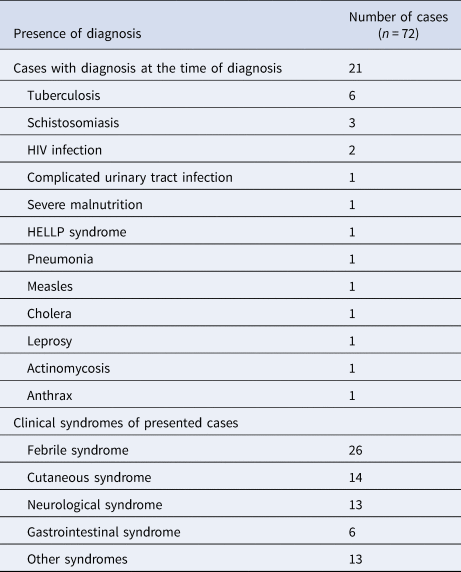
At the time of presentation, twenty-one (29 percent) of the patients were already diagnosed, twenty of whom with infectious disease diagnosis (95 percent). Twenty-six (36 percent) telemedicine cases were patients with a febrile syndrome, fourteen (19 percent) were cutaneous syndrome, and thirteen (18 percent) a neurological syndrome. More information is given in Table 2.
Clinical Information and Diagnosis of the Cases (Seventy-Two Cases)

It is important to note that nine (12 percent) of the telemedicine sessions were motivated exclusively by training interest: three cases of Schistosoma haematobium infection, one case of measles, one case of cholera, one case of leprosy, one case of actinomycosis, and one case of anthrax. Of the three cases of S. haematobium infection, two presented photographic images showing the “Swimmer's dermatitis” of the acute infection in two European voluntary health workers. The case of measles was one of the first cases of the outbreak of measles suffered in Cubal in 2013. The same situation was experienced months later with a possible case of cholera presented in a telemedicine session that helps to unveil the cholera outbreak in Cubal and to inform public health authorities.
Discussion
The present study describes seventy-two cases presented in telemedicine sessions between HNSP and VHUH hospitals over a period of 4 years (2011–14). Approximately half of the cases corresponded to pediatrics cases, and the main reason for the presentation was to resolve doubts regarding the diagnosis or management of the patient. The population under 15 years was 48 percent, and 95 percent of cases presented had an infectious disease. These data are in accordance to the Demographic and Health Indicators of Angola, where 47.3 percent of the Angolan population is less than 15 years and 96.3 percent of the morbi-mortality is produced by infectious diseases (11;12).
The HNSP presents the peculiarity that, despite being a hospital with more than 300 beds, only has one licensed doctor to take care of this large volume of patients. This precarious situation is partially compensated by qualified nursing staff trained for diagnosis and treatment, but without proper qualifications. This fact possibly influences that 46 percent of the cases were presented for diagnostic doubts and therapeutic management. Those presented exclusively because doubts regarding therapeutic management (8.45 percent) were focused in the management of antituberculous and antiretroviral treatment. These data do not differ from the pathology treated in the HNSP, reference national hospital in these two diseases, with 827 patients diagnosed with tuberculosis and 606 in active treatment of HIV in 2016 (14). As we mentioned previously, despite the scarcity of university education, only 13.88 percent of the sessions did not have a classical clinical history structure. This may be due to the influence of doctors from different nongovernmental organizations or volunteers that had collaborated since the HNSP foundation.
An important aspect in any project is its viability. In the study published in 2014 by Ndlovu et al., the quality and cost-effectiveness were evaluated. This study was conducted in four hospitals in Botswana, where a pilot telemedicine project was implemented. The results showed such high effectiveness that the Ministry of Health approved the application of the project throughout the country (Reference Ndlovu, Littman-Quinn, Park, Dikai and Kovarik4). A similar situation is shown in the report submitted to the Ministry of Health of Cape Verde, by Artur Correia, on the benefits and weaknesses of telemedicine carried out between the cardiology service of the Hospital de Praia and the Hospital de Coimbra (Portugal) (Reference Correia, Azevedo and Velez-Lapão5). This report was used to approve a project in Cape Verde funded by the Slovenia Government that would cover the application of telemedicine in the fields of electrocardiography, teleradiology, and ultrasound.
In fact, the telemedicine sessions between the two hospitals started years ago than indicated in the present study. They were asynchronous telemedicine, via email, between the Spanish doctors of the HNSP and the staff of the HUVH Infectious Unit. The sessions were carried out with the same objective, questions of clinical management of patients admitted to HNSP. According to this continuous communication between the staff of both hospitals and with the intention of involving the rest of the healthcare staff, the telemedicine sessions presented in our study arise, are developing.
Like all the beginnings, this was also complicated, especially due to the low quality of the HNSP Wi-Fi connection, one of the main problems of the telemedicine sessions that continues to take place today. Once these sessions were included in the work plan of the staff of both hospitals, their continuity has been maintained to date. Similar initiatives have been carried out in Angola, the PEDITEL Project and the RAFT Project, both of which had to be suspended due to maintenance reasons and the lack of economic funds in their continuity (Reference Pedro de Oliveira9). We must emphasize that in our study, the necessary technologies, such as the computer, the free access Skype platform, and the internet connection, were already available and did not imply an overstrain for either hospital. The limitation of the Wi-Fi connection has forced, even in our days, to have to interrupt sessions already started without being able to end them or even must suspend them before the start.
The present study does not have the objective of quantifying the benefit of these sessions, for this a study with methodology would be needed. Our study aims to reveal the experience of a synchronous telemedicine between two hospitals with quite different realities but that can complement each other. The purpose, which we can subjectively extract, is its formative interest, the capacity for the staff of both hospitals. And also, to provide benefits in the clinical management of patients admitted to the HNSP, which is another benefit of sessions. It is always presented an open character in the discussion of the cases by the staff of both hospitals, reflecting bidirectional training for both staff.
The study has some limitations that have to be mentioned: difficulties with internet access which sometimes delayed or made not possible the realization of the session, lack of information in the presentations, and lack of information regarding the outcome of the cases. Moreover, we could not collect information from those cases presented without any text or image support. The objective of the study is to show an experience of several years and that making it keep on today and that could be the starting of another type of study where the utility and benefit of these sessions for both hospitals are evaluated.
In summary, our study shows a photograph of synchronous telemedicine sessions, through a free platform, between two hospitals with different realities and separated by distance, the HNSP (Angola) and the HUVH (Spain). Despite its technical difficulties, synchronous telemedicine can be maintained over time and offers the opportunity to train healthcare workers from distant hospitals connected by their vocation in medicine.
Funding
This research received no specific grant from any funding agency in the public, commercial, or not-for-profit sectors.
Conflict of Interest
The authors declare that they have no conflict of interest.