The purpose of formulating a probiotic starter culture involves selecting and optimizing combinations of strains in addition to producing a fermented probiotic-containing milk with a high degree of sensory acceptability.
Kefir, a fermented milk beverage with probiotic properties originating and widely consumed in the Caucasus region as well as in Eastern Europe, is a source of bacteria with potential probiotic properties. Kefir grains, used as starters for cultures, consist of a matrix of polysaccharides and proteins containing a complex mixture of lactococci, lactobacilli, acetic-acid bacteria, and yeasts that are found in symbiotic association. Kefir-fermented milk has immunomodulatory (Vinderola et al. Reference Vinderola, Perdigón, Duarte, Thangavel, Farnworth and Matar2006; Hong et al. Reference Hong, Chen, Chen and Chen2009) and antioxidant action (Güven et al. Reference Güven, Güven and Gülmez2003; Liu et al. Reference Liu, Chen and Lin2005), lactose-reducing metabolic effects (Hertzler & Clancy, Reference Hertzler and Clancy2003), and antagonistic activity against spore germination and the growth of toxigenic strains of Bacillus cereus (Kakisu et al. Reference Kakisu, Abraham, Perez and De Antoni2007).
Several microorganism isolated from kefir have probiotic properties. Certain strains of Lactobacillus. kefir have protective effects against Salmonella enterica serovar Enteritidis invasion (Golowczyc et al. Reference Golowczyc, Mobili, Garrote, Abraham and De Antoni2007). Lb. plantarum CIDCA 83114, isolated from Argentine kefir grains, is beneficial because that strain avoids the damage induced by enterohaemorragic Escherichia coli on the Hep-2 cell-culture model. This strain minimizes the morphological alterations and F-actin rearrangements induced by Esch. coli in such cultured cells and thus prevents their detachment. The protection against Esch. coli could be attributed to the production of metabolic signals by the eukaryotic cells as a consequence of the adhesion of the lactobacilli (Hugo et al. Reference Hugo, Kakisu, De Antoni and Perez2008).
Kluyveromyces marxianus CIDCA 8154, a potentially probiotic kefir yeast, exhibits a capacity to inhibit the innate response of the intestinal epithelium triggered by different proinflammatory pathways through a mechanism dependent on necrosis factor-κB modulation (Romanin et al. Reference Romanin, Serradel, González Maciel, Lausada, Garrote and Rumbo2010). Moreover, Echeverría et al. (Reference Echeverría, Garrote and De Antoni2007) found that milk fermented with a mixed starter containing Lb. plantarum CIDCA 83114 and K. marxianus that had been incubated at 30°C for 48 h decreased the lactose concentration of the milk to 1 g/100 ml, that value being equivalent to the concentration in commercial delactosed milk. The characteristics of a given microbial starter culture and its optimal conditions for subsequent growth influence those physicochemical properties of a fermented milk that are directly related to that product's sensory attributes.
The aim of the present work was therefore to analyze the physicochemical, microbiological, and sensory attributes of milk fermented with a combination of probiotic Lb. plantarum with Streptococcus thermophilus and/or K. marxianus with reference to the criteria for acceptable fermented milk. In addition, the effectiveness of these starter cultures in antagonizing enterohaemorragic Esch. coli cytotoxin in a cell-culture model was also studied.
Materials and Methods
Strains and culture conditions
Lb. plantarum CIDCA 83114 (Garrote et al. Reference Garrote, Abraham and De Antoni2001), K. marxianus CIDCA 8154 (Romanin et al. Reference Romanin, Serradel, González Maciel, Lausada, Garrote and Rumbo2010), isolated from kefir grains, and Str. thermophilus CIDCA 321 (Perez et al. Reference Perez, De Antoni and Añon1991), isolated from artisanal yogurt starters, were used. Lb. plantarum and K. marxianus were grown in De Man, Rogosa, and Sharpe agar broth (Difco, Sparks, MD, USA) at 30°C. Str. thermophilus was grown in commercial ultrahigh-temperature partially skimmed milk (Sancor, Argentina and Kaiku, Spain) at 37°C. All the strains isolated belong to the culture collection of CIDCA (La Plata, Argentina) and were stored in milk at −80°C.
Esch. coli, a clinical isolate typified as O157:H7 and named as strain 69160, was obtained from Hospital Interzonal de Agudos ‘Sor María Ludovica’ (La Plata, Argentina).
Cell cultures
Vero cells were grown in Dulbecco's Modified Eagle's Minimal Essential Medium (DMEM; Gibco BRL Life Technologies, Rockville, MD, USA) supplemented with: 12% (v/v), heat-inactivated (30 min/60°C) foetal-bovine serum (PAA Laboratories, GmbH, Pasching, Austria), 1% (v/v) nonessential amino acids (GIBCO BRL Life Technologies, Rockville, MD, USA), 12 mg streptomycin/l, and 12 IU penicillin G/ml. Cells were inoculated (2 5×10⁵ cells per well) in 24-well tissue-culture plates (Greiner Bio One, Frickenhausen, Germany) and incubated at 37°C for 48 h in an atmosphere of 5% CO2–95% (v/v) air.
Starter cultures and fermentation conditions
Two starter cultures were separately prepared: one containing Lb. plantarum CIDCA 83114 and Str. thermophilus CIDCA 321, referred to as the two-strain starter culture, and the other containing Lb. plantarum CIDCA 83114, Str. thermophilus CIDCA 321, and K. marxianus CIDCA 8154, designated the three-strain starter culture. Each microorganism was grown under the conditions described previously; stationary-phase cultures of each were harvested by centrifugation at 10 000 g for 10 min, resuspended in the same volume of medium, and finally diluted in a convenient volume of milk.
Both starters were inoculated into milk to reach the following concentration: the two-strain culture contained 108 CFU Lb. plantarum/ml and 107 CFU Str. thermophilus/ml, while the three-strain culture contained those same two strains plus 103 CFU K. marxianus/ml. The milk preparations were then incubated at 37°C, and at different time intervals samples were taken to determine the pH. The acidification kinetic was performed with single cultures of each strain and the readings were measured up to pH 4 5.
The fermented products obtained by incubation at 37°C to a pH of 4 5 were stored at 4°C for 21 days. Immediately after incubation and during storage, samples were removed for the determination of microbial counts, apparent viscosities, and lactose and organic-acid concentrations.
Microbiological analysis
Viable cells were determined by the plate-count method. Lactobacilli counts were performed on De Man, Rogosa, and Sharpe agar medium (Difco, Sparks, MD, USA) at 30°C under aerobic conditions. Streptococci counts were carried out on Lee's agar medium (Lee et al. Reference Lee, Vedamuthu, Washam and Reinhold1974) at 37°C under aerobic conditions. Yeasts were grown on yeast-glucose-chloramphenicol agar medium (Biokar, Beauvais, France) at 30°C under aerobic conditions. All agar plates were incubated for two days. Tryptone (Biokar, Beauvais, France) at a concentration of 1 g/l was used to prepare the dilutions for the microbiological analysis.
Cytotoxicity assays
The potential probiotic effect of these starter cultures was evaluated by analyzing the antagonism against enterohaemorragic–Esch. coli–shiga-toxin cytotoxicity on surface-cultured Vero-cells. Crude supernatants of Esch. coli were prepared in the following manner: The clinical isolate of Esch. coli was grown in tripticase-soy broth (LW, Córdoba, Argentina) under aerobic conditions at 37°C for 18 h. The cultures were centrifuged at 10 000 g for 10 min and filtered through 0 45 μm (Millipore, Bedford, MA, USA) to obtain the Esch. coli-supernatant fractions used for these cytotoxicity studies. To investigate the dose-response of the shiga toxin, different dilutions of toxin-containing bacterial supernatants in DMEM were used. Cytotoxicity was evaluated by the determination of extracellular lactate dehydrogenase (LDH) activity as a measure of cell damage. For these studies, confluent cultures of Vero cells were inoculated with a mixture of Esch. coli supernatant and the test microorganisms, with the latter being included in the medium either as mixed or individual starter cultures. The microorganisms for inoculation were obtained by centrifugation at 10 000 g for 10 min with the pellet being initially resuspended in the same volume of phosphate-buffered saline and then diluted appropriately in DMEM.
The tissue-culture plates were incubated at 37°C in 5% CO2-air for 48 h. The assays were done in duplicate. LDH was determined in the cell-free supernatant medium of each well by a commercial kit (Wiener Lab, Rosario, Argentina) in which NADH+H+ concentration was measured by optical density at 340 nm in a spectrophotometer (Beckman DU 650, Palo Alto, USA). The total concentration of LDH per well was determined after lysis of the monolayer with 3% (v/v) Triton X-100 (Sigma Chemical Co, St. Louis, MO, USA). The percentage of viable cells was calculated as ODs/ODc×100, where ODs and ODc were the absorbance of the sample and the control, respectively, at 340 nm. At least three independent experiments were performed for each condition.
Physicochemical analysis
Measurements of pH were performed with a combined glass-calomel electrode coupled to a pH meter from Crison GLP 22 (Barcelona, Spain).
Lactose determinations in the fermented milk were carried out by an enzymatic method (International Dairy Federation, 1991) through the use of a ß-galactosidase UV kit (R-Biopharm GmbH Damstadt, Germany). The increase in NADH+H+ is measured spectrophotometrically by absorbance at 340 nm.
Organic acids were determined both qualitatively and quantitatively by high-performance liquid chromatography according to Lombardi et al. (Reference Lombardi, Bevilacqua and Califano1994). Lactic and acetic acids were separated on an AMINEX HPX-87H ion-exchange column (Biorad Labs, Richmond, CA, USA) with the organic acids being monitored with a 214-nm detector (Waters™ 996, Millipore Corporation, Milford, MA, USA). Acid identification was based on matching the retention times with a run containing standard acids. An aliquot of each fermented product was centrifuged at 10 000 g for 10 min. The resulting supernatants were filtered through a 0 45 μm nitrocellulose filter (Millipore, Bedford, MA, USA). Ten μl of the resulting filtrates were injected into the chromatograph (Waters™ 717, Millipore, Milford, MA, USA). The acids used in the standard mixture were HPLC grade (Sigma Chemical Co., St. Louis, MO, USA). All solvents had been previously degassed under vacuum.
The apparent viscosity (ηapp) of the fermented products was measured with a coaxial-cylinder viscometer (Haake Viscotester VT550, Karlsruhe, Germany) with a NV sensor system. Ten millilitres of the fermented milks were deposited into the viscometer. During the testing, the temperature of the samples was maintained at 30°C by a circulating water bath connected to the jacket surrounding the sensor system. The flow curves were obtained by increasing the shear rate from 0 to 300 s−1 within 2 min, maintaining the level for 1 min at the maximum, and then decreasing the shearing from 300 to 0 s−1 within 2 min. The ηapp was calculated in the up-curves at 300 s−1 and expressed as millipascals per second (mPa s).
All physicochemical determinations were performed in triplicate with independent samples.
Sensory analysis
All sensory assays were carried out at the sensory laboratory of the Public University of Navarre, in a tasting room designed to fulfil the requirements stipulated by the International Standards (ISO 8589, 2007) consisting of an area for the preparation of the samples along with seven separate isolation cabinets for the panellists with controlled humidity and luminosity. Sensory analyses were performed with Kaiku partially skimmed milk.
During the evaluation, each panellist was situated in an individual booth under incandescent light of intensity approximately 350 lx. Tap water was provided between samples to rinse the palate. Transparent plastic cups with 50 ml fermented milk at 10°C were provided, and a maximum of six samples were evaluated in each session. Samples were coded by three-digit numbers and given to the panellists in aleatory fashion. The order of sample evaluation was randomized for each panellist and was presented in such a manner that the panellist could not identify the sample. For sensory analysis, milk samples fermented with two-strain and three-strain starter cultures were taken either directly after fermentation at pH 4 5 or after storage at 4°C for 2, 7, 14, or 21 days. The samples were analyzed in triplicate by at least seven assessors trained in evaluating dairy products that had been selected according to the International Standards (ISO 8586, 2008) and belonged to the trained panel accredited by Entidad Nacional de Acreditación (ENAC) according to ISO 17025 (2005). These panellists had been previously trained with similar commercial fermented products (e.g. yogurt, milk fermented with Bifidobacteriun bifidum or with Lb. casei) in four sessions in order to define the 25 specific attributes according to the International Standards (ISO 6564, 1985; ISO 4121, 2003; ISO 22935-1: 2009; ISO 22935-2: 2009; ISO 22935-3: 2009). Among the attributes initially defined, only 14 were considered in this study: viscosity, odour intensity, fermented odour, milky odour, and other odours; flavour intensity, milky flavour, fermented flavour, other flavours; taste intensity, bitter taste, sour taste, milky taste; astringency; and acceptability. Each attribute was scored on an increasing scale of from 1 to 7:1 (not present), 2 (very weak), 3 (weak), 4 (moderate), 5 (strong), 6 (intense), 7 (very intense). The trained assessors were asked to qualify acceptability on an increasing scale from 1 to 5:1 (unacceptable), 2 (scarcely acceptable), 3 (acceptable), 4 (quite acceptable), 5 (very acceptable).
Statistical analysis
Physicochemical and microbiological variables were analyzed by the Student t-test at a 95% confidence level (i.e. P<0 05).
Analysis of variance (ANOVA) at 95% confidence intervals was run on each of the sensory variables in order to reveal possible differences among the samples with respect to the variable of storage time. Analysis of variance was performed with the SPSS statistical package version 15.0 (SPSS Inc., Chicago, IL, USA). Pearson's correlation analyses were carried out for the different sensory attributes evaluated. Differences in sensory acceptability were determined by Fisher's least significant difference (LSD) mean discrimination test, using P⩽0 05 as level of significance.
Results
Protective effect of the two- and three-strain starter cultures against Esch. coli-supernatant cytotoxicity
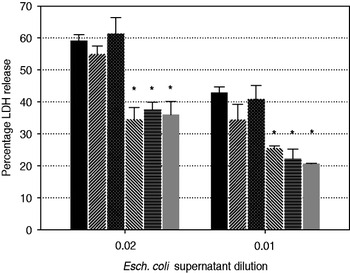
Cytotoxic activity of Esch. coli supernatant fractions were assayed on Vero cells by the determination of intracellular LDH release as a marker of changes in membrane permeability. As evidenced by the release of LDH, the cytotoxic effect was higher at higher concentrations of supernatant (Fig. 1). Single-starter cultures of Lb. plantarum CIDCA 83114 decreased LDH release, thus manifesting a protective effect; but neither Str. thermophilus CIDCA 321 nor K. marxianus CIDCA 8154 exerted a similar antagonic action.
Cytotoxic action of different doses of Esch. coli supernatant on Vero cells in the presence of two- and three-strain starter cultures. Cell damage was determined by the release of lactate dehydrogenase (LDH). Esch. coli supernatant ( ); Esch. coli supernatant previously incubated with Str. thermophilus CIDCA 321 (
 ); Esch. coli supernatant previously incubated with K. marxianus CIDCA 8154 (
 ); Esch. coli supernatant previously incubated with Lb. plantarum CIDCA 83114 (
 ); Esch. coli supernatant previously incubated with three-strain starter culture (
 ); Esch. coli supernatant previously incubated with two-strain starter culture (
 ). (*) Significant difference (P<0 05) between LDH liberated by Vero cells incubated with Esch. coli supernatant with or without treatment.

When the assay was performed in the presence of the two- or the three-strain starter cultures, the decrease in LDH release was similar to that seen with Lb. plantarum. This result would imply that that protective effect exerted by the two-strain and the three-strain starter cultures is produced by the Lb. plantarum present per se and is not modified by the other two microorganisms.
Physicochemical and microbiological characterization of the fermented milks
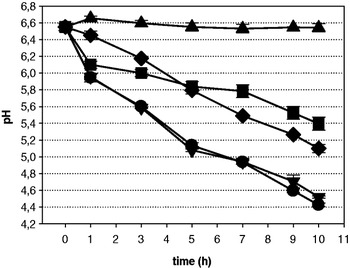
Figure 2 shows the acidification kinetics of milk at 37°C with single and mixed cultures. Single-starter cultures of Str. thermophilus CIDCA 321 produced a rapid decrease in pH, reaching a value of 5 1 after 10 h of incubation. Lb. plantarum CIDCA 83114 exhibited a lower acidification rate than did the streptococci, while K. marxianus CIDCA 8154 caused no acidification of milk under these conditions.
Acidification kinetics of milk fermented with single cultures and with two- and three-strain starter cultures at 37°C. Milk fermented with: Str. thermophilus CIDCA 321(◆), Lb. plantarum CIDCA 83114 (▪), K. marxianus CIDCA 8154 (▲), two-strain starter culture (●) and three-strain starter culture (▼).

When a mixed culture with Lb. plantarum CIDCA 83114 and Str. thermophilus CIDCA 321 in combination was used, the acidification rate of the fermented milk was higher than the one obtained with the single strains. The same rate was obtained when K. marxianus CIDCA 8154 was included in the starter culture, indicating that the presence of the yeast did not modify the acidification activity of the two bacterial strains.
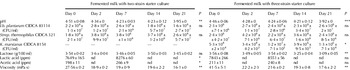
Table 1 summarizes the microbiological and physicochemical characteristics of both fermented products. When either of the mixed starter cultures was used, the fermented milk reached a pH of 4 5 after 10 h (Day 0, Table 1 & Fig. 2). The concentration of Str. thermophilus and K. marxianus increased in the final product by 1 log unit each with respect to the initial concentration, the former from 7 to 8 log units and the latter from 3 to 4 log units. In contrast, Lb. plantarum maintained its initial concentration (at 8 log units) during the entire fermentation. Therefore, the viability of these strains was not affected by low pH. The lactose concentration in the milk fermented with either starter was 3 5 g/100 ml (Day 0, Table 1), thus indicating a reduction in the lactose concentration in the milk of 29% during the fermentation. The lactic- and acetic-acid concentrations were similar in the two fermented milks, with the concentration of lactic acid being 10 times higher than acetic acid in either (Day 0, Table 1).
Changes in physicochemical and microbiological values in the fermented milks using two- and three-strain starter cultures

nd, non-determined; ns, non-significant. *P<0 05, **P<0 01, ***P<0 001
The apparent viscosity at 300 s−1 (ηapp expressed as mPa s) was determined at 30°C. The milk fermented with the two-strain starter culture presented a ηapp of 27 mPa s, while the milk fermented with three-strain starter culture showed a higher value, at ηapp of 41 5 mPa s (Day 0, Table 1).
Physicochemical and microbiological assays were performed in both brands of milk and no differences were observed between them.
Physicochemical and microbiological changes in the fermented milks during storage
As is shown in Table 1, the number of viable bacteria, at 108 CFU/ml for Lb. plantarum and Str. thermophilus in either fermented milk did not change during storage. The yeasts, however, were able to grow in the fermented milk with the three-strain starter culture from 5 3×10⁴ to 3 9×10⁶ CFU/ml after 14 days of storage at 4°C, while the acidity of both fermented milks increased slowly from a pH of 4 5 to one of about 3 9 after 21 days. The lactose concentration of the two fermented milks exhibited no significant changes during the first 7 days of storage, but thereafter, in the milk fermented with the three-strain starter culture, decreased gradually to a value 38% below the initial concentration.
The apparent viscosity of the milk fermented with the two-strain starter culture decreased from 27 mPa s to 16 1 mPa s, whereas that of the milk fermented with the three-strain starter culture dropped from the more viscous state of 41 5 mPa s down to a comparable value 17 6 mPa s.
Analysis of the sensory properties of the fermented milks
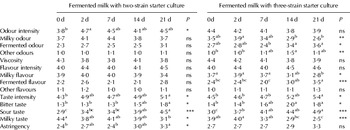
Table 2 shows the sensory analyses for both freshly fermented samples. The assessors trained in evaluating fermented dairy products did not detect differences in the selected sensory attributes of the two fermented milks.
Mean odour-, flavour-, texture- and taste-attribute values of fermented milks made with two- and three-strain starter cultures
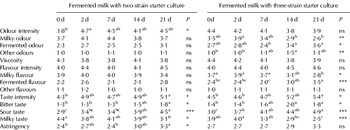
ns, non-significant. *P<0 05, **P<0 01, ***P<0 001
For each fermented milk, different superscripts in the same row indicate significant differences between the mean values
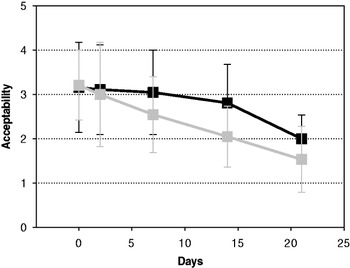
As a result of this unanimous acceptability – with both fermented milks having qualified with a minimum value of 3, in a hedonic scale from 1 (unacceptable) to 5 (very acceptable) – the two fermentation products passed judgement in this analysis (Fig. 3). The milk fermented with the two-strain starter culture was deemed acceptable after two weeks of storage, while the product obtained with the three-strain starter culture was judged as acceptable for less than a week (P⩽0 05).
Acceptability of fermented milk with two- (▪) and three-strain starter cultures ( ) after storage at 4°C.

The main changes in the sensory attributes during storage as detected by the trained panel were the increase in sour taste and the decrease in milky taste in the milk fermented with the two-strain starter culture (Table 2). The astringency and taste intensity were rated as significantly different during storage.
The analysis of the milk fermented with three-strain starter culture revealed that the changes in the perceptual attributes that were the most salient after storage were increases in sour taste, fermented odour, and fermented flavour. The assessors also detected a decrease in milk-associated attributes (odour, taste, and flavour), but did not detect differences in the attribute of viscosity (Table 2), though the physical measurements had indeed indicated decreases in the measured viscosity during storage (Table 1).
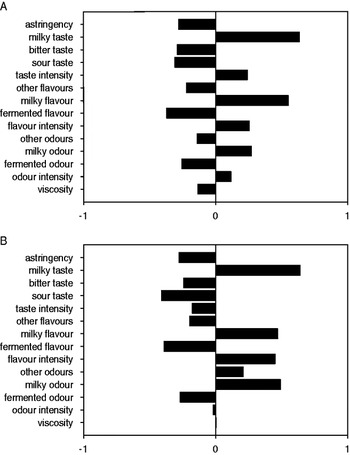
The correlation between different sensory attributes and acceptability (Fig. 4A, B) indicated that the panel was positively influenced by milky attributes (taste, odour, and flavour) as well as by flavour intensity. In contrast, a fermented odour or flavour or a sour or bitter taste affected the general acceptability of the fermented products negatively.
Correlations between acceptability and sensory attributes (A) fermented milk with two-strain starter culture. (B) Fermented milk with three-strain starter culture.

Discussion
Lb. plantarum CIDCA 83114 with its protective effect against enterohaemorragic Esch. coli, is a promising strain to include in fermented milk products. This protective effect observed in culture is maintained in the presence of Str. thermophilus CIDCA 321 and K. marxianus CIDCA 8154, a result that prompted us to study the possibility of preparing a fermented milk containing this potential probiotic strain included in the starter-culture mixture (either as a two- or a three-strain starter culture). The inclusion of K. marxianus CIDCA 8154 was also of interest because this yeast has been shown to exert a down-regulated immune response to proinflammatory stimuli in epithelial cells. The capability to reduce the cell activation induced by inflammatory agent is a positive effect in the control of gut homeostasis (Romanin et al. Reference Romanin, Serradel, González Maciel, Lausada, Garrote and Rumbo2010).
The use of two-strain and three-strain starter cultures improved the acidification rate of the milk, a property that is an advantage for application to industrial fermentation.
Maintaining the viability of Lb. plantarum CIDCA 83114 after fermentation and storage at 4°C is an extremely significant characteristic for the development of a probiotic milk since a minimum concentration of a given probiotic strain is required to exert its health-promoting effect, another encouraging results within the context of using these strains for the industrial production of fermented milk.
During the storage of the milk fermented with the three-strain starter culture, the yeast concentration increased. The yeast growth was also related to a decrease in the lactose concentration, probably as a result of the fermentation of the sugar. By contrast, the lactose concentration of the milk from the two-strain starter culture was not modified during storage, though an increase in the organic acids was observed. Changes in lactic acid concentration without significant changes in lactose concentration may be due to the low detection limit of the method used in this work to quantify this sugar.
The milk fermented by the two strain-starter culture had a lower viscosity than that of the product from the three strain-starter culture. The apparent viscosity of an acidic-milk gel is related, among other properties, to the production of exopolysaccharides by the starter culture. Some strains of Str. thermophilus are able to produce high-molecular-weight polysaccharides. Since Str. thermophilus CIDCA 321 produces an acidic gel with a low viscosity that increases with the addition of a supernatant fraction of Lb. delbrueckii subsp. bulgaricus (Moreira et al. Reference Moreira, Abraham and De Antoni2000), the same effect could be occurring with the co-cultivation of Str. thermophilus CIDCA 321 with K. marxianus in the milk fermented by the three-strain starter culture. In this regard, Cheirsilp et al. (Reference Cheirsilp, Shimizu and Shioya2007) demonstrated that the growth and exopolysaccharide-production rate of Lb. kefiranofaciens are significantly enhanced in a mixed culture with Saccharomyces cerevisiae compared with those parameters in a pure culture.
In rheological analysis, the apparent viscosity of both fermented milk products decreased significantly during storage in association with a decrease in pH. A low acidity in acidic-milk gels unfavourably influences the consistency at pHs below 4 6 because of insufficient protein hydration (Rasic & Kurmann, Reference Rasic, Kurmann, Rasic and Kurmann1978).
Trained assessors considered the fresh fermented milks obtained with the two- and three-strain starter cultures to be sensorially acceptable and described both fermented products as having a prevalence of milky attributes. Sensory tests, however, demonstrated that the milk fermented with the three-strain starter culture did not exhibit a desired acceptability after storage in the cold under standard conditions, a result that was associated with a high concentration of K. marxianus in the fermented product. Nevertheless, Beshkova et al. (Reference Beshkova, Simova, Simov, Frengova and Spasov2002) had prepared a fermented milk that did maintain a sensory acceptability for one week at 4°C after including in the starter culture a yeast that did not ferment lactose.
In the present work, the main difference between both starters was the presence of K. marxianus. The principal changes in the fermented odour and fermented flavour detected in this product could be attributed to the metabolic activity of the yeast with respect to the production of alcohol and other volatile compounds (diacetyl, acetaldehyde, 2-propanol, 2, 3-methylbutanol and 2, 3-methylbutanal) that could be responsible of the final unacceptability and short shelf life (Beshkova et al. Reference Beshkova, Simova, Frengova, Simov and Dimitrov2003; Álvarez Martín et al. Reference Álvarez Martín, Flórez, Hernández Barranco and Mayo2008; Cais-Sokolińska et al. Reference Cais-Sokolińska, Danków and Pikul2008).
Between both fermented milk, the one obtained from two-strain starter culture would be the more promising alternative for inclusion of the potential probiotic Lb. plantarum CIDCA 83114 in a fermented milk product. Considering that this product is formulated without additives, it is relevant that it was considered acceptable for at least two weeks. Although the yeast could improve the health claim of the product, the benefits of adding the yeast may be overridden by the short shelf life.
The authors acknowledge Consejo Nacional de Investigaciones Científicas y Técnicas (CONICET, Argentina), Agencia Nacional de Promoción Científica y Tecnológica (ANPCyT, Argentina), Programa Iberoamericano de Ciencia y Tecnología para el Desarrollo (CYTED), Universidad Nacional de La Plata (UNLP, Argentina) and Universidad Pública de Navarra (Pamplona, Spain). E. J. Kakisu is a postdoctoral fellow from CONICET, A. G. Abraham is member of the Carrera de Investigador Científico y Tecnológico of CONICET, and G. L. De Antoni is researcher of the Comisión de Investigaciones Científicas de la Provincia de Buenos Aires (CIC-PBA). P. Torre and A. Irigoyen are professors of the Universidad Pública de Navarra. We wish to thank Dr Donald F. Haggerty, a retired career investigator and native English speaker, for editing the final version of the manuscript.