London’s dramatic growth from a marginal northern European city to a global metropolis was one of the distinctive transitions in early modern history. The city’s expansion was underpinned by a complex of factors, but ultimately it depended on the movement of a large number of people from the countryside to the town.Footnote 1 One of the most significant mechanisms facilitating the migratory flow into London was apprenticeship. London’s field of attraction was vast. Between 5 and 10 percent of English teenaged males entered apprenticeships in London in the seventeenth century.Footnote 2 Apprenticeship’s demographic importance was matched by its economic significance in reproducing the skilled work force of the nation’s largest center for manufacturing and trade, while the number and potential disorderliness of London’s apprentices made them a political and cultural force to be reckoned with.Footnote 3
Yet apprenticeship in London, and England more generally, had a forbidding aspect that is easily overlooked. A London apprenticeship was costly, long, and unstable. Youths entered much longer terms of service than their peers on the continent.Footnote 4 The minimum term of seven years allowed little adjustment for prior skills or ability. To enter the more profitable trades, apprentices often paid a substantial fee to their master.Footnote 5 Moreover, the outcome was uncertain: fewer than one in two of those who entered apprenticeships would become freemen of the city, able to establish businesses and take apprentices of their own.Footnote 6 For masters, the likelihood that apprentices would leave before completing their indentures presented its own problems: if apprentices quit, masters could not offset any early investment in training and maintaining them against their skilled labor in the latter part of their term.Footnote 7 The high costs and substantial risks involved in apprenticeship were surely accentuated by the isolation and youth of the apprentices: most came from homes far from the city, and they rarely had prior ties of kinship or connection to their masters before entering service.Footnote 8
The fact that thousands of youths became apprentices each year makes it clear that in many cases these problems were overcome, but it does not explain how this was achieved. For an explanation, some economic historians have emphasized the importance of contract enforcement mechanisms, both formal, such as guilds and city authorities, and informal, such as the reputational costs of quitting.Footnote 9 This approach is inspired by a wider literature on contractual problems in modern training. The uncertainties that beset early modern apprenticeship were an extreme example of the problems of asymmetric information and incomplete contracting observed in modern training, which are often overcome through additional incentives and monitoring.Footnote 10 Social historians of youth have drawn parallel conclusions, arguing that the broad strategy of guild and city institutions faced by disorder in early modern households was to “heal the rift,” as Paul Griffiths puts it, returning master and apprentice to their appropriate place.Footnote 11
This article describes a very different, and entirely neglected, side of apprenticeship in London: the city’s system of contract dissolution. I suggest that easy dissolution played a vital role in sustaining apprenticeship in London and that it was apparently echoed in a weaker form elsewhere in England. Contract dissolution was, it must be emphasized, normal. Metropolitan apprenticeships frequently ended prematurely. Many apprentices left their master during their contracted term of service, often after only a few years of service.Footnote 12 Premiums offered some compensation for the risk of departure: apprentices likely to leave paid more.Footnote 13 Even without premiums, masters could avoid losses by balancing apprentices’ work and training.Footnote 14 But alongside these private solutions ran a public system, which is uncovered here for the first time.
The city of London possessed a formal institutional process in the Lord Mayor’s Court that gave apprentices a simple, cheap, and effective means to cancel contracts and then to recover a proportion of their financial investment in training. The court rebalanced the asymmetries of power involved in apprenticeship. It reduced the risks taken in entering training contracts in which prospective masters and apprentices had limited information about each other or about future conditions that might affect their capacity to work or train. The activities of the court profoundly alter our interpretation of the effects of formal contract enforcement mechanisms on apprenticeship in this period. That the city’s institutions played a major role in facilitating apprentices’ exit from their indentures seriously complicates earlier views of institutions as agents of enforcement in apprenticeship, and it draws our attention away from the work of the guilds in this sphere. The court’s activities imply the operation of a different economic model of training to that normally imputed to apprenticeship, one that can accommodate premature ending of contracts.Footnote 15 They alter our understanding of the political and social character of the city and its institutions, locating apprenticeship far closer to accounts of order based on negotiation and accommodation than has been traditional in analyses of the formal rules of service.
Explaining the success of early modern apprenticeship through its mechanism for exiting contracts may seem perverse. Histories of labor and contract generally focus on the relative unfreedom of labor, not its agency, before the late nineteenth century. Apprenticeship in England was regulated by the Statute of Artificers (1562), which was the foundation of a relatively rigid and exploitative labor market that later statutes intensified and which applied London’s standard terms of apprenticeship to the nation at large.Footnote 16 The statute’s rules tied labor into subordinate positions. Legally, serving an apprenticeship became a requirement for entering many occupations. Masters could use the law to arrest apprentices who broke contracts, and they applied these remedies heavy-handedly in the early nineteenth century, while apprentices, servants, and other employees had far more limited powers to seek redress or leave their employers.Footnote 17
Yet the applicability of an oppositional model based on domination and subordination to preindustrial, nonpauper apprenticeship is unclear. Before the nineteenth century, apprentices and servants found a more balanced audience among justices of the peace, who had been given the responsibility for hearing complaints from apprentices who were misused by their masters in the Statute of Artificers.Footnote 18 London apprenticeship in particular had distinctive characteristics that suggest an alternative interplay of power and influence. Apprentices were often from gentry or wealthy families and represented substantial investments.Footnote 19 They were the sons of their masters’ peers, sometimes of their social superiors. Although formally subject to their master’s patriarchal authority, they and their families possessed voice and agency.Footnote 20 If we sought a modern parallel for early modern metropolitan apprenticeship, it would be in mass higher education, not blue-collar apprenticeship. And like today’s university students, apprentices sometimes discovered they had made bad choices and demanded a way out. While this realization might be motivated by anything from the appearance of a more attractive alternative, such as marriage, to a violent clash with their master, in London the outcome converged toward two pathways. If the apprentice and his master agreed to satisfactory terms, the indenture could end privately. If not, then they could turn to the Lord Mayor’s Court.
Apprenticeship and the City Courts
The Lord Mayor’s Court was the hub of London’s system for apprenticeship dissolution. Held in the outer chamber of the Guildhall, with the city recorder officiating, the Mayor’s Court had both a common law and an equitable jurisdiction. Among the city’s courts, it was the main court for cases involving city customs. It oversaw the discharge of apprentices from their contracts, as did justices of the peace elsewhere, hearing “any cause … between a master and his apprentice, bound according to the custom of the city of London, which intitles the apprentice to his discharge.”Footnote 21 Under statute, it also heard suits from any mariner’s apprentice.Footnote 22 Above it stood the Court of Aldermen. Until the 1640s, some apprenticeship suits occasionally appeared in this higher court to halt proceedings in the Mayor’s Court or to deal with equity issues, but the approach of the Court of Aldermen echoed that of the Mayor’s Court.Footnote 23
At first sight, we might expect the Mayor’s Court to serve as a place of last resort, settling hard cases but shielded from most disputes. As Griffiths describes, powerful pressures for the reconciliation of masters and apprentices operated through various agencies.Footnote 24 Both apprentices and masters could turn to family and friends to intervene. William Palmer’s mother paid £14 to his master for fabric and rings he had stolen so he could reenter service.Footnote 25 In 1656, Edward Mundey’s father traveled 150 miles to London to persuade his master to keep Edward.Footnote 26 Private arbitration was widely used, with each side nominating a representative.Footnote 27 Livery companies also arbitrated disputes and chastised masters or apprentices, seemingly with the intent that apprenticeships should persist.Footnote 28 The city chamberlain heard complaints by masters and apprentices in his court at 3 shillings a time, as did justices of the peace outside the city.Footnote 29 The chamberlain had often been involved in disputes before they reached the Mayor’s Court, generally urging reconciliation.Footnote 30
If apprentices and masters reached an agreement to end their contract, they would avoid the Mayor’s Court. In English law, ending an apprenticeship consensually required no external agency to register the process. Similarly, if both parties consented, apprentices could be turned over to new masters to serve out the remainder of their term without the involvement of the court, although in London transfers were required to be enrolled with the chamberlain and relevant guilds. Consensual discharges are occasionally described in later suits. For example, Nicholas Greene described his apprentice asking to leave his service: for “mere Love” Greene “did then deliver up … his parte of the said indentures”—although they later fought over returning the premium.Footnote 31
However, the potential for private resolution needs to be set against the centrifugal forces stressing apprenticeships. In the close confines of early modern houses, masters, their families, and apprentices interacted constantly, with few opportunities to escape observation. Apprentices had little control over their situation: their food, lodging, and leisure were determined by their master. While the contract endured, masters too were compelled to accommodate a youth whose idleness, incompetence, or venality they might punish but not prevent. Sickness could make a promising apprentice a burden.Footnote 32 Both the master and the apprentice faced incentives to break their agreement. Masters could duck difficult training or profit from apprentices’ premiums. Apprentices might prefer to earn a wage or serve a different master. A lucky few inherited the wealth to live on; according to his master, Richard Nest’s inheritance allowed him to “leave the citty and settle himselfe in the country.”Footnote 33 Emotion and opportunism could preclude negotiation.Footnote 34
It was in this atmosphere that apprentices turned to the Lord Mayor’s Court when their apprenticeships collapsed and no agreement could be reached with their master over ending the contract. In the Lord Mayor’s Court, indentures could be canceled—and hundreds were each year.
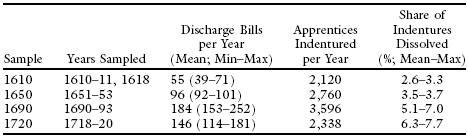
While the court’s records have been explored for evidence about apprentices’ lives, its wider role has not been recognized.Footnote 35 Apprenticeship provided much business to the common law side of the court, although debt suits dominated. Unfortunately, the court’s records are extensive, partial, and fragmented, and the evidence used here reflects this, as is discussed in the appendix. Nonetheless, counts of discharge bills from particular years that survive suggest that from the 1610s to the 1720s at least 3–8 percent of London apprentices entered bills for discharge (table 1). While the apparent rise in the proportion of apprentices who were
Volume of Discharge Bills in the Lord Mayor’s Court
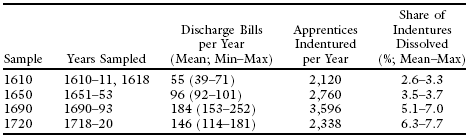
Note The table reports counts of the number of bills initiated in each sample year that were found in the set of archive boxes that chronologically span the sample years: London Metropolitan Archives, CLA/024/02/44/13, 15–17, 19–20, 23, 26, 28–41, 43–46, 59–61, 64, 100–101, 113–14, 116–20, 123, 125–29, 145–46, 148, 261–62, 264–72, 313–20. The estimates of apprentices indentured per year for 1610 and 1650 are extrapolated from the data set of Cliff Webb, London Livery Company Apprenticeship Registers (London, 1994–2011); the 1690 estimate is a linear interpolation between the 1650 estimate and the 1699 total in the London orphan tax records; the 1720 figure is a linear interpolation of the 1699 and 1730 totals in the London orphan tax records. See Chris Minns and Patrick Wallis, “Apprenticeship and Skill in Eighteenth Century England: The Decline of Apprenticeship in London,” paper presented at the World Economic History Congress, Utrecht, 2009. In the last column the range given in share of indentures dissolved is from mean to max bills per year; the minima presented in col. 3 are likely to be undercounts due to partial survival.
discharged may reflect changes in the institution of apprenticeship, this increase could also be an artifact of record survival, as an unknown proportion of records are now lost and losses may be concentrated in the earlier period. More important is the basic impression of the number of apprenticeships ending in the court: given that only around 40 percent of apprentices remained with their original masters and another 10 percent would die, at least one in ten apprentices who left their original master used the court.Footnote 36 This formal legal institution played an important role in ending apprenticeships in the city.
The court saw a fairly representative cross section of London’s apprentices throughout the seventeenth and early eighteenth centuries.Footnote 37 When compared to a matched sample of city apprentices, those entering bills were no more likely to be locals or citizens’ children, as one would expect if social capital mattered in the court.Footnote 38 Female apprentices were rare, but they did appear.Footnote 39 Apprentices entered
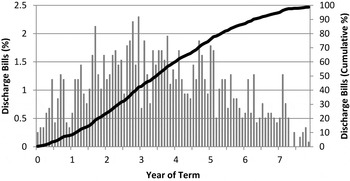
Distribution of discharge bills by point in apprentices’ term of service. Vertical bars report percentage of discharge bills from each month of service (left-hand axis). The cumulative percentage of bills is given by the solid line (right-hand axis). See text for source of information.

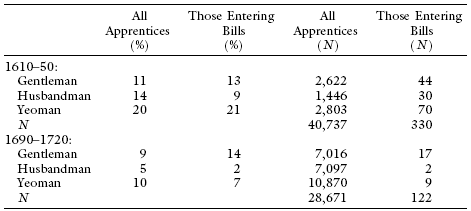
pleas throughout their terms (fig. 1). There was a peak in discharges during the middle years of apprenticeship terms, when apprentices were most likely to depart, but both new and advanced apprentices used the court. Apprentices from wealthy backgrounds were somewhat overrepresented. As table 2 shows, gentlemen’s sons appeared more often, and relatively poorer husbandmen’s sons less, than their share of the population of apprentices would predict. However, the court was certainly not the preserve of the rich. Tailor, butcher, and weaver were among the ten most common parental occupations reported in bills; shoemaker and laborer were among the twenty most common.
Apprentices came to the court from a wide cross section of livery companies, in numbers that generally matched their share of apprentices more generally.Footnote 40 By the end of the seventeenth century, apprentices from the larger, prestigious, and politically important, but less occupationally homogenous, “Great Twelve” companies were underrepresented: concern that apprentices and masters follow the proper legal and contractual processes may have been weakening faster in these companies, something also apparent in noncompletion rates.Footnote 41 The court was heavily used by youths learning relatively low-status trades. Wealthy merchant apprentices did appear frequently, bringing 3 percent of cases. However, the most common four occupations mentioned by apprentices were relatively menial: tailor,
Social Background of Apprentices Entering Discharge Bills Compared to the Population of Apprentices
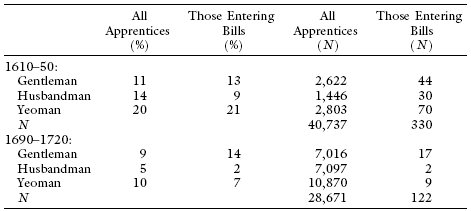
Note Table compares a subsample of apprentices who entered discharge bills, which is limited to apprentices from companies for which full apprentice listings survive. See note 38.
weaver, joiner, and vintner.Footnote 42 These were not trades associated with large premiums or high incomes.
The volume of apprenticeship suits, and their social depth, fits with evidence of intensive litigation over debt and other civil causes in this period.Footnote 43 Apprenticeships ended in the court to an extent we would expect from such a litigious society. This turn to formal institutions was eased by the low costs involved. Entering a plea in the court cost just 4d., and a case could be brought to trial within a fortnight for 30s.Footnote 44
In certain respects, however, apprenticeship cases were unusual. The plea was itself distinctive. Written in French, except during the Commonwealth, the apprentice petitioned the “right honourable mayor and aldermen,” informing them that his master had breached the city’s customs. The apprentice sought to be discharged and committed to another freeman for the residue of his term—the new master was almost never specified and may have never existed. Discharge petitions were brought only by apprentices: Emerson, in his treatise on city law, published in 1794, stated as a rule that application was “always at the instance of the apprentice.” Bills also relied on referring to a limited number of causes. Emerson cited nine “usual” causes: breaches of city rules (apprentices bound under fourteen years old, for fewer than seven years, and not having their indenture enrolled before the chamberlain within the first year of service), breaches of apprentice contracts, particularly mistreatment (“unreasonable” chastisement, lack of food or necessaries, being turned out), and failures in training (masters leaving trades, failing to instruct, or quitting the city).Footnote 45
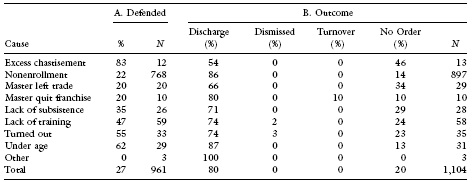
The variety of causes described by Emerson was not reflected in practice, however: one cause, nonenrollment, dominated. Nonenrollment was cited by four out of five bills.Footnote 46 Failure to train was alleged by 6 percent of apprentices, and just 3 percent of apprentices complained they had been turned out, lacked subsistence, or were bound under age. Even fewer alleged excessive punishment or other causes. The prominence of nonenrollment is all the more striking given that it was a technicality. Enrollment was quick and easy, and it simply involved the master registering an indenture with the city’s chamberlain within a year after binding.Footnote 47 As this implies, nonenrollment was a cause that undoubtedly concealed far more than it reveals of the real reasons for an apprenticeship to end. It was only in the equity side of the court that some of the more immediate and unpleasant characteristics of the disputes that led apprentices to the court were revealed, as is discussed later, although even there it was filtered through the matrix of faults defined by the standard apprenticeship contract.
Apprentices’ actions were also vastly more likely to reach a conclusion than other civil suits. Judgments were reached in four-fifths of cases, compared to 3 percent of debt suits in borough courts and 12 percent of business and debt suits at chancery.Footnote 48 Moreover, in nearly every case, the apprentice obtained the discharge. A substantial minority of cases never reached judgment, but cases were dismissed only twice, and only twice did the court limit the discharge by specifying to whom the apprentice was committed.
The court’s process can appear monotonically dominated by apprentices. But masters did sometimes defend themselves. The nature of court records clouds our understanding of this area: where a suit stops with the original plea, arbitration and negotiation may have been involved, but so could many other factors. For most bills, however, the master’s response, or lack of response, is recorded. If a master wished to defend himself, he would appear in court. But even then most never went beyond appointing an attorney or entering an answer. Few cases—only thirty of 944 in the sample—reached the final stage of impaneling a jury. Masters who chose not to defend themselves simply ignored the court summons. The apprentice was then discharged immediately. Given that master and apprentice could have agreed on a discharge or turnover privately without resorting to the court, these cases presumably reflect a breakdown in the apprentice-master relationship that made an agreement to end the contract difficult. Such breakdowns
The Outcome of Discharge Bills by Cause
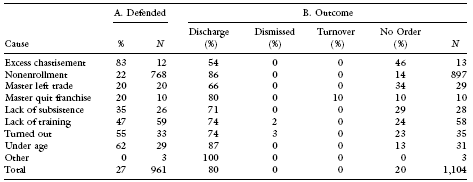
Source Discharge bills with cause recorded (see text).
Note The samples for defended and outcome differ slightly due to differences in data recorded. Other includes master’s widow marrying a nonfreeman (n = 2) and master not paying Stamp Tax (n = 1).
could occur for any number of reasons, whether because the desire for exit was held by one party only or in the case of disputes over money, possessions, or time.
Masters’ responses depended on the cause brought forth by the apprentice. Masters accused of nonenrollment or of leaving their trade or the city rarely appeared in court to defend themselves (table 3, panel A). But masters accused of excessive chastisement, turning away apprentices, or binding youths under age were much more likely to contest bills.Footnote 49 Accusations of excessive chastisement, in particular, led masters to fight vigorously: although cited by barely 1 percent of bills, such accusations led to 13 percent of jury trials. As table 3, panel B, also shows, these cases were also far less likely to reach a judgment, presumably as a result of the master’s resistance. Whereas 86 percent of cases citing nonenrollment produced a discharge, just 54 percent of cases alleging excessive chastisement did. Cases citing a lack of necessaries or training were also less conclusive.
No master’s defense ever changed the court’s standard decision: judgments were inevitably discharges, even in jury trials. By contesting bills, masters won time to respond to, and perhaps halt, the complaint outside the court, presumably by negotiation. Time was a tool in disputes; as William Palmer later suggested, his master’s opposition to his suit was “upon purpose to vex and delay.”Footnote 50 For the master, a successful defense ended with the bill left stationary in the court’s files. We might thus regard a fair proportion of the fifth of cases that did not end in a discharge as instances where apprentices were reconciled with their masters or else reached some private arrangement. That masters defended themselves most vigorously when they were accused of mistreatment or bad training surely indicates an underlying concern with reputation.
The lack of successful defenses by masters does not imply they made no effort to maintain apprenticeships. As in debt cases, these suits often came late in a longer process.Footnote 51 Apprentices generally entered bills after leaving their master. However, their contracts had often broken down gradually. Apprentices and masters regularly attempted to overcome problems informally. Numerous cases mention masters accepting runaway apprentices back after parental intervention or negotiating compensation for embezzlements. For example, one master’s witnesses described how, when his apprentice returned after absenting himself, he “did receive him kindly … in hope thereby to oblige him to be the more diligent in his business for the future.”Footnote 52
Despite the marked changes that occurred in the city over the seventeenth and eighteenth centuries, the court showed much consistency. The mix of apprentices resorting to the court was broadly stable, and there were surprisingly few changes in the process and outcomes of the discharge bills they entered. The only notable shift was in the causes that bills cited. Nonenrollment fell from 100 percent of causes cited in late sixteenth-century bills to 63 percent of early eighteenth-century bills.Footnote 53 A cluster of causes centered on the quality of training, and access to it emerged alongside nonenrollment, with bills referring to want of instruction, being turned out, or a master quitting the trade increasing in frequency.Footnote 54 The proportion of cases reaching a judgment also fell suddenly in the 1720s, although this probably reflects a shift in record retention; a large number of bills containing no record of any element of court process survive in the court’s files for the first time at this point.Footnote 55 Where we know that a process was started, the judgment itself remained unchanged. The reasons that underlay the growing importance of other causes alongside nonenrollment in the later seventeenth century—at a time when enrollment rates were, as we will see, probably declining—are obscure. One might speculate that this reflected an increase in the flexibility of London apprenticeship, particularly if the volume of court business was expanding, as it may have been. In the sixteenth century, exit via the court was concentrated among the small group of apprentices whose indentures were already distinguished by not being enrolled. By the later seventeenth century, a broader range of apprentices were turning to the court.Footnote 56 However, without more evidence on enrollment and the court’s practices, we cannot say more at present.
The peculiarities of the court bear reemphasis. For apprentices, a bill provided a near certain discharge from their indentures. When they could cite nonenrollment, no defense existed, allowing a “no-fault” divorce between apprentice and master. Even when citing other causes, they were still generally discharged, although the process might be slower. That the court discharged most apprentices on a technicality, nonenrollment, meant that the court was not itself a contract enforcement mechanism, as it might have been if it had examined contractual performance. Nor should the ease of exit and the importance of nonenrollment be taken as implying that these discharges were previously agreed upon between master and apprentice. Because London’s enrollment records were destroyed, we cannot exclude the possibility that nonenrollment was sometimes pretended rather than real, acting as a legal fiction that permitted a consensual discharge to be registered officially. However, there is also no evidence that this occurred or that such a process for formalizing discharge would be useful. Where both parties agreed to a discharge it could be done directly and immediately by returning and canceling each parties’ half of the indentures without resorting to the court, while there was no barrier to an apprentice being turned over to another master as long as their current master consented. Most apprentice discharges and movements presumably used these other routes, given the gap between rates of departure of apprentices and the number of bills. It was where a consensual discharge was difficult to agree upon or unavailable that the Lord Mayor’s Court had its most obvious role in unraveling the apparent certainties of apprenticeship indentures: there, London gave institutional recognition to the fact that many apprenticeships would fail.
The Pragmatics of Nonenrollment
While the outline of the city’s dissolution mechanism is clear, it leaves us with several questions. Nonenrollment demands explanation in particular. Why did masters not enroll apprentices when this allowed them to quit on a technicality? Moreover, did masters really have so little agency? Was the power to exit indentures distributed as asymmetrically as it seems? Finally, how could apprenticeship survive—even prosper—if contracts were so easily abandoned?
The questions of nonenrollment and masters’ agency are interconnected. Enrollment was a master’s responsibility.Footnote 57 The freeman’s oath included swearing to enroll apprentices.Footnote 58 Company registration was a separate, prior process. The enrollment fee was low: 2s. 6d., plus 4d. to the clerk, as it had been since the 1500s. Any savings needed to be set against the fine of 9s. 2d., imposed when an apprentice who was not enrolled became a freeman.Footnote 59
Yet nonenrollment was widespread. The loss of the city’s apprenticeship records makes it impossible to establish actual rates of enrollment, but estimates can be obtained from the fines paid by new freemen: between one-quarter and one-half of apprentices who became freemen had not been enrolled from the mid-sixteenth to the early eighteenth centuries, with signs of a decline in the rate of enrollment over time.Footnote 60 An alternative measure is available for the 1730s and 1760s, when the chamberlain’s accounts indicate that apprentices were enrolled in only slightly higher numbers than freemen were freed.Footnote 61 As around half of apprentices would become freemen, this also suggests that only around half of apprentices were enrolled.
This breach of city regulations was repeatedly condemned by city officials, who urged freemen to enroll their apprentices.Footnote 62 The power that nonenrollment gave an apprentice to escape their contract was described as a major problem in the city’s printed guidance for new freeman, leading to “the Ruin of Hundreds of [apprentices]; for being sensible that it is entirely in their Power to leave their Service whenever they please, they too often presume upon it to behave in an unbecoming Manner to their Masters, to neglect their Business, and to take … bad Courses.”Footnote 63 Despite this dark prospect of misbehavior, there is every sign of complicity on enrollment between apprentices and masters. Nonenrollment had one key consequence: facilitating discharge. The obvious beneficiary was the apprentice, who initiated any suit and was freed by the judgment. But apprentices only obtained this contractual break point through their master’s inaction, and the frequency of nonenrollment suggests that many were willing facilitators. Perhaps unsurprisingly, several masters asserted that it was the apprentice who had been “unwilling to be inrolled.”Footnote 64
There is some evidence that apprentices and their families did sometimes favor nonenrollment to avoid any difficulties in leaving a master. The odds of discharge seemingly increased among apprentices who were not enrolled: four-fifths of actions alleged nonenrollment, yet around half or more of apprentices were enrolled.Footnote 65 Nonenrollment would be more useful where a premium was at stake, as it strengthened the apprentice’s hand in negotiating a transfer and quickened access to the equity side where they could recover some of their money. As this would suggest, nonenrollment increased over time in parallel with what we know of the growing use of premiums (although the weakening regulatory influence of the city may have also lessened masters’ concern).Footnote 66 And there is evidence that nonenrollment was associated with larger premiums, implying that apprentices’ families sought to protect larger investments, although it was used by apprentices across the full range of trades.Footnote 67 The frequency of discharges implies that many parents would probably have been aware of this aspect of London’s system. Nonenrollment may thus parallel the practice in the King’s Bench of borrowers confessing judgments in advance so that lenders could “take uncontested legal action in case of default.”Footnote 68
Masters may have also valued nonenrollment for their own reasons. This might seem perverse, given that it weakened their contractual position. But contemporary city officials attributed masters’ inaction to their desire to retain the ability to eject apprentices at will, even at the price of permitting their apprentices a parallel freedom to depart at will. Masters apparently believed that by avoiding enrolling their apprentices “they have it in their Power to part with them if they should prove disorderly.”Footnote 69 Although official sources suggested this was not the case, arguing that nonenrollment did not free masters from their obligations, nonenrollment may have been taken as having that effect. For example, in 1599, when the barber surgeon Thomas Jones refused to maintain his apprentice Peter Phillips or accept him back into his service, he based this refusal on nonenrollment.Footnote 70 Whether or not masters could freely and legally eject nonenrolled apprentices, turning out did happen in practice. In such cases, another advantage of nonenrollment is apparent. Nonenrollment provided apprentices with a straightforward and neutral means for discharge that preserved their master’s reputation from public accusations of fault—accusations that might induce a master to fight a case. Indeed, in subsequent equity-side suits, apprentices regularly describe seeking their discharge for nonenrollment after their master had turned them out or committed other faults. Thomas Prouting even claimed he had been advised to pursue this course after being turned out by his master, Nathaniel Lawford: “tho your Orator [i.e., Prouting] would have assigned the aforesaid cause for his discharge yet your Orator was advised & did pray to be discharged from his said apprenticeship for that the said Lawford had not caused your Orator Thomas to be enrol’d according to the Custom of this Honourable City.”Footnote 71
Apprentices regularly offered a darker version of this analysis: masters who avoided enrollment were hoping to encourage their apprentices to quit in order that they could obtain their premium. Richard Nest, for example, said his master neglected enrollment “on purpose to give your orator … occasion to sue forth his indentures thereby intending to keepe himself ye sd fifty pounds.”Footnote 72 Worse, apprentices such as Joel Burford described his master beating him “to force [him] … to quit his service but also to keep to his own use the said Thirty pounds.”Footnote 73 William Browne claimed his master had “purposefully and wifully ommitted and neglected to inroll” him. Having falsely accused him of embezzlement, Browne’s master extorted a bond from his guardian, threatening to turn him out, “saying that your orator was not enrolled.”Footnote 74 Masters themselves explained nonenrollment by ignorance, “mere forgetfulness,” or the press of business, just as some apprentices, perhaps occasionally with good reason, claimed they had not known about enrollment’s importance.Footnote 75 However, widespread ignorance is scarcely credible given the scale of the court’s business.
Even if masters saw some advantages in nonenrollment, the apparent autonomy over exit this gave to apprentices is hard to reconcile with standard accounts of apprenticeship. Indeed, the ease of discharge in the court seems to leave masters with remarkably little control. However, the apprentices’ role in the court process did not mean that masters had no agency. Masters could themselves terminate contracts unilaterally by physically turning their apprentice away and refusing to receive them again. As Robert Fary reportedly told one apprentice’s father, he would not keep his son any longer and “if he did not take care of him … he would immediately turne him out of doors.”Footnote 76 Masters’ theoretical obligation to provide for apprentices appears to have carried little weight. Informal arbitration could not force a master to take back an apprentice against his will. As later equity cases indicated, turned-out apprentices had little option but to sue for discharge in the court to prevent their “further ruin”: that pleas were always entered by apprentices did not mean that dissolution was always their decision. Masters therefore even avoided the legal costs of terminating apprenticeships.
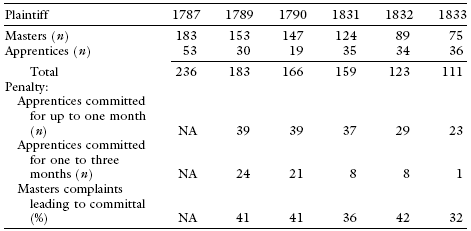
Masters also had greater disciplinary powers over apprentices while they remained in their service. As well as being able to punish apprentices themselves, they were supported by other institutions. As Hay noted, the Chamberlain’s Court, which provided a venue for apprentices and masters to complain about misbehavior, was substantially biased in process and practice, as were provincial justices of the peace. Guilds likely also shared a tendency to favor the master.Footnote 77 Masters appealed to the chamberlain more often than apprentices. Where the chamberlain might
Cases in the Chamberlain’s Court
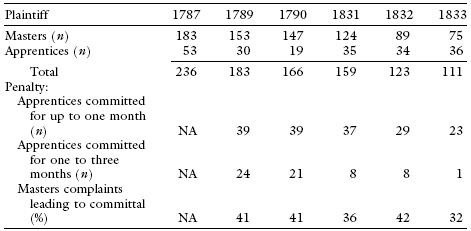
Sources Data for 1787: Douglas Hay, “England, 1562–1875: The Law and Its Uses,” in Hay and Craven, Masters, Servants, 76. Data for 1789–90: Chamberlain’s Court Complaint Book, COL/CHD/AP/04/02/002, January 1789-September 1793. Data for 1831–33: Second Report of the Commissioners Appointed to Enquire into the Municipal Corporations in England and Wales: London and Southwark: London Companies, House of Commons, Parliamentary Papers, c. 239, vol. 25 (1837), 101.
Note NA = not available.
admonish an unsatisfactory master, a recalcitrant apprentice risked committal to Bridewell. By the 1830s, there had “been no committal of a master for a century and a half.”Footnote 78 The records of the Chamberlain’s Court before the late eighteenth century are lost, but as table 4 shows, in the 1780s and 1830s, this court was primarily a resource for masters, and it regularly imprisoned apprentices.
By contrast, apprentices lacked an equivalent mechanism for secure informal exits, and they also had a weaker position within negotiations. If they departed without permission, they were in theory vulnerable to pursuit and punishment. Their indentures put them at risk of being pursued at law if they entered another contract, whether of apprenticeship or employment. Moreover, without a discharge, any bond that had been given for an apprentice’s honesty during their service might be acted on by their master and any premium forfeited. However, once discharged, the apprentice was free to find a new master or leave the city. Subsequent equity cases and freedom records do show that at least some apprentices and their families did find new masters after discharging themselves through the Lord Mayor’s Court, although we have no sense of the frequency or ease of this.Footnote 79 The liberties the Mayor’s Court gave apprentices were thus at best a rebalancing of a basic inequity in apprenticeship contracts.
Equity and Apprenticeship
Relatively easy dissolution raises its own problems for apprenticeship. Apprentices and masters both invested in training. Apprentices’ families, in particular, often gave large sums to masters to obtain positions, as well as supplying valuable sets of clothing. Premiums have sometimes been interpreted as contract enforcement mechanisms.Footnote 80 If they were lost when apprentices defaulted, they might operate as such: without money, apprentices struggled to fund a premium for a replacement master. However, the abundance of discharges, and other evidence of apprentices departing early, suggests that this constraint was generally overcome. In practice, instead of being forfeited, premiums were, in part, repaid to apprentices who left early, allowing them to use their capital to enter new apprenticeships or pursue alternative opportunities.
In consensual departures, informal negotiation could cover premiums. Charles Bathurst’s father even included this in the negotiation over binding his son: if his son left, two preselected referees were to redistribute his £200 premium.Footnote 81 Where negotiation failed, the solution lay in the equity side of the Lord Mayor’s Court. Obtaining a discharge judgment allowed apprentices to petition for repayment of their premium and other expenses. The court had exclusive jurisdiction in such cases.
The archives of the equity side of the court have attracted historians’ attention because of the detailed narratives about apprenticeship recorded in its “interrogatories,” its sets of witness depositions. However, to appreciate the function of these suits we need to turn to a different set of the court’s records: the “decrees” that record its judgments.Footnote 82 Decrees summarize court business; they are noted on single sheets, each covering a day. For apprenticeship suits, they name the plaintiff and the defendant and summarize the case, noting the contract terms and the reasons the apprenticeship failed. They then give the court’s judgment, indicating what share of the premium should be restored and any allowances for costs or other issues, such as embezzlements.
These records are not complete: the surviving decrees contain 245 apprenticeship cases from 1668 to 1707, with eight surviving per year on average. The most from a single year is eighteen. Unfortunately, none of the equity records are in a coherent series that give a measure of activity in the court. Between six and eleven “questions” (bills initiating suits) survive from each year. Around half can be linked to decrees, suggesting that around sixteen apprenticeship suits occurred each year. Linking decrees and interrogatories indicates that around twelve to fourteen suits each year led to interrogatories in the 1670s and 1680s. With no way to estimate how often both bill and decree have been lost, these are no more than rough minima of the volume of court business. But with 200 or more discharge bills in the common law side of the court each year, surely only a minority resulted in an equity suit. As the credible threat of an equity suit might allow private negotiation to succeed, it is nonetheless possible that many discharge bills were entered with some anticipation of an equity suit. Certainly previous deals over premiums are occasionally mentioned in equity cases. Nicholas Hanbury, for example, had already returned £17 of the £80 he had received with his apprentice Humphrey Babington.Footnote 83 James Netherwood’s mother protested that if his former master had ever “offered any reasonable satisfaccon or proposalls” about the premium, she “would have been very ready to have accepted of the same.”Footnote 84
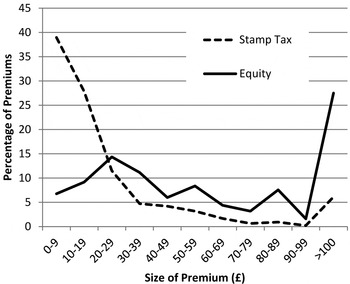
Not all discharges would have led to an equity suit though. The equity side was relatively expensive: costs were often awarded, but not always, and, at around £6, they were substantial.Footnote 85 Thus, equity suits were brought by apprentices with large premiums: 53 percent paid £50 or more, compared to 13 percent of London apprentices in 1711–21 (fig. 2), the earliest period for which we have extensive information. Apprentices who paid large premiums were a distinctive group. If we compare the social characteristics of plaintiffs in equity suits to those seeking discharges, apprentices bringing equity suits were more often citizens’ sons or locals.Footnote 86 They were from higher status backgrounds: around 30 percent were the sons of gentlemen and esquires.Footnote 87 And they were entering more prosperous trades: the largest occupational group were merchants’ apprentices, who brought 13 percent of equity suits against just 3 percent of discharge bills.Footnote 88
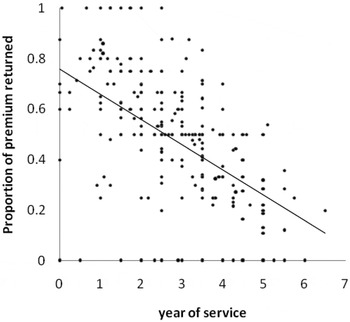
In several respects, however, the equity side of the court mirrored the common law side. Again, all suits were brought by apprentices and their families or guardians.Footnote 89 And again apprentices generally did well from the court: only twenty-six of 244 plaintiffs received none of their premium back, and just six cases were dismissed.Footnote 90 The court’s judgments shared some of the mechanical regularity of discharge suits. Even the proportion of the premium returned was quite predictable. As figure 3 shows, it declined steadily as the time served increased, suggesting a clear rule of thumb.Footnote 91 Interestingly, the court apparently understood premiums not as compensation for the initial costs to masters from training new apprentices,
Premiums mentioned in equity cases and London apprenticeships, 1711–20. The distribution of premiums for London apprenticeships, 1711–20, is based on the premiums registered for stamp duty by London citizens in this period (n = 13,709): Inland Revenue, Board of Stamps: Apprenticeship Books, The National Archives, IR1. This omits indentures for which no premium was paid. For sources of the equity cases, see the text.

but as fees for access and living costs: no year was worth much more or less than another, despite the increasing value of apprentices’ labor over time.
Where the two sides of the court diverge, however, is in the nature of the process. The rapid and homogenous resolution of discharge bills possesses a sterile inevitability. However, equity cases produced heated and contradictory accounts of exploitation and contractual failure. While most equity cases derived from discharges citing nonenrollment, the apprentices involved now reported a litany of abuses underlying the separation.Footnote 92 In 61 percent of decrees, either apprentice or master or both were found wanting. The court identified a range of failings from general misbehavior (drunkenness, surliness) to embezzlement or excessive correction. No single fault predominates, although embezzlement is mentioned in 17 percent of decrees.
For equity cases, fault mattered. Indeed, in one case lack of fault meant that “the court forbeareth to decree the cause for that noe just cause appeareth agt the deft except want of inrollment.”Footnote 93 The decrees reference only a fraction of the accusations that apprentices and masters made, which are apparent in their questions,
Share of premium returned in equity cases. For sources of equity cases, see the text.

answers, and interrogatories. As Pelling noted, these stories are often impossible to reconcile.Footnote 94 To give one example, from April 1691, Caleb Trenchfield’s deponents told how, when he met his apprentice James Ellis for arbitration, Ellis asserted: “Now he had sued out his Indentures by which he was cleared from him the defendant … he would now make the best of his time to his owne advantage urging it with a great deal of vehemency that he would not returne againe to the deft.” Yet Ellis’s own deponents said that it was Trenchfield who had protested that “he would not take [Ellis] againe for an hundred pounds.”Footnote 95 Similarly extreme contrasts are apparent between the apprentice Prouting’s statement that he had been a day or two absent “upon some urgent occasion” and his master’s assertion that Prouting had admitted that “he had been in St. Giles during the said Time and that he had layen with Six whores, and that he lay with one of them three times in one night, and that he had been in company with Pickpocketts, and that he had received money of them as his share for handkerchifts which they had stolen.”Footnote 96
In these litanies of faults, equity cases reiterate the norms of apprenticeship in London. The evidence that was given in the court was refracted through the standardized terms of London’s apprenticeship indentures. However, the court’s accounting is ultimately financial. The bottom line was the apprentice’s premium. Masters sought to retain as much money as possible; apprentices to recover what they could. Apprentices’ broken heads, bad diet, and paltry instruction were thus weighed against unexplained absences and saucy words, thefts, and threats that they dealt to their masters. Worn-out clothes, absences, stolen shop goods, and medical treatment were all carefully quantified and if possible priced: complaints list the wages of journeymen employed in apprentices’ absence, apothecaries’ bills, and garment prices. Apprentices protest that no new master could be obtained without a premium and that their masters had faced no great expense in keeping them—the cost of their subsistence after departure was rarely mentioned. Fault was both moral and financial, however. Costs could only be measured as deviations from an ideal of apprenticeship in which each party fulfilled the oath to serve or instruct. The court adjusted liability according to culpability. The final settlement reflected the behavior and intent of each side.
This post hoc balance sheet explained the intense conflict over why an apprentice left: if it was a voluntary departure, it weakened the apprentice’s case; if he was driven off, it weakened the master. Although masters who wanted to be rid of an apprentice could simply turn them away, they preferred them to run. As a result, any absence could be seized upon. In one case, an apprentice returned from the Lord Mayor’s show to find he was locked out.Footnote 97 Any evidence that the other side favored dissolution was important. Hence, John Walmesley’s suit was undermined when one of his master’s servants, Martha Bragg, recalled that “she hath heard the Complainant severall times say that he would not stay with the Defendant for that he had no mind to a handicraft trade and particularly the night before he went away [he] told this dept that he would and could goe from the Deft for that he was not enrolled & stayed out that night till past twelve of the clock on purpose (as this Deponent believeth) to give occasion for the Defendant to quarrel with him.”Footnote 98
More pungently, the mother of one master reported that her son’s apprentice had said he “did not care a fart for living with his Master … & did not care a turd for the £25 his master had with him.”Footnote 99 In a similar vein, apprentices claimed they had been forced out “by vyolence,” as Weaver put it.Footnote 100 Browne, for example, claimed his master had “called for his pareing shovell and threatened to beate your orator down therewith and to charge your orator with a constable unless your orator would goe out of his doores.”Footnote 101 For the same reason, the efforts each made to resolve their differences were emphasized: apprentices consistently describe repeatedly submitting themselves to their master, and masters to having
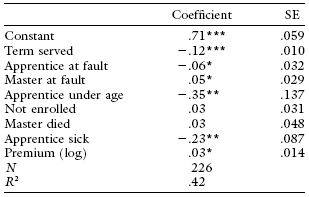
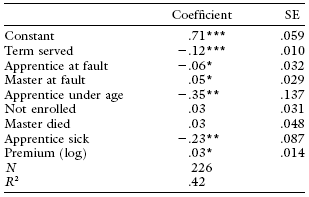
The Share of Premium Returned to Apprentice
* Significant at the 10% level.
** Significant at the 5% level.
*** Significant at the 1% level.
“offered to reffer the said matter to any Indifferent persons,” as Lovelace Apleford put it.Footnote 102
If we take the faults mentioned in equity decrees as those the court believed proven, we can see how the algebra of dissolution worked. Table 5 reports the results of a regression in which the dependent variable is the share of premium returned to the apprentice by the court. A series of dummy variables summarize the circumstances described in the decree. The coefficients can be interpreted as the shift in the proportion of premium the court returned where they occurred, all else being equal (if multiplied by 100, they give percentage changes). For every year served, apprentices received around 12 percent less back. Where apprentices had misbehaved, the amount they received fell by 6 percent.Footnote 103 Similarly, when masters were at fault, they returned about 5 percent more.Footnote 104 If apprentices had been sick, they received much less, having cost their masters money and earned little. Those bound under age also had less returned. Apprentices who paid a higher premium received slightly more back, suggesting a bias in favor of wealthy apprentices’ and, probably more importantly, their parents. In short, when an apprentice or a master convinced the court that the other was at fault, he profited.
The equity side of the court provided a means to resolve the financial consequences of the discharges executed by its common law side, allowing discharged apprentices to recover a proportion of their premium. It was not as cheap or simple as the common law side. But the integration of both sides of the system is clear. Where discharge bills allowed apprentices to settle the contractual uncertainties left by a failed apprenticeship, the equity side helped rebalance the advantage that possession gave to masters in negotiating over the premium. In the equity side we also see an aspect of the city’s understanding of apprenticeship that is hidden in the near automaticity of the common law discharges. To the Lord Mayor’s Court, apprenticeship remained a social and economic exchange that operated within a well-established set of norms that were defined by the indenture and apparent in the customs of the city. While the city offered to end contracts on demand, the financial reparations it allowed reveal a clear sense of what behavior was required from both master and apprentice and show that in the court’s view apprenticeship still turned on an exchange of sufficient training for satisfactory service.
Conclusion
This account of the way the Lord Mayor’s Court shaped apprenticeship in London has described what appears to be a largely stable institution whose activities with regard to service changed relatively little over the century or so after 1600. The boundaries of analysis are set by the survival of detailed records for the court. Yet, so far as we can tell, this appears to be a snapshot from a much longer period of at least five centuries in which the court played much the same role in apprenticeship. Hovland’s recent study of apprenticeship in medieval London suggests that the court’s role in apprenticeship had emerged by the late thirteenth century; when and how it acquired this role is uncertain.Footnote 105 Even at this earliest stage, the court’s business included discharges. Hovland concludes that in the fourteenth century many apprentices “appeared only in order to be formally released from their apprenticeships, and in a quarter of cases they had not been enrolled.”Footnote 106 The city’s system of enrollment that supplied the technical basis for many discharges was created around 1300 in an attempt to control access to the freedom; its implications for discharge were presumably unintentional.Footnote 107 The court’s activities continued into the nineteenth century. Suing out indentures for nonenrollment was mentioned in later eighteenth-century publications.Footnote 108 In the 1830s, parliamentary commissioners noted the court discharging apprentices, often for nonenrollment, and commented that the equity side remained “almost entirely confined to bills of discovery and suits for compelling restitution of premiums to apprentices.”Footnote 109 The court provided a framework for apprenticeship that, it should be also noted, predated the formation of most of the city’s guilds and lasted after most had abandoned any aspirations to regulate training.
The Lord Mayor’s Court was the nexus of a metropolitan system that emerged, perhaps accidentally, in a city that dominated the nation’s apprenticeship training just as it dominated its economy. Outside London, there is no evidence that an equivalent formal process for discharge operated in other borough courts in the seventeenth and eighteenth centuries. Enrollment was only required in some boroughs, and even then it was often patchy.Footnote 110 Researchers on borough courts have not noticed similar bodies of plaints.Footnote 111 Dissolutions and restitutions for contractual breaches in apprenticeships did occur elsewhere in England, however. The Statute of Artificers empowered justices of the peace to discharge apprentices on the complaint of either party and to punish recalcitrant apprentices. The system evolved to reflect social differences between apprentices: later statutes strengthening justices’ powers to force apprentices to fulfill contracts applied only to apprentices with low premiums.Footnote 112 Justices made regular use of their powers, and provincial apprentices did often win discharges, although quarter sessions records suggest that the process was more contestable than in London, with provincial masters often successfully defending themselves.Footnote 113
Restitution of premiums is less visible beyond London. Provincial apprentices and masters sometimes applied to the central equity courts of Chancery, Exchequer, and Requests.Footnote 114 By the eighteenth century, justices’ guides generally suggested that they could order money to be restored “for this, by an equitable Construction of the Statute, is a Power consequential upon their Jurisdiction to discharge.”Footnote 115 Certainly, cases at quarter sessions show justices restoring premiums, but we lack a survey of this practice.Footnote 116 Thus, while the tone of metropolitan and provincial apprenticeship overlapped, at first blush it appears that provincial apprentices lacked an exit mechanism that was as cheap, quick, and effective as that supplied by the Lord Mayor’s Court in London.
If London’s system of apprenticeship regulation was as distinctive as it now appears, this reflects the city’s unique position in English society and the scale of its training market. London attracted a wide swathe of the children of England’s middling sort and elite into apprenticeship. From a distance, early modern apprentices can appear tied by oath, law, and custom into an uneasy subordination. For early historians of apprenticeship reacting against sweated child labor, this feature—the tying down of youths into their master’s households—was one advantage of the institution.Footnote 117 More recently, historians exploring the preservation of order within urban households have emphasized the tensions generated within service and the consequent negotiation, conflict, and conciliation that generated. Yet, whether optimistic or pessimistic about the capacity of households to contain these pressures, the city and its institutions have generally been identified as one of the bulwarks of order.Footnote 118
Law and custom, however, had a double nature in the city, as the surprising activities of the Lord Mayor’s Court reveal. While the chamberlain and guilds aimed at reconciliation, whether through arbitration or punishment, the Lord Mayor’s Court cleared up the contractual and financial mess left when relationships ended. Two different perspectives on service were at play here. The chamberlain and guilds, favoring order and hierarchy in workshop and household, are more familiar to historians. In the Lord Mayor’s Court, however, household relationships were examined in terms of contract, an approach that undermined patriarchal ideals, as C. W. Brooks has suggested.Footnote 119 What this combination of agencies and roles looked like from the perspective of individual apprenticeships is hard to recover. It seems likely that London’s institutions offered resources that competed with as much as complemented each other.Footnote 120 If nothing else, the sheer scale of apprenticeship business in the Lord Mayor’s Court—with cases relating to around 5 percent of indentures in the city—argues for its prominence. Acting on contractual breaches, often technical in nature, the court put apprentices and masters asunder almost on demand. It restored premiums and costs according to an equitable construction that balanced faults and time served. In doing so, the city itself inverted household hierarchies, rebalanced asymmetries within apprenticeship, and substantially moderated the risks involved in entering expensive, long-lasting training contracts.
The effect of the court’s disordering of household hierarchies was, it seems, the promotion of wider social stability. By providing a mechanism through which conflicts could be resolved formally, the city recognized and addressed the tensions that frequently crippled apprenticeships and which might otherwise leave youths in legal and economic limbo, unable to end their indentures or to fulfill them. While much work on the production and maintenance of social order in early modern societies has drawn attention to the ways in which power was negotiated between governors and governed, giving voice and agency to theoretically marginalized groups, the activities of the Lord Mayor’s Court in persistently breaking the legal ties that bound youths into positions of subordination to masters have no obvious equivalent.Footnote 121 In essentially turning servitude into service at will, the court went far beyond showing a “respect for justice and equity” and treating both parties’ positions seriously in the manner that has been observed in other courts and tribunals dealing with disputes between superiors and subordinates.Footnote 122
That a corporate body populated by citizens whose cherished privileges included the taking of apprentices should act to undermine the employer, not the employee, could seem aberrant when set against the general tendency of contemporary labor law to favor masters over servants and wider contemporary practices and discourses of order that expressed great anxiety about riotous and criminal apprentices.Footnote 123 Nonetheless, several countervailing pressures affected the city’s institutional pathway, and these offer us a way to make sense of this apparent inversion of hierarchy. Collectively, the city depended on the migration of apprentices to survive and expand. It also struggled to manage the threat that apprentices jointly or individually could present to order in the city, whether through riot, crime, or vagrancy, adding to the appeal of a way to regulate and legitimize the ending of those contracts that failed. We should also recognize that London’s citizens were parents, relations, and guardians as often—perhaps more often—as they were employers. Even prospective masters may have accepted the provision of escape clauses and guarantees to apprentices if they increased families’ willingness to fund training. The flood of apprentices choosing to train in London suggests the combination of arbitration and dissolution provided by the city’s institutions gave an additional advantage to the capital.
In the Lord Mayor’s Court, the city undermined the force of contracts, weakening property rights in labor. Its activities run opposite to the standard assumption that the effective enforcement of contracts is crucial to the effective operation of economic institutions and long-term training systems. It also contradicts most interpretations of the social role of urban institutions, which usually emphasize their focus on preserving and restoring household order. The success of this system of dissolution was a consequence of the basic instabilities of early modern apprenticeship and of the private and social costs that would have been incurred in reducing contractual failure through stronger enforcement. Of course, no direct measure exists for the effect of this system, and economic factors were the strongest force explaining the appeal of metropolitan apprenticeship. Nevertheless, we might reasonably conclude that apprenticeship in London thrived in part because of its institutions for contract dissolution.
APPENDIX: THE MAYOR’S COURT ORIGINAL BILLS
The Lord Mayor’s Court Original Bills fill 321 boxes, roughly covering the period 1327–1723 (cataloged as CLA/024/02). Bills only begin to survive in substantial number from the 1560s. From this point (box 9 onward), the series is roughly chronological, but fragmented and incomplete, with some boxes containing bills resorted by type, while other bills remain in their original files.
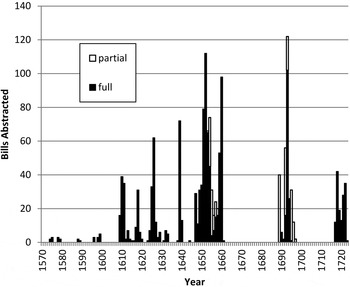
The core sample used here was constructed by surveying runs of boxes from the late sixteenth century, the 1610s, the 1650s, the 1690s, and the 1720s and abstracting the first 150 bills for each period (except for the 1650s, where a larger initial sample was collected). The number of bills from any particular year depended on their appearance in the boxes as they were surveyed. Counts were then taken of bills from specific years to provide estimates of the number surviving (used in table 1). The late sixteenth-century records were very fragmentary: the twenty-five boxes from 1569–1600 (11–27) contained just twenty-four bills from 1574 to 1599. For the 1610s, boxes 37–46 were surveyed, and 150 bills from 1609–19 were abstracted. For the 1650s, boxes 113 and 117–26 were surveyed, and 335 bills were abstracted. For the 1690s, boxes 261–72 were surveyed, and 153 bills from 1690–95 were abstracted. For the 1720s, boxes 310, 313–20 were surveyed, and 150 bills from 1717–22 were abstracted. In total, I surveyed 59 boxes. This produced a core sample of 813 bill abstracts. For a few years in the 1650s and 1690s, I also abstracted partial information (on company and occupation only) on a supplementary sample of 231 bills, which is used here as relevant. This gave me an uneven, but randomly generated, distribution of bills from particular years within each sample period. This core sample was substantially supplemented with 491 abstracts collected by Michael Scott, who abstracted ten boxes containing concentrations of apprentice bills from 1614 to 1661. The final distribution of abstracts by year is shown in figure 1. As can be seen, adding Scott’s material further weighted my data set to 1610–60, with a particular cluster in the 1650s; because of this, much of the quantitative analysis compares two extended periods, 1610–50 and 1690–1720. In addition, the size of the sample available for the different statistics given in this article varies due to partial survival or recording of particular items of information on bills and also from some differences between Scott’s abstracts and my own. In addition, sixty-five cases brought by mariners’ apprentices bound outside London have been excluded from the statistics in this article.
As well as the Original Bills, a large body of other material survives from cases in the Lord Mayor’s Court. The main classes of records used here relate to cases on the equity side of the court, as these generated voluminous discussions of the events that had led to the suit. The categories of material generated by the court are distinguished by the LMA reference system and follow the sequence of the case from the first Complaints and Answers (CLA/024/07), through the Interrogatories and Answers (CLA/024/05 and MC6), to the final Decrees and Orders (CLA/024/08).
—Apprentice discharge bills in the sample by year