INTRODUCTION: UNDERSTANDING AMBIGUOUS ELECTIONS
During the fiercely contested, but seriously flawed, 2000 federal election in southern Ethiopia, two elderly voters expressed their frustrations against the incumbent in the following manner: ‘They [the government] cannot let us only smell democracy, now they have to allow us to eat it too! Election is personal and personally one must vote as one desires’ (Tronvoll Reference Tronvoll2001). The phrase captures the ambiguity of elections in countries in transitions from authoritarian rule; the qualitative substance of democracy cannot be fully measured by the ‘smell’ of formal electoral procedures alone. Elections need to reflect the ‘taste’ and ‘digested desires’ of the electorate too.
Formal political procedures and the performance of the election institute itself, the ‘smell’ of democracy, are of course important elements in understanding democratic transition; however, other events and processes outside the electoral arena may also play a crucial role in influencing the conduct of elections. This ‘non-electoral context’ in which elections are situated is often overlooked in democratisation studies, in order not to obscure an otherwise clear model or theory of transition. A key challenge for research on democratisation processes is thus how to balance electoral ‘formalities’ with contextual factors and qualitative perceptions of democracy, in order to reach a more nuanced and comprehensive understanding of democratic transitions. This article advocates a multilayered approach – or ‘thick description’ – to elections, in order to capture the diversity of real life experiences and expose alternative power discourses competing with the electoralist one in influencing the path of democratisation.
The coming to power in Ethiopia of the Ethiopian Revolutionary Democratic Front (EPRDF) in May 1991 ostensibly heralded a new paradigm of multiparty democracy, constitutionalism and human rights protection in the country (Abbink Reference Abbink1995; Henze Reference Henze1998; Tronvoll Reference Tronvoll2000; Vaughan Reference Vaughan1994). Embedded in a complex, multi-tracked and partly contradictory process of post-conflict political transition, the conduct of elections in the country has been both praised and criticised by domestic as well as international observers, to the extent that the role of elections in the overall transition appears quite ambiguous.
Some doomed the democratic transition to fail for various reasons already at its incipient stage (de Waal Reference de Waal1992/93; Engedayehu Reference Engedayehu1993; Harbeson Reference Harbeson and Kumar1998b; Joireman Reference Joireman1997). Others hesitated whether elections in themselves represented an end to (Lyons Reference Lyons1996) or the beginning of a transition (Lyons Reference Lyons2006), or simply served as an extension of it (Harbeson Reference Harbeson2005). The first general election of 1995 was characterised by some as ‘democratic in formal structure as well as in spirit and practice’ (Henze Reference Henze1998), while others rebuffed such an assessment and concluded that EPRDF rule fell way short of democratic standards and could not be considered as an electoral democracy (Harbeson Reference Harbeson1998a; Joseph Reference Joseph1998).Footnote 1 All emphasised formal democracy indicators as well as the government's ‘intention’ and ‘will’ to open up for competitive politics in their analysis, but reached opposite conclusions.
A broad interdisciplinary study published after the second general election in 2000, taking stock of a decade of democratisation in Ethiopia, emphasised the subordinate and irrelevant role of elections as a power-distributing institution, since true political power was anchored in a parallel non-elected shadow governmental system operated by the government party and cadre structure, branching out to all administrative levels of the state (Pausewang et al. Reference Pausewang, Tronvoll and Aalen2002).
The 2005 general election also produced a challenge for democracy assessment, as most observers were in great qualms on how to reconcile the rather positive process leading up to election day with the tragic and turbulent events unfolding in the aftermath of the election. The competitive and open process leading up to the 2005 election, and the increased electoral support gained by the opposition, made many scholars characterise it as something fundamentally new in Ethiopian politics, to the extent that the 2005 election was labelled as ‘founding’, ‘formative’ and ‘genuine’ for true democracy by leading political scientists within the field of Ethiopian studies (Clapham Reference Clapham2005; Harbeson Reference Harbeson2005; Lyons Reference Lyons2006). Other scholars, however, assessing the 2005 elections from an anthropological viewpoint and within the broader context of Ethiopian political culture (Abbink Reference Abbink2006a), or from the point of view of the peasantry (Lefort Reference Lefort2007), emphasised the continuation of authoritarianism in the electoral process, which basically ‘placed genuinely “free and fair” elections out of reach’ for the electorate (ibid.: 253). The latter perspectives interpret elections within localised socio-political contexts, and argue that formal electoral politics are governmental posture only, not allowing for true electoral competition. This perspective also sparked a scholarly debate over methodological approaches to understanding the outcome of the electoral process, as Jon Abbink's (Reference Abbink2006b) interpretation of authoritarian continuities was criticised by Tobias Hagmann (Reference Hagmann2006) as being ‘culturalist’ and political reductionist in its interpretation. Post-election studies, furthermore, assessing the elections in relation to political and judicial reforms and to human rights implementation, suggest that the overall political transition in Ethiopia is markedly negative and political space is restricted partly as a consequence of the electoral race itself (Aalen & Tronvoll Reference Aalen and Tronvoll2009b; Tronvoll Reference Tronvoll2008).
It seems clear that the role of Ethiopian elections in the process of democratisation can be interpreted differently, in accordance with the criteria emphasised, time-span considered and analytical approach preferred. Focusing on electoral formalities only, it may appear that the Ethiopian democratic transition has been quite successful, with more political parties, broader participation, and increased parliamentary opposition during the course of three rounds of national elections. In a ‘narrow’ analytical approach, these gains may be attributed to the successful process of democratisation itself, as repetitive elections in states in transition are an important causal factor in the development of democracy (Lindberg Reference Lindberg2006a). The conduct of Ethiopian elections may thus be interpreted as a catalyst of democratic change. However, if we go beyond the electoral arena to include contextual and non-electoral events in the analysis, the influence of elections on democratisation becomes more blurred, and may even be interpreted as an impediment to improvement.
A key challenge in studies on democratic transition is thus how to define the ‘electoral arena’, in order to include all relevant factors and processes impinging on the democratic transition. Most observers agree that elections are only one of several indicators for a successful consolidation of democracy. For instance, during the fifteen years of multiparty elections in Ethiopia, the country has inter alia also experienced: a restructuring of the system of governance from a unitary state into an ethnic federation; a full-scale bilateral war with a former close ally (Eritrea); a government dissent movement and party rupture which almost toppled the premier from within; and the continuation of low-scale insurgent wars from multiple resistance movements. How we should analyse the impact of these events in relation to the Ethiopian elections and process of transition is by no means clear and agreed upon.
In order to exhibit the perceived ambiguity of Ethiopian elections, this discussion seeks to identify the missing pieces in the jigsaw puzzle, so as to explain in full the nuances of Ethiopian democratisation. Or, in other words, to build up a sufficient ‘thick description’ of the Ethiopian democratisation process which can arrest the residual analytical ambiguity of a more limited approach.
After a brief section on Ethiopian transitions and multiparty elections, the first ‘layer’ of analysis of Ethiopian elections is based on internationally accepted electoral indicators. These show that elections may appear as a catalyst of change in the country. Subsequently, a second ‘layer’ of information is added, emphasising contextual politics and post-election and between-election events. This questions the liberalising effect of elections to such an extent that elections may actually appear as impediments to improvement in Ethiopia. Finally, a third ‘layer’ of analysis incorporating formative non-electoral political events is added in order to reach what anthropologists term a ‘thick description’ of the political transition. At this point, we learn that the apparent contradictory democratic ‘gains’ and ‘set-backs’ experienced in the 2005 elections are explainable and make sense. The article concludes with some comments on the future role of multiparty elections in the country.
ETHIOPIAN TRANSITIONS
Before adopting multiparty democracy in 1991, Ethiopia had experienced two violent successions of government: the coup d'état against the regime of Emperor Haile Selassie I in 1974, and the defeat of the Marxist–Leninist military junta of Colonel Mengistu Hailemariam (called the Derg)Footnote 2 by the EPRDF in 1991. Since the fall of the Derg and the dissolution of the single-party political system, Ethiopia has undertaken three federal elections, in 1995, 2000 and 2005 (in addition to elections for the Constituent Assembly in 1994, and four rounds of local elections).
Multiparty elections were launched in Ethiopia one year after the fall of the military junta, in the 1992 local and regional elections. This milestone event, which was intended to symbolise the change to plural politics, also indicated the continuation of authoritarianism in the country as it spurred the withdrawal of the Oromo Liberation Front (OLF) and other political groupings from the Transitional Government of Ethiopia (TGE) and the elections as a protest against what these saw as increasing EPRDF domination and the curtailment of political space.Footnote 3 The OLF constituted the second biggest party in the TGE, after the EPRDF block, and was a vital component in legitimating an all-inclusive transitional government. However, just a few weeks after the establishment of the TGE, a growing discord over which front should administer the south-eastern parts of Ethiopia escalated into armed clashes between EPRDF and OLF troops. Despite reaching a political agreement, skirmishes continued and escalated, involving various other Oromo, Somali and Afar factions, which fought one another and the EPRDF. A new agreement was reached in February 1992, with the assistance of the United States and the Eritrean People's Liberation Front (EPLF), which required all troops in the Oromia region to be encamped before the first local and regional elections were carried out in June 1992 (de Waal Reference de Waal1992/93: 772). However, the fragile truce established between the two parties was soon squandered. A few days before the election, the OLF decided to withdraw from the process and annulled all their candidates in the upcoming election, due to the non-conducive democratic atmosphere in the country. Immediately thereafter, the OLF also withdrew from the Transitional Government and decided to pull its 15,000 troops out of the camps (NDI/AAI 1992). The latter move was met with massive force by the EPRDF, and another brief civil war ensued before the EPRDF crushed the OLF's capability to launch a military campaign against the TGE, and restored military control of Oromo territories. Over 19,000 Oromo were detained in the process (AI 1995), many of whom are still lingering in jail seventeen years later.
The 1992 local election was thus carried out in a context of fear and armed clashes in several parts of the country. Obviously, the country was not ready, either politically or logistically, to carry out such a complex political endeavour (Joireman Reference Joireman1997: 399). The UN coordinated Joint International Observer Group's mission was aborted and observers evacuated due to the OLF–EPRDF confrontation. Observers reported that the 1992 election was marred by irregularities (NDI/AAI 1992; NIHR 1992), and the post-election period was marked by political crackdowns. In the aftermath of the election, further non-EPRDF parties left the transitional government, which has since been completely dominated by the EPRDF. Since the dramatic 1992 election, the OLF has been banned from participating in the electoral process in the country, due to its status as an illegal armed resistance front. By disqualifying the presumed popular OLF from the electoral arena, the voting pattern among the huge Oromo constituency in Ethiopia (constituting about 40% of the total population of the country) is likely to be askew and not representative of the true will of the electorate.Footnote 4 The political effects of the 1991–2 period have thus lingered throughout all Ethiopian elections, an issue whose influence on the democratisation process is impossible to assess.
The first federal election in 1995 was intended to stand as a democratic culmination of the transition period, but amidst accusations of closure of political space the main organised opposition continued its earlier boycotts (Lyons Reference Lyons1996; Tronvoll & Aadland Reference Tronvoll and Aadland1995). For the 2000 federal and regional elections, the opposition gave up its non-engagement strategy and for the first time voters at national level were given concrete alternatives to the EPRDF-affiliated parties. Due to both poor organisational capacities and harassment and intimidation, the opposition did not pose a real electoral threat to the EPRDF party structure (with the exception of one district in the Southern region) (Tronvoll Reference Tronvoll2001). Addis Ababa showed again promising degrees of openness, as the government allowed political ‘space’ to opposition leaders to conduct rallies and to be interviewed in the press. But on the ground in rural areas, the opposition faced restrictions and harassment by local authorities and cadres (Pausewang et al. Reference Pausewang, Tronvoll and Aalen2002).
The 2005 elections to regional and federal assemblies apparently constituted a radical change from earlier elections. During the electoral process, the electorate witnessed an unprecedented context of openness and plurality of political opinions through campaigning and broadcast through public media. For the first time ever, ‘politics’ as open critique of the ruler was initially accepted, and the collective apprehension which had prevailed in the population since the brutal and horrendous Red Terror purges in the 1970s faded away (Tegegn Reference Tegegn2008: 290). Moreover, in the 2005 election the incumbent party was for the first time truly challenged through the ballot box by a coordinated opposition at a national level (Lyons Reference Lyons2006). Two opposition blocks, the United Ethiopian Democratic Front (UEDF) and the Coalition for Unity and Democracy (CUD),Footnote 5 fielded candidates in most of the country's constituencies, posing a real political alternative to the EPRDF government party.
Immediately after the closing of the polls, however, the democratic spirit nourished in the campaign was cowed, as the government imposed a blanket ban on freedom of assembly in Addis Ababa, and simultaneously suspended the counting process in many areas. The EU observer mission assessed the closing and counting process negatively in almost half of the urban polling stations observed, and even more in rural stations (EU-EOM 2005a: 2; see also Carter Center 2005). After a dubious process of re-count and re-elections in certain constituencies, the Ethiopian National Election Board proclaimed the EPRDF as the victor. Although the opposition block had gained a dramatic increase in representation in the parliament from earlier elections, winning one third of the seats, they protested at the announcement. Renewed nationwide demonstrations were called, in which close to 200 demonstrators were killed in Addis Ababa during protests in June and late November 2005. In order to curb the increasing resistance against the government, a nation-wide clamp-down was ordered. About 20,000–30,000 opposition members and sympathisers, mostly affiliated to the CUD, were detained for shorter and longer periods (Abbink Reference Abbink2006a). The CUD leadership, including the newly elected mayor of Addis Ababa, was arrested on charges of instigating violence, attempted unconstitutional change of government, and even attempted genocide (a charge later dropped by the court). Civil society organisations and the private media were also targeted and closed down. The promising 2005 electoral process as experienced prior to the election day in May turned into a bloody and failed affair by the end of the year.
FIRST LAYER: ELECTORAL FORMALITIES
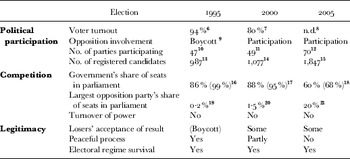
The first layer of analysis presents the formalities of democratisation through a set of internationally recognised election indicators focusing on the realisation of actual participation, contestation, and legitimacy in and of elections (Lindberg Reference Lindberg2006a). By emphasising these indicators, we discover that the Ethiopian elections appear to have contributed to a broadening of the politics of pluralism in the country. The third round of elections in Ethiopia in 2005 in particular marked a significant improvement in terms of political participation and competition (see Table 1).
Electoral development 1995–2005

Political participation is the fundamental principle in any kind of democracy, and the overall participation as measured through voter turnout in the Ethiopian elections has been remarkably high in all elections conducted under EPRDF rule (see Table 1). The official statistics indicate that the turnout of registered voters has been between 80% and 94%, a surprisingly high figure considering the size of the country and its predominantly rural population. Although we see a drop in turnout from the 1995 to the 2000 elections, this is probably not due to reduced popular interest in the 2000 election, but may relate to a shift of government strategy to mobilise people to vote: the coercion and intimidation employed in 1995 to mobilise the rural population to the polls did not take place (at least on a large scale) in 2000.
Participation by all political parties in the electoral process is not given in transitions from authoritarianism to democracy. Partial or full boycott of the electoral process may be the only leverage a strained opposition party can use in order to influence how the process is played out by a dominant and maybe semi-authoritarian government party (Lindberg Reference Lindberg and Schelder2006b). One may thus assume that the full participation of all parties indicates a higher democratic quality in elections than if some or all of the opposition parties had boycotted. The Ethiopian electoral trajectory in this regard represents a positive trend, as the 1995 opposition boycott strategy was abandoned in favour of partial participation in the 2000 and full participation in the 2005 elections.Footnote 22 Furthermore, if we look more closely at the number of parties and candidates running for election, we see a very positive overall increase in participation, with the number of candidates for parliament actually doubling from 1995 to 2005, with a particular high increase in the severely contested 2005 election.
An election is the formal public organisation of political competition. To realise this objective, it has to present (or at least allow for) true and viable political alternatives for the electorate to chose between. There must thus both a component of de jure recognition of the formation and contestation of alternatives, as well as a de facto acceptance of such alternatives through facilitating political campaigning and effective participation in the polls. The influence of the election on the composition of parliament is selected as an apt indicator of the level of electoral competition. As shown in Table 1, the EPRDF party more or less held a monopoly of the seats in parliament in both the 1995 and 2000 elections. A radical change in the control of seats occurred in the 2005 election, when the opposition in total gained control of just under one third of the seats, and the biggest opposition party, the CUD, alone controlled about 20%.
The 2005 election clearly signals a new parliamentary paradigm in Ethiopia, as the two main opposition parties, the CUD and UEDF, gained 109 and 52 representatives respectively.Footnote 23 As electoral competition goes, the 2005 election apparently heralded a shift in how political contestation was channelled and facilitated through the ballot box. The ultimate indicator of competition, the turnover of power, was seriously tested in the 2005 election, but remains to be recognised in Ethiopia.
Legitimacy is the most obvious distinguishing feature between elections in democracies, non-democracies and hybrid regimes (Lindberg Reference Lindberg2006a: 43). In Ethiopia the conduct of all three elections has been questioned and challenged by opposition actors, through strategies of boycott in 1995, while in 2005 both the incumbent and the opposition protested against the results in the majority of the constituencies (EU-EOM 2005a). After a prolonged process of investigation and re-election in certain constituencies, the incumbent accepted the overall result, whereas the opposition continued to doubt the accuracy and transparency of the process. However, the two opposition blocks chose different strategies to pursue their objections. The UEDF coalition conceded the overall outcome and took up its seats in parliament, whilst the CUD leadership continued to protest and refused to take up its rightful positions in parliament and other elected offices (inter alia that of mayor of Addis Ababa) (Smith Reference Smith2007). Despite the major gains achieved by the opposition in the 2005 election, the lack of acceptance of the results by certain key actors obviously undermined the overall legitimacy of the electoral process.
The absence of politically related violence during the electoral process is critical to its overall electoral legitimacy. Violence in elections may encompass both elite and popular elements, since acts of violence can be perpetrated by both. The Ethiopian elections have shown a negative trend in regard to the use of violence: no violence was reported in 1995; isolated events occurred in 2000, when a few constituencies in southern Ethiopia experienced certain critical incidents (Tronvoll Reference Tronvoll2001); and there was an increase to large-scale and widespread post-election turmoil in 2005, with about 200 civilians killed and prolonged unrest in many urban centres for several months after the election (Abbink Reference Abbink2006a).Footnote 24
Despite the increasing level of opposition protest and electoral violence, the electoral regime has survived intact. The government has at least claimed to be furthering and consolidating democratic values, and has not yet signalled any major revisions or restrictions of the overall electoral system, although certain legislative ‘adjustments’ have been carried out (Aalen & Tronvoll Reference Aalen and Tronvoll2009b).
The above trends in the conduct of elections in Ethiopia, along the three dimensions of participation, competition and legitimacy, seem to be in keeping with Africa-wide developments (Lindberg Reference Lindberg2006a: 96–8). It is in particular interesting to note the significant increase and broadening of participation and competition in the third round of elections. By looking only at the statistics on Ethiopia's three rounds of general elections, it may thus appear that the country has successfully evolved into an electoral democracy. But is this so?
SECOND LAYER: CONTEXTUAL PERSPECTIVES
Most observers of political transitions agree that democratic elections cannot be fully understood by emphasising only such formal criteria as voter turnout, election result and acceptance, in order to assess the level of participation, competition and legitimacy. A quantitative approach to elections tends to overlook the reality that democratisation, institution building and elections in Africa are both heavily influenced by ideology, international relations and donor interests, and are also embedded in a context enmeshed with traditional forms of political, cultural and religious authority and power. Hence, a focus on ‘formal’ politics as conceived within a quantitative approach and categorised from the viewpoint of Westphalian statehood tends to reduce the number of possible variables impinging on the conduct of elections (Abbink Reference Abbink2006a). In order to avoid falling into that trap, a second layer of contextual and qualitative analysis is added, revealing that the Ethiopian elections may actually be conceived as an impediment to fostering political pluralism in the country.
Revolutionary democracy and participation
To understand electoral competition in Ethiopia, it is crucial to understand the ideological anchoring of the government, which influences the norms and rules of political participation. Analysing the origin of TPLF/EPRDF, and its ideological basis, it seems clear that the EPRDF has never appeared as an organisation committed to pluralism for its own sake (Vaughan Reference Vaughan2003; Vaughan & Tronvoll Reference Vaughan and Tronvoll2003; Young Reference Young1997). The leadership has its own understanding of democracy, which differs significantly from liberal democracy (see also Milkias Reference Milkias2001). The party's conception of democracy is not the liberal ‘bourgeois’ variety, based on individual participation, a diversity of interests and views, and plural representation (Vaughan & Tronvoll Reference Vaughan and Tronvoll2003). Indeed, the EPRDF has considered liberal democracy to be a misfit under the social, economic and political conditions prevailing in Ethiopia. What the Front calls ‘popular democracy’ (or ‘revolutionary democracy’, see EPRDF 1999/2000) does not correspond to our understanding of the concept, but is based on communal collective participation and representation based on consensus. The EPRDF's perception of democracy is formed partly by ideological conditioning (Marxist and Maoist precepts of mass political mobilisation), and partly by historical experience during the TPLF's seventeen-year struggle to liberate Tigray from the yoke of the Derg regime (Tadesse & Young Reference Tadesse and Young2003). Various ‘levelling’ policies implemented in the liberated areas during the struggle (such as, for instance, land reform) entailed that the peasantry was regarded as a ‘homogenous mass’ with common needs, interests, and political outlook. Political participation in these ‘mass’ terms presumes such commonality, which makes pluralism irrelevant. This does not rule out debate for the purpose of arriving at the information, clarification and persuasion required to reach consensus; but once consensus is achieved, the community speaks with one voice, and dissent is ruled out – or rather does not ‘objectively’ emerge since decisions are not made until consensus is achieved (Vaughan & Tronvoll Reference Vaughan and Tronvoll2003). Such a perspective generates all the relevant terms associated with elections and liberal democracy (decentralisation, participation, inclusiveness of discussion, etc.). But it also invests each with a markedly different meaning, premised on the certainties of historical materialism, rather than the vagaries of plural interaction. Unsurprisingly, elections promoted under the auspices of such an ideology will meet practical constraints not experienced in liberal democracies. A case in point was the critical self-evaluation (gimgema) carried out by EPRDF in the aftermath of the 2000 election, since the loss of twelve seats to the opposition was considered a failure of their strategy to secure all seats in the House of Representatives (Pausewang et al. Reference Pausewang, Tronvoll and Aalen2002).
The basis of (non-)participation and (non-)competition
Official statistics claim that the voter turnout in the 1995 election reached 94% (subsequent elections also show a high turnout): a remarkably high number in any election, and particularly so when all major opposition parties called for a boycott of the election. The Ethiopian National Election Board explained the high turnout with the emphasis that had been put on voter education informing the public about the importance of participating in the election, in combination with the fact that ‘voters are aware that the present election is decisive for them to reaffirm their authority’.Footnote 25 This interpretation was backed by government officials who claimed that the high registration and turnout was a confirmation of their popularity, in particular considering the opposition's call to boycott the election.Footnote 26 As political legitimacy is drawn from popular participation, did this high turnout really reflect popular support for the incumbent EPRDF in 1995 and subsequently in 2000?
Considering the nation-wide focus of elections, it may appear that the electorate has congruous reasons to participate and vote. However, this overlooks the reality that different population groups may have differing reasons to participate in elections, as they have different historical relationships, experiences and perceptions of the state, the incumbent party, and the electoral process itself. This was the case with the Ethiopian electorate. It is vital to understand how state power is differentially projected and perceived at the grass-roots of society, in order to make sense of peasant participation in the electoral process. Peasant participation may well be motivated on ideological grounds, but is just as likely reasoned in other contextual tropes. Varying ethnic groups' conception of the Ethiopian state itself, for instance, may motivate or discourage electoral participation, as different voters will understand the process of ‘choosing government’ differently, particularly as the Amharised notions of state, government and power are fused into the singular concept of mengist. The ethnography of the electoral process needs thus to be reflected.
Several qualitative research studies on the 1995 electoral process question the popular basis of participation in the election (Aspen Reference Aspen1995; Poluha Reference Poluha1995, Reference Poluha1997; Tronvoll & Aadland Reference Tronvoll and Aadland1995). Presumably, a large share of the Ethiopian electorate registered and voted against their will and political conviction. The main motivating factor was a combination of insecurity of survival and coercion exercised by the local administrative structures (kebelle). The Ethiopian peasantry make up about 85% of the population, and the dominant mode of production is subsistence agriculture. Land-ownership is vested in the state and access to land is administered by the local administrative apparatus. The power over agricultural land invests the government with direct control over the peasants, who are dependent on the land for their own survival. The unsettled issue of land-ownership and access to land in the aftermath of the EPRDF takeover of power in 1991 created insecurity and anxiety among the peasantry, a sentiment intensified by government threats of eviction from agricultural land if the peasants did not participate in the election (Aspen Reference Aspen1995; Tronvoll & Aadland Reference Tronvoll and Aadland1995). Furthermore, in order to enforce collective mobilisation, a rumour about forthcoming nation-wide land redistribution was circulated. Local party cadres stressed to the peasants the importance to register and participate in the election since the electoral roll would form the basis for usufruct claims to land.Footnote 27 Other factors related to usufruct of land, as for instance enrolment in fertiliser development credit schemes, were also employed in a coercive strategy to force peasants to register. Together these mechanisms served as an efficient government tool for voter mobilisation, despite stated reluctance by scores of the peasantry to support the incumbent party.
During the 2000 election it was also noted that the incumbent used its power over state resources and institutions in order to coerce population groups into electoral submission. The state responses were most sophisticated in the southern region of the country, where the opposition party Southern Ethiopian Peoples' Democratic Coalition (SEPDC) had started to organise a vibrant local constituency. At that time, a local famine necessitated the distribution of relief food aid to the population, as well as additional agricultural inputs (e.g. seed cereals). This relief distribution became politicised, and the local authorities communicated to the peasantry that only people who turned out to vote for the ruling party would receive state donations (Pausewang & Tronvoll Reference Tronvoll2000).
Both coercion and cosmological perceptions of state and power influence electoral participation, which may also reflect a calculated strategy to vote for the winner, since to do otherwise carries intense risks to their welfare and even survival (Lefort Reference Lefort2007). Anthropological studies of peasant political behaviour in Ethiopia make comprehensible the wielding of power to subjugate pluralism of thought and to coerce uniformity and quiescence (Poluha Reference Poluha, Poluha and Rosendahl2002; Tronvoll Reference Tronvoll2001; Zewde & Pausewang Reference Zewde and Pausewang2002). As Lefort (Reference Lefort2007: 269) observes, one of the key questions a rural voter asked in the 2005 elections was: ‘With which candidate do I stand the least risk of reducing my chances of survival?’ Since the massive display of support to CUD in political rallies prior to the election made it difficult to predict the outcome, many rural voters deliberately abstained from voting, or made their ballot invalid, in order not to make a choice for fear that it would be too risky.Footnote 28
The participation of political parties in the Ethiopian elections may appear, at first sight, to be truly participatory, since there have been between 47 to 70 parties running. Analysing the pattern of party coalitions, affiliated and subsidiary parties, however, shows that the absolute majority of the parties are affiliated to or controlled by the EPRDF (Vaughan & Tronvoll Reference Vaughan and Tronvoll2003). Likewise, the participation of individual candidates cannot be taken as an indication of a broader political pluralism in the country, as in the 1995 elections for instance, more or less all of the individual candidates were actually asked, or ordered, by the incumbent party itself to run, in order to create a semblance of multi-choice in the elections for the consumption of international society (Tronvoll & Aadland Reference Tronvoll and Aadland1995). Behind a façade of multi-partyism, the Ethiopian people have reported a lack of genuine choices to vote for (see Valfort Reference Valfort2006). The hobbled electoral process has undermined peoples' trust and confidence in participatory politics. A recent survey shows that relatively few Ethiopians express confidence in their country's social and political institutions; among the institutions ranked, elections receive the lowest levels of trust of them all with only 13%.Footnote 29 Elections as a mode of transition in Ethiopia apparently do not garner trust in the process from the presumed most important actor, the electorate.
Voters, as both individuals and collectives, have different loyalties, experiences and perceptions of national politics. This will also of course provide for differing reasons to engage – or not – in electoral processes. Using only such formal statistics as the number of registered voters and turnout glosses over the multiple reasons why people actually participate in elections. Furthermore, when the incumbent regime uses the electoral process as a means to forcefully impose conformity and political mobilisation in accordance with its own political priorities, elections may actually work against fostering politics of plurality and enhancing openness in the country.
Claims of (il)legitimacy
As on no previous occasion, the 2005 election engaged the electorate in a truly contested process. During the post-election period, on the other hand, arguably the true colours of governmental manipulation and intimidation became apparent, as the incumbent cracked down on any civilian display of protest. Whilst there is ample evidence of irregularities during pre-election, polling day, vote counting and the appeals process, the available data are not sufficient to claim that the joint opposition forces actually won the election at federal level, and were subsequently robbed of it (as suggested by EU-EOM 2005b; and argued by for instance Tegegn Reference Tegegn2008).
The donor assistance group (DAG) in Ethiopia was generally critical of the post-election phase, and after the November 2005 political crack-down, direct budget support was suspended in order to pressure the government to release political prisoners and respect human rights. However, Meles Zenawi did not alter his position, and rebuffed calls from DAG and other international actors to ‘loosen up the grip’ on Ethiopian civil society (Aalen & Tronvoll Reference Aalen and Tronvoll2009b). The Ethiopian government's conscious strategy of resisting donor imposition, as well as donors' inability to consistently follow coherent and coordinated strategies, have led to a marginalisation of the donor group's influence on domestic politics in Ethiopia (Borchgrevink Reference Borchgrevink2008). At certain points, donor pressure may led the government to open up (as allowing for international election observers ahead of the 2005 elections), but in the long-term perspective it is difficult to trace any effect on Ethiopian policies of donor conditionality (ibid.).Footnote 30
The grievances expressed in the immediate aftermath of the May 2005 election have been sustained due to continued governmental political manipulations and restrictions. The events that followed the 2005 election thus reflect the pattern established for all elections since 1991, with dramatic closures of political space and post-election reprisals after the opposition has made inroads into EPRDF dominance (Pausewang et al. Reference Pausewang, Tronvoll and Aalen2002).
The 2005 election and its aftermath must thus be analysed as a phase in a longer trajectory of political development in Ethiopia under the EPRDF. The 2005 election may be compared to the 2000 election, only writ large. The only research study of the 2000 election concluded that if the opposition had been better organised in several regions in Ethiopia, the government would have met a much stiffer challenge, and the post-election events would have been more critical for the whole of Ethiopia (ibid.). Partly, this is what happened in 2005. The opposition was much stronger and better organised, which led to a more comprehensive crack-down in the aftermath of the elections.
Within this perspective, the post-2005 election clamp-down did not come as a surprise. Although significant shifts in voter preferences towards the opposition occurred, Abbink (Reference Abbink2006a: 173) notes that the authoritarian political tradition in Ethiopia reasserted itself in the reluctance of the incumbent government to allow a transparent and accountable counting and re-election process. The election may be interpreted as a step forward, but did not signify a decisive, non-reversible move towards full democracy because of the manipulated counting and re-election process, and new institutional restrictions imposed on the broader sphere of democratic activities (media, NGOs, parliament, etc.). The 2005 election thus follows in the same path as the previous ones, as they ‘revealed major constraints in Ethiopia's political system, underlining that after the regimes of Emperor Haile Sellassie (1930–74) and the military leader Mengistu (1974–91), centralist authoritarianism is not gone but perhaps is being reinvented in a new form’ (ibid.: 174). As such, the 2005 post-election crackdown is explainable. But the sudden broadening of participation in the election, the opposition gains and the incumbent's losses, are hard to explain in relation to the electoral context or on the basis of democratic transition theory (Lindberg Reference Lindberg2006a). Thus we need to thicken our intake of explanatory data in order to find complementary reasons why the government did not manage to tackle opposition participation and campaigning at the grass-roots in the run-up to the 2005 election.
THIRD LAYER: NONE-ELECTORAL EVENTS' INFLUENCE ON ELECTIONS
The significant shift in true participation, competition and election outcome occurred only during the third election in 2005, which again, presumably, enhanced the legitimacy of the outcome. The popular participation in the process, as demonstrated by multi-million pre-election pro-opposition demonstrations in Addis Ababa, indicated a shift away from government-coerced participation to genuine and free support for an open process. What inspired this change of mentality among the electorate? A possible nexus can be found in the outbreak of the new Eritrean–Ethiopian war in May 1998.
The war was ostensibly fought over a disputed border area (Negash & Tronvoll Reference Negash and Tronvoll2000; Plaut & Gilkes Reference Plaut and Gilkes1999). The two governments and former allies, the Eritrean People's Liberation Front (EPLF) and the TPLF/EPRDF, mobilised huge military and monetary resources to wage the war; at the same time, they sought to explain the war to their populations by revising immediate past history, and designing new paradigms of identity politics in which former allies were turned into new enemies, and old foes into new friends (Tronvoll Reference Tronvoll2009). The paradigmatic shifts put in motion by the 1998–2000 war had a dramatic impact on post-war political processes which again eventually played into the 2005 election: a government party rupture and the recurrence of pan-Ethiopian nationalism with the subsequent political crystallisation into the electoral process.
The TPLF/EPRDF party rupture
In the wake of the war, internal dissent brewed against the Ethiopian government and party leadership.Footnote 31 The main criticism against Prime Minister Meles Zenawi originated within his own party, the TPLF, and subsequently spread to the other component parts of the EPRDF government coalition (Milkias Reference Milkias2001; Vaughan & Tronvoll Reference Vaughan and Tronvoll2003).
The main issue that instigated the dissent against Meles Zenawi and his leadership was disagreement over the handling of relations with the Eritrean government; but other policy differences exacerbated the dispute and the breakdown of trust within the party. The dissenters argued for a stronger stand against Eritrea prior to the outbreak of the war (that Ethiopia should not ‘sponsor’ Eritrean development), and after its outbreak they pushed for a more radical military strategy to beat back the invasion and to eliminate the political and military capacity of the Eritrean regime. Meles Zenawi, on the other hand, appeared to be more inclined to engage in negotiations than in military options to settle the war, and was subsequently criticised on that ground.
Later, when the internal discussion of the party moved to an evaluation of the previous ten years, debate centred on ideological differences and divergent development strategies. In the intense power struggle that followed, the dissenters made the crucial mistake of withdrawing from party central committee meetings; they thus lost the vote in the party and were expelled from the organisation (Vaughan & Tronvoll Reference Vaughan and Tronvoll2003). Following the expulsions, the party political and military apparatus underwent a comprehensive and cleansing ‘criticism and self-criticism’ process (gimgema), and thousands of individuals who supported the dissenters were ousted, including rank and file members and military heroes, as well as the leaders of the EPRDF coalition partners OPDO and SEPDF.
The 2001 process of dissent altered the power relations both within the EPRDF and between EPRDF and the Ethiopian constituency (ibid.). Since a number of the dissenters were popular in Tigray (not least for their war record both during the struggle and during the war with Eritrea), many Tigrayans were frustrated by the handling of the internal dissent. This resulted in the alienation of large segments of the Tigrayan constituency, and other Ethiopians sympathetic to the role played by these individuals in the Eritrean-Ethiopian war (Tronvoll Reference Tronvoll2009).
Following the rupture in the ruling party in 2001, Meles Zenawi and his remaining leadership were forced to undertake drastic reorganising measures in order to reconsolidate their political power base after the purges (Tadesse & Young Reference Tadesse and Young2003). Since the core dissent group was anchored within the TPLF/EPRDF party apparatus, whereas Meles Zenawi and his leadership were associated with state organs, a realignment of the relations between state and party was undertaken. Thus, the role of party functionaries was modified to make them accountable also within the state structure, so as to preclude the emergence in future of party factions operating outside the purview of the council of ministers (Vaughan & Tronvoll Reference Vaughan and Tronvoll2003). The reforms resulting from the EPRDF ‘renewal’ process (tehadso) strengthened the powers of the political leadership under the government, but correspondingly weakened the party apparatus. The power of the EPRDF and its component and affiliated parties was severely emasculated, which again influenced their capacity on the ground to ‘deliver’ – by coercion or cajoling – support in the upcoming election.
Developments in the wake of the war and dissent process may be interpreted in two ways (ibid.). The political reforms undertaken can be understood as an effective ‘fusion’ of party and state, with the party leadership now more or less identical with that of the government, at federal and regional state levels. Or, alternatively, they may imply the downgrading of the party structures in favour of the bureaucratised state executive. Whichever interpretation one adopts – or a combination of the two – it seems clear that below the leadership level, the role of the party became less clear, and the organisation less active, than was previously the case. The post-dissent political system in Ethiopia rested more clearly on the capacity of a single structure – the state – instead of the two legs of party and state as had been the case under the EPRDF until after the 2000 election.Footnote 32 Hence, when the 2005 election approached, the capacity of the party at the grass-roots to wage a comprehensive campaign was severely weakened. Moreover, the purge itself to a certain degree delegitimised the democratic credentials of the EPRDF in the eyes of the public, as certain political views were cleansed out of the party. Come the 2005 election, it was a severely weakened and emasculated local party apparatus which had to tackle the new and strong trends of resurgent pan-Ethiopianism.
War and the resurgence of pan-Ethiopianism
First on the EPRDF agenda when they assumed power in 1991 was to redress the ethnic question in Ethiopia. They dismantled the unitary Ethiopian state, and emphasised ethnic equality and autonomy within a ‘new’ Ethiopian federal state. In order to create confidence in this new state, every ethnic group in Ethiopia was given the right to autonomy and secession if it so desired (Constitution 1995: Article 39). To anchor this political argument within a politico-historical context, the EPRDF revised Ethiopian history. By rejecting the deep historical trajectories of the Abyssinian state, and launching the ‘100-years of Ethiopian history’ paradigm, the EPRDF signalled that they did not believe in any unique historical ‘Ethiopianness’, and discarded state policies which buttressed Ethiopian nationalism.
The ethnic policies of the ‘new’ Ethiopia were highly controversial at the time of their introduction; and more contentious than the ethnic federal policy itself was the EPRDF's discourse on Ethiopian identity and history, in particular for the urban middle class and intellectuals, a driving force behind any alternative to the EPRDF. Prior to the war, Prime Minister Meles Zenawi had demeaned Ethiopian national symbols, and provoked large sections of the Ethiopian public (Tronvoll Reference Tronvoll2009).
The Eritrean–Ethiopian war radically changed EPRDF policies on this issue, and had a dramatic impact on how both informal and formally sanctioned discourses on identity were expressed. Suddenly, ‘Ethiopia’ rose like a phoenix from the ‘revolutionary ashes’, positioning herself at the centre of political discourse on identity. Internal ethnic identity boundaries were downplayed, and the national entity was emphasised. The resurgence of Ethiopian nationalism due to the war contributed to the rapid growth of the new pan-Ethiopian political coalition, CUD, established in its aftermath. CUD grew out of the sentiments created by the war: frustrations over a perceived failed EPRDF policy of ethnic federalism and the restoration of a proud Ethiopianness. Although two forerunners and component parts of the new CUD had previously campaigned on a pan-Ethiopian ticket, the political context in the country was too constrained for them to be effective in the 2000 election. The Eritrean–Ethiopian war, however, prompted a revival of pan-Ethiopian politics, and the CUD filled this lacuna in the political landscape of the country.
For the first time since the EPRDF gained power, an opposition party managed to present itself as a national alternative to the incumbent. The various ethnic constituencies interpreted the political discourse differently and voted for this alternative for different reasons: the multi-ethnic/mixed urban constituencies wanted their grievances to be heard and not ignored as had happened under the EPRDF; the multi-ethnic south voted for CUD as a national alternative and protest to EPRDF; parts of the Amhara constituency wished to restore some elements of the unitary Ethiopia; Tigrayans voted for CUD (yes, many Tigrayans in urban areas actually voted for CUD) since they felt that EPRDF's ethnic policies were not to their advantage, and that they had become ethnically stigmatised as regime supporters and thus vulnerable to attack from other groups. As one Tigrayan explained, ‘Meles is pulling us all down with him’.Footnote 33 And so the list goes on.
The outbreak of new war furthermore proved that the EPRDF, in the eyes of many Ethiopians, had failed in its core rationale: to bring peace and stability to the country. The sustained ethnic conflicts and widespread human rights abuses also helped to undermine the legitimacy of the EPRDF as ‘something different’ from Ethiopia's former rulers (Tronvoll Reference Tronvoll2008). Even the EPRDF's promise to deliver ‘development’ and poverty reduction was perceived by the electorate to have failed, as the CUD also profited from economic grievances among large sections of the Ethiopian constituency (Arriola Reference Arriola2003 [2008]).
CONCLUSION: AMBIGUITY NO MORE
The Ethiopian case illustrates some of the inherent ambiguities in evaluating the role of elections in democratic transitions. This article questions a narrow formalistic approach of measuring the ‘democratic content and effect’ of elections, relying only on a set of universally accepted ‘objective’ criteria, since non-electoral events (which are not included in conventional election studies) may determine the conduct of elections and radically alter the path of democratisation. Thus, the ‘thinner’ the account of elections provided, the more ambiguity it contains, which may be used to justify the spectrum of partisan evaluations of the process of democratisation. Looking only at the statistics of elections in Ethiopia, it may be argued that the country has evolved into an electoral democracy. But, by adding contextual and other non-electoral information and analysis, it seems clear that the electoral process has not managed to deliver ‘more democracy’ to Ethiopia, but rather the contrary.
The altered path of Ethiopian democratisation, with the formative pre- and post-election events of 2005, cannot be understood without reference to the 1998–2000 Eritrean–Ethiopian war. The war's impact on Ethiopian electoral politics appears to be crucial. The internal dissent movement inspired by the war almost led to the downfall of Prime Minister Meles Zenawi, who in order to reconsolidate his power base severely weakened the party apparatus ahead of the 2005 election. Concomitantly, centralist and pan-Ethiopian political forces capitalised on the nationalistic sentiments created by the war and established an electoral platform opposing the EPRDF on its core policy areas: emphasising Ethiopian unity and nationalism against the argued divisive forces of ethnic federalism. The domestic political impact of the Eritrean–Ethiopian war almost managed to do what President Issaias Afwerki of Eritrea never came close to: removing Meles Zenawi and the EPRDF from power.
The 2005 election jolted the EPRDF government, undermining their belief that they could control the electoral outcome of ‘revolutionary democracy’. Thus, to consolidate their power, the EPRDF initiated a party re-energising process, inter alia increasing the number of party members from 760,000 in 2005 to 4·5 million in 2008. Parallel to the party-enlargement, new structural and legislative obstacles to a vibrant civil society serving as checks-and-balances to government authority were created (Aalen & Tronvoll Reference Aalen and Tronvoll2009b). Hence, since the ‘founding’, ‘formative’ and ‘genuine’ 2005 election, Ethiopia has undergone a markedly negative political development, severely undermining liberal values and the politics of plurality in the country. The conduct of the 2008 local election, the most recent election in Ethiopia, aptly illustrates this trend. The process leading to election day was reminiscent of the coercive and controlling strategies employed in advance of the first 1992 local elections under EPRDF rule; consequently the main opposition parties again withdrew from the election in order not to give legitimacy to a result which they perceived to be totally manipulated (Aalen & Tronvoll Reference Aalen and Tronvoll2009a). By re-arresting Birtukan Medeksa, the former CUD leader and current chairwoman of the pan-Ethiopian opposition party Unity for Justice and Democracy (Andinet), in late December 2008, the Ethiopian government firmly shut the door to the liberalising ‘effect’ of elections. Birtukan's earlier pardon from the life sentence she was given after the 2005 election unrest was suspended, according to Ethiopian authorities, since she had violated the pardon agreement (HRW 2009). She is now serving her life sentence, and, according to Prime Minister Meles Zenawi, no international pressure on the Ethiopian government can make them alter that decision (Addis Fortune 2009b).
With this action, Meles Zenawi confirms the predictions offered by the renowned political scientist Samuel P. Huntington in 1993. During an assignment in 1993 to assess the prospects for democracy in Ethiopia, Meles Zenawi asked Huntington (Reference Huntington1993: 2) the following question: ‘Professor Huntington, I have read your book The Third Wave. According to your analysis, countries become democratic after they have become wealthy. Ethiopia is an extremely poor country, very far from a high level of economic development. Does that mean that democracy is impossible in this country?’ Huntington was prepared for such a question, and had to admit that the overall balance of economic, social, and other conditions in Ethiopia was not favourable to democratisation and the development of a ‘Western style democracy’. He was quick to emphasise, however, that conceivably some other type of democratic system could be created in Ethiopia, but, he added, ‘whether it is or not depends overwhelmingly on the extent to which political leaders want to create an Ethiopian democracy. Political regimes are created not by preconditions but by political leaders’ (ibid.: 3).
The EPRDF leadership has apparently decided on the future of Ethiopian democratisation; and the prospects for a truly competitive 2010 election are bleak. As this article has shown, elections are a major and much-contested discursive and symbolic field of political interaction, where actors clash over defining and defaming political legitimacy. To capture the implications of policies adopted by political leaders, and to make sense out of the electioneering game, we thus need to strive to achieve a ‘thick’ as possible description of the process of transition.