

In later childhood and adolescence, peer-to-peer aggression and victimisation represent recurrent and enduring adverse experiences that have been linked, both concurrently and over time, to a range of mental health conditions and school adjustment difficulties (Hawker & Boulton, Reference Hawker and Boulton2000; Nakamoto & Schwartz, Reference Nakamoto and Schwartz2010; Reijntjes, Kamphuis, Prinzie, & Telch, Reference Reijntjes, Kamphuis, Prinzie and Telch2010; Stadler, Feifel, Rohrmann, Vermeiren, & Poustka, Reference Stadler, Feifel, Rohrmann, Vermeiren and Poustka2010). In particular, relational aggression and victimisation, defined as the perpetration or receipt of behaviours intended to harm via damaging social relationships, have been linked to both adaptive and maladaptive functioning (Card, Stucky, Sawalani, & Little, Reference Card, Stucky, Sawalani and Little2008; Zimmer-Gembeck, Geiger, & Crick, Reference Zimmer-Gembeck, Geiger and Crick2005). For example, relational aggression has been associated with elevated depressive symptoms (Zimmer-Gembeck, Hunter, & Pronk, Reference Zimmer-Gembeck, Hunter and Pronk2007), delinquent behaviour (Crick, Ostrov, & Werner, Reference Crick, Ostrov and Werner2006), being disliked by peers (Zimmer-Gembeck et al., Reference Zimmer-Gembeck, Geiger and Crick2005), and peer victimisation (Crick & Bigbee, Reference Crick and Bigbee1998; Sullivan, Farrell, & Kliewer, Reference Sullivan, Farrell and Kliewer2006). What has been more surprising, however, is that relational aggression has also been positively associated with popularity (Hawley, Little, & Card, Reference Hawley, Little and Card2007; Zimmer-Gembeck, Pronk, Goodwin, Mastro, & Crick, Reference Zimmer-Gembeck, Pronk, Goodwin, Mastro and Crick2013) and greater social intelligence (Björkqvist, Österman, & Kaukiainen, Reference Björkqvist, Österman and Kaukiainen2000). This reflects the idea and findings of past research showing that relational aggression and victimisation may occur among both socially isolated adolescents and among popular adolescents (Pronk & Zimmer-Gembeck, Reference Pronk and Zimmer-Gembeck2010; Zimmer-Gembeck et al., Reference Zimmer-Gembeck, Pronk, Goodwin, Mastro and Crick2013). However, the implications for the unfolding and escalation of aggression and victimisation over time may depend on status. Our aim in the present study was to test temporal associations between adolescents’ relational aggression and victimisation, while also identifying whether these associations over time may be weaker when adolescents are more popular and liked, especially when the focus is on girls as compared to boys.
Social Process and Peer Socialisation Models of Aggression and Victimisation
Before discussing the roles of social status and gender in relational aggression and victimisation, it is important to focus only on how relational aggression and victimisation may influence each other over time. Two theories have most commonly been relied upon to explain the unfolding of the associations between aggression and victimisation. Taken together, these theories highlight that aggression and victimisation can be bidirectionally associated, with victimisation preceding increasing aggression, as well as aggression preceding increasing victimisation. The first model, often referred to as the social process model (Boivin & Hymel, Reference Boivin and Hymel1997), proposes that stable behavioural tendencies, such as aggression, can lead to challenging peer encounters, such as victimisation over time (Boivin, Hymel, & Hodges, Reference Boivin, Hymel, Hodges, Juvonen and Graham2001). That is, when children or early adolescents tend to display particular patterns of social behaviour within the peer group, such as aggression, this may in turn influence peer attitudes, which are primarily communicated through behaviours such as victimisation (Boivin & Hymel). In support of this theory and also suggesting the importance of gender, Ostrov (Reference Ostrov2008), when studying young children, found that relational aggression was predictive of increasing relational victimisation over time, but only for girls.
The second model, the peer-socialisation model (Rose & Rudolph, Reference Rose and Rudolph2006), has emphasised peer victimisation and its association with increasing aggression over time. Specifically, victimisation is expected to precede aggression, with aggression considered a socially reinforced form of retaliation. That is, vulnerable, victimised children and adolescents may learn to respond in kind, modelling aggressive acts in subsequent interactions with peers (Ostrov, Reference Ostrov2010). The peer socialisation model has been empirically supported in two short-term longitudinal studies, with relational victimisation associated with increasing relational aggression over time in early childhood (Ostrov, Reference Ostrov2010) and preadolescence (Yeung & Leadbeater, Reference Yeung and Leadbeater2007).
Social Status as a Moderator
When the social process and peer socialisation models are taken together, aggression and victimisation should be reciprocally associated over time. Recently, Ostrov and Godleski (Reference Ostrov and Godleski2013) tested these interrelations, with findings showing support for both the peer socialisation and social process models in their sample of children and young adolescents. Specifically, bidirectional associations were found between aggression against peers and victimisation by peers over a 3-year period. Despite these findings, associations between aggression and victimisation over time do not always co-occur, and temporal influences can be small (Mathieson et al., Reference Mathieson, Murray-Close, Crick, Woods, Zimmer-Gembeck, Geiger and Morales2011; Ostrov & Godleski, Reference Ostrov and Godleski2013; Zimmer-Gembeck & Duffy, Reference Zimmer-Gembeck and Duffy2014; Zimmer-Gembeck & Pronk, Reference Zimmer‐Gembeck and Pronk2012). One possibility is that there are other characteristics of individual adolescents or other aspects of the peer social world that may weaken or strengthen the temporal associations between relational aggression and victimisation. For example, in a longitudinal study supporting the social process model, Zimmer-Gembeck and Duffy (Reference Zimmer-Gembeck and Duffy2014) found that girls who were relationally aggressive and high in emotional sensitivity (defined as rejection sensitivity, fear of negative evaluation, and avoidance of peer intimacy) showed higher and increasing victimisation over time, but these same associations were not found for aggressive girls who were low in emotional sensitivity, and it was not found for boys. In this same study, the peer socialisation model was also tested, but no associations were found between earlier relational victimisation and later aggressive behaviour.
Therefore, it is possible that girls low in emotional sensitivity were protected in some way from relational victimisation by their peers, even when they themselves were relationally aggressive. One possibility is that girls low in emotional sensitivity were protected because of their relatively higher status with peers. This suggests that peer social status could moderate the associations between relational aggression and victimisation over time. In particular, two possible social status moderators have been suggested, including being more accepted (i.e., liked or being preferred) by peers and being more central, prominent and popular (Zimmer-Gembeck & Duffy, Reference Zimmer-Gembeck and Duffy2014). It is somewhat surprising that social status has not often been examined as a moderator of the bidirectional links between relational aggression and victimisation over time, particularly given the range of evidence that shows social status can structure peer interactions (Coleman & Byrd, Reference Coleman and Byrd2003; Prinstein & Cillessen, Reference Prinstein and Cillessen2003). That is, peer status in the form of more popularity (Hawley, Reference Hawley1999) and greater peer acceptance (Cillessen & Marks, Reference Cillessen, Marks, Cillessen, Schwartz and Mayeux2011; Luthar & McMahon, Reference Luthar and McMahon1996; Parkhurst & Hopmeyer, Reference Parkhurst and Hopmeyer1998) has been shown to protect children and adolescents from peer rejection or victimisation that can occur in response to frequently enacted aggressive acts (Bierman, Smoot, & Aumiller, Reference Bierman, Smoot and Aumiller1993; Nangle & Foster, Reference Nangle and Foster1992; Ostrov & Godleski, Reference Ostrov and Godleski2013; Pellegrini & Long, Reference Pellegrini and Long2002; Vaillancourt, Hymel, & McDougall, Reference Vaillancourt, Hymel and McDougall2003; Volling, MacKinnon-Lewis, Rabiner, & Baradaran, Reference Volling, MacKinnon-Lewis, Rabiner and Baradaran1993).
Thus, in the pattern of the social process model (Boivin & Hymel, Reference Boivin and Hymel1997) and as suggested in previous research (Zimmer-Gembeck & Duffy, Reference Zimmer-Gembeck and Duffy2014), young people with more relationally aggressive behavioural tendencies may be at less risk of relational victimisation because they have greater status with their peers. That is, both popularity and peer group acceptance could protect against peer victimisation, even when popular and accepted youth are aggressive. Both groups have power and authority (and perhaps generally prosocial reputations) in the peer group that may preclude victimisation in response to their aggression (de Bruyn Cillesen & Wissink, Reference de Bruyn, Cillessen and Wissink2010). Also, in the pattern of the peer socialisation model (Rose & Rudolph, Reference Rose and Rudolph2006), unpopular, victimised children and adolescents may become increasingly aggressive over time in an attempt to induce fear among their peers or because they have little other way to exert power or authority (Kirkpatrick, Waugh, Valencia, & Webster, Reference Kirkpatrick, Waugh, Valencia and Webster2002). In the present study, we expand on previous work by considering social status as a moderator of the aggression-victimisation (or victimisation-aggression) link.
Gender Differences and Moderation
Gender differences in aggression and victimisation are common considerations in research. However, the findings are quite varied across studies. Some researchers have reported no difference in the relational aggression and victimisation reported by boys and girls (Atlas & Pepler, Reference Atlas and Pepler1998; Henington, Hughes, Cavell, & Thompson, Reference Henington, Hughes, Cavell and Thompson1999; Paquette & Underwood, Reference Paquette and Underwood1999; Phillipsen, Deptula, & Cohen, Reference Phillipsen, Deptula and Cohen1999). Moreover, gender moderation also finds no support in some research, with no support for gender moderation of the aggression-victimisation link in one study (Mathieson et al., Reference Mathieson, Murray-Close, Crick, Woods, Zimmer-Gembeck, Geiger and Morales2011). However, in other studies, gender-specific associations (e.g., Archer, Reference Archer2004; Coie & Dodge, Reference Coie, Dodge, Eisenberg and Damon1998; Galen & Underwood, Reference Galen and Underwood1997; Maccoby, Reference Maccoby1998) and the conditional effects of gender in the association between aggression and various psychosocial outcomes have been demonstrated (Ostrov & Godleski, Reference Ostrov and Godleski2010; Zimmer-Gembeck & Duffy, Reference Zimmer-Gembeck and Duffy2014). For example, in one longitudinal study, relational aggression and relational victimisation were associated over time, but only for girls (Ostrov, Reference Ostrov2008). According to gender schema theories, exposure to dissimilar social norms may foster more relational than physical aggression and victimisation among girls, and prompt boys to be the perpetrators and victims of overtly aggressive acts (Bem, Reference Bem1981; Berkowitz, Reference Berkowitz1993; Block, Reference Block1983; Crick, Casas, & Ku, Reference Crick, Casas and Ku1999; Crick & Grotpeter, Reference Crick and Grotpeter1995; Ostrov & Godleski, Reference Ostrov and Godleski2010; Maccoby & Jacklin, Reference Maccoby and Jacklin1974; Parke & Slaby, Reference Parke, Slaby, Hetherington and Mussen1983; Xie, Farmer, & Cairns, Reference Xie, Farmer and Cairns2003; Zimmer-Gembeck et al., Reference Zimmer-Gembeck, Geiger and Crick2005).
In light of this emphasis on gender in past research and the need to clarify gender differences and moderation, gender moderation was examined in the present study. The inclusion of the combined moderating effect of gender and social status also arose from previous research, which has highlighted the ‘two cultures’ of boys and girls when considering social status and other aspects of child development (Maccoby, Reference Maccoby1998; Rose, Glick, & Smith, Reference Rose, Glick, Smith, Cillessen, Schwartz and Mayeux2011; Rose & Rudolph, Reference Rose and Rudolph2006). For example, studies have highlighted the stronger associations between popularity and social acceptance for boys compared to girls (Cillessen & Mayeux, Reference Cillessen and Mayeux2004; LaFontana & Cillessen, Reference LaFontana and Cillessen2002). It has also been suggested that more frequently enacted or more gender-specific behaviours might also be moderately to strongly correlated with social status (Rose et al., Reference Rose, Glick, Smith, Cillessen, Schwartz and Mayeux2011). For example, ethnographic research has illustrated that popular girls act in relationally aggressive ways in order to gain competiveness in pursuit of popularity whereas physical and verbal fighting skills are important correlates of popularity for boys (e.g., Adler, Kless, & Adler, Reference Adler, Kless and Adler1992). Therefore, in the present study, the moderating roles of gender and social status were considered as part of all analyses in order to advance understanding of social status and gender as moderators of longitudinal associations between relational aggression and victimisation.
The Present Study
In sum, social process (Boivin & Hymel, Reference Boivin and Hymel1997) and peer-socialisation (Rose & Rudolph, Reference Rose and Rudolph2006) models suggest prospective and bidirectional associations of adolescents’ relational aggression with relational victimisation. The first aim of this study was to examine these bidirectional associations. In addition, because it has been suggested that social status with peers will structure how aggression and victimisation unfold over time (Ostrov & Godleski, Reference Ostrov and Godleski2013; Zimmer-Gembeck & Duffy, Reference Zimmer-Gembeck and Duffy2014), a second aim was to investigate the hypothesis that high social status would weaken the temporal association of relational aggression with later victimisation, while also testing whether this moderation by status is more striking among girls as compared to boys.
Method
Participants
The participants were 185 boys (49%) and 172 girls (51%) in Grades 5 (n = 130), 6 (n = 132) and 7 (n = 96; age 9 to 13, M = 11.00, SD = 1.00) in two urban Australian schools. The majority of students (90%) were aged 10, 11, and 12 years. They completed two assessments during a school year, with a lag between assessments of 7 months. Wave 1 of the study comprised 358 students. Of these students, 13 boys and 16 girls did not complete wave 2 of data collection. All participants had returned a signed parental consent form and assented to participate in the study. According to information from the schools, the school body included those in the low-middle to high-middle range of socioeconomic status, and ethnicity represented the region from which the schools were selected, with approximately 90% white Australian or New Zealander and 10% Asian, Aboriginal Australian, Maori, Middle Eastern, or from other sociocultural backgrounds.
Measures
A peer nomination instrument was used to measure all peer relations constructs (relational aggression, relational victimisation, and social status, in the form of popularity and social preference). Students nominated up to three others in their classroom who fit each of the descriptors. Nominations were summed to provide a total number of nominations for each participant for each item. These items were standardised using z scores (M = 0, SD = 1) within each classroom to adjust for unequal nomination pools and following procedures developed in past research (Coie, Dodge, & Coppotelli, Reference Coie, Dodge and Coppotelli1982; Crick, Reference Crick1996). Due to time restraints, children nominated up to three classmates for each item.
Relational aggression and victimisation
Eight peer nomination items were utilised to assess relational aggression and relational victimisation. Three items required participants to nominate adolescents in their classroom who were relationally aggressive (e.g., ‘Who spreads rumours, gossips, or talks behind others backs?’) and five items gathered nominations for relational victimisation (e.g., ‘Who tends to get ditched by their friends for others?’). The number of nominations received from peers for each item were then standardised using z scores and averaged to create total scores for relational aggression at T1 (α = .87) and T2 (α = .90) and relational victimisation at T1 (α = .90) and T2 (α = .94).
Social status with peers
Peer nominations were also used to assess popularity and social preference, with participants nominating up to three same-sex students from their grade. Popularity at T1 was assessed with one nomination item, ‘most popular’. Social preference at T1 was assessed with two nomination items, (1) ‘like the most’ and (2) ‘like the least’. Following procedures used in past research (Cillessen & Rose, Reference Cillessen and Rose2005; Hughes, Cavell & Willson, Reference Hughes, Cavell and Willson2001), the liked least score was subtracted from the liked most score to form a measure of social preference for each participant.
Procedure
Prior to commencement of the study, approvals were sought from the University Human Subjects Review Committee and the state-appropriate school administration body. Parent information sheets and student assent forms were distributed to students, who returned them to the school on completion. Children with parental consent who also agreed to participate were given questionnaire booklets, in their classrooms, during class hours. Questionnaires were completed in students’ regular classrooms. Students without consent completed an alternate task. It took approximately 20 minutes for students to complete the items used in this study. Questions were read aloud for the Grade 5 students, but students in Grades 6 and 7 completed the surveys independently. Students were given the opportunity to debrief with a psychologist after completing the questionnaire. The same procedure was followed for the second wave of data collection, which occurred 7 months after the first wave.
Overview of the Data Analyses
Data were initially examined for univariate normality. All measured variables showed moderate positive skew, except for social preference, which was mildly negatively skewed. In addition, all variables had positive kurtosis. However, log transformations did not succeed in normalising the distributions or changing the significance of any results, despite weakening some associations (e.g., changing from <.01 to <.05). Therefore, untransformed data were utilised in all subsequent analyses in order to assist with variable interpretation (Tabachnick & Fidell, Reference Tabachnick and Fidell2007).
We then examined zero-order correlations between all measures, and compared measures between boys and girls. Following this, the hypothesised longitudinal paths between relational aggression and victimisation were tested, while also testing whether paths were moderated by gender, using two-group (boy vs. girl) path analyses. AMOS software (Arbuckle, Reference Arbuckle2012) was used to conduct the analyses. The rate of missing data from T1 to T2 was 8%, primarily reflecting attrition over the course of the investigation. Cases with missing data were included in all analyses using the maximum likelihood (ML) estimation method available in AMOS, in order to avoid the well-known biases of listwise deletion (Schafer & Graham, Reference Schafer and Graham2002).
We then extended on the previous models to test status as a moderator by adding interactions of T1 peer status (popularity and social preference) with T1 relational victimisation or T1 relational aggression in separate models. To test double moderation by gender and status in each model, models were also fit constraining all paths to gender equality (boys vs. girls) and then freeing all paths of interest (i.e., all paths except intercorrelations with time and stabilities of measures over time) to allow them to differ between boys and girls. The χ2 difference test (∆χ2) was used to contrast the fit of these fixed and freed models. If a difference was found, then each path was freed one at a time and compared to the gender fixed model. Path coefficients for boys and girls are only reported separately if there was evidence of significant gender moderation in these analyses. For each model, fit was assessed with commonly used indices, including the χ2-test and associated level of significance, and the Comparative Fit Index (CFI; Bentler & Bonett, Reference Bentler and Bonett1980). The Root Mean Square Error of Approximation (RMSEA; Browne & Cudeck, Reference Browne and Cudeck1993) provided an estimate of error due to approximate fit of the models.
Results
Descriptive Statistics, Correlations, and Comparisons of Boys and Girls
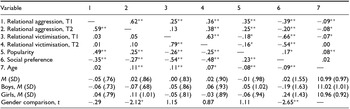
Bivariate correlations, Ms and SDs, and t tests comparing boys and girls on all measures are shown in Table 1. Relational aggression at T1 was significantly positively associated with T2 relational victimisation, but only for girls. However, T1 relational victimisation was not significantly correlated with T2 relational aggression for either gender. Both boys and girls who were more relationally aggressive at T1 were nominated as more popular, yet lower in social preference by their peers. In addition, older boys were nominated as more, and older girls were nominated as less relationally aggressive at T2. Boys’ popularity and social preference decreased with age whereas girls’ popularity increased with age. When examining group differences, boys were lower in relational aggression at T2 than girls (but not T1). Also, boys were lower in social preference than girls.
Bivariate Correlations Between all Variables, Means and SDs, and Comparison of Boys and Girls (N = 357)

Note: Correlations for boys (n = 185) are below the diagonal and correlations for girls (n = 172) are above the diagonal.
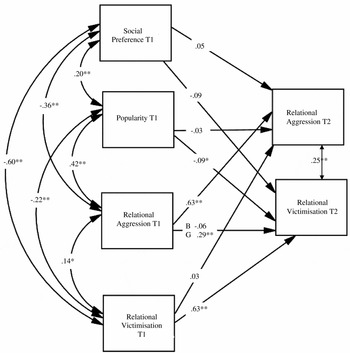
Social Process and Peer Socialisation in Boys and Girls
In the first path model, the focus was only on gender moderation of the direct effects between relational aggression and victimisation over the two waves, and the direct effects of T1 peer status on T2 aggression and T2 victimisation. Thus, we tested a two-group (boy, girl) model of all associations shown in Figure 1. The model had zero degrees of freedom, so fit statistics are not reported. In this model, there was evidence of gender moderation. When we compared the fit of a model with all paths fixed to gender equality to a model with all paths freed to differ by gender, the fit of these two models was significantly different, χ2 diff (14) = 39.22, p < .001. Upon further analyses, only one directional path was found to differ for girls and boys. T1 relational aggression was significantly associated with more T2 relational victimisation (relative to T1, which we will sometimes refer to as change over time) for girls, but not boys. Also, T1 popularity was associated with a less relational victimisation by T2.
Results of testing the social process model and peer socialisation model of relational aggression and victimisation.

Relational Aggression Predicting Later Victimisation: Gender and Peer Status Moderation
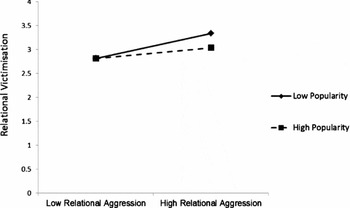
We next tested both gender and peer status as moderators of the association of T1 relational aggression with T2 relational victimisation (i.e., the association of aggression with changes in victimisation over time). Thus, we tested a group (boy, girl) model, adding the relational aggression × popularity interaction. This model had a good fit to the data, χ2(1) = 1.146, p = .284, CFI = 1.00, RMSEA = 0.02 (90% CI 0.00–0.14), p = .472, the relational aggression × popularity interaction was associated with T2 relational victimisation (−.09, p = .043) and there was no evidence of gender moderation. When the significant interaction was examined further (Gaskin, Reference Gaskin2012), the association between T1 relational aggression and T2 relational victimisation (relative to T1 victimisation) was weaker when participants were high, relative to low, in popularity as hypothesised (see Figure 2).
Social process model: Illustration of the significant interaction effect of T1 relational aggression and popularity with T2 relational victimisation (relative to T1 victimisation).

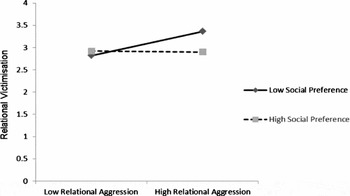
Next, we added the relational aggression × social preference interaction to the two-group (boy, girl) model, which resulted in a good fit, χ2(1) = 3.38, p = .066, CFI = .997, RMSEA = 0.08 (90% CI 0.00 to 0.18), p = .189. The relational aggression × social preference interaction was associated with T2 relational victimisation, and gender differences were suggested, χ2 diff (14) = 57.65, p < .001. The association of the relational aggression × social preference interaction with T2 relational victimisation was significantly stronger (and only significant) in girls (−.24, p < .01) than boys (.03, ns). When we probed the significant interaction for girls further (Gaskin, Reference Gaskin2012; see Figure 3), the association between T1 relational aggression and T2 relational victimisation (relative to T1) was weaker for more preferred girls compared to those girls nominated as lower in preference by their peers.
Social process model: Illustration of the significant interaction effect of girls’ T1 relational aggression and social preference withT2 relational victimisation (relative to T1 victimisation).

Relational Victimisation Predicting Later Aggression: Gender and Peer Status Moderation
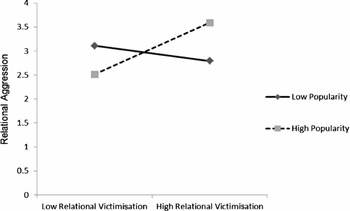
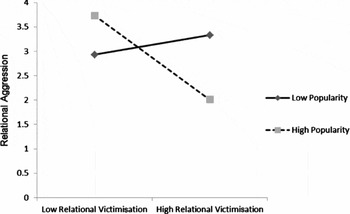
We next tested gender and peer status as moderators of the association of T1 relational victimisation with T2 relational aggression. Adding the relational victimisation × popularity interaction to the two-group (boy, girl) model resulted in an adequate fit to the data on most indices, χ2(1) = 6.87, p = .009, CFI = 0.991, RMSEA = 0.13 (90% CI 0.05 to 0.23), p = .047. The interaction had a direct association with T2 relational aggression, and gender moderation was supported, χ2 diff (14) = 46.61, p < .01, with the interaction differing and significant for both boys (.27, p = <.01) and girls (−.21, p = .048). When the interaction was probed further, the association between T1 victimisation and T2 aggression (relative to T1 aggression) was stronger and negative for high popular compared to low popular girls (see Figure 4), but stronger and positive for high popular compared to low popular boys (see Figure 5).
Peer socialisation model: Illustration of the significant interaction effect of girls’ T1 relational victimisation and popularity with T2 relational aggression (relative to T1 aggression).

Peer socialisation model: Illustration of the significant interaction effect of boys’ T1 relational victimisation and popularity with T2 relational aggression (relative to T1 aggression).

Finally, when the path from the relational victimisation × social preference interaction to T2 relational aggression was added, this model had a good fit to the data, χ2(1) = 3.90, p = 0.048, CFI = .997, RMSEA = 0.09 (90% CI 0.01–0.19), p = .153. However, the interaction path was not significant, and there was no evidence of gender moderation.
Discussion
In the present study, the focus was on the bidirectional unfolding of relational aggression and victimisation, which is enacted to harm social relationships in the peer group. We investigated whether early adolescent relationally aggressive behaviour may yield increasing relational victimisation with time, as proposed by the social process model (Boivin & Hymel, Reference Boivin and Hymel1997), and whether early relational victimisation may yield increasing relationally aggressive behaviour over time, consistent with the peer socialisation model (Rose & Rudolph, Reference Rose and Rudolph2006). We hypothesised that these associations, especially the association of aggression with later victimisation, would differ depending on popularity and acceptance by peers, and differ for girls and boys. In particular, being highly popular or more preferred by peers was expected to protect against increasing relational victimisation in response to aggression, as has been suggested in previous research (Zimmer-Gembeck & Duffy, Reference Zimmer-Gembeck and Duffy2014). Also, such protection may be particularly found among girls rather than boys, given that girls’ aggressive behaviour has previously been more strongly associated with indices of peer status than the same behaviour exhibited by boys (Bukowski, Gauze, Hoza, & Newcomb (Reference Bukowski, Gauze, Hoza and Newcomb1993).
Summary of Findings
When we examined gender moderation of the direct bidirectional effects between relational aggression and victimisation, without testing moderation by peer status, our findings generally supported the social process model (Boivin & Hymel, Reference Boivin and Hymel1997), rather than the peer socialisation model (Rose & Rudolph, Reference Rose and Rudolph2006), but only among girls. Consistent with previous research (e.g., Ostrov, Reference Ostrov2008), we found that relationally aggressive girls were reported by their peers as experiencing more relational victimisation over time. However, contrary to previous research (Yeung & Leadbeater, Reference Yeung and Leadbeater2007) and the proposed direct associations in the peer socialisation model (Rose & Rudolph, Reference Rose and Rudolph2006), relational victimisation was not associated with relational aggression over time in this model.
When peer status, measured as popularity and social preference, was examined as a moderator of associations between relational aggression and victimisation, there was some support for both social process and peer socialisation models. First, relational aggression had a weaker association with relational victimisation over time among girls who were more liked by their peers. This finding was in support of the social process model (Boivin & Hymel, Reference Boivin and Hymel1997) and our hypothesis that social preference would protect relationally aggressive girls from victimisation. When considering popularity, no gender differences were found, with results highlighting the protective effects of popularity among relationally aggressive early adolescents against increasing relational victimisation. Therefore, low levels of popularity add risk for victimisation regardless of gender, whereas low social preference adds risk for victimisation, particularly for relationally aggressive girls. This finding highlights how popularity and social preference are each resources that seem to protect relationally aggressive early adolescents and girls, respectively, from future peer-reported relational victimisation.
Second, there was some support for the peer socialisation model (Rose & Rudolph, Reference Rose and Rudolph2006) among both boys and girls when examining the moderating role of popularity, but not social preference in the relational victimisation-aggression link. That is, popularity moderated the link between victimisation and increasing aggression over time for both boys and girls, albeit in opposite directions. Specifically, among high popular girls, those who were more relationally victimised were more likely to be nominated by their peers as relationally aggressive over time. Thus, being victimised seemed to have a stronger socialising effect on popular girls’ aggressive behaviour at T2. In contrast, among high popular boys, those who were more relationally victimised were less likely to be nominated by their peers as relationally aggressive over time.
Perhaps this pattern stems from the different ways that early adolescent boys and girls experience relational victimisation. Previous research has shown that boys tend to find rumour spreading and attempts at social exclusion less threatening than girls (Crick, Grotpeter, & Bigbee, Reference Crick, Grotpeter and Bigbee2002). Therefore, it is possible that, for boys, relational victimisation is seen as reinforcing their popular status and maintaining their reputation among male and female peers alike, resulting in less aggression in response. These boys may not consider retaliation in the form of relational aggression necessary, compared to relationally victimised popular girls who may feel more threatened by rumour spreading and social exclusion and react with aggression increasing over time. However, these gender-specific patterns were not found when considering the moderating role of social preference in the direction of the peer socialisation model (Rose & Rudolph, Reference Rose and Rudolph2006). That is, social preference did not moderate the relational victimisation-aggression link.
Strengths and Limitations
Whereas the present study had a number of noteworthy strengths, including its longitudinal design, and inclusion of peer-nominated relational aggression and victimisation, there were also two primary limitations. First, although we had a relatively large group of participants, 90% of the study sample were white Australians, potentially compromising generalisability to other cultural groups. Previous research has shown that nominations of relational aggression (e.g., from teachers or peers) may be influenced by gender role norms and stereotypes (Underwood, Galen, & Paquette, Reference Underwood, Galen and Paquette2001), as well as different cultural perceptions of aggression (Weisz, Chaiyasit, Weiss, Eastman, & Jackson, Reference Weisz, Chaiyasit, Weiss, Eastman and Jackson1995). Therefore, future research should consider implementing research designs that can be interpreted cross-culturally, such as those with multiple methods, including observation techniques (French, Jansen, & Pidada, Reference French, Jansen and Pidada2002).
Second, different forms of aggression have been utilised in combination and also differentiated in various ways throughout the literature (i.e., direct, indirect, physical, verbal, social, relational). In the present study, we utilised ‘relational aggression’, a term which has been well validated and which is commonly distinguished from overt aggression (physical and verbal) in the extant literature (Cillesen & Mayeux, 2004; Little, Henrich, Jones, & Hawley, Reference Little, Henrich, Jones and Hawley2003). However, it may be pertinent to consider reconceptualising overt and relational aggression to align with more contemporary research, which acknowledges that some relational forms of aggression may be less covert in nature (e.g., name calling) and may overlap with the verbal component of overt aggression. For example, in future research, verbal aggression and relational aggression may be categorised based on the salience of the perpetrator (Juvonen, Wang, & Espinoza, Reference Juvonen, Wang and Espinoza2013).
Conclusion
The present study findings expand on previous research testing social process and peer socialisation models (e.g., Ostrov, Reference Ostrov2008; Ostrov & Godleski, Reference Ostrov and Godleski2013; Rose & Rudolph, Reference Rose and Rudolph2006; Zimmer-Gembeck & Duffy, Reference Zimmer-Gembeck and Duffy2014), and highlight the relevance of social status, both popularity and social preference, and gender for understanding how relationally aggressive behaviour and victimisation unfold over time. Primary support was found for a social process model of relational aggression and victimisation among girls, but with the addition of social status in the present study, these associations were further elucidated. Including social status as a moderator highlighted that both social process and peer socialisation models may be at work when identifying patterns of increasing relational aggression and victimisation over time, during early adolescence. Moreover, considering popularity and social preference identified girls and boys who were more protected or more vulnerable to increasing relational aggression or victimisation. These findings inform future research in this field with the suggestion that relational aggression and victimisation, and their association, may differ depending on gender and peer status, with each contributing to these behaviours and experiences as they unfold over time.