Introduction
Pipunculidae (Diptera) is a family of generally small flies that are immediately striking in appearance for possession of almost spherical heads that are mostly covered by their compound eyes. They have about 1400 described and perhaps as many as 2700 total extant species distributed worldwide (Rafael and Skevington Reference Rafael and Skevington2010). The family is well known for their endoparasitic larvae, all of which (where known) develop within Auchenorrhyncha, with the exception of Nephrocerus Zetterstedt, whose larvae have been found in adult Tipulidae (Diptera) (Koenig and Young Reference Koenig and Young2007; Kehlmaier and Floren Reference Kehlmaier and Floren2010). Rafael and Skevington (Reference Rafael and Skevington2010) recently provided a brief summary of their natural history.
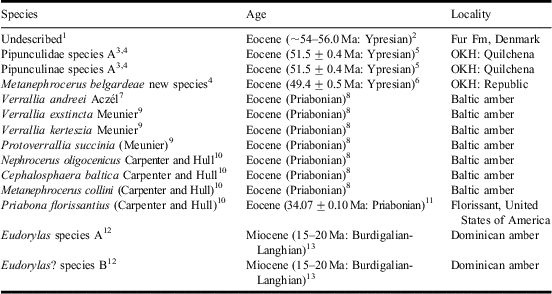
The oldest currently known fossil pipunculid is from the earliest Ypresian (early Eocene) Fur Formation of Denmark (Bonde et al. Reference Bonde, Andersen, Hald and Jakobsen2008). The remaining fossils are from later in the Eocene (Baltic amber; Florissant, Colorado, United States of America) and the early Miocene (Dominican amber) (Table 1). Here, we expand knowledge of the fossil record of the family to include the mid to late Ypresian, describing three new species (one named) from the Okanagan Highlands series of deposits of far-western North America (Archibald et al. Reference Archibald, Greenwood, Smith, Mathewes and Basinger2011). Two are based on specimens from Quilchena, British Columbia, Canada, mentioned briefly by Archibald and Mathewes (Reference Archibald and Mathewes2000), and a third is based on a new specimen from the Klondike Mountain Formation at Republic, Washington, United States of America. We also examined the single known specimen of the late Eocene (Priabonian) Protonephrocerus florissantius Carpenter and Hull from Florissant, Colorado, re-describe it, and transfer it to a new genus that we propose here.
Localities and ages of fossil Pipunculidae.

The age of Baltic amber is not precisely known, and is considered older in the Eocene by some authors; we follow Perkovsky et al. (Reference Perkovsky, Rasnitsyn, Vlaskin and Taraschuk2007) in considering it to be Priabonian (late Eocene) in age. OKH = Okanagan Highlands. The specific epithet “exstincta” (Verrallia exstincta Meunier) was misspelled “extincta” by Carpenter and Hull (Reference Carpenter and Hull1939). The question mark states that the specimens most liekly belongs to Eudorylas.
1, Bonde et al. (Reference Bonde, Andersen, Hald and Jakobsen2008); 2, Chambers et al. (Reference Chambers, Pringle, Fitton, Larsen, Pedersen and Parrish2003), and see discussion by Archibald et al. (Reference Archibald, Cover and Moreau2006); 3, Archibald and Mathewes (Reference Archibald and Mathewes2000); 4, this paper; 5, Villeneuve and Mathewes, 2005; 6, Wolf et al. (Reference Wolfe, Gregory-Wodzicki, Molnar and Mustoe2003); 7, Aczél (Reference Aczél1948); 8, Perkovsky et al. (Reference Perkovsky, Rasnitsyn, Vlaskin and Taraschuk2007); 9, Meunier (Reference Meunier1903); 10, Carpenter and Hull (Reference Carpenter and Hull1939); 11, Evanoff et al. (Reference Evanoff, McIntosh and Murphey2001); 12, De Meyer (Reference De Meyer1995); 13, Iturralde-Vinent and MacPhee (Reference Iturralde-Vinent and MacPhee1996).
Material and methods
Localities
The mid to late Ypresian material that we examined here consists of three specimens preserved as compression fossils in lacustrine shales recovered from two of the Okanagan Highlands series of fossiliferous depositional basins. These occur sporadically over about a 1000 km of south-central British Columbia, Canada, into north-central Washington, United States of America. The region was covered by a forest that was broadly similar to (and perhaps the antecedent of) the modern Eastern Deciduous Zone of eastern North America, but also included plant taxa that are now extinct, or range in East Asia (e.g., Metasequoia Hu and Cheng; Cupressaceae) or low latitudes (e.g., palms) (Greenwood et al. Reference Greenwood, Archibald, Mathewes and Moss2005). This was a temperate-climate upland during the warmest sustained portion of the Cenozoic (Zachos et al. Reference Zachos, Dickens and Zeebe2008). Archibald et al. (Reference Archibald, Greenwood, Smith, Mathewes and Basinger2011) recently summarised the environment and paleontology of these deposits, and Greenwood et al. (Reference Greenwood, Archibald, Mathewes and Moss2005) and Moss et al. (Reference Moss, Greenwood and Archibald2005) treated their climates and forest communities in detail.
Quilchena
The Quilchena basin contains conglomerate, sandstones, minor coal and fossilifereous lacustrine shales, and mudstones of the Coldwater Beds (Cockfield Reference Cockfield1948). The locality where specimens in this paper were collected is on the west side of Quilchena Creek, which has been radiometrically dated as mid-Ypresian (51.5 ± 0.4 Ma) based on argon-argon dating of sanidine (Villeneuve and Mathewes Reference Villeneuve and Mathewes2005). A diverse fossil flora was supplemented by new collections of plants and insects (Archibald and Mathewes Reference Archibald and Mathewes2000). Leaf margin analysis and nearest living relative analysis indicate that Quilchena was the warmest of the Okanagan Highlands localities, with mean annual temperature (MAT) estimated as lower mesothermal ∼15 °C (Greenwood et al. Reference Greenwood, Archibald, Mathewes and Moss2005).
Republic
The Klondike Mountain Formation bears a rich record of insect, plant, and other fossils recovered from exposures in and near the town of Republic, Ferry County, north-central Washington. It is late Ypresian, 49.4 ± 0.5 Ma old (Wolfe et al. Reference Wolfe, Gregory-Wodzicki, Molnar and Mustoe2003). The fossil described here was collected at exposure B4131, within the town of Republic. The climate was mesic, with an upper microthermal MAT of about 9–11 °C by leaf physiognomy, and a few degrees warmer by nearest living relative bioclimatic-based analysis, and mild winters with few, if any frost days (Greenwood et al. Reference Greenwood, Archibald, Mathewes and Moss2005).
The re-described species is from Florissant Formation lacustrine shale at Florissant, Colorado, United States of America.
Florissant
The Florissant Formation has a long history of paleontological work on its rich flora and insect fauna, as summarised by Meyer (Reference Meyer2003). It is radiometrically dated as 34.07 ± 0.10 Ma, i.e., late Priabonian (Evanoff et al. Reference Evanoff, McIntosh and Murphey2001). Like the Okanagan Highlands, it preserves a temperate-climate montane forest community, but about 15–18 million years younger. Climatic estimates indicate a similar to higher MAT than the Okanagan Highlands, ranging from 10.8–17.5 °C by various analyses (review by Smith Reference Smith2008).
Terminology
Morphological terminology follows previous works by C.K. (e.g., Kehlmaier Reference Kehlmaier2005). Geochronology follows Gradstein et al. (Reference Gradstein, Ogg, Schmitz and Ogg2012). Abbreviations of institution names are: SR, The Stonerose Interpretive Center, Republic, Washington (WA), United States of America; SFU, Simon Fraser University, Burnaby, British Columbia (BC), Canada. Ma is Mega annum, million years. The abbreviation K-Pg (Cretaceous-Paleogene) is used rather than the outdated K-T (Cretaceous-Tertiary).
Systematics
Subfamily Nephrocerinae Carpenter and Hull
Tribe Protonephrocerini Aczél
Genus Metanephrocerus Aczél
Metanephrocerus belgardeae Archibald, Kehlmaier, and Mathewes, new species
(Fig. 1)
Metanephrocerus belgardeae Holotype, SR 08-06-02. (A), photograph; (B), drawing; (C), labelled drawing of wing (veins labelled in blue, i.e., A1, CuA2, are folded over); (D), detail of the distal portion of the abdomen; (E), details of the preserved portions of the thorax and legs. Abbreviations: wing veins: cx, coxa; dm, discal medial cell; fe, femur; mb, membrane that enables great articulation between tergites 6 and 7, great mobility of the ovipositor; pl, postpronotal lobe; s1, sternite 1; st, setae, which we treat as pleural setae (see text); t1-t7, tergites 1–7; tb, tibia; tr, trochanter. A, B to scalebar; C to scalebar; D, E to scalebar; all = 2 mm.
Diagnosis. Separated from other species of Protonephrocerini by large size, wing 9.2 mm long (others:<6 mm); and by wing colouration (others: hyaline apart from pterostigma).
Etymology. The specific epithet is a patronym formed from the surname of Ms. Azure Rain Belgarde, collector of the holotype, recognising her contribution in donating this specimen to the Stonerose Interpretive Center.
Material. Holotype: SR 08-06-02; part only. A female with both wings, which are clearly preserved, but with their basal posterior portions folded; clearly preserved abdomen in dorsal aspect; damaged and somewhat indistinct thorax, also in dorsal aspect; and possibly parts of the legs (see Discussion; Fig. 1), all disarticulated, in close proximity. Housed in the SR collection. Collected by Azure Rain Belgarde at Republic, Washington, exposure B4131, 9 May 2007.
Description. Female. Head absent. Thorax indistinctly preserved (see Discussion; Fig. 1). Legs fragmentary, portions preserved, separated from thorax. Apex of femur with some stronger bristles possibly part of anterior row of bristles. Wing. Length 9.3 mm; width not determinable as preserved (folded). Membrane heavily infuscated in basal half except basalmost portion; weakly infuscated in apical half, most distinctly along veins. Pterostigma complete, very long. Third costal section as long as second costal section, 3X fourth costal section. R4+5, M1 terminate separately at apex. M2 present, about half M1+2 stem length. Crossvein r-m joins cell dm shortly basad its basal third. Cell dm upper margin (sections 2, 3 of vein M1+2) angled where r-m joins cell dm but both sections individually straight. Crossvein dm-cu straight, without appendix. M1 gently curved distad dm-cu to margin. Anal vein (A1) developed, joining CuA2 before wing margin (presence of anal lobe not determinable as posterior half of wing hind margin folded in both wings). Abdomen. Length from anterior midpoint of tergite 1 to posterior tip ∼4.4 mm as preserved. Sternite 1 preserved as two small triangular sclerotised plates. Tergite 1 without a distinct lateral patch of long setae. However, lateral portions of tergites 1, 2 with longer setae, roughly 0.2 mm. Tergites 1–6 sparsely, evenly covered with short setae (roughly 0.13–0.15 mm), slightly longer towards tergite posterior margin (best preserved on tergites 3, 4). Suture between tergites 5, 6 faintly visible. Abdomen broadest in posterior half tergite 4 (∼2.1 mm). Ovipositor appears (see preservation, below) rather short (extending towards anterior margin of tergite 4), base clearly roughly trapezoid (tergite/sternite 7), slightly less than half width of tergite 5. Membrane between tergite 6, 7 that enables great ovipositor articulation, visible as ovate region. Morphology distad base of ovipositor (suture between tergites 7, 8; tergite 9, i.e., actual piercer) indistinctly preserved.
Locality and age. Republic, WA, late Ypresian.
Discussion. The thorax is quite poorly preserved, perhaps somewhat crushed as well as indistinct, and its characters are difficult to interpret, and we describe few details of its morphology. The postpronotal lobe, the scutum, and possibly also the scutellum are visible; however, a distinct suture/fold between the scutum and scutellum cannot be discerned. The only apparent longer bristles visible are likely disarticulated from the thorax, and so their preserved positions are not informative as to whether these belong to the scutum, and are notopleural setae, or to the anepimeron, and are pleural setae (other detected thoracic setae might also have had their positions shifted post mortem). However, their lengths are consistent with that of pleural setae (notopleural setae are much longer), which, therefore, we consider these to be. The reduction of sternite 1 is the normal condition in Pipunculidae, and the two small, rather triangular portions preserved in this specimen might well have constituted a single, larger sternite 1 with translucent margins.
SR 08-06-02 is distinct from species belonging to Pipunculinae and Chalarinae by the following.
Pipunculinae: by its long third costal section (Pipunculinae: shorter); and by the third section of M (anterior margin of cell dm distad crossvein r-m) being long and straight (Pipunculinae: normally distinctly curved posteriad; in Collinias Aczél and some Tomosvaryella Aczél straight but much shorter).
Chalarinae: separated from Verrallia Mik, Jassidophaga Aczél by shorter lateral abdominal setae (in Verrallia and Jassidophaga, these are longer); the long third costal section (in Verrallia and Jassidophaga, it is shorter); and by ovipositor shape (in Verrallia and Jassidophaga, the base is more elongate). It is separated from Chalarus Walker by size (species of Chalarus are ∼2–3 mm long) and wing venation, which is partly reduced in Chalarus.
We assign this new species to the Nephrocerinae and Protonephrocerini respectively, based on its combination of wing venation character states discussed above and below. The monophyly of this subfamily is in question (Skevington and Yeates Reference Skevington and Yeates2000), although within this group as defined, it is most easily excluded from the Nephrocerini (one genus: Nephrocerus) by possession of six unmodified abdominal segments (in the Nephrocerus female, there are seven); by its long third costal section (in Nephrocerus, this is very short); and by the presence of a pterostigma (absent in Nephrocerus).
The other tribe of Nephrocerinae, the Protonephrocerini, has two described genera, Protonephrocerus Collin and Metanephrocerus Aczél (we treat a new, third genus as tribe incertae sedis, below). Monophyly of the Protonephrocerini was supported by the analysis of Skevington and Yeates (Reference Skevington and Yeates2000), but the relationships among its three species was unresolved.
The length of the setae, discussed above as pleural setae, is consistent with Metanephrocerus, although longer setae might be absent as a taphonomic artefact. More significantly, R4+5 terminates on the wing margin not as far below the apex as in Protonephrocerus, but rather as in Metanephrocerus. Although this region is folded in both wings, an anal lobe is evident, consistent with the condition found in the Baltic amber Metanephrocerus collini Carpenter and Hull, but lacking in the extant Protonephrocerus chiloensis Collin (present in Priabona florissantius, see below) (Fig. 2). By these factors, we assign this species to Metanephrocerus, although tentatively, awaiting more complete specimens to add further clarity to this determination. We exclude this species from Priabona as in the diagnosis of that genus, below.
Comparative wings of (A), Metanephrocerus collini (late Eocene, Baltic amber), redrawn from Aczél (Reference Aczél1948); (B), Priabona florissantius (late Eocene, Florissant, Colorado, United States of America); (C), Protonephrocerus chiloensis (extant, Chile, drawn from a specimen in the collection of the Finnish Museum of Natural History). Metanephrocerus collini and P. florissantius possess an anal lobe (al) posteriad vein A1, which P. chiloensis lacks. In (B), the dotted lines indicate the folded, damaged margin of the wing, which extends at least some amount further; in the basal portion, exact wing margin is indistinct, but the presence of an anal lobe is confident by detected microtrichia covering the membrane. Not to scale.
At ∼9.3 mm in length, the wings of SR 08-06-02 are among the largest known in the family; only those of Nephrocerus are larger, reaching up to 12 mm, e.g., Nephrocerus scutellatus (Macquart). The wings of Claraeola nigripennis (Hardy) reach 9 mm, and those of Amazunculus Rafael species are up to 8.5 mm in length; all others are smaller. Second, its pattern of wing infuscation is distinct from any other Protonephrocerini; indeed, from any other pipunculid. Such broad wing colouration is only found in a few members of Eudorylini (Pipunculinae): Amazunculus (in three species: all with the basal third completely coloured); Basileunculus Rafael (in three species: entire wing equally dark) and C. nigripennis (entire wing equally dark).
Tribe incertae sedis
Genus Priabona Archibald, Kehlmaier, and Mathewes, new genus
Etymology. The genus name is derived from “Priabonian”, the age of the Florissant Formation from which the genus is known, which is in turn named for the small village Priabona in the northern Italian region of Veneto, the locality of the traditional type section of the age (Gradstein et al. Reference Gradstein, Ogg, Schmitz and Ogg2012). Gender masculine.
Diagnosis.Priabona is defined here as a distinct evolutionary lineage of generic rank tentatively placed within the Nephrocerinae, separated from others of that subfamily by the following character states (e.g., Fig. 2). Femora with at least some dark peg-like spines ventrally (others, absent); third section of vein M1+2 strongly bent, i.e., upper margin of cell dm (as in some Pipunculinae, not other Nephrocerinae). Further distinct from Metanephrocerus, Protonephrocerus by posterior margin of head distinctly incised halfway up; further from Protonephrocerus by presence of anal lobe. Further distinguished from Nephrocerus by flagellum with pointed tip below (kidney-shaped, rounded below in Nephrocerus); by mid, hind femora with longer setae anteriorly/anterodorsally towards apex (absent in Nephrocerus); by wing with darkened pterostigma (absent in Nephrocerus); by long third costal section (very short in Nephrocerus).
Description. As for its only species.
Type species.Protonephrocerus florissantius Carpenter and Hull, here designated.
Included species.Priabona florissantius (Carpenter and Hull), new combination.
Discussion.Priabona is excluded from the Chalarinae by morphology of the flagellum, which is similar to that of Pipunculinae; by the distinctly incised posterior margin of the head; and also by the presence of at least some dark peg-like spines ventrally on the femora, which are absent in that taxon (although also absent in other Nephrocerinae). While the morphology of the flagellum does suggest a pipunculine affinity, it is excluded from that subfamily by the distinctly incised posterior margin of the head and the presence of longer setae anteriorly/anterodorsally towards the apex of the mid and hind femora. It is further distinct from some Pipunculinae by the darkened pterostigma of the wing and the strongly bent third section of vein M1+2, (i.e., the upper margin of cell dm, not drawn so strongly curved by Carpenter and Hull Reference Carpenter and Hull1939: fig. 5).
Although this genus does not conform to the tribe concepts of either Nephrocerini or Protonephrocerini as currently defined, we hesitate to erect a new tribe for it, particularly given its tentative placement in the Nephrocerinae. We, therefore, treat it here as tribe incertae sedis, awaiting clarification of its affinity at this level from new fossils.
Priabona florissantius (Carpenter and Hull), new combination (Fig. 3)
Protonephrocerus florissantius Carpenter and Hull, Reference Carpenter and Hull1939: 14.
Priabona florissantius, holotype, MCZ 3976. (A), photograph; (B), drawing; (C), closeup photograph of head, with eye notch indicated by arrow; inset drawing of antenna; (D), labelled drawing of right wing; (E), labelled drawing of left wing (reversed left-right for comparison). Diagonal lines showing in photograph are cracks in the Canada balsam coating, not in the rock. Much of the precise wing hind margins in (B), (C), (D), are difficult to determine precisely (where dotted lines absent), and are represented as likely here; presence of anal lobes confidently established by wing membrane microtrichia. Wings are hyaline apart from pterostigma, but appear lightly infuscated by their covering of microtrichia. On legs, dashed lines indicate indistinct edges; dots indicate setal bases. al = anal lobe, ?? = unaccounted for leg portion (possibly another insect?). All to scale = 2 mm.
Revised diagnosis. This sole species of Priabona, distinguished from others of Nephrocerine as in genus diagnosis.
Revised description. Body length 4.5 mm. Head. No details (e.g., frons, ocellar triangle, mouth parts) confidently discernable, except antennae with small scape, pedicellus, Pipunculinae-like flagellum with pointed tip ventrally. Arista introduced anterodorsally, of ordinary length, thickened towards its base. Posterior margin of head appears distinctly notched/incised half way up. Occiput not discernable from ommatidia of compound eye; its dimension unknown. Thorax. Scutum, scutellum, sub-scutellum discernible, as in Fig. 3. Arrangement of thoracic sclerites, chaetotaxy unknown by preservation. No distinct long bristles detected, probably detached from body if present. Legs. All six legs partly visible (especially femora, tibiae). Coxae, trochanters not clearly discerned. One profemur with some small, dark peg-like spines posteroventrally near apex. One mid femur with small dark peg-like spines forming an anteroventral and a posteroventral row. One hind femur with small dark peg-like spines anteroventrally towards apex. One mid femur with three long anterodorsal setae at apex, some short, dorsal setae forming two rows. One hind femur with anterodorsal row of longer setae visible in apical third. Tibiae with longitudinal rows of minute dark setae. No distinctly longer bristles or setae detected. Tarsi hardly visible, but basitarsus of one hind leg appears rather short. Wing. Length 4.6 mm; width not determinable as preserved (posterior margins folded or indistinct). Membrane hyaline except pterostigma. Pterostigma complete, touching Sc. Third costal section about half second section length, 2.5X fourth costal section. R4+5, M1 terminate separately at apex. Stem length of M1+2 straight, slightly longer than dm-cu, which is damaged in both wings. M2 present, length unknown by wing damage. Distad branching of M2, M1 moderately curved. Crossvein r-m joins cell dm shortly before its basal third. Cell dm upper margin (sections 2, 3 of vein M1+2) angled where r-m joins cell dm; section 3 strongly curved. Anal vein (A1) developed, apparently joining CuA2 before wing margin (with some doubt: region somewhat damaged). Presence of anal lobe discernible by presence of wing membrane posteriad anal vein. Abdomen. Tergites 1–5 confidently discerned. Longer lateral bristles on tergite 1 not detected, but few setae covering tergites (longest ∼0.1 mm). Interpretation of structures posterior to tergite 5 ambiguous (see Discussion). Tergite 6 clearly present, but size not determinable.
Material examined. Holotype: MCZ 3976; part only. A complete specimen of undeterminable sex, with body preserved in lateral aspect, covered with a coating of Canada balsam.
Locality and age. Florissant, Colorado, late Priabonian.
Discussion. Determination of the sex of this insect with any confidence is not possible. The globular structure at the apex of the abdomen might be interpreted either as the sytergosternite 8, in which case this is a male, or as part of the female terminalia including the ovipositor.
Subfamily Pipunculinae Aczél
Pipunculinae species A (Fig. 4)
Pipunculidae indet. Archibald and Mathewes, Reference Archibald and Mathewes2000: 1449, Table 1, fig. 9D.
Pipunculinae species A, Q-0397. (A), photograph; (B), drawing; (C), labelled top wing in (A) and (B); (D), bottom wing in same orientation as (C) for comparison. Wing membrane is hyaline apart from pterostigma; appearance of light infuscation results from microtrichia. Scale = 2 mm.
Description. Body: little known as preserved; complete length estimated close to 5 mm judging from wing length. Head, legs absent. Thorax apparently without any distinct bristles (as preserved). Wing: length 4.7 mm preserved (more complete wing), likely ∼4.8 mm complete; width ∼1.4 mm; third costal section close to 1.5 length of fourth; R4+5 ending below wing apex; ratio between fourth, fifth costal section 1:2.3; R4+5 rather straight; R4+5 and M1+2 separate to margin; M1+2 simple, M2 absent; M bounding cell dm distad r-m rather straight, only gently curved distally; crossvein r-m joins cell dm at basal fifth; cell dm comparatively long, narrow, with upper margin (sections 2, 3 of M1+2) rather straight, only gently curved distally; M1+2 distad cross-vein dm-cu to margin weakly sinuate; dm-cu straight, without appendix; anal vein A1 developed; anal lobe narrow. Abdomen. Tergite 1–4 partly preserved. Tergite 2, 3 same length (about 0.6 mm). Short setae visible on tergites 2–4 apparently evenly, sparsely distributed as preserved.
Material. Q-0397 (part only): a mostly incomplete specimen of unknown sex. Preserved: posterior part of thorax (scutum, scutellum); parts of tergites 1–4 (in dorsolateral aspect); both wings, largely intact, apparently not greatly distorted. Housed in the collection of SFU, collected by R.W.M., late 1990s.
Locality and age. Quilchena, BC; mid-Ypresian.
Discussion. The body and wing lengths of Q-0397 are within the ranges seen in other published pipunculid fossils. Despite its fragmentary state and the lack of longer bristles or setae on the posterior margin of the scutellum and tergites, the fully coloured pterostigma, the moderately long third costal section, the presence of an anal lobe, and the absence of vein M2 makes it most likely that this specimen belongs to the Pipunculinae. The fact that R4 + 5 reaches the wing margin below the wing's apex represents a synapomorphy shared with Protonephrocerus and Metanephrocerus (although distinctively further below the apex in Protonephrocerus, see above), genera currently placed within the Nephrocerinae. However, there is growing evidence for a paraphyletic Nephrocerinae with Protonephrocerini (Protonephrocerus and Metanephrocerus) as sister to Pipunculinae (Skevington and Yeates Reference Skevington and Yeates2000), in which case, this character state would be plesiomorphic. The location of crossvein r-m is very basal relative to cell dm, a state found in many Dorylomorpha Aczél and some Cephalops Fallén (both Pipunculinae). Further, the comparatively narrow and long cell dm with its upper margin, which is only gently curved distally, resembles the condition found in Microcephalopsini (Pipunculinae). There has been considerable dispute among Pipunculidae workers as to whether the presence/absence of a separated vein M2 is a valid character for distinguishing genera (Kehlmaier Reference Kehlmaier2006; Kehlmaier and Assmann Reference Kehlmaier and Assmann2010). Undoubtedly a plesiomorphic character state, the current knowledge of Pipunculidae systematics indicates that both character states can be present within some genera, e.g., Claraeola Aczél, Pipunculus Latreille, and Verrallia.
Subfamily incertae sedis
Pipunculidae species A (Fig. 5)
Pipunculidae indet. Archibald and Mathewes, Reference Archibald and Mathewes2000: 1449, Table 1.
Pipunculidae species A, Q-0118 (A), photograph; (B), drawing; (C), labelled left wing in (A) and (B). Abbreviations as in Fig. 1, except o = base of ovipositor. (r-m) = inferred joining point of crossvein r-m with M by characteristic bend in M. All to scale = 2 mm.
Description. Body. Head. Partly preserved but distorted; no diagnostic features can be assessed. Thorax. Scutum, scutellum clearly visible but no evidence for chaetotaxy detected. One pleural surface visible but no fine structures discernible. Legs not preserved. Wing. Length ∼5.9 mm, width ∼2.0 mm; “right” (see Discussion) wing seems somewhat detached from body; colouration indistinctly preserved, but pterostigma clearly visible in distal portion of Sc space; third costal section about 3X length of fourth; R4+5, M1 terminate separately at wing apex. M2 present, its apical portion missing due to damaged rock; crossvein r-m vaguely visible on one wing, meets cell dm shortly before its basal third (at point where M is slightly angled); crossvein dm-cu gently curved, without appendix. M1 gently curved distad branching of M2 to wing margin; A1 developed; anal lobe present, developed. Abdomen. Approximately 3.1 mm length from posterior tip of scutellum to posterior tip of abdomen. Tergites 1–6, base of ovipositor (tergite 7) visible. No comments can be made concerning chaetotaxy as preserved.
Material. Q-0118 (part only), a rather complete female, with legs and part of the head missing and indistinctly preserved wings, in dorsal aspect, except the head and thorax are in dorsolateral aspect; housed in the collection of SFU. Collected by R.W.M. at Quilchena, British Columbia, in the mid-1990s.
Locality and age. Quilchena, BC; mid-Ypresian.
Discussion. Placement of this specimen within a genus or even subfamily is not possible due to insufficient preservation of diagnostic characters. However, it can be excluded with certainty from Nephrocerus (six abdominal segments), Protonephrocerus (anal lobe present), Chalarus (wing venation complete), and Tomosvaryella and Dorylomorpha (pterostigma present). The curvature of crossvein dm-cu on both wings indicates that this is not merely an artefact. A distinctly curved dm-cu is only known in Amazunculus (Eudorylini) (Skevington and Yeates Reference Skevington and Yeates2001: fig. 4A), but a weak curvature as seen in our specimen does occur in other genera as well (e.g., Eudorylas Aczél and Pipunculus) (Rafael Reference Rafael1986; Rafael and Menezes Reference Rafael and Menezes1999).
We refer to the “right” wing in the description, meaning as depicted in Fig. 5. There was no counterpart to this fossil found, which is preserved without relief on the rock; therefore, it is impossible to know if this side were the mirror image side of the pair, and whether this wing is the right or left wing.
Evolutionary implications of the Okanagan Highlands Pipunculidae
The new Okanagan Highlands species indicate that the general outline of modern Pipunculidae diversity was set early in its history. The molecular analysis of Wiegmann et al. (Reference Wiegmann, Trautwein, Winkler, Barr, Kim and Lambkin2011) indicates that it is sister to the Schizophora, and that these diverged in the late Cretaceous, about 70 Ma ago in the Maastrichtian. The considerably differing morphologies of these new species – representing two of the three modern subfamilies (Nephrocerinae, Pipunculinae) – show a high degree of diversification by the mid to late Ypresian, only about three million years after the oldest known pipunculid fossil from the early Ypresian Fur Formation of Denmark (Bonde et al. Reference Bonde, Andersen, Hald and Jakobsen2008). This diversity is further increased shortly after in the Priabonian, as seen in Priabona florissantius and the Baltic amber species (Table 1), which include the third extant subfamily (Chalarinae). The joined M1+2 in the Okanagan Highlands Pipunculinae species A shows the presence of this derived character state, dominant in modern species, over twice as old as was previously known from Miocene Dominican amber (De Meyer Reference De Meyer1995).
The Eocene history of the Pipunculidae is set in the greater ecological/evolutionary context of recovery following the K-Pg extinction crisis. In western North America, Cretaceous floras and insect leaf herbivory ichnofossil data show high diversity plant communities and plant–insect interactions, which were replaced by largely depauperate plant communities and highly disturbed food webs during a prolonged Paleocene recovery (Wilf and Labandeira Reference Wilf and Labandeira1999; Johnson and Ellis Reference Johnson and Ellis2002; Labandeira et al. Reference Labandeira, Johnson and Wilf2002; Wilf and Johnson Reference Wilf and Johnson2004; Wilf et al. Reference Wilf, Labandeira, Johnson and Ellis2006). Outside North America, however, extinctions may have been less severe with greater distance from the Chicxulub bolide impact site, or recovered more rapidly, or both (Iglesias et al. Reference Iglesias, Wilf, Johnson, Zamuner, Cúneo, Matheos and Singer2007; Wappler et al. Reference Wappler, Currano, Wilf, Rust and Labandeira2009).
In the Ypresian, plant and insect diversities regained high levels at least into mid-latitudes, with modern tropical levels of species richness in insects and plants found in the Okanagan Highlands (Wilf et al. Reference Wilf, Cúneo, Johnson, Hicks, Wing and Obradovich2003; Archibald et al. Reference Archibald, Bossert, Greenwood and Farrell2010; Archibald et al. Reference Archibald, Greenwood and Mathewes2012; Smith et al. Reference Smith, Basinger and Greenwood2012). Insect leaf feeding damage also indicates a return to balanced, highly diverse food webs (Labandeira Reference Labandeira2002; Wilf et al. Reference Wilf, Labandeira, Johnson, Cúneo and Dilcher2005; Currano et al. Reference Currano, Wilf, Wing, Labandeira, Lovelock and Royer2008; Wappler et al. Reference Wappler, Labandeira, Rust, Frankenhäuser and Wilde2012).
Where known, Pipunculidae are almost exclusively parasitoids of Auchenorrhyncha (Hardy Reference Hardy1987; Skevington and Marshall Reference Skevington and Marshall1997; Rafael and Skevington Reference Rafael and Skevington2010; but see Koenig and Young Reference Koenig and Young2007; Kehlmaier and Floren, Reference Kehlmaier and Floren2010), who, like pollinators and some other phytophagous insect groups (e.g., phytophagous Coleoptera and Lepidoptera), underwent large-scale Paleogene diversification (Grimaldi Reference Grimaldi1999; Grimaldi and Engel Reference Grimaldi and Engel2005). By the late Ypresian, auchenorrhynchs had become rich, prominent community elements in these diverse forests (Fig. 6); over 97 species were recently illustrated from Republic (Archibald et al. Reference Archibald, Greenwood and Mathewes2012), and 55 were recovered in a three-week collecting effort at the nearby Okanagan Highlands McAbee locality (Archibald et al. Reference Archibald, Bossert, Greenwood and Farrell2010). Although Quilchena is less sampled, their fossils are anecdotally common there as well.
A sample of Auchenorrhyncha from Republic, Washington, United States of America. (A), SR 95-01-19; (B), SR 87-28-11; (C), SR 96-10-04; (D), SR 06-31-08; (E), SR 06-28-01; (F), SR 09-42-01B (forewing). Where known, almost all Pipunculidae are endoparasites of mostly Auchenorrhyncha, which were plentiful and diverse in the Okanagan Highlands. The great size of Metanephrocerus belgardeae is not surprising, given that North American Eocene Auchenorrhyncha include numerous impressively large species like these (Scudder Reference Scudder1890, p. 315: “some of them are gigantic”; Reference Scudder1895, p. 14: “we are struck by the great size of these insects”). Note Plecia (Diptera: Bibionidae) in 6B (black arrow) for size comparison. All from Republic exposure B4131 (like M. belgardeae) except (A) and (C), which are from A0307, about 800 m south of B4131. All SR collection. All to scale = 1 cm.
The Pipunculidae is, then, an exemplar in miniature of a broad Paleogene ecological/evolutionary revolution. Its early history is concordant with expanding food web dynamics during recovery from the K-Pg extinction, the diversification and spread of complex, species-rich angiosperm-dominated forest types, and the associated radiation of phytophagous insects and their predators, the Pipunculidae among them.
Acknowledgements
The authors thank Catherine Brown at the Stonerose Interpretive Center (Republic, Washington), for loan of Republic specimen SR 08-06-02 and Azure Rain Belgarde for its donation to Stonerose; and Guy Rose for support of paleontology at Quilchena. They thank David Anthony, Lisa Phillips, Michael Sternberg and Jan Hartford, Darrell Kittilstred, Kelley Carlson, and Karl Volkman, the collectors and donors (to Stonerose) of the Auchenorrhyncha fossils depicted in Fig. 6 (in the order of appearance). They also thank Marlow Pellatt of Parks Canada for use of microphotography equipment. The authors thank Vladimir Makarkin (Russian Academy of Sciences, Vladivostok, Russia) for helpful comments on a draft of this manuscript. R.W.M. and S.B.A. gratefully acknowledge funding by grant # 3835 to R.W.M. from the Natural Sciences and Engineering Research Council of Canada (NSERC).