This article seeks to explain the abundance of rural churches located outside village boundaries in late antique Palestine. Despite the ‘extramural’ location of these churches, since they were constructed by leading local citizens of those very villages they were obviously in close contact with them. Why were they built? What were the relations between them and churches built within village boundaries? These churches present a socio-political-cum-religious conundrum and, digressing as they do from the ‘canon’ imposed by the ecclesiastical administration, they represent an intriguing dimension of life in the rural Levant in late antiquity.
This phenomenon has hitherto been under-represented in the study of private religious buildings in the Byzantine Empire, in both late antiquity and subsequent periods. John Philip Thomas deals extensively with the construction of church institutions by private entrepreneurs in rural areas of the empire, and although he is familiar with private chapels (eukteria) in rural environs, he does not deal with their location and function in the rural landscape or analyse their relationship to the village.Footnote 1
This article will tell the story of these churches and explain their presence as a manifestation of a struggle over control in what Pierre Bourdieu defines as ‘the field of religious goods’. After contextualising the basic principles of Bourdieu's theory, a few examples of churches built outside villages in late antique Palestine will be examined. It will be suggested that their shared characteristics identify them as family churches that fit Bourdieu's analytical framework.
Theoretical analysis of this subject may require comparative study with parallel rural areas throughout the Levant, because references in imperial legislation to church buildings on private land in the countryside, especially in the days of Justinian, show that they were widespread throughout the empire, and it is reasonable to assume that such legislation was directed not only at sacred building initiatives within settlements but also to construction carried out on private rural estates (χωρία).Footnote 2 To this end, a few relevant examples of late antique churches in Syria and Phoenicia, whose characteristics are similar to the churches in Palestine will also be examined. Nevertheless, the relatively large number of examples in Palestine suffice for an exposition of the theoretical model.
The construction of family churches as part of competition in ‘the field of religious goods’ will be examined and briefly related to imperial civil and ecclesiastical legislation as it pertained to private religious construction and the way in which private churches were run. It will be demonstrated that the establishment of an extramural family church is a material manifestation of an ongoing struggle between non-establishment forces in rural society and the imperial and ecclesiastical establishment, a struggle waged in the field of religious goods.
The field of religious goods: theoretical conceptualisation
Three fundamental concepts underpin Bourdieu's social theory: field (‘champ’), habitus and capital. The field is the arena of ongoing struggles to preserve or change the balance of power among players in that field. For the field to function, there must be objects of struggle and people who are prepared to ‘play the game’, that is, subjects who are willing to enter the field and fight to change or to maintain its balance. The fields are varied – political, economic, cultural or religious; they are all scenes of struggles to amass capital, whether that capital is material or symbolic.Footnote 3
The religious field, like any socio-political field, is a competitive arena in which individuals and institutions vie for the production, amassing and control of the capital, whether material or symbolic, that is unique to that field. In the religious field, competition is usually between the orthodox-hierarchical establishment, whose investments in that field Bourdieu defines as ‘professional’, and those in the private sector (the laity) who compete with that establishment.Footnote 4 The religious field, like other fields, is also conformist, organising itself according to an economic logic that can relate and respond to every practice, even if that practice does not conduct itself according to economic logic. It does so as a means of maximising symbolic profit from the capital produced by that practice.Footnote 5
How do the players conduct themselves within the field? What are the guidelines or the practices that lead them to act in that field both as individuals in society and as having individual interests? The way in which various entities conduct themselves in any field is defined by Bourdieu through the concept of ‘habitus’. Habitus is a collection of behaviours, habits, talents, tendencies and preferences that a person acquires during his or her life. It is a system of rules inculcated in a person by means of specific situations. The person acts as an individual according to that system of rules, which associates social characteristics to the individual's actions. Given that all members share the same habitus, such actions give individuals their place within their social circle.
The struggles in the field may take place among individuals and groups that either share the same habitus or, as the case may be, come from a different social background and hence a different habitus. A relevant example would be the main protagonists of the current article, i.e. the wealthy rural philanthropist and the village clergyman. They operate in the same religious field even though they do not necessarily share the same habitus. The case may well be that members of a certain habitus acting within a certain field will take upon themselves the rules of that field and act according to the field's known criteria so as to reap material and symbolic profits from that field and to maximise them without exceeding its rules and boundaries.
These profits manifest themselves in the third aspect of Bourdieu's theory – capital. This concept refers to assets amassed by the actions of people in the habitus of the field in question. Capital can be social, economic or symbolic; amassing capital of one type does not necessarily come at the expense of amassing capital of another type. On the contrary, it can strengthen and maximise the profits.Footnote 6
The construction of ecclesiastical buildings by private individuals, utilising private resources, is a material expression of struggles in the religious field that cannot be understood only by means of the categories of faith and religion. It is also part of a complex process that seeks to derive personal profits through the demonstration of religious piety and serves as a key tool in the competition in the field of religious goods. That said, while the construction of religious structures within the boundaries of the village, like those constructed outside those boundaries, is also driven by philanthropy and therefore produces symbolic and material gains, the construction of family churches outside the boundaries of the village requires additional explanation. Before turning to that explanation the examination of a few case studies is in order.
Private family churches outside village limits: test cases from late antique Palestine
Ḥorbat Ḥeshek: Upper Galilee
In 1993 Mordechai Aviam discovered the remains of a church at Ḥorbat Ḥeshek in the western Upper Galilee, near the ruins of a village from the Byzantine period, known as Ḥorbat Maḥoz, which was in the diocese of the Galilean city of Sepphoris.Footnote 7 The church has three apses and a well-preserved colourful mosaic floor. Near the reservoir under the atrium, part of a family tomb was found. Likewise, not far from there, abutting the northern wall of the church, was a wine press similar to those found at other churches in the area. Inscriptions uncovered on the mosaic floor of the church help to identify it as a family church.
The content of the inscriptions provides a glimpse into the world view, values and aspirations of the builder.Footnote 8 The church was built in ad 518 by a private individual, Demetrius, who held the ecclesiastical rank of deacon. In one of the inscriptions he states that he built the church for ‘his own salvation, and for the salvation of George his son and of all their household’. The church was dedicated to St George, apparently the famous martyr who was to become one of the most venerated saints in the Christian world. Demetrius also took the trouble to dedicate a special chapel to another saint, Sergius, to two of his other children – Demetrius and Theodora – who died at a young age, and to his father Somas. A similar case of a private family church is a small but lavish chapel excavated in El Bire, south-east of Hierapolis (modern Manbij) in northern Syria, where a deacon named Julian dedicated a ‘prayer house’ (οἰκτήριον) to ‘the victorious martyrs’ (τῶν καλλινίκων μαρτύρων), at his own expense. Unfortunately the nearby ancient village was not surveyed.Footnote 9 At Ḥorbat Ḥeshek, however, the spatial picture is reasonably clear. The church is located some 250 metres from the village at Ḥorbat Maḥoz. A few dozen metres east of the village are two more small churches that have not yet been excavated but whose remains, which can be seen on the surface (atrium, narthex, plastered reservoir, apse, lintels with crosses and winepress), resemble those at Ḥorbat Ḥeshek. Two more churches have been surveyed in the village, one of which was apparently the village community church.
Although no plan of Ḥorbat Maḥoz was published following the survey, a schematic plan may be sketched of an archetypal village, conforming to the landscape there, as well as to other villages in Palestine in particular and in the Levant in general (see fig. 1). It shows how, in addition to the community church, private churches built by individuals might be found both within and beyond the built areas of villages. There might also be monasteries, both within the village boundaries and a short distance away from them.Footnote 10
A schematic plan of an archetypal village.

The findings from Ḥorbat Ḥeshek raise a number of questions. For example, why there is no mention of a priest in the inscriptions? Can it be concluded that religious rituals in such places, if they were regularly conducted,Footnote 11 were performed by the founding deacon? And, more generally, why would a person invest a great deal of money and effort to establish a private church outside the village limits? Who would attend this church, considering the distance between it and the village houses? Is it possible to distinguish between the motives of those who established private churches within the village and those who established them outside of it, which were thus perhaps beyond the influence of the provincial ecclesiastical establishment? And, more important, can we attribute significance beyond pure faith to this rather large investment in the demonstration of religious piety?
As far as the absence of a priest from the private oratory is concerned, it seems unlikely that the founder, the deacon (Demetrius at Ḥorbat Ḥeshek and Julian at El Bire in Syria), conducted the liturgy himself.Footnote 12 It is more likely that he relied on members of the local village priesthood, who shared the same ‘habitus’, to conduct the liturgy. It is also likely that the liturgy was not performed on a regular basis but only on saints’ days or family occasions.
The answers to the rest of the questions can be found within the socio-political framework that Bourdieu presents in his theory on competition in the religious field. However, before analysing the data from Horbat Ḥeshek in accordance with this theory, some similar examples from Byzantine Palestine may be examined.
Ḥorbat Kenes, Karmiel
The church at Ḥorbat Kenes (Khirbet el-Kanayis) was uncovered during the construction of a school in the city of Karmiel in Galilee. This is a fairly large church, dated to the sixth century, with well-preserved inscriptions on its mosaic floor.Footnote 13 In an earlier study it was concluded that the church was a rural monastery built in close proximity to the village of Ḥorbat Bata. Thus the remains of the church at Ḥorbat Kenes was linked to the unusual landscape that was believed had to have developed around Ḥorbat Bata: a village surrounded by satellite monasteries.Footnote 14
Further research on the village and its monasteries, and re-examination of the inscriptions from Ḥorbat KenesFootnote 15 led to revised conclusions: Ḥorbat Kenes was not a rural monastery, but a private church built by a family from Ḥorbat Bata. The church was apparently a martyrium in honour of St Conon, who was martyred in Pamphylia, but originally came from Nazareth in the Galilee.Footnote 16 Hence his veneration in this Galilean village may have been an expression of a local saint's cult.Footnote 17 The inscription mentioning the saint is truncated and the first lines are missing. Those are the lines that may have mentioned the name of the principal donor to the construction of the church, and extended a blessing to the whole village (apparently Ḥorbat Bata), its saints (plural) and St Conon. The rest of the mosaic inscriptions mention other individuals, including a deacon and an archdeacon, but not a priest. In contrast, inscriptions uncovered in another church in the nearby village, alongside many donors who were not clerical officials, refer to two priests, two archdeacons and the church's oikonomos or housekeeper (οἰκνόμος τῆς ἐκκλησίας), ranks and offices typical of community churches.Footnote 18
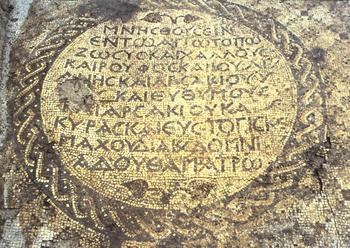
The main inscription in the church at Ḥorbat Kenes (see fig. 2) is in a medallion uncovered in the narthex, in front of the entrance to the nave. It opens with the words: ‘In the holy place’ (ἔν τῷ ἃγιῳ τόπῳ). Four of the names it mentions are couples (Zosus and Khalus, Rufus and Juliana, Eutymia and Arsakius, Kyra and Eustorgious), one is a son of one of the couples (a second Arsakius, the son of Rufus and Juliana) and three names at the end of the inscription are of women mentioned alone, Domna, Adutha and Matrona. The inclusion of the three women in the inscription supports the opinion that this was an extended family, with its couples and children, unmarried men and unmarried women. While a baptistery was built in a side chapel in the church, which was not common in family churches, it may be assumed that the church's proximity to the village and its dedication to the local martyr, Conon, led the villagers, and certainly the members of the extended family on whose land the church was built, to use Conon's martyrium to baptise their newborns.
The church at Ḥorbat Kenes, Karmiel: the main inscription. Reproduced by courtesy of the Israel Antiquities Authority.

Three tombs were discovered in the church (in a side chapel, in the corner of the narthex and in the southern portico of the atrium). These apparently date to the period when the church was in use. The dating is based on their orientation, which conforms to the direction of the church, as well as on the fact that they were hewn and built rather than dug into the ground. The southern tomb, in the atrium, is covered with stone slabs one of which was perforated, apparently because this was where libations were poured. In addition, after the tomb was hewn it was covered with a new mosaic, which shows that the atrium continued in use after the burial. Repairs to the floor over the other two tombs could not be discerned with certainty because the edges of the mosaic around the tomb were not preserved. Although complete skeletons were not discovered in the tombs, but only bone fragments, they were found to contain pottery vessels and jewellery – which might indicate that this was a family burial.
It should also be noted that in this church, unlike others discussed in this article, no installations for agricultural production have yet been found.
Kissufim
Near Kibbutz Kissufim in the western Negev a church was discovered, built in the late sixth century, with a richly decorated mosaic floor featuring floral and geometric patterns, mythological scenes and inscriptions.Footnote 19 In two of the inscriptions Theodoros, deacon, paramonarios (warden), monk and abbot of the St Elias Monastery, is mentioned.Footnote 20
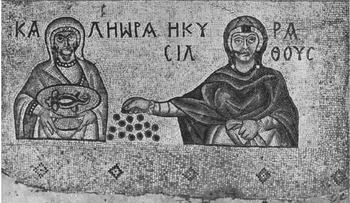
On the panel in the central mosaic carpet, above the scene of a horseman defeating a panther, an inscription appears: ‘Work of Alexander’, perhaps either Alexander the Great or the artisan who made the mosaic.Footnote 21 Two female figures are also depicted: one, the Lady Silthous (or Lady of Silthos), is shown offering a donation (supposedly to the church itself). Next to her is another woman, apparently a symbolic figure, carrying a tray with an offering and the word καληωρα, i.e. ‘good hour’, appearing near her image (see fig. 3). This scene is a reminiscent of the image of Anicia Juliana, the sixth-century Byzantine princess, who was known as patron of the arts and appears as such on the famous Vienna Dioscorides manuscript.Footnote 22 Yet while Anicia Juliana belonged to the royal family and her image, distributing largesse, seems to have symbolised imperial patronage,Footnote 23 in contrast, the Lady Silthous built a private church within the framework of her own local, rural community, where she sought to appear as a pious contributor. Nevertheless, in both cases, their role as donors competing in the field of religious goods is vividly reflected in the artist's work.
The church at Kissufim: the Lady Silthous on the mosaic floor. Reproduced from Cohen, ‘A Byzantine church and its mosaic floors at Kissufim’, by courtesy of the Israel Exploration Society.

The richness of the mosaic in Kissufim, the name of the donor (or founder), and the possibility that the objects falling from the hands of the Lady Silthous are coins, symbolising her generosity, led to the suggestion that this is a rural family church, whose deacon, Theodoros, lived in the nearby village or nearby monastery and was a holy man, venerated by the villagers and by the Lady Silthous. When the church was built the founder mentions him along with Mishael, bishop of the city of Gaza (who is not known from any other source) as the person in whose day the church was built. At the centre of the church's northern aisle a tomb was discovered containing five skeletons. One was that of a woman named Maria, and the other of a priest by the name of Zonainus; both are mentioned in the inscription over the tomb.Footnote 24 However, no priest is mentioned in the dedication inscription on the church floor, and it may be assumed that – like the church at Ḥorbat Ḥeshek – the priests who officiated in this church, and perhaps in the monastery of Theodoros, came from the nearby village. The priest Zonainus and the woman Maria, whose relationship is unknown, were buried at the site when the church was built; they apparently belonged to the founding family.
Ḥorbat Tinshemet
Another example of a rural family church was discovered at Ḥorbat Tinshemet (near the modern town of Shoham). This church, dated to the sixth century, was dedicated to St Bacchus and was built about 300 metres from a village that the excavator identifies as Betomelgezis, which appears on the Madaba Map.Footnote 25 The church has an impressive mosaic floor in the centre of which is a medallion with an inscription that reads: ‘This is the place of the lord Jesus’. Adjacent to the church is a large olive oil press, and about twenty metres away, a cistern and a burial cave. Pieces of an unusual marble medallion, bearing the image of the goddess of fortune, Tyche, were discovered in the oil press and in the church. The medallion mentions one Flavius Theodoros Procopius, who was apparently a senior official in the administration of Palæstina Prima. The medallion had once been affixed to the wall of the church with five bronze nails and, according to Uzi Dahari, it was brought there from the Gaza area, where it had been used in a public building and not a church. Dahari believes that the landowner who built the church hung the medallion as a blessing over the oil press that was adjacent to the church.Footnote 26 The components of this church, its location and the adjacent oil press and family burial cave, as well as the absence of any mention of a priest, all very much resemble the church at Ḥorbat Ḥeshek.
Some typological characteristics of rural family churches
Joseph Patrich's Digital corpus of early Christian churches in the Holy Land presents five types of churches: monastic, community and memorial churches, martyria and burial chapels.Footnote 27 A variety of models could exist even in the same small rural community like the one at Ḥorbat Maḥoz (see fig. 1). Churches similar to the one at Ḥorbat Ḥeshek are included in the types that Patrich calls ‘memorial churches’ or ‘martyria’. In the light of the four test cases examined a further subgroup may be proposed: extramural family churches. Private memorial churches and martyria were fairly common in the East in late antiquity; most of them were built within villages or in monasteries as a manifestation of religious piety and philanthropy. However, family memorial churches built on private land outside villages are unique to late antiquity and the circumstances of their establishment warrant a separate study.
Although the above-mentioned churches are only a few examples of family churches in the rural landscapes of late antiquity, a number of characteristics can be pin-pointed which are common to most of the churches of this type and are less common, and perhaps even rare, in community churches within the village:
1. Extramural churches were located at a short distance from the village and were visible from it. The visibility of the extramural church seems to have played a significant role in the competition in the religious field.
2. Rites commemorating martyrs were performed in the extramural churches. In contrast, churches within villages, like the one in Ḥorbat Bata, were not necessarily dedicated to one specific saint.Footnote 28
3. Extramural churches contained tombs in which only a few individuals, apparently relatives of the founder, were interred, in a family plot on which the church was built. In village community churches, if burials were identified, they were cut under the floor after the church was built.Footnote 29
4. Lower-echelon clergy, such as deacons and lectors, and, more rarely, priests, are mentioned in inscriptions found in these churches. They were probably the founders of the family church, regardless of their religious role in the community.Footnote 30 In a few cases the inscriptions indicate that the clergy mentioned were relatives of the church's founder. The officiants at the church were apparently priests who came from the village. In contrast, in the case of a village church, a plethora of senior church officials is usually commemorated in inscriptions, including archbishops, bishops, country bishops (chorepiskopoi) and rural inspectors (periodeutai).Footnote 31 Moreover, in many village churches, a variety of local donors, including both minor clergy (deacons, readers and subdeacons) and laypersons (men and women) were commemorated for their donations.
5. All the surviving inscriptions in village churches mention only the initiators of their construction, which may indicate the desire of the founders to make a highly visible impression. In the village church, on the other hand, it was also common to commemorate a large number of lay persons for their donation to such churches. In the church at Bata, for instance, beside the bishop and the priests who are commemorated on the mosaic floor, the names of twelve villagers appear – lower clergy and lay persons – each of whom donated only a negligible amount of money.Footnote 32
6. In three of the extramural churches there are reservoirs and adjacent agricultural installations – wine presses or olive oil presses; it is unusual to see presses attached to churches within the village.Footnote 33
To the churches so far discussed above, which meet all the suggested characteristics, may be added dozens of others that have been excavated in rural areas of Palestine and that meet some of the typological criteria presented here. A few meet most of the criteria, like the church at Khirbet Damun on Mount Carmel,Footnote 34 the church at Khirbet Beit Sila in western Samaria,Footnote 35 the churches at Ein DabFootnote 36 and Beit Anun in Judea.Footnote 37 However, in most cases it is difficult to determine the relationship between the excavated church and the adjacent village, which is usually not excavated, or in most cases even surveyed.
If the suggested classification is accepted, the background to the construction of rural private family churches and the reasons for constructing them must be clarified, for it was clearly not to provide religious and ritual services to the local community. First, however, it is appropriate to survey the attitude of the imperial and ecclesiastical authorities towards private religious building initiatives. This is of great importance since the wide distribution of extramural churches was the result of a socio-economic-religious reality that is clearly manifested in imperial and canonical legislation.
Private churches in civil and ecclesiastical law
Most of the churches that were built in the Byzantine Empire were private initiatives.Footnote 38 This was largely a continuation of the involvement of the pagan Roman aristocracy in public construction.Footnote 39 However, in the Christian empire, religious devotion and philanthropy were additional motives for church construction. This led to a growth in such private initiatives and the transformation of private church construction into a quite unregulated area until the mid-fifth century ce. According to an early law, from ad 398, clergy were to be appointed from the congregations at such institutions or from those who lived or worked there. Footnote 40 This law apparently led to the appointment of low-ranking clergy without suitable training.Footnote 41
The lack of supervision and control over these churches with regard to ceremonies, content or the theological messages that they conveyed was very disturbing to the ecclesiastical authorities, and led to debate over the matter at the Council of Chalcedon in ad 451. The council adopted a canon requiring private builders of churches to place them under supervision and to place their clergy under the control of the local bishop. Moreover, from that time, the appointment of deacons and priests for these churches was prohibited without the approval of the bishop in whose diocese the church was located. About a hundred years later, the emperor Justinian was still dealing with this issue; he promulgated two new edicts (in ad 537 and 545), which did no more than reiterate the principles of the Council of Chalcedon on the question.Footnote 42 Thus it is clear that efforts to bring order to this unregulated realm had so far been unsuccessful and that private individuals continued to build private churches, frequently ignoring the law requiring their supervision by the ecclesiastical authorities.
Regulations enacted by church leaders and legislation passed by emperors to affirm the status of bishops in leading and organising private religious rituals in private churches attest to an existing situation: landowners built churches and appointed clergy to serve there as they wished.Footnote 43 The goal of the legislation on the matter was not only to strengthen the status of the bishop, but also to protect the ‘true faith’ (Chalcedonian Orthodoxy) in private churches, and prevent them from becoming bastions of ‘heresy’, that is, of Monophysitism.Footnote 44 The fact that the emperor had repeatedly to legislate to impose restrictions on the builders of private churches shows that such construction was prevalent, as indeed is evident from the archaeological evidence.
If the motives for the private construction of religious institutions in urban contexts, and possibly also within villages, can be understood as resulting from a combination of Roman aristocratic tradition and Christian piety, how is construction of private family churches outside the built areas of the villages to be explained? According to Doron Bar, most churches in rural areas were built on the edges of the villages or outside their built areas; Bar interprets this as a manifestation of Christianity's weakness in the hinterland and of a dearth of involvement by the urban ecclesiastical establishment.Footnote 45 An alternative interpretation is that the flourishing of ecclesiastical foundations in rural areas towards the end of the fifth century and during the sixth century was the result of economic growth and prosperity rather than of missionary activity on the part of the ecclesiastical establishment. In fact, the construction of private churches without the patronage of the church hierarchy – as is the case with the extramural churches – indicates that Christianity was quite deeply rooted in the life of the rural population.
The reasons for building family and private churches in the countryside should therefore be sought in the socio-political and economic realities of rural society. Bourdieu's conceptualisation can be used to explain the ecclesiastical and imperial response to the proliferation of private church construction as a manifestation of the struggle of the establishment in the field of religious goods against participants of a different habitus who were attempting to increase their status in that field.
A Bourdieusian view of the construction of the Christian rural landscape in late antiquity: struggles in the field of religious goods
In late antiquity, a local elite developed in the hinterland, consisting of a rural-secular oligarchy and minor clergy.Footnote 46 Opposing it was the provincial ecclesiastical hierarchy, which strengthened its position in the urban hinterland by means of chorepiscopoi or periodeutai and priests in villages and monasteries.Footnote 47 The church owned rural lands and also initiated construction projects on those lands. John Rufus, for example, mentions the village of Gantha, north of Jerusalem, which the Empress Eudocia bequeathed to the Church of Jerusalem.Footnote 48 In dedicatory inscriptions from Ein Samia, in that same area, construction of a community church initiated by the periodeutes Sergas is mentioned. It was assisted by contributions from two respected villagers, Sergius and Zonanus.Footnote 49 According to Bourdieu, investments by church authorities in the field of religious goods were ‘professional’ investments. Wealthy lay donors – villagers with the means and desire to enter into a struggle in this field and to invest their own resources – competed with them. These two elites, the rural and the ecclesiastical, each represented a different habitus, both of which were in competition.
An example of this can be found at Khirbet Suhmata in the Galilee. In the inscriptions on the mosaic floor of the church there, an archbishop named John is mentioned (possibly of Tyre), along with Kyriakos the chorepiscopos, and as a senior official in the provincial administration, Marinus the comes. The man who built the church, Stephanos the archipresbyteros, is also mentioned. Michael Avi-Yonah, who published the inscriptions in 1934, remarked on the balance of power reflected in these inscriptions: he pointed out that private donors with the rank of deacon are mentioned in an inscription in the aisle, while the dominant church hierarchy is mentioned in the foundation inscription.Footnote 50 Although Avi-Yonah could not have been aware of Bourdieu's theory, his analysis seems to emphasise the place of the ecclesiastical hierarchy of the diocese in the rural ‘field of religious goods’.
The wealthy could also build private churches or private monasteries within the village and thus leverage their contribution to the community and their status in the field of religious goods in their village.Footnote 51 In contrast, in family construction outside the village, the philanthropic element in religious piety was missing. The landowner arrived at the field of symbolic assets with a different opening gambit – he made his church subservient to the local ecclesiastical hierarchy, but he appointed lectors and deacons who were his relatives. That is the reason why inscriptions in most extramural family churches do not mention chorepiscopoi or periodeutai, who are found in village churches and sometimes even in monasteries.
An exception is the church at Ḥorvat Gerarit in the Gaza area. The church uncovered at that site is located a few hundred metres from the nearest village, and in an inscription discovered on its floor a bishop and a chorepiscopos are mentioned, as well as a deacon and an oikonomos. However, if Leah Di Segni's analysis of the inscription – by which not only the bishop and the chorepiscopos mentioned there represent the ecclesiastical rank of the diocese (in this case, of the city of Gaza), but also the deacon and the oikonomos – is accepted, then the construction of the church was not necessarily an initiative of the inhabitants of the nearby village, but rather of the urban ecclesiastical authorities of Gaza, to which the village was subservient.Footnote 52 The land at the site may even have been owned by the church and not by the village aristocracy; the mention in the inscription of the oikonomos – the housekeeper, who was also responsible for the land assets of the church – underscores this possibility.Footnote 53
Since lower-echelon clergy were prevented from administering the sacraments in the village church, these ceremonies – apparently not in consistent liturgical order – were carried out by priests who came from the nearby village. Thus the family maintained liturgical ties to the rural community and the necessary subservience to the episcopal see (which operated not only in the religious field, but also in the field of government, which Bourdieu calls the ‘field of power’). Meanwhile, the family also bolstered and increased its symbolic profits in the religious field. Ancillary material profits also increased because the land was cultivated, producing additional income for the family. That is attested by the agricultural installations found adjacent to most churches of this type.Footnote 54 Thus, practical thinking, not unconnected to religious piety, manifested itself; the presence of these installations near the church may even have given their products a halo of sanctity, which was an added blessing to the church-building landowner.
Bourdieu defines ‘power’ as the outcome of constant struggle for legitimacy in a given field.Footnote 55 Based on this concept, the construction of family churches in the countryside in late antiquity can be seen as a struggle to create and maintain power.
If for this reason alone there should be no separation between piety – and the demonstration of religious piety in the construction of a family church near the village – and the utilitarian purchase of symbolic capital that led to the donor's augmented social and economic influence over his or her surroundings. By means of religious construction, landowners and church-builders were able to purchase an ‘entry ticket’ into the ‘field’ in which economically valuable goods were traded by means of increasing symbolic social capital.
The mosaic floor of the church at Kissufim, in which the Lady Silthous is depicted bestowing coins on the church that she entrusted to a monk from a nearby monastery, is an artistic manifestation of the activities of the rural elite in the field of religious goods. While the Lady Silthous was a member of the village aristocracy and therefore related to the habitus of the traditional rural oligarchy, Anicia Juliana from Constantinople represented the opposite habitus, the one that may be represented in the provinces by the governor and his administration and by the higher levels of the church hierarchy.
Drawing on the ‘holy trinity’ of concepts that largely frame Bourdieu's analysis of society – field, capital and habitus – this article has attempted to explore, explain and contextualise a unique phenomenon in late antique Palestine: family churches, built just outside the village perimeter. Harnessing these concepts and the relationship between them as developed by Bourdieu enables a new and distinctive understanding of a primary aspect of his sociology of religion – the field of religious goods. This is the field in which different players take part and struggle over the various capitals to be found in religious activities. Like any other field, the religious field is not devoid of economic, political and social components and does not shy away from struggles over various capitals.
As the religious landscape reveals, private construction of church institutions was very common in the Byzantine Empire, in both urban and rural contexts. However, the extramural private churches built in rural areas deserve special attention. These churches were the initiatives of local gentries which at times were defying direct orders from the official clergy who tried to stop them. The questions underlying this study focused on trying to make sense of the dynamics that drove private entrepreneurs to build this type of church and of the differences between these churches and village community churches. An examination of a number of extramural churches highlighted the significance of construction of churches of this type in the rural landscape of Palestine in late antiquity.
While the involvement of the local lay elite in religious construction within village boundaries strengthened the bonds between them and the new elite of ecclesiastical officials, their extramural initiatives gave members of this elite the opportunity to act piously without subordinating their profits to the diocesan administration. Recurrent imperial and ecclesiastical legislation against the unauthorised ordination of clergy by private initiators on the one hand, and the fact that these private individuals tried to avoid subordinating their institutions to the provincial church hierarchy, on the other, may explain the distribution of the extramural churches.
Contextualising this phenomenon in a sociological framework using Bourdieu's theory of fields suggests that the building of extramural private family churches was a product of the struggle between two reference groups, each representing a different habitus: the traditional rural elite on the one hand and the ecclesiastical establishment on the other. The phenomenon of extramural churches can offer a new way to look at the relationships between the two groups that developed in the hinterland. The existence of a large number of family churches in cases where the community lacked a real religious need for them can be explained as part of a socio-political process of amassing social capital on the part of the rural elite. The acquiring of such capital contributed directly to the entry of these entrepreneurs into the field of religious goods – as Bourdieu describes it – as part of their ongoing struggle to remain relevant or dominant in the economic field, and to protect their social status. The more these individuals were able to increase their symbolic capital, the greater was their influence on their material environment and their ability to aggrandise not only their status, but also their access to the field of economic goods.