In the Congo, in order to survive, we all have to be a bit corrupt, a bit ruthless. That's the system here. That's just the reality of things. If you don't bribe a bit and play to people's prejudices, someone else who does will replace you.... Even you, if you were thrown into this system, you would do the same. Or sink.
—Parliamentarian in the Democratic Republic of the CongoFootnote 1Recent research finds that states with more women involved in government are also less prone to corruption (Dollar, Fisman, and Gatti Reference Dollar, Fisman and Gatti2001; Swamy et al. Reference Swamy, Knack, Lee and Azfar2001). But a review of experimental evidence indicates that “women are not necessarily more intrinsically honest or averse to corruption than men” in the laboratory or in the field (Frank, Lambsdorff, and Boehm Reference Frank, Lambsdorff and Boehm2011, 68).Footnote 2 Rather, the attitudes and behaviors of women concerning corruption depend on institutional and cultural contexts in these experimental situations (Alatas, Cameron, and Chaudhuri Reference Alatas, Cameron and Chaudhuri2009; Alhassan-Alolo Reference Alhassan-Alolo2007; Armantier and Boly Reference Armantier and Boly2008; Schulze and Frank Reference Schulze and Frank2003). If women's inclination toward corruption is contextual, then what are the contexts in which we would expect female involvement in government to fight corruption? The answer is important to understand where gender equality initiatives present a cost-effective and politically feasible approach to cleaning up government.
We believe that democratic institutions activate the relationship between gender and corruption. These institutions make corruption a risky proposition by shrinking the potential profit, increasing the probability of discovery, and morally stigmatizing the perpetrators (Bueno de Mesquita et al. Reference Bueno de Mesquita, Smith, Siverson and Morrow2003; Kolstad and Wiig Reference Kolstad and Wiig2011; Kunicova Reference Kunicova and Rose-Ackerman2006). The risks are smaller in autocratic states where bribery and favoritism are often a normal part of doing business (Treisman Reference Treisman2007); indeed, not being corrupt may be riskier than corruption in this context. Our key argument is that women are differentially impacted by these risks and thus feel greater pressure to conform to existing political norms about corruption. There are many reasons to expect this differential impact; for example, experimental evidence indicates that women are more averse to risk-taking than men when facing comparable incentives (Jianakoplos and Bernasek Reference Jianakoplos and Bernasek1998; Watson and McNaughton Reference Watson and McNaughton2007). Women are also more vulnerable to punishment for violating political norms because of explicit or tacit sex discrimination (Stolberg Reference Stolberg2011). As a result, we think that women are less susceptible to corruption in democracies but are equally susceptible in autocratic systems. This may explain why one study finds that the relationship between female participation in government and corruption is weakened once the influence of democratic institutions is statistically controlled (Sung Reference Sung2003). As a practical consequence, we expect increasing women's participation in government to have uneven effects on corruption that vary widely across political and social contexts.
In this article, we flesh out the details of our idea and present evidence to support it. First, we examine whether men are more tolerant of bribery than women at different levels of institutionalized democracy/autocracy. Then, we investigate whether the negative association between corruption and female participation in government is robust in democratic and autocratic contexts. To preview our results, we find strong evidence that a gender gap in corruption attitudes and behaviors is present in democracies but that it is weaker or nonexistent in autocracies. This is consistent with our claim that women have stronger incentives to adapt to political norms because of the risks created by gender discrimination. We conclude by exploring alternative interpretations of our empirical findings and their policy implications. Each emphasizes a different intersection between identity factors and institutional forces as key to the context-specific relationship between women and corruption (Manuel Reference Manuel2006), but all reinforce the idea that recruiting women into government would be unlikely to reduce corruption across the board. Furthermore, they all support the idea that the relationship between lower corruption and greater female participation in government is a byproduct of the differential treatment of women (by voters or political elites).
POWER, GENDER, AND CORRUPTION
Women might be the “fairer sex” when it comes to approving of and engaging in corrupt behaviors: evidence presented by Dollar, Fisman, and Gatti (Reference Dollar, Fisman and Gatti2001, 427) shows that “a one standard deviation increase in [female participation in government] will result in a decline in corruption … of 20 percent of a standard deviation.” A more comprehensive study by Swamy et al. (Reference Swamy, Knack, Lee and Azfar2001) examines World Values Survey data at the individual and country level, survey data from firms in the country of Georgia, and covariation between corruption and female participation in government and in the labor force at the country level. Their study finds that “(a) in hypothetical situations, women are less likely to condone corruption, (b) women managers are less involved in bribery, and (c) countries which have greater representation of women in government or in market work have lower levels of corruption” (Swamy et al. Reference Swamy, Knack, Lee and Azfar2001, 26).
Some governments have already supported feminization initiatives designed to fight corruption; Swamy et al. (Reference Swamy, Knack, Lee and Azfar2001, 26) give two specific examples. In August of 1999, the police chief of Mexico City established a women-only traffic police force to fight corruption (Moore Reference Moore1999). Five months later, no female officer had yet been accused of soliciting or accepting bribes (Quinones Reference Quinones1999). Corruption also reportedly went down after women were recruited into the police force in Lima, Peru (McDermott Reference McDermott1999). Follow-up research in Lima more than a decade after the feminization initiative found a reduction in low-level corruption but persistent corruption among supervisors (Karim Reference Karim2011).
The possibilities presented by these results are exciting. Fighting corruption by increasing female participation in government would diminish the need for a painful, expensive, and politically difficult process of rooting out corruption via oversight and prosecution. Countries would also have an economic incentive to promote gender equality, bringing needed attention to the unequal status of women around the world.
Understanding the theoretical mechanisms behind this relationship would be helpful to structuring policy initiatives. The two studies cited above are largely agnostic on this point, but some recent experimental evidence suggests that the gender differences they observed are not universal.Footnote 3 For example, an experiment by Alatas, Cameron, and Chaudhuri (Reference Alatas, Cameron and Chaudhuri2009) has subjects in four different countries choose whether to punish other participants who are offering and accepting bribes; these punishments are costly for the punisher but lower the payoff of the punished participant. Regardless of whether he or she chooses to punish, bribery has negative externalities (lowers payoffs) for subjects not directly involved in the transaction. Their results show that men's willingness to punish bribery in this situation is similar in all four countries, but that women's willingness to punish is variable cross-nationally: “[W]hile women are less tolerant of corruption than men in Australia, no significant gender differences are seen in India, Indonesia, and Singapore” (Alatas, Cameron, and Chaudhuri Reference Alatas, Cameron and Chaudhuri2009, 663). Though the authors point out that “it is possible that countries with different cultural backgrounds display gender differences to different degrees,” they call for further work to “understand the reasons for the variations in gender differences in attitudes towards corruption across countries and to establish in which countries gender differences do exist” (Alatas, Cameron, and Chaudhuri Reference Alatas, Cameron and Chaudhuri2009, 678). We believe that the incentives and opportunities of an environment influence men and women in different ways, resulting in different behaviors in some situations but not in others.
Proposed Explanations for Gender Differences
We suspect that women will resist corruption in places where it is already culturally and institutionally stigmatized but will be no different than men where such practices are simply a normal part of doing business or are even expected. Women are more powerfully subject to social norms because systematic discrimination against them makes their position more tenuous. Insomuch that sex discrimination means holding women to a different (higher) standard than men for the same reward, it is riskier for them to flout the formal and informal rules of political culture because transgressions are more likely to invite retaliation. Thus, if a political culture discourages corruption, then women will avoid corrupt activities more and profess greater aversion to it (compared to men) because they anticipate suffering more severe consequences than their male counterparts.
Some experiments support the idea that punishments activate gender differences in corruption. For example, in an experiment assessing subjects' willingness to accept bribes, Schulze and Frank (Reference Schulze and Frank2003) find that women are less willing than men to accept bribes when there is some chance that bribery will be detected and punished but find no gender gap in willingness when bribery is free of risk. Similarly, Armantier and Boly (Reference Armantier and Boly2008) conduct a field experiment in the United States and Burkina Faso, where they find that, compared to men, women are equally likely to accept bribes in the absence of monitoring but are substantially less likely to accept bribes when being monitored. This may be because women are punished more harshly for corruption than men because of different social expectations for their behavior, as has been anecdotally observed in American politics: Celinda Lake, a Democratic strategist, says female politicians are punished more harshly than men for misbehavior.Footnote 4 “When voters find out men have ethics and honesty issues, they say, ‘Well, I expected that,’” Ms. Lake said. “When they find out it's a woman, they say, ‘I thought she was better than that’” (Stolberg Reference Stolberg2011).
If voters, judges, and administrators are quicker to condemn and punish women's corruption (compared to men's), then women will probably be cleaner—but only in political systems that work to fight corruption. This does not require that women be intrinsically cleaner but merely that whoever is responsible for dealing out punishment expects them to be (and that women rationally respond to these incentives).
But even if men and women are punished equally for corruption, studies have demonstrated that women tend to be more risk-averse than men in the same circumstances, particularly in financial matters (Jianakoplos and Bernasek Reference Jianakoplos and Bernasek1998; Watson and McNaughton Reference Watson and McNaughton2007). This implies that women will stay cleaner to avoid punishment even in the absence of implicit or explicit sex discrimination—at least in places where corruption is stigmatized. Indeed, this explanation implies that women would willingly participate in bribery, nepotism, and other corrupt practices if those practices were socially and politically expected (and failing to participate invited sanctions). We might, therefore, expect no gender gap (or perhaps a reversed gender gap) in corruption attitudes and behaviors in these situations.
Our explanation focuses on gender disparities in the detection and punishment of corruption, but it is also possible that women are simply provided with fewer opportunities for corruption in systems where it is surreptitious and extralegal because they are excluded from the relevant social and political networks through which corruption flows. Alhassan-Alolo (Reference Alhassan-Alolo2007, 230) presents survey data from Ghana and draws the following conclusions:
1. There is no gender gap in officials' attitudes toward corruption “when exposed to opportunities for corruption.”
2. There is also no gender gap in officials' attitudes toward corruption when officials are “surrounded by networks that engage in and/or condone corruption.”
3. There is no gender gap in officials' attitudes toward corruption “when the society expects certain acts of corruption as a moral obligation.”
Thus, it may be that women are not inherently cleaner but are less frequently in a position to take advantage of opportunities for corruption (Goetz Reference Goetz2007). If this constraint is more binding in (democratic) contexts where corruption is stigmatized and practiced in secret so that privileged information is necessary in order to find these opportunities, then this could manifest in a negative association between women in government and corruption in democracies only. As we discuss more fully in the conclusion, some implications of this argument are similar to those of our own.
Democratic Institutions as Mediator of the Relationship Between Gender and Corruption
In sum, these studies invite us to consider how institutionalized structures of punishment interact with gender politics to create the relationship between corruption and female participation in government observed in Dollar, Fisman, and Gatti (Reference Dollar, Fisman and Gatti2001). In particular, we should look at institutional arrangements that change the incentives to appropriate public policy for private advantage. When vote-buying, favoritism in government contracting, nepotism, bribery, personal loyalty over obedience to law, and other such behaviors are viewed as “corruption,” when there are incentives to expose these corrupt behaviors, and when corruption is stigmatized and punished, we expect a gender gap: women will express more disapproval and be more reluctant to participate. On the other hand, when these behaviors are ignored or are integral aspects of the structure of governance, we expect no gender gap.
Our study focuses on institutionalized democracy/autocracy measures as indicators of the social, political, and financial stigmatization of corruption. While far from comprehensive, we believe that our approach is sensible and practical. It is sensible because there are reasons to believe that some institutions associated with democracy will (on average) tend to publicize, disincentivize, and facilitate condemnation of the private use of power at public expense (Bueno de Mesquita et al. Reference Bueno de Mesquita, Smith, Siverson and Morrow2003, 102–103 and Chapter 4; Kolstad and Wiig Reference Kolstad and Wiig2011; Kunicova Reference Kunicova and Rose-Ackerman2006). It is practical because suitable measures of institutionalized democracy/autocracy are readily available. It also speaks to an existing literature that notes potential confounding between democracy and female participation in government (Sung Reference Sung2003).
There are four reasons why we believe that democracy/autocracy measures are appropriate for our study. First, democracies often divide authority among many different actors. Bribery and other forms of influence-buying agreements are more expensive, harder to monitor for compliance, and harder to keep secret when there are more rulers to buy off. Autocracies have fewer veto players and are consequently more amenable to corruption. Separation of powers might also make it difficult for corrupt officials to coordinate on raising more money than required and diverting it to private interests (Persson, Roland, and Tabellini Reference Persson, Roland and Tabellini1997; Persson and Tabellini Reference Persson and Tabellini2002, 239–41).
Second, democracies typically have electoral systems that are more competitive and have broader suffrage than autocracies. This makes efficient governance and provision of public goods a more effective means of winning the necessary number of supporters to gain office than patronage and corruption (Bueno de Mesquita et al. Reference Bueno de Mesquita, Smith, Siverson and Morrow2003). Competitive elections create a powerful incentive to expose publicly and punish corruption: viz., electoral advantage in a political campaign (Kunicova and Rose-Ackerman Reference Kunicova and Rose-Ackerman2005; Myerson Reference Myerson1993). The electoral risk associated with bribery and favoritism (and the loss of all subsequent benefits of holding public office) makes them less attractive opportunities. In autocracies, where elections are shambolic or nonexistent, these corruption-fighting incentives do not exist.
Third, the freedoms of speech and expression that are typically protected in democracies provide a greater opportunity to discover and popularize corrupt activities (Brunetti and Weder Reference Brunetti and Weder2003; Chowdhury Reference Chowdhury2004; Freille, Haque, and Kneller Reference Freille, Haque and Kneller2007). In order for corruption to be punished and stigmatized, it must first be discovered by someone who is not a beneficiary to the scheme. Journalists with a professional incentive to discover and publicize newsworthy secrets would presumably be interested in stories about corruption. Laws that protect potential whistleblowers from ex ante surveillance and prosecution make it possible for these journalists to recruit knowledgeable informants without placing them in personal danger. Open records laws make it easier to compile forensic evidence of corruption. All contribute to the dissemination of public knowledge about corrupt activities and enable formal and informal punishments to be demanded. In autocracies that restrict individual free speech and press freedoms, these pressures are all reduced.
Finally, the basis of democratic authority provides a stronger moral and conceptual basis for defining bribery, favoritism, nepotism, and personal loyalty as corrupt when compared to the basis of authoritarian government. Democratic governments purport to represent the interests and welfare of their citizens, and most forms of corruption transparently revolve around private enrichment at public expense. That is, insomuch that democratic government is by and for the people, corruption is philosophically inimical to democratic government. By contrast, autocratic governments are frequently built on the concept of personal authority, military hierarchy, or even the divine right to govern; public welfare may be only one of the state's many objectives. Additionally, the explicitly hierarchical structure of many autocratic governments directly rewards personal loyalty at the expense of loyalty to codified laws or the public weal. In this context, behaviors like favoritism, legal caprice, and bribery are not extraordinary “corruption” but rather the normal operation of a hierarchical system of personal authority.
None of this is to say that it is impossible for democracies to coexist with a culture of corruption: for example, India is recognized as a well-functioning democracyFootnote 5 but has a significant corruption problem.Footnote 6 Indeed, this may explain why Alatas, Cameron, and Chaudhuri (Reference Alatas, Cameron and Chaudhuri2009) find no gender differences in corruption attitudes in India: if corruption is ignored by voters or treated as an integral aspect of government, then we expect no gender gap. Other sociological and cultural influences may overwhelm the incentives against corruption that democracy provides. But holding these factors constant, democratic countries stigmatize corruption more than autocratic countries, and, therefore, institutionalized democracy is a viable measure of the political stigmatization of corruption in a statistical analysis that controls for potentially confounding factors.
CORRUPTION ATTITUDES AND POLITICAL INSTITUTIONS
Our theoretical framework is consistent with a gender gap in tolerance for political corruption that varies as a function of a country's political institutions. In particular, women are more disapproving of corruption than men where (democratic) institutions suppress corruption but equally approving otherwise (in autocratic contexts). We find this pattern in a cross-section of 68 countries in the World Values Survey (World Values Survey Association 2009).
Dependent Variable: Gender Gap in Tolerance of Bribes
Our World Values Survey sample contains cross-sectional data from 1999–2002.Footnote 7 For our analysis, we looked at a survey question asking respondents about the justifiability of accepting a bribe on an ordinal scale from 1–10, 1 meaning never justifiable and 10 meaning always justifiable. We created a variable that measures the difference between the average response to the question for men and women for each country in the data set. Positive numbers indicate that men are more approving of bribery than women, while negative numbers indicate that men are less approving of bribery than women. The resulting variable has a mean of 0.101 and a standard deviation of 0.100, consistent with the findings of Swamy et al. (Reference Swamy, Knack, Lee and Azfar2001) that (on average) men are more approving of bribery than women.
Independent Variable: Institutionalized Democracy and Autocracy
Our key measure of institutionalized democracy and autocracy comes from the Polity IV Project's revised combined Polity score (Marshall, Jaggers, and Gurr Reference Marshall, Jaggers and Gurr2010), as reported in the Quality of Government Dataset (Teorell et al. Reference Teorell, Charron, Samanni, Holmberg and Rothstein2009). The score places countries on a scale from −10 to 10, where −10 is strongly autocratic and 10 is strongly democratic. The combined score is the sum of two subscores: the institutionalized democracy score and the institutionalized autocracy score. Institutionalized democracy measures the extent to which a state has competitive political participation, competitive and open recruitment of executives, and constraints on executive power. Institutionalized autocracy measures the same characteristics, plus a measure of the regulation of political participation. The revised score removes or converts some special or missing cases from the normal index.
We choose the revised combined Polity score over alternatives for two reasons. First, Polity includes institutional aspects of democracy/autocracy that we wish to target and excludes other features of democracy that are not of interest to our study. Some alternative measures, such as the Freedom House measures of civil liberties and political rights, include aspects of the dependent variable, like “Is the government free from pervasive corruption?” and “Does the rule of law prevail in civil and criminal matters?” (Freedom House Reference House2012, 34–35). Second, Polity is a reasonably continuous measure that allows for heterogeneity on multiple institutional dimensions; this contrasts with, for example, the measure of Chiebub, Gandhi, and Vreeland (Reference Chiebub, Gandhi and Vreeland2010) that is based on the idea that democracy is an integrated set of institutions functioning as a unit and is, therefore, a binary classification. We do not claim that Polity's underlying concept of democracy is better or more accurate than others but simply that it is suitable for our purpose.
Robustness Check: Alternative Measure of Democracy
To ensure that our results are not peculiar to the Polity score, we repeat our analyses using the democratization index of Vanhanen (Reference Vanhanen2005), as reported in the Quality of Government Dataset (Teorell et al. Reference Teorell, Charron, Samanni, Holmberg and Rothstein2009). This index combines
[…]two basic dimensions of democracy—competition and participation—measured as the percentage of votes not cast for the largest party (Competition) times the percentage of the population who actually voted in the election (Participation). This product is divided by 100 to form an index that in principle could vary from 0 (no democracy) to 100 (full democracy). (Empirically, however, the largest value is 49.) (Teorell et al. Reference Teorell, Charron, Samanni, Holmberg and Rothstein2009, 65)
While this index focuses on the electoral aspects of democracy, it provides a helpful opportunity to check our results.
Control Variables
To prevent spurious correlation from presenting a problem for our analysis, we control for factors that may intervene in the relationship between political system and the gender gap in corruption tolerance. First, it is plausible that gender discrimination is a pathway of spurious correlation between democracy and corruption because greater gender discrimination implies a diminished capacity for women to influence political and economic outcomes (including corruption), and it is plausible that gender discrimination is correlated with democratic institutions. Thus, we need to block this pathway by controlling for the degree of gender discrimination faced by women in a state. We accomplish this using two measures of women's political and economic rights from the Cingranelli and Richards (Reference Cingranelli and Richards2010) human rights dataset.
Second, it is likely that both democracy level and corruption attitudes correlate with wealth and population. As a result, some demographic influence on bribery attitudes might be picked up by the Polity score if we do not separately control for these factors. We therefore included measures of log per capita GDP and log population from the United Nations Statistics Division as reported in the Quality of Government Dataset (Teorell et al. Reference Teorell, Charron, Samanni, Holmberg and Rothstein2009).
Results
We use an ordinary least squares regression to predict the bribery tolerance gender gap using the Polity score and our control variables. Our independent variable data come from 2002, but our results are not much different using data from 1999–2001.Footnote 8 A simple bivariate regression of the relationship between a country's gender gap in average tolerance of corruption and that country's Polity score is shown in Figure 1. As the figure indicates, there is little difference in corruption tolerance between men and women for countries that rank lowest on the Polity scale. In more democratic countries, however, men are considerably more tolerant of corruption than women.
Gender differences in tolerance of corruption against polity score.

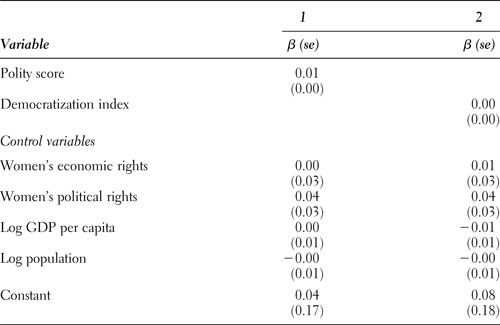
To check whether this finding is influenced by spurious correlation, we add control variables to the model and report our results in Table 1, column 1. The table confirms a substantively and statistically significant relationship between the Polity score and the gender gap in corruption tolerance. A gender gap in the tolerance of corruption seems to be associated with a country's democracy level, with the gap largest in the most democratic countries. As the Polity score changes from its minimum (−10) to its maximum (10), we would expect the gender gap between men and women to grow by 0.11; this change corresponds to about one standard deviation of the dependent variable. The results are substantively similar for a model using our alternative democracy measure (column 2). The results are consistent with a microfoundational story explaining why greater female participation in government is associated with lower corruption. Different political cultures place different pressures on women, who have a greater incentive to conform to these pressures than men due to sex discrimination. In consolidated democracies, whose institutions discourage corruption, women are (on average) more disapproving of corruption than men. In autocratic countries, where corruption is a part of business as usual, the difference between the sexes is considerably smaller. Thus, we can read our behavioral analysis with an attitudinal understanding in mind: if the relationship between women in government and corruption is mediated by democratic institutions, then we can plausibly attribute this difference to greater pressure on women to conform to the norms and imperatives of the political system.
Political institutions and the corruption tolerance gender gap
Notes: Dependent variable = gender gap (male-female) in average response to WVS bribery question. Larger numbers indicate greater relative male tolerance of bribery. Entries are coefficients and standard errors from an OLS regression model computed using Stata 11.2. Model 1: N = 67, R 2 = 0.22. Model 2: N = 68, R 2 = 0.23. Cross-national data from the year 2002. Standard errors computed using Efron's HC3 heteroskedasticity-consistent VCV.
BEHAVIORAL FINDINGS: CORRUPTION, FEMALE PARTICIPATION IN GOVERNMENT, AND INSTITUTIONALIZED DEMOCRACY
Indeed, our attitudinal findings appear to have behavioral implications: we find that female participation in government is unrelated to corruption in autocracies, but negatively related to corruption in democracies. Our research examines 157 countriesFootnote 9 over a nine-year span, from 1998–2007.Footnote 10
Dependent Variable: Corruption in Government
Objectively measuring corruption is challenging for a simple reason: “[T]hose with knowledge of a corrupt act usually share an interest in keeping it concealed” (Johnston Reference Johnston2005, 425).Footnote 11 As a result, many time-series cross-section corruption indicators are measures of corruption perception rather than reported incidences of corruption, prosecutions, or the total number of bribes. This is certainly true for many components of our primary measure of corruption, the World Bank Control of Corruption index from the World Bank's Governance Indicators dataset (Kaufmann, Kraay, and Mastruzzi Reference Kaufmann, Kraay and Mastruzzi2010).
The World Bank defines control of corruption as “the extent to which public power is exercised for private gain, including both petty and grand forms of corruption as well as ‘capture’ of the state by elites and private interests” (Kaufmann, Kraay, and Mastruzzi Reference Kaufmann, Kraay and Mastruzzi2010, 4). The Control of Corruption measure combines data from multiple resources to form the index, including expert assessments and surveys of business people or citizens; while some experts may have privileged knowledge of corruption activities, by and large these measures are still indirect, perception-based measures and not direct measures of corrupt activities. To aggregate the sources, the WGBI uses “an extension of the standard unobserved components model, which expresses the observed data in each cluster as a linear function of the unobserved common component of governance, plus a disturbance term capturing perception errors and/or sampling variation in each indicator” (Kaufmann, Kraay, and Mastruzzi Reference Kaufmann, Kraay and Mastruzzi2003, 258). The technique is designed to make scores comparable across both countries and years, allowing researchers to assess relative trends in corruption over time (Kaufmann, Kraay, and Mastruzzi Reference Kaufmann, Kraay and Mastruzzi2003, 261). Higher scores correspond to greater control of corruption (i.e., less corruption) on this measure.
Robustness Check: Alternative Measures of Corruption
Because the measurement of corruption levels worldwide is difficult and controversial, it is important to ensure that our results do not depend on one measure of corruption, particularly because almost all corruption measures are indirect by necessity. Thus, as a robustness check, we replicate our core results using two alternative measures of corruption: Transparency International's Corruption Perceptions Index and the International Country Risk Guide's Corruption Index.
Transparency International combines 13 different polls and surveys from 10 independent sources, including both expert rankings and opinion surveys of those doing international business, to develop its Corruption Perceptions Index.Footnote 12 The index defines corruption as “the abuse of public office for private gain” (Transparency International 2011, 2) and constructs the measure accordingly.Footnote 13 Transparency International uses a matching percentiles and standardization technique to construct the CPI index, a technique designed to place the scores of the individual sources onto the same 0–10 scale and make them comparable across countries (Lambsdorff Reference Lambsdorff, Sampford, Shacklock, Connors and Galtung2006, 88–89; Transparency International 2011, 5–6). Trends in the CPI, however, might be attributable to changing samples of source material or methodological revisions, and thus “the index primarily provides an annual snapshot of the views of businesspeople, with less of a focus on year-to-year trends” (Lambsdorff Reference Lambsdorff, Sampford, Shacklock, Connors and Galtung2006, 83). The variable is coded so that countries with a higher score correspond to cleaner (less corrupt) countries.
The ICRG's Corruption Index attempts to measure “financial corruption in the form of demands for special payments and bribes connected with import and export licenses, exchange controls, tax assessments, police protection, or loans. Such corruption can make it difficult to conduct business effectively, and in some cases may force the withdrawal or withholding of an investment” as well as “excessive patronage, nepotism, job reservations, ‘favor-for-favors,’ secret party funding, and suspiciously close ties between politics and business” (Political Risk Services Group 2012). Its corruption measure is part of the ICRG's Political Risk Rating, which is determined by compiling an index of 12 different components, weighted differently, on a 0–100 scale. Points are assigned by ICRG editors from a series of preset questions in order to ensure consistency. In order to ensure reliability over both countries and time, each ICRG editor uses the same questions as a basis for each rating. As before, the variable is coded so that countries with a higher score correspond to cleaner (less corrupt) countries.
Independent Variables: Female Participation in Government and Institutionalized Democracy
This portion of our study uses two key independent variables. The first is the Polity score used in the previous section. We also use the Vanhanen democratization index as an alternative measure and robustness check, as before. The second key variable is female participation in government, which we measure using the Inter-Parliamentary Union's data for the percentage of women in parliament in a given country (Inter-Parliamentary Union 2012). If data from only one house are available (e.g., if the country's parliament is unicameral), then we use the percentage from that house. If data for both houses are present, then we use the percentage of women in both houses by adding the total number of women in both houses and dividing it by the total number of representatives in both houses.Footnote 14
Control Variables
Many studies blame economic factors for corruption (e.g., Nwabuzor Reference Nwabuzor2005; Tanzi Reference Tanzi1998). In countries with more strict economic regulations regarding issuing licenses, permits, and other authorizations, there is a greater opportunity for those in charge to exploit their power. This also may increase the likelihood of bribes. Countries with low economic freedom often have bans on imports, which promote corruption in customs services. In less economically free societies, the government determines prices and wages, presenting an opportunity for corruption. Economic freedom is also often associated with the political freedoms related to democracy, one of our key independent variables.
As a result, we include several measures of economic freedom and openness as control variables. First, we use a modified form of the Heritage Foundation's Economic Freedom Index (Heritage Foundation 2012); we removed its trade freedom (we deal with this factor through another control variable), property rights (because corruption is included in the measurement of this value), and freedom from corruption (because this is what we are trying to predict) components but left in the seven remaining factors that make up the index, including business freedom, fiscal freedom, and labor freedom.Footnote 15 We also included the United Nations Statistics Division's Openness to Trade variable from the Quality of Government Dataset (Teorell et al. Reference Teorell, Charron, Samanni, Holmberg and Rothstein2009) to control for any influence of an open economy on corruption.
Beyond these control variables, we also include all the control variables from the attitudinal study—women's political and economic rights, the log of per capita GDP, and the log of population—for the reasons previously stated. In particular, it is important to control for women's political and economic rights because greater gender discrimination probably correlates with both of our key independent variables (democratic institutions and female participation in government) and is conceptually related to women's ability to affect corruption (the dependent variable) once in government. Furthermore, because there may be systematic scaling issues in the measurement of corruption from year to year, we include dummy variables for each year to control for these potential intercept shifts. Finally, to remove the confounding influence of any unit-level heterogeneity not captured by our existing controls, we include dummy variables for each of 10 regions of the world as coded in the Quality of Government Dataset (Teorell et al. Reference Teorell, Charron, Samanni, Holmberg and Rothstein2009).Footnote 16
Results
As an initial look at the data, we divide our sample into two subsamples: one with all observations for which the Polity score was less than or equal to zero (labeled “Autocratic Leaning”) and those for which the Polity score was greater than zero (labeled “Democratic Leaning”). We then construct a simple bivariate plot showing the relationship between the percentage of women in parliament and the WBGI control of corruption index. The results are depicted in Figure 2.
Women in parliament and control of corruption.
In the states with a low Polity score, there is a slight, negative bivariate relationship between the control of corruption and the percentage of women in parliament: a line fitted via OLS indicates that every 10% increase of women in parliament is associated with a 0.135 decline in the WBGI Control of Corruption score, a relationship that is statistically significant (p = 0.002) but substantively quite small (corresponding by construction to 0.135 of a standard deviation of the corruption variable). It may be that the greater incentive to conform to the expectations of the political culture that women face due to their relative disempowerment actually induces them to be more willing to participate than men. But for practical purposes, this relationship is close to zero (and disappears with the addition of control variables later in our analysis).
By contrast, in the states with a high Polity score, there is a strong, statistically significant (p < 0.001), and positive bivariate relationship between control of corruption and women in parliament. An OLS line indicates that every 10% increase in female participation in parliament is associated with a 0.515 point increase in the WBGI score, or about half a standard deviation increase on the scale of the index. Thus, female involvement in government is associated with lower corruption in states that disincentivize corruption.
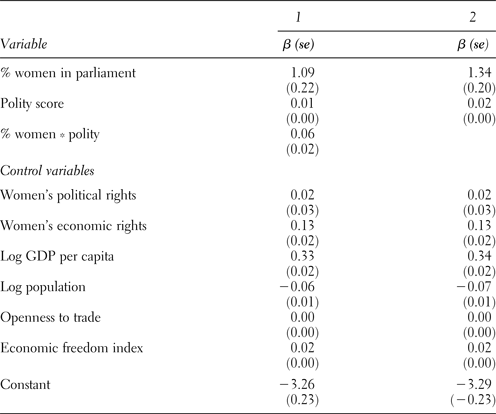
The same substantive conclusions are borne out in a linear regression that includes our control variables, as shown in Table 2. Model 1 in the table includes an interaction term between Polity score and percent women in parliament, as we believe to be necessary, while Model 2 omits this term in a manner consistent with Dollar, Fisman, and Gatti (Reference Dollar, Fisman and Gatti2001). Model 2 yields results that are substantively similar to those of Dollar, Fisman, and Gatti (Reference Dollar, Fisman and Gatti2001): a positive relationship exists between female participation in government and control of corruption. When the interaction between the percentage of women in parliament and Polity score is included (in Model 1), this interaction is positive and statistically significant. This indicates that the relationship between female participation in government and clean government gets stronger as the Polity score rises. Thus, we have initial evidence from the model to conclude that the power of female participation in government to control corruption is contingent on democratic political institutions, with a stronger relationship in democratic states compared to autocratic states.
Estimating the relationship between corruption and women in government, conditional on political institutions
Notes: Dependent variable: WBGI Control of Corruption Index. Higher numbers mean less corruption. Entries are coefficients and standard errors from an OLS regression model computed using Stata 11.2. Year and Region dummy coefficients are omitted. N = 1208, Model 1 R 2 = 0.83, and Model 2 R 2 = 0.83. Standard errors computed using White's Heteroskedasticity-consistent VCV. Model 1 includes an interaction term between % women in parliament and polity score, while Model 2 excludes this term, as in Dollar, Fisman, and Gatti (Reference Dollar, Fisman and Gatti2001).
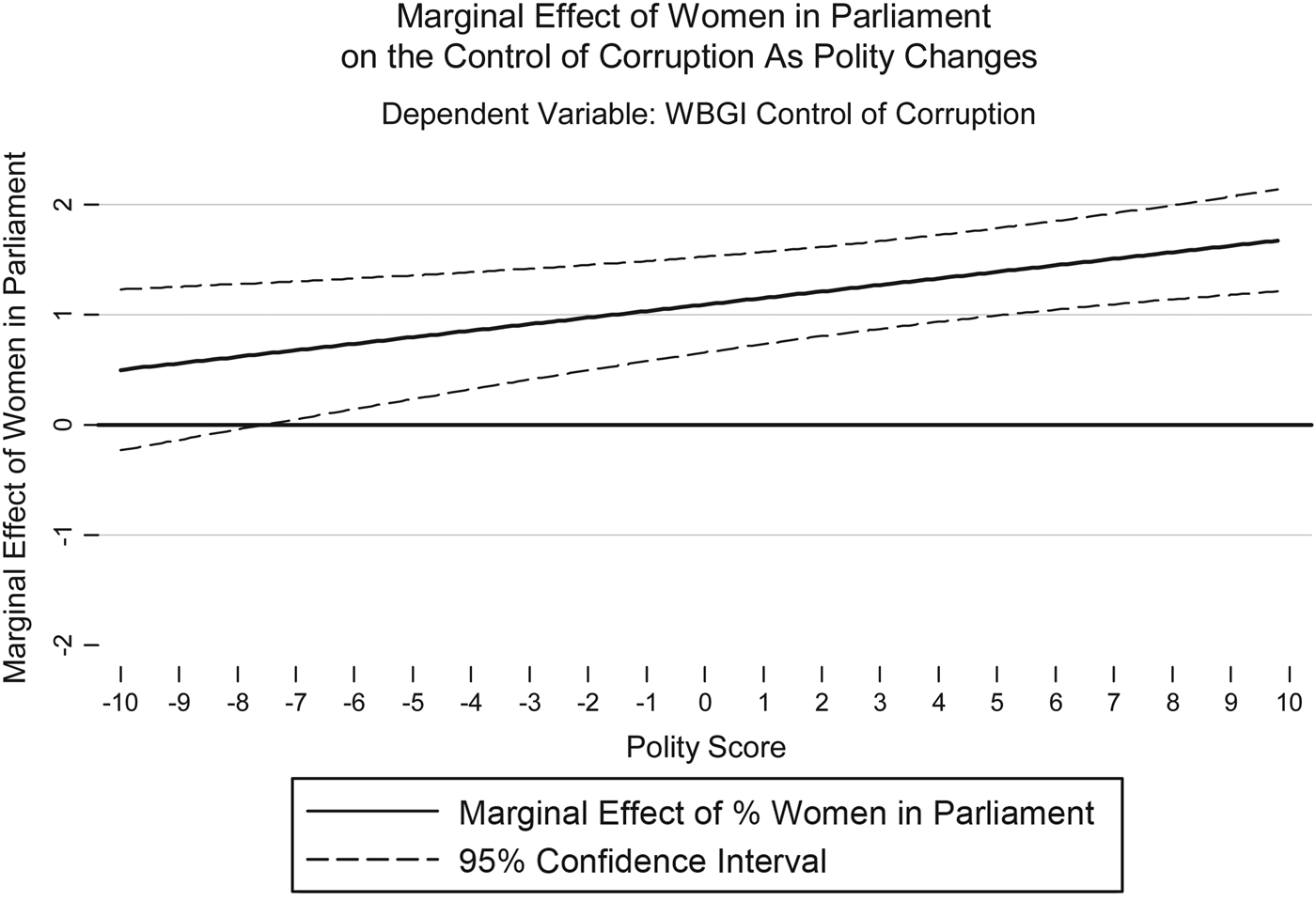
We calculate the predicted marginal relationship between women in parliament and the control of corruption over the range of the Polity score, as described in Brambor, Clark, and Golder (Reference Brambor, Clark and Golder2006), using the estimates of Model 1. This marginal effect is equal to
 $$\displaystyle{{\partial \hbox{control of corruption}} \over {\partial \percnt \hbox{women in parliament}}} = \beta _{\hbox{women}} + \beta _{\hbox{product}} \hbox{Polity}$$
where β women is the coefficient on women in parliament and β product is the coefficient of the interaction term. We plot this marginal effect and its standard error in Figure 3. For the most autocratic states, the relationship between women in parliament and the control of corruption cannot be statistically distinguished from zero. As a state becomes more democratic, the relationship grows stronger and more positive until eventually it becomes statistically significant: more women in parliament is associated with a cleaner government. Finally, at the highest levels of institutionalized democracy, a 10 percentage point increase in women in parliament is associated with an increase in the control of corruption corresponding to about 0.15 standard deviations of the dependent variable.
Female participation in government and government cleanliness, by polity score.
Robustness Check: Alternative Measures of Democracy and Corruption
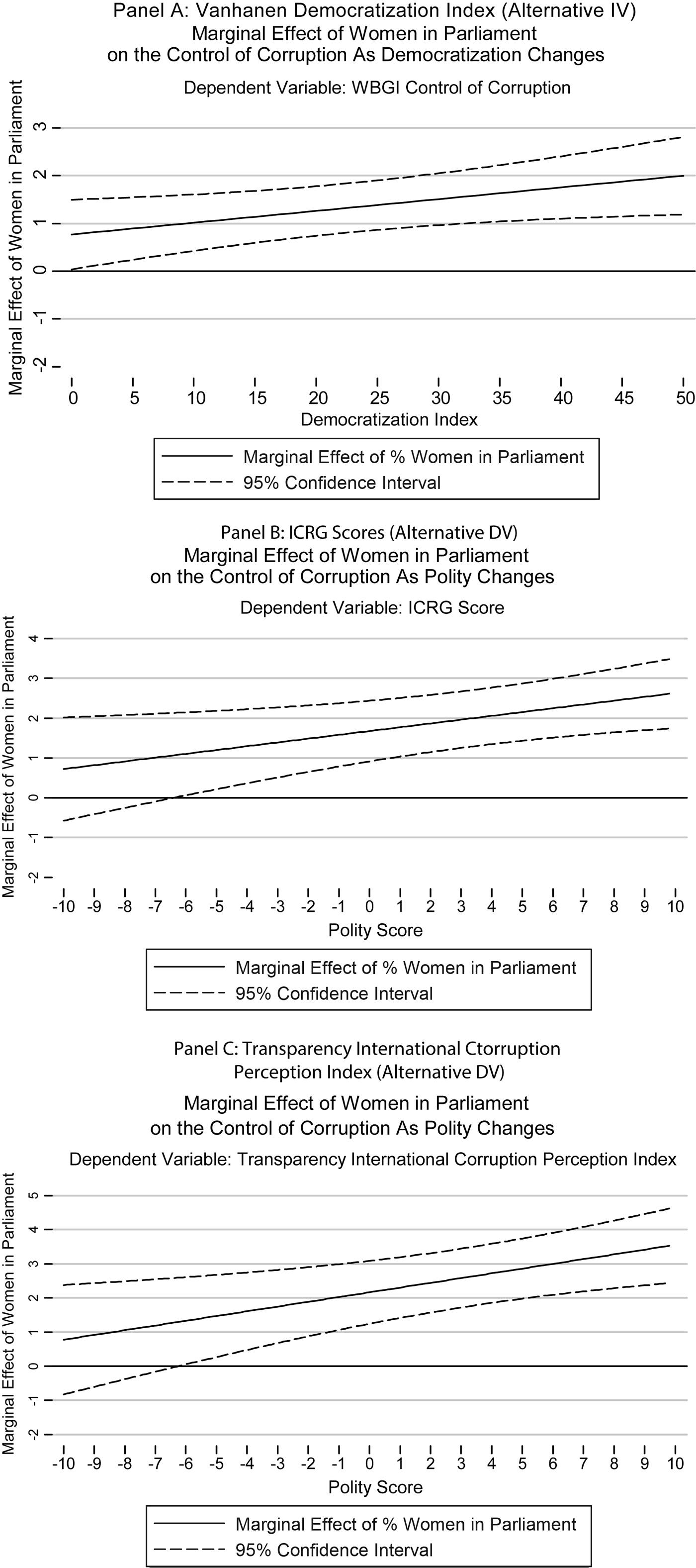
As we indicated earlier, we are concerned that our results may be specific to the particular measures of democracy and corruption that we employ. We, therefore, reestimate Model 1 from Table 2 but substitute alternative measures of the dependent or key independent variable. The Vanhanen democratization index is our alternative IV measure, while the ICRG and Transparency International measures of government corruption are our alternative DVs (where, in both cases, higher scores indicate less corruption). Marginal effects plots derived from these models are depicted in Figure 4.
Female participation in government and government cleanliness, alternative IV and DV.
All of our alternative measures yield the same basic story as our main measures. More female participation in government is not associated (or is weakly associated, in the case of the democratization index) with government cleanliness for autocratic countries. But for democratic countries, there is a strong and statistically significant association between more women's participation in government and government cleanliness. Our robustness checks bolster the credibility of our original result, as this result appears largely insensitive to our choice of measures.
CONCLUSION
In summary, we find evidence that the relationship between gender and corruption differs by institutional context. We think this is because women are more averse to the risks of violating political norms and because gender discrimination makes violating institutional norms a riskier proposition for women than men. Where corruption is stigmatized, women will be less tolerant of corruption and less likely to engage in it compared to men. But if “corrupt” behaviors are an ordinary part of governance supported by political institutions, then there will be no corruption gender gap.
Attitudinal data from the World Values Survey and behavioral outcomes measured by corruption indices are consistent with this story. Female disapproval of bribe-taking is greater than male disapproval, but only in countries with democratic institutions. We think this result can be interpreted to mean that female attitudes are constrained to follow their society's political norms: the more that the society disapproves of corruption, the more women disproportionately express disapproval of corruption. State corruption is strongly and negatively related to female participation in government in the context of democratic institutions but is weaker or indistinguishable from zero in the context of autocratic ones. This finding is consistent with the idea that women in government are bound by social and political norms in practice, including when they make decisions as government officials.
If our explanation is correct—that women are more sensitive to their incentives as a consequence of their more precarious position in government and that consequently they will engage in corruption or not depending on which action tends to solidify their position in government—then recruiting women into government positions will not reduce corruption wherever participation in corrupt activities aids in selection for and retention in government office (as in many autocratic regimes). Female participation in government would only reduce corruption in functional democracies where the electorate tends to punish corruption via removal from office. Unfortunately, this is only a subset of the total number of states where corruption is a hindrance to economic development.
But this is not the only possible interpretation of our evidence: there are other causal mechanisms that could plausibly underlie our findings. These different interpretations of our evidence reflect different views of which intersection of identity factors (aside from gender) is most relevant to shaping women's experience with corruption in government (Manuel Reference Manuel2006). But each of these mechanisms supports the inference that recruiting women into government is unlikely to uniformly reduce corruption, though it may have this effect in a subset of cases. Additionally, each mechanism relies on the idea that the link between women in government and reduced corruption is rooted in gender discrimination.
For example, suppose that a state's democracy level correlates with its degree of institutionalized gender discrimination. Our analysis attempts to remove this source of spurious correlation by controlling for measures of women's political and economic rights, but it is challenging to measure the effective degree of gender discrimination intrinsic to a social or political system, and thus our controls may be ineffective. We may presume that gender discrimination inhibits women's ability to effect change in government in a variety of ways. If this story is true, then we would expect women's participation in government to be uncorrelated with corruption in high-discrimination states (that is to say, nondemocracies) because women are not in a position to be able to effect change in these cases. Women in government would be in a position to improve corruption in low-discrimination states (namely, democracies), and thus we could see a negative relationship between the two in those cases. The underlying reasons for women's aversion to corruption would remain unknown, and we would thus be uncertain as to whether the relationship would endure over time. But we would still not expect increasing female participation in government to reduce corruption in states where women were legally, culturally, and/or economically unequal. A greater benefit would presumably derive from trying to recruit women into government only as a part of a larger program to reduce gender inequality in other ways.
If women in government engage in less corruption because they have less access to the personal networks through which corruption flows (and thus simply have fewer opportunities for corruption), then the fact that female participation in government is associated with less corruption in democracies but not autocracies could be a consequence of these regimes' different processes for recruiting people into government service.Footnote 17 If recruitment into autocratic government requires contact with and personal loyalty to people who are already involved in the government, then these contacts and loyalties will presumably provide an entŕee into corruption networks where these networks exist. Thus, women recruited into these governments have equal opportunity for corruption and engage in it at the same rate as their male counterparts. Recruitment into a democratic government is ultimately a matter of gaining more than 50% of the vote share in an electorate, and thus outsiders who can leverage their own talents and resources outside existing political networks may be able to get elected. If women form a disproportionately large share of these outsiders, then we would expect them to enter government with a smaller network of internal contacts and thus fewer opportunities for corruption. In this scenario, recruiting more women into government would only have a short-term effect on corruption in democracies, one that faded as women became more firmly integrated into insider political networks, and no effect in autocracies.
We believe that it would be helpful for future research to focus on a finer-grained picture of the environment beyond broad institutional context. For example, examining the pathway through which women enter politics could help us understand how they behave once entrenched in government. The women who gain office through a top-down, party- or government-directed initiative would probably be very different than a group of women who won an open and competitive election, and we might expect them to have systematically different attitudes toward corruption. The personal characteristics that make a person attractive for appointment into a hierarchy are different from those that make someone a good electoral candidate. Furthermore, these two pathways might lead to women holding different sorts of offices (elected vs. appointed offices, or open seats vs. reserved gender quota seats) that might in turn provide different opportunities to benefit from corruption. As we note above, the differences we observe in autocracies and democracies might be ascribed to the different ways that women enter government in these systems. In autocracies, much participation in government (including female participation) is imposed from above via appointment, which could socialize appointees into existing networks of corruption. In democracies, where elections are used to fill many offices, women in office could be disproportionately outsiders who are not invited into these networks. But these and other possibilities cannot be explored without collecting detailed information about the nature of female participation in government.
We also believe that future research should study variation in specific aspects of both gender discrimination and corruption attitudes inside of democratic and autocratic contexts. As we know from Alatas, Cameron, and Chaudhuri (Reference Alatas, Cameron and Chaudhuri2009) and our own Figure 1, not all democracies have a gender gap in corruption attitudes. It may be that public preferences and institutional features differ among democracies in ways that put more or less pressure on elected officials to fight corruption. The presence of a “culture of corruption” may in turn influence whether female government participation is associated with lowered corruption; our theory is built on the idea that institutional incentives encourage or discourage such a culture, but a more direct time-series cross-sectional measurement of the concept may permit a more direct test. It is also plausible that gender discrimination against women in government differs both in nature and degree across different states and that different kinds of discrimination will have different implications for women's engagement with corruption. Cross-national measures of gender discrimination that focus specifically on political behavior (including corruption) would be useful for clarifying how social and cultural attitudes combine with institutional variation to influence how much men and women in government engage in corruption.