Introduction
Bipolar disorders (BDs) are more frequent and disabling than originally thought, with many patients showing significant impairment or subsyndromal symptoms between episodes (e.g. Judd et al. Reference Judd, Akiskal, Schettler, Endicott, Maser, Solomon, Leon, Rice and Keller2002; Judd & Akiskal, Reference Judd and Akiskal2003; Solomon et al. Reference Solomon, Leon, Coryell, Endicott, Chunsham, Fiedorowicz, Boyken and Keller2010). Although medication is needed, the role of psychosocial factors in the onset and course of BD has become obvious (e.g. Alloy et al. Reference Alloy, Abramson, Urosevic, Walshaw, Nusslock and Neeren2005; Johnson, Reference Johnson2005) and has led to the development of several psychosocial interventions.
Cognitive behaviour therapy (CBT) relies on the assumption that the interaction of thoughts, behaviours and emotions is the underlying psychopathology, including depression and mania. Indeed, empirical evidence has demonstrated the role of cognitive vulnerability factors such as dysfunctional attitudes or attributional style for BD and mania (e.g. Johnson, Reference Johnson2005; Jones et al. Reference Jones, Scott, Haque, Gordon-Smith, Heron, Caesar, Cooper, Forty, Hyde, Lyon, Greening, Sham, Farmer, McGuffin, Jones and Craddock2005; Alloy et al. Reference Alloy, Abramson, Walshaw, Gerstein, Keyser, Whitehouse, Urosevic, Nusslock, Hogan and Harmon-Jones2009). Several reviews have looked at the efficacy of psychotherapy for BD (e.g. Beynon et al. Reference Beynon, Soares-Weiser, Woolscott, Duffy and Geddes2009; Miklowitz & Scott, Reference Miklowitz and Scott2009; Szentagotai & David, Reference Szentagotai and David2010), and in summary indicate that CBT for BD works better than waiting for treatment (Scott et al. Reference Scott, Garland and Moorhead2001), is more beneficial than brief psycho-education (Zaretsky et al. Reference Zaretsky, Lancee, Miller, Harris and Parikh2008) and has mostly proved to be superior to treatment as usual (TAU) with respect to functioning and relapse prevention (e.g. Lam et al. Reference Lam, Watkins, Hayward, Bright, Wright, Kerr, Parr-Davis and Sham2003; Ball et al. Reference Ball, Mitchell, Corry, Skillecorn and Malhi2006). Focusing on overall relapse rates from four randomized controlled trials (RCTs) in their meta-analysis, Lynch et al. (Reference Lynch, Laws and McKenna2010) concluded that CBT is not effective for BD. Although Scott et al. (Reference Scott, Paykel, Morriss, Bentall, Kinderman, Johnson, Abbott and Hayhurst2006) did not find an overall effect for CBT with regard to relapse prevention for severe BD, they did report that individuals with fewer episodes benefited from receiving CBT. Despite these encouraging results, there are limitations, for example the amount of attention patients in the control groups had received has not been controlled. Waiting for treatment also has its own negative effects, with 30% of patients dropping out (Scott et al. Reference Scott, Garland and Moorhead2001). By contrast, TAU mostly included regular visits to the psychiatrist and crises management. This was usually provided to all study participants, so that in effect CBT was an add-on intervention. Therefore, the patients treated with CBT received much more attention and support of any kind compared to those in the control conditions. This renders interpretations ambiguous (e.g. Goldfried & Wolfe, Reference Goldfried and Wolfe1998).
The primary aim of our study was therefore to examine whether the positive results with regard to relapse rates and post-treatment improvements in former studies are still evident if people are randomized to CBT or another treatment condition that is matched in frequency and intensity of contact (i.e. supportive therapy, ST). We used relapse rates as the main outcome variable but also considered symptom levels and indicators of cognitive vulnerability (e.g. locus of control). It was expected that CBT would lead to lower relapse rates, decrease symptoms levels and cognitive vulnerability (e.g. increased internal locus of control). A secondary aim was to test whether illness-related variables that have been identified in other studies predict survival time, specifically length of treatment, number of prior episodes, age of onset, medication, psychosocial functioning and type of BD (e.g. Miklowitz et al. Reference Miklowitz, George, Richards, Simoneau and Suddath2003; Scott et al. Reference Scott, Paykel, Morriss, Bentall, Kinderman, Johnson, Abbott and Hayhurst2006, Reference Scott, Colom and Vieta2007; Zaretsky et al. Reference Zaretsky, Lancee, Miller, Harris and Parikh2008).
Method
Participants
Recruitment took place in the Department of Psychology, University of Tübingen, Germany, between August 1999 and September 2004. The patients were either referred by local hospitals, psychiatrists or were self-referrals due to public information in newspapers or on the radio. Participants were invited to a screening session in which they were informed about the study and gave written informed consent. Baseline assessment consisted of at least three consecutive sessions, in which clinical interviews (e.g. SCID-I and SCID-II) and self-ratings (e.g. the Beck Depression Inventory, BDI) were completed.
The inclusion criteria for the study were (a) a primary disorder of BD according to DSM-IV (APA, 1994), (b) age between 18 and 65 years, and (c) willingness to continue current or start medication. Exclusion criteria were: (a) the primary diagnosis is a non-affective disorder including schizo-affective disorder, (b) current major affective episode (depressed, mixed or mania according to SCID-I) or Bech–Rafaelsen Melancholia Scale (BRMS; Bech & Rafaelsen, Reference Bech and Rafaelsen1980) score >14 or Bech–Rafaelsen Mania Rating Scale (BRMAS; Bech et al. Reference Bech, Rafaelsen, Kramp and Bolwig1978) score >9, (c) substance-induced affective disorder, or affective disorder due to a general medical condition, (d) current substance dependency requiring detoxification (abuse did not qualify for exclusion), (e) serious cognitive deficits (IQ <80), and (f) being currently in psychological treatment.
Treatment conditions
Patients were randomly allocated to individual CBT or ST using a stratified randomization strategy controlling for gender, bipolar I or II disorder, and age of onset (before/after age of 20 years). Treatment started within 2–4 weeks after the assessments. Both treatments consisted of 20 sessions (50–60 min) distributed over 9 months. The first 12 sessions were provided on a weekly basis, then biweekly sessions were offered for the next 2 months and the remaining sessions were scheduled monthly. Manuals were provided for both treatments; with the CBT one being published (Meyer & Hautzinger, Reference Meyer and Hautzinger2004). Both treatment conditions included information (e.g. symptoms, aetiology, medication) and mood monitoring in the form of a mood diary. The difference between therapies was such that, in the ST condition, therapists adopted a client-centred focus, meaning that whatever problems the patient presented were dealt with by providing emotional support and general advise. If no specific topic was mentioned by the patient, information about BD and medication was delivered by the therapist without referring to written or any other material. In contrast to the CBT, no efforts were made to specifically link this information to the individual's biography or experience. The mood diary was checked by the therapist who provided brief feedback (e.g. regularity of medication, of sleep and overall mood) or probed for missing information but without using any CBT-related techniques such as guided discovery, problem solving or reality testing.
CBT covered (a) an information and motivation module (providing and jointly elaborating on information and an understanding of BD, its symptoms, aetiology, course, triggers and pharmacotherapy based on and linked to the individual's experience, but also addressing, for example in this context, potentially dysfunctional beliefs about BD and medication), (b) an individual relapse module (including life chart analysis, identification and monitoring of individual early warning symptoms for mania and depression, functional behaviour analysis or risky behaviours, coping with prodromal symptoms), (c) cognitive and behavioural strategies dealing with depression and mania (e.g. cognitive restructuring, activity schedule/daily routine, planning pleasurable activities), and (d) training of communication skills and/or problem-solving skills depending on the individuals strengths and deficits.
Therapists (n=8, one being T.D.M.) had a least 1-year postgraduate training in CBT and had attended a specific 2-day workshop about CBT and ST for BD with role plays and video training. All therapy sessions were video-taped and weekly supervision was provided.
Materials and procedures
SCID-I and SCID-II (First et al. Reference First, Gibbon, Spitzer and Williams1996, Reference First, Gibbon, Spitzer and Williams1997) were used by trained clinical psychologists to diagnose mental health problems at baseline and in the follow-up period. All interviews were videotaped, and a random sample of 53 patients was used to estimate reliability, which proved to be excellent (κ=0.93 for bipolar I, κ=0.89 for bipolar II). Relapse was defined as any mood episode that fulfilled DSM-IV criteria. Throughout the therapy period recordings were made of hospitalizations and episodes obtained by the clinicians' notes and from the patients' mood diaries [including also weekly assessments using the Center for Epidemiologic Studies Depression Scale (CES-D; Radloff, Reference Radloff1977; Meyer & Hautzinger, Reference Meyer and Hautzinger2003)]. Severity of symptoms and functioning was also assessed repeatedly throughout the study period using the BRMS, the BRMAS and the Global Assessment Scale (GAS), with good reliability: intraclass correlation coefficient (ICC)=0.87, 0.77 and 0.81 respectively. Several self-rating measures were used, such as the BDI (Beck & Steer, Reference Beck and Steer1987; α=0.89) and the Self-Rating Mania Inventory (SRMI; Shugar et al. Reference Shugar, Scherzer, Toner and di Gasbarro1992; α=0.94). In addition, the Locus of Control for health and illness (LC; Lohaus & Schmitt, Reference Lohaus and Schmitt1989) and the Disease Concept Scale [‘Krankheitskonzeptskala’ (KK); Linden et al. Reference Linden, Nather and Wilms1988] were used. The 21 items of the LC are rated on a scale from 1 (totally true) to 6 (not at all true) and three composite scores can be calculated: internal LC (α=0.89), external LC – powerful others (α=0.76), and external LC – chance (α=0.88). The KK is so far the only existing German scale that has been evaluated to assess subjective illness concepts of patients. All 29 items are rated on a five-point scale (from 0=do not agree at all to 4=totally agree). Seven subscales were derived through factor analysis: trust in medication, trust in psychiatrist, negative expectations, guilt, chance, vulnerability, and idiosyncratic assumptions [0.67 (chance) <α <0.85 (trust in medication)]. The LC and KK scales were assumed to be psychological concepts related to adherence and to reflect effects of psychotherapy. To estimate adherence to medication, the Somatotherapy Index (Bauer, Reference Bauer2001) was used. The best available data were used (mostly blood serum levels) to ensure the most accurate reporting of the maximum level of somatotherapy across medication types (i.e. ‘0’ no or very low levels of medication; ‘4’ indicating optimal pharmacotherapy). Cognitive testing was undertaken to ensure that intellectual functioning was sufficient, using the intelligence test (Leistungsprüfsystem, LPS) devised by Horn (Reference Horn1983) .
After baseline assessment (t0), participants were randomly assigned to CBT or ST. Immediately following treatment, the post-treatment assessment (t1) took place with raters who were blind to the treatment conditions. Further follow-up assessments took place every 3 months for the first year and one further assessment after 2 years. The analysis reported here focuses on the immediate effects of CBT on symptoms and psychological variables comparing pre- (t0) and post-treatment assessment (t1) and also relapse rates for the total 33-month period.
Statistical analysis
In the original planning stage, a power analysis assuming a large effect size (with power=0.80, p<0.05) suggested a required sample size of 2×20 patients to detect mean differences and 2×26 for detecting differences in χ2 tests (Cohen, Reference Cohen1988). According to Chambless & Hollon (Reference Chambless and Hollon1998), such a sample size should reveal differences that are clinically meaning.
Baseline comparisons were made if appropriate parametrically, using t tests for dimensional measures and χ2 for categorical variables. All main analyses are presented as intent-to-treat (ITT) analyses. Using SPSS version 17.0 (SPSS Inc., USA), treatment effects were analysed with an ANOVA with repeated measurements including the factors time, treatment condition and their interaction. For the analyses, exact p values were reported up to p=0.15. The primary hypothesis referring to survival time (in weeks) was analysed using Kaplan–Meier curves with significance tests based on the log rank test. The secondary hypothesis was tested by running Cox proportional regressions to estimate the effects of the specified covariates for the whole sample including therapy condition: number of prior episodes, diagnosis (coded as ‘1’ for bipolar I and ‘2’ for bipolar II), age of onset, medication adherence (Somatotherapy Index, 0 to 4), number of therapy sessions, and baseline overall functioning (GAS). Skew, kurtosis and univariate outliers were checked, and the ‘number of episodes’ was transformed using the natural logarithm (ln). No transformation improved the skew of the ‘number of therapy sessions’ so the original raw scores were used. Two multivariate outliers were identified (both men in their sixties with a co-morbid personality disorder, one CBT/one ST), but because their inclusion did not change the results, they were included in the analyses. Analyses were conducted separately for any new affective episode, and also for depressive and manic episodes (including hypomanic and mixed episodes).
Results
Patient characteristics
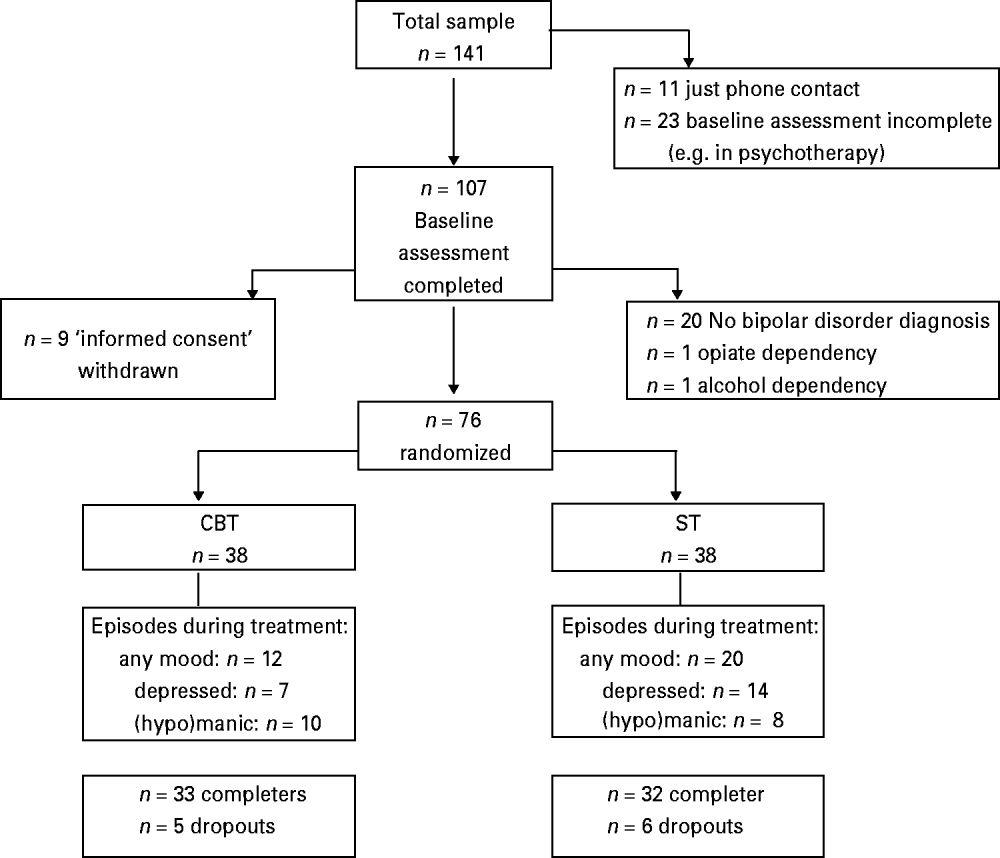
Overall, 141 patients contacted us (Fig. 1). In some cases the only contact was by telephone. Twenty individuals did not have a primary BD. Two patients were excluded because they had a current substance dependency. Nine patients withdrew their informed consent prior to start of treatment (mainly because of the required videotaping of the therapy sessions). Comparing the randomized patients to the non-participating patients revealed no differences with respect to gender, type of BD, lifetime diagnosis of alcohol- or substance-related disorders, personality or anxiety disorders (all χ2 or Fisher's exact tests p>0.10). The same was true for age, age of onset, current medication adherence or current level of depression (all t <|1.15|). Patients who participated had low but significantly higher manic ratings (BRMAS) than those who discontinued [t(77.76)=2.73, p<0.008, d=0.41, mean=1.68 (s.d.=3.22) v. 0.50 (s.d.=0.86)]. Despite their higher subsyndromal manic symptoms, their current psychosocial functioning was considered significantly higher than those who did not continue with the study [t(90)=2.10, p<0.05, d=0.58, mean=69.59 (s.d.=12.64) v. 62.31 (s.d.=12.45)].
Flowchart of recruitment of patients. CBT, Cognitive behaviour therapy; ST, supportive therapy.

Fifty-three (69.7%) out of the 76 patients were taking at least one mood stabilizer (and in 17 cases this was accompanied by antidepressant medication). Seven (9.2%) were only on antidepressant medication and 16 (21.1%) did not take any medication at the beginning of the study. Of the 53 receiving mood stabilizers, the majority (51.3%, n=39) had one, 13 (17.1%) had a combination of two and one individual (1.3%) had three mood stabilizers (lithium: n=30; valproate: n=16; carbamazepine: n=9; antipsychotics: n=13). The groups did not differ in whether they had a mood stabilizer or antidepressant medication [all χ2⩽1.27, n.s. (data not shown)].
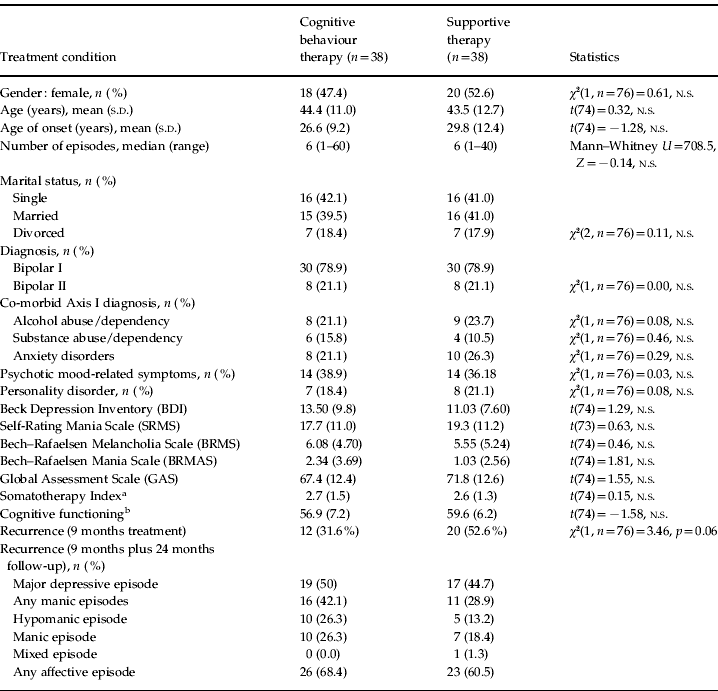
Table 1 displays the baseline characteristics of the final sample. No significant baseline differences between CBT and ST were found for any of the variables, suggesting successful randomization. Completers were those patients who attended at least 16 out of 20 sessions. A total of 11 patients attended less than 16 sessions and were considered drop-outs (14.5%). Most patients (82%) dropped out before session 10. Dropping out was not related to treatment condition, sex, marital status, type of BD or co-morbid substance use or anxiety disorders (all χ2 ⩽1.81 or Fisher's exact test p>0.15). The same was true for age, current symptoms of depression, number of episodes or psychosocial functioning according to the GAS (all t<1.58). Drop-outs were more likely to have a personality disorder diagnosis (54.5%) than completers (13.8%) (Fisher's exact test p=0.006). When excluding drop-outs, the average number of sessions attended was 18.53 (s.d.=1.09) for CBT and 19.28 (s.d.=1.17) for ST.
Baseline characteristics of patients before treatment (t0) and recurrence rates during follow-up

s.d., Standard deviation; n.s., not significant.
a The Somatotherapy Index is a score varying between 0 and 5 to describe the quality of prescribed and taken medication based primarily on blood serum levels (M. Bauer et al., unpublished manuscript).
b Cognitive functioning was assessed with an intelligence test (Leistungsprüfsystem, Horn, Reference Horn1983), which provide standardized t scores (mean=50, s.d.=10).
Primary outcomes: post-treatment effects and relapse rates
Post-treatment effects
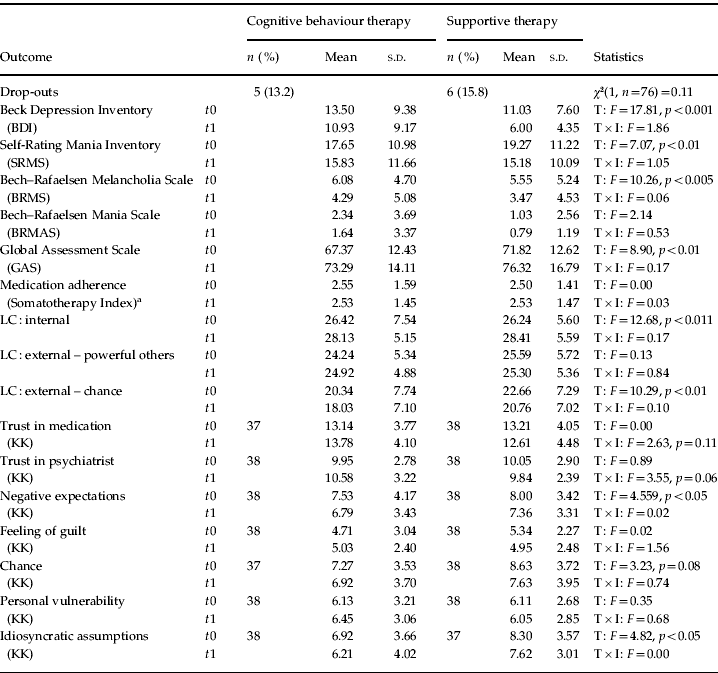
Descriptive data for baseline and post-treatment symptoms and indicators for psychosocial functioning are presented in Table 2. This table shows that symptoms of depression decreased significantly over time, but there was no significant time×treatment interactions for self-ratings or observer ratings. Self-rated but not clinician-rated manic symptoms decreased significantly over time. Psychosocial functioning (GAS) improved, but this was not specific to either treatment condition. Using the Somatotherapy Index to quantify current medication adherence based on blood levels of different medications, there was no evidence for any change.
Symptoms and indicators of psychosocial functioning pre- (t0) and post-intervention (t1)

KK, Krankheitskonzeptskala (Disease Concept Scale); LC, Locus of Control; s.d., standard deviation; T, F value for main effect of time; I, F value for main effect of treatment condition; I×T, F value for the interaction term of time and treatment condition.
a The Somatotherapy Index is a score varying between 0 and 5 to describe the quality of prescribed and taken medication based primarily on blood serum levels (M. Bauer et al., unpublished manuscript).
Internal LC increased significantly over time and external LC (chance) decreased but no significant time×treatment interaction was observed. External LC (powerful others) did not change over time. Some of the illness-related cognitions (e.g. negative expectations, idiosyncratic assumptions) changed over time in the expected direction, but no significant effect was found favouring CBT. There was only a non-significant trend for CBT-treated patients to trust their clinicians more after therapy.
Relapse rates
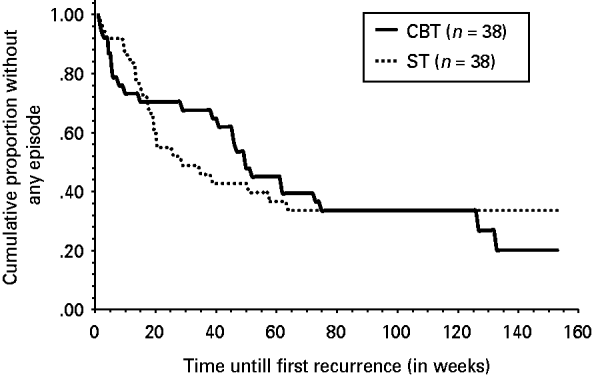
Overall, 64.5% (n=49) of the patients had at least one recurrence within the 33 study months (see Table 1). On average, the first recurrence occurred 67.53 (s.e.=9.21) weeks after treatment had started for the CBT group and 66.25 (s.e.=10.58) weeks for the ST group. Kaplan–Meier analyses revealed that survival times until first recurrence of any affective episode did not differ significantly between therapy conditions [log rank (Mantel–Cox) χ2=0.004, n.s. (Fig. 2)]. With regard to first depressive recurrence, the mean survival times were 86.05 (s.e.=9.75) and 88.86 (s.e.=11.15) weeks for CBT and ST respectively (log rank χ2=0.02, n.s.). The corresponding survival times for any hypomanic, manic or mixed episode were 95.85 (s.e.=10.05) and 113.60 (s.e.=0.97) weeks, again revealing no significant difference in survival time (log rank χ2=1.33, n.s.).
Cumulative survival functions with regard to recurrence of any affective episode for cognitive behaviour therapy (CBT) and supportive therapy (ST).

Secondary outcomes: predictors of survival time
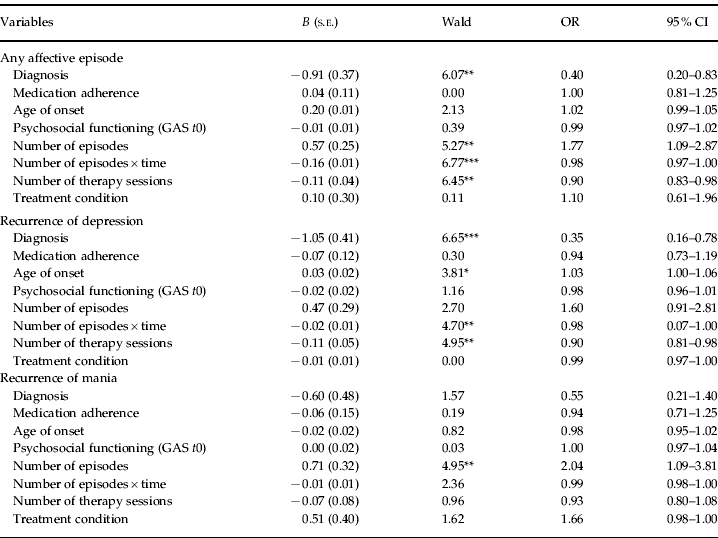
Proportionality of hazards was tested and was given for all but ‘number of prior episodes (ln)’ so that its interaction with time was included in the analysis. The results of the Cox regression model are displayed in Table 3. Confirming the prior analysis, there was no statistically significant effect of therapy condition after adjusting for the seven covariates [−2 log likelihood χ2(df=1)=0.11, p=0.75, R 2=0.001]. Survival time till any mood episode was, however, predicted by the set of covariates [log likelihood χ2(df=7)=20.12, p<0.005, R 2=0.23], with three predictors being significant and not including 1.00 in the confidence interval. Patients with bipolar I disorder had a 60% decrease in risk for a recurrence compared to bipolar II patients. Examination of the logarithm of the number of episodes for each increase of one point increased the risk for relapse by 7%. However, risk for relapse decreased by 10% with each therapy session.
Predictors in the Cox regression models for recurrence of depression, mania and any affective episode

GAS, Global Assessment Scale; s.e., standard error; OR, odds ratio; CI, confidence interval.
Diagnosis coded ‘1’ as bipolar I and ‘2’ as bipolar II. Number of prior episodes were logarithmically transformed (ln). Medication adherence was scored according to the Somatotherapy Index: 0=no medication and 4=optimal level of medication. Treatment condition coded ‘0’=supportive therapy (ST), ‘1’=cognitive behaviour therapy (CBT).
* p<0.10, ** p<0.05, *** p<0.01.
Analysis of survival time until first depressive episode indicates that again the covariates contributed significantly to the prediction [log likelihood χ2(df=7)=20.68, p<0.005, R 2=0.24], with bipolar I versus II and the number of therapy sessions being significant predictors. More therapy sessions were again associated with longer time until a depressive episode, and bipolar II was associated with increased risk for a depressive relapse. A different picture emerged for manic-like episodes. Although the number of prior episodes emerged as a significant predictor of shortened survival time, overall the set of covariates did not significantly predict survival time [log likelihood χ2(df=7)=8.11, n.s., R 2=0.10 (Table 3)].
Discussion
Several reviews have concluded that, overall, studies have shown that adjunctive psychotherapy has beneficial effects for patients with BD (e.g. Beynon et al. Reference Beynon, Soares-Weiser, Woolscott, Duffy and Geddes2009; Miklowitz & Scott, Reference Miklowitz and Scott2009; Szentagotai & David, Reference Szentagotai and David2010). However, at least when focusing on the studies evaluating CBT, it is only justified to conclude that adjunctive CBT is mostly more effective than TAU, waiting for treatment or a brief psycho-education. We therefore addressed the question of whether CBT shows any evidence for post-treatment benefits and relapse prevention that go beyond those of an ST equal in number and duration of sessions and including information and a mood diary.
Disregarding any trends, the general picture is that the changes observed over time in both CBT and ST in subsyndromal symptoms and cognitive factors such as LC were the same, but that the treatments did not differ on post-treatment outcome. The same was true for rates of recurrence and time to recurrence. Partially in line with prior studies (e.g. Scott et al. Reference Scott, Paykel, Morriss, Bentall, Kinderman, Johnson, Abbott and Hayhurst2006; Zaretsky et al. Reference Zaretsky, Lancee, Miller, Harris and Parikh2008), higher risk for any recurrence was predicted by a greater number of prior episodes, a lower number of therapy sessions and bipolar II disorder. The pattern for depressive and manic recurrence was different but it is not clear whether this is due to low power for distinct episodes or evidence for polarity-specific predictors (e.g. Johnson & Meyer, Reference Johnson, Meyer, Johnson and Leahy2004).
Our results contrast with other studies that have shown that psychosocial treatments significantly reduced relapse rates (e.g. Lam et al. Reference Lam, Watkins, Hayward, Bright, Wright, Kerr, Parr-Davis and Sham2003; Miklowitz et al. Reference Miklowitz, George, Richards, Simoneau and Suddath2003). However, most studies either used a waiting list control group, TAU or fewer sessions (e.g. Zaretsky et al. Reference Zaretsky, Lancee, Miller, Harris and Parikh2008). As Colom et al. (Reference Colom, Vieta, Martinez-Aran, Reimares, Goiholea, Benabarre, Terrent, Comes, Corbella, Patramon and Corominas2003) used an unstructured group setting as a control condition, their study and ours are not directly comparable; they focused on group treatment whereas we had an individual therapy setting. Furthermore, our ST included information and daily mood monitoring. Most closely resembling our ST condition is the ‘intensive clinical management’ used by Frank et al. (Reference Frank, Kupfer, Thase, Mallinger, Swart, Fagiolini, Grochocinski, Houck, Scott, Thompson and Monk2005) as a control group in their RCT evaluating interpersonal and social rhythm therapy (IPSRT). Initial analyses revealed that it is not the specific kind of treatment per se but the continuity of the treatment condition from the acute to the maintenance phase that was beneficial (Frank et al. Reference Frank, Swartz, Mallinger, Thase, Weaver and Kupfer1999).
What do our results imply? Time effects do not necessarily reflect treatment effects because other factors could also contribute to or account for those changes. Non-significant differences in relapse rates can indicate either a lack of efficacy for both CBT and ST or equal effectiveness. The pattern of results (decreases in depression, increases in psychosocial functioning, no changes in medication adherence, specific changes in LC) does resemble other studies (e.g. Scott et al. Reference Scott, Garland and Moorhead2001; Lam et al. Reference Lam, Watkins, Hayward, Bright, Wright, Kerr, Parr-Davis and Sham2003). Very few other studies have included such a long follow-up of 2 years in addition to the treatment period, but the overall relapse rate of 64.5% for 33 months is still within the range of relapse rates reported by some others (e.g. Colom et al. Reference Colom, Vieta, Martinez-Aran, Reimares, Goiholea, Benabarre, Terrent, Comes, Corbella, Patramon and Corominas2003: 66.7% v. 91.7%; Lam et al. Reference Lam, Hayward, Watkins, Wright and Sham2005: 63.8% v. 84%). We therefore conclude that the observed effects are unlikely in the absence of any treatment added to medication.
The question remains: why did CBT and ST lead to these comparable outcomes? First, information was incorporated in both conditions and is generally considered essential in all psychosocial treatments for BD (Scott et al. Reference Scott, Colom and Vieta2007; Miklowitz & Scott, Reference Miklowitz and Scott2009). Second, the mood diary was originally used to increase the credibility of our ‘control condition’ and to disguise the outcome of the randomization process. However, we consider that the self-monitoring proved to be central for many patients and triggered in many patients self-management and self-regulation processes regardless of the treatment condition.
Before drawing any final conclusions, some limitations should be considered. First, the sample size might be considered small. Although we acknowledge that this study is smaller than others (e.g. Lam et al. Reference Lam, Watkins, Hayward, Bright, Wright, Kerr, Parr-Davis and Sham2003, Reference Lam, Hayward, Watkins, Wright and Sham2005; Scott et al. Reference Scott, Paykel, Morriss, Bentall, Kinderman, Johnson, Abbott and Hayhurst2006), the sample was larger than needed according to our original power analysis. Additionally, the effect size of R 2=0.001 for treatment effects with regard to recurrences implies that only an enormous sample would potentially find any evidence for differential effects or moderators for CBT versus ST. Second, we did not formally assess adherence to the treatment manuals. We cannot totally rule out that this could have affected the results, but the training and especially the weekly video-based supervision were aimed at reducing risk of deviating from the manuals. Third, a potential bias in participation and drop-out was observed, which affects generalizability of the results but this is not surprising (e.g. Shea et al. Reference Shea, Pilkonis, Beckham, Collins, Elkin, Sotsky and Docherty1990; McFarland & Klein, Reference McFarland and Klein2005). However, we were less restrictive in our inclusion criteria than other studies trying to increase external validity.
In summary, our study adds to the complex picture that CBT might work better when there is nothing else in place (e.g. waiting, TAU), but we did not find much evidence for specific effects of CBT for BD. Given that there are several psychological approaches for BD, future research should focus on the question of matching patients to treatments. Furthermore, with regard to depression, different treatments have been developed so that treatment options now differ for acute depression, chronic depression and recurrent depression (e.g. McCullough, Reference McCullough2000; Segal et al. Reference Segal, Williams and Teasdale2002; Barton et al. Reference Barton, Armstrong, Freeston and Twaddle2008). A similar approach might be needed for improving outcomes in patients with bipolar I or II disorder or those with different co-morbidities.
Acknowledgements
This research was supported by a grant provided by the Deutsche Forschungsgemeinschaft (DFG ME 1681/6-1 to 6-3). We are indebted to all the therapists and independent raters, especially Drs P. Peukert and K. Salkow, and also the research assistants for all their work, support and help. We also especially thank Professor J. Scott (Newcastle University) who provided very helpful and highly valued comments on an earlier draft of this paper with regard to the analyses, and Dr J. Rogers (Newcastle University) for final editing and proofreading.
Declaration of Interest
None.