Introduction
Viviparous monogeneans of the genus Gyrodactylus von Nordman, 1832 (Gyrodactylidae) are tiny ectoparasites of many freshwater, brackish-water and marine fishes, although they are infrequently recorded on chondrichthyans and do not infect agnathans (Bakke et al., Reference Bakke, Harris and Cable2002; Boeger et al., Reference Boeger, Kritsky and Pie2003). Worldwide, nearly 500 Gyrodactylus species have been described, of which 466 can be considered valid species. Although their species richness is probably much higher, the exact number remains unknown as a consequence of synonyms, nomina nuda and differences in taxonomic interpretation (Bakke et al., Reference Bakke, Harris and Cable2002, Reference Bakke, Cable and Harris2007; Boeger et al., Reference Boeger, Kritsky and Pie2003; Harris et al., Reference Harris2004; Shinn et al., Reference Shinn2011). Of the 23 known monogenean species (11 genera) reported from Antarctic fishes (Oğuz et al., Reference Oğuz2015; Klapper et al., Reference Klapper, Klimpel, Kuhn and Melhorn2017), only nine Gyrodactylus have been described from Notothenioid fishes: G. antarcticus, G. australis Gusev, 1967, G. byrdi, G. centronoti Hargis & Dillon, 1968, G. coriicepsi, G. nudifronsi, G. rhigophilae Hargis & Dillon, 1968, G. trematomi Hargis & Dillon 1968 and G. wilkesi Hargis & Dillon, 1968.
To date, research on this cosmopolitan genus has tended to focus on Eurasian and African freshwater and coastal environments (Harris et al., Reference Harris2004; García-Vásquez et al., Reference García-Vásquez2011; Vanhove et al., Reference Vanhove2011; Přikrylová et al., Reference Přikrylová, Blažek and Gelnar2012a, Reference Přikrylová, Blažek and Vanhoveb) and, as a consequence, knowledge on members of the genus from Antarctic waters remains limited. The Southern Ocean is home to fewer than 350 teleost fish species, a small number compared to their known global diversity of 28,000 species (Eastman, Reference Eastman2005; Nelson, Reference Nelson2006). The dominant group, representing 35% of all known fishes from the Southern Ocean, are the Notothenioidei, comprising eight families, 44 genera and 139 species, with Nototheniidae Günther the most diverse and species-rich family (Eastman and Clarke, Reference Eastman, Clarke, di Prisco, Pisano and Clarke1998; Eastman, Reference Eastman2005). To date, the nine known Antarctic Gyrodactylus spp. have been recorded on just nine host fish species (Gusev, Reference Gusev1967; Hargis and Dillon, Reference Hargis and Dillon1968; Rokicka et al., Reference Rokicka, Lumme and Ziętara2009; Oğuz et al., Reference Oğuz2015; Klapper et al., Reference Klapper, Klimpel, Kuhn and Melhorn2017).
The majority of descriptions of these nine Gyrodactylus spp. have been based on morphometric characterization of the opisthaptoral hard parts, cirrus and pharynx. In comparison, molecular data for Antarctic Gyrodactylus spp. are limited to just two species, G. nudifronsi and G. coriicepsi (Rokicka et al., Reference Rokicka, Lumme and Ziętara2009), a tiny fraction of the 166 Gyrodactylus spp. characterized molecularly to date (GenBank, searched August 2016).
In the past, taxonomy and phylogenetic relationships among gyrodactylid genera were inferred based on morphological characters only (Malmberg, Reference Malmberg1998; Kritsky and Boeger, Reference Kritsky, Boeger, Combes and Jourdane2003). Malmberg (Reference Malmberg1998) reconstructed the evolutionary lineages within the Gyrodactylidae on the basis of six types of protonephridial systems. Later, Kritsky and Boeger (Reference Kritsky, Boeger, Combes and Jourdane2003) based their phylogenetic hypothesis on morphological characters of the haptoral hard parts. More recently, molecular characterization based mainly on ribosomal RNA (rRNA) genes and the associated internal transcribed spacers (ITS) has been introduced to supplement morphological methods, for more precise identification of gyrodactylid parasites (Cunningham et al., Reference Cunningham, McGillivray and MacKenzie1995; Cunningham, Reference Cunningham1997; García-Vásquez et al., Reference García-Vásquez2011; Přikrylová et al., Reference Přikrylová, Blažek and Gelnar2012a, Reference Přikrylová, Blažek and Vanhoveb). The ITS region allows accurate species identification and description and has also been used to reconstruct phylogenetic hypotheses (Matějusová et al., Reference Matějusová2003; Ziętara and Lumme, Reference Ziętara and Lumme2003; Rokicka et al., Reference Rokicka, Lumme and Ziętara2009). In addition, a small subunit of the rRNA gene (18S rDNA) has also been included in phylogenetic studies of Gyrodactylidae Cobbold, 1864 (Matějusová et al., Reference Matějusová2003; Přikrylová et al., Reference Přikrylová2013). Most recently, the use of both ITS and 18S nuclear markers has been demonstrated as a suitable approach for inferring deeper phylogeny within the Gyrodactylidae (Gilmore et al., Reference Gilmore2012; Přikrylová et al., Reference Přikrylová2013).
Members of the Gyrodactylidae are thought to have originated in freshwater environments of South America as parasites of catfishes, their origin being associated with a host-switching event by an oviparous marine ancestor that colonized South American freshwaters (Boeger et al., Reference Boeger, Kritsky and Pie2003). This hypothesis is supported by phylogenetic analyses based on Gyrodactylus spp. ITS2 sequences, including those of Antarctic species (Rokicka et al., Reference Rokicka, Lumme and Ziętara2009). European freshwater Gyrodactylus species are distal in their competent branches, suggesting that the evolutionary lineage crossed the ocean following their marine hosts, which inhabited back rivers (Rokicka et al., Reference Rokicka, Lumme and Ziętara2009).
The present study provides a morphological and molecular characterization of Gyrodactylus spp. collected from four Notothenioidei fishes from the Prince Gustav Channel (Weddell Sea, Antarctica), including a redescription of two species and a discussion on their relationship to other related Gyrodactylus spp.
Materials and methods
Sample collection
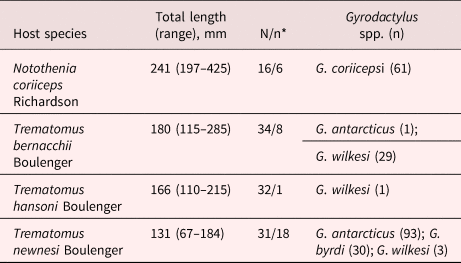
A total of 115 fish comprising five species were collected during two Antarctic summer expeditions to the Czech Johann Gregor Mendel Antarctic Station (James Ross Island) between January 2013 and March 2014. The fish were caught in the Prince Gustav Channel (63.799547°S, 57.920097°W) at a depth of 5–25 m, using gill nets and rods, and were transported alive to the laboratory at the station for further analysis. The fish were identified to species according to Gon and Heemstra (Reference Gon and Heemstra1990) and Fischer and Hureau (Reference Fischer and Hureau1985), and their total body length (TL, in mm) was measured (table 1). The fish were euthanized by severing the spinal cord just posterior to the cranium, and the gills and fins were examined for the presence of monogenean parasites, using a binocular microscope. All parasites were removed with the aid of dissection needles and mounted in a mixture of glycerine and ammonium picrate (APG; Malmberg, Reference Malmberg1970). Some specimens were cut transversally, the anterior end of the parasite body being stored in 99% ethanol and the posterior parts mounted on slides with AGP. The total number of Gyrodactylus spp. collected from each fish is presented in table 1.
An overview of Gyrodactylus spp. from the Notothenioid fishes from Prince Gustav Channel, Weddell Sea, examined in this study.
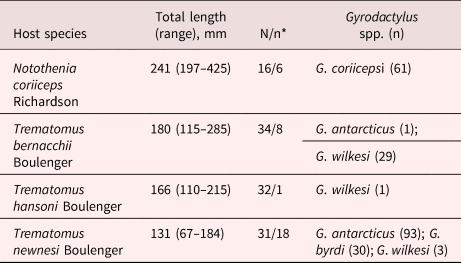
*N/n, number of host fish examined/infected
Morphometric analysis
Parasite identification and all further analyses were performed at the laboratories of the Department of Botany and Zoology, Masaryk University, Brno (Czech Republic). Gyrodactylus specimens were examined using an Olympus BX51 compound microscope (Olympus, Tokyo, Japan) equipped with phase-contrast. Images of the hard parts were prepared for each specimen with the aid of a drawing attachment and Adobe Photoshop CS6 and Adobe Illustrator CS6 version 13.0. Parasite body and opisthaptoral hard part measurements were based on those of Christinson et al. (Reference Christinson, Shinn and Van As2005). Fifteen measurements were taken on the hard parts: hamulus total length (HTL), hamulus point length (HPL), hamulus shaft length (HSL), hamulus root length (HRL), ventral bar median length (VBL), ventral bar membrane length (VBML), ventral bar width (VBW), dorsal bar length (DBL), dorsal bar width (DBW), marginal hook total length (MHTL), marginal hook sickle length (MHSL), marginal hook handle length (MHHL), marginal hook sickle distal width (MHSDW), marginal hook sickle proximal width (MHSPW) and marginal hook sickle aperture distance (MHSAD). Metric characteristics were obtained using the Olympus MicroImage 4.0 software package (Olympus, Japan). All measurements are presented in micrometres (μm), as a mean value with the range in parentheses. Available literature sources (Gusev, Reference Gusev1967; Hargis and Dillon, Reference Hargis and Dillon1968; Rokicka et al., Reference Rokicka, Lumme and Ziętara2009) were used for comparison. The paratype specimen of G. byrdi (USNM Helm. Coll. 62876) was obtained from the U.S. National Collection, Maryland, USA.
Molecular analysis
Amplification of ITS rDNA was undertaken following the protocol of Přikrylová et al. (Reference Přikrylová2013). In brief, ethanol was evaporated from the fixed tissue in a vacuum centrifuge and the DNA was then extracted using the Qiagen Blood and Tissue Isolation kit (Qiagen, Hilden, Germany), according to the manufacturer's protocol, the final sample being eluted to a final volume of 50 μl. The resulting DNA segments were amplified using the primers ITS1F (5´-GTTTCCGTAGGTGAACCT-3´) (Rokicka et al., Reference Rokicka, Lumme and Ziętara2007) and ITS2 (5´-TCCTCCGCTTAGTGATA-3´) (Matějusová et al., Reference Matějusová2001) in a Mastercycler ePgradient thermocycler (Eppendorf, Hamburg, Germany), the total volume of the polymerase chain reaction (PCR) being 20 μl (2 μl DNA and 18 μl PCR mix). Each amplification reaction contained 2 μl of template DNA, 1× PCR buffer, 1.25 mm MgCl2, 100 μm dNTPs, 0.1 mg/ml bovine serum albumin (BSA), 0.5 μm of each primer (Generi Biotech, Hradec Králové, Czech Republic) and 1.5 U of Taq Fermantase polymerase. The initial denaturation cycle took 3 minutes at 95°C, followed by 30 cycles of 1 minute at 94°C, 1 minute at 50°C and 1 minute 30 s at 72°C. Five μl of the PCR product was visualized on Gold View stained agarose gel (1%) and the remaining 15 μl was purified using the High Pure PCR Product Purification Kit (Roche, Basel, Switzerland). The purified products were measured for DNA concentration with a Qubit fluorimeter using a Qubit dsDNA HS Assay kit (Invitrogen, Carslbad, California, USA). Products of sufficient concentration were used for the sequencing reaction, using the same primers as the amplification reaction. The Big Dye Chemistry Cycle Sequencing Kit v.3.1 was used to prepare the sequencing reaction and purified samples were sequenced on an ABI 3130 Genetic Analyser automated sequencer (both Applied Biosystems, Foster City, California, USA). The newly obtained sequences were then analysed using Sequencher software (Gene Codes Corp., Ann Arbor, USA). New sequences were deposited in the nucleotide database the European Nucleotide Archive (ENA) under the following accession numbers: G. antarcticus (LT719090), G. coriicepsi (LT719089), and G. wilkesi (LT719091). Fourteen Gyrodactylus spp. sequences were retrieved from the GenBank nucleotide database, the selection of parasites being based on similarities found using a BlastN search. The species included in our phylogenetic analysis were those with identity of 85% and higher and cover 83% and higher after comparing both G. wilkesi and G. antarcticus sequences. The species selected were as follows: G. aideni Mullen, Cone, Easy & Burt, 2010 (HM481248), G. coriicepsi (FJ009451), G. corti Mizelle & Kritsky, 1967 (KJ124725), G. groenlandicus Levinsen, 1881 (KJ095104), G. flesi Malmberg, 1957 (AY278039), G. hrabei Ergens, 1957 (DQ288252), G. longipes Paladini, Hansen, Fioravanti & Shinn, 2011 (GQ150536), G. mariannae Winger, Hanse, Bachmann & Bakke, 2008 (DQ288255), G. nudifronsi (FJ009452), G. perlucidus Bykhovskiy & Polyanskiy, 1953 (FJ435202), G. pleuronecti Cone, 1981 (HM481247) and G. robustus Malmberg, 1957 (AY278040). Gyrodactylus branchicus Malmberg, 1964 (AY061977) and G. rarus Wagener, 1910 (FJ435196) were chosen as an outgroup based on the study of Rokicka et al. (Reference Rokicka, Lumme and Ziętara2009).
All sequences were aligned using the Clustal W multiple alignment program (Thompson et al., Reference Thompson, Higgins and Gibson1994) in MEGA v.6.0 (Tamura et al., Reference Tamura2013), with newly built alignments trimmed using trimAl v.1.2 (Capella-Gutiérrez et al., Reference Capella-Gutiérrez, Silla-Martínez and Gabaldón2009). The optimal molecular evolution model was selected based on the Bayesian information criterion (BIC; Schwarz, Reference Schwarz1978) and the corrected Akaike information criterion (AICc; Hurvich and Tsai, Reference Hurvich and Tsai1989) using MEGA 6.0, with neighbour-joining methods applied on the alignment. The GTR +Γ (Tavaré, Reference Tavaré and Miura1986; Rodriguez et al., Reference Rodriguez1990) with a gamma-shape parameter of 0.26 was selected for the ITS alignment. Bayesian inference (BI) was performed with MrBayes v.3 (Huelsenbeck and Ronquist, Reference Huelsenbeck and Ronquist2001; Ronquist and Huelsenbeck, Reference Ronquist and Huelsenbeck2003), posterior probabilities being calculated over 1.106 generations, the Markov chain sampled every 100 generations and 25% of samples discarded as ‘‘burn-in’’. A maximum likelihood (ML) search was then performed under the optimized model in PhyML v.3.0 (Guindon and Gascuel, Reference Guindon and Gascuel2003). Nodal support was assessed through 1000 bootstrap samples, using the nearest-neighbour interchange branch-swapping algorithm. Conversion of alignment was carried out using ALTER v.1.2 (Glez-Peña et al., Reference Glez-Peña2010) and phylogenetic trees were viewed in FigTree v.1.3. The final version of the trees was adjusted using Adobe Illustrator.
Results
A total of 218 Gyrodactylus specimens were found on the gills and fins of N. coriiceps, T. bernacchii, T. hansoni and T. newnesi. Based on molecular and morphometric analysis, four Gyrodactylus species were identified: G. antarcticus, G. byrdi, G. coriicepsi and G.wilkesi, with G. antarcticus being the most prevalent (table 1).
Family: Gyrodactylidae Cobbold, 1864
Genus: Gyrodactylus von Nordman, 1832
Gyrodactylus wilkesi Hargis & Dillon, 1968
Amended description
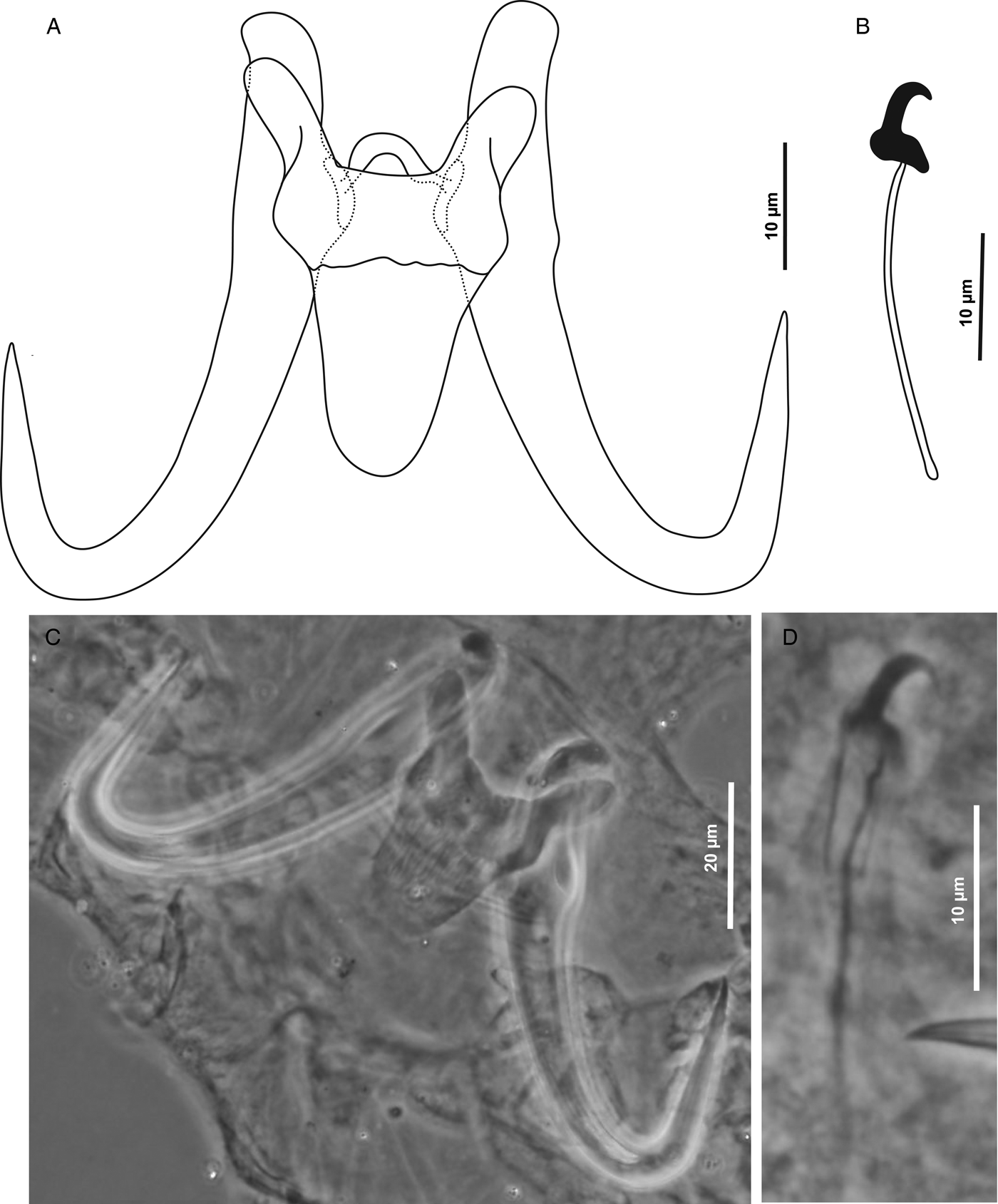
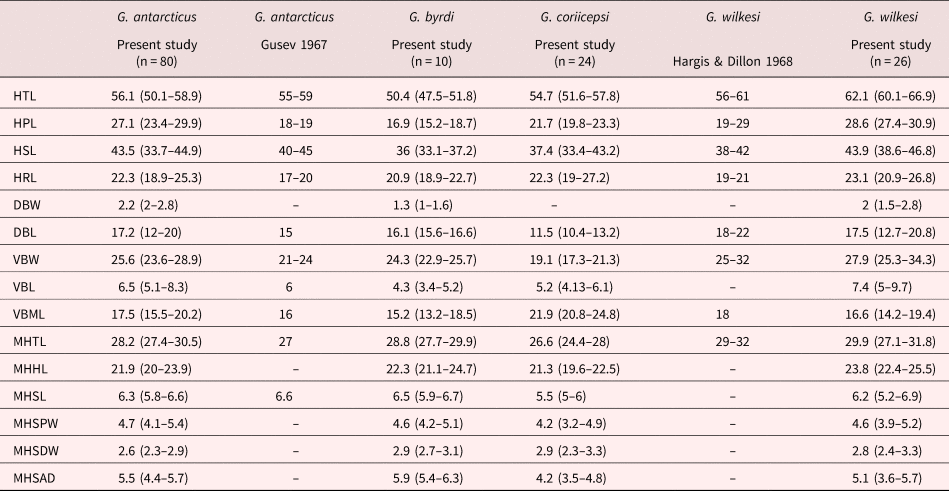
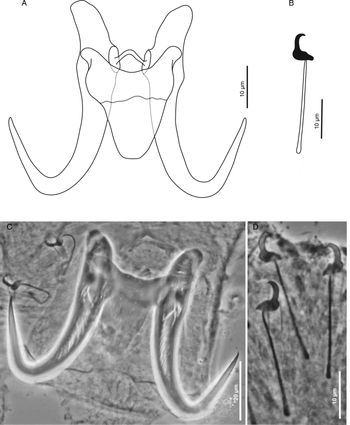
Based on 26 coverslip-flattened specimens and four excised opisthaptors (fig. 1). Opisthaptoral sclerite measurements are given in table 2. Total body length 640 (568–764; n = 17); maximum width at level of uterus 82–111 (105; n = 17). Pharyngeal bulb 57.6 (46.2–67.6; n = 17) long and 61 (49.5–78.1; n = 17) wide. Male copulatory organ 14.7 (13.5–15.9; n = 8) long and 15.1 (14.8–15.5; n = 8) wide. Opistohaptor clearly differentiated from rest of body. Hamuli robust with straight shaft, points and short roots head outwards. Opisthaptoral hard part measurements are given in table 2. Hamuli connected with simple dorsal bar. Ventral bar of elongated shape with very prominent lateral processes, tongue-shaped large membrane. Marginal hook handle connects to base in front third of the hook. Robust marginal hook sickle proper rises forwards from base, curves in second third. Sickle point short, not extending to toe edge; base narrowed in part where handle reaches base, toe rounded and gradually narrows.
Gyrodactylus wilkesi. (A) Line drawing of opisthaptoral central hook complex; (B) line drawing of marginal hook; (C) light micrograph of opisthaptoral central hook complex; (D) light micrograph of marginal hook.

Comparative measurements (in μm; mean, with range in parentheses) of opisthaptoral hard parts of Gyrodactylus spp. from Antarctic fishes.

Abbreviations: HTL, hamulus total length; HPL, hamulus point length; HSL, hamulus shaft length; HRL, hamulus root length; DBW, dorsal bar width; DBL, dorsal bar length; VBW, ventral bar width; VBL, ventral bar length; VBML, ventral bar membrane length; MHTL, marginal hook total length; MHHL, marginal hook handle length; MHSL, marginal hook sickle length; MHSPW, marginal hook sickle proximal width; MHSDW, marginal hook sickle distal width; MHSAD, marginal hook sickle aperture distance.
Taxonomic summary
Type host. Trematomus bernacchii Boulenger (Perciformes: Nototheniidae).
Other hosts. Trematomus hansoni Boulenger (Perciformes: Nototheniidae), Trematomus newnesi Boulenger (Perciformes: Nototheniidae).
Site of infection. Fins.
Type locality. Prince Gustav Channel, Weddell Sea, Antarctica (63.799547°S, 57.920097°W).
Deposited material. Two voucher specimens are deposited in the Helminthological Collection of the Institute of Parasitology, Czech Academy of Sciences, České Budějovice, Czech Republic (IPCAS Coll. M-685). A further two vouchers are deposited in the Natural History Museum, London, UK (NHMUK 2018.11.28.3-4).
Sequence data
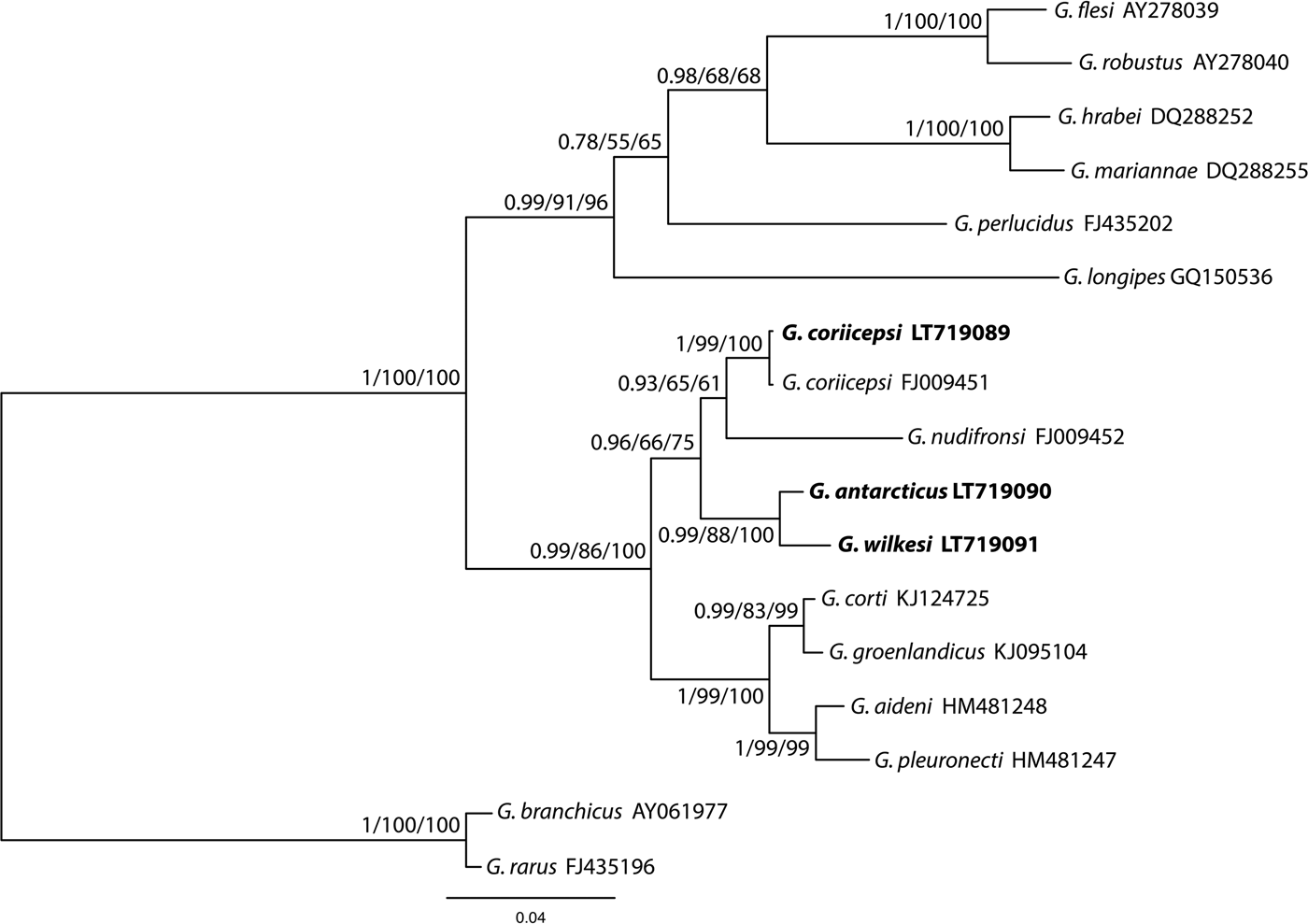
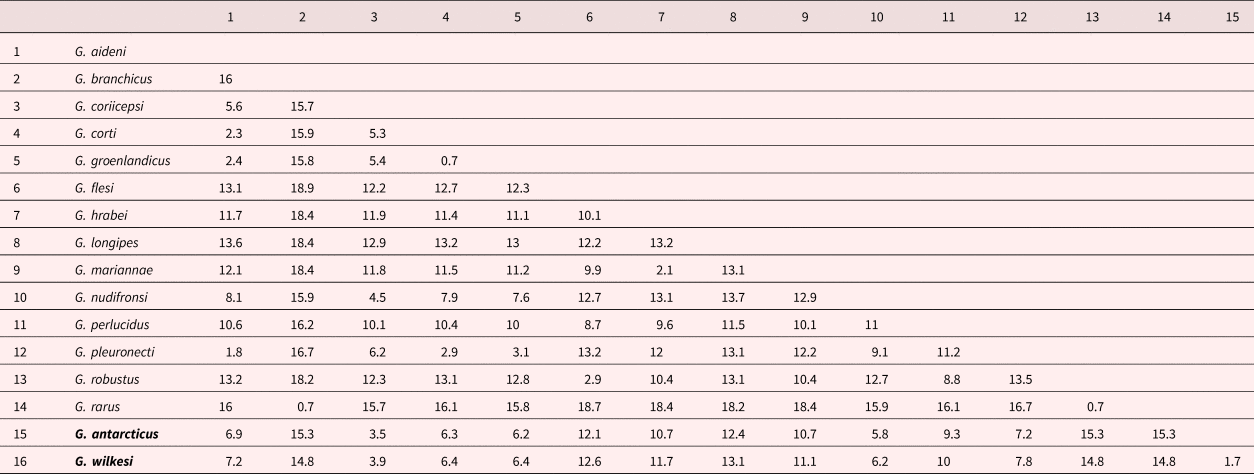
For molecular characterization, the ITS1-5.8S-ITS2 rDNA fragment was successfully sequenced from five specimens; fragments identical for all specimens. The sequences obtained ranged in length from 946 bp to 957 bp. The 957 bp rDNA sequence covered the ITS rDNA gene ITS1 (370 bp), 5.8S (157 bp) and ITS2 (430 bp). A BlastN search in the GenBank database (September 2016) using the entire sequence detected no identical hits. Gyrodactylus wilkesi is most closely related to G. antarcticus, based on an uncorrected p-distance of 1.7% (table 3) and its position in the phylogram (fig. 2). The longest newly obtained fragment is deposited in the European Nucleotide Archive (ENA) under accession number LT719091.
Phylogram for Gyrodactylus spp. based on Bayesian inference (BI) analysis of ITS rDNA region sequences. Nodal support values are presented as BI/maximum likelihood/neighbour joining. Newly obtained sequences are presented in bold.

Uncorected p-distances between the taxa included in the phylogenetic analysis, for the alignment of 911 bp (ITS rDNA).
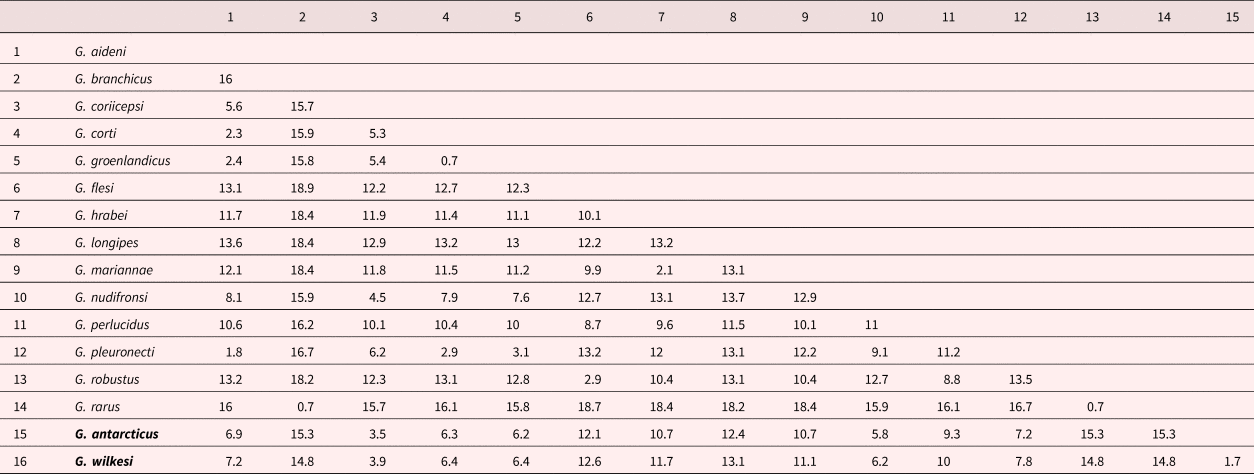
Newly obtained sequences are presented in bold.
Remarks
The dimensions of the hamuli, shaft and point, and total length of the marginal hooks of G. wilkesi corresponded with values from the original description (Hargis and Dillon, Reference Hargis and Dillon1968). The shape of the hamuli and ventral bar of G. wilkesi is similar to that of G. antarcticus, but hamuli total length of G. wilkesi is longer than that of G. antarcticus (60.1–66.9 vs 50.1–58.9 μm) and the lateral processes of the ventral bar are more prominent than those of G. antarcticus. The sickle proper of the marginal hook in G. wilkesi is thicker, with its point heading sharply downwards, and has a downward declining toe with a short upper line of base, while the sickle proper of G. antarcticus is thin, with the tip pointing forwards. The present study provides details on marginal hook shape, which was not a focus of the original species description of G. wilkesi.
Gyrodactylus antarcticus Gusev, 1967
Amended description
Based on 80 specimens (fig. 3) measured under coverslip pressure. Measurements of the opisthaptoral sclerites are given in table 2. Body 625 (494–765; n = 25) long and 112 (73–157; n = 25) wide. Pharyngeal bulb 58.3 (45.6–73.2; n = 25) long and 54.7 (39.9–69.7; n = 25) wide. Male copulatory organ 18 (15.7–22.1; n = 20) long and 18.5 (14.4–20.7; n = 20) wide. Opisthaptor clearly differential from rest of body and hamuli situated medially in opisthaptor. Hamuli with straight shaft, points and roots head outwards, simple dorsal bar. Ventral bar of elongated shape with large anterolateral processes going upwards. Slender marginal hook sickle, sickle point not extending beyond edge of toe. Toe of marginal hook sickle rotated forwards, gradually narrowing.
Gyrodactylus antarcticus Gusev, 1967 . (A) Line drawing of opisthaptoral central hook complex; (B) line drawing of marginal hook; (C) light micrograph of opisthaptoral central hook complex; (D) light micrograph of marginal hooks.

Taxonomic summary
Type host. Trematomus newnesi Boulenger (Perciformes: Nototheniidae).
Other host. Trematomus bernacchii Boulenger (Perciformes: Nototheniidae).
Site of infection. Fins.
Type locality. Davis Sea.
Other records. Prince Gustav Channel, Weddell Sea, Antarctica (63.799547°S, 57.920097°W).
Deposited material. Three voucher specimens (IPCAS Coll. M-684) and a further two vouchers (NHMUK 2018.11.28.1-2).
Sequence data
The ITS1-5.8S-ITS2 rDNA fragment was successfully sequenced from ten specimens for molecular characterization. The sequences obtained ranged in length from 947 bp to 972 bp. The 972 bp rDNA sequence covered ITS rDNA gene ITS1 (382 bp), 5.8S (157 bp) and ITS2 (433 bp). A BlastN search in the GenBank database (September 2016) using the entire sequence revealed no identical hits. Gyrodactylus antarcticus is most closely related to G. wilkesi based on uncorrected p-distance value (1.7%) (table 3) and its position in the phylogram (fig. 2). The longest newly obtained fragment is deposited at the ENA under accession number LT719090.
Remarks
The hamuli and marginal hook dimensions of G. antarcticus are similar to those of G. coriicepsi. The two species differ, however, in the shape of the marginal hook sickle and ventral bar. The ventral bar of G. coriicepsi has reduced anterolateral processes and a large membrane vs longer anterolateral processes and a smaller membrane in G. antarcticus. The proper sickle of G. antarcticus has a short point and is thinner than that of G. coriicepsi, which is more robust and has a bevelled heel end and overhanging toe.
Molecular analysis
Sequences of the ITS rDNA segment were successfully obtained from three species: G. antarcticus, G. coriicepsi and G. wilkesi. Amplification of one G. byrdi sample failed. From the initial complete alignment spanning 946 positions, 911 bp were retained after trimming, of which 292 were variable, 224 parsimony informative and 619 conservative. All three analyses resulted in identical tree topology and formed a well-supported cluster, including two lineages: Antarctic species and a sister group of Northern Hemisphere Gyrodactylus species (fig. 2). Gyrodactylus antarcticus + G. wilkesi and G. coriicepsi + G. nudifronsi always formed couples with high bootstrap values. Of the Antarctic species, G. antarcticus is the closest relative to G. wilkesi (1.7%) and is more closely related to G. coriicepsi (3.5%) than G. nudifronsi (5.8%). Gyrodactylus antarcticus is closest to the European G. perlucidus (9.3%); the distances of the other three Antarctic species are higher than 10%. Uncorrected ITS rDNA p-distances between G. wilkesi and the other species are given in table 3.
Discussion
Knowledge of Antarctic parasites, including monogenea, is limited, partly due to the extreme environmental conditions that limit access to the area.
Most gyrodactylid species have been found around the Davis Sea and the coast of Wilkes Land in eastern Antarctica (Gusev, Reference Gusev1967; Hargis and Dillon, Reference Hargis and Dillon1968). The two Gyrodactylus spp. found by Rokicka et al. (Reference Rokicka, Lumme and Ziętara2009), however, were from the South Shetlands (Admiralty Bay, King George Island) and represent first records from north of the Antarctic Peninsula. Previous research in the same area found no Gyrodactylidae species and only one monogenean species (Pseudobenedenia nototheniae Johnston, 1931) described from N. coriiceps (Zdzitowiecki and Laskowski, Reference Zdzitowiecki and Laskowski2004). The Gyrodactylus spp. findings presented here represent the first record of these ectoparasites from within the Weddell Sea (Prince Gustav Channel), east of the Antarctic Peninsula.
Antarctic waters are inhabited by approximately 283 fish species (www.fishbase.org), only a few of which have been adequately studied to date. Thus, previous studies on the occurrence, distribution and biology of monogenean parasites of Antarctic fishes probably represent just a small fraction of the potential diversity in this region, with many more new parasite species likely to be found as more fish species are examined. In the present study, four Gyrodactylus ectoparasites were identified, with G. antarcticus dominating overall. Furthermore, its presence on T. bernacchii represents a new host record. In general, the Gyrodactylus spp. showed high host specificity, with G. byrdi and G. coriicepsi found on their type hosts only, G. antarcticus found on two hosts and G. wilkesi on three hosts; the low number of specimens found on non-type hosts (table 1) represents either accidental infection or a ‘permanent trial’ for host switching. It has previously been reported, for example, that viviparous gyrodactylids are able to transmit from one host to another, leading to the rare situation of widened host specificity (Cable and Harris, Reference Cable and Harris2002). Further, as the number of hosts diversifies, rapid radiation may provide ideal conditions for more intensive host switching (Zahradníčková et al., Reference Zahradníčková2016).
For many years, the taxonomy of Gyrodactylus spp. was based on morphological characteristics alone, with Antarctic Gyrodactylus spp. divided into two groups based on ventral bar morphology, i.e. those having a ventral bar with large anterolateral processes (G. antarcticus, G. byrdi and G. wilkesi) and those with small or almost no anterolateral processes (G. australis, G. centronoti, G. rhigophilae, G. trematomi, G. coriicepsi and G. nudifronsi) (Rokicka et al., Reference Rokicka, Lumme and Ziętara2009). In the present study, this grouping was also supported by genetic evidence, the clade position of species in the neighbour-joining phylogenetic tree corresponding with ventral bar morphological similarities (fig. 2).
The ITS rDNA sequences obtained were used to reveal Gyrodactylus interspecies relationships. All three phylogenetic methods applied (BI, ML and NJ) resulted in identical tree topology with conclusive results on the phylogenetic position of the Antarctic lineage (fig. 2). A phylogenetic study based on ITS1-5.8S-ITS2 rDNA sequences by Rokicka et al. (Reference Rokicka, Lumme and Ziętara2009) proposed a monophyly of Gyrodactylus groups including Antarctic and European marine and freshwater species. Future analyses based on the 18S rDNA may better determine the position of Antarctic species within the genus Gyrodactylus, as this region has been proposed as more suitable for inferring relationships within and between Gyrodactylidae genera (Přikrylová et al., Reference Přikrylová2013).
Analysis based on currently available ITS rDNA sequences places G. antarcticus as a sister taxon to G. wilkesi and G. corricepsi to G. nudifronsi in a well-supported lineage of Antarctic species (fig. 2), with these forming a sister taxon to the North American and European marine species G. aideni, G. pleuronecti, G. corti and G. groenlandicus. These four species were not included in the work of Rokicka et al. (Reference Rokicka, Lumme and Ziętara2009), who presented European marine and freshwater species as sister taxa to the Antarctic species G. coriicepsi and G. nudifronsi.
As molecular data for Antarctic Gyrodactylus spp. are still limited, species identification must rely on morphometric identification based on the shape and metric parameters of the marginal hook sickles along with the hamuli, ventral and connecting bars. However, the present study goes some way to amend this situation by producing updated descriptions of two of the Antarctic species, providing improved morphological descriptions and molecular data that will facilitate their correct identification.
Author ORCIDs
I. Přikrylová 0000-0003-4761-8943.
Acknowledgements
Iva Přikrylová and processing of the material were supported by the Czech Science Foundation (Project No. P505/12/G112). We are grateful to the staff of the Czech J. G. Mendel Antarctic Station (James Ross Island; 2013 and 2014 Antarctic expeditions) for their help and support. We also thank Dr Pavel Jurajda for help in collecting the fish. This is contribution number 269 from the NWU-Water Research Group.
Conflict of interest
None.
Ethical standards
All procedures performed in studies involving animals were in accordance with the ethical standards of the institution according to § 17 of the Act No. 246/1992 Coll., on Prevention of Cruelty to Animals.