The Census as a Central Administrative Practice in the Production of Knowledge
The population of Austria-Hungary was counted five times between 1869 and 1910.Footnote 1 This process of counting established a new relationship between the state and its citizens.Footnote 2 The state procured vast knowledge about its citizens, and the latter became accustomed to contact on a regular basis with state authorities and administrative practices. By the end of the nineteenth century, both the state and its citizens knew more of each other than ever before.Footnote 3 This article scrutinizes the administrative translation of reality into discourse and the effects this had on the two parties involved.
The census was certainly the most prominent, though not the only, measure by which the state gathered information in a coordinated and structured way. In 1869 the state began the Dritte Landesaufnahme (third land survey), an ambitious project that gained Austria-Hungary an international recognition and produced maps that were still considered to be state-of-the-art in the middle of the twentieth century.Footnote 4 Only a few years earlier the so-called Grundsteuerkataster (land tax cadastre) had been finalized. Additionally, since the end of the eighteenth century, constant efforts had also been made to bring house numbering to the entire territory of the state to completion. In all these practices—counting the population, surveying the land, and numbering the dwellings—science and administration met. In a joint effort, state officials and academicians contributed to the production of a new category of knowledge, which in the course of the nineteenth century became a public resource. It enabled the state and its administration to dominate and control the totality of its citizens by coercing them to provide administrative discourse with a specific input, which it then arranged into a certain order. In this regard the census has come to be seen as an act of violence rather than just an innocuous collection of data. I refer to José Rabasa, who points out that “[t]he equation discourse is violence […] refines the commonplace knowledge is power; it displaces the formulation of the problem from the misuse of information to an integral view of knowledge as a form of domination, of control.”Footnote 5
This observation applies particularly to the knowledge the census generated. Most studies dealing with colonial censuses, but also many on the census in European contexts, use this perspective to frame their principle analysis.Footnote 6 Yet in the context of the nineteenth century, the production of knowledge as a basis of informed decision making has also been regarded as a major step forward toward a more egalitarian, equal, and meritocratic society. Many citizens considered the census not as a means of oppression and control, but as an instrument of emancipation and of great promise when it came to the determination of stakes for the further expansion of electorates and the distribution of political participation.Footnote 7 These two perspectives have to be kept in mind when dealing with Central European variants of censuses in the nineteenth century, as they interacted strongly and were in many places able to promote each other, despite their seemingly contradictory motivations.
The present article scrutinizes this tension by approaching the census from two seemingly different sides, those of science and administration. It draws on the insights of the larger complex of research conducted on the census in general during the past half-century.Footnote 8
It is important to clarify two terms in the beginning: “administration” and “state.” In the mid nineteenth century the Habsburg Empire featured a complex society. In this article I focus on a few collective identities within that society. In particular, officials and the civil service play major roles in this inquiry, thus requiring further specification. Since the era of Joseph II, these groups had been considered a nucleus of enlightened thinking and later of political liberalism. Conservative political elites in the first half of the nineteenth century did their best to keep a wary eye on the officials. However, that group was also the subject of massive social change between roughly 1848 and 1870. As a consequence of the changes brought by the revolutions of 1848, the civil service expanded in order to integrate the functions of older administrative structures, in particular those administrative and judicial responsibilities that had previously been exercised by local lords in the manorial system. At the same time, civil servants, especially in high-ranking positions, were given more agency as the neoabsolutist state expanded its administrative competencies. The description and analytical naming of a group as heterogeneous as that of the “officials” is indeed difficult, yet scholars agree on certain criteria that allow us to make a rough outline of a functional group. Top civil servants in particular shared a certain set of values and conventions that were closely connected to their common educational background. The strong focus on principles of meritocracy that structured the civil service since the time of Joseph II and an enlightened belief in the benefits of education made civil servants a leading group in the emergence of a civil society in the modern sense in the first half of the nineteenth century in Austria.Footnote 9
The second important term is “state.” In his work on the civil service in the late Habsburg Empire, historian John Deak describes the state as “being comprised of a series of engagements or negotiations between the civil service elites and political elites.”Footnote 10 Deak does not subscribe to the notion that the state is an entity in its own right with its own agency. Rather, he suggests modeling the state as a series of processes. His definition makes sense, since it allows us to identify the particular agents that are important for the developments under scrutiny here.
Imperial Austria between 1848 and 1867 is difficult to define in terms of statehood. An empire was supposed to turn into a central state by the late 1840s, therefore building an enormous administrative apparatus. With the exclusion of aristocratic elites from imperial rule, the state had to generate its own formations of bureaucratic knowledge in order to be able to exercise power. Census taking and mapping were among the most important measures to achieve that end. Still, in the mid 1860s, the odds were that the Habsburg Empire was not going to implement a general census procedure, one that would cover the entire territory of the state. The German-speaking parts of the state were willing to census population together with the states of the Zollverein (German Customs Union), an option that would exclude most of the other parts of the empire, which would have had to hold their own censuses. With the exclusion of the Habsburg monarchy from the German Confederation after Königgrätz, however, the empire had to find a new frame by which to legitimate its existence. The multinational state finally was to become this new form, and the 1869 census was supposed to provide the structure for this modern manifestation of the old empire.Footnote 11 From that moment on, modernization became not simply a political imperative but also an administrative one.Footnote 12
Sources and Approach
The anthropological methodology used by practitioners of science studies requires a rich body of source material. The census is a well-documented procedure, accompanied by an elaborated scientific discourse. The statistical and scientific discourses about the census procedure that appeared in professional journals, such as the Mittheilungen aus dem Gebiete der Statistik, provide a context and background for scrutiny of the actual census procedure.Footnote 13 This journal is of particular importance, since it published not only a series of lectures by Adolf Ficker, the director of administrative statistics (and thus head of the office in charge of the execution of the census), but also the protocols of the k.k. statistische Central-Commission up to the early 1870s.Footnote 14 I have also integrated newspaper treatment of the census operation into this analysis, including roughly a dozen newspaper titles—the Neue Freie Presse (liberal-bourgeois), the official Wiener Zeitung, Die Presse (liberal-bourgeois, though further to the Right than NFP), Das Vaterland (Catholic-aristocratic), and Neues Fremden-Blatt proved particularly relevant—in order to examine a representative sample of German-language newspapers. Further, I examined the official results of the 1869 population census, printed in two volumes. The second volume also contains the so-called Erläuterungen zu den Bevölkerungs-Ergebnissen (Annotations to the Population Results), which are of great interest as they included vast information on the obstacles and difficulties with which the census operation had to deal in the field.Footnote 15 I have also integrated a large number of archival sources into the analysis, among them Zählungs-Operate, the actual census forms completed by citizens. Since only a small proportion of these forms have been preserved, they could be scrutinized extensively. Most records of the statistische Central-Commission are lost, since the archive of this institution no longer exists. Another important group of sources for this article are legal texts that defined, determined, and regulated the census operation. These texts established the normative framework for counting the population, and explained in detail where and how facts had to be established and reality had to be measured and transformed into discourse.
Comparison of the above-mentioned census forms with the census rules indicates that, by and large, the rules were observed in practice. In order to ensure that the instructions were followed to the letter, the administrators of the census operation enforced a control system, which threatened severe penalties for violations. However, some of the categories that the census was supposed to establish were later discarded, as they did not work the way they were supposed to; I provide examples of these later in my analysis.
Census and State: Modernity by Numbers
Modern censuses in Central Europe were taken from the eighteenth century onward. These early censuses resembled inventories in their form and purpose. By the mid nineteenth century, however, the situation had largely changed. Censuses were increasingly understood as scientific operations as well as administrative imperatives, and they contributed greatly to what Benedict Anderson has called “serialization: the assumption that the world was made up of replicable plurals.”Footnote 16 Seriality entails the creation of such global terms as “working class,” “imperialism,” and “revolution” through media and state discourse; it is the coining of a vocabulary allowing for the depiction of new social facts and events. By introducing this terminology, print media in particular shaped new opportunities for identification. This process took place on different levels. Anderson differentiates between the seriality produced, for instance, by newspapers and theaters and that produced by the state's institutions:
Unbound seriality, which has its origins in the print market, especially in newspapers […] is exemplified by such open-to-the-world plurals as nationalists, anarchists, bureaucrats, and workers. […] Bound seriality, which has its origins in governmentality, especially in such institutions as the census and elections, is exemplified by finite series like Asian-Americans, beurs, and Tutsis.Footnote 17
The production of seriality was a major process in global modernization and catalyzed the formation of new and increasingly global collective subjectivities. From 1853 onward, international statistical congresses took place biannually and promoted the standardization of census procedures so that (European) states and their characteristics could become basically comparable.Footnote 18 We see unbound seriality in action here: a common vocabulary (and thus a common view of the world, with shared epistemic entities and values) was developed in a discursive environment. The major categories and groups of modern societies were negotiated in this setting. Unbound seriality could lead to bound seriality, though, as the statistical congresses were to develop a strong influence on the development and the reform of the census, and defined and shaped not only most of the categories and modes determining the operation, but also the general framework in which it was embedded.
Political Change and the Civil Service
The persons in charge of the 1869 census, such as Adolf Ficker in Vienna, were well aware that this operation not only had to provide administration with important knowledge on the structure and the distribution of population, but also had to shape the external image of the state as modern and promising. The situation was not at all new; the imperial administration was quite familiar with pressures to modernize. Since the days of Joseph II, enlightened ideals had formed the basis of the esprit de corps of the officials of the Zentralstellen (central state authorities).Footnote 19 To many of the top officials, the vast keyword “modernization” provided a certain agency and an opportunity to develop a working agenda of their own when a more reactionary regime took over after Joseph. For a supposedly liberal-minded civil service, modernization was a back-door route through which to pursue objectives that were not completely in line with the interests of Vormärz era and later neoabsolutist rule.Footnote 20 Yet, the political conditions of the 1850s also compelled officials to be extremely cautious. Two figures were particularly important: Karl Czoernig, the leading figure of administrative statistics in the Habsburg Empire during roughly 1841–65, and Adolf Ficker, the most important statistician in Austria in the late 1860s through the 1870s. Czoernig remains a singular figure in the development of administrative statistics in the Austrian Empire. He entered the civil service in 1828 and was in charge of administrative statistics as of 1841. In this function, he not only made the humble statistical data that the state procured accessible to a broader public, he also brought the production of such knowledge to a new level. His activities peaked in the well-known Ethnographie der oesterreichischen Monarchie (Vienna, 1855–57). But his undertakings exceeded the career of an official by far; he was also elected to the Frankfurt parliament in 1848. Although he had not shown political commitment before, he was involved with a number of associations, and his responsibilities in the civil service stretched over several distinct fields. Statistics seems to have played a minor part in his professional life.Footnote 21
Ficker, a former protégé of Czoernig, took over most of his patron's statistical duties once the latter stepped down in 1865. The reasons for Czoernig's early departure are difficult to determine. Health issues as well as his support for the political regime of neoabsolutism are considered the most likely factors leading to his retirement.Footnote 22 Recent research by Waltraud Heindl sheds some new light on the circle to which Czoernig belonged, and on the complex context that formed the background of administrative action in the Habsburg Empire in the 1850s and 1860s. In her impressive study on Austrian bureaucracy in the nineteenth century, she emphasizes the role that liberal mindsets and values played in the establishment of the utopia of a centralized state that bridged the span between the revolutionary years of 1849–50 and the Austro-Hungarian Compromise of 1867.Footnote 23 Heindl examines the civil servants in a time of two major transitions: first, the establishment of a neoabsolutist system, then its development into a constitutional state. She points to an extremely important aspect: the mutual dependency that bound ruling political elites and civil servants to each other, which seems to have had an interesting effect on the character of conflict between the two groups involved.Footnote 24 Political elites relied on the expertise and the know-how of their civil servants in order to be able to exercise political power and, more important, control; officials were existentially dependent on their jobs. Although disciplining of members of the civil service took place in the aftermath of the revolutionary years, the number of such cases was relatively low. The new political elites had to content themselves with the civil servants who were at their disposal, particularly as the neoabsolutist system required more rather than fewer officials. Both transitions, the one to neoabsolutism and the one to constitutionalism, are relevant. Though neither fundamentally shifted the mindsets and values of the civil service and of those working for it, they changed the ways in which arguments could be made and things be discussed. Thus it is unrewarding to ask for positions or convictions of politicians, scientists, and administrators concerning census issues. Rather, I focus here on the ways in which certain decisions and actions could be debated conclusively.
Looking closer at high-ranking civil servants such as Ficker or Czoernig, it is interesting that that basically liberal mindsets were not inevitably doomed to collide with the limitations that (another) autocratic regime inflicted upon the civil service. On the contrary, for many civil servants, particularly in the statistical offices, the era of neoabsolutism seems to have provided opportunities rather than risks, in spite of the fact that the mindsets of many officials were theoretically in conflict with the dogmas of the new regime.Footnote 25
Politics, Administration, and the Public: Discursive Frames
Social stability was a theme of great importance to political elites in the neoabsolutist context and still later. After the revolutions in 1848–49, even liberally minded observers and sympathizers expressed shock and disgust in the light of chaos and destruction for which particularly members of the working class, joining the revolutionary movement, were held responsible. As a consequence, issues of social control became important among Central European liberals of the 1850s and 1860s as well. These constituted a shared interest of almost all groups that produced political discourse. By the mid 1860s, censuses had become instruments that seemed to expand the state's set of tools to that purpose.Footnote 26 In his famous lectures held for civil servants employed in the state's central administration, Ficker promised control and predictability of population development. This message persuaded conservative political elites as well as liberally minded officials, though not for the exact same reasons. The first group viewed the knowledge that was produced by the census as a basis for governmentality, the latter as a foundation for a better understanding of society and for further interventions yielding social improvement (although governmentality was not absolutely undesirable for high-ranking, liberal-minded civil servants of that time).
Also by the mid nineteenth century, censuses gained enormous public importance because they served as a basis for the definition of electorates and for military conscription. These latter two aspects, for instance, were of particular interest to the (liberal) press. Newspaper reports concentrated mainly on these issues.Footnote 27
The obvious contradiction between these two large complexes—governmentality on the one hand, the definition of an electorate so as to enable the political participation of larger parts of the population on the other—describes quite well the ambiguous character of the Central European census operation, rooted as it was in two completely different endeavors: an autocratic striving for control and the requirements of the liberal state. In public perception as in political discourse of the late Habsburg Empire, the census practice got stuck between these two poles. Both sides, conservative/state and liberal/public, faced a double-edged sword. However, there is no sharp dividing line between these two poles, and a closer examination of Adolf Ficker shows there were even connections that allowed for negotiations between the two seemingly disparate ends: public and state, liberal requirements and governmental fantasies. In order to render these connections visible, it is necessary to focus on the contemporary ideals of scientific practice and objectivity and on the role these played in developing the census.
The Promise of Science
A properly conducted census provided the administration with profound and reliable insights into the structure and the social makeup of society. It further promised a certain predictability of social shifts and developments. The census in imperial Austria proceeded on the assumption that “reality” and “population” both existed and could be observed like any other natural phenomenon.Footnote 28 Ficker and the statistische Central-Commission considered population to be synonymous with reality, although there were limits to how far they took their positivism.Footnote 29 The census thus took a picture and produced a representation of reality.Footnote 30
The position of Ficker and his colleagues, which is not completely in line even with contemporary (social) scientific discourse, leads to the identification of a major disparity between scientific argument in political and administrative discourse and scientific practice in the execution of the census. Although science was a major argument in the preparation of the census, scientificity was not an issue of much importance in its execution. Ficker and his colleagues, not only in the statistische Central-Commission but also in other statistical offices in Europe, had limited access to scientific and particularly statistic knowledge and methodology. In terms of objectivity they adhered to what Lorraine Daston and Peter Galison would call “truth-to-nature.”Footnote 31 The generation of census makers to which Ficker belonged could hardly be described as scientists, not even by contemporary standards.Footnote 32 Nevertheless, Ficker, Richard Boeckh, and other personalities of the time were quite successful in the late 1860s and early 1870s in presenting themselves precisely as scientists rather than as administrators, as men who served their respective states less by following political guidelines than by employing science and its universal validity in the state's interest. Science had become a factor that could no longer be ignored, and even reactionary forces could no longer put aside the truth it delivered.
Looking upon the different reports of the Subcommittee for the Revision of the Census Regulation (Special-Comité zur Revision der Volkszählungs-Vorschrift) between roughly 1864 and 1868, we can observe a shift in the line of argumentation. The statistische Central-Commission successfully made recourse to scientific evidence as a means to intervene in legal and administrative procedures. A scientific state of the art thus proved a major counterweight against absolutist arbitrariness. The census seems to have been a major testing ground in this regard. Yet arguing with the requirements of scientific research not only turned out to be an efficient weapon against reactionary politics; it also helped to break the resistance of those citizens who opposed the census on the grounds of fear of repression and governmentality. During the census of 1869, especially in the Littoral and in Dalmatia, citizens resisted the counting and were even able to delay the completion of the results.Footnote 33 The animal count remained the subject of constant complaint, as citizens did not trust that the authorities would not use the data for fiscal issues.Footnote 34 And finally, the authorities debated the state's right to interfere with the citizens’ most private sphere.Footnote 35 A mid-nineteenth-century understanding of modern science and its supposed universality became an important means of intervention and of exerting agency, in particular for higher-ranking officials, who therefore transformed themselves into scientists when the occasion required it.Footnote 36
Suspiciously Eyeing Each Other: International Exchange and Supervision
Further backing for this strategy came from a strong international community of experts in administrative statistics, which had been established only in the fifteen years preceding the 1869 population census: the International Statistical Congress. This consortium set certain standards that made it more and more difficult for states to maintain positions that could not be justified in terms of their modernity.Footnote 37 The latest definitions of modernity were usually negotiated in the peculiar forums that the International Statistical Congresses set up. These excluded to a certain extent the ruling political elites and the public.
Most certainly, the weak position of imperial Austria's state administration between 1866 and 1867 that resulted from the far-reaching consequences of Königgrätz and the 1867 Hungarian Compromise enabled the establishment of a relatively progressive legal framework for a new population census.Footnote 38 The census provided a good opportunity to gain some recognition on the international level, where the state's reputation was quite battered. With Ficker in a leading role, the statistische Central-Commission was even able to make a dent in positioning itself as an authority in administrative statistics when it came to the execution of the census operation.Footnote 39 By the early 1870s, the success of this strategy was reflected by a number of honorary positions held by Ficker himself and some of his colleagues.
Ficker was walking a thin line. A stern believer in scientific objectivity and observable reality, the former assistant to Czoernig also knew quite well the extent to which he could rely on his expertise as a scientist without coming into conflict with political elites. In the protocols of the central commission from the late 1860s, the extreme prudence and caution he displays toward his political and administrative superiors leaves little doubt about his loyalty vis-à-vis his disciplinarians. After the Compromise of 1867 he let his guard down; he left his defensive stance and pleaded more openly in favor of a distinctly liberal position concerning the census. By doing so, he was usually able to provide an argument that pleased liberal mindsets as well as more conservative (right up to extremely conservative) demands. Ficker presented the census and its objectives in a way that fit it into two perspectives, a rather liberal-emancipative one, and a more conservative-governmental one.Footnote 40 Scientificity could be used as an argument in both contexts, not at least because many liberals sympathized secretly with the idea of stronger control, as long as it did not affect their own class.
Things became difficult though when questions of language and nationality had to be dealt with, where irreconcilable positions met, positions moreover, that were drifting even further apart. Although all parties involved agreed in principle on the multinational character of the state's population, they disagreed as to how to deal with that situation, and further, their political objectives differed vastly.Footnote 41 In the heated atmosphere of the late 1860s, administration proved its capacities as a mediator. Being fully aware of the explosive nature of nationality issues, Ficker provided an “objective” explanation for not even counting at least languages. His expertise stated that nationality could not be measured objectively, as it was a quality that could only be ascertained upon collectives, not upon individuals, which implied at the same time that social reality could not be determined objectively in the last resort. A language count would not equal a nationality count, according to Ficker. There is good reason to assume that Ficker's position derived from a particular objective, which was to prevent these issues from entering the realm of solid and incontestable knowledge.Footnote 42
By keeping nationality and language out of the census in the first place, the state could gain some time in order to establish greater stability and legitimacy.
Already in the early 1870s the Austrian decision was contested by German statisticians, not at least because Ficker, then one of the most renowned administrative statisticians in Europe, developed a comprehensive argument in order to prevent nationality from entering the state discourse in other states as well.Footnote 43 He supported the statisticians’ claim for a language count, though he stuck to the position that this would not equal a determination of nationality of individual citizens. Ficker, then head of the International Statistical Congress, was in the difficult situation of having to defend the idea of the multinational state against newly established nation-states to the northwest and the south of the Habsburg monarchy.Footnote 44 Yet, only a few years later Ficker's German counterpart, Boeckh, got his way. At least in the international scientific debate, language and nationality were declared to be synonymous, and the language count became the prevalent means of ascertaining nationality in a number of countries.
Setting up the Census: Legal Frameworks and Spatial Control
The census itself started at an unusual point. In the first place, it was not at all concerned with citizens, but rather with space. The law of 29 March 1869, which prescribed the particular steps of the procedure in detail, described in its first ten paragraphs where the display of house numbers and of place-names was required.
This leads to the first level of analysis: space. As has been mentioned, the Habsburg monarchy made serious efforts throughout the entire nineteenth century to become more familiar with the space that it claimed to control. Two land surveys had been effectuated (1763–85, 1806–69), house numbering promoted (from 1770 onward), and a land tax cadastre (1817–61) completed. It was precisely at this moment, when the state grasped space and tried to get hold of it in the form of representations, that it actually began to control it. Maps rendered space visible. House numbering was at the same time house counting, and thus led to some sort of inventory; and place-name signs fixed matters spatially. Modern land surveys required an enormous administrative and scientific effort, but in return they promised objective representations of the state's interior space.Footnote 45 They helped to make the modern state imaginable and manageable by defining it as the content of a finite, stable, and delimitable piece of land.Footnote 46 Its equivalence with a homogenous territorial sphere has to be considered the sine qua non of the modern state.
By the mid nineteenth century, the administration of the Habsburg monarchy could finally provide its civil servants with a uniform spatial—as Latour would put it—inscription. The medium of the official map presented the space controlled by the state in a consistent and reproducible way, from a completely new perspective.
This enforcement of a new and official interpretation of space did not go unchallenged. In particular, lords of manors and members of the aristocracy tried to resist the appropriation of space by the state. Both they and normal citizens, or subjects, also had to number their houses, and thus grant the authorities better and more direct access to their lives.Footnote 47 Several decades of more or less consequential structuring, marking, and subordination of space by the state had preceded those first ten paragraphs of the law of 29 March 1869, and these activities had left visible traces. Place-name signs (§9 of the census law), house numbers (§§1–8), and maps were inscriptions that allowed the census to take place, and to relocalize the knowledge it produced.Footnote 48
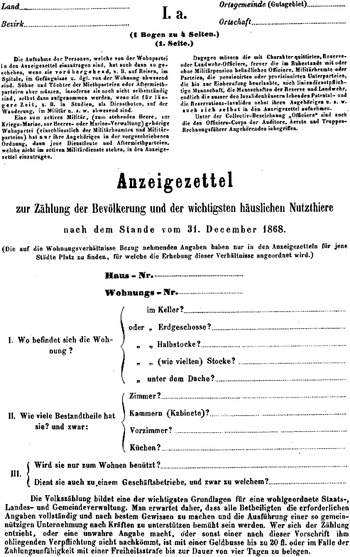
What happened in towns, villages, communities, and houses once the census started? At the outset, the law established a dichotomy between urban and rural spaces.Footnote 49 Although all citizens were required to deliver the same information whether they lived in urban areas or not, the administration developed different printed forms. Under urban conditions, the census was taken via so-called Anzeigezettel (report sheets; see fig. 1), whereas in rural areas Aufnahmsbogen (intake forms) were used. The forms were nearly identical, but completed in different ways. Anzeigezettel had to be completed by the citizens themselves, or, to be more precise, by homeowners. They were obliged to distribute the forms among their tenants or cohabitants, to collect them after completion, to ensure that answers had been made correctly, and finally to return the documents to the authorities.
First page of the Anzeigezettel. Source: Mittheilungen aus dem Gebiete der Statistik 17.2 (1870): 37.

Aufnahmsbogen were completed by so-called Zählungs-Commissäre (census commissars). They entered the oral statements of “heads of family” on the forms. No further specification was made as to the circle of persons considered capable of doing the job. Municipalities selected their own Zählungs-Commissäre, and their choices did not always make officials happy.Footnote 50
The Forms
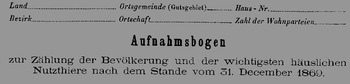
The Anzeigezettel and Aufnahmsbogen matched the criteria that apply to forms in general: they allowed “active […] participation of the citizen in an asymmetrical communication with the administration.”Footnote 51 Identical apart from the first page and the instructions, they comprised four pages. At the head of the first page, four entries were required: Land (province), Bezirk (district), Ortsgemeinde (Gutsgebiet) (municipality/estate), and Ortschaft (village) (see fig. 2). On each form, the house number also had to be indicated. These five parameters permitted organization of the information being gathered into the spatial inscriptions mentioned already, such as official maps. State-approved place-names were input directly into the forms. So too were the house numbers, but only on the Aufnahmsbogen and not on the Anzeigezettel (as the latter represented single apartments instead of entire houses).
Header of the Aufnahmsbogen. Source: Mittheilungen aus dem Gebiete der Statistik 17.2 (1870): 45.

The census form was one of several devices that helped bridge the gap between reality and discourse. It belonged neither exclusively to one realm nor the other; it combined qualities of both. The correlation between real objects that acted as signs (place-name signs, house numbers) and the information inscribed in the forms allowed the administration to organize society according to a particular reality and discourse.
The census thus began with the determination of a position in space. The citizen's social reality could be read and processed by the authorities only once they knew where exactly it took place, as this ensured integration into the administration's space-based model of society.
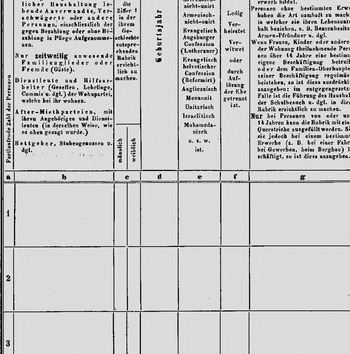
Once the citizen's spatial position had been determined, the first page of the census form could be turned. Pages two and three resembled a huge table, a coordinate system, comprising eleven columns in all.Footnote 52 There, the form rendered information spatially: each bit of social reality that filled a box of the census sheet received a clear position in the table (see fig. 3).
Left side (columns “a”–“g”) of the eleven-column questionnaire table in the Anzeigezettel and Aufnahmsbogen forms. Source: Mittheilungen aus dem Gebiete der Statistik 17.2 (1870): 38.

What was considered knowable? The bureaucracy desired to know ten aspects of the citizen's/subject's life: name, gender, year of birth, religion, marital status, profession or occupation, place of birth, local citizenship, whether he or she was present or absent, and general remarks. It added another column (the first column with the designation ‘a’) for numbering all the citizens registered on a single form.
The person's name appeared in column ‘b’ and had to be indicated completely. Moreover, citizens had to be recorded in a certain order. The topmost row was reserved for the head of the household. He or she was followed by relatives in descending order. After family members came servants, and then subtenants, their relatives, their servants, and finally lodgers.Footnote 53
The social order of society as defined and respectively imagined by the central state was hence the organizing principle of the census. Each sheet indicated precisely where the citizens in question could be found, and which social position they occupied. Administrative precautions prevented reality from entering the census freely: it was restricted and controlled from the very first step. Nevertheless, citizens entered the survey as individuals, and as such they were perceived by the state administration.Footnote 54
Column ‘c’ asked about gender. It was divided in two subcolumns, male and female, and the applicable subcolumn was to be marked with a ‘1.’ One's year of birth had to be stated in column ‘d,’ and column ‘e’ asked about religion:
Here it has to be indicated whether the person is Roman Catholic, Greek Catholic, Armenian Catholic, Greek Orthodox, Armenian Orthodox, Protestant–Augsburg Confession, Protestant–Helvetic Confession, Anglican, Mennonite, Unitarian, Israelite, Mahometan etc.Footnote 55
Like column ‘b’ (name), this column implied a hierarchical order. Religions recognized by the state were listed in a certain sequence, starting with the Roman Catholic belief of the head of state.
Column ‘f’ requested marital status. Here it becomes clear how difficult the “measuring of reality” actually was. Only four options were offered: unmarried, married, widowed, or separated as a consequence of dissolution of marriage. This limited range of possible states caused problems, because at the time marriage was still administered and controlled by the recognized religious communities. Thus different social practices coexisted—a pattern that was not in the interest of the central administration. Not every religious community offered its members the same options. Some communities allowed divorce, but the Roman Catholic Church did not, which is one of the reasons why divorce did not appear on the form as an option. This aspect was recognized as a problem by the creators of the census and also constituted a subject of broader debate. Misunderstandings or discordant interpretations were viewed as a significant threat to the proceedings, because the census could deliver truthful results only if its requirements and instructions were fully understood and followed by citizens and Zählungs-Commissäre alike. The state administration and in particular the statistische Central-Commission were all too aware of this difficulty.
Inquiries into marital status demonstrated particularly vividly how the social realities of different citizens could differ. What was (in theory) unavailable to the Catholic majority of the population, namely divorce, was everyday practice among members of other denominations. Finding a common range of expressions that would apply to all citizens, which would be a prerequisite for all scientific description of the population, proved impossible. Furthermore, as an administrative project, the census was basically bound to a certain legal vocabulary. The authorities knew from earlier such undertakings that citizens frequently failed to indicate their marital status correctly, in particular when it came to separation and divorce. Using only the prescribed legal expressions on the census forms would thus have distorted the results. Ficker devoted significant time and thought to this problem, and finally decided on the four categories listed above. “Separated as a consequence of dissolution of marriage” did not correspond to any existing administrative category; it was created to channel the confusion that might result for citizens from poor knowledge of their own marital status. A Catholic, Ficker hoped, would have to indicate “married” even if he (or she) were separated, as he did not fit any other category.Footnote 56
The whole debate outlined here refers to what Anderson describes as the “impermissibility of fractions.” Because the census does not accept fractionality, certain aspects of reality have to be categorized in a more or less arbitrary way.Footnote 57 Furthermore, this debate shows how serialization works: a common vocabulary must be established, in order to allow for exchange and communication between the central administration and a large number of very different and diverse citizens. It is particularly interesting to see that this dynamic process has an effect on both sides involved. The administration is urged to adapt its categorization to what citizens are able to answer in a meaningful and predictable way. Citizens, meanwhile, integrate seriality into their self-conceptions and begin to realize their involvement in the greater context of “imagined communities.”Footnote 58
Columns ‘g’ and ‘h’ dealt with profession and occupation. I will not go into detail about them here, as this part of the investigation was vast and complicated, and would deserve an article of its own.Footnote 59
Column ‘i’ concerned place of birth, once again in the language of the central administration. Permitted responses here were at the same time inscriptions, as they corresponded to a unified code used by the authorities: “Province,” “District,” and “Municipality” had to be stated.
Column ‘k’ also concerned space. It inquired whether a person possessed a right of domicile in the place where he or she actually resided and was tallied in the census. A binary framing of the question was put in place: a ‘1’ had to be entered for domiciled where tallied, a ‘0’ for domiciled elsewhere.
Columns ‘l’ and ‘m’ concerned the physical presence of a person, and whether their presence or absence was of a permanent or temporary character. Here again, a ‘1’ had to be entered into one of two subcolumns. A more general sense of presence versus absence is invoked here, as the growing mobility of the population produced a number of challenges to the administration, whose officials tried to determine where persons generally lived.
Finally, column ‘n’ left some space for general remarks, although the character of these was supposed to be quite specific. The remarks had to be of interest and relevance to the state administration. Here blindness and deafness had to be registered, as well as whether persons were members of the armed forces or invalids. For persons not domiciled in their place of residence, the municipality of domicile had to be indicated. This category thus canalized certain consequences of the disbanding of manorial rule. The state had to reorganize poverty relief and the care of the handicapped. This became a highly sensitive matter, and was soon conferred on the municipalities, for which this was a heavy financial burden. Thus municipalities would not grant the right to domicile easily, and handicapped people had to struggle all the more.
Science and Seriality: Census and Map
The generation of seriality—more precisely, of bound seriality—was frequently closely linked to scientific practices. Nineteenth-century administrations, for instance, disposed of a certain practical knowledge regarding large-scale scientific operations. Structural similarities between the execution of land surveys and the conduct of the census thus appear to be no coincidence. In the eyes of the administration, these tasks were comparable. Social realities of citizens had to be gathered in a standardized and uniform way in order to ensure comparability. To this end, realities had to be “measured.” The census form can be regarded as an instrument serving these purposes.Footnote 60
For complex relations such as social realities to become objects of measurement required the definition of attributes able to describe reality. Moreover, these attributes had to be countable.Footnote 61 This perspective allows us to consider the census form, whether Anzeigezettel or Aufnahmsbogen, as a measuring device. It not only had to measure reality, but, as we have seen, also had to arrange the results in a specific array, reflecting a system of order. Order was of utmost importance to the administration, especially when it came to dealing with the huge mass of data the census delivered. Only through order could reality be rendered legible to the authorities.Footnote 62
A major conflict emanated from the incompatibility of two major, mutually dependent goals of the census operation: order and simplicity.Footnote 63 Counting the population was supposed to deliver not only valuable knowledge concerning a population, but also new insight into social relations, a new view of society from above. But realities were far too complex to be represented thoroughly; loss and distortion of information were inevitable. Although it was the aim, particularly of scientists involved in the procedure, to lose as little information as possible, it was also a major objective of the census to reduce complexity and to render the population in numbers as uniform and regularized as possible. In particular, officials sought to keep all information that was not considered essential out of data collection.Footnote 64 However, administrative efficiency had clear limits.
In the census form, reality and discourse intersected almost immediately. The form allowed reality to enter the realm of words and numbers, but it functioned as a gate, keeping out many aspects that were of no interest to administration. As a consequence there were only a few spots where a connection between the lives of the citizens and an administrative reality could be established. These spots were to become the so-called Hauptgesichtspuncte (principal aspects).Footnote 65 They linked reality and discourse at the outset, altering reality according to the requirements of the form, which had to prevent chaos and confusion from disturbing the order of administration. The sheet as a measuring instrument thus made provisions against an invasion of disorder.Footnote 66
Measuring Realities
Not much has so far been said about column ‘a,’ as its sole purpose was to number the people inscribed into the list. But this column bore an integral function: it provided the form with a vertical axis. The census sheet became a grid; the lines constituted the x-axis, the columns the y-axis. As each column was addressable by a letter character and each line (with the exception of the headline) by a number (i.e., an individual), social realities were transformed into a coordinate system. Much as the land survey had defined the state's space, the census mapped citizens’ social realities.Footnote 67
Each first page of the census sheets contained the information as to where the data were collected: this information used the spatial code, the spatial inscriptions that administration had developed. The province, district, municipality (estate), and village where the particular form had been completed were given there, and the sheet could thereby be attributed to a location on a map of imperial Austria. Inside the census sheet the realities of the citizens were transformed and represented spatially. These realities needed to be captured and recorded in order to describe the population, as Ficker claimed to do.Footnote 68
I would like to emphasize the enormous degree of spatiality that can be found in all of these practices. The mid-nineteenth-century census began with the control of space, be it physical or social.Footnote 69 Several powerful instruments and procedures allowed administrations to realize this ambitious project. The production of maps and the numbering of houses evoked an impression of space under control. Cartography and census shared a basic pattern. The underlying practice was the application of a grid, the filling of coordinate systems.Footnote 70
But the census did more than map social realities onto a form; it also transformed reality into signs, serialized the latter, and arranged them in a certain order.
First, reality was transformed into signs. It might come as a surprise how much of the information collected was immediately translated into numbers (i.e., “digitized”): gender, right of domicile, presence/absence, and temporary/permanent all became numbers, and year of birth was already numerical. Four of these five, all but birth year, were even brought into binary states, allowed only values of 1 or 0. It is important to note how consequently this process of quantification was pushed ahead. Numbers not only allowed for a significant simplification in the transmission of information, but also shifted the value of the knowledge produced onto a new level.Footnote 71 Three further aspects allowed only a limited number of options: religion, marital status, and place of birth. That last aspect constituted a particular case, as it delivered information that was at the same time a spatial inscription.
How unrestrictedly could reality enter into discourse? A short look at the eleven aspect columns that regulated the inquiry shows that the census sheet already contained much of the knowledge that it was meant to produce. It defined reality through administrative eyes and left citizens only limited spaces to present what they considered their social reality.
As noted, the individual citizens were not listed arbitrarily. Since both administration and science were interested not only in the individual citizens but also in their interrelations, the form found a way to represent these. The higher the (relative) social position of a citizen, the further up he or she was listed. The same applied to socioeconomic background, with homeowners and lords of the manor dominating. Nevertheless, the form appeared to act in an egalitarian fashion.Footnote 72
If the sheets were cut into horizontal strips, along the lines of the forms, they would have lost all value to administration and science. The information could not have been relocated anymore, as the utmost important spatial inscriptions on the first page would have been lost, and all relationships among the residents of houses or apartments could not have been reconstructed. The sheet was not only the bracket holding together one central entity of social reality (the household); it also structured and hierarchized its members into a pattern that could be read. This gaining of order has to be seen as amplification (in Latour's sense) as well.
The Census in Further Contexts: A Pioneering Achievement?
The major challenge to administration was ensuring that the information it collected entered its representations in a coherent and uniform way. Thus, the knowledge generated about the population needed to adhere to certain universal standards, no matter where and by whom. The census procedure, like the land survey before it, depended on a standardized practice of data acquisition. The census form represented the uniform and coherent measuring impulse that was dispersed across the territory of the state, and it was of utmost importance that no misunderstanding be possible when it came to completing that questionnaire. This was extremely challenging, since citizens in Tirol had different perceptions and a different general understanding of the state did than citizens from Lower Austria, Austrian Silesia, or Galicia.Footnote 73
The real achievement of the census operation reached far above the collection of population data: it serialized the social realities of the citizens in a uniform way. Every single citizen could be described individually by the same criteria, once the census was completed; each had acquainted him- or herself with central aspects of bureaucratic discourse, such as religion, marital status, age, and gender;Footnote 74 and each should have been able to answer competently when asked about these features, regardless of his or her birthplace or mother tongue.Footnote 75
Through the census the citizens’ social realities were further intertwined with what had become the official image of the state's territory, which was at the same time imagined as the state's body. One must bear in mind that for centuries the Habsburg Empire had comprised a large number of feudal entities. Each of these had its own administration, its specific bureaucratic tradition, and its ruling class. Despite the efforts of Maria Theresa and Joseph II, many aspects of the state still more or less resembled this feudal structure even in the mid-nineteenth century. The existing centralized bureaucracy could not access its subjects’ life realities directly. It was only the March Revolution of 1848 that led to the establishment of an unprecedented central-state architecture.Footnote 76
The new census defined a state and its contents. It built a framework of knowledge of which every single citizen was a part, and defined the citizen as an individual through its requisite eleven categories. At the same time, these eleven strictly limited the maximum allowable difference that citizens could manifest in 1869: there was no way to express any other difference and no option not to answer any of the questions.Footnote 77 Because each form was clearly connected with a well-defined place in the official map, the administration not only produced knowledge but it was able to locate it.
The census essentially leveled the population, establishing a small number of general properties and erasing traces of earlier administrative knowledge. This operation had a wider context, as it was one of administration's goals to render the gained knowledge comparable within an international statistical discourse.Footnote 78 It might also be analyzed in the further context of a policy of difference, as is suggested by recent research on empires. According to Jane Burbank and Fred Cooper, “maintaining or creating difference, including racialized difference, was not natural; it took work.”Footnote 79 Looking into the census, the creation and stabilization of all sorts of difference can be well observed: social order was established, class difference introduced, and racialization instituted. At the same time, some categories that applied only to a part of the population had to be extended to the entire population. Nationality, for instance, was a minor subject in large parts of the rural Habsburg monarchy, where bi- or multilingualism were well-established strategies to cope with diversity. The same might be said about certain class differences, as for instance the emergence of a working class in the industrializing regions of Central Europe.Footnote 80 Nevertheless, such categorization affected the totality of the population. In the 1869 census operation, every citizen had to define his or her affiliations in terms of class; a social position on a global (thus state-encompassing) scale was determined, and aspects of private family life had to be reflected.
It is important to note an additional outcome of the census: by compelling citizens to cooperate in their categorization, the state also provided them with a new set of tools, one that helped them to shape new forms of self-identification, new solidarities, and new fields of political participation.
Amplifications, Reductions, and Transformations
Once the raw data acquisition, the filling of the census forms, was complete, the two different types required some adjustment. The Anzeigezettel, used in urban areas, recorded single households, whereas the rural Aufnahmsbogen registered entire houses. As most urban houses contained several households, the multiple households of one house were first assembled into a so-called Verzeichniss der gesammelten Anzeigezettel (register of collected report sheets).Footnote 81
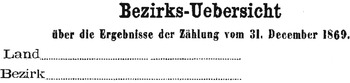
The Aufnahmsbogen and Verzeichniss der gesammelten Anzeigezettel together formed the basis of the next step, the completion of the so-called Orts-Uebersichten (village overview), in which houses were transformed into fully mappable places. This step was closely linked with the five spatial inscriptions on the fronts of the forms, each referring to one spatial level: Land, Bezirk, Ortsgemeinde (Gutsgebiet), Ortschaft, and Hausnummer. In the Orts-Uebersichten, what had been the lowest-level inscription, the house number, was moved off the front page and into the table, becoming the new element of organization (see fig. 4).
Header of the Orts-Uebersicht. Source: Mittheilungen aus dem Gebiete der Statistik 17.2 (1870): 49.

Whereas the Anzeigezettel and Aufnahmsbogen focused on single citizens, the Orts-Uebersichten focused on single houses. In the first column of the village overview, houses were to be listed in numerical order by house number.Footnote 82 Thus, each line of the new table in the new form represented one house, instead of one citizen as in the earlier forms. Another major transformation took place in the making of the Orts-Uebersichten: the citizens’ realities were now converted entirely into numbers.
To accomplish this, the number of columns was greatly expanded, from the eleven in the primary data collection forms to the Orts-Uebersichten's forty-six, each of which represented one possible response to the categorization questions. Of course there were limitations: the occupation census, for instance, was separated from the general operation and continued in a procedure of its own. The year of birth was also singled out into another table. The individual's name and place of birth were simply dropped: these two categories were no longer pursued.
Thus, in the course of the production of the Orts-Uebersichten citizens were turned into sets of manifestations of different aspects (Gesichtspuncte). As persons they no longer existed. The unity that they represented in reality was converted into numbers. Religion and marital status were both given one column for each possible (allowed) response. As noted earlier, many other aspects had already been treated this way during primary data collection.Footnote 83
Knowledge that was not quantifiable was sorted out during this procedure. We can observe here the characteristics of bound seriality as defined by Anderson: impermissibility of fractions, anonymity, and totality.Footnote 84 The census simultaneously performed an immense process of both amplification and reduction. To phrase this in the terminology of Latour, the citizens’ realities lost almost all of their individuality. In an administrative (and scientific) discourse they existed no longer as individuals but as numerical variations of a discursive existence, one that could soon be expressed in terms of a probabilistic model.Footnote 85
Seeing Like a StateFootnote 86
By the completion of the Orts-Uebersichten, the immense extent of the transformations undergone by social realities was clearly visible. Individual social reality had been limited and defined in a first step, then transformed into numbers rid of all individuality in a second one. Citizens existed in the administrative discourse of the Orts-Uebersichten only as statistical units, as members of certain groups.Footnote 87 Realities had been converted into tables of contents of houses. Numbers could describe everything deemed relevant. Even more important, once complete, these tables were self-sufficient: the information they contained could be validated by simple summaries integrated into the tables. No recourse to the materials of the primary data collection was necessary, although that remained an option. Every single number in the Orts-Uebersichten could be traced back to an Anzeigezettel or an Aufnahmsbogen; the chain of transformations was reversible, and every single number could (in theory) still be attributed to one particular citizen. This is basically what Latour describes as circulating reference.
The further aggregations conducted do not require detailed analysis as the principle remains the same. The Orts-Uebersichten belonging to one municipality were consolidated into Gemeinde-Uebersichten (municipal overviews). Instead of house number, the Ortschaft (village) became the new organizing element. The columns remained the same, but their frame of reference changed; each form listed on the third level of the census operation the numbered contents of villages in one municipality.
On the fourth level, so-called Bezirks-Uebersichten (district overviews) were produced (see fig. 5). These listed the municipalities for each district. The higher-level Landes-Uebersichten (provincial overviews) listed the districts and were finally consolidated into the census.
Header of the Besirks-Uebersicht. Source: Mittheilungen aus dem Gebiete der Statistik 17.2 (1870): 61.

This multistep procedure—first defining and measuring the social realities of individuals, then disassembling and regrouping results in accordance with administrative discourse—allowed a new perspective on the social world, exposing new views of such groups as the married, the widowed, or the members of various religious communities.
The population was encapsulated as no simple list of all citizens. The finalized census did not resemble any sort of a register or a phonebook. It did not even allow directly looking up individuals. Rather, it transformed individual social realities into a matrix that allowed administrative and scientific expertise to identify certain groups.Footnote 88 Nevertheless it also represented the totality of citizens of the Habsburg state and could thus claim integrity.Footnote 89
Chains of Reference
The census procedure, aiming to measure reality at the level of citizen, to a certain extent defined the lowest common denominator of social reality—or at least tried to do so. As noted earlier, though, the bottommost level of data acquisition already entailed major transformations: incredibly diverse and complex lives were reduced to somewhat manageable sets of information, mapped in large forms that specified whereabouts of the individuals listed therein. Each citizen's life was recorded on just one line—ten questions carefully selected to elicit clear and unambiguous answers, plus the sequential identifying number in column ‘a.’ Thus reality lost complexity and detail while gaining order, spatial information, hierarchy, and structure.
The completed forms of the primary data collection effectively constituted envelopes. On the outside of these, one could read the spatial inscriptions that had been made: house number, village, municipality, district, and province. On the inside, the collected citizens’ data were shielded from view.
Each subsequent aggregation was to lose from its outside the finest-grain spatial inscription found on its predecessor; that information was now moved inside the envelope. Thus, for the village overviews, it was the house numbers that were moved inside, becoming a new vertical axis (replacing names) along which to organize the data contained in the rows. One level above, for the municipal overviews, the spatial inscriptions of the villages moved inside the envelope to sequence the data. This procedure repeated itself analogically until the topmost level of the census was reached.
Spatial and social orders were closely entangled. Neither could be extracted from the observation of social reality: they had been imposed by those who made the census. These orders provided the key to the encoding and decoding of the major representation of reality. This became particularly visible when it came to the identification of social groups.
The overviews, be they on the level of house, village, municipality, district, or province, allowed one to identify what appeared to be the basic constituents of the state: different groups that each shared one characteristic. Singles, widowers and widows, husbands and wives—each constituted one of these groups. Various Catholic and other Christian denominations each did so as well; even men and women were considered to be fundamental groups constituting the state. The census allowed the identification of each of these groups and its respective sizes at different levels, from village to state. Knowing these groups meant being able to analyze a new and hitherto quite unknown entity, one destined to become synonymous with the state: society.
Did these groups, identified and at the same time defined by the census, represent social realities? Of course Jews, or Christians of one village tended to know each other, from religious ceremonies or other occasions related with sharing one's belief. But to what extent did such connectedness apply to people who were, say, married or widowed? These constituted groups in the eyes of administration, but in reality those widowed in imperial Austria did not share anything at all with each another than that data point. Their lives beyond the statistic might differ completely. This fundamental difference between real-life groups and groups identified by an administrative practice has to be kept in mind. Administrative perspectives were in the long term able to eclipse real life.Footnote 90
The process of grouping, which has played a major role in recent explanations of ethnicity, could be encountered in the census procedure on all levels. It is a key process in understanding the development of modern societies.
Administrative Views
The groups carved out at the second (village) level of the census procedure represented a general administrative perspective on the population and the social world. Once these groups were set, not much was going to change anymore, apart from the spatial frame to which the respective stage of the census referred.
After the severe reduction of reality at the primary data collection stage—each citizen represented by one line of tightly restricted data and connected to one particular house—another severe disturbance took place at the second level. Citizens were disaggregated; their unity as individuals ceased to exist in the discourse. Their characteristics had been transformed into numbers, each now assigned to one category. The individual became part of a combination of categories, defined and denominated by civil servants/scientists. Moving any responses still requiring words (e.g., occupation) into supplemental forms allowed the core operation to become an entirely mathematical and scientific one. Again, one can observe both reduction (of individuality and unity) and amplification (in terms of generalization and numbering). The resulting tables allowed for the treatment of reality as transformed into discourse, and thus for the application of aggregation. The collectives rendered visible on the level of the village resembled, in many cases, existing social groups.
From the third level on, the structure of the population knowledge produced remained basically untouched, but the spatial frame changed: villages were grouped together into municipalities, which then were grouped into districts, which joined into provinces. Amplifications and reductions still took place, but they concerned mainly scale effects and perspectives. When finally the provinces were grouped together, in an aggregation describing (within limits) the total population of imperial Austria, the administration could view social reality along certain axes and from various perspectives. James Scott would consider this a successful “attempt to make a society legible.”Footnote 91
There are a couple of points that one should keep in mind here. First, the new collectives defined and identified on the level of the village did not emerge from reality itself—although census makers continued to claim that they did. Adolf Ficker, for instance, insisted on the notion that reality itself dictated the outcomes and the order of the census. Second, the knowledge contained in the census was entangled with the state's territorial order: it was impossible to deviate from the official perspective on how people lived. One could easily obtain any information one required on, say, Wiener Neustadt as a district in its official borders. However, it was impossible to obtain any information on certain parts of Wiener Neustadt (with the exception of some information made available on Gerichtsbezirke, or judicial districts), nor on areas comprising pieces of several districts. The acceptance and acquiescence of the territorial order of the Habsburg authorities was thus the prerequisite for any use of the knowledge provided by the census.Footnote 92 This meant that the production of this knowledge could be regarded, in the words of José Rabasa, as a “form of domination, of control.”Footnote 93
The modus operandi of the census as described here allows some analysis of what was to happen ten years later, when the language count was introduced. As each citizen could only declare one language of daily use, the logics of the spatial representation were to produce a multicolored rag rug. As the district was the smallest entity of central administration, control over districts became an issue of nationalized conflict, reinforced by the entanglement of a certain spatial order with the knowledge produced by the census.Footnote 94 In many cases, linguistic realities on the ground were distorted by the limited range of representations that were at the disposal of the central administration.
The generation of a population was not an act in which a clear separation could be made between an active administration, which counted and collected data, and passive citizens, whose participation was limited to the delivery of some personal information. On the contrary, there is massive evidence proving that the success or failure of the census operation depended in many details on the willingness of the citizens to comply.Footnote 95 A vast number of reports and archival material give rich evidence of this process.Footnote 96
The citizens were no weak-willed and submissive victims, but rather agents with certain scopes of action, ready and willing to use these in order to achieve certain goals, much to the detriment of the administration.Footnote 97 By looking at resistance, we also have to state that, by and large, the census was to become a successful and well-accepted procedure over the decades to come. Among the vast majority of citizens that complied without resistance, many were successful in setting and following their own agendas. The appropriation and politicization of the language count in later censuses might serve as a good example here. The census, however, also helped to represent the case of a growing working class, raised knowledge about social disparities and triggered certain measures to tackle these, and produced a particular notion of society.
Conclusion
I would like to direct attention once more to the establishment of an administrative spatial order through the entanglement of the official map with the census. The enormous importance of spatial inscriptions (as they have been named here) to the functioning of the circulating reference (both terms referencing Latour) has become quite clear. Reality and discourse were indissolubly entangled via these spatial inscriptions. All of the practices that rendered the modern census possible involved techniques to make space controllable. This applied to house numbering as well as to land surveying. Seen from this perspective, the census has to be regarded as a logical continuation in the production of administrative power-knowledge. However, this proximity among the different administrative techniques was not perceived as such in the discourse itself.
It also appears to be of some interest that the census compels a certain understanding of space. A territorial conception of the modern state is a precondition of the census procedure.
In addition, the relationship between administration and science is of utmost importance. In the sources it became quite clear that these two must be understood as resources for each other.Footnote 98 A clear analytical separation between these two fields of activity can hardly be accomplished, a fact that references the larger background of the processes of modernization taking place in Central Europe in the second half of the nineteenth century.
The motivations behind the census were multifaceted. The scientific pretense that it evoked allowed it to appear more or less unbiased. The state's interest in private or tax matters appears to have been secondary, though these issues raised citizens’ mistrust: the annexed livestock census, for instance, encountered severe protests, which led to distorted results. Although military conscription still played a role in the census operation, other concerns were of greater importance. The census was intended to provide an empirical basis, internationally and diachronically comparable, for the formulation of impartial and effective public policy. It rested on enlightened notions of knowledge and of certain kinds of equality among human individuals.
The seemingly useless knowledge produced by the census referred mainly to a new entity, one that was becoming stronger in international discourse: society. It was an abstract entity, consisting of features and properties that could be measured not individually, but mostly, nearly exclusively, collectively. Statistical knowledge about society promised a better understanding of this complex phenomenon, and further enhanced control and governmentality. Society was a main component of the modern state—though in 1869 the question of what this modern state was going to look like in the future was still quite open. Several options were on the table, the nation-state and new forms of empire among them.
Finally, the census operation produced numbers with more direct implications for the state, its economics, and what was to become a social security system. By counting the handicapped, for example (as these “most regularly drew on resources from municipalities and state”), or the professionals (divided into a large number of different categories) the census takers took a first step toward an evaluation of the state's human resources.Footnote 99