Heat treatment and calcium fortification of milk are both widely used in the dairy industry. While the former process is performed to ensure microbiological safety and extend shelf life, the latter is used to increase nutritional value (McKinnon et al. Reference McKinnon, Yap, Augustin and Hemar2009). However, a combination of these two processes can change both the physical and chemical properties of the milk affecting taste and texture. The addition of calcium salts causes a drop in pH which in turn destabilises the proteins causing them to aggregate upon heating. As an example, McKinnon et al. (Reference McKinnon, Yap, Augustin and Hemar2009) observed marked increases in the viscosity of heated (90 °C/10 min) 10 mm calcium-enriched skim milks at pH 6·4. Other criticisms include difficulties with sedimentation, dispersion and protein coagulation during processing, leading to a gritty mouth feel in the product. Recently, Ashokkumar et al. (Reference Ashokkumar, Lee, Zisu, Bhaskaracharya, Palmer and Kentish2009a, Reference Ashokkumar, Kentish, Lee, Zisu, Palmer and Augustinb) have developed a novel approach to overcoming such issues with heat stability. It has been shown that application of ultrasound for a very short time after a heating step breaks down the protein aggregates formed at high temperatures, through the generation of shear forces by cavitation bubbles. The protein aggregates do not reform on post heating, thereby increasing the heat stability. However, this approach has not been tested on calcium-fortified milks.
The effect of ultrasonication on milk gels has been reported (Vercet et al. Reference Vercet, Oria, Marquina, Crelier and Lopez-Buesa2002; Riener et al. Reference Riener, Noci, Cronin, Morgan and Lyng2009, Reference Riener, Noci, Cronin, Morgan and Lyng2010; Nguyen & Anema, Reference Nguyen and Anema2010). Acid gel firmness (G′) was found to be altered when skim milk was ultrasonically treated prior to acidification, although the effect was attributed largely to denaturation of whey caused simply by the temperature increase that occurred during ultrasonication (Nguyen & Anema, Reference Nguyen and Anema2010). The simultaneous application of heat and ultrasound under moderate pressure (manothermosonication) has enabled the formation of improved yoghurt gels of greater strength compared with those obtained from untreated milk (Vercet et al. Reference Vercet, Oria, Marquina, Crelier and Lopez-Buesa2002). Riener et al. (Reference Riener, Noci, Cronin, Morgan and Lyng2009) studied the gelation properties of yoghurt cultures from milk which was preheated to 45 °C and subjected to thermosonication (TS) for 10 min at an ultrasound amplitude of 24 kHz. Thermosonicated yoghurts had higher gelation pH values, greater viscosities, higher water- holding capacities (WHC) and lower gel syneresis compared with conventional yoghurts prepared from pre-heated (90 °C, 10 min) milks. In addition, the average particle size in TS yoghurts was smaller (<1 μm) than conventional yoghurts (Riener et al. Reference Riener, Noci, Cronin, Morgan and Lyng2009, Reference Riener, Noci, Cronin, Morgan and Lyng2010). Sensory properties showed superior texture and colour properties. Although positive effects have been observed for the use of ultrasonication to prepare such acid gels, the effects on calcium-enriched acid gels have not been studied.
The main aim of the present study is to evaluate the use of ultrasound to improve the heat stability of 30 mm calcium enriched skim milks without the introduction of any calcium chelating agents. Furthermore, the effect of the ultrasound on gelation properties will be investigated. The gel quality plays an important role in the manufacture of calcium-fortified yoghurts.
Materials and methods
Preparation of reconstituted calcium-enriched skim milk solutions and gels
Skim milk powder (MG Nutritionals, Cobram, Victoria, Australia), was reconstituted in MilliQ water to obtain 10% (w/w) solids non-fat (SNF) solutions. After 10 min stirring, 30 mm calcium chloride was added to the skim milk solution and the pH was adjusted to 6·7 using 1 m NaOH. The skim milk solutions were stirred for 1 h at room temperature (25±3 °C) and then placed in the fridge overnight at 4 °C to ensure complete rehydration. The following day, the skim milk solutions were equilibrated at 25 °C for 1 h prior to further analysis.
Four sets of experiments were performed.
Experiment 1: Properties of ultrasonicated calcium-enriched skim milk (Ca-milk)
Ca-milk solutions were subjected to ultrasonication for up to 20 min. Ultrasonication was carried out at 20 kHz frequency using an ultrasonic horn (19 mm diameter, Branson Sonifier 450, Danbury, CT, USA) delivering 31 W calorimetric power. During ultrasonication ice water was circulated continuously to maintain sample temperature at <10 °C.
Experiment 2: Effect of heat treatment prior to ultrasonication on Ca-milk properties
Ca-milk solutions were pre-heated at 72 °C for 1 min. The pre-heated samples were ultrasonicated for up to 20 min under above mentioned ultrasound conditions.
Experiment 3: Heat stability of Ca-milk following pre-heat & ultrasonication
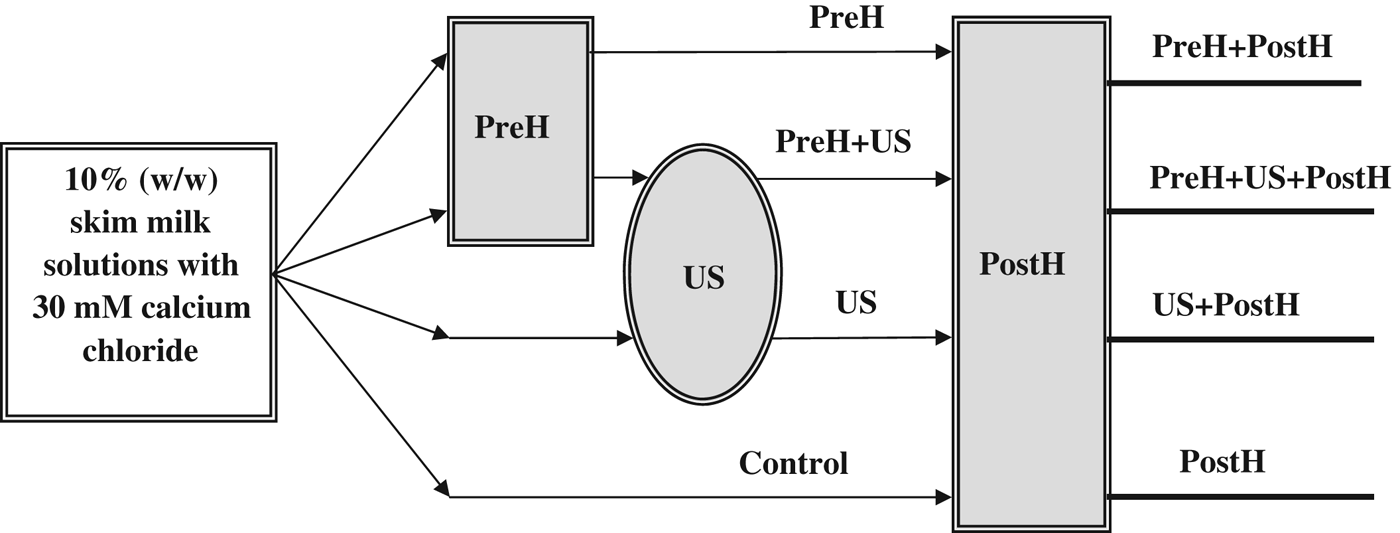
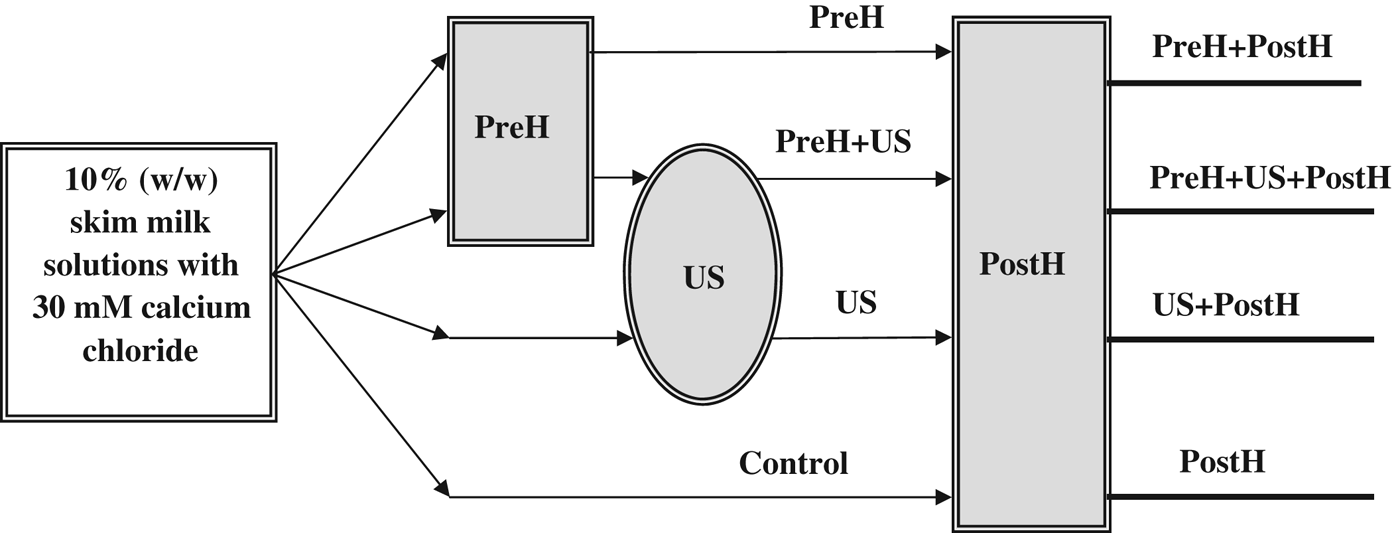
Ca-milk solutions were subjected to pre-heating, ultrasonicating and post-heating steps as depicted in Fig. 1 and as described by Ashokkumar et al. (Reference Ashokkumar, Lee, Zisu, Bhaskaracharya, Palmer and Kentish2009a). The pre-heat step involved heating at 72 °C for 1 min, ultrasound step carried out at 20 kHz frequency with 31 W delivering power for 1 min, and the post-heating performed at 80 °C for 20 min.
A summary of treatments for Experiment 3 of 10% (w/w) skim milk solutions with 30 mm calcium chloride; Control (without treatment), pre-heating (PreH), ultrasonication (US) and post-heating (PostH).
Experiment 4: Gelation properties of Ca-milk following pre-heat & ultrasonication
Six differently treated Ca-milk solutions were prepared: (i) Control with no treatment, (ii) Ultrasonicated at 31 W for 1 min, (iii) Ultrasonicated at 31 W for 10 min, (iv) Pre-heated at 72 °C for 1 min, (v) Ultrasonication of pre-heated Ca-milk solution for 1 min, and (vi) Ultrasonication of pre-heated Ca-milk solution for 10 min. They were acidified at pH 4·2 using Glucono Delta Lactone (GDL) (Sigma-Aldrich Pty Ltd, Castle Hill, NSW 1765, Australia) at 30 °C to form gels. The level of GDL required achieving a pH of 4·2 after 4 h reaction was first calculated from standard curves and was found to be 2·5% (w/w). induced for gelation.
Physical characterisation of calcium-enriched skim milk solutions and gels
The turbidity of the Ca-milk solutions was measured using a UV-vis spectrophotometer (Carey 3E, Varian, Palo Alto, CA, USA) by transmission of light (λ=860 nm) through a 2 mm path-length quartz cuvette.
The particle size distribution of the Ca-milk solutions was measured using a Malvern Mastersizer 2000 laser diffraction system (Malvern Instruments, Worcestershire, UK) at ∼23 °C. Samples were added directly to a Hydro 2000S dispersion chamber circulating dispersant (deionised water) at 1250 rpm to achieve an obscuration of 10–12%. The refractive index of the sample 1·35 (0·001 absorption) and 1·33 for the dispersant were used. Three measurements were made and analysed using Mie theory of light scattering. The volume-weighted average particle size was expressed as the D[4,3] value.
The viscosity of the Ca-milk solutions was measured using a Rheometrics ARG2 rheometer (TA Instruments C/O Waters Australia Pty Ltd, Rydalmere, NSW 2116, Australia). A steady-stress sweep experiment was performed using 40 mm parallel plate geometry and a 1 mm gap at 25 °C. The stress was varied to obtain the viscosity data between the shear rate of 50–200 s−1.
Dynamic viscoelastic properties (storage elastic component (G″) and viscous loss (G′)) of the acidified Ca-milks were measured as a function of time with a Model TA AR2000 rheometer (TA Instruments C/O Waters Australia Pty Ltd, Rydalmere, NSW 2116, Australia). The sample mixed with GDL (15 ml) was placed in a cup and a cover bob arrangement was placed over the sample to prevent evaporation. The oscillation amplitude was kept sufficiently low (strain=1%) to ensure linear behaviour and the angular frequency was fixed to 0·1 Hz. G′ and G′ were measured every 30 s for 4 h at 30 °C. The shear modulus (Pa) at 4 h was considered to be the final G′.
Statistical analysis
When necessary, one way ANOVA with a 95% confidence interval was used. Trends with P<0·05 were considered statistically significant.
Results & discussion
Experiment 1: properties of ultrasonicated calcium-enriched skim milk (Ca-milk)
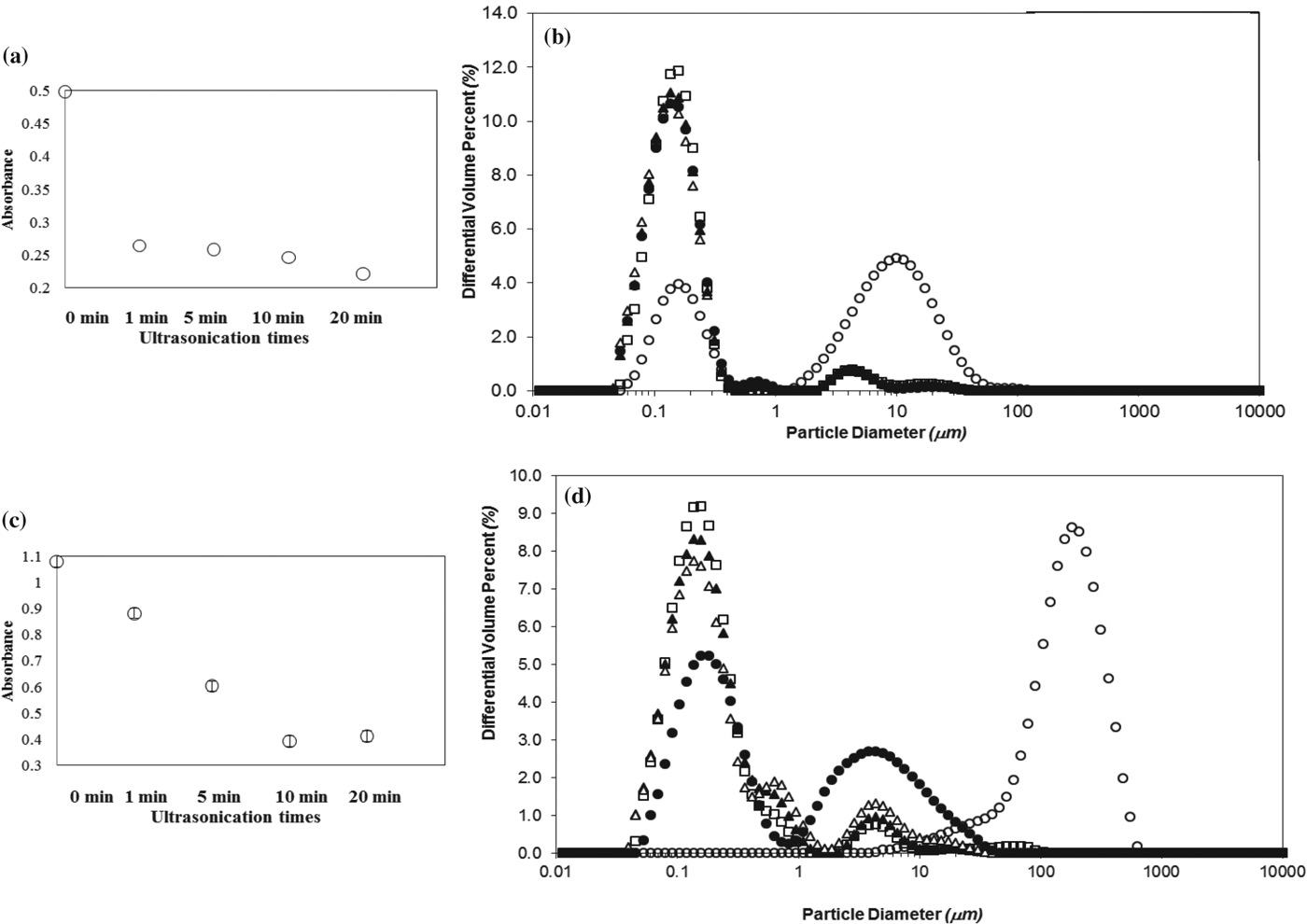
Figure 2a shows the relative turbidity of 10% w/w calcium-enriched skim milk solutions as a function of ultrasonication treatment time. Turbidity decreased significantly (P<0·05) within the first minute of ultrasonication. Prolonged ultrasonication led to a further decrease, although to a lesser extent. Figure 2b shows the corresponding particle size distributions. The Ca-milk solution which is not subjected to ultrasonication contained a high percentage of larger particles (∼10 μm). The addition of calcium salts would be expected to increase the size of protein aggregates within the milk (Ozcan et al. Reference Ozcan, Horne and Lucey2011). Hence, in the present study, a much wider particle size distribution was observed for Ca-milk solution compared with skim milk solutions. After one min exposure to ultrasound, the size distribution has shifted dramatically to show a higher percentage of smaller particles (∼0·2 μm). The proportion of these smaller particles increased slowly as ultrasonication time increased. During ultrasonication, acoustic cavitation occurs subjecting the solutions to extreme forces that disrupt the integrity of the protein-protein aggregates, causing them to fragment into smaller particles. Samples subjected to ultrasonication for even the shortest time (1 min) showed a significant decrease in turbidity and particle size highlighting the efficiency of ultrasonication. This is beneficial for the dairy industry where conserving time and energy is an important strategy for maintaining profitability. The results are consistent with those of Nguyen & Anema (Reference Nguyen and Anema2010) where a significant decrease in particle size was also observed for skim milk after 5 min ultrasonication (20 kHz). Further decreases in particle sizes were observed as the ultrasonication time was increased, so that the particle sizes were about 20 nm smaller after 30 min ultrasonication. However, the study by Nguyen & Anema (Reference Nguyen and Anema2010) was carried out on acidified skim milk samples without the addition of calcium salts.
Turbidity (a, c) and particle size distributions (b, d) of calcium-enriched skim milk solutions (Exp. 1) without pre-heating (a, b) and (Exp. 2) with pre-heating (c, d) as a function of ultrasonication treatment time (b, d): ○, Control; •, 1 min US; △, 5 min US; ▲, 10 min US; □, 20 min US).

Experiment 2: effect of heat treatment prior to ultrasonication on Ca-milk properties
Preheating of the Ca-milks caused protein aggregation, with a large peak appearing at >100 μm (Fig. 2d) and this led to high turbidity (Fig. 2c). When exposed to temperatures in excess of 70 °C, the whey proteins in milk become denatured and aggregate with each other and/or with the casein micelles. In addition, increases in temperature can cause precipitation of calcium phosphate in calcium-fortified milks (Reaction 1). The removal of HPO42− from the serum phase requires re-equilibration of Reaction 2 which results in a decrease in pH until the equilibrium is re-established.
 $$Ca_{{(aq)}} ^{2 +} + 0.7HPO_4^{2 -}{ _{(aq)}} + 0.2PO_4^{3 -} \Leftrightarrow Ca(HPO_4^{2 -} )_{(0.7)} (PO_4^{3 -} )_{(0.2)} (s)$$
 $$HPO_4^{2 -} {_{(aq)}} \Leftrightarrow H_{(aq)}}^ + + PO_4^{3 -} {_{(aq)}} $$
While not obvious from the particle size distribution (Fig. 2d) such precipitation of calcium phosphate clearly occurred upon heat treatment in the present study, with the pH dropping from 6·7 to 6·37.
Experiment 3: heat stability of Ca-milk following pre-heat & ultrasonication
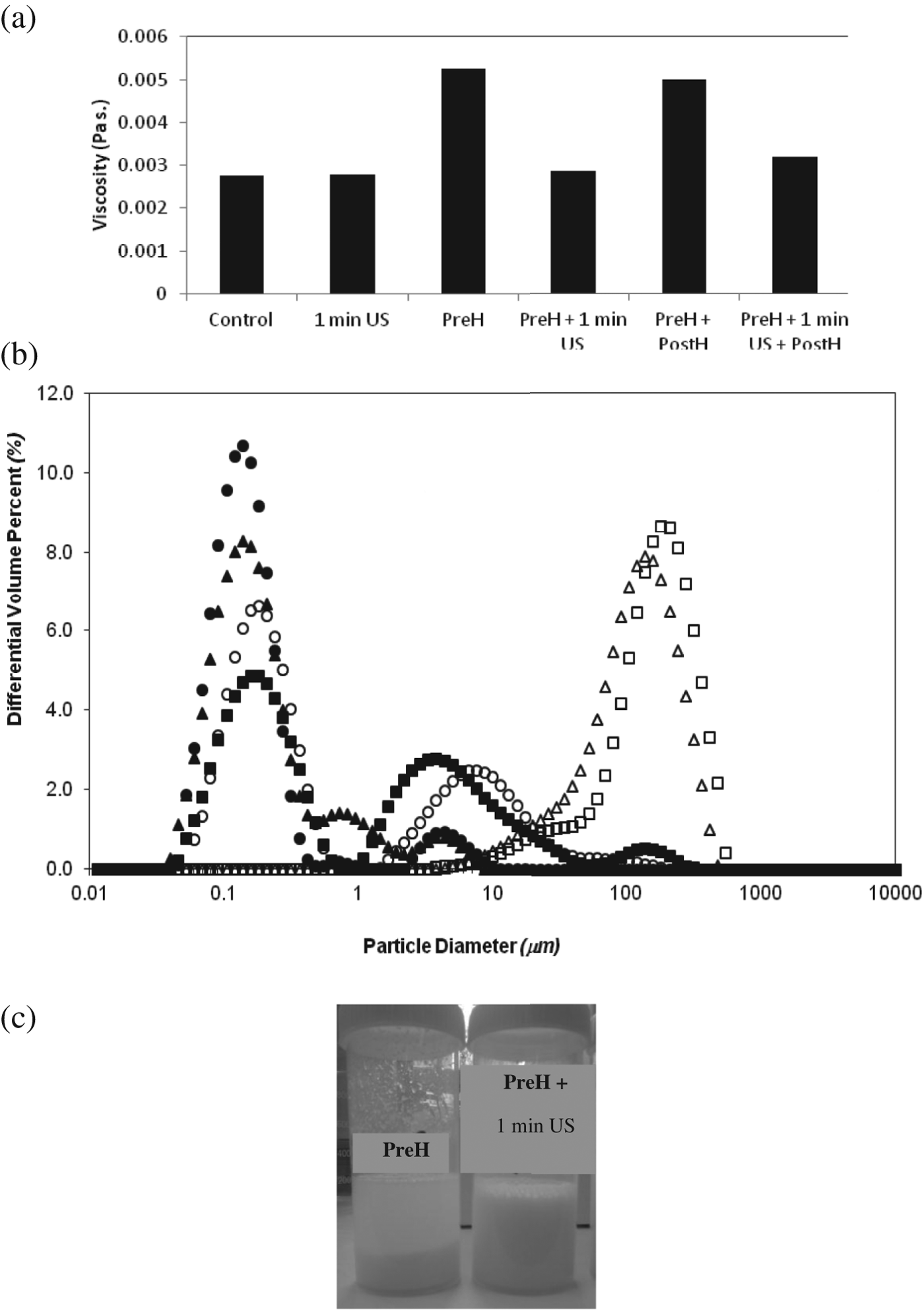
The protein aggregation observed upon heating was reflected in increased viscosity (PreH; Fig. 3a). Again, ultrasound was effective in reducing this increased viscosity, with viscosity levels after only 1 min ultrasonication of the pre-heated Ca-milk system almost as low as the control (PreH+1 min US; Fig. 3a). Applying further heating to the pre-heated ultrasonicated Ca-milk solution had little effect on the viscosity (PreH+1 minUS+PostH; Fig. 3a). Conversely, post-heating of the pre-heated Ca-milk solution without ultrasonication led to higher viscosities (PreH+PostH; Fig. 3a). These thermal effects were reflected in the particle size distributions (Fig. 3b). The PreH and PreH+PostH samples showed the widest distribution of larger particles compared with the control (without any treatment) having D[4,3] values around 127 and 173 μm, respectively. The particle size of the pre heated and 1 min ultrasonicated Ca-milk solution (PreH+1 minUS) decreased to lower values, and the post-heating process (PreH+1 minUS+PostH) had only a small effect on the particle size with a D[4,3] of ∼8 μm. Figure 3c shows the appearance of the PreH and PreH+1 minUS Ca-milk solutions. The pre-heated Ca-milk solution prior to post-heating shows clear evidence of large protein aggregates settling to the bottom. However, the pre-heated and ultrasonicated Ca-milk solution prior post-heating shows no sign of settling, and the skim milk solution appears as uniform and homogeneous.
Viscosity (a), particle size distributions (b) and appearance (c) of calcium-enriched skim milk solutions (a): PreH, pre-heating; PostH, post-heating; US, ultrasonication; (b): ○, Control; •, 1 min US; △, PreH; ▲, PreH+1 min US; □, PreH+PostH; ■, PreH+1 min US+PostH; (c): PreH and PreH+1 min US).
Ultrasound generates acoustic cavitation in liquids. The liquid medium is subjected to extreme forces that include shear, turbulence, microstreaming and heating (Ashokkumar et al. Reference Ashokkumar, Lee, Kentish and Grieser2004). In addition, chemical reactions such as highly reactive radicals are generated (Ashokkumar et al. Reference Ashokkumar, Lee, Kentish and Grieser2004). These observed changes in viscosity (Fig. 3a) might be due to both physical and chemical effects. However, Ashokkumar et al. (Reference Ashokkumar, Lee, Zisu, Bhaskaracharya, Palmer and Kentish2009a) had proved that the viscosity reductions of Whey Protein Concentrates (WPC) solutions are caused primarily by physical forces generated through acoustic cavitation and not through chemical effects. Ashokkumar et al. (Reference Ashokkumar, Lee, Zisu, Bhaskaracharya, Palmer and Kentish2009a) also stated that the changes to some functional groups responsible for protein interactions such as free thiols, hydrophobic segments etc induced by ultrasonication may be responsible for further protein aggregation, but to lesser extent during PostH. Similarly, Gulseren et al. (Reference Gulseren, Guzey, Bruce and Weiss2007) proposed that ultrasonication can alter functional properties of Bovine Serum Albumin (BSA) through some structural changes due to acoustic cavitation. However, a recent study by Chandrapala et al. (Reference Chandrapala, Zisu, Palmer, Kentish and Ashokkumar2011) found that ultrasonication alone caused very small changes to the thiol groups of the proteins present in WPC solutions. Hence, the breakdown of protein aggregates due to extreme shear forces generated through acoustic cavitation can be considered the sole factor for the improved heat stability of WPC solutions. A possible protein aggregation mechanism for the ultrasound-induced heat stability of WPC solutions can be inferred by examining thiol-disulphide interchange reactions, electrostatic- and hydrophobic interactions (Chandrapala et al. Reference Chandrapala, Zisu, Kentish and Ashokkumar2012). The contribution of surface charge, which is indicative of electrostatic interactions, was found to have a negligible effect on ultrasound-induced heat stability. Thiol-disulphide interchange reactions were also absent in the protein aggregation process as reactive thiol groups showed little change in response to ultrasonication. In contrast to electrostatic and thiol-disulphide interactions, the surface hydrophobicity of whey protein solutions was altered. The reduction in protein surface hydrophobicity of partially denatured and ultrasonicated whey protein aggregates suggested that physical shear generated through acoustic cavitation lowers the surface hydrophobicity. This effect prevents heat-induced re-aggregation of proteins through hydrophobic interactions, thereby conferring heat stability to the WPC solutions (Chandrapala et al. Reference Chandrapala, Zisu, Kentish and Ashokkumar2012).
Experiment 4: gelation properties of Ca-milk following pre-heat & ultrasonication
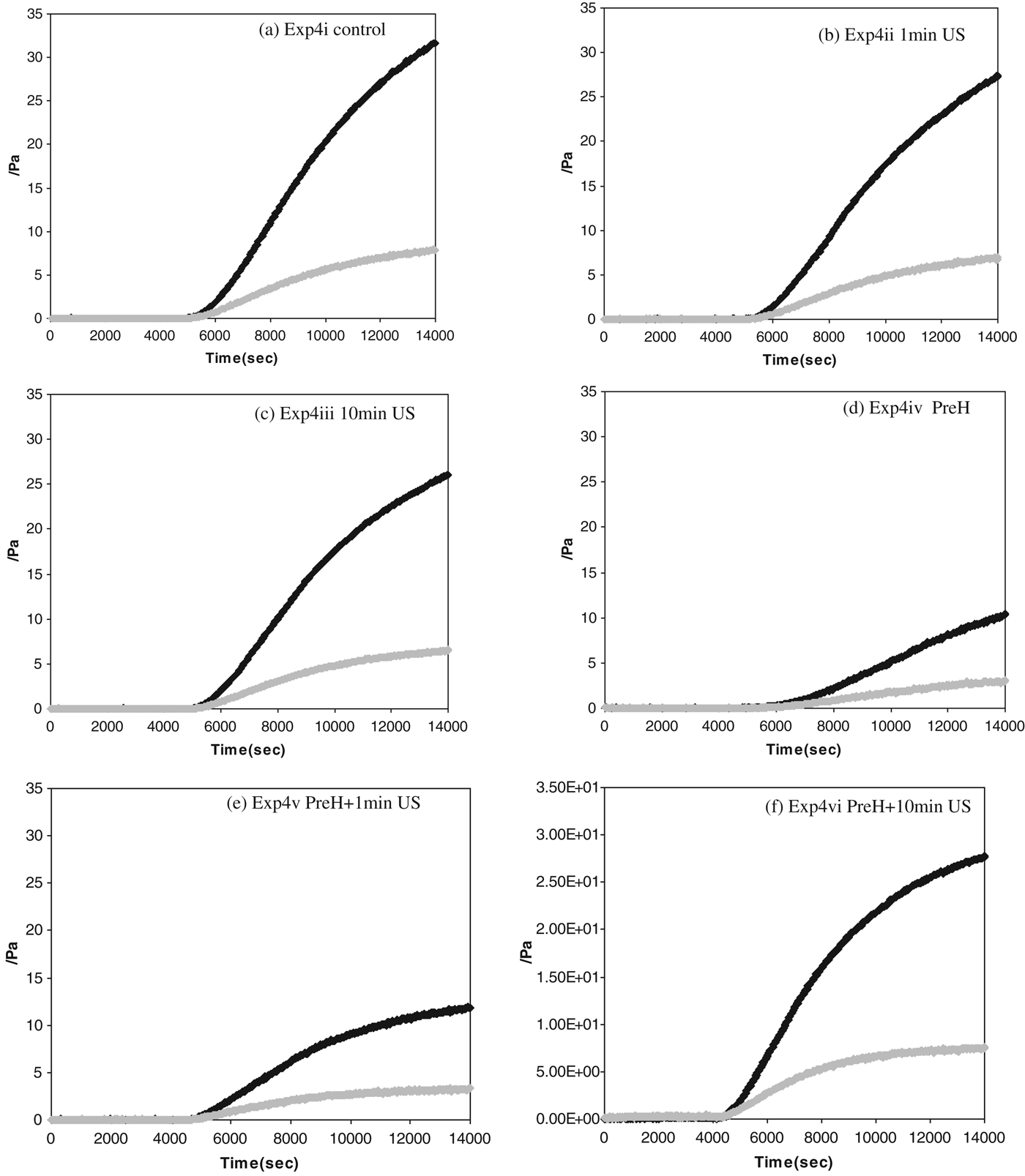
All samples displayed typical acid gelation curves with low G′ in early stages of acidification, a gel point where G′ begins to increase and then a continued increase as the acidification time increases (Fig. 4). G′ was dominant over G′ as is typical for such acidified dairy systems.
Dynamic rheological data (G′, ◆; G″,  ) over time at 30 °C for calcium-enriched skim milk solutions undergoing slow acid-induced gelation by D-glucono-delta-lactone (GDL). (a), Control, Exp. 4i; (b), 1 min ultrasonicated, Exp.4ii; (c), 10 min ultrasonicated, Exp. 4iii; (d), pre-heated at 72 °C for 1 min, Exp. 4iv; (e), pre-heated at 72 °C for 1 min and ultrasonicated for 1 min, Exp. 4v; and (f), pre-heated at 72 °C for 1 min and ultrasonicated for 10 min, Exp. 4vi.
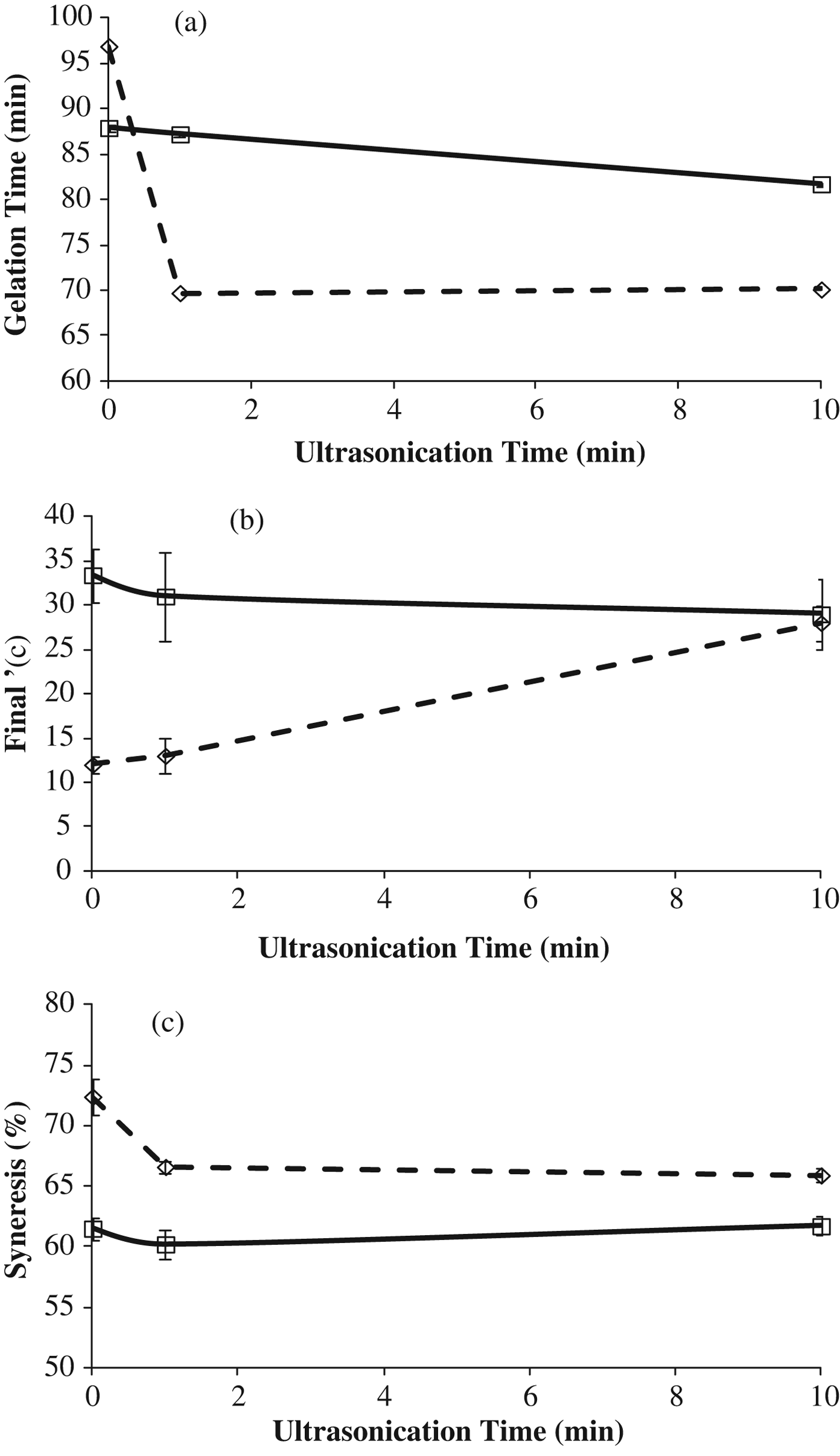
In the absence of ultrasound, heating (Exp, 4iv) significantly increased the time to gelation (P<0·05) (Fig. 5a) and reduced the strength of the gel (Fig. 5b). Other workers have shown that if gel formation is induced in unheated milk only casein contributes to the gel formation, whereas heating leads to whey protein denaturation, allowing these proteins to also participate in the formation of a protein network (van Vliet et al. Reference van Vliet, Lakemond and Visschers2004). Graveland Bikker & Anema (Reference Graveland Bikker and Anema2003) thus found that acid gels prepared from unheated skim milk had very low G′ values, long gelation times, whereas heat treatment of skimmed milk at 80 °C for 30 min led to markedly higher G′ and reduced gelation times. Our study resulted in the opposite effect. This may be due to the presence of high amounts of calcium in the skim milk system. Calcium is largely retained in negatively charged casein curd above the isoelectric point and gelation in milk protein is a manifestation of calcium-facilitated casein micelle aggregation. Thus, the addition of calcium would be expected to form stronger crosslinks in curd (Ozcan et al. Reference Ozcan, Horne and Lucey2011). The heat treatment created larger casein micelle aggregates which could have sedimented to the bottom through gravity, preventing their participation in gel formation. Further, the lower surface area of the larger casein micelle aggregates may have reduced the number of contact points between aggregated particles. It should be noted here that the rigidity of skim-milk gels and their resistance to deformation is depended on the number and strength of such contact points. Our results are indeed more consistent with those of Lucey et al. (Reference Lucey, Teo, Munro and Singh1997) who found that while heating milk at 75 °C for 30 min caused increases in G′, more severe heat treatment conditions resulted in a reduction in G′.
Time-dependent changes of (a) gelation time, (b) final G′ and (c) gel syneresis of gels prepared from unheated (□; Exp4i, ii & iii) and pre-heated (◇; Exp.4iv, v & vi) calcium-fortified skim milks ultrasonicated for 0, 1 or 10 min.
Even limited ultrasonication dropped the gelation time substantially for the heated skim milk solution (Exp. 4(v)), so that it gelled considerably in advance of the unheated skim milk gel (Exp. 4(i): Fig. 5a). These trends persisted with increased ultrasonication (Exp. 4(vi)). This turn around in gelling behaviour may reflect disruption of larger protein aggregates, increasing the number of contact points and allowing the effects of whey protein denaturation to now come into play as observed by Graveland Bikker & Anema (Reference Graveland Bikker and Anema2003). Similarly, the G′ for the heated milk gel increased gradually with ultrasonication, reflecting the loss of the large protein aggregates (Exp. 4(v & vi)). The G′ for skim milk gels subjected to ultrasonication (Exp. 4(ii & iii)) alone fell slightly as time progressed, consistent with (Nguyen & Anema, Reference Nguyen and Anema2010) in this case. It is noteworthy that the two skim milk gels, while markedly different before ultrasonication, had the same strength after 10 min of ultrasonication.
Gel syneresis was not significantly (P<0·05) changed with ultrasonication alone (Exp. 4(ii & iii); Fig. 5c). Heating (Exp. 4(iv)) led to increased gel syneresis, which fell gradually with ultrasonication (Exp. 4(v & vi)), but never reached the lower levels of the unheated product (Exp. 4(i)).
Conclusion
Ultrasonication of heat-treated calcium enriched skim milk solution resulted in a viable product with high calcium content, good appearance and the appealing physical properties of low viscosity and turbidity. In particular, ultrasonication for 10 min prior to acid gel formation resulted in a skim milk gel of identical G′, although the gel syneresis was a little higher and the gelation time slightly longer. The successful disruption of protein aggregates through ultrasonication after a severe heating step, and the lack of further formation upon post-heating, suggests that ultrasound treatment is a viable technology for the processing of calcium-fortified skim milk. In particular, the approach opens the door to the use of greater calcium fortification without issues of heat stability. Alternatively, it may avoid the need to introduce calcium chelating salts, which is used in some cases to circumvent this issue.
Authors would like to acknowledge Australian Research Council and Dairy Innovation Australia for financial support.