Introduction
Echinostomes are ubiquitous trematode parasites of wildlife and have been used extensively as experimental models to study host–parasite interactions. However, the emergence of cercariae from the snail host is one aspect of their biology which has received little attention (Toledo et al., Reference Toledo, Munoz-Antoli and Fried2007), particularly in freshwater habitats, although it is apparent that some species demonstrate a diurnal emergence pattern synchronized to light–dark alterations (Christensen et al., Reference Christensen, Frandsen and Roushdy1980; Toledo et al., Reference Toledo, Munoz-Antoli and Esteban1999). The production of cercariae is a fundamental component of transmission success in trematodes (Poulin, Reference Poulin2006) because cercarial emergence rhythms are adaptive to principally enhance contact with the target host (Combes et al., Reference Combes, Fournier, Mone and Theron1994). A range of biotic and abiotic factors can affect the emergence of cercariae (Chernogorenko, Reference Chernogorenko1982); however, light and temperature are considered the predominant controlling influences (Galaktionov & Dobrovolskij, Reference Galaktionov and Dobrovolskij2003). To better understand the dynamics of freshwater echinostome life cycles in the environment, further information on factors influencing cercarial emergence is needed.
Echinoparyphium recurvatum is a cosmopolitan echinostome of freshwater snails and birds in the UK and has been studied extensively. In particular, laboratory investigations have focused on cercarial transmission into a range of molluscan species, acting as second intermediate host, for elucidating transmission dynamics (Evans & Gordon, Reference Evans and Gordon1983a, Reference Evans and Gordonb; McCarthy, Reference McCarthy1990, Reference McCarthy1999a, Reference McCarthyb; Adam & Lewis, Reference Adam and Lewis1992; Morley et al., Reference Morley, Adam and Lewis2007) and the impact of pollutants (Evans, Reference Evans1982; Morley et al., Reference Morley, Crane and Lewis2002, Reference Morley, Crane and Lewis2004a, Reference Morley, Leung, Morritt and Cranec). Nevertheless, studies on cercarial emergence have received limited attention. Both McCarthy (Reference McCarthy1999d) and Morley et al. (Reference Morley, Crane and Lewis2003a) examined the emergence of cercariae from naturally infected snails under constant temperature (~20°C) and the effects of mixed infection with Plagorchis sp. and cadmium toxicity, respectively, on cercarial production. These studies were undertaken in laboratory conditions where both temperature and light-cycling were controlled. However, rigidly controlled laboratory conditions can distort the emergence patterns of cercariae, particularly artificial fluorescent lighting (Kawashima et al., Reference Kawashima, Blas and Santos1985) which lacks the gradual rise and fall in light levels present under natural conditions.
Further distortions may also be caused by the source of infected snails used. Unlike many previous investigations that utilize precisely controlled laboratory cultures of hosts and parasites, the present study uses naturally infected snails. This is because laboratory cultures are notoriously inbred, with distinct artificial strains (Bryant & Flockhart, Reference Bryant and Flockhart1986), and are considered no substitute for natural populations in studies on the transmission of trematodes (Richards & Shade, Reference Richards and Shade1987). In particular, it has been found that fewer cercariae emerge from snails kept in laboratory cultures compared to those derived from wild populations (De Souza et al., Reference De Souza, Araujo, Jannotti-Passos and Guimaraes1994; Keas & Esch, Reference Keas and Esch1997).
Therefore to provide the most realistic conditions for elucidating the dynamics of E. recurvatum cercarial emergence in the wild, the present study was undertaken under natural light conditions using field-collected infected snails, and investigated the effects of two important parameters: (1) temperature, an important consideration of parasite transmission under climate change (Poulin, Reference Poulin2006); and (2) host size, a factor important for determining intramolluscan development (Zischke, Reference Zischke1967, Reference Zischke1968; Lim & Lie, Reference Lim and Lie1969; Niemann & Lewis, Reference Niemann and Lewis1990) but poorly understood in relation to studies on echinostome emergence.
Materials and methods
Collection and maintenance of infected snails
Lymnaea peregra naturally infected with Echinoparyphium recurvatum were collected from a stream in Bushy Park, Middlesex (National Grid Reference TQ158692) as previously described by Morley et al. (Reference Morley, Lewis and Adam2004b). In the laboratory, snails were maintained in plastic tanks at 20°C containing filtered stream water and fed on lettuce leaves and Tetramin fish flake food until required. Cercarial emergence was investigated in a room unlit by artificial lighting with observations being carried out under diffused sunlight near a window. Hourly data of diffuse sunlight irradiation on a horizontal surface (Watt/h/m2) for July and August, the seasonal period of investigation, were obtained from a nearby weather station (latitude 51°23′N, longitude 0°4′W, 73 m above sea level).
Cercarial emergence
An initial survey of the sampled L. peregra population revealed that no E. recurvatum cercariae emerged from snails smaller than 10 mm. Therefore all snails below this size were not observed further. In total, 118 infected snails were used with no snails being used in multiple experiments. Emergence was assessed by counting the number of cercariae shed from each individual snail. In order to estimate the pattern of hourly periods of cercarial emergence over a 24-h period and to determine whether these emergence patterns changed over time, preliminary experiments were undertaken at 21°C, where snails were observed hourly from 06.00 hours for a 72-h period. This was followed by three weekly samples on days 10, 17 and 24 with observations undertaken between 06.00 and 00.00 hours. Snails were separated into size ranges: (1) 10.0–10.9 mm (n = 9), (2) 11.0–11.9 mm (n = 9), (3) 12.0–12.9 mm (n = 9), (4) 13.0–13.9 mm (n = 9), (5) 14.0–14.9 mm (n = 7), (6) 15.0–15.9 mm (n = 7), (7) 16.0–16.9 mm (n = 5). Each snail was placed individually into a glass tube with 50 ml of water and lettuce for food, with each tube being fitted with a piece of mesh cloth to prevent escapes. Snails were fed on a small amount of lettuce as required. Tubes were placed in a water bath at 21°C and snails were allowed to acclimatize before measurements were undertaken.
Further experiments were designed to investigate long-term daily and weekly cyclic variations in cercarial output for 3 weeks. Due to the limited availability of material, the emergence of three snails was investigated in only three size categories (11.0–11.9 mm, 13.0–13.9 mm and 14.0–14.9 mm). Observations were undertaken at 21°C as described previously, with water changes every 2 h during the day.
A final study investigated the effects of temperature on cercarial production between 10°C and 29°C, as preliminary experiments had demonstrated that no emergence took place below 10°C. Snails (n = 18) within each size range of 10–11 mm, 13–14 mm and 16–17 mm were selected. Snails were chosen for their similar daily emergence (total daily cercarial output) within each size range. Each snail group was randomly separated into groups of three and each snail individually placed in a glass tube containing 50 ml of water with small amounts of lettuce for food. Each group was acclimatized to a different temperature, either 10°C, 14°C, 17°C, 21°C, 25°C or 29°C, for 3 days within a water bath. Daily emergence was subsequently observed on three variable days over a 6-day period at each temperature.
Data analysis
Emergence data were log transformed and analysed using either a Pearson product–moment correlation coefficient, for correlating natural light intensity with emergence, or a repeated measures ANOVA, for comparing emergence between individual size ranges of snail hosts, using an SPSS computer package (SPSS Inc., Chicago, Illinois, USA). The effect of temperature on cercarial production was analysed using the Q 10 value, a measure of physiological processes, such as metabolic rate, that rely on underlying enzymatic reactions which are known to increase markedly in ectothermic animals with increasing temperature. Q 10 values ranging between 2 and 3 are typically the norm and are indicative of a doubling or tripling of physiological rates per 10°C increase in temperature (Prosser, Reference Prosser1973; Randall et al., Reference Randall, Burggren and French2001). Such a general range of Q 10 values provides a rough null hypothesis for studying temperature-dependent cercarial production, so that if cercarial output over a 10°C elevation in temperature increases two- to three-fold the emergence follows the basic pattern for other physiological processes (Poulin, Reference Poulin2006). A value of less than 2 indicates little change in cercarial output rate, whereas a value less than 1 indicates a reduced output rate. Q 10 values are generally not constant for different sections of the temperature range and therefore values were calculated for a range of temperatures that approximately encompassed three temperature increases of roughly 10°C: 10–21°C ( ≈ 15°C), 14–25°C ( ≈ 20°C) and 21–29°C ( ≈ 25°C). The Q 10 was calculated using the following form of the van't Hoff equation (Randall et al., Reference Randall, Burggren and French2001):
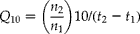
where n 1 and n 2 are cercarial output rates at temperatures t 1 and t 2, respectively.
Results
Cercarial emergence and snail size
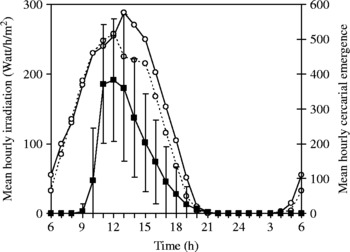
The majority of E. recurvatum cercarial emergence from L. peregra occurs only when the snail is partially or fully emerged from the shell. Cercariae, which emerge from a small area of the mantle collar near the posterior corner of the shell aperture, demonstrated a single diurnal emergence cycle with a wavelength of 24 h that was positively correlated (Pearson correlation r = 0.837, P < 0.001) with the daily natural irradiation curve of sunlight occurring over the experimental period of July and August (fig. 1). There was a large variation in the number of cercariae emerging from individual snails over both hourly and daily time periods in both the same and different snail size classes.
Correlation of daily emergence curves of Echinoparyphium recurvatum cercariae from Lymnaea peregra (■) with the mean hourly natural diffuse sunlight irradiation during July and August (○— July; ○- - - August) at 21°C. Error bars are standard error.

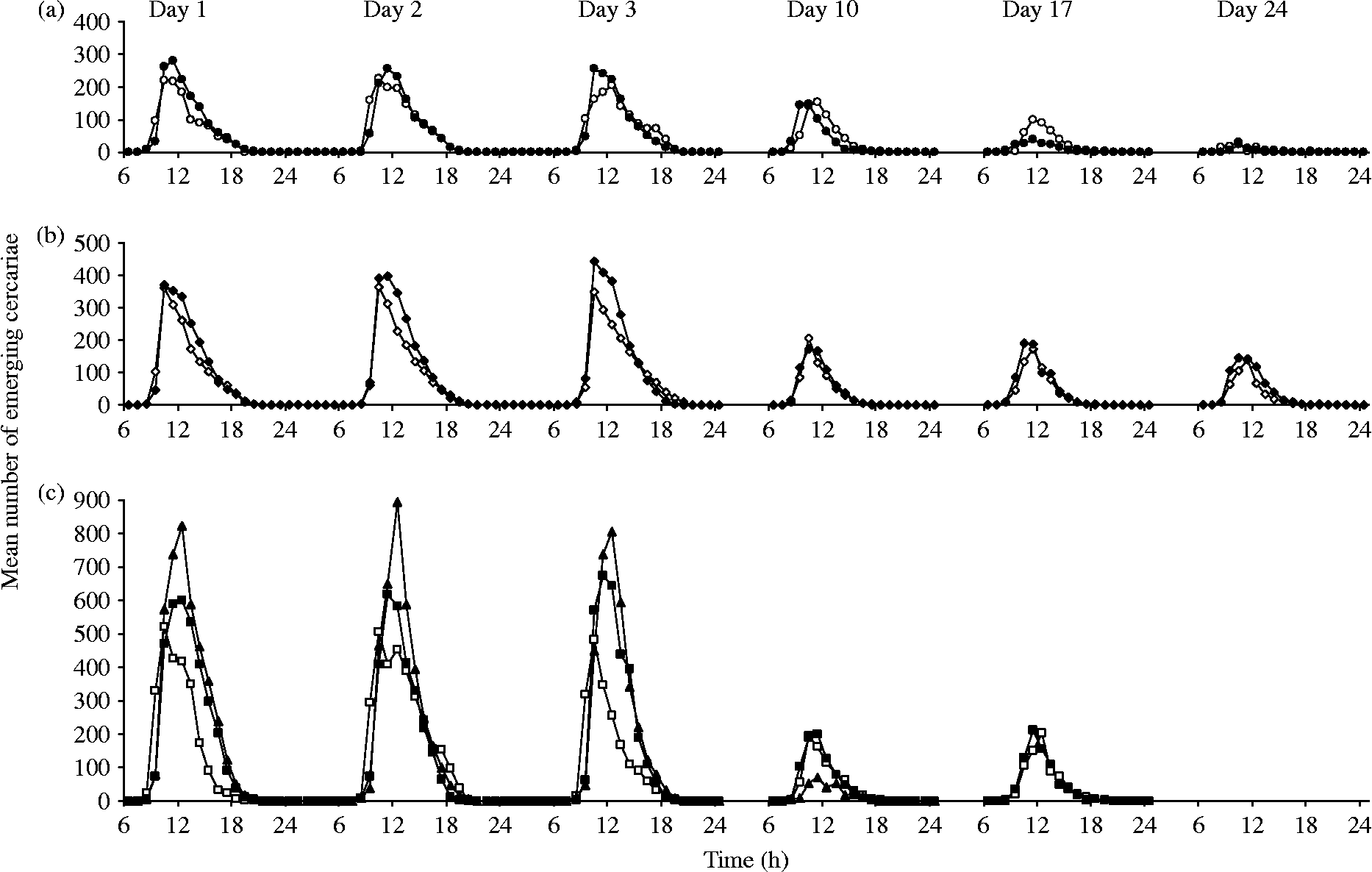
In all snail sizes, emergence of cercariae generally began between 08.00 and 11.00 hours with the majority commencing between 08.00 and 09.00 hours. Cercarial emergence continued for between 7 and 13 h over the day. Mean values of emergence for the different snail size classes overlapped but demonstrated a gradual increase with increasing snail size. At the end of the experiment, qualitative examinations of the infected snails indicated that the larger individuals had elevated numbers of redia in their tissues compared to smaller ones. Differences in emergence were most obvious between the smallest and largest sizes (fig. 2). The peak in cercarial emergence generally occurred between 10.00 and 13.00 hours, with peaking being earlier in smaller snails (10.00–11.00 hours) than in larger ones (12.00–13.00 hours) (fig. 2). Emergence terminated over an extended period between 15.00 and 22.00 hours, depending on individual snails but with little differences between size classes. The number of emerging cercariae was generally low after 15.00 hours. Differences in the pattern of hourly emergence between size classes were only significant for the more distant size classes. For example, the 10–10.9 mm group had significantly lower emergence only compared with size classes of 15–15.9 mm or larger (repeated measures ANOVA P ≤ 0.041, F 1,23 ≥ 8.801) whereas the 16–16.9 mm group had a significantly greater emergence compared only with the 13–13.9 mm or smaller size classes (repeated measures ANOVA P ≤ 0.014, F 1,23 ≥ 70.307).
Hourly emergence of Echinoparyphium recurvatum cercariae from Lymnaea peregra of different sizes at 21°C (error bars not shown). (a) ○, 10.0–10.9 mm; ●, 11.0–11.9 mm; (b) ⋄, 12.0–12.9 mm; ♦, 13.0–13.9 mm; (c) □, 14.0–14.9 mm; ■, 15.0–15.9 mm; ▲, 16.0–16.9 mm.
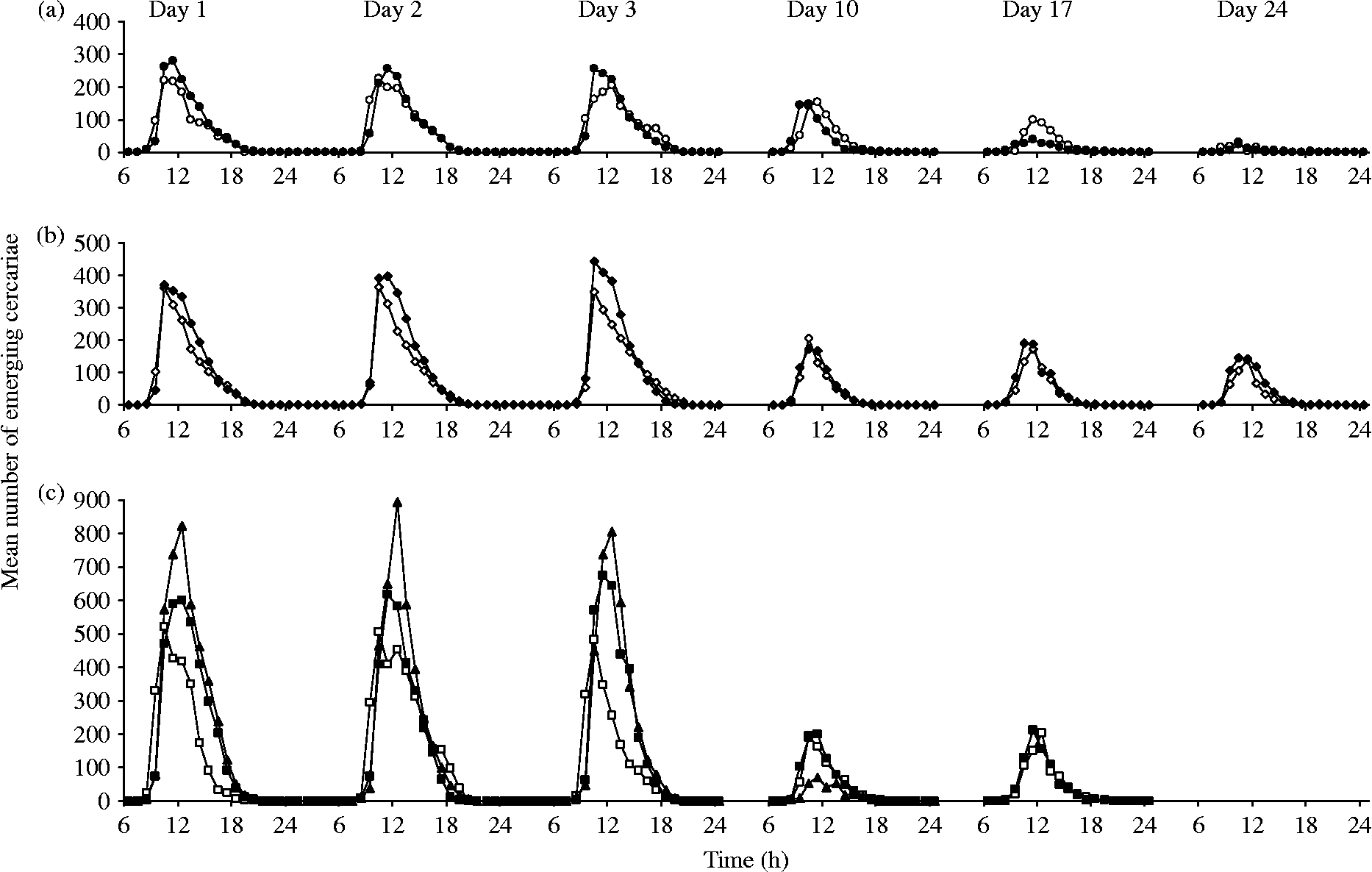
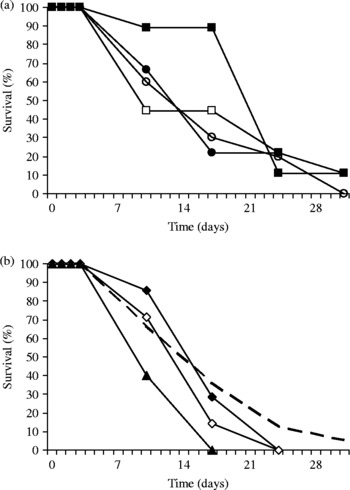
Variations in emergence patterns occurred between individual days. As time progressed the number of cercariae emerging declined for all snail size classes, and by day 10 differences in emergence between snail sizes became less pronounced (fig. 2). These reductions in daily emergence are likely to be associated with a lower output from dying snails as a decline in survival of L. peregra was apparent for all size classes by day 10, particularly larger infected snails (fig. 3).
Survival of different sizes of Lymnaea peregra infected with Echinoparyphium recurvatum over the study period at 21°C. (a) ■, 10.0–10.9 mm; □, 11.0–11.9 mm; ●, 12.0–12.9 mm; ○, 13.0–13.9 mm; (b) ♦, 14.0–14.9 mm; ⋄, 15.0–15.9 mm; ▲, 16.0–16.9 mm; - - - -, total survival.

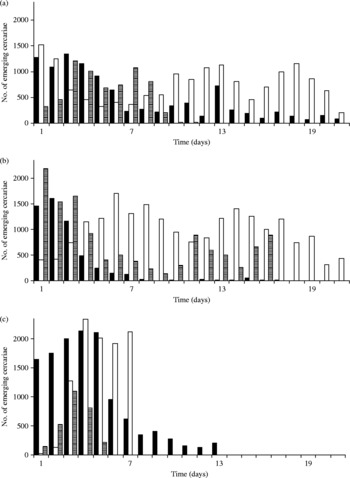
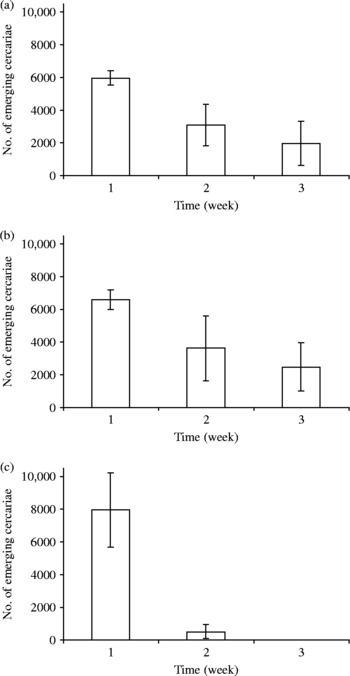
Daily emergence of cercariae over a 3-week period demonstrated limited evidence of cyclic fluctuations in emergence numbers for many snails (fig. 4) but only a minority survived for the entire experimental period. The number of daily emerging cercariae increased with snail size. Some snails demonstrated a sudden significant drop in daily cercarial output, emergence continuing at this lower rate over the remainder of the experimental period. For those snails demonstrating cyclic fluctuations, mainly in the smaller size classes, it appeared that every 3–4 days the numbers emerging dropped from a maximum to a minimum before rising again to a maximum. However, such cyclic fluctuations did not interfere with the general trend of declining emergence in all size classes over the 3-week experimental period (fig. 5).
Rhythms of daily variations in Echinoparyphium recurvatum cercarial output from snails of different sizes at 21°C. (a) 11.0–11.9 mm; (b) 13.0–13.9 mm; (c) 14.0–14.9 mm. Black bars, snail 1; white bars, snail 2; striped bars, snail 3.

Weekly emergence of Echinoparyphium recurvatum cercariae from Lymnaea peregra of different sizes at 21°C. (a) 11.0–11.9 mm; (b) 13.0–13.9 mm; (c) 14.0–14.9 mm. Error bars are standard error.

Cercarial emergence and temperature
The activity of L. peregra is influenced by temperature. At 10°C the snail withdraws its soft tissue into the shell and little locomotory activity is apparent, but within the temperature range of 14–29°C normal movement behaviour around the container occurs. No emergence of cercariae occurred below 10°C. At this temperature a few cercariae emerged in all snail sizes but not enough to determine any daily cyclic rhythm.
Maximum emergence occurred in the range 17–25°C before declining at higher temperatures (table 1) with the cyclic rhythm of daily emergence maintained in all temperatures and size classes. Q 10 analysis of cercarial output (table 1) showed that for all sizes at ≈ 15°C there was a substantial increase in cercarial emergence with all Q 10 values exceeding 100, indicating an increase significantly greater than 2 or 3, typical of the norm for physiological rates over a 10°C increase in temperature. At ≈ 20°C both the 13–14 mm and 16–17 mm sizes had Q 10 values between 1 and 2, indicating little change in cercarial output at this higher temperature range. However, the 10–11 mm size snails had a Q 10 value of 3.514, indicative of an elevated cercarial output that still exceeded the norm. Nevertheless, the total Q 10 value for all combined size classes for this temperature range indicated a normal Q 10 value of 1.782. At the ≈ 25°C range, Q 10 values for all snail sizes had dropped to less than 1, indicating a reduced cercarial emergence at this higher temperature range (table 1). Qualitative examinations of the snails at the end of the experiment indicated that those exposed to 10°C, 14°C and 29°C had an increase in the number of metacercarial cysts in the visceral mass, a site only accessible to cercariae from within a snail harbouring a primary infection, suggesting that at these temperatures a proportion of mature cercariae encyst in the first intermediate host rather than emerge.
The effect of temperature on the emergence of Echinoparyphium recurvatum cercariae from the freshwater snail Lymnaea peregra, relative to snail size.

Discussion
The emergence of E. recurvatum cercariae from L. peregra is controlled by a number of biotic and abiotic factors. Emergence does not take place unless the soft tissues of the host are fully or partially emerged from the shell. This, in turn, only occurs if the snail is in an active state, such as moving or feeding, which are routine parts of its circadian activity. The activity of gastropods is driven by an endogenous circadian oscillator with the pacemaker characterized by a free-running periodicity of approximately 24 h, entrained by a light/dark cycle and a temperature compensation (Getting, Reference Getting and Willow1985).
The emergence of Trichobilharzia ocellata cercariae from Lymnaea stagnalis was found to be related to the daily locomotory activity of the snail host (Anderson et al., Reference Anderson, Nowsielski and Croll1976). Host activity and cercarial emergence were both photoperiodic. The results of the present study also indicate illumination as the principal exogenous factor influencing activity, in a similar manner to emergence by the related echinostome Euparyphium albuferensis (Toledo et al., Reference Toledo, Munoz-Antoli and Esteban1999). Asch (Reference Asch1972) suggested that Schistosoma mansoni cercarial emergence was in response to a light-controlled rhythm of the snail host rather than to illumination itself. However, in a reversed illumination experiment L. peregra were active in the dark without E. recurvatum cercariae emerging (unpublished observations), indicating that emergence is essentially invoked by illumination and the release of cercariae is made possible by movements of the snail host, exposing the preferred cercarial exit region to the environment. Echinoparyphium recurvatum cercariae may also directly respond to illumination within the intramolluscan environment, as once emerged into water they demonstrate both phototactic and geotactic orientation behaviour (McCarthy, Reference McCarthy1999c; Morley et al., Reference Morley, Crane and Lewis2003b). The correlation of emergence with first intermediate host activity will also synchronize maximum cercarial production with the daily activity of second intermediate molluscan hosts. This is an important consideration with E. recurvatum, as entry to the second intermediate host occurs via natural openings because cercariae lack penetration glands (Adam & Lewis, Reference Adam and Lewis1992) and therefore an active target host, with exposed soft tissue, emitting a strong chemotactic signal is required to facilitate and maximize transmission success.
In the present study there was a single photoperiodic circadian cycle of emergence, with one peak, which extends from 10.00 to 14.00 hours, in the various host size classes, with smaller snails demonstrating an earlier emergence peak. The light intensity was important for all stages of daily cercarial emergence. The initiation of emergence did not occur until 4–6 h after sunrise, approximately 08.00 hours, when light intensity was greater than 100 Watt/h/m2. The pattern of emergence thus correlates with the rise and fall in light intensity, with termination occurring when light intensity declines close to 0 Watt/h/m2.
This emergence pattern is broadly comparable to both E. recurvatum and other echinostome emergence studies undertaken with artificial light conditions (McCarthy, Reference McCarthy1999d; Toledo et al., Reference Toledo, Munoz-Antoli and Esteban1999; Morley et al., Reference Morley, Crane and Lewis2003a). In particular, the present study compares well with the work of Morley et al. (Reference Morley, Crane and Lewis2003a), which also used naturally infected L. peregra collected from the same geographical population. However, a number of differences are apparent. Fewer E. recurvatum cercariae emerged daily under artificial lighting in both previous studies (1600 lux, snail size 14–15.5 mm (McCarthy, 1999d); 600 lux, snail size 15–17 mm (Morley et al., Reference Morley, Crane and Lewis2003a)) than with comparable host sizes under the natural light of the present study. A direct analysis between the present study (15–15.9 mm snail size) and Morley et al. (Reference Morley, Crane and Lewis2003a), which used the same naturally infected population and similar experimental temperature (~20°C) and protocols, shows that a significantly higher number of cercariae emerged daily under the natural light conditions of the present study (t-test, P = 0.001, t = 10.423). Nevertheless, such direct comparisons must be treated with some caution, as these experiments were not undertaken concurrently with exactly comparable parameters. Similar differences in cercarial emergence between laboratory and naturally infected snails have been reported for other host–parasite systems (De Souza et al., Reference De Souza, Araujo, Jannotti-Passos and Guimaraes1994; Keas & Esch, Reference Keas and Esch1997). In addition, under the more intense fluorescent lighting used by McCarthy (Reference McCarthy1999d), there was an initial high level of emergence occurring after the commencement of the light period at 08.00 hours, with a peak between 09.00 and 10.00 hours and emergence ceasing by 14.00 hours. In contrast, at the lower intensity lighting of Morley et al. (Reference Morley, Crane and Lewis2003a) there was a more gradual rise and fall in emergence, with numbers peaking between 13.00 and 14.00 hours. Emergence continued up to the end of the light period at 20.00 hours, with small numbers of cercariae emerging during the dark period (20.00–08.00 hours). Under natural conditions no emergence took place in the dark, and the number of emerging cercariae increased more gradually at the start of the day. Caution must therefore be taken when extrapolating cercarial emergence patterns conducted in artificial lit laboratory experiments to natural conditions.
Variations of cercarial output are also closely related with the size of the snail host. Larger snails produced greater numbers of cercariae. This may be attributable to the greater intensity of parasite intramolluscan stages found in larger snails (Zischke, Reference Zischke1967; Graham, Reference Graham2003), possibly due to more available space in these hosts for trematode development (Niemann & Lewis, Reference Niemann and Lewis1990), which for echinostomes has been found to be regulated by the growth rate of the snail (Zischke, Reference Zischke1967). It is therefore apparent that utilizing only a narrow host size range of 1–2 mm for experimental studies may provide a distorted view of emergence under natural conditions.
Nevertheless, variation in cercarial emergence can often be wide amongst snails in the same size class and may be associated with cercariogenesis and the developmental cycle of the intramolluscan stages. High cercarial output suggests that most daughter rediae are producing cercariae, while a low output indicates that immature cercariae are still developing. For schistosomes in controlled laboratory conditions successive maturation of sporocysts leads to a successive maturation of cercariae, cycles taking 35–40 days to complete, resulting in variations in daily output (Theron, Reference Theron1981a, Reference Theronb). For E. recurvatum a rhythmic long-term production of cercariae is difficult to interpret because of the relatively low survival rate of naturally infected snails. Although some individual L. peregra demonstrated a fluctuating rhythm of daily cercarial emergence over the 21-day experimental period, the majority showed only a gradual decrease in released cercariae. This was presumably associated with a decline in the physiological functioning of the host preceding death. It therefore seems unlikely that E. recurvatum adopts a long-term strategy of gradual cercarial deployment as found with schistosomes.
Temperature can have a profound effect on living organisms. In general, Q 10 values for ectotherms increase with increasing animal size over a physiologically normal range of temperatures. However, Q 10 may vary depending on the habitat temperature for which the organism is adapted (Rao & Bullock, Reference Rao and Bullock1954). Nevertheless, the genetic capacity for temperature acclimation may be greater in animals where annual and diurnal temperature fluctuations are considerable, as in temperate latitudes, than in tropic and polar latitudes where the biological temperature regime is relatively constant (Prosser, Reference Prosser1973). In the UK, temperatures in freshwater habitats can range annually from 0 to 29°C with diurnal fluctuations greater than 11°C (Russell Hunter, Reference Russell Hunter, Wilbur and Yonge1964), which are typical values for temperate latitudes.
Temperature has also been recorded to influence snail–trematode relationships (Vernberg, Reference Vernberg1969; Ginetsinskaya, Reference Ginetsinskaya1988), and can have different effects on either the host or the parasite. In some species of trematode intramolluscan stages, a peak of metabolic activity at high temperatures is not correlated with their molluscan host, but instead reflects the body temperature of their definitive host. Thus, the thermal environment of the snail host has little or no influence on thermal acclimation patterns of trematode larvae (Vernberg, Reference Vernberg1969). On the other hand, the metabolic demands of individual parasite species using the same host species can induce different effects on the thermal acclimation pattern of the snail (Vernberg, Reference Vernberg1969).
The development of intramolluscan trematode stages is influenced by temperature, an increasing temperature leading to a reduction in the time of development (Ginetsinskaya, Reference Ginetsinskaya1988). However, at low temperatures development appears to be restricted to the formation of more intramolluscan stages, with little indication of cercariogenesis (Dinnik & Dinnik, Reference Dinnik and Dinnik1964; Al-Habbib & Grainger, Reference Al-Habbib and Grainger1983). In the present study, cercarial emergence was significantly affected by temperature. Few cercariae were released at 10°C, but as the temperature rose to 17°C the number of emerging cercariae increased rapidly, before stabilizing in the range 17–25°C, subsequently declining at higher temperatures. The cyclic rhythm of daily cercarial output was maintained throughout the temperature range, except at the lowest temperature (10°C) where so few cercariae emerged that no rhythm was apparent. However, at both very low and very high temperatures an increasing number of cercariae encysted without emergence from the first intermediate host. First-host encystment appears to be triggered by poor environmental conditions, including temperature (Rees, Reference Rees1932; Morley et al., Reference Morley, Crane and Lewis2004a). Although it seems likely that only a small proportion of mature cercariae react in this manner, an increase in first-host encystment will reduce transmission viability because snails harbouring a primary infection represent only a small proportion of the mollusc population.
Q 10 values for cercarial output indicate that at ≈ 15°C there is a substantial surge in emergence significantly exceeding the physiological norm that would be expected in this temperature range, while at the highest temperature range, ≈ 25°C, all snail size classes demonstrated a reduced output. However, at ≈ 20°C there was little change in total cercarial output, although an examination of individual size classes shows that the smallest (10–11 mm) still retained an elevated cercarial emergence, which may be related to the physiology of the snail host. Lymnaea sp. respire as a direct function of weight, with larger snails having greater oxygen consumption. However, trematode-infected snails respire at a lower rate, increasing only in a more limited manner in larger snails (Duerr, Reference Duerr1967). This limited increase in metabolism with increasing size may be a factor in the different Q 10 values between smaller and larger snails at ≈ 20°C as snail metabolism, and hence activity, is an important factor for E. recurvatum cercarial emergence.
As ≈ 20°C is considered a focal temperature for comparisons of Q 10 values of cercarial emergence among different host–parasite systems under the influence of global climate change (Poulin, Reference Poulin2006), the present results indicate that snail host size is an important consideration at this temperature range and the risk of distorted unnatural results may be increased if only narrow host size ranges are used in experiments.
The stability of E. recurvatum cercarial emergence (present study) and transmission (Morley et al., Reference Morley, Adam and Lewis2007) in the temperature range 17–25°C may be due to the wide climatic conditions encountered by this species at both temperate latitude and within the shallow freshwater habitats where the snail host is commonly found. Indeed, studies on E. recurvatum metacercarial prevalence and intensity within second intermediate molluscan hosts indicate a gradual accumulation over the summer period, reaching a maximum in September when temperatures are lower than their peak in July (Morley et al., Reference Morley, Leung, Morritt and Crane2004c). Cercarial transmission dynamics of another freshwater echinostome, Echinostoma liei, also remain constant over a similar temperature range (Evans, Reference Evans1985) indicating an equivalent degree of tolerance and possibly a comparable stability in emergence.
Therefore the transmission of E. recurvatum is unlikely to increase with elevated temperatures, in contrast to the general conclusions of Poulin (Reference Poulin2006) on cercarial emergence under global climate change. Indeed, prolonged high temperatures are likely to result in reduced cercarial emergence (present study) and transmission (Morley et al., Reference Morley, Adam and Lewis2007). It is possible that other temperate freshwater trematode species may demonstrate a similar thermal response and, consequently, raised temperatures at these latitudes may not result in significant increases in cercarial abundance.
Indeed, from the present results an emergence pattern influenced by temperature is apparent which may be applicable to most cercarial species. With the onset of emergence associated with increasing temperature above the minimum required to induce cercarial output, there is an initial substantial elevated level of cercarial shedding until a peak is achieved at an optimal temperature range for parasite transmission. As temperature increases above this optimum, emergence declines significantly.
The present study has highlighted the limitations of using both artificial lighting and a narrow range of host sizes in studying cercarial emergence. Only studies that encompass a wide range of experimental parameters are likely to provide a realistic representation of emergence under natural conditions. Although temperature has been highlighted in previous studies (e.g. Poulin, Reference Poulin2006), few have used wide-ranging parameters. Therefore further work on the influence of temperature is required to better understand cercarial emergence in a globally changing climate.