I. INTRODUCTION
Diketopyrrolopyrrole (DPP) dyes have been widely used in many applications; for example, in inks, paints and plastics for coating purposes since they were first developed in the early 1970s. Reference Farnum, Mehta, Moore and Siegal1,2 In subsequent decades, DPP-based organic semiconductors were extended into various applications such as opto–electronic devices including organic light emitting diodes (OLEDs), Reference Fenwick, Fusco, Baig, Di Stasio, Steckler, Henriksson, Fléchon, Andersson and Cacialli3 organic field effect transistors (OFETs), Reference Li, Singh and Sonar4,Reference Yi, Wang and Liu5 organic photovoltaics (OPVs), Reference Qu and Tian6,Reference Li, Sonar, Murphy and Hong7 chemical sensors, Reference Surya, Nagarkar, Ghosh, Sonar and Rao8,Reference Wang, Huynh, Wu, Do, Cancilla, Torrecilla, Nahid, Colwell, Puniredd, McNeill, Sonar and Haick9 and memory devices Reference Zhou, Han, Sonar and Roy10 due to their excellent fluorescent, charge carrier mobility, and photo absorbance properties. In particular, OFETs and OPV devices fabricated using thin films of donor–acceptor (D–A) type organic semiconductors using an electron-accepting DPP moiety have received considerable attention and there are numerous publications on these applications. Reference Qu and Tian6,Reference Li, Sonar, Murphy and Hong7,Reference Grzybowski and Gryko11 The backbone of DPP is unique because of its fused aromatic conjugated structure, which enhances strong π–π stacking and improves charge transport properties. Association of the fused aromatic DPP acceptor unit with appropriate electron donating building blocks in the conjugated backbone results in strong interaction in the solid state through intermolecular D–A and π–π interactions leading to highly ordered structures at the molecular and microscopic levels. Reference Kaur and Choi12 Such closely packed molecules and crystalline domains are helpful for intermolecular and inter-domain (or inter-granular) charge transport. Furthermore, the energy levels of such conjugated materials can be adjusted to obtain p-type, n-type, or ambipolar organic semiconductors with highly efficient charge transport properties, depending on the type of moieties incorporated. Reference Pron and Leclerc13
To use DPP derivatives in any of the aforementioned device applications, it is essential to prepare thin films of DPP derivatives in the form of oligomers and polymers. In general, DPP-containing polymers or oligomers have been prepared using various synthesis methods such as polycondensation palladium-catalyzed cross-coupling reactions (Suzuki, Stille, and Heck coupling). Reference Tieke, Rabindranath, Zhang and Zhu14 The materials synthesized by these methods usually are bulk organic semiconductors materials, which need further purification. If such compounds are solution-processable then they can be spin-coated for fabricating thin film devices, otherwise more expensive techniques such as vacuum deposition need to be used. Electropolymerization is an alternative method, which offers a simple way of preparing oligomer/polymer films directly on a conductive substrate, in a catalyst-free approach. Reference Cirpan, Argun, Grenier, Reeves and Reynolds15,Reference Cosnier and Karyakin16 A further advantage of this method is that controlling various parameters like the number of potential sweeps can optimize the film thickness as well as scan rate, and monomer concentration. Very few reports have been published regarding the electropolymerization of thin films of DPP derivatives. For example, in 2009, Zhu et al. reported that the electron rich ethylenedioxythiophene end capped phenyl flanked DPP moiety 1,4-diketo-2,5-di-hexyl-3,6-bispyrrolo[3,4-c]pyrrole (EDOT-DPP-EDOT) could be electropolymerized as a thin film of poly (EDOT-DPP-EDOT) directly on an indium tin oxide (ITO) coated glass electrode. Reference Zhu, Zhang and Tieke17 The obtained poly (EDOT-DPP-EDOT) film was insoluble in organic solvents and the thin film was successfully used in electrochromic applications. In the same year, Zhang et al. studied the electropolymerization of three new DPP derivatives using N-arylated and N-alkylated EDOT-substituted pyrrolo[3,4-c]pyrrole-1,4-dione derivatives on an ITO electrode, and the optical and electronic properties of the electropolymerized thin films were studied. Reference Zhang, Tieke, Forgie and Skabara18 From this study, it has been understood that the presence of either N-alkyl and N-aryl groups in the DPP unit has only a small effect on the optoelectronic properties of either the monomers or polymers, however, the insertion of the electron rich EDOT moiety to the phenyl ring in 3- and 6-, or 2- and 5-position of DPP affects them significantly. Reference Zhang, Tieke, Forgie and Skabara18 Recently, in 2015, Welterlich et al. reported the electropolymerization of another thiophene flanked DPP analogous compound 1,3,4,6-tetraarylpyrrolo[3,2-b]pyrrole-2,5-dione (isoDPP) substituted with thiophene. Reference Welterlich, Neudorfl and Tieke19 In their work, another electron rich thiophene moiety was attached to the original thiophene flanked isoDPP moiety (to make it more electron rich) with varying alkyl chains followed by electropolymerization study on ITO coated glass. A stable, well-adhered, insoluble electropolymerized thin film was formed which exhibited a wide absorption profile. Additionally, CV data indicates that the color of the film could be altered which might be useful for constructing electrochromic devices. Reference Welterlich, Neudorfl and Tieke19 In all the above examples, either the thiophene or phenyl flanked DPP monomers substituted with an electron rich EDOT or thiophene moiety was used for electropolymerization. It has been well documented that thiophene-based compounds are known for forming conducting polymer thin films via the electropolymerization route where these films offer good mechanical stability and excellent optoelectronic properties. Therefore, they have been the focus of studies for smart windows, Reference Low, Neo, Ye, Ong, Wong, Lin and Xu20 antistatic coatings, Reference Wang, Cai, Zhu and Zhou21 biosensors, Reference Kros, Nolte and Sommerdijk22 bio-imaging, Reference Huang, Liu, Wang, Yang, Luo, Zhang, Cao, Kang and Wang23 and drug delivery applications. Reference Ftouni, Bolze, de Rocquigny and Nicoud24 The monomer structure and electropolymerization method can be designed and selected based on the respective application of the electropolymerized thin film. From a fundamental understanding point of view, the electropolymerization method also offers the advantage of studying the factors responsible for electron transfer reactions between the polymer thin film and the electrode, ion transport within polymer films, polymer lattice motion and polymer conformation changes on the surface. Reference Sanford, Tori, Smeltzer, Beaudoin, Bowser, Anderson and Brown25,Reference Waltman and Bargon26 In the present work, we have used electron deficient thiophene flanked DPP derivatives with different alkyl chains in an electropolymerization study. The DPP derivatives chosen for the present study are electron deficient systems where the thiophene moiety (polymerizable electron rich building block) is directly attached to the core of the DPP moiety, unlike the earlier reports where either electron rich moieties were attached to the phenyl or thiophene flanked DPP core. Reference Zhang, Tieke, Forgie, Vilela, Parkinson and Skabara27,Reference Naik and Patil28 In addition, straight and branched chain alkyl groups substituted at the DPP core are also expected to show a steric hindrance effect on the electropolymerization reaction. Despite the very poor electron donating ability of these monomers, we are interested in investigating these systems to gain new fundamental knowledge and an understanding of such moieties. DPP electropolymerization is still in its infancy and this approach is expected to provide us some insights into the redox behavior of both monomers and polymers. In addition to the electrochemical behavior of monomers and polymers, we have also studied optical, thermal, theoretical, and solid-state ordering behavior of these monomers in detail.
II. EXPERIMENTAL PART
A. Materials
Tetrabutylammonium hexafluorophosphate (TBAPF6), dichloromethane (DCM), and ferrocene (FOC) were obtained from Sigma Aldrich, Australia. All three DPP derivatives were synthesized according to a previously reported procedure. Reference Li, Sonar, Singh, Soh, van Meurs and Tan29 All other chemicals used for the electropolymerization study of DPP derivatives were of analytical grade. The diamond polished glassy carbon (GC) working disc electrodes having a geometric area of 0.785 cm2 were purchased from Buehler, Ltd. (Esslingen, Germany). A platinum wire (A & E Metals, Marrickville, Australia) and silver wire (A & E Metals) were used as counter and reference electrodes respectively. Polishing slurries and pads (Micro cloth®) were purchased from Thermo Fisher Scientific (Scoresby, Australia). All the electrochemical experiments were performed in anhydrous DCM solution containing 0.1 M TBAPF6 as supporting electrolyte. The electrolyte was purged using argon for 20 min before beginning electrochemical experiments.
B. Instrumentation and characterization
UV–Vis absorption spectra were recorded using a Cary 50 probe UV–Vis spectrometer (Agilent Technologies Inc., Santa Clara, California). Photoluminescence spectra were measured using an Argus Cary eclipse fluorescence spectrometer (Agilent Technologies Inc.). Thermal transitions were carried out using chimaera Q100-DSC 2005 differential scanning calorimetry (DSC; TA Instruments, Sydney, Australia) whereas, thermogravimetric analysis (TGA) was conducted with a Pegasus Q500 (LECO Corporation, Saint Joseph, Michigan). All electrochemical experiments were carried out using an Autolab PGSTAT204 potentiostat (Metrohm Autolab B.V., Utrecht, The Netherlands) with a custom-made three-electrode cell setup in which the GC disc acts as the working electrode. All experiments were conducted in a DCM medium containing 0.1 M TBAPF6 as a supporting electrolyte and the respective DPP monomers using a potential cycling protocol of 50 cycles between −0.5 and +2.0 V at a scan rate of 0.1 V/s. Theoretical modeling was performed using Density Functional Theory Reference Hohenberg and Kohn30,Reference Kohn and Sham31 and the Gaussian 09 code. Reference Barnes, Petersson, Montgomery, Frisch and Martin32 The B3LYP functional Reference Becke33 and the LANL2DZ basis set were used. Reference Dunning and Hay34,Reference Check, Faust, Bailey, Wright, Gilbert and Sunderlin35 A polarized continuum model Reference Mennucci36 of the chloroform solvent was used. Optical properties (absorption and photoluminescence) were computed with time-dependent DFT (TD-DFT). Reference Casida37 The PL spectrum was obtained by optimizing the first excited state. X-ray diffraction (XRD) patterns were collected using a PANalytical X’Pert Pro diffractometer (PANalytical Australia, Sydney, Australia; Co Kα1) operating at 40 kV and 40 mA. Data was collected in θ–2θ geometry using a parabolic mirror and 0.09° parallel plate collimator, with samples front-pressed into low background quartz sample holders. These holders were used because some of the samples were paste-like and would not pack appropriately into a capillary. The XRD patterns were collected for 1.5 h at a step size of 0.02° over the 3–60° 2θ range using 0.04 radian soller slits, 10 mm mask, and 0.5° divergence slit. Atomic force microscopy (AFM) measurements were made using an NT-MDT Solver AFM (Bruker Analytical Instruments, Preston, Australia) equipped with NT-MDT ETALON HA-NC cantilevers (f res = 150 kHz/250 kHz). All measurements were made at room temperature under ambient conditions. Representative images were collected at 4 × 4 μm with 512 × 512 pixels. Multiple locations on each sample were analyzed to produce the average RMS roughnesses reported. Image flattening and roughness analysis were done using WSxM. Reference Horcas, Fernández, Gomez-Rodriguez, Colchero, Gómez-Herrero and Baro38
III. RESULTS AND DISCUSSION
A. Synthesis of the monomers
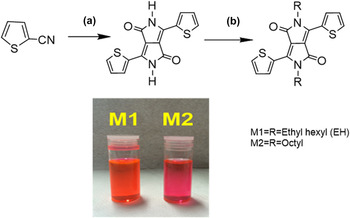
In the current work, first the thiophene flanked DPP core was synthesized using 2-thiophenecarbonitrile, di-n-butyl succinate ester with an excess of potassium t-butoxide as a strong base in 2-methyl-2-butanol high boiling point solvent medium according to a previously reported procedure (Scheme 1). Reference Tamayo, Walker and Nguyen39,Reference Bürgi, Turbiez, Pfeiffer, Bienewald, Kirner and Winnewisser40 To make soluble precursors for these two monomers, the DPP core was alkylated using an excess of short-branched ethyl hexyl (EH) bromide and straight octyl bromide in anhydrous dimethylformamide (DMF) in the presence of potassium carbonate (K2CO3) as the base (Scheme 1). The crude monomers, 1,4-diketo-2,5-di-hexyl-3,6-bis(4-(ethylendioxythienyl)phenyl)pyrrolo[3,4-c]pyrrole (EH-DPP) and N,N′-bis(octyl)-3,6-dithienyl-1,4-diketopyrrolo[3,4-c]pyrrole (Octyl-DPP) were further purified by column chromatography using chloroform as the solvent, resulting in a dark orange-red crystalline solid. The purity of all three monomers EH-DPP (M1) and Octyl-DPP (M2) was confirmed by NMR spectroscopy and then used for further optoelectronic comparative and electropolymerization studies.
Synthesis of DPP monomer derivatives EH-DPP (M1) and Octyl-DPP (M2); (a) di isopropylsuccinate/t-C5H11OK/2-methyl-2-butanol/120 °C; (b) alkyl bromide/K2CO3/DMF/130 °C.

B. Thermal characterization of the monomers
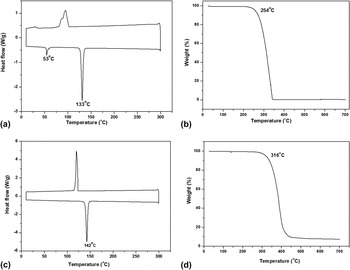
The thermal properties of all the DPP based monomers EH-DPP and Octyl-DPP were characterized by repetitive heating–cooling cycles using DSC and thermogravimetric analysis (TGA) with the results shown in Fig. 1. DSC analysis was conducted at a heating rate of 10 °C/min. In the DSC thermogram, all the DPP derivatives showed crystalline to isotropic transitions with a sharp melting temperature (T m) varying from 130 °C to 145 °C. The melting temperatures of EH-DPP (M1) and Octyl-DPP (M2) were measured at 133 °C and 142 °C, respectively. The straight octyl chain substituted Octyl-DPP exhibits the highest melting temperature when compared to EH-DPP: indeed, both EH-DPP and Octyl-DPP exhibits the melting temperature in a comparable range, which is due to the same number of carbon atoms (C8H17) involved in the alkyl chains of the both structures. The branched ethyl hexyl chain substituted DPP might have a stronger propensity to melt compared to the straight alkyl chain analogous compound due to its more amorphous nature arising from the branched alkyl chain. Octyl-DPP exhibits a sharper melting point when compared to the branched EH-DPP monomer, which is a significant indication of a more crystalline nature of this monomer compared to the other monomer. The TGA analysis was conducted by heating the sample from room temperature to 700 °C. Both monomers are stable around 280 °C. The 5% weight loss for EH-DPP and Octyl-DPP is observed at 254 °C and 316 °C respectively. Octyl-DPP exhibits higher stability around the 300 °C range when compared to EH-DPP due to its straight alkyl chain. The thermal data of both the monomers are also summarized in Table I.
DSC and TGA analysis of monomers EH-DPP (a & b) and Octyl-DPP (c & d) respectively.

Optical and thermal data of the monomers EH-DPP and Octyl-DPP.

C. Optical characterization of the monomers
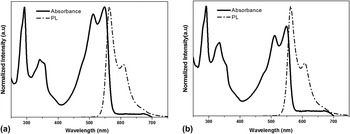
The optical properties of both monomers were measured by absorption spectroscopy in DCM solutions as shown in Fig. 2. Both monomers exhibit absorption bands in the ultraviolet (280–400 nm) and visible (400–600 nm) regions of the spectrum. Absorption peaks for both monomers were found around 290–292 nm range which is attributed to n–π* transitions. The EH-DPP (M1) and Octyl-DPP (M2) show a second absorption maxima in the short wave length region at 343 and 333 nm respectively, and this is due to π–π* transitions of the diketopyrrolopyrrole unit. Strong absorption maxima with a broad absorption profile in the long wave length region appear at 550 and 547 nm for EH-DPP and Octyl-DPP monomers, respectively. These bands are related to the intramolecular charge transfer (ICT) associated with the thiophene donor and DPP lactam core acceptor. All monomers exhibit similar absorption profiles with a small disparity in absorption values, which depends on the type of alkyl chain, attached to the thiophene flanked DPP core. The observed absorption maxima for both compounds (M1 and M2) are around 40 nm red shifted compared to the earlier reported EDOT-DPP-EDOT Reference Zhu, Zhang and Tieke17 molecule which is attributed to the more planar structure of the thiophene flanked DPP compared to the twisted structure of the EDOT-phenyl flanked DPP. The branched alkyl substituted DPP monomers (EH-DPP) showed similar absorption maxima in both regions with a similar difference in the primary and secondary peaks (7 nm). The straight alkyl chain substituted monomer (Octyl-DPP) exhibits a smaller blue shift in both the short and the long wave length regions compared to the branched alkyl chain substituted monomers (EH-DPP). Similar observations in terms of branched and straight alkyl chain substitution effects on optical properties were made by Patil et al. Reference Naik, Venkatramaiah, Kanimozhi and Patil41 The optical band gaps of all monomers are calculated from the absorption cut off values and the values are in the range of 2.12 eV and 2.15 eV for EH-DPP and Octyl-DPP, respectively. The difference in the optical band gap between both monomers is very minimal due to the similar conjugated backbone structure. This observation clearly indicates that alkyl substitution on the conjugated backbone of the thiophene flanked DPP does not have any significant influence on the spectra of the species in solution. In solution, all compounds demonstrate a strong orange to dark red emission. The photoluminescence (PL) spectroscopy data of EH-DPP and Octyl-DPP exhibits two well-resolved emission peaks in the 563–565 nm and 606–608 nm regions, respectively, with a small Stokes shift of 12–15 nm. Again, there is minimal difference in the PL maxima of all monomers, which is attributed to the identical nature of the core structure of the monomers. These optical properties are in a good agreement with earlier reported DPP molecules and are presented in Table I. Reference Naik, Venkatramaiah, Kanimozhi and Patil41
UV–visible absorption (black) and photoluminescence (red) spectra of monomers (a) EH-DPP and (b) Octyl-DPP in DCM.

D. XRD analysis of the monomers
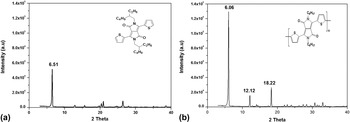
To study the solid state ordering and crystalline behavior of the DPP monomers, the powder XRD was performed. The XRD diagram patterns for EH-DPP and Octyl-DPP are shown in Fig. 3. For the monomer EH-DPP, the primary peak was measured at 2θ = 6.51° (d = 15.75 Å) whereas for the monomers Octyl-DPP the primary peaks were assigned at 2θ = 6.04° (d = 16.98 Å). The highest intensity was observed for the straight alkyl substituted Octyl-DPP compound compared to the branched alkyl substituted compound EH-DPP. This observation is also in a good agreement with the observed sharp DSC thermogram of straight short alkyl chain Octyl-DPP than branched alkyl chain EH-DPPT. From these observations, it is clear that the shorter alkyl chain substituted EH-DPP and Octyl-DPP compounds have smaller interspacing distances. The smaller diffraction peaks between 2θ = 20–30° correspond to diffraction from d-spacings along the stacking axis of the molecules. Reference Yanagisawa, Mizuguchi, Aramaki and Sakai42 For the compound Octyl-DPP, very strong peaks were observed at 2θ = 12.12° and 2θ = 18.22° which are attributed to the second and third order peaks of the primary diffraction peak (2θ = 6.06°), this clearly indicates the better ordering of Octyl-DPP in solid state than EH-DPP.
XRD diagrams of monomers (a) EH-DPP and (b) Octyl-DPP respectively.

E. Theoretical modeling of the monomers
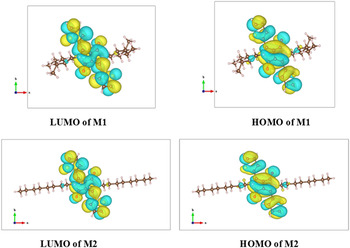
We performed ab initio modeling of the three monomers to get an insight into their properties, and specifically, how different alkyl chains affect them. The computed absorption spectra match well with the solution absorption data and the longer wave length absorption peak maximum measured at 546 and 545 nm for EH-DPP and Octyl-DPP, respectively (see Supplementary Material and Table II). The theoretical optical band gap calculated from the UV–Vis absorption spectra has been determined to be 1.86 and 1.82 eV for the EH-DPP and Octyl-DPP. These theoretical optical band gaps were found to be nearly 0.25–0.30 eV lower than the experimentally calculated optical band gaps. This is not surprising given the known propensity of the B3LYP functional to underestimate the band gap for large molecules. Reference Salunke, Wong, Feron, Manzhos, Lo, Shinde, Patil, Lee, Roy, Sonar and Wadgaonkar43 What is important here is that the modeling confirms that there is no significant effect on the band gap energy or optical spectrum from the attached chains, in agreement with the experimental measurements. This is understood by considering that the frontier orbitals responsible for the transitions are localized on the DPP moiety and that the alkyl chains have a rather weak electron donating ability which minimally affects the HOMO and LUMO levels when the chain length changes.
Theoretical UV–Vis, PL optical band gaps, HOMO, LUMO of EH-DPP, and Octyl-DPP.

The emission spectra were also computed and the theoretical emission maxima for EH-DPP and Octyl-DPP were calculated at 636 nm, 635 nm respectively (see Supplementary Material and Table II). These theoretical PL maxima values are slightly higher than (25–30 nm) the experimental PL maxima. Additionally, other effects such as computation in the gaseous state and solvent effects could also be possible reasons for the small disparity. The electron density isocontours of the HOMO and LUMO levels of EH-DPP and Octyl-DPP monomers are shown in Fig. 4. The HOMO energy level is largely delocalized on the thiophene moiety and the DPP core whereas the LUMO orbital is largely dispersed either on the electron withdrawing lactam ring or on the thiophene and DPP units. The theoretically calculated HOMO energies of EH-DPP and Octyl-DPP are found around −5.44 eV to −5.45 eV whereas the LUMO values are found at −3.04 eV to −3.05 eV. The calculated HOMO–LUMO gap was found to be −2.40 eV and the respective data are summarized in Table II. It has been well documented Reference Naik, Venkatramaiah, Kanimozhi and Patil41 that the alkyl chain attached to the lactam influences the planarity of the molecule to some extent based on both theoretical modeling and single crystal data of DPP compounds.
The optimized geometries and electron density isocontours of HOMO and LUMO of EH-DPP and Octyl-DPP monomers.

F. Electrochemical and electropolymerization study of the monomers
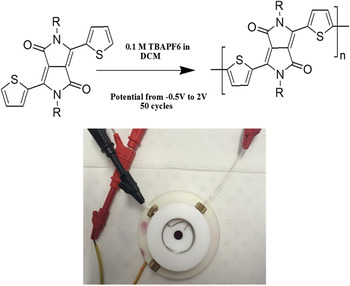
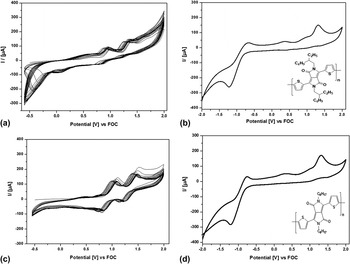
The electrochemical and electropolymerization study of EH-DPP and Octyl-DPP monomers were performed at a GC electrode in a custom made three-electrode cell setup using 0.1 M TBAF6 as supporting electrolyte in DCM at room temperature under an argon atmosphere. The electropolymerization reaction conditions and a pictorial presentation of this custom made cell are shown in Scheme 2. The concentration of DPP monomers used was 1 mg/mL. The electrochemical polymerization of EH-DPP and Octyl-DPP monomers were investigated under potentiodynamic conditions i.e., the potential was repeatedly cycled between −0.5 and +2.0 V versus ferrocene. In Figs. 5(a) and 5(c), the repeated potential cycling of the EH-DPP and Octyl-DPP monomers in 0.1 M TBAPF6/DCM is shown. As expected, the electropolymerization CV’s shows a gradual increase in the peak current for each cycle which confirms the electropolymerization process. Here both the monomers exhibit different electropolymerization behavior. Although, the monomers EH-DPP and Octyl-DPP have the same number of carbon atoms in the alkyl chain with a difference in the nature of the alky chain (either branched or straight), yet it is sufficient enough to affect the electropolymerization behavior. The straight alkyl chain based Octyl-DPP exhibits two pronounced oxidation peaks (E pa) centered at 1.08 and 1.48 V (based on the first cycle) in the anodic scan [Fig. 5(c)]. During the cathodic scan, two counter reduction peaks (E pc) centered at 0.81 and 1.23 V were observed. On the other hand, the branched alkyl chain substituted EH-DPP exhibited oxidation peaks (E pa) at 1.00 and 1.38 V during the anodic scan and the counter reduction peaks (E pc) at 0.82 and 1.25 V during the cathodic scan [Fig. 5(a)]. Interestingly, both the E pa’s of EH-DPP are around 10 mV lower than the Octyl-DPP counterpart and there is negligible potential difference between their E pc’s. Furthermore, the observed electropolymerization current of the EH-DPP is lower than that of the Octyl-DPP indicating that polymerization of the former one is more difficult than of the latter. The observed lesser electropolymerization of EH-DPP is due to the steric hindrance created by the branched alkyl chain. Reference El-Maiss, Darmanin and Guittard44 On the other hand, the van der waals force between the straight alkyl chains in Octyl-DPP marginally supports electropolymerization in spite of the electron deficiency nature of the system. Reference Sadanandhan, Devaki, Narayanan and Cheriyathuchenaaramvalli45 Thus, it can be postulated that the straight alkyl chain compounds can be a promising choice of materials for electropolymerization compared to the branched alkyl chain compounds. In addition, straight alkyl chain substituted Octyl-DPP is expected to show a higher crystallinity and potentially better packing of the polymer chains rather than the branched alkyl chain on the GC conducting substrate. This has been also supported from the DSC and XRD data of the Octyl-DPP compound.
Electrochemical reaction and possible structure of electropolymerized DPP polymers (top). Pictorial representation of custom-made electrochemical setup (bottom).

Continuous cyclic voltammograms for the electropolymerization of monomers (a) EH-DPP and (c) Octyl-DPP on a GC electrode in dichloromethane containing 0.1 M TBAPF6 as supporting electrolyte. The monomer concentration used was 0.1 mg/mL. Cyclic voltammograms of the electropolymerized polymer thin film (b) poly-(EH-DPP) and (d) poly-(Octyl-DPP) deposited on glassy-carbon electrodes in 0.1 M TBAPF6/DCM. The scan rate used in all cases was 0.1 V/s.

The oxidation onset potentials for the monomers EH-DPP and Octyl-DPP were observed at 0.90 and 0.83 V as per the first cycle of the electropolymerization process. The onset potentials were determined from the intersection of two tangents drawn on the rising current wave and on the baseline charging current of the CV traces. The HOMO value of monomer EH-DPP (exp) is −5.70 eV whereas for Octyl-DPP it is −5.63 eV calculated using the oxidation onset potential. The observed oxidation onset and peak potentials of both the monomers are higher compared to a previously reported EDOT-DPP-EDOT monomer (0.57 V versus ferrocene-oxidation onset potential), which is due to the more electron deficient nature of the present monomers. Coming back to polymers, polymerization mainly proceeds via the alpha position of the thiophene heterocycle due to the higher electron density. During repetitive potential cycling, the peak currents marginally increase and then decrease with the number of cycles, which demonstrates the growth of oligomer/polymer material on the surface of the GC electrode. The decrease in peak current after a few cycles may be due to the decrease in conductivity of the film and also the rate of diffusion within the films. Reference Sayyah, Mohamed and Shaban46 The electrochemical analysis of poly(EH-DPP) and poly(Octyl-DPP) films was done by running a CV between −2.0 and 2.0 V in 0.1 M TBAPF6 in DCM. The CVs for both electropolymerized electrodes are shown in Figs. 5(b) and 5(d), which confirm the formation of a polymer film on the GC electrodes. To rule out the possibility of the CVs being significantly affected by physisorbed molecules, two cross check experiments were carried out. First, the bare GC electrodes were immersed into the corresponding monomer solution for 1 h and subsequently washed with DCM prior CV measurements. In the second experiment, prior to CV characterization, the polymer/oligomer-modified electrodes were repeatedly washed with copious amount of DCM for four times to remove any physisorbed or left over monomers on the modified electrode surface. The above two experiments were primarily conducted to clearly confirm that the CVs obtained on electropolymerized electrode are from the polymer film adhered to the GC electrode and not from the physisorbed monomers. As expected both the oligomer/polymer modified electrodes exhibited redox reactions similar to those shown in Figs. 5(b) and 5(d) even after four washes. On the other hand, the bare GC electrode after immersing into the monomer solution does not show any redox reactions or any faradaic current. These observations clearly confirm the formation of a polymer/oligomer film on the electrode surface and the obtained redox reactions are not due to physisorbed molecules. The polymers poly(EH-DPP) and poly(Octyl-DPP) exhibit irreversible oxidation processes and a quasi-reversible reduction process. The poly(EH-DPP) shows oxidation peaks at −0.69, 0.35 and 1.13 V and a reduction peak at −1.23 V respectively. Whereas, poly(Octyl-DPP) shows oxidation peak at −0.76, 0.33, 1.30 V and a reduction peaks at −1.21 V. Further, it is worth mentioning that the oxidation onset potential of the polymers is lower than that of the corresponding monomers. Obviously, in conducting polymers, the oxidation potential of the oligomers/polymers is lower than the corresponding monomers due to increased chain length. Reference Calderon, Dangate, Manfredi, Abbotto, Salamone, Ruffo and Mari47 This decrease in oxidation potential of the polymerized film in comparison to the monomer is the additional proof for the electropolymerized film on the electrode surface. This observation also supports the argument that there are no physisorbed molecules on the electrode surface as physisorbed molecules are expected to show the same oxidation onset potential as the monomers. We have also cross verified these observations by conducting independent experiments using blank GC and ITO electrodes in dichloromethane containing 0.1 M TBAPF6 as supporting electrolyte through continuous cyclic voltammogram study (see Figs. S6 and S7 respectively).
The HOMO values for all materials were calculated using the equation −E HOMO = (E onset(ox) + 4.8) eV. The HOMO values for poly(EH-DPP) and poly(Octyl-DPP) are −5.81, −5.59 eV respectively. These newly synthesized monomers also exhibit a quasi-reversible reduction process due to the central electron withdrawing DPP core and the end capping groups. LUMO values were also calculated (in a similar manner to the HOMO value determination) from the corresponding reduction onset potentials using E LUMO = (E onset(red) + 4.8) eV. Reference Leonat, Sbarcea and Branzoi48 The LUMO values calculated for EH-DPP and Octyl-DPP are −4.05 and −4.10 eV respectively. The low LUMO values of all polymers clearly exhibit the electron withdrawing (n-type) nature of the polymers and this has been seen from the clear reduction peaks of these two polymers in the CV data. The observed electrochemical HOMO and LUMO values of these two polymers are deeper (with respect to vacuum) than poly(EDOT-DPP-EDOT) due to the more electrons withdrawing nature of the polymer. We can also compare the effect of the various alkyl groups on the energy levels and band gaps from this data. The electrochemical band gaps of the polymers obtained from the HOMO–LUMO differences were found to be 1.76, 1.49 for poly(EH-DPP) and poly(Octyl-DPP)m respectively (Table III). The smaller electrochemical band gap of poly(Octyl-DPP) compared to poly(EH-DPP) clearly reveals that the Octyl-DPP is a more favourable system for electropolymerization than the EH-DPP based on the conjugation length in the backbone and this has been also proved from the monomer and polymer analysis. The obtained HOMO–LUMO values and band gaps for these electropolymerized homopolymers are in a good agreement with the homopolymer synthesized by chemical method. Reference Li, Sun, Sonar and Singh49
Onset oxidation potential, onset reduction potential, and estimated (experimental) HOMO and LUMO energy levels of the polymers synthesized by electropolymerization using EH-DPP and Octyl-DPP monomers.

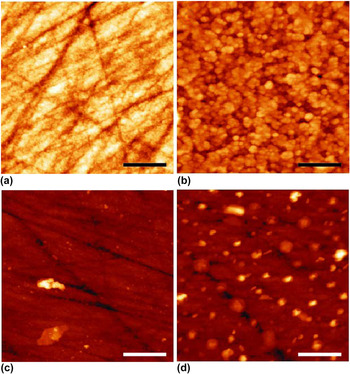
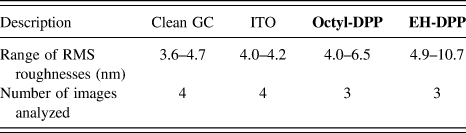
To further confirm the formation of an electropolymerized oligomer/polymer thin film on the working electrode, AFM measurements were performed on four different samples including a pure electrode surfaces, a clean GC electrode and a clean piece of ITO deposited glass electrode, as well as on two samples of GC electrodes covered with electropolymerized oligomer/polymer coatings, denoted as Octyl-DPP and EH-DPP. All four AFM micrograph images are shown in Fig. 6. The AFM measurements, taken at image areas of 4 × 4 μm, were used to calculate the average roughness of the surfaces and to characterize the topography of the surfaces. The ITO and the clean GC electrode were found to have similar roughnesses (see Table IV), but the two electrodes have markedly different appearances: the GC electrode was flat, with extended scratch-like marks criss-crossing the surface, whereas the ITO surface comprised discrete islands with lateral dimensions from tens to hundreds of nanometres. Both of the GC electrode surfaces deposited with electropolymerized oligomer/polymer were rougher than the clean GC electrode due to the presence of islands and cluster-like features not observed on the clean GC electrode. The resultant root mean square (RMS) roughness values for the different samples are compiled in Table IV. The areal coverage of the obtained electropolymerized islands like microstructures were analyzed with a flooding analysis (see Supplementary Material). For the Octyl-DPP sample shown in Fig. 6(c), the island cover just ∼2.2% of the surface, whereas the EH-DPP islands shown in Fig. 6(d) cover ∼16.6% of the surface.
Representative AFM images of pure electrodes (a) GC (b) ITO and micrographs of electrodeposited thin films (c) Octyl-DPP and (d) EH-DPP. The lateral scale bar in each image is 1 μm is reproduced to its right.

AFM-measured RMS roughnesses for different samples, obtained from analysis of images.

IV. CONCLUSION
Two diketopyrrolopyrrole monomers substituted with different alkyl chains (ethyl hexyl and octyl) were synthesized and characterized using various techniques. The thermal, optical, theoretical, solid-state ordering, and electrochemical properties of both monomers were studied in detail and the obtained data was compared with respect to tuning the nature of the alkyl chain. The main objective of this research was to compare the electrochemical behavior of two electron deficient diketopyrrolopyrrole monomers with straight and branched alkyl substitution and to evaluate their ability for electropolymerization. From the above work, we can conclude that the DPP monomers are fundamentally capable of being electropolymerized by anodic oxidation but it is difficult to get a good quality film with high molecular weight due to electron deficient nature. The films obtained on a GC electrode upon electropolymerization are very discontinuous, as revealed by an AFM microstructure study. We also attempted to electropolymerize thin films of these DPP monomers directly on ITO coated glass to use them directly for organic electronic devices but it was unsuccessful. Both the monomers exhibited different electrochemical behavior with respect to the substituted alkyl chain on the lactam nitrogen atom and from this study; it appeared that the straight short alkyl chain based compounds are a better choice of materials than the long-branched alkyl substituted monomers. By keeping the electropolymerization conditions constant, it is possible to reproducibly make very thin polymeric films on a GC electrode. The electropolymerized thin films gave different results in the oxidation and reduction onset and peak potentials and therefore the subsequent HOMO–LUMO values with respect to the varying alkyl chains. The ability to prepare films with DPP covalently attached to an electropolymerization moiety makes these films attractive in designing devices but there is a need for more electropositive, robust, and stable monomers to provide effective and consistent performance. This work offers new insights into the electrochemical polymerization ability of electron deficient DPP monomers with different alkyl chains (shorter to longer and from straight to branched alkyl chain). We are currently looking toward the selection of appropriate monomers for thin film deposition using electrochemical approaches so we can use these films for the development of spectroelectrochemical sensors, electrochromic materials, display devices, and energy applications.
Supplementary Material
To view supplementary material for this article, please visit https://doi.org/10.1557/jmr.2017.158.
ACKNOWLEDGMENTS
Supreetha is thankful to the CRC for Polymers and Central Analytical Research Facility (CARF), Institute of Future Environments, Queensland University of Technology (QUT) for providing equipment support. Supreetha is also thankful to Thu Trang Do for her help in NMR characterization and Prof. Godwin A. Ayoko for the helpful discussion and suggestions. P. M. S is thankful to QUT for the financial support from QUT core funding (QUT/322120-0301/07). P. M. S also acknowledges to the Australian Research Council (ARC) for the Future Fellowship (FT130101337).