





Introduction
For animals relying on fruit, keystone species are described as plant taxa that produce fruit during resource-poor periods (Terborgh Reference Terborgh, Soulé and Michel1986). Ficus (family Moraceae)—a hyper-diverse pan-tropical genus considered to be a quintessential food source due to several factors. First, their typically high crop yield can provide large amounts of figs (fruits of Ficus). For example, the crop size per tree of Ficus fulva in Sarawak reached over 700 fruits in 26 days (Harrison et al. Reference Harrison, Yamamura and Inoue2000), and of Ficus caulocarpa, in Malaysia has been recorded to provide up to 250,000 figs in only 18 days (Lambert et al. Reference Lambert, Marshall, Journal, Sep, Lambert and Marshal1991). Second, figs are a species-rich genus that is extensively distributed across the tropical region (Kuo et al. Reference Kuo, Bain, Chiu, Ho and Chen2017; Muhanguzi and Ipulet Reference Muhanguzi and Ipulet2012). Third, their nutritional value, in addition to high water and sugar content (Nevo et al. Reference Nevo, Valenta, Helman, Ganzhorn and Ayasse2022), includes high amino acid and mineral content, where one-third of the digestible components are present in fig pulp (Wendeln and Runkle Reference Wendeln and Runkle2000). Calcium concentration in figs is also noteworthy, up to three times higher than in other fruits (O’Brien et al. Reference O’Brien, Kinnaird and Dierenfeld1998). Fourth and most importantly is their presumed inter-tree asynchrony of fig maturation (Kattan and Valenzuela Reference Kattan and Valenzuela2013), which could in theory provide a reliable food source throughout the year.
Multiple studies have supported the observation that Ficus has a broadly aseasonal fruit production such that figs of any developmental stage can be available throughout the year (Corlett Reference Corlett1987; Figueiredo and Sazima Reference De Figueiredo and Sazima1997; Janzen Reference Janzen1979; Milton et al. Reference Milton, Windsor, Morrison and Miguel1982). This has been attributed to their unique pollination ecology: figs are pollinated by specialized wasps who use figs as brood sites, and asynchrony is hypothesized to assure survival of the wasps by providing year-round brood sites (Compton and Greeff Reference Compton and Greeff2020; Corlett Reference Corlett2006; Janzen Reference Janzen1979; Ragusa Reference Ragusa2002). However, the general pattern of asynchrony is also presumed, as some species and populations exhibit more pronounced phenological fruiting patterns. For example, no fruit was observed for several months in F. religiosa in Hong Kong; F. palmata in the Himalayas fruits only twice a year; and in monoecious Ficus in China, only a few trees retained figs throughout the winters. This demonstrates high seasonality of fig maturation and a complete absence in some parts of the year (Corlett Reference Corlett2006; Tamta et al. Reference Tamta, Tewari, Tamta and Shah2023; Zhang Reference Zhang2019). In other words, members of the genus exhibited deciduous characteristics (Azmil and Juliana Reference Azmil and Juliana2013), and their fruits do not occur year-round. A clear seasonality is known for F. trinctoria in southwest China, which fruits only during the cold season (Chen et al. Reference Chen, Rasoarahona, Folega and Manjaribe2015). Further, figs in Gabon are even described as an unimportant resource for frugivores, as only 1.5%–9% of trees bore fruits for four months of the year (Gautier-Hion and Michaloud Reference Gautier-Hion and Michaloud1989). As such, there is some evidence that members of the genus Ficus do show, at least in some species and ecosystems, clearer phenological patterns, with downstream effects on local frugivores. Critically, the majority of investigations conducted on the subject of Ficus phenology have not distinguished between ripe and unripe figs (Aruna and Balasubramanian Reference Aruna and Balasubramanian2015; Justiniano and Fredericksen Reference Justiniano and Fredericksen2000; Lin et al. Reference Lin, Zhao and Chen2008; Muhanguzi and Ipulet Reference Muhanguzi and Ipulet2012; Suresh and Sukumar Reference Suresh and Sukumar2018). This is problematic as it artificially inflates the number of fruits by including those that are not available to animals for consumption. As a consequence, fruiting phenology is underestimated. Moreover, it ignores the fact that phenological patterns are critical in different manners as a keystone resource: unripe figs for pollinators (Janzen Reference Janzen1979) and ripe figs for frugivorous seed dispersers (Rasplus et al. Reference Rasplus, Aumeeruddy-thomas, Cruaud, Rafidison, Mckey, Hossaert-mckey, Rasplus, Aumeeruddy-thomas, Cruaud, Kjellberg and Verohanitra2023).
Madagascar has a unique ecosystem in which over 82% of the vascular plant species are endemic (Callmander et al. Reference Callmander, Philipson, Schatz, Andriambololona, Rabarimanarivo, Rakotonirina, Raharimampionona, Chatelain, Gautier and Lowry2011), and which interacts with the island’s unique frugivorous, primarily composed of lemurs—the local endemic primates—fruit bats, and birds. To date, 24 Ficus spp. have been described on the island, 75% (18) of which are endemic (Berger Reference Berger1986; Rafidison et al. Reference Rafidison, Rakouth, Carrière, Kjellberg and Aumeeruddy-Thomas2020; Rasplus et al. Reference Rasplus, Aumeeruddy-thomas, Cruaud, Rafidison, Mckey, Hossaert-mckey, Rasplus, Aumeeruddy-thomas, Cruaud, Kjellberg and Verohanitra2023). The pivotal role of the Ficus spp. in Madagascar’s forest ecosystems is attributable to two primary factors. First, the species are ubiquitous within the island’s diverse forest biogeography. Secondly, they constitute a substantial component of the diets of numerous Malagasy frugivores (Table S1), encompassing avian and mammalian species (Rasplus et al. Reference Rasplus, Aumeeruddy-thomas, Cruaud, Rafidison, Mckey, Hossaert-mckey, Rasplus, Aumeeruddy-thomas, Cruaud, Kjellberg and Verohanitra2023). Thus, the degree to which they can serve as keystone species is critical for the long-term survival of certain endemic vertebrate species of Madagascar. Figs grow in all local habitats, including the wet forests of the eastern slopes of the island and the dry forests of the west coast and the Central Highlands (Dalecky et al. Reference Dalecky, Kerdelhue, Johnson, Razafindratsita, Grassi, Razafiarimalala, Overdorff and Raspuls2003). As such, figs are common in both moist habitats that are less likely to drive strong phenological patterns and drier ones in which fruiting phenology is more likely to be synchronized with seasonal variations in precipitation. Yet while some aspects of their biology and ecology have been described, the phenology of Madagascar’s Ficus in wet and dry habitats (Berger Reference Berger1986; Goodman and Ganzhorn Reference Goodman and Ganzhorn1997b)—and hence the potential to be a keystone species and/or fallback resource to the island’s unique fauna—remains unresolved.
The objective of the current study is to investigate the phenology of Malagasy Ficus in two different habitats to (1) test the hypothesis Malagasy Ficus spp. show structured timing in the production of unripe and ripe figs across the year and (2) test the hypothesis that due to a more seasonal climate, the degree of fruiting seasonality will be greater in the dry forests of Ankarafantsika National Park compared with the wet forest of Andasibe-Analamazaotra. In the context of the three-year study, 27 months were devoted to following the phenology of 94 individuals from 11 Ficus spp. at the two study areas.
Materials and methods
Study sites
We conducted the investigations at two sites: near Analamazaotra National Park (18°48’56.1” S; 048°25’11.2” E), in the locally managed part of Mitsinjo, Andasibe site (ADS, Figure S1) for 27 months (September 2021–August 2024) and Ankarafantsika National Park (16°19’14” S; 046° 48’ 25” E) in Ambatoboeny (AKF, Figure S2) for 20 months (August 2021–May 2024). ADS is a fragmented evergreen wet forest comprising altitudes of between 850 and 950 m (Dolch Reference Dolch2003). Mean precipitation in 2021 was around 1684 mm (WorldClim 2023), and mean temperature fluctuated between 14.5°C and 23.6°C (Figure S3). AKF is situated in central northwestern Madagascar. It is a dry deciduous forest within 136 513 ha (Parc National Ankarafantsika 2025). The average annual rainfall during four years (2016–2019) was 1195–1615 mm with the wet season between November and April (Sato Reference Sato2022). Mean daily temperature is between 21 and 29°C (Figure S3).
Study species
During the rainy season of 2021, when most of the locally occurring tree species were producing fruits (Bollen and Donati Reference Bollen and Donati2005), we counted Ficus tree species bearing figs along existing trails at each study site. Along with phenology monitoring, we noted dead trees (naturally dead or by human induced fire) and added other fruiting trees to replace dead ones. This allowed us to continually monitor the fig tree species during the study period. At AKF, monitoring began with 42 Ficus trees in the first year. Three individuals died during the second year and two in the third. No replacement trees were added, as no additional individuals were observed fruiting throughout the monitoring period. In contrast, at the ADS site, 50 trees were monitored in both 2021 and 2022 and 51 in 2023 and 2024, following the inclusion of one newly fruiting tree in the third year.
We collected and opened fig syconia to determine the reproductive system—dioecious or monoecious—as Ficus spp. exhibit a unique morphology that encloses flowers or seeds depending on the maturation stage (Anstett Reference Anstett1997). The monoecious group comprised Ficus botryoides Baker, F. assimilis J. Linn, F. tiliifolia Baker, and F. reflexa Thunb., all of which bear both male and female flowers within the same syconium and thus produce seeds. Conversely, the remaining species, all female trees in this study (Berger Reference Berger1986)—F. politoria Lam., F. polita Vahl, F. lutea Vahl, F. sycomorus Linn, and F. brachyclada—have a dioecious reproductive system (Figure S4). We confirmed the sex (male vs. female) of monitored tree species by combining literature and observation through images taken of some of the individual figs (Figure S4). In addition, we collected herbarium specimens for species identification, which followed the revised taxonomy of Comorian and Malagasy Ficus (Berger Reference Berger1986; Rafidison et al. Reference Rafidison, Rabevohitra, Aumeeruddy-Thomas, Hossaert-McKey, Rasplus and Kjellberg2011), and we cross-validated names using the FigWeb database (Simon and Rasplus Reference Simon and Rasplus2004). In parallel, we sequenced samples of monitored individual trees, which further confirms the taxonomic identifications (Nguyen et al. Reference Nguyen, Ebersbach, Razafimandimby, Rasplus, Uthe, Rafaliarison, Döll, Poeschl, Valenta, van Dam and Nevo2025).
Data collection
We selected individual trees based on their maturity (reproductive), proximity to the trail, ease of viewing, and use by birds, lemurs, and other mammals (rodents, bats) for further investigation. We refer to figs as fruit for convenience. As we could not detect the fruit stage externally, we judged figs as unripe by their smaller size and colour. For the following species, colour was reliable indicator of ripeness stage with unripe fruits being green and ripe fruits being either red or yellow: Ficus botryoides, F. lutea, F. madagascariensis C.C. Berg, F. reflexa, F. tiliifolia, F. sakalavarum Baker, F. sycomorus, F. assimilis, and F. brachyclada Baker. Several species in our dataset do not exhibit colour changes upon ripening, so for the following species we assessed ripeness based on fruit size: F. politoria and F. polita.
We monitored fig phenology for 20 months in AKF and 27 months in ADS during 2021–2024 (Figure S5–S8). We inspected 94 individuals (52 in ADS and 42 in AKF) belonging to 11 Ficus spp. (six in ADS and five in AKF). Monitoring in AKF took place at the beginning of each month and in ADS towards the end. Monitoring lasted three and five days for all individuals in AKF and ADS, respectively. Each Ficus spp. is represented by a minimum of three individuals. To quantify the number of ripe and unripe figs per tree, we visually counted the number of figs per branch from the base to the top of the tree, as detailed in Chapman et al. (Reference Chapman, Chapman, Struhsaker, Zanne, Clark and Poulsen2005). By multiplying the number of main branches by the number of fruits, we obtained an estimate of fruit quantity. For F. botryoides, F. tiliifolia, and F. sakalavarum with fruits in clusters, the estimated number of fruits was multiplied by the total number of clusters. Then, we split the data into four classes of total fruit number: small (1; n < 75), medium two (2; 75 ≥ n ≤100), medium three (3; 100 > n < 200), and big (4; n > 200).
Statistical analysis
To investigate (1) the pattern of phenology in Malagasy figs, we analysed phenological patterns of their fruiting, both with unripe and ripe figs, in the two study sites using the Circular package in R (Agostinelli Reference Agostinelli2024; Morellato et al. Reference Morellato, Alberti and Hudson2010) within RStudio 2023.12.1. To account for uneven monthly sampling across the study period (20 months in AKF and 27 months in ADS), fruit production for each species and ripening stage (unripe, ripe) was calculated as the mean quasi-quantified fruit count per month. Thus, each analysis (e.g. ripe fruits of F. tiliifolia) relied on exactly 12 data points representing the average quasi-quantified number of fruits in all individuals, while the sample size behind these averages (N trees and months) is larger and can be found in the supplementary tables. For each species, we used the Rayleigh test (Jammalamadaka et al. Reference Jammalamadaka, Sengupta and Sengupta2001) to examine whether the presence of figs followed the null hypothesis of uniform distribution (= no phenology) or the alternative hypothesis of a unimodal distribution (= phenology). We then compare the resulting r value through Wilcoxon test between the sites to assess whether (2) phenological patterns are different among species growing in the two different forest types.
Results
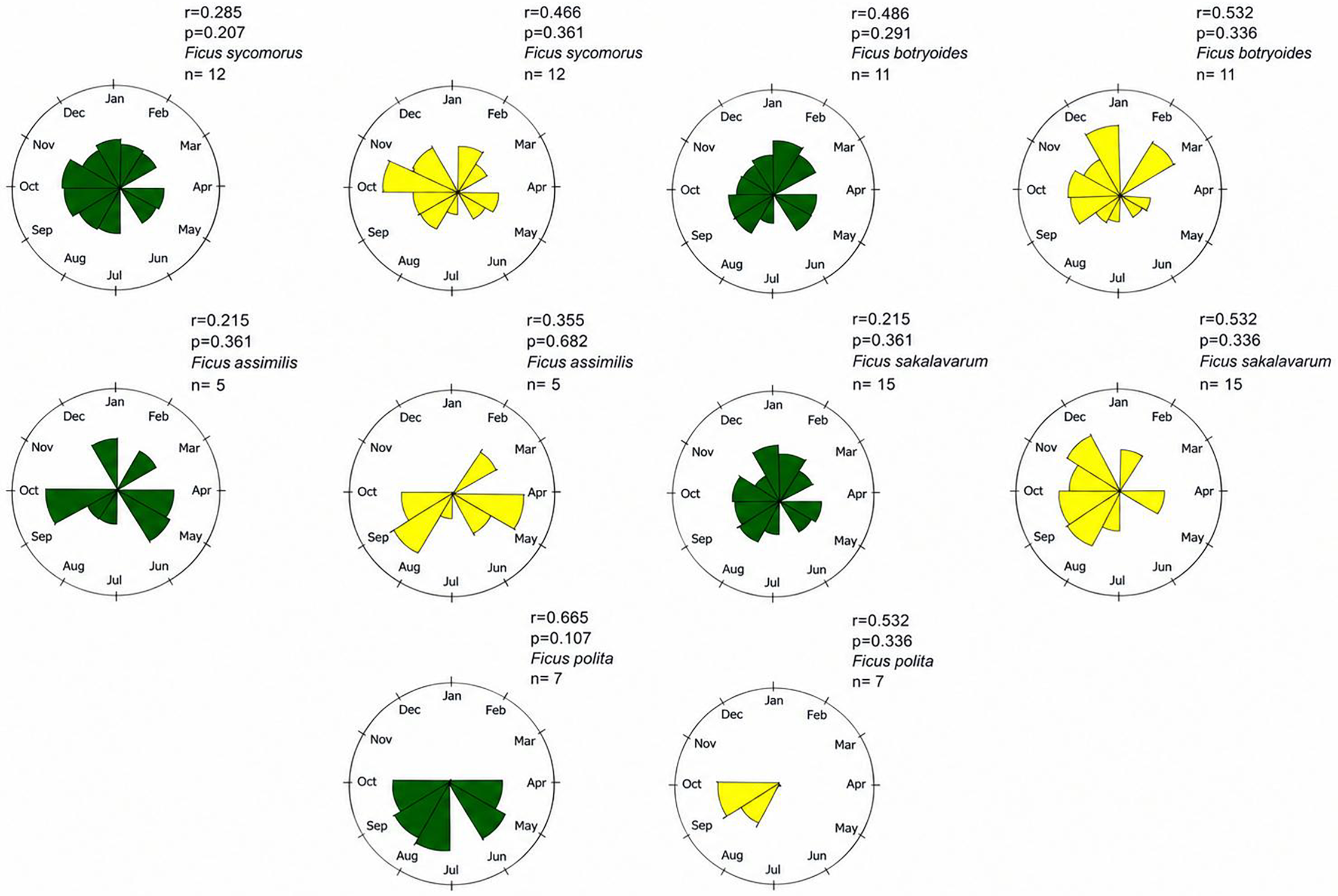
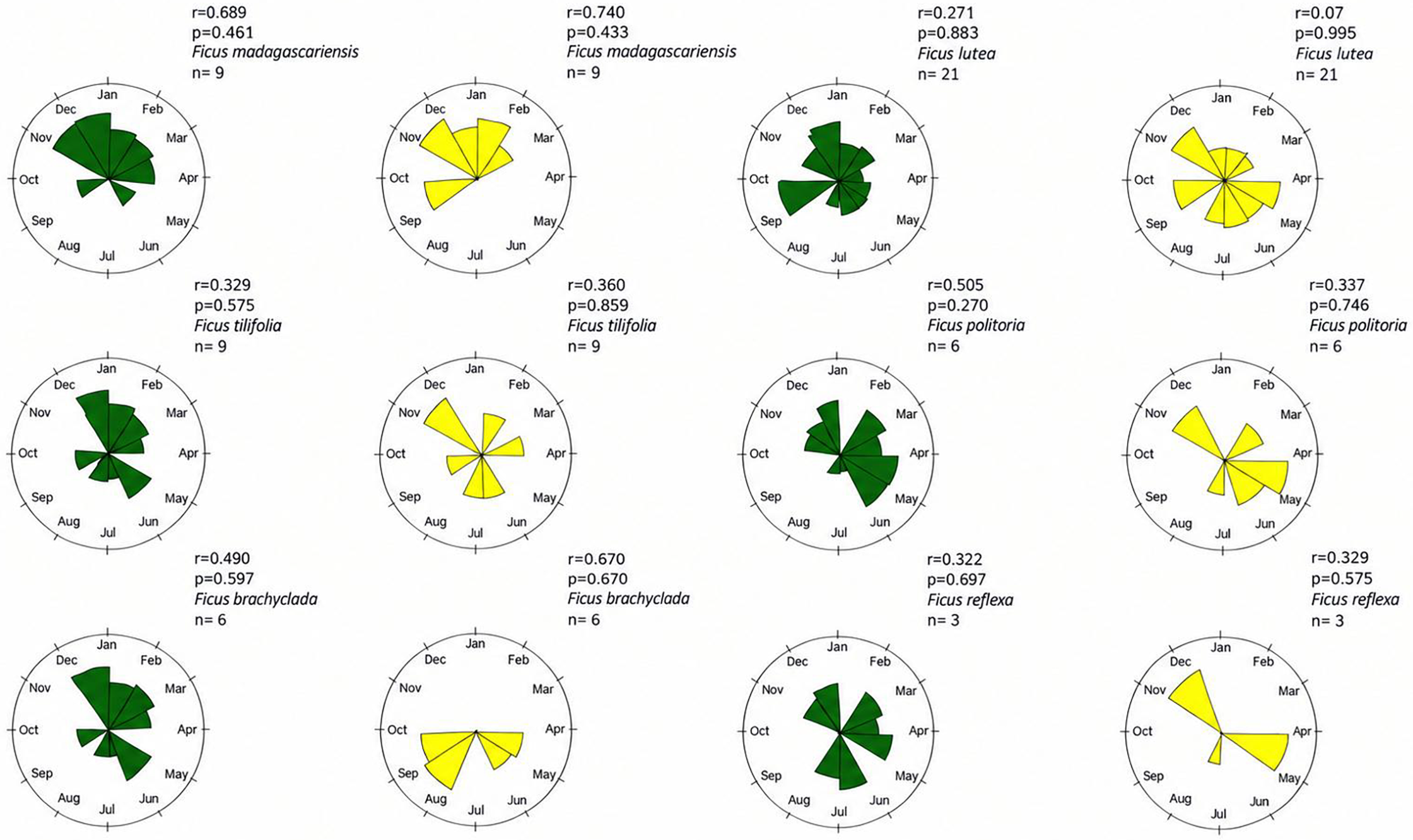
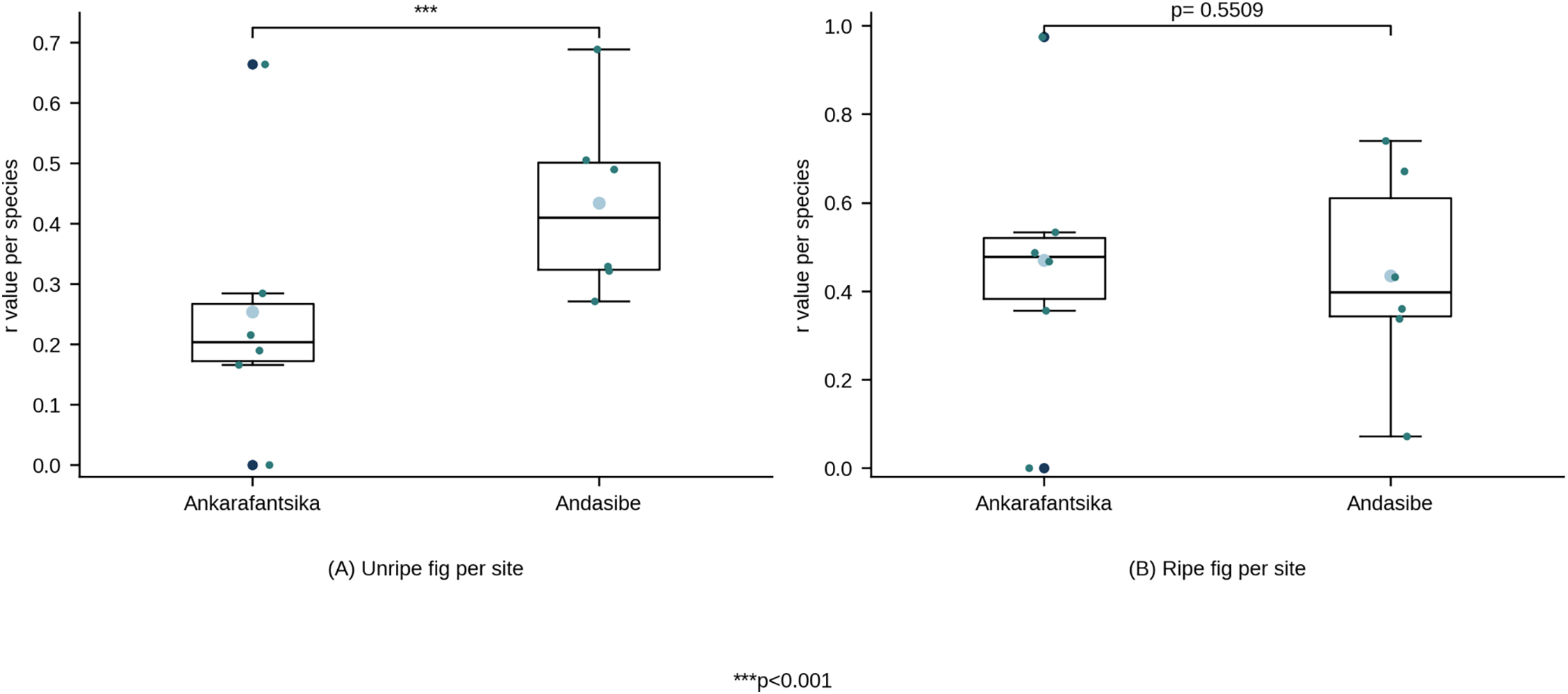
Overall, phenological patterns in the studied Malagasy Ficus spp. appear to be similar across species. Fruiting occurred within comparable timeframes, indicating a shared temporal structure in their reproductive cycles. Fruiting intensity varied among species and sites, and both unripe and ripe figs were observed across multiple months of the year, with unripe fruit presence generally spanning longer than ripe fruits. Despite visible qualitative patterns, no species in our dataset presented significant deviation from the null hypothesis of a uniform distribution, indicating no clear phenological patterns or a distinguishable peak fruiting season (question 1; Figures 1 and 2). This applies to both ripe and unripe fruits, whose distribution across months was statistically indistinguishable from a uniform (= no phenology) distribution. Contrasts between the two study sites were apparent only in unripe fruits, where r values (the tendency towards a deviation from the null hypothesis of a uniform distribution) were significantly higher in the wet forests of ADS compared to the dry forest of AKF (Figure 3a, Wilcoxon test W = 1298.5, df = 73.765, p < 0.001,). Yet ripe fruits, whose phenology is the one relevant for frugivores, did not differ among the study sites (Figure 3b, Wilcoxon test W = 980, df = 77.91, p = 0.55).
Unripe (green) and ripe (yellow) fruit in Ficus spp. (n = 42 individual trees) during 20 months in AKF: Bars represent the mean quasi-quantified fruit number (small (1; n < 75), medium two (2; 75 ≥ n ≤ 100), medium three (3; 100 > n < 200), and big (4; n > 200)) of unripe fruit (no bars correspond to absence of fruit not missing data; bar height corresponds to fruiting quantity); r corresponds to the value of the Rayleigh test, and p is the p-value of the test. A significant p < 0.05 indicates a deviation from the null hypothesis of a uniform distribution, i.e. phenology.

Figure 1. Long description
The figure contains ten circular rose diagrams arranged in four panels in the first two rows and two panels in the third row. Each diagram shows monthly observations from January to December, labeled clockwise. Green and yellow sectors represent two categories of observations: unripe and ripe stage respectively. Each diagram is accompanied by the species name, sample size (n), and correlation (r) and p-values. The diagrams are: Ficus sycomorus (n=12; r=0.285, p=0.207; r=0.466, p=0.361), F. botryoides (n=11; r=0.486, p=0.291; r=0.532, p=0.336), F. assimilis (n=5; r=0.215, p=0.361; r=0.355, p=0.682), F. sakalavarum (n=15; r=0.215, p=0.361; r=0.532, p=0.336), and F. polita (n=7; r=0.665, p=0.107; r=0.532, p=0.336).
Unripe (green) and ripe (yellow) fruit of Ficus spp. (n total = 52 individual trees) during 27 months in ADS: Bars represent the mean quasi-quantified fruit number (small (1; n < 75), medium two (2; 75 ≥ n ≤ 100), medium three (3; 100 > n < 200), and big (4; n > 200)) of unripe fruit (no bars correspond to absence of fruit not missing data; bar height corresponds to fruiting quantity); r corresponds to the value of the Rayleigh test, and p is the p-value of the test. A significant p < 0.05 indicates a deviation from the null hypothesis of a uniform distribution, i.e. phenology.

Figure 2. Long description
The figure contains twelve circular rose diagrams arranged in three rows and four columns. Each diagram shows months from January to December, labeled clockwise. Green and yellow sectors represent two categories of observations: unripe and ripe stage respectively. Each diagram is accompanied by the species name, sample size (n), and r and p-values. The diagrams represent Ficus madagascariensis (n=9; r=0.689, p=0.461; r=0.740, p=0.433), F. lutea (n=21; r=0.271, p=0.883; r=0.07, p=0.995), F. tilifolia (n=9; r=0.329, p=0.575; r=0.360, p=0.859), F. politoria (n=6; r=0.505, p=0.270; r=0.337, p=0.746), F. brachyclada (n=6; r=0.490, p=0.597; r=0.670, p=0.670), and F. reflexa (n=3; r=0.322, p=0.697; r=0.329, p=0.575).
Comparison between r (correspond to the length of an average directional vector) value from Rayleigh test of (A) unripe fig and (B) ripe fig per site, Ankarafantsika: dry forest, Andasibe: wet forest. A significant p < 0.05 indicates differences between site.

Figure 3. Long description
The figure consists of two side-by-side boxplots comparing r values between Ankarafantsika and Andasibe. (A) Unripe fig per site: Ankarafantsika values range from 0 to approximately 0.66, with a median near 0.20; Andasibe values range from about 0.27 to 0.69, with a median near 0.41. A bracket above the groups indicates a highly significant difference (***). (B) Ripe fig per site: Ankarafantsika values range from 0 to approximately 0.97, with a median near 0.48; Andasibe values range from about 0.07 to 0.74, with a median near 0.39. The comparison is labeled p = 0.5509.
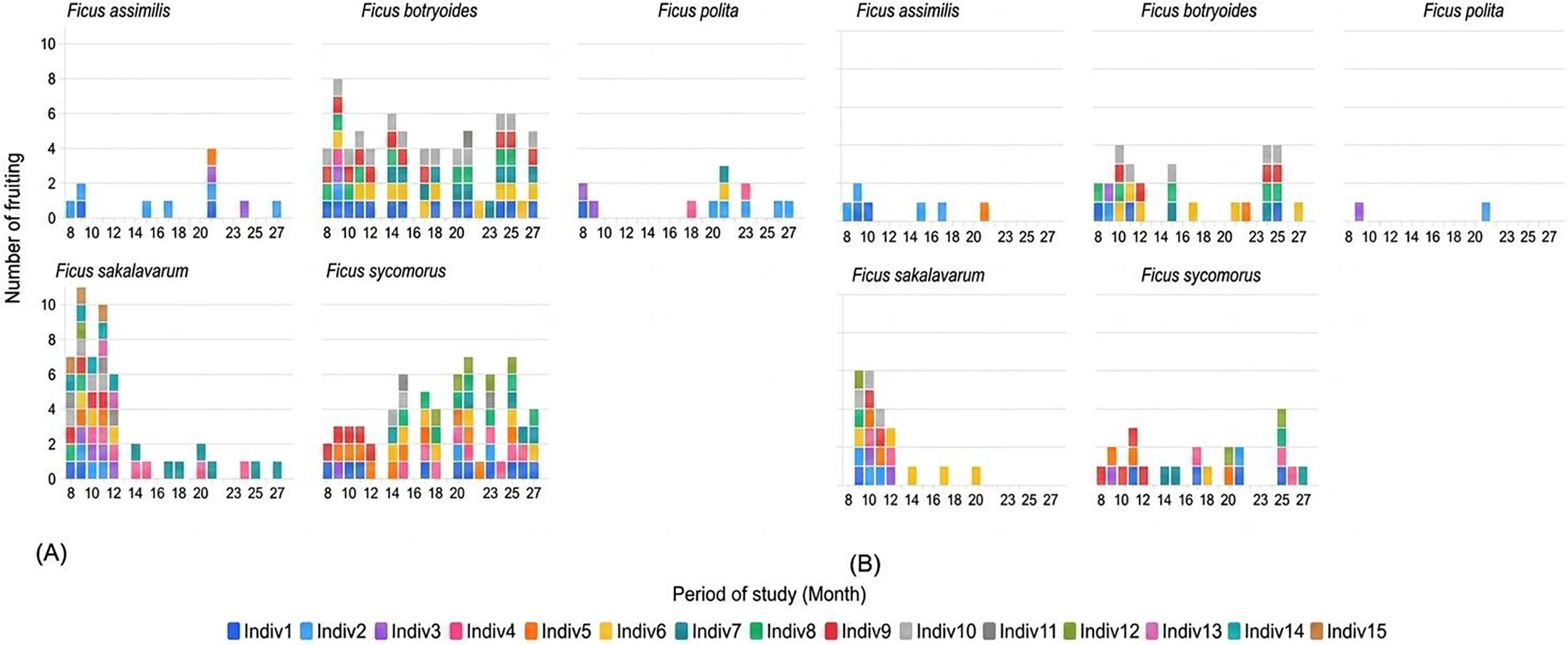
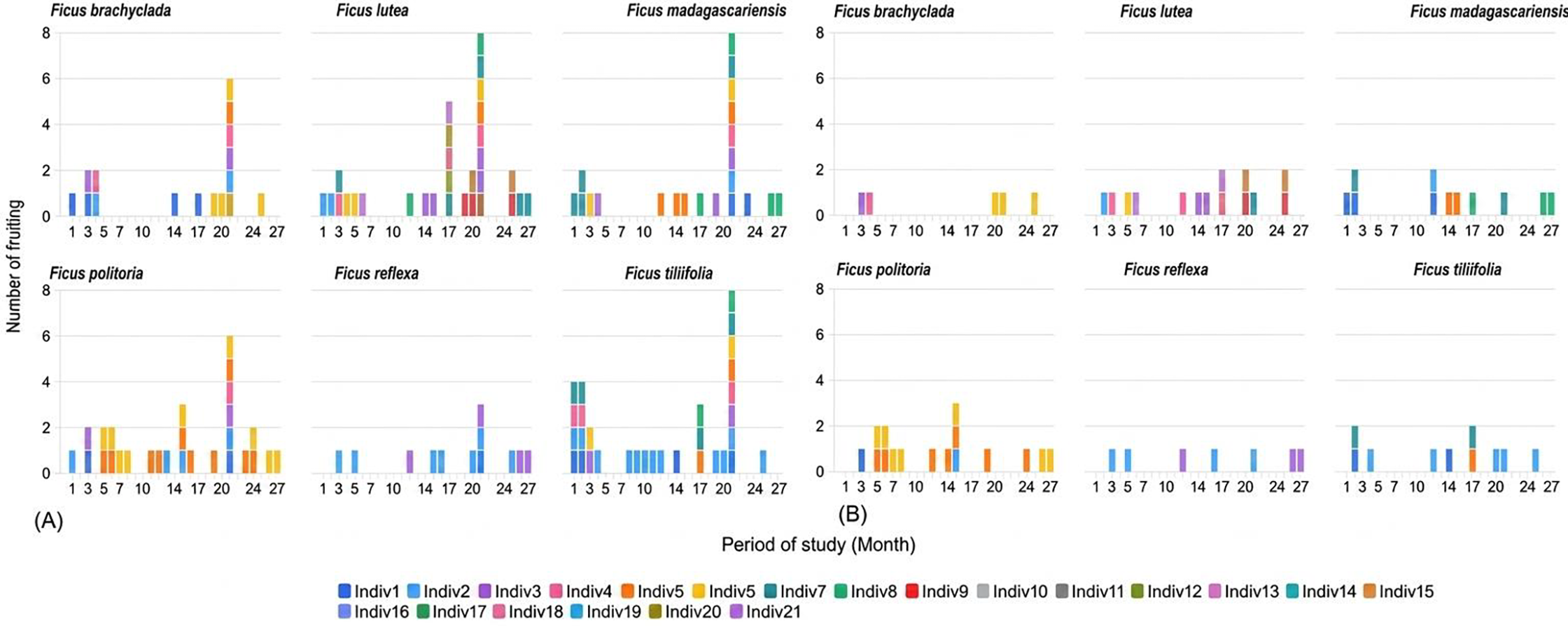
In addition to the similarities observed between sites, substantial variation in fruiting patterns was evident among individuals within same species (Figures 4 and 5). Several individuals produced figs over multiple consecutive months at the beginning of the monitoring period but subsequently showed little or no fruit production during the remainder of the study (Ficus tilifolia Figure 4; Ficus sakalavarum, Figure 5). Conversely, other individuals of the same species fruited at different times or maintained fruit production over longer periods (Ficus lutea, Figure 4; Ficus sycomorus, Figure 5). This heterogeneity was observed in both sites, populations and across multiple species. Thus, species-level phenological patterns appeared broadly seasonal and individual trees often exhibited distinct fruiting schedules, contributing to temporal variation in fig availability throughout the study period.
Number of fruit production (fruiting): unripe (A) and ripe (B) fig per individual within Ficus spp. in AKF along the study period (20 months). Empty columns correspond to no fig production and not missing data (month without data are not presented).

Figure 4. Long description
The figure contains two sets of stacked bar charts, labeled (A) and (B). Each set includes five Ficus species in Ankarafantsika: F. assimilis, F. botryoides, F. polita, F. sakalavarum, and F. sycomorus. The y-axis shows the number of fruiting, and the x-axis shows the study period (month), with months numbered from 8 to 27. Bars are divided into colored segments representing individual trees, identified in the legend as Indiv1 to Indiv15. Panel A shows monthly fruiting records for the five species for unripe stage, while panel B presents the corresponding records for the same species for ripe stage.
Number of fruit production (fruiting): unripe (A) and ripe (B) fig per individual within Ficus spp. in ADS along the period of study (27 months). Empty columns correspond to no fig production and not missing data (month without data are not presented).

Figure 5. Long description
The figure contains two sets of stacked bar charts, labeled (A) and (B). Each set includes six Ficus species in Andasibe: F. brachyclada, F. lutea, F. madagascariensis, F. politoria, F. reflexa and F. tiliifolia. The y-axis shows the number of fruiting, and the x-axis shows the study period (month), with months numbered from 1 to 27. Bars are divided into colored segments representing individual trees, identified in the legend as Indiv1 to Indiv21. Panel A shows monthly fruiting records for the six species for unripe stage, while panel B presents the corresponding records for the same species for ripe stage.
Discussion
Figs have long been hypothesized to be keystone species in many tropical ecosystems, primarily due to their asynchronous maturation and the occurrence of major fruiting peaks when most other tree species lack fruit (Janzen Reference Janzen1979; Shanahan et al. Reference Shanahan, Samson, Compton, Corlett, So, Compton, Corlett, Scott, Studies, Po, Reserve, Long and Kong2001). This is particularly relevant to Madagascar, a biodiversity hotspot with endangered endemic frugivore species coupled with a generally low diversity of frugivore species (Goodman and Ganzhorn Reference Goodman and Ganzhorn1997a). We conducted a phenological study of 11 Ficus spp. during several months at two study sites to test (1) whether Malagasy fig species show particular phenological patterns and (2) whether phenological patterns either in unripe or ripe stage are different between a dry deciduous forest and a wet forest. Our results indicate that Malagasy Ficus spp. exhibit a largely aseasonal fruiting phenology pattern, with no evidence of distinct fruiting periods. Although temporal fluctuations in fruit availability were observed, fruiting events remained broadly distributed throughout the year. These findings suggest that reproductive activity in Malagasy Ficus is not strongly synchronized with particular periods of the annual climatic cycle, such as temperature and rainfall, and are consistent with previous studies showing that many Ficus spp. display extended and asynchronous fruiting schedules, resulting in a relatively continuous supply of figs over time (Harrison Reference Harrison2005; Lambert and Marshall Reference Lambert and Marshall1991; Shanahan et al. Reference Shanahan, Samson, Compton, Corlett, So, Compton, Corlett, Scott, Studies, Po, Reserve, Long and Kong2001).
Nonetheless, the stark climatic contrasts between moist and dry forests may lead to differences in the timing of fig production. Unripe fig production in AKF was more than a month behind production in ADS, suggesting that habitat-specific climatic regimes may influence the amplitude and predictability of fruiting. This is in line with other studies (Bollen and Donati Reference Bollen and Donati2005; Schaik et al. Reference Schaik, J.W. and Wright1993), as within species, phenological patterns can be affected by abiotic factors. For example, the phenology of Ficus pedunculosa in Taiwan shows that even within a single species, contrasting habitat contexts—upland versus lower elevation—can yield distinct phenological rhythms driven by topographic and microclimatic variation (Kuo et al. Reference Kuo, Bain, Chiu, Ho and Chen2017). Yet, fig phenology could respond primarily to shared climatic seasonality rather than forest type per se, as in the case of Ficus variegata that shows clear annual cycles linked to rainfall seasonality (Spencer et al. Reference Spencer, Weiblen and Flick1996) and also Ficus squamosal that variates fruit production according to climatic variation (Pothasin et al. Reference Pothasin, Compton and Wangpakapattanawong2016). Overall, the results indicate that climatic conditions do not strongly affect fig phenology in Madagascar, suggesting that temporal variation in fruit production is largely decoupled from local climatic drivers such as rainfall and temperature. This weak climatic signal implies that other factors, including species-specific traits or endogenous reproductive strategies, may play a more important role in shaping fruiting dynamics.
The relative continuity of the supply of figs over time, in conjunction with the absence of a discernible climatic signal, is characteristics that could define the significance of a resource. At the unripe stage, which encompasses all stages of fig prior to seed maturation, figs of all species were present year-round despite some fluctuations. This means that potential brooding sites for pollinating wasps routinely open up, ensuring that their populations are supported throughout the year. This is in line with the Janzen’s original proposition (Janzen Reference Janzen1979). Similarly, the lack of phenology in ripe figs indicates that figs can provide critical food resources for frugivorous vertebrates year-round. These results underpin the potential importance of Ficus to Malagasy ecosystems, as they may therefore function as a keystone resource through its dual role in sustaining pollinators and frugivores across seasonal fluctuations in tropical forest ecosystems (Eisikowitch and Ghara Reference Eisikowitch and Ghara2015; Harrison and Rasplus Reference Harrison and Rasplus2006; McPherson Reference McPherson2005; Wiebes Reference Wiebes1979; Yang et al. Reference Yang, Tzeng and Chou2013).
However, the presence of figs across months does not necessarily imply that abundant figs were available at all times, including during periods of general resource scarcity. The extent to which figs can fulfill a keystone role ultimately depends on the fruiting phenology of other plant species within the community, as well as the abundance of figs. If ripe fig availability coincides with periods of low fruit abundance from alternative resources, and if crop sizes are sufficient enough in size, this temporal complementarity would strengthen the characterization of Ficus as a keystone resource for frugivore seed dispersers within the ecosystem (Dunham et al. Reference Dunham, Razafindratsima, Rakotonirina and Wright2018; Federman et al. Reference Federman, Sinnott-armstrong and Baden2017; Lambert and Marshall Reference Lambert and Marshall1991; Razafindratsima and Dunham Reference Razafindratsima and Dunham2019; Terborgh., Reference Terborgh, Soulé and Michel1986). Conversely, in systems where fruit production by non-fig species overlaps substantially with fig fruiting, frugivore reliance on figs may be reduced, weakening their functional importance (Harrison Reference Harrison2005).
While systematic recording of crop size was beyond the scope of this project, our data presented 94 trees spread around three or more territory groups of lemur ∼30 ha each. Of these, 48.5% of trees fell within the large crop class (n > 200) and 28.3% within the medium crop (75 ≤ n < 200). On average, Ficus trees yielded 2083.33 ± 955.56 × 10.31 g month−1 of ripe fruits from 52 trees in Andasibe, over a period of 27 months and 2216.67 ± 2122 × 13.66 g month−1 of ripe fruits from 42 trees in Ankarafantsika, during 20 months. Collectively, these yields represented approximately 30% of the monthly mass intake required by groups of Eulemur fulvus during the lean period (21,479 g month−1 per group), 5% of dry-matter intake by community of Propithecus verreauxi (422,241.84 g month−1 per group) and 4% of that required by a community of Varecia variegata variegata (497,289.6 g month−1 per group) in other Malagasy forest areas (Campbell et al. Reference Campbell, Williams and Eisemann2004; Irwin et al. Reference Irwin, Rahalinarivo, Raharison, Ramorasata, Farmer, Razafiarivony, Ranaivoarisoa and Rothman2026). Even during the lowest-yield months (September–October in ADS and January–February in AKF, Figure S6 and S8), Ficus fruit production remained comparably low, continuing to meet only around 30% of the monthly fruit requirements of Eulemur fulvus, 5% of those of Propithecus verreauxi and 4% of those of Varecia variegata variegata. Although these are only crude estimates, they suggest that Ficus alone is insufficient to meet the full dietary requirements of these lemur species but may still represent a modest, consistent supplementary food resource within the frugivore community, particularly for Eulemur fulvus even during periods of low fruit availability.
At the same time, it should be noted that our study covered a limited number of individuals and particularly years, meaning that its results may not be fully representative of long-term patterns. Tree sample sizes vary across species (e.g. n = 3 F. reflexa vs n = 21 F. botryoides), and individual trees display distinct fruiting schedules (Figures 4 and 5), pooling data risks obscuring key intraspecific variation. Consequently, this community-level averages should be treated as broad baseline trends rather than precise species patterns. Most importantly, significant differences in the number of individuals across species may affect the results, as the appearance of phenological patterns is more likely when the number of individuals is small. At the same time, our analysis included all individuals that were available under the study criteria, and our goal was to assess phenology from the perspective of frugivores. As such, a phenological pattern deriving from low population densities is not only a statistical artefact; it is also the ecological reality of the consumers in the system. Nonetheless, the consistency of results across species indicates that this is unlikely to have substantially affected the results. In addition, the quasi-quantification, while necessary in this case, renders the analysis less accurate than it would be if fruit numbers were fully quantified.
Our study examines the phenology patterns of Malagasy Ficus spp. in dry deciduous and wet forest of Madagascar. With data from over three years, the study demonstrates that among all Ficus species, fruiting pattern is generally aseasonal. It provides insights into how fig availability, in both unripe and ripe stages, which lack in many studies (Aruna and Balasubramanian Reference Aruna and Balasubramanian2015; Justiniano and Fredericksen Reference Justiniano and Fredericksen2000; Lin et al. Reference Lin, Zhao and Chen2008; Muhanguzi and Ipulet Reference Muhanguzi and Ipulet2012; Suresh and Sukumar Reference Suresh and Sukumar2018), may differ between habitat types, with significant implications for the feeding ecology and conservation of Madagascar’s limited frugivore communities. It also contributes to a long and still open discussion on the generality of Ficus phenological patterns, almost half a century after Janzen’s publication (Janzen Reference Janzen1979). As such, this research deepens our understanding of plant–animal interactions in this biodiversity hotspot, reinforcing the importance of Ficus in maintaining ecological stability amid environmental fluctuations. Our finding thus supports the view that Ficus phenological patterns and ecological functions may vary among tropical regions and should not be generalized universally. The study also contributes to the longstanding discussion surrounding the ecological role of Ficus in tropical ecosystems since the seminal works of John (Terborgh, Reference Terborgh, Soulé and Michel1986) and Annie Gautier (Gautier-Hion and Michaloud Reference Gautier-Hion and Michaloud1989). More broadly, this research contributes to a better understanding of plant–animal interactions in this biodiversity hotspot and provides a foundation for future studies investigating the ecological roles and phenological variability of Ficus across Madagascar.
Supplementary material
The supplementary material for this article can be found at https://doi.org/10.1017/S0266467426100820.
Acknowledgements
We would like to offer our special thanks to the assistants in fieldwork: Johnny Kennedy, Fanomezantsoa Prosper, and Mahandry, as well as to the Mitsinjo staff and the Madagascar National Park Ankarafantsika staff. Data were collected under permit number 383/21/MEDD/SG/DAPRNE/SCBE.Re AR N°301/21 in 12/07/2021 by the Ministère de l’Environnement et du Développement Durable. We thank Dr. Jean‑Yves Rasplus for the insightful feedback on species identification.
Financial support
D.R. was supported by Mad Dog Initiative for the duration of her time in the field. The research project is supported by the German Science Foundation (DFG) grant number. NE 2156/3-1.
Competing interests
On behalf of all authors, the corresponding author confirms that no involvement or association exists that could call into question the neutrality of the work or the outcomes presented.
Ethical statement
None.


 Open access

