Introduction
Since its introduction to the market as an over-the-counter medication, the transdermal nicotine patch has prevailed as an accessible and affordable smoking cessation treatment. The nicotine patch has been broadly recognised in clinical trials for doubling rates of cessation when compared with placebo (Stead, Bergson, & Lancaster, Reference Stead, Bergson and Lancaster2008). Although rates of effectiveness are comparable, smokers attempting to quit appear to prefer the transdermal nicotine patch over other forms of nicotine replacement therapy including the gum and the lozenge (West, McNeill, & Raw, Reference West, McNeill and Raw2000). Despite these advantages, the average user of the nicotine patch has only a 20–25% chance of achieving long-term abstinence (Fiore et al., Reference Fiore, Jaen, Baker, Bailey, Benowitz and Curry2008). The effectiveness of the patch is increased among smokers who report greater adherence to the recommended daily use of the medication (Hollands, Sutton, McDermott, Marteau, & Aveyard, Reference Hollands, Sutton, McDermott, Marteau and Aveyard2013; Shiffman, Brockwell, Pillitteri, & Gitchell, Reference Shiffman, Brockwell, Pillitteri and Gitchell2008). Thus, there has been growing recognition of the need to identify factors that may be related to adherence in order to devise interventions specifically targeted to boost adherence and, in turn, cessation rates from patch use.
Low rates of adherence to recommended dosing with the nicotine patch have been recognised for some time (Toll, McKee, Martin, Jatlow, & O'Malley, Reference Toll, McKee, Martin, Jatlow and O'Malley2007) and non-adherence continues to represent an important clinical barrier (Hollands et al., Reference Hollands, McDermott, Lindson-Hawley, Vogt, Farley and Aveyard2015). Previous studies have focussed on negative attitudes and beliefs about the patch, such as possible side effects and perceived ineffectiveness, as important correlates of patch adherence (Balmford, Borland, Hammond, & Cummings, Reference Balmford, Borland, Hammond and Cummings2011; Etter & Perneger, Reference Etter and Perneger2001). Other studies have found level of nicotine dependence, quit motivation (Alterman, Gariti, Cook, & Cnaan, Reference Alterman, Gariti, Cook and Cnaan1999), and gender (Cooper et al., Reference Cooper, DeBon, Stockton, Klesges, Steenbergh and Sherrill-Mittleman2004) to be important correlates of patch adherence. But despite the important role of adherence in helping to determine the effectiveness of the patch for helping smokers to quit, remarkably little is known about smoker characteristics, particularly prospective changes during a quit attempt, that relate to adherence to the patch during a treatment programme.
In this study, we attempted to extend the limited literature on correlates of adherence to nicotine patches by evaluating a broad range of variables that have been associated with smoking cessation outcomes in patch studies. These included demographic characteristics (e.g., age, gender, race), smoking-related variables (e.g., level of nicotine dependence), cessation-related constructs (i.e., craving and withdrawal symptoms), psychological factors (i.e., depression and anxiety symptoms), and behavioural variables (i.e., complementary and alternative reinforcers) (e.g., al'Absi, Carr, & Bongard, Reference al'Absi, Carr and Bongard2007; Goelz et al., Reference Goelz, Audrain-McGovern, Hitsman, Leone, Veluz-Wilkins and Jepson2014; Kaufmann et al., Reference Kaufmann, Hitsman, Goelz, Veluz-Wilkins, Blazekovic and Powers2015; Niaura et al., Reference Niaura, Britt, Shadel, Goldstein, Abrams and Brown2001). Additional unique strengths of the current analyses include the availability of prospective data to allow for the evaluation of longitudinal changes among smokers who were or were not adherent to patch therapy and the relatively large and diverse sample, the latter being a function of these data being taken from an effectiveness clinical trial with limited inclusion and exclusion criteria. This more in-depth analyses of the factors that are associated with adherence to nicotine patch treatment can help guide novel interventions designed to enhance medication adherence in order to maximise the potential of the nicotine patch to effectively treat nicotine dependence.
Methods
Participants
Data for this study were collected from participants in a clinical trial evaluating the effectiveness of 8-, 24-, or 52-weeks of behavioural counselling and transdermal nicotine (Schnoll et al., Reference Schnoll, Goelz, Veluz-Wilkins, Blazekovic, Powers and Leone2015; ClinicalTrials.gov Identifier: NCT01047527). Eligible participants had to be 18 years of age or older, report currently smoking at least 10 cigarettes per day, and had to express an interest in quitting smoking. Additional exclusions were included to minimise potential risk to subjects (e.g., current medical condition that would make transdermal patch use unsafe, abnormal ECG, allergy to latex, etc.), but were limited since this was an effectiveness trial that emphasised the generalisability of the study findings (see Schnoll et al., Reference Schnoll, Goelz, Veluz-Wilkins, Blazekovic, Powers and Leone2015). To control for treatment duration, only data until week 8 of the study were included in these analyses. In addition, while 525 participants were included in the trial from which the data were taken, 85 participants provided very limited data on adherence (i.e., were lost at follow-up and did not complete study appointments where adherence data were collected) and were, thus, excluded from this study, leaving 440 individuals retained for the present analysesFootnote 1 .
Study Procedures
All study procedures obtained approval from the University of Pennsylvania and Northwestern University Institutional Review Boards. Recruitment was accomplished through media advertisement. A face-to-face intake appointment confirmed participant eligibility. In accordance with medication labelling and clinical guidelines, all eligible participants received 21 mg of open-label transdermal nicotine treatment (Nicoderm CQ; GlaxoSmithKline, Research Triangle Park, NC). Each participant was randomised to 8-, 24-, or 52 weeks duration of treatment and received standardised smoking cessation counselling designed to help the participant prepare for cessation and manage urges and triggers to resume tobacco use. Counselling, based on established treatment guidelines (Fiore et al., Reference Fiore, Jaen, Baker, Bailey, Benowitz and Curry2008), occurred at weeks 2 (baseline), 4, and 8. The analyses for this study were based on data collected at week 2, week 4, and week 8. At 8-weeks, self-reported smoking cessation was confirmed with a breath carbon monoxide (CO) reading assessed using the Vitalograph BreathCO monitor, which is regarded as a valid method for confirming self-reported cessation (SRNT Subcommittee on Biochemical Verification, 2002).
Measures
Covariates
Participants were asked at baseline to provide demographic (e.g., age, sex, race) and smoking-related information (e.g., cigarettes per day, the Fagerström Test for Nicotine Dependence [FTND; Heatherton et al., Reference Heatherton, Kozlowski, Frecker and Fagerström1991]). In addition, saliva samples (5 ml) were collected at baseline for the purpose of measuring a participant's nicotine metabolism using the nicotine metabolite ratio (NMR) and participants completed the modified version of the reasons for smoking (RFS) scale (Horn & Waingrow, Reference Horn and Waingrow1966), which includes subscales for smoking for stimulation (e.g., ‘l get a definite lift and feel more alert when smoking’), smoking for negative affect regulation (e.g., ‘When I feel blue or want to take my mind off cares and worries, I smoke cigarettes’), and smoking for the addiction (e.g., ‘When I have run out of cigarettes, I find it almost unbearable until I can get one’). Psychiatric comorbidity was assessed using the Mini International Neuropsychiatric Interview (MINI; Sheehan et al., Reference Sheehan, Lecrubier, Sheehan, Amorim, Janays and Weiller1998).
Side Effects
A checklist of nicotine patch-related side effects used previously was administered (Schnoll et al., Reference Schnoll, Goelz, Veluz-Wilkins, Blazekovic, Powers and Leone2015). The severity of side effects (e.g., nausea, rash) were rated by participants from 0 (none) to 3 (severe). For each time-point assessed, a total summary score was computed.
Withdrawal and Craving
Withdrawal symptoms associated with smoking cessation were measured using the Minnesota Nicotine Withdrawal Scale (MNWS; Hughes et al., Reference Hughes, Hatsukami, Pickens, Krahn, Malin and Luknic1984). This scale measures DSM-IV criteria for nicotine withdrawal (i.e., anger, anxiety, depression, difficulty concentrating, increased appetite, insomnia, restlessness, impatience, and craving) and items were summed. Cigarette craving was measured using the 10-item Questionnaire of Smoking Urges (QSU; Cox, Tiffany, & Christen, Reference Cox, Tiffany and Christen2001). The items were summed to yield a total craving score.
Symptoms of Anxiety and Depression
Anxiety was assessed using the 21-item Beck Anxiety Inventory (BAI; Beck, Epstein, Brown, & Steer, Reference Beck, Epstein, Brown and Steer1988). Total scores were obtained as a summary for each item rated on a four-point scale. Frequency and severity of depressive symptoms were assessed using the 30-item Inventory of Depressive Symptomology (IDS; Rush et al., Reference Rush, Giles, Schlesser, Fulton, Weissenburger and Burns1986), which are based on DSM-IV depression criteria.
Substitute and Complementary Reinforcers
Substitute and complementary reinforcers were assessed using the Pleasant Events Schedule (PES; MacPhillamy & Lewinsohn, Reference MacPhillamy and Lewinsohn1982) as done previously (Goelz et al., Reference Goelz, Audrain-McGovern, Hitsman, Leone, Veluz-Wilkins and Jepson2014). The shortened PES version includes 45 items that assess the prevalence and enjoyability of ordinary rewarding activities over the past 30 days. An individual's reinforcement from a given activity is measured by taking the cross-product of the prevalence score (0 = has not happened to 2 = happened often) and enjoyability score (0 = not pleasurable to 2 = very pleasurable). Participants were then asked to rate each activity as associated or not associated with smoking. Complementary reinforcers were defined as activities associated with smoking behaviour (e.g., getting together with friends at a bar) and substitute reinforcers (e.g., exercise) were defined as activities not associated with smoking behaviour.
Transdermal Nicotine (Patch) Adherence
A timeline follow-back measure (Brown, Burgess, Sales, Evans, & Miller, Reference Brown, Burgess, Sales and Whiteley1998) was used to assess daily patch use from weeks 0 to 8. Degree of adherence was calculated using the number of days per week an individual reported patch use and adherence was defined as wearing the patch for > 6 of 7 days/week across the 8 weeks as done previously (Alterman et al., Reference Alterman, Gariti, Cook and Cnaan1999; Baker, Piper, Stein, Smith, & Fiore, Reference Baker, Piper, Stein, Smith and Fiore2016; Berg, Ahluwalia, & Cropsey, Reference Berg, Ahluwalia and Cropsey2013; Kaufmann et al., Reference Kaufmann, Hitsman, Goelz, Veluz-Wilkins, Blazekovic and Powers2015).
Smoking Behaviour
Smoking from baseline to week 8 was assessed by the timeline follow-back (Brown et al., Reference Brown, Burgess, Sales and Whiteley1998). Breath samples biochemically verified self-reported cessation for the 7 days before Week 8. Carbon monoxide levels, assessed using the Vitalograph BreathCO Monitor, were measured in parts per million (ppm). As per existing guidelines (SRNT Subcommittee on Biochemical Verification, 2002), participants who reported abstinence for 7 days prior to the week 8 assessment and who provided a breath sample with CO < 10ppm using the Vitalograph monitor were considered abstinent. Individuals who could not provide a sample, withdrew from the study, or provided a CO breath sample greater than 10 ppm were considered smokers.
Statistical Analysis
We evaluated the sample in terms of demographic data and smoking history using descriptive statistics (e.g., mean, standard deviation, proportions). We assessed differences between participants who were adherent vs. non-adherent to patch use over 8 weeks using chi-square tests (for categorical variables) or ANOVA (for continuous variables). Variables associated with patch adherence (p < 0.10) were included in a logistic model predicting 8-week adherence based on baseline variables. We used chi-square to assess the relationship between adherence and 8-week smoking cessation. Lastly, we used longitudinal regression methods (generalised estimating equations; GEE) to determine whether changes in withdrawal and craving, depression and anxiety symptoms, and substitute and complementary reinforcers, from baseline to 8 weeks were related to patch adherence. Main and interaction effects for the repeated measures independent variable (i.e., time: baseline to week 4; baseline to week 8) and the between-group independent variable (i.e., nicotine patch adherence over 8 weeks: adherent or non-adherent) were assessed. Separate models were conducted for each potential predictor of adherence. All analyses were completed using SPSS (Version 20.0, IBM Corp., Armonk, New York) or STATA (Version 13.1, StataCorp, College Station, Texas).
Results
Sample Characteristics
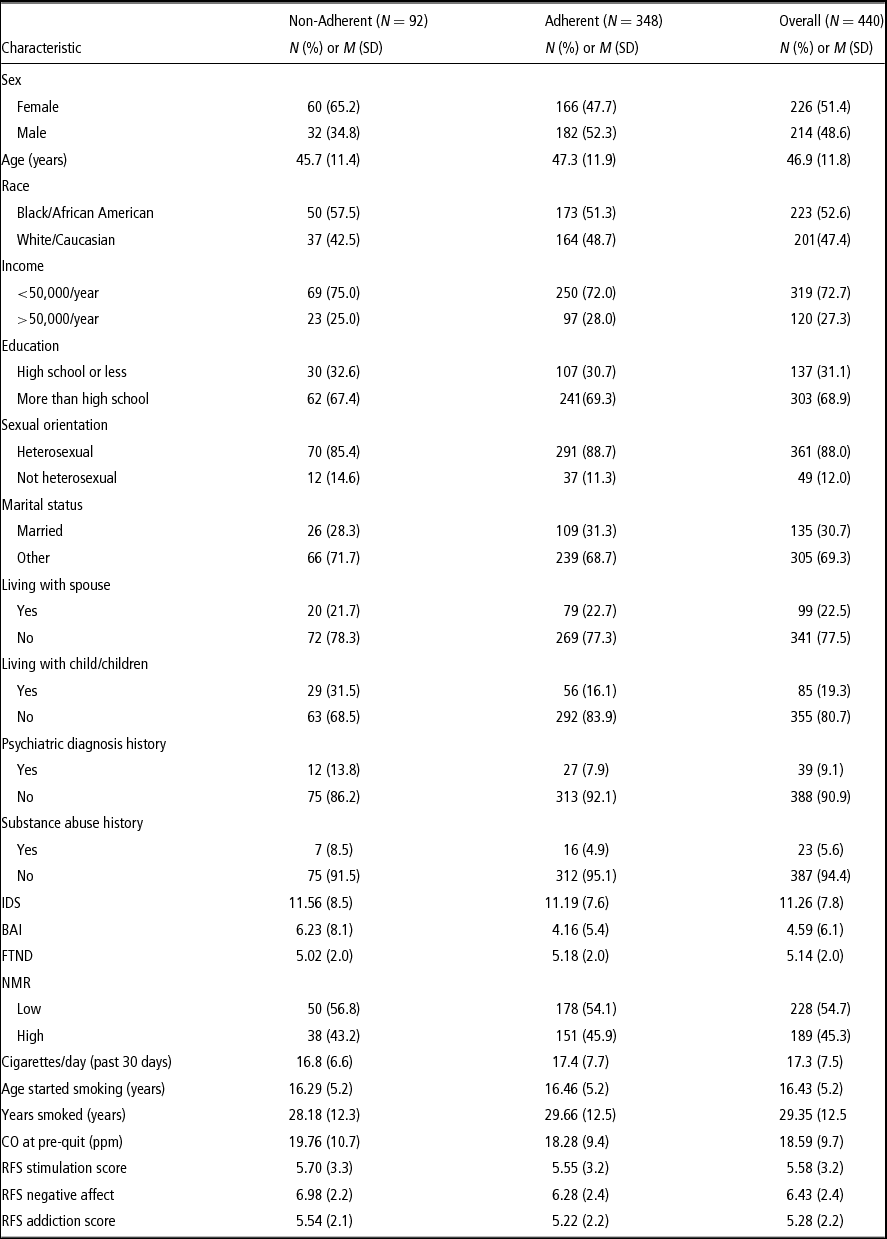
Table 1 shows the characteristics of the study sample (N = 440). Close to 80% of the sample (348/440) were considered adherent to the patch. More than 50% of the sample were female, the average age of participants was 46.9 years, more than half the sample were African American, and close to 9% of the sample reported a history of a psychiatric diagnosis. The sample reported smoking for close to 30 years, on average, and had a mean FTND score of 5.14.
Characteristics of sample

Note. IDS = Inventory of Depressive Symptoms; BAI = Beck Anxiety Inventory; FTND = Fagerstrom Test for Nicotine Dependence; NMR = Nicotine Metabolite Ratio; RFS = Reasons for Smoking.
Adherence and Cessation and Baseline Predictors of Adherence
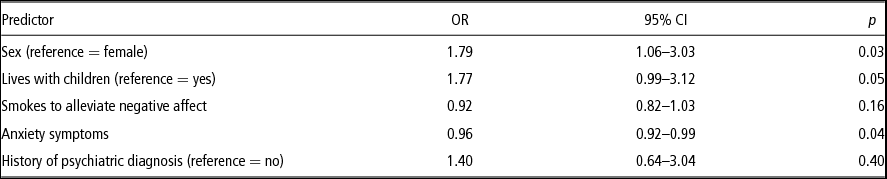
Adherence to patch use was strongly associated with the likelihood of smoking cessation at week 8 (χ 2 [1] = 25.45, p < 0.001). More specifically, 42.2% (147/348) of participants who were considered adherent to patch use were abstinent at week 8, compared to 15.2% of participants (14/92) who were not adherent to patch useFootnote 2 . Assessment of sample characteristics (from Table 1) as possible correlates of adherence indicated that adherence with the patch was significantly associated with sex, cohabitation with child/children, endorsement of negative affect as RFS, self-reported anxiety, and a history of psychiatric diagnosis (p’s < 0.05). These variables were included in a logistic regression model predicting week 8 adherence to nicotine patch treatment. When included together in the model (see Table 2), being female, living with a child or children, and higher self-reported anxiety symptoms were predictive of lower rates of adherence to patch use.
Multivariate logistic regression analysis of nicotine patch adherence

Longitudinal Differences Between Adherent and Non-Adherent Participants
We next examined prospective changes in craving and withdrawal, substitute and complementary reinforcers, side effects, and depression and anxiety symptoms between those who were adherent and those who were not.
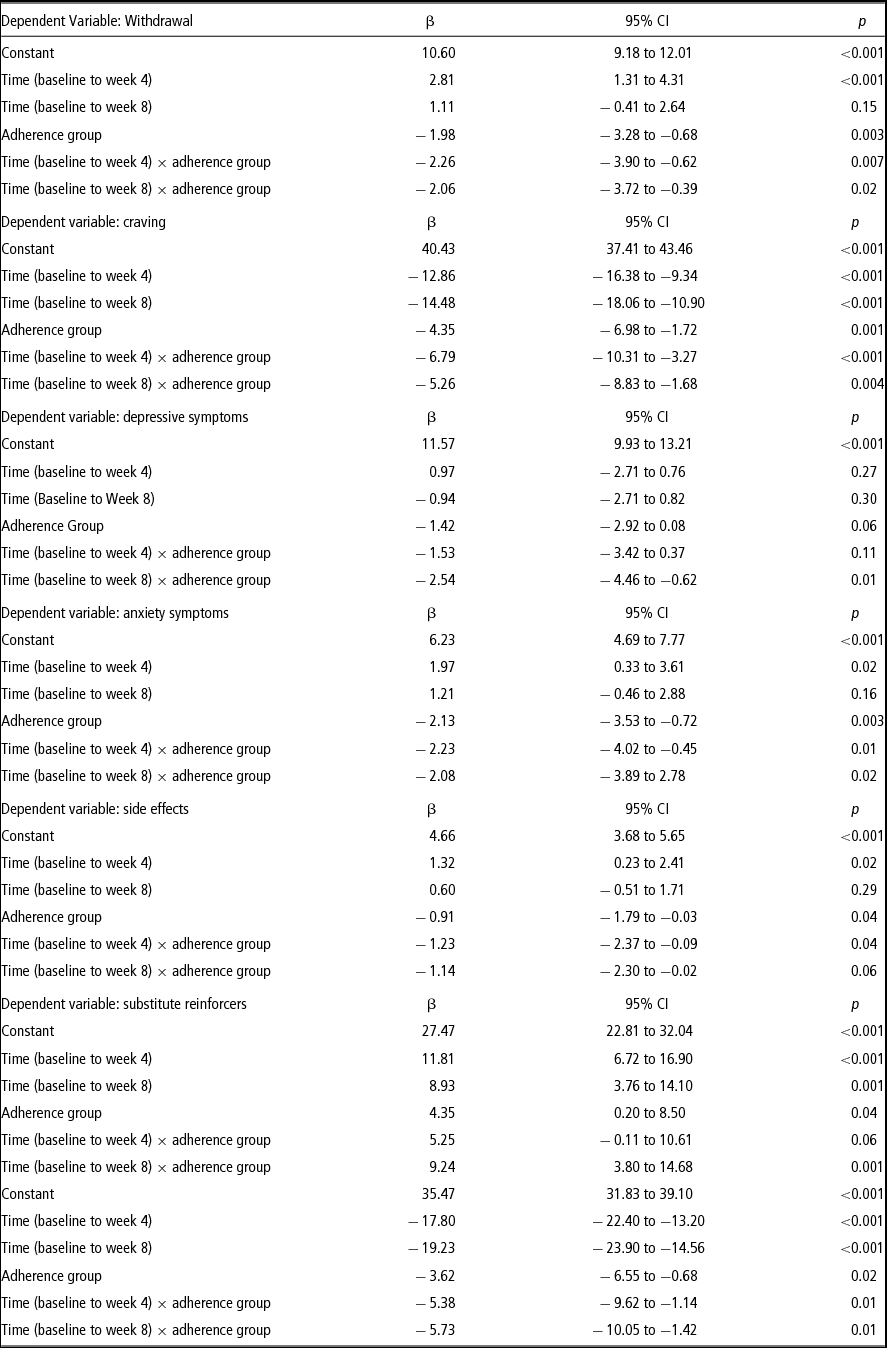
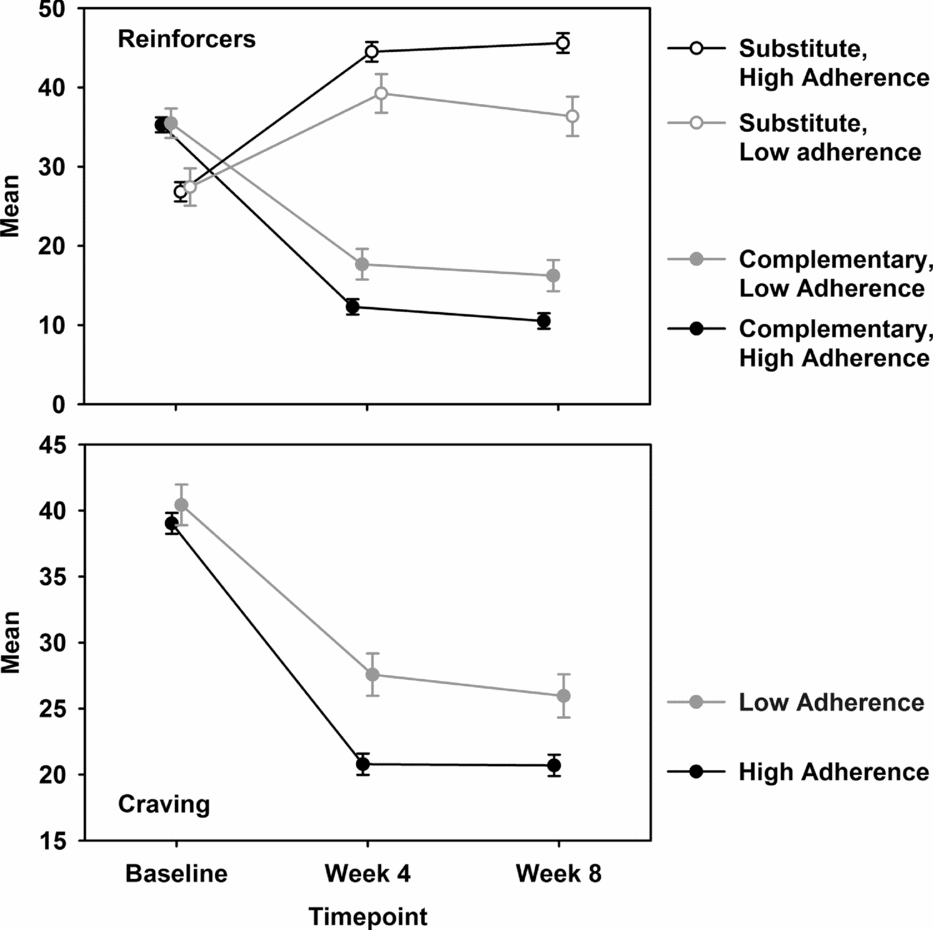
The longitudinal analysis yielded a significant time × adherence interaction for craving symptoms (χ 2 [2] = 7.65, p = 0.02). As shown in Table 3, there were significant main effects for time (baseline to week 4; β = −12.86, 95% CI: −16.38 to −9.34, p < 0.001; and baseline to week 8; β = −14.48, 95% CI: −18.06 to −10.90, p < 0.001) and adherence (β = −4.35, 95% CI: −6.98 to −1.72, p = 0.001) and there were significant interactions effects for baseline to week 4 (β = −6.79, 95% CI: −10.31 to −3.27, p = 0.004) and for baseline to week 8 (β = −5.26, 95% CI: −8.83 to −1.68, p = 0.004). While both adherent and non-adherent participants reported the same levels of craving symptoms at the baseline assessment, over time, adherent participants reported a significant decrease in craving symptoms, compared to non-adherent participants (see Figure 1).
Separate GEE analyses of withdrawal, craving, depressive symptoms, anxiety symptoms, side effects, and substitute and complementary reinforcers, by adherence, over time

Note. The constant coefficient provides a value to determine the scale value for parameters in the individual models.
Changes in substitute and complementary reinforcers (top) and craving (bottom) between participants adherent vs. non-adherent over 8 weeks.

The longitudinal analysis also yielded a significant time × adherence interaction for substitute reinforcers (χ 2 [2] = 11.42, p = 0.003). As shown in Table 3, there were significant main effects for time (baseline to week 4; β = 11.81, 95% CI: 6.72 to 16.90, p < 0.001; and baseline to week 8; β = 8.93, 95% CI: 3.76 to 14.10, p = 0.001) and adherence (β = 4.35, 95% CI: 0.20 to 8.50, p = 0.04) and there was a significant interaction effect for baseline to week 8 (β = 9.24, 95% CI: −3.80 to 14.68, p = 0.001). As shown in Figure 1, both adherent and non-adherent participants reported the same engagement in substitute reinforcers at the baseline assessment but, over time, adherent participants reported a significant increase in engagement in substitute reinforcers at weeks 4 and 8, compared to non-adherent participants.
Likewise, the longitudinal analysis yielded a time × adherence interaction for complementary reinforcers that approached significance (χ 2 [2] = 5.58, p = 0.06). As shown in Table 3, there were significant main effects for time (baseline to week 4; β = −17.80, 95% CI: −22.40 to −13.20, p < 0.001; and baseline to week 8; β = −19.23, 95% CI: −23.90 to −14.56, p < 0.001) and adherence (β = −3.62, 95% CI: −6.55 to −0.68, p = 0.02) and there were significant interactions effects for baseline to week 4 (β = −5.38, 95% CI: −9.62 to −1.14, p = 0.01) and for baseline to week 8 (β = −5.73, 95% CI: −10.05 to −1.42, p = 0.01). As shown in Figure 1, both adherent and non-adherent participants reported the same engagement in complementary reinforcers at the baseline assessment but, over time, adherent participants reported a significant decrease in engagement in complementary reinforcers at weeks 4 and 8, compared to non-adherent participants.
While individual models for withdrawal, depressive and anxiety symptoms, and side effects, yielded some individual main or interaction effects (see Table 3), the overall interaction effects for these models were not significant, indicating that change over time in these characteristics were similar for adherence vs. non-adherent participants (p’s > 0.05).
Discussion
The transdermal nicotine patch doubles the probability for successful cessation, compared to placebo, but only about one-fifth of smokers using this treatment will be able to achieve long-term cessation. One factor that is strongly associated with response to the nicotine patch is level of patch adherence. Yet, remarkably few studies have characterised differences between those adherent or non-adherent to patch treatment. Thus, this study was designed to establish a better understanding of patch adherence. Our main findings are discussed below.
First, this study found that close to 80% of the sample were considered adherent with patch treatment and adherence was associated with the likelihood of smoking cessation after 8 weeks of patch treatment and counselling, a finding that is consistent with the current literature (Hollands et al., Reference Hollands, Sutton, McDermott, Marteau and Aveyard2013; Shiffman et al., Reference Shiffman, Brockwell, Pillitteri and Gitchell2008). In comparison to the literature on other smoking cessation treatments (i.e., varenicline and bupropion), which have found rates of adherence of 75–73%, respectively, and a strong association of adherence to cessation outcome, our findings are similar (Catz et al., Reference Catz, Jack, McClure, Javitz, Deprey and Zbikowski2011; Swan et al., Reference Swan, McAfee, Curry, Jack, Javitz and Dacey2003).
Together with the present finding that about 20% of our sample were considered non-adherent to patch treatment, understanding characteristics that differentiate adherent and non-adherent individuals could have important clinical implications.
Second, in an assessment of baseline predictors of adherence, we found that being male, not cohabitating with a child, and lower self-reported anxiety were significantly associated with greater adherence. The finding for gender is consistent with the literature which suggests that the nicotine patch is less favoured by women than men and that women tend to respond less favourably to the patch than men (e.g., Perkins & Scott, Reference Perkins and Scott2008; Wetter et al., Reference Wetter, Fiore, Young, McClure, de Moor and Baker1999). As such, women may need additional intervention to boost adherence. Given that adherence among women is still fairly high, we do not suggest that women be discouraged from using the transdermal nicotine patch as a smoking cessation treatment. Existing literature that explores adherence to treatment more generally yields inconsistent findings on gender and adherence. For example, female gender has been related to decreased adherence in cardio rehabilitation and statin therapy programmes, but increased adherence to heart healthy diet restrictions (Chung et al., Reference Chung, Moser, Lennie, Worrall-Carter, Bentley and Trupp2010; Daly et al., Reference Daly, Sindone, Thompson, Hancock, Chang and Davidson2002; Lewey et al., Reference Lewey, Shrank, Bowry, Kilabuk, Brennan and Choudhry2013). Thus, the relationship between gender and medication adherence is likely specific to treatment targets (Osterberg & Blaschke, Reference Osterberg and Blaschke2005).
We also found that participants who reported that living with a child were significantly less likely to be adherent to the patch, which is contrary to previous results (Jarvis, Reference Jarvis1994). The present finding is likely confounded by the relationship between sex and cohabitation with children, since in the present study, women were more than three times more likely than men to be living with children. Finally, our logistic regression model found that lower baseline anxiety symptoms were associated with greater adherence. This result is consistent with a previous study (DiMatteo, Lepper, & Croghan, Reference DiMatteo, Lepper and Croghan2000) as well a growing literature that documents the important role of anxiety sensitivity in determining smoking cessation outcomes (see Leventhal & Zvolensky, Reference Leventhal and Zvolensky2015). Post-hoc analysis showed that baseline anxiety level was strongly associated with side effect reporting (r for baseline side effects = 0.72, p < 0.001, and r for week 4 side effects = 0.31, p < 0.001), suggesting that higher anxiety participants may be more sensitive to patch side effects as a mechanism for lower adherence. Lastly, our GEE analyses revealed that non-adherent study participants experienced greater difficulty managing nicotine craving, engaging in substitute reinforcers, and limiting exposure to complementary reinforcers. The relationship between patch adherence and craving is somewhat difficult to tease apart since the direction of the relationship is hard to determine; reduced adherence may increase craving or the inability for the patch to alleviate craving may reduce patch adherence. The ability to manage craving is seen as critical to increasing the probability of successful cessation (Schnoll et al., in press; Swan, Ward, & Jack, Reference Swan, Ward and Jack1996) and the present study indicates that the link between increased craving and lower cessation rate may involve treatment adherence. The GEE analyses also showed that engagement in alternative reinforcers is strongly associated with nicotine patch adherence. This result converges with the growing recognition that constructs rooted in Behavioral Economic theory impact tobacco-related behaviours (Green & Freed, Reference Green and Freed1993). We (Goelz et al., Reference Goelz, Audrain-McGovern, Hitsman, Leone, Veluz-Wilkins and Jepson2014; Schnoll et al., in press) and others (Acker & MacKillop, Reference Acker and MacKillop2013; MacKillop et al., Reference MacKillop, Brown, Stojek, Murphy, Sweet and Niaura2012) have shown that increased engagement in substitute reinforcers and reduced engagement in complementary reinforcers are associated with greater smoking cessation success. The present findings suggest that one potential mechanism through which this relationship is maintained is patch adherence. Indeed, for some participants, adhering to treatment, a novel behaviour that is often perceived as incompatible with smoking, may be a substitute reinforcer itself. It is also possible that for many individuals attempting to quit, adherence to a smoking cessation treatment is one part of a constellation of greater lifestyle changes being made to improve one's health. Adherence to the patch and the belief that the medication is working may add momentum that increases an individual's engagement with substitute reinforcers, and success with substitute reinforcers may support adherence.
The present study findings should be considered along with the study's limitations. First, the results should not be interpreted to indicate causal relationships. The absence of randomisation and potential for confounding variables means that the relationships described are correlational and not causal. Second, while the data were from an effectiveness study that had limited inclusion/exclusion criteria, the results are not generalisable to all smokers in the US. In addition, variable selection was based on data collected from the parent trial that focussed on smoking cessation outcomes and was not a comprehensive selection of factors from the adherence literature. Future studies, therefore, should consider covariates specifically thought to be related to adherence in order to more fully understand adherence to smoking cessation interventions. Further, since we did not collect biochemically confirmed abstinence data prior to week 8, our analyses were limited in that we could not examine how early abstinence could have influenced adherence. We also acknowledge the limitations of relying on self-reported adherence data, and suggest that future studies confirm adherence with a biological assay if possible and feasible given complexity and costs. It is also worth noting that the results concerning anxiety symptoms are based on a very small sample (i.e., only 9% of the sample). Lastly, the results are not necessarily applicable to other forms of nicotine dependence treatment or even other forms of nicotine replacement therapy and we used self-reported patch adherence rather than assessing nicotine levels among those confirmed to be abstinent during treatment.
Nevertheless, the present study offers new information concerning the characteristics of smokers who exhibit lower levels of patch adherence. Women and smokers who may be more vulnerable to symptoms of anxiety may be more susceptible to low patch adherence. Further, those who show low levels of patch adherence may experience challenges managing nicotine craving, engaging in substitute reinforcers, and limiting exposure to complementary reinforcers. These characteristics may serve as potential targets of an intervention to help increase patch adherence in future studies. Such efforts to identify effective ways to increase treatment adherence are necessary if the benefits of medications for nicotine dependence are to be fully realised.
Acknowledgements
None
Financial Support
This research was supported by grants from the National Institute on Drug Abuse (R01 DA025078 and R01 DA033681) and from the National Cancer Institute (R01 CA165001 and P30 CA16520).
Conflict of Interest
Dr. Schnoll and Dr. Hitsman receive medication and placebo free of charge from Pfizer and have provided consultation to Pfizer. Dr. Schnoll has also consulted for GlaxoSmithKline. These companies had no involvement in this study.
Ethical Standards
The authors assert that all procedures contributing to this work comply with the ethical standards of the relevant national and institutional committees on human experimentation and with the Helsinki Declaration of 1975, as revised in 2008.