I. INTRODUCTION
Controlled drug-delivery systems (DDSs) are one of the most promising applications for human health care and they can be basically described as formulations that release the drug in a predetermined manner or that target a specific site in the body.Reference Smirnova, Suttiruengwong and Arlt1 One form of controlled release drugs is that small drug molecules dispersed in a matrix with a physical or chemical combination. Mesoporous silica is an excellent candidate for controlled DDSs on account of their stable mesoporous structures, large surface areas, tunable pore sizes and volumes, and well-defined surface properties. Organic solvents such as methanol, acetone, methylene chloride, etc. are usually used to soak the powdered mesoporous silica and the drug to disperse small drug molecules in the nanochannels of the matrix. Many researchers have made substantial efforts relating to this and have significantly developed the DDSs.Reference Charnay, Bégu, Tourné-Péteilh, Nicole, Lerner and Devoisselle2–Reference Vallet-Regi, Rámila, del Real and Pérez-Pariente5 However, the problem of elimination of the residual of organic solvents was yet to be effectively resolved. Supercritical fluids (SCFs) have many advantages including low viscosity, high diffusivity, and near-zero surface tension. What is more, it is convenient for tuning the properties by varying the pressure and temperature. SCF as a green solvent has been attracting more attention in the field of DDSs.Reference Belhadj-Ahmed, Badens, Llewellyn, Denoyel and Charbit6, Reference Kawashima and York7
There are two kinds of processes to prepare nanocomposites using SCF as solvent: supercritical solvent impregnation (SSI)Reference Duarte, Casimiro, Aguiarricardo, Simplicio and Duarte8–Reference Yoganathan, Mammucari and Foster10 and supercritical fluid deposition (SCFD).Reference Duarte, Caridade, Mano and Reis11, Reference Ni, Xu, Xu, Wang and Yin12 The substrate and the drug do not have contact with each other directly in SCFD method and it is more convenient for collecting the product. This method has been proved to be feasible for the preparation of uniformly dispersed metal nanoparticles or long nanowires within the channels of mesoporous silica materials.Reference Zhang, Yin, Xu, Zhang and Wang13–Reference Xu, Yin, Zhang and Wang15 There are only a few reports about loading drugs in mesoporous silica using SCFD method.Reference Belhadj-Ahmed, Badens, Llewellyn, Denoyel and Charbit6 The feasibility of using this method for preparing DDSs has been proved by these researchers. However, more extensive and systematic work requires to be undertaken before establishing the universality of this method in the field of DDSs, for the reason that there are many parameters (including deposition time, pressure, temperature, the concentration of the solute in the SCF, etc.) influencing the deposition process in supercritical media; what is more, it will be even more complicated if we were also to consider the impact of addition of cosolvent. In addition, the knowledge of phase equilibrium and solute solubility in a SCF is essential for the design of SCFD process and the determination of the best operating conditions. Because these experiments are usually conducted at high pressure, it is difficult to test the solubility of the solute in SCF and even more difficult to investigate the dissolution of the solute.
For confirming the feasibility of dispersing drug molecules in the nanochannels of mesoporous silica and providing more useful cases, Ibuprofen (IBU) drug molecules were loaded in mesoporous silica SBA-15 using supercritical carbon dioxide (scCO2) as solvent. Ibuprofen has a carboxyl group which can form a hydrogen bond with silanol groups in the mesoporous particles. Also, its size (0.5 × 1.2 × 0.8 nm) is suitable for inclusion in the pores of the mesoporous-structured silica material. CO2 is environmentally benign, inexpensive and has moderate critical point (T C = 304.2 K, P C = 7.37 MPa). The solubility of IBU in scCO2 was tested through a high-pressure view cell first and the experimental data were correlated with data using Chrastil equation as well as Mendez-Santiago and Teja equation. In addition, the effects of the drug concentration in scCO2on the drug loading were investigated when the deposition pressure and temperature were fixed. Finally, the in vitro release of IBU/SBA-15 was performed in simulated body fluid (SBF) and the modified Noyes–Whitney equation was used to model the release kinetics for all the samples.
II. EXPERIMENTS
A. Materials
IBU was obtained from Shandong Xinhua Pharmaceutical Company (Zibo, China). Pure carbon dioxide (>99%) was supplied by DaLian Guangming Gas Co. Ltd. (DaLian, China). Ethanol were supplied by Tianjin FuYu Fine Chemicals Co. Ltd. (TianJian, China). P123 [Poly (ethylene glycol)-block-poly (propylene glycol)-block-poly (ethylene glycol)] was obtained from Sigma-Aldrich (St. Louis, MO) and TEOS (tetraethylorthosilicate) was supplied by Tianjin Kermel Chemical Reagent. All chemicals are in analytical grade.
SBA-15 was synthesized according to the method reported by Tu et al.Reference Wang, Tu, Zheng, Wang and Zhang16 First, 2 g plutonic P123 was dispersed in 59 mL HCl (2 M) and 15 mL H2O with stirring. The solution was heated to 313.15 K over a water bath for 2 h. Then 4.56 mL TEOS was added dropwise with constant stirring. After being stirred for another 24 h using a magnetic stirrer, the mixture was transferred to a teflon-lined autoclave for hydrothermal treatment at 373.15 K for 24 h. The as-obtained white precipitate was filtered out, washed with deionized water and dried at 373.15 K for one night. Finally, the product was calcined in a muffle furnace (2 K/min) at 773.15 K for 6 h.
B. Experimental method
1. Solubility experiment
The dissolution of drug in scCO2 is an important prerequisite for transporting small drug molecules into the nanoscale channels of mesoporous silica using SCFD method. In this article, a high-pressure view cell was used to measure the solubility of IBU in scCO2 because it is more sensitive and responsive in comparison to the flow-type apparatus. The details of our apparatus have been described elsewhere.Reference Zhou, Yu, Xu and Yin17 In brief, it mainly consists of an optical cell with two quartz windows, a high-performance liquid chromatography (HPLC) pump and the variable volume plug piston. First, desired amount of IBU was put into the high-pressure view cell. Then the CO2 cylinder was connected to the lines and the air in the system was removed by CO2. After that CO2 was slowly charged into the view cell until the solid IBU disappeared and the solution became transparent. Then the pressure in the cell was gradually decreased by controlling the variable volume plug piston till the split-phase emerged and phase transition pressure was obtained. We repeated the experiment three times and took the average phase transition pressure. Peng–Robinson equation of stateReference Peng and Robinson18 was used to calculate the density of scCO2in the view cell (29.23 mL) at the experimental pressure and the temperature.
2. SCFD process
The deposition reaction was carried out in a high-pressure stainless steel reactor (the effective volume being 84 mL). The details of the experimental apparatus have been reported previously.Reference Xu, Zhang, Zhang, Yin and Liu19 For each run, different amount of IBU was put in the bottom of the reactor and a stainless steel basket containing 300 mg SBA-15 was then fixed in the upper part of the reactor, the aim being avoidance of the substrate being directly brought in contact with the drug. Then the reactor was sealed and connected to the lines. After that, the reactor was preheated then CO2 was charged into the reactor using a piston pump until the pressure of the system got up to the desired pressure (17 MPa). The solution in the reactor was stirred continuously during the whole process of deposition. Keeping the pressure and temperature for the required duration, the reactor was depressurized slowly for avoiding the IBU that is being deposited onto the pores from being removed by CO2.
C. Characterizations
The resulting composites were characterized by x-ray diffractometry (XRD), scanning electron microscope (SEM) and N2 adsorption. XRD was used to obtain the phase composition of the composites using a continuous mode from 10 to 90 ° of 2θ at a scanning speed of 5 °/min on a PW3040/60 X' Pert PRO (PANalytical, Almelo, The Netherlands) diffractometer using a Cu Kα radiation source (λ = 0.15432 nm), operated at 40 kV and 30 mA. A scanning electron microscope (KYKY-2800B, Peking, China) was used to analyze the morphology of the mesoporous silica before and after loading of ibuprofen. The surface area, pore volume and the pore size of the substrate and the nanocomposite were determined from N2 adsorption-desorption isotherms obtained (at 77 K) on a Micromeritics ASAP2010 analyzer (Atlanta, GA). The samples with IBU were degassed at 308 K under a vacuum (residual pressure <10−5 Torr) before N2adsorption.
D. In vitro release study
The release experiment was performed by soaking the samples in 100 mL SBF with continuous magnetic stirring at 310.15 K, and at physiological pH of 7.4. SBF has a composition very similar to the human plasma (ppm: 142.0/5.0/2.5/1.5/1478/4.2/1.0/0.5 = Na+/K+/Ca2+/Mg2+/Cl−/HCO3−/HPO42−/SO42−). Before being soaked into the solution, the samples were conformed as 0.3 g disks by uniaxial (2.75 MPa) and isostatic pressure (3 MPa). The delivered IBU concentration was monitored by UV spectrometry at 265 nm using a UV-1800 spectrometer.
III. RESULTS AND DISCUSSION
A. Solubility of IBU in scCO2
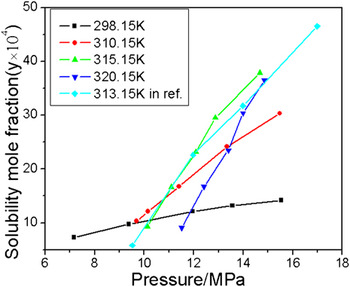
The experimental solubility data of IBU in scCO2 at different temperatures and pressures are shown in Fig. 1. It can be seen that the solubility is significantly affected by the pressure and temperature of the system. At a constant temperature, the solubility of IBU in scCO2 increases with the increase of the pressure. It is well known that both the density of carbon dioxide and the specific interaction between the solute and solvent molecules increase with the increase of pressure.Reference Gurdial and Foster20 What is interesting, however, is that the increment of solubility for the same delta P (∆P) at higher temperatures is much larger than that at lower temperatures. As the temperature increases, the increase of solute’s vapor pressure improves the solubility, while the decline of the solvent’s density decreases the solubility of solute in solvent. For the system of IBU and CO2, at the temperature ranging from 298.15 to 320.15 K and the pressure ranging from about 7 to 17 MPa, the influence of the rising vapor pressure of IBU on the solubility is dominant. The crossover pressure of the solubility curves at 310.15 and 315.15 K was observed when the pressure was used as the operating variable as shown in Fig. 1. Charoenchaitrakool et al.Reference Charoenchaitrakool, Dehghani, Foster and Chan21 reported the solubility data at temperature of 313.15 K as shown in Fig. 1 from which it can be seen that this crossover point represents the same solubility of IBU in scCO2 at three different temperatures but at the same pressure about 10.8 MPa. It is mainly caused by the combined impact of the increased solute’s vapor pressure on the one hand and decreased solvent’s density on the other, with increasing temperature. What is more, the melting point depression of IBU was also found in the presence of scCO2 and IBU started to melt at 320.15 K when the system was pressurized to 9.8 MPa according to our experiments. The melting point of IBU at atmospheric pressure is about 348.15 K, as the pressure increases the solubility of the SCF in the solute phase increases, resulting in lower temperatures being required to melt the solute. The melting point depression was also observed in racemic ibuprofen and scCO2 system in the literature,Reference Charoenchaitrakool, Dehghani, Foster and Chan21 which was depressed from 349.15 K (at atmospheric pressure) to 323.15 K when the solute was present in scCO2 at 9.6 MPa. In addition, it shows that the solubility of IBU in liquid CO2 (at 298.15 K) is much lower than that in scCO2 even at a high pressure due to weaker solvent power, therefore we used scCO2 instead of liquid CO2to dissolve IBU and deposit it in silica.
Experimental solubility data obtained in the pressure range of 7–17 MPa (■) 298.15 K, (●) 310.15 K, (▲) 315.15 K, (▼) 320.15 K, (◆) 313.15 K.

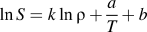
Two of the most widely used density-based equations were used here to correlate the experimental solubility data. The Chrastil’s equation,Reference Chrastil22 which correlates the solubility of a solute, in a supercritical solvent, to the density and temperature, is expressed as follows:
 $$<![CDATA[$$\ln S\, = \,k\ln {\rm{\rho }} + {{a \over T} + b}\quad.$$
In this expression, S (kg/m3) is the solubility of the solute in the supercritical phase,  ${\rm{\rho }}$ (kg/m3) is the density of the pure SCF, T (K) is the operating temperature, and k, a, b are the model constants that can be estimated from experimental solubility data in SCF.
Mendez-Santiago and Teja presented a semiempirical model based on the theory of dilute solutions.Reference Mendez-Santiago and Teja23 They demonstrated that the solubility y plotted as T In E (E, enhancement factor) against the density of the solvent could yield a single line. The modified Mendez-Santiago and Teja model expressionReference Sparks, Hernandez and Estévez24 contains three adjustable parameters and can be expressed by the Eq. (2):
 $$<![CDATA[$$T\ln yP\, = \,A + B{\rm{\rho }} + CT\quad,$$
where y is the solute mol fraction,  ${\rm{\rho }}$ (kg/m3) is the density of the pure SCF, T (K) and P (MPa) is the operating temperature and pressure, and A, B, C are the adjustable parameters.
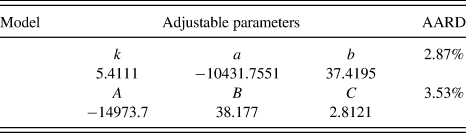
The values of calculated parameters for the correlation are in Table I, together with the average absolute relative deviation (AARD) between experimental and calculated solubility. The correlation by the two equations revealed the acceptable values of AARD at less than 3.53%. It is shown that Chrastil’s equation fits better correlation results than modified Mendez-Santiago and Teja model, but difference is not large.
Results of solubility data correlation for IBU in scCO2at 310.15 and 315.15 K using the equations of Chrastil, and Mendez-Santiago and Teja.
B. SBA-15 deposition with IBU
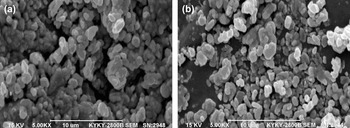
Figure 2 displays SEM observations of SBA-15 and IBU/SBA-15 particles. SBA-15 silica was obtained as nearly spherical particles with a size of a few micrometers. It is clearly seen that the shape of the particles is preserved after the deposition process in scCO2and very little IBU was found on the outer surface of the substrate.
SEM micrographs of (a) SBA-15, (b) IBU/SBA-15 composites (3.57 g/L, 310.15 K, 17 MPa, 24 h).

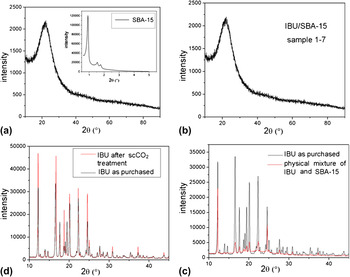
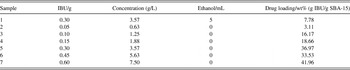
The structural properties of SBA-15 used in this study have been determined by XRD analysis. As shown in the inset in Fig. 3(a), three well-resolved peaks at 2θ of 0.5°–2.0° can be clearly seen in the synthesized SBA-15 indicating the well-ordered structure of SBA-15 for this investigation. Figure 3(b) showed the XRD patterns of the samples prepared using SCFD method; the preparation conditions and drug loading of IBU/SBA-15 composites are shown in Table II. It can be seen that XRD patterns of none of the samples show any characteristic peak of IBU. It indicates that most drugs were loaded inside the pores of SBA-15 and they were amorphous. This is in agreement with a crystallization study carried in confined space, which has shown that the crystallization can occur only for a channel pore size significantly larger than the molecular size, about 20 times the length of the molecules.Reference Charnay, Bégu, Tourné-Péteilh, Nicole, Lerner and Devoisselle2 The average diameter of SBA-15 pores are 5.67 nm in our experiment, and the length of IBU molecule is about 1.2 nm, thus the deposited IBU did not crystallize with the restriction of the nanoscale pore. However, it is doubtful whether the crystal IBU will become amorphous after scCO2 treatment. Figure 3(c) shows that the corresponding peaks of crystal IBU increase after being treated with scCO2. The main reason is that the depressurization process from a relatively high pressure will lead to recrystallization of IBU drug molecules, which dissolve in the scCO2. In the case of the physical mixture of SBA-15 and IBU [Fig. 3(d)], diffraction peaks characteristic for crystal IBU are obtained which demonstrates that simple mixing of drug and substrate was not helpful either in loading the drug in the nanoscale channels of SBA-15 or in making the diffraction peaks of IBU disappear.
XRD patterns of (a) wide-angle and low-angle XRD of SBA-15; (b) IBU/SBA-15 with different drug loading (sample 1–7); (c) IBU as purchased and IBU after scCO2treatment at 310.15 K, 17 MPa for 24 h; (d) IBU as purchased, physical mixture of IBU and SBA-15.

Preparation conditions and results of IBU/SBA-15 composites (T = 310.15 K, P = 17 MPa, 24 h, SBA-15 300 mg).

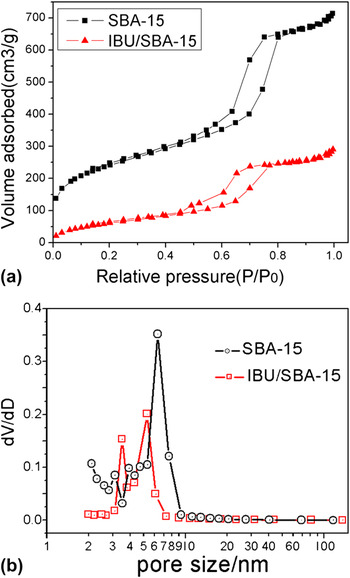
For further confirming that the drugs are inside the pores of the substrate, N2 adsorption of SBA-15 and IBU/SBA-15 composite (sample 5) were preformed. The N2 adsorption isotherm of SBA-15 [Fig. 4(a)] shows a typical step in the 0.6–0.7 relative pressure (p/p 0) range, which is characteristic of a highly ordered mesoporous porous lattice. The Brunauer, Emmett, and Teller (BET) surface area was decreased from 864.0 m3/g to 237.6 m3/g, and the total pore volume of the sample, directly derived from the adsorption isotherm (p/p 0 = 0.995), was decreased from 1.105 to 0.4497 cm3/g. Figure 4(b) indicates the size distribution of SBA-15 and IBU/SBA-15 derived from the desorption branch, it can be clearly seen that the average pore size of the substrate was decreased from 6.3 to 5.3 nm. The peak observed around 4 nm does not reflect the exact porous properties of the material and it is mainly due to the tensile strength effect (TSE).Reference Groen, Peffer and Pérez-Ramírez25 The decrease of these parameters indicates that most IBU were loaded inside the pores of SBA-15.
SBA-15 and IBU/SBA-15 (sample 5): (a) Nitrogen adsorption-desorption isotherms, (b) BJH pore size distribution derived from the desorption branch.

The adsorbed amounts of IBU on SBA-15 were determined by the in vitro release study and are reported in Table II. The drug loading was defined as the ratio of the weight of adsorbed IBU to the weight of the substrate. The solubility of ibuprofen in CO2 is 13.86 g/L at 310.15 K and 17 MPa according to our test, and the precursor concentration for each deposition experiment was much less than the saturated concentration. It can be seen that at the same temperature and pressure, the drug loading increased with the increasing drug concentration. The incremental drug loading with the increase of drug concentration at lower concentrations is more significant than that at higher ones. This might be due to stronger interactions of the drug with the solvent than with the matrix. As reported in previous works by Duarte et al.,Reference Duarte, Simplicio, Vega-González, Subra-Paternault, Coimbra, Gil, de Sousa and Duarte26 the interactions between the solute and the carbon dioxide molecules are detrimental to the bonding forces between the solute and the substrate. It was also found that adding a little ethanol as cosolvent in scCO2 significantly decreased the drug loading. When the concentration of drug was 3.57 g/L (P = 17 MPa, T = 310.15 K), the drug loading decreased from 36.97 wt% (sample 5) to 7.78 wt% (sample 1) after adding 5 mL ethanol in the system. Because of the fact that IBU has a carboxyl group, which can form a hydrogen bond with silanol groups in the mesoporous particles, there is a competition between IBU and cosolvents that have also the ability to form hydrogen bonds with the silica surface. Besides, the ethanol molecules are smaller than IBU molecules and present in a larger amount thus they tend to block IBU adsorption in the mesoporous pores. The negative effect of cosolvent on the drug loading was also reported by Hillerström et al.Reference Hillerström, van Stam and Anderson27
C. Drug release in SBF
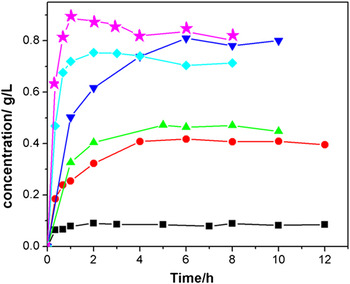
The in vitro tests were carried out by soaking IBU/SBA-15 samples into a stirred SBF solution at 310.15 K and pH 7.4. It can be observed in Fig. 5 that the equilibrium time greatly decreases as drug-loading decreases. After 1 h, sample 6 and sample 7 released about 100% of incorporated drug, whereas about 62% of IBU was released by sample 5. It is widely hypothesized that the drug molecules in the substrate exist in two forms: some are adsorbed on the inner surfaces, and others are on the outer surfaces. There are some Si-OH groups on the inner surfaces which can form hydrogen bonds with IBU, thus if most of the IBU drug molecules adsorbed on the inner surface of the substrate, the release rate will be slow. Although the drug loading of sample 5 and 6 have a few differences (36.97 and 33.53 wt% respectively), it can be concluded that the adsorbed amount on the outside of the substrate may be significantly different because of the distinctively different drug concentrations (3.57 and 5.63 g/L respectively), which will lead to different release rates.
IBU release profiles of different samples in SBF (prepared at 310.15 K, 17 MPa for 24 h at different precursor concentrations): (■) sample 2, 0.63 g/L; (●) sample 3, 1.25 g/L; (▲) sample 4, 1.88 g/L; (▼) sample 5, 3.57 g/L; (◆) sample 6, 5.63 g/L; (★) sample 7, 7.50 g/L.

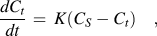
The dissolution of a drug confined in inert porous carriers is widely reported in literature.Reference Manzano, Aina, Areán, Balas, Cauda, Colilla, Delgado and Vallet-Regí28, Reference Mortera, Fiorilli, Garrone, Verné and Onida29 It is necessary to consider not only the nature of the matrix, but also the properties of SBF. As reported by Vallet-Regi et al.,Reference Manzano, Aina, Areán, Balas, Cauda, Colilla, Delgado and Vallet-Regí28 silica is nearly insoluble at pH 7.4, so the release kinetics of the IBU drug molecules can be assumed to be controlled by diffusion along the ordered array of mesoporous materials and delivery of IBU to the SBF solution should therefore be determined by the Noyes–Whitney (NW) equation.
 $$<![CDATA[$${{dC_t } \over {dt}}\, = \,K(C_S - C_t )\quad,$$
where Ct is the concentration of the solute at the time t, Cs is the drug solubility in the equilibrium at the test temperature, K is a proportionality constant.
Onida et al.Reference Mortera, Fiorilli, Garrone, Verné and Onida29 proposed that the equilibrium concentration of silica matrix MCM-41 in SBF was about 2.3 mM. For modeling the kinetic curves accurately, the equation was modified taking into account the dissolution of the substrate affecting the mesopore volume. They modified the equation as follows:
 $$<![CDATA[$$\left\{ \matrix{ {{dC_t } \over {dt}} = K(C_S - C_t )\,\,\,\,\,\,\,\,\,\,\,\,\,\,\,\,\,\,\,\,\,\,\,\,\,\,\,t \lt 1\, \hfill \cr {{dC_t } \over {dt}} = (Ke^{ - {\rm{\alpha }}(t - 1)} )(C_S - C_t )\,\,\,\,\,t \,\ge \,1\,\, \hfill \cr} \right.\quad.$$
Taking into account the different values of the mesopore volume at different points of time, rearranging constants and integrating Eq. (4), the IBU release can be represented by the following equation:
 $$<![CDATA[$$\left\{ \matrix{ {{W_t } \over {W_0 }} = {{C_S V} \over {PI_L }}(1 - e^{ - Kt} )\,\,\,\,\,\,\,\,\,\,\,\,\,\,\,\,\,\,\,\,\,\,\,\,\,\,\,\,\,\,\,\,\,\,\,\,\,\,\,\,\,\,\,\,\,\,t \lt t_0 \hfill \cr {{W_t } \over {W_0 }} = {{C_S V} \over {PI_L }}\left( {1 - e^{(Kt_0 /{\rm{\alpha }})e^{ - {\rm{\alpha }}(t - t_0 ) - K((1 + {\rm{\alpha }})/{\rm{\alpha }})} } } \right)\,\,\,\,\,\,\,t \,\ge\, t_0 \hfill \cr} \right.\quad,$$
where Wt and W 0 are the IBU mass at time t and the initial mass of IBU in the porous matrix respectively, t 0 is the time when the mesoporous volume started to change.
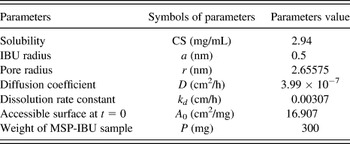
In the experiments covered by this article, release of all the samples with different drug-loadings has been carried out as per the same procedure as mentioned in Sec. II. D. In consideration of the adsorption affecting the accessible surface area, the proportionality constant K results to be:
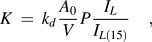 $$<![CDATA[$$K\, = \,k_d {{A_0 } \over V}P{{I_L } \over {I_{L(15)} }}\quad,$$
where IL is the drug loading of the samples, other parameters of the formula are shown in Table III.
List of constants and parameters used in Eq. (6).

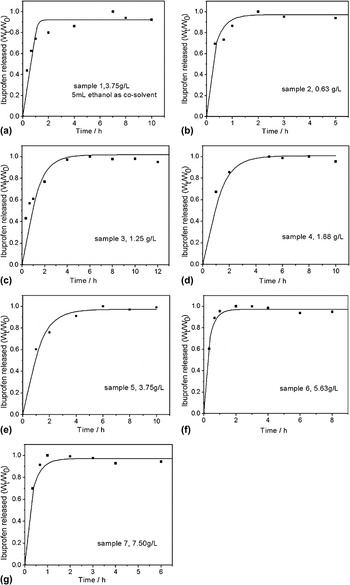
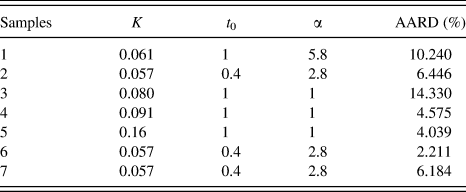
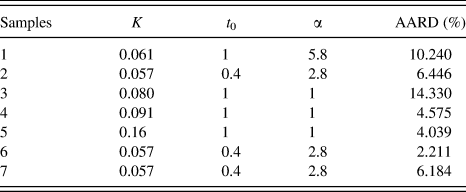
Figure 6 shows the experimental and the simulated release curves. It can be seen clearly that the modified equation fits the experimental data well. The values of calculated parameters for the correlation and the AARD between experimental and calculated solubility are tabulated in Table IV. It is shown in Fig. 6 that the release data of the samples prepared without inclusion of cosolvent fit the modified equation better than that using ethanol as cosolvent. This can be attributed to the fact that desorption of the adsorbed solute from a mesopore wall included not only ibuprofen but also ethanol. The interaction between the ethanol and the matrix formed steric hindrance for the remaining drug molecules, so the release from the impregnation sample has been slower than the simulation release.
IBU release kinetics of composites prepared at different conditions:experimental data (■) simulating results using modified NW equations (—).

Adjustable parameters of controlled release of ibuprofen in SBF from SBA-15 using modified Noyes–Whitney equation.
IV. CONCLUSION
In summary, scCO2 is an effective and clean solvent for deposition of IBU drug molecules into the nanoscale channels of mesoporous silica without any cosolvents. The solubility of IBU in carbon dioxide was measured through a high-pressure view cell and the mole fraction in the fluid phase was found to range from 7.299 × 10⁻⁴ to 37.841 × 10⁻⁴ at the temperature range of 298.15–320.15 K, and pressure range of 7–17 MPa. The Chrastil’s equation and modified Mendez-Santiago and Teja equation were used to correlate the solubility data in scCO2. The correlation by the two equations showed acceptable values of AARD at less than 3.6%. What is more, the melting-point depression of IBU in scCO2 was found at 9.8 MPa and the crossover pressure of the solubility curves was also observed when the pressure was used as the operating variable.
On the basis of the measurement of IBU solubility in scCO2, the appropriate solute concentration, deposition temperature and pressure were selected to prepare controlled release nanodrug. It was found that the drug loading increased with the increase of drug concentration in scCO2. Characterization using SEM, XRD, and N2 adsorption indicated that most drugs adsorbed were inside the channels of SBA-15 and the physical state of the drugs were amorphous due to the restriction of the nanoscale channels. Taking into account the dissolution of the substrate affecting the mesopore volume, modified N-W equation was used to model the release kinetics of IBU/SBA-15 in the SBF and a good agreement was obtained between the model representation and experimental data.
ACKNOWLEDGMENT
The work was supported by the National Natural Science Foundation of China (Nos. 20976026 and 20976028).